
- articles
eBay VeRO Guide 2026: Avoid Bans & Check the List
Quick answer: eBay VeRO stands for Verified Rights Owner, the reporting system brands use to flag listings that infringe their trademarks, copyrights, patents, design rights, or utility models. When a rights owner submits a valid report, eBay removes the listing first and notifies the seller afterwards. The VeRO program eBay operates covers intellectual property only, so pricing rules and distribution agreements fall outside it.
Most sellers meet VeRO the same way: a listing that had been running quietly for weeks disappears overnight, and an email arrives explaining that a rights owner objected to it. Nothing warns you in advance. There is no negotiation window, and nobody at eBay weighs your side of the story before the listing comes down.
This guide covers what actually triggers a report in 2026, what the public VeRO list does and does not contain, where the risk sits inside a typical eBay dropshipping catalogue, and what to do once a removal lands.
What eBay VeRO Is and Why Listings Get Removed

VeRO is eBay’s channel for intellectual property complaints. Rights owners register, submit a Notice of Claimed Infringement with a reason code and evidence, and eBay acts on valid reports by removing or requiring revision of the listing. The program launched in 1998, the same year the US Digital Millennium Copyright Act created safe harbour obligations for online platforms.
eBay is legally required to act on properly filed infringement notices, which is why removals happen quickly and why the platform will not adjudicate whether your item is genuine. eBay states plainly in its Seller Center guidance that it cannot verify the authenticity or legal status of specific items. That responsibility sits with you.
Two things get reported, and confusing them is the single most common reason sellers misdiagnose a strike. The first is the item itself, which is an infringement when the product is counterfeit, an unauthorized copy, or a physical imitation of a protected design. The second is the way the item is presented, which is an infringement when the photos, text, logos, or brand claims in the listing belong to someone else. A completely genuine product can be pulled because of the second category alone.
What Triggers a VeRO Violation on eBay
A VeRO violation is triggered by what you put in the listing as often as by what you sell. The decisions below account for most reports, and eBay documents its position on all of them in Seller Center.
| What you put in the listing | Allowed? | Why VeRO eBay reports follow |
|---|---|---|
| A brand name in the title of an item that brand actually made | Yes | You may name the brand when the product is genuinely theirs |
| A claim that you are an authorized dealer or reseller | Only with authorization | A false claim of affiliation is treated as trademark infringement |
| Photos taken from the supplier, the manufacturer, or another listing | No | Copyright. This is the single most common cause of removals |
| Images pulled from the eBay product catalog | Yes | Catalog content is licensed for use in listings |
| “Compatible with iPhone” on an accessory built specifically for the iPhone | Yes | A compatibility term in front of the trademark is required |
| “iPhone case” on an accessory Apple did not make | No | Trademark used on a non-brand product |
| A brand name on a universally compatible item such as a USB-C cable | No | Where an item fits everything, eBay asks you to leave brand names out entirely |
| Several brand names in one title, for example on a car part | No | One brand in the title, the rest in the description with “fits” or “for” |
| The manufacturer’s product description, copied | No | Copyright covers the text as well as the images |
| A manufacturer’s warranty mentioned in the listing | Only if it transfers on resale | Misstating warranty cover is treated as a form of trademark infringement |
Several of those rows have nothing to do with authenticity. A genuine product does not protect a careless listing, and the photograph that came from the supplier will end a listing just as fast as a fake.
One line at the bottom of eBay’s NOCI form settles a long-running argument among resellers: VeRO does not process complaints about selective distribution agreements, minimum advertised pricing, or private contractual terms. A brand that dislikes your price cannot use VeRO to remove you. It can, however, look for a copied image on the same listing and report that instead, which is how most “MAP enforcement” removals actually happen.
How a VeRO Claim Travels From Brand Owner to Seller
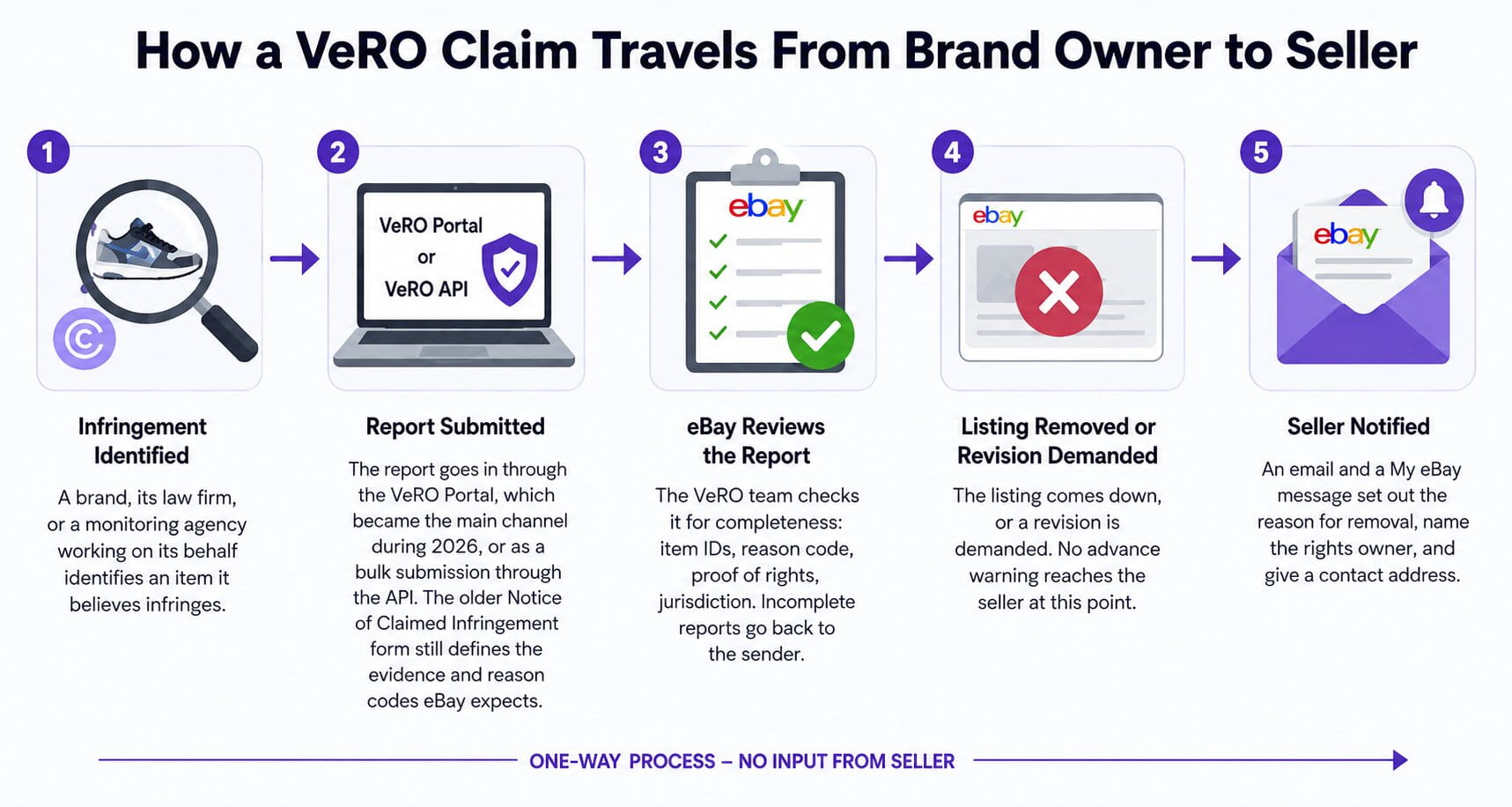
A claim moves in one direction and never pauses for your input. A rights owner files a report through the VeRO Portal or eBay’s VeRO API. eBay checks it for completeness, removes the listing if the report is valid, then emails the seller with the reason and the rights owner’s contact details.
Here is the sequence:
- A brand, its law firm, or a monitoring agency working on its behalf identifies an item it believes infringes.
- The report goes in through the VeRO Portal, which became the main channel during 2026, or as a bulk submission through the API. The older Notice of Claimed Infringement form still defines the evidence and reason codes eBay expects.
- The VeRO team checks it for completeness: item IDs, reason code, proof of rights, jurisdiction. Incomplete reports go back to the sender.
- The listing comes down, or a revision is demanded. No advance warning reaches the seller at this point.
- An email and a My eBay message set out the reason for removal, name the rights owner, and give a contact address.
From there the seller has three routes: contact the rights owner and ask for a retraction, file an appeal with eBay, or revise the listing and republish it in compliant form.
eBay’s own FAQ explains why nothing in this chain asks the seller first: when a report arrives, the platform is obliged to remove the content as quickly as possible in order to comply with the law and protect the rights owner.
Bulk reporting has changed the tempo. Most large brands do not police eBay themselves. They retain brand protection vendors, Corsearch, BrandShield and OpSec among the better known, whose business is crawling marketplaces and filing at volume. Enforcement at that scale runs through the VeRO API, which accepts up to 150 items per call and can be called repeatedly, so a seller with three hundred listings from one supplier can lose the whole cluster in an afternoon.
How eBay Scans Listings for VeRO Risk
Enforcement is layered. Rights owners and their monitoring agencies do most of the detection, eBay runs its own automated checks on listing content, and buyers or rival sellers can report items through the general content reporting flow.
Search for VeRO eBay scanning and you will find a lot of confident claims that eBay reviews every listing with AI and matches it against a master blacklist. The picture is less tidy. eBay does run automated screening on titles, images, and item specifics, and it does act on patterns like duplicated manufacturer copy or a brand name attached to an obviously generic product. Most removals, though, begin with a rights owner or the third-party monitoring service it hires.
Those services scan continuously. They look for the brand in the Brand item specific field, for manufacturer imagery reused anywhere on the page, for comparative phrasing such as “similar to” or “style”, and for sellers whose feedback history suggests volume reselling. Enforcement is therefore uneven by design. Two near-identical listings can sit side by side for months while only one is reported, and eBay confirms this openly: a rights owner may simply not have reached the other listing yet, or that seller may be authorized.
The old advice about running short auctions to outrun detection no longer holds. Ended listings remain visible on eBay and remain reportable, and ending a listing after a report has been filed does not erase the violation from your account record. Repeat infringement is what escalates matters from a warning to selling restrictions and eventually to a permanently suspended eBay account.
The eBay VeRO List: What the Official Directory Actually Contains
What sellers call the VeRO eBay list is the public directory of participant profiles in Seller Center, arranged A to Z. It contains only those rights owners who chose to publish a profile page, which makes it a useful reference but a badly incomplete blacklist.
The VeRO list eBay maintains is a set of brand-authored pages. Each one is written and managed by the rights owner, and typically sets out which trademarks and copyrights the company protects, the conditions under which its products may legitimately be resold, what it treats as infringement, and how to contact its enforcement team. eBay hosts these pages free of charge and points sellers to them in removal notices.
The figure of 40,000 registered rights owners gets quoted almost everywhere. It came from an eBay policy page and has since been overtaken. In an eBay-hosted podcast a member of the VeRO team put the figure above 97,000 registered brand owners, and eBay does not publish a live count anywhere. The honest description is that registration runs into the tens of thousands and keeps growing, while the public directory shows a much smaller subset.
That gap matters more than the headline number. eBay states directly on the directory page that it is not a comprehensive list of brands with IP rights, and that not all rights owners in the program have a profile there. A brand can register, report, and remove your listing without ever appearing in the directory you checked. Treating the VeRO list as an exhaustive “do not sell” register is the mistake that catches most new sellers.
Profiles also disappear or go stale. Some pages have not been revised in years and describe policies the brand’s current enforcement agency no longer follows. Read them for the brand’s stated position, then assume enforcement in practice may be broader.
International directories
Sellers on the European sites often search for the liste VeRO eBay and land on a local version of the same directory. The UK Seller Centre and Canadian Seller Centre both publish participant profiles, and the underlying set of brands is largely shared across sites.
Reporting, by contrast, is localized. eBay publishes country-specific NOCI forms for Australia, Germany, Spain, France, and Italy, so a claim about an item listed on eBay.de is handled through the German process. If you sell cross-border, check the images, videos and text policy for each site you list on.
Region-locked goods deserve separate attention, because the legal mechanism behind them surprises people. It is regional exhaustion of trademark rights. A brand’s control over a particular item ends once it puts that item on the market inside the relevant territory, and in the EU that territory is the European Economic Area, while the UK operates its own regime post-Brexit. Goods first sold outside those territories were never exhausted there, so the rights owner can lawfully block their import and sale. That is why a completely genuine US-market product offered to a buyer in Germany can be removed as trademark infringement, and why parallel imports sit under reason code 6.1 instead of the counterfeit codes.
How VeRO Risk Gets Into a Catalogue at Volume
Knowing the rules and following them at scale are separate problems. Almost every case of VeRO on eBay that hits a large seller arrives through the import step, where nobody reads the listing before it publishes.
The Brand item specific is where this shows up most often. Listing tools copy that field straight from the source page, so a generic phone case arrives on eBay filed under Apple, and the seller who wrote a careful, brand-free title never notices. Monitoring bots read the field directly, and it is the cheapest possible match for them to make.
Images travel the same way. A bulk importer pulls whatever the supplier page offers, which means manufacturer press shots and stock photography land in your listing under your account name. Cropping an image or dropping it on a white background does not make it yours. Copyright reports need nothing more than a link to where the original lives, which is why they are the easiest claims to file and the hardest to argue with.
Titles are the one place where scale and compliance genuinely conflict. You want the brand name because buyers search for it, and eBay’s search manipulation policy sits on top of the trademark rules to stop exactly that. Stacking brands in a title is two violations, not one. The eBay Title Builder helps here, because the constraint is writing a dense title out of words you are entitled to use.
Warranty text is the quiet one, and it is almost always inherited. Supplier descriptions carry manufacturer warranty language, importers copy the description wholesale, and the seller ends up asserting cover that does not survive resale. If you offer a guarantee, say plainly that it comes from you.
What these four have in common is timing. Every one of them is cheap to prevent and expensive to undo, because by the time the notice arrives the listing is gone and the violation is already recorded. That is the argument for screening while a product is being sourced instead of after it is live. Easync works at that stage, steering product research away from suppliers with a history of VeRO problems and flagging items that carry known trigger terms before they reach your store. It will not know about a brand that has never reported anyone, which is a limit every checker shares, but it removes the mistakes that come from importing at speed.
Before you argue any image claim, run a reverse image search on your own listing photo. It takes ten seconds. If the shot is sitting on a dozen brand sites, the report was correct and reshooting will be faster than appealing.
High-Risk Categories and the Most Active VeRO Brands on eBay
Printer consumables, filtration, phone accessories, licensed media and apparel, prescription devices, and anything carrying a sports or entertainment licence draw the heaviest enforcement. The most active VeRO brands on eBay tend to be those with dedicated in-house IP teams or retained monitoring agencies.
Categories worth approaching carefully in 2026:
- Third-party printer ink and toner, where compatibility claims are policed aggressively
- Replacement water and air filters marketed as fitting a named appliance brand
- Phone cases and screen protectors, particularly anything using the OtterBox or Apple names
- Fitness and training programmes sold on physical media
- CPAP machines, mobility aids, and other prescription or regulated devices
- Products with CBD in the title, which run into restricted-item rules as well as IP ones
- Licensed sports, film, music and character merchandise
- Automotive parts, where multi-brand fitment titles routinely breach the one-brand rule
- Energy drink, streetwear and luxury logos of any kind
Brands with a long record of active reporting include Nike, Chanel, Microsoft, Velcro, Monster Energy, Disney, and the major automotive manufacturers, though the list shifts. A brand that ignored eBay for years can appoint an enforcement agency and clear hundreds of listings in a week.
There is also a practical financial angle. A single item with a contested provenance that comes back as a return will damage your account metrics far more than a run of mediocre feedback, and it costs you the eBay selling fees on a sale you never keep. When you are choosing what to add to a store, product research that filters on IP risk earns its keep faster than any margin calculation will show.
Using an eBay VeRO List Checker and Listing Software
An eBay VeRO list checker compares your titles, descriptions and suppliers against a database of brands and terms known to trigger reports. These tools reduce obvious mistakes, but no eBay VeRO checker sees eBay’s internal enforcement data, so treat each result as a prompt to look closer.
Manual checking works up to a few dozen SKUs. Past that, sellers running automated dropshipping need the screening to happen at import, for the reason set out above.
Several free options exist. PriceYak publishes a free eBay VeRO checker that connects to a store and emails back a report on flagged listings. Browser extensions that do the same job come and go, and the ones that survive usually belong to a listing platform, so check who publishes an extension and what it charges before you install it. Most commercial eBay listing tools now include some form of keyword screening, including AutoDS, ZIK Analytics, and Easync, which filters suppliers and flags VeRO keywords during product import rather than after publication. A side-by-side view of how the main platforms handle this sits in our comparison of Easync, AutoDS, Zendrop, DSers and CJDropshipping.
Expect false positives, and expect them to be strange. Colour words trip filters constantly, because “ivory” and “coach” are also brand names, and “military” appears in enough enforcement histories that some databases flag it outright. A title describing a red kitchen scale can come back marked. These filters match strings. They have no idea what the product is.
False negatives cost more. A checker built on a community-maintained list only knows about brands somebody has already been burned by, so newly registered rights owners and brands that report through an agency without publishing a profile simply will not appear.
How to Tell If You Have a VeRO Violation
eBay sends a removal notice to your registered email address and to My eBay Messages. It names the rights owner, gives their contact address, states the reason for removal, and explains whether the listing can be revised. Anything arriving from a non-eBay address is a phishing attempt.
Three places are worth checking when something disappears. My eBay Messages holds the official copy of every notice, which is why the email address on your account needs to be current and monitored. Seller Help shows policy issues attached to your account with the resolution steps eBay expects. And Seller Hub’s removed or hidden listings view tells you which items came down and why.
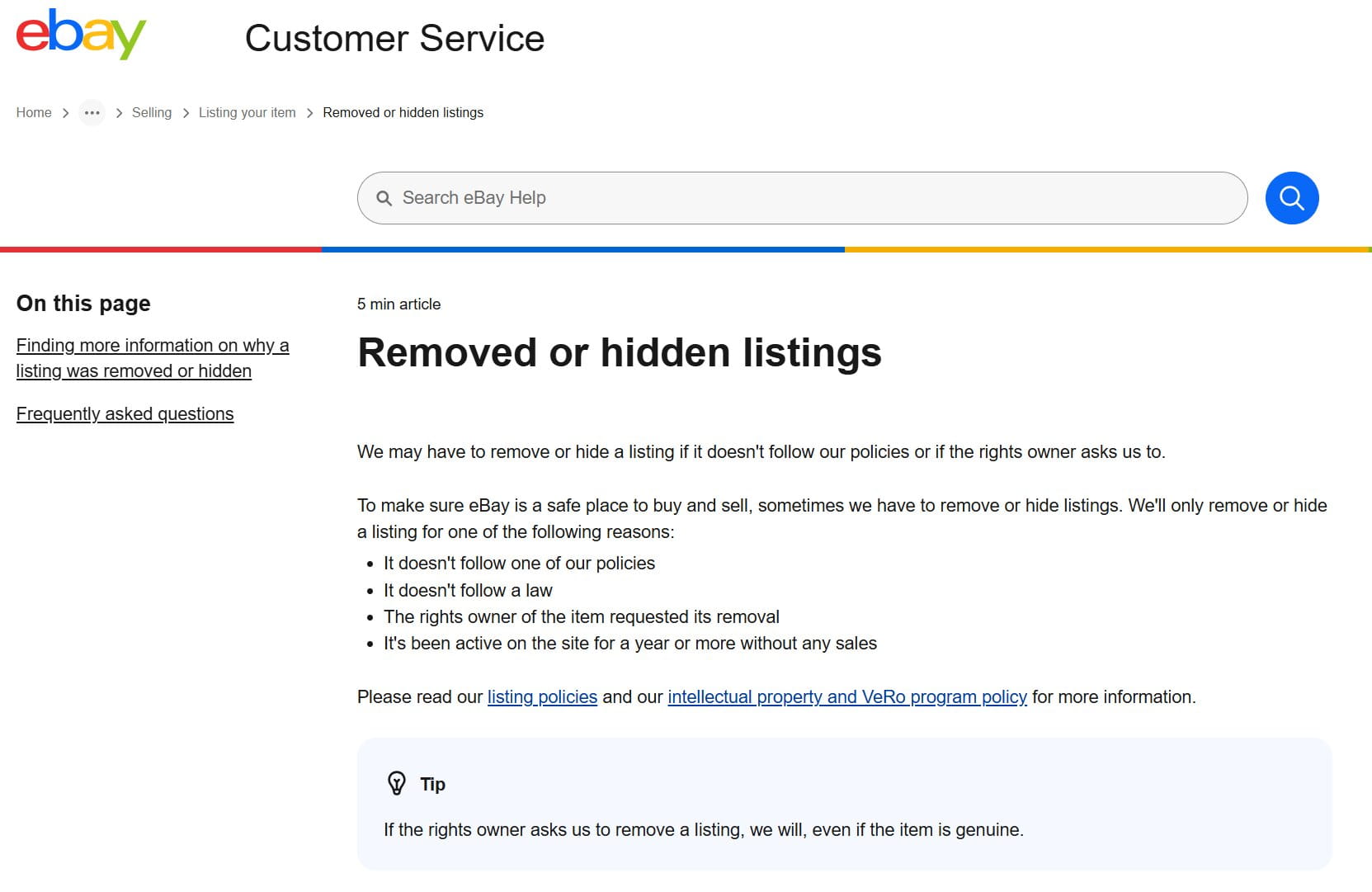
eBay rebuilt these notices in September 2025 to explain removals in more detail and to signpost the appeal route more clearly. If your last VeRO experience predates that change, the current notices are considerably more informative.
Consequences escalate, but not on a fixed schedule. eBay describes a range running from a warning through selling restrictions to permanent suspension, and the trajectory depends on how many reports you accumulate and how quickly you address the cause. Older guides that quote a precise ladder of one to two days for a first offence and two to three weeks for a second are describing a policy eBay has never published. If your account is already restricted, our guide to reinstating a suspended eBay account covers the appeal mechanics in detail.
Fee refunds are possible. eBay will consider refunding listing fees depending on which policy was breached and your prior history, though it is discretionary.
How to Resolve a VeRO Removal
Start by working out whether the item or only the listing content caused the problem. If the content was at fault, rewrite it and relist. If the item was at fault, contact the rights owner for a retraction or appeal to eBay with proof of authorization.
What the reason code tells you
Every report submitted through the Notice of Claimed Infringement form carries exactly one reason code, and that code appears in your removal notice. It is the fastest way to tell whether the listing is fixable or the product simply cannot be sold.
| eBay reason code | What was reported | What resolves it |
|---|---|---|
| 1.1 | Counterfeit, replica or “dupe” infringing a trademark | Stop sourcing the product. Appeal only if you can document that the goods are genuine |
| 2.1 | Listing content infringes a trademark: brand name on a non-brand item, several brands in one title, altered spellings, false dealer claims | Rewrite the title and description, add “for”, “fits” or “compatible with” |
| 3.1, 3.2 | Software sold outside its licence, or a counterfeit product infringing copyright | Delist |
| 4.1, 4.2, 4.3 | Listing infringes copyrighted text, images, or both | Replace with your own photos and original copy |
| 5.1 | Item infringes a registered patent. In the US, Australia and Canada eBay requires a court order for these reports | Delist and take legal advice |
| 5.2 | Item infringes a registered design right or utility model | Delist |
| 5.3, 5.4 | Item or listing content violates an individual’s right of publicity | Remove the content or the item |
| 6.1 | Other infringement, including misrepresented warranty and region-restricted parallel imports | Correct the claim or restrict shipping destinations |
Codes in the 2.x and 4.x families point at your listing content, which means the underlying product is usually still sellable once the offending text or image is gone. Codes 1.1, 3.x and 5.x point at the item itself, and no amount of rewriting will help.
For a content problem, revise through the Resolution Hub, remove whatever caused the report, and republish. Be aware that a revised listing is assessed as a separate case from the original. If you appeal the original removal and lose, the revised version is still reviewed on its own merits, and the reverse also applies.
For a substantive dispute, the rights owner is your first contact rather than eBay. Their details come in the removal notice. Before writing, read their participant profile if they have one, since it often answers the question directly. When you do write, include your eBay user ID, the account email address, the removed item numbers, and photos of the actual product where relevant. Keep it factual. A short message explaining what you sold, where you sourced it, and what you have already changed does more than an apology. If the rights owner accepts that the report was mistaken, they have to submit the retraction themselves, from an authorized email address to askvero@ebay.com. eBay will not reverse the removal on your say-so.
On eBay’s side there are several ways in. You can file an appeal with evidence of permission from the rights owner. You can send documentation to askvero@ebay.com showing you are authorized to use the IP, such as a copy of a distribution contract. Or, if the removal was a US copyright report and you believe it was wrong, you can file a DMCA counter notice with eBay’s designated agent at copyright@ebay.com. A valid counter notice is forwarded to the rights owner. Under section 512(g) of the DMCA the platform must restore the material no less than ten and no more than fourteen business days after receiving the counter notice, unless the rights owner tells eBay in that window that it has filed a court action to restrain you. eBay’s own wording quotes the ten-day floor, so plan for the listing to come back somewhere inside that band and not on a fixed date. Counter notices carry legal exposure and cover US copyright claims only. If your listing was on a non-US site, or the claim was about a trademark, patent or design instead of copyright, the counter notice route is closed to you and the only paths left are the rights owner and eBay’s own appeal. Take advice before filing one.
If a rights owner does not respond at all, sellers can escalate to eBay after roughly five business days without a reply. Phone is worth trying if your account is restricted and seller chat is unavailable.
Repeated violations move the conversation out of eBay’s hands. A rights owner that has reported you several times can pursue a civil claim, and marketplace suspension becomes the smaller of your two problems.
How to Register as a Rights Owner and Use the eBay VeRO Portal
Brands and their authorized agents can join VeRO by submitting proof of ownership of the relevant trademark, copyright, patent or design. Reporting then runs through the eBay VeRO portal, which lets them file notices, manage several brands, track submitted reports, and request seller contact details where the law permits.
This route matters to sellers who manufacture, brand, or commission their own products. Registration means providing evidence of the rights you are asserting, which usually means registration numbers and the issuing office for trademarks and designs, and evidence of authorship or ownership for copyrighted material. Agencies reporting on a brand’s behalf also supply proof of authorization.
The contact address changed during 2026. VeRO correspondence now goes to askvero@ebay.com, and the old vero@ebay.com address no longer works. eBay has also been steering rights owners toward the portal as the primary route, and practitioners reported that legacy submission channels would be wound down from 1 July 2026. As of eBay’s own page in mid-July, email submission of a NOCI to askvero@ebay.com was still listed as available, so treat the portal as the route eBay wants you to use and check the current guidance before relying on email. High-volume reporters can keep integrating through the VeRO API. Whichever route you use, reports need item IDs, a single reason code, registration details, and a clear explanation of why the listing infringes.
Two things fall outside the programme entirely. VeRO handles intellectual property and nothing else, so distribution agreements, selective selling policies and price floors are out of scope. It also cannot be used to report stolen goods, which eBay directs to local law enforcement instead.
A participant profile is optional and free. Draft the content in a document and email it to askvero@ebay.com, and eBay will publish it if it meets the guidelines. It is worth doing if you sell branded goods through authorized resellers, because it tells legitimate sellers what they may do with your images and brand name and cuts down the volume of enquiries you have to answer after each takedown. The guidelines are narrow: stick to your intellectual property, leave out MAP pricing, contracts and off-eBay sales, and avoid claims about how eBay will enforce anything. Your own logo is fine as long as it does not infringe somebody else’s.
Timing expectations should be modest. eBay reviews reports for completeness before acting and may come back for more detail, so removal is usually a matter of hours. eBay commits to no particular turnaround.
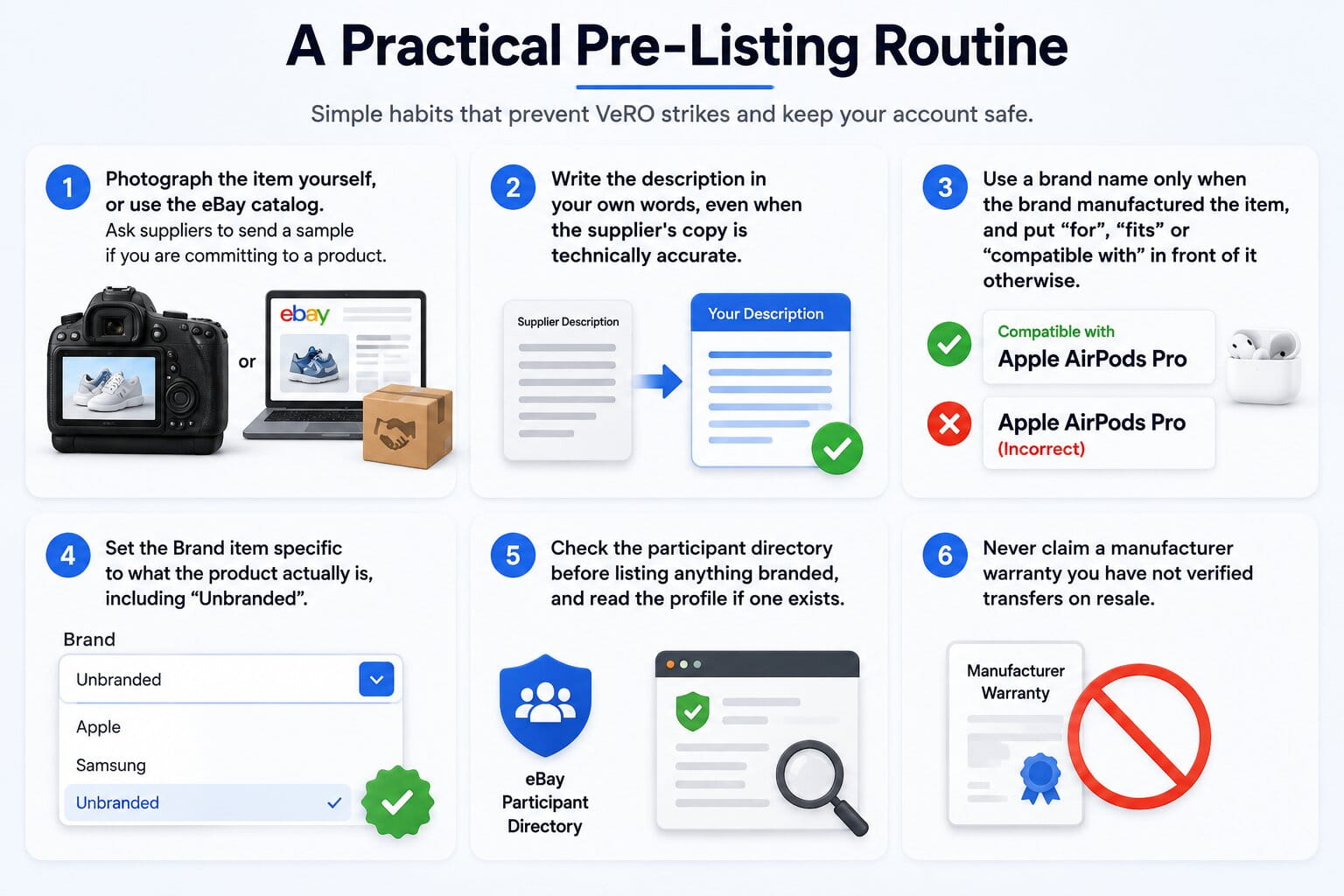
A Practical Pre-Listing Routine
The habits that prevent most strikes are unglamorous:
- Photograph the item yourself, or use the eBay catalog. Ask suppliers to send a sample if you are committing to a product.
- Write the description in your own words, even when the supplier’s copy is technically accurate.
- Use a brand name only when the brand manufactured the item, and put “for”, “fits” or “compatible with” in front of it otherwise.
- Set the Brand item specific to what the product actually is, including “Unbranded”.
- Check the participant directory before listing anything branded, and read the profile if one exists.
- Never claim a manufacturer warranty you have not verified transfers on resale.
Sourcing discipline sits underneath all of this. Suppliers offering branded goods at prices that make no commercial sense are usually selling counterfeits, and a supplier who cannot produce an authorization letter has told you everything you need to know. The distinction between dropshipping and wholesale matters here, because wholesale relationships come with paperwork you can actually show eBay.
Bottom Line
VeRO has been part of eBay since 1998 and is not going away. It exists because the platform carries legal obligations to rights owners, and it is enforced through a process designed to favour speed over deliberation. Plenty of individual removals are unfair. Very few of them get reversed, which is the part worth planning around.
The practical response is to build compliance into how listings get created instead of firefighting afterwards. Original content, careful brand language, honest item specifics, and a filtered supplier list remove most of the exposure. Screening software catches a good share of what slips past, provided a clean result is read as untested rather than approved.
None of this is unique to eBay. Amazon, Shopify, Walmart and Facebook Marketplace all operate comparable IP enforcement, and a brand protecting itself on one platform is usually protecting itself on all of them. A catalogue built to survive VeRO tends to survive everywhere else too.
FAQ
What is VeRO on eBay?
VeRO is the Verified Rights Owner program, eBay’s mechanism for intellectual property owners to report listings that infringe their trademarks, copyrights, patents, design rights or utility models. It has operated since 1998.
What does a VeRO violation actually mean for my account?
The reported listing comes down, and the violation is recorded against your account. A first incident normally goes no further than a warning. Accumulate more and eBay applies selling restrictions, then suspension. The escalation depends on volume and on whether you fix the underlying cause.
Can I sell branded items on eBay at all?
Yes, if they are genuine and you describe them accurately with your own photos. What you cannot do is claim to be an authorized dealer when you are not, use the brand’s images, or list items intended for a market you are not selling into. Some brands restrict resale more tightly than others, which is what their participant profiles exist to explain.
How do I check whether a brand is on the VeRO list?
Open the participant profiles directory in Seller Center and use Ctrl+F to search the A to Z index. Bear in mind that many registered rights owners have no profile there, so an absence proves very little.
Is a VeRO checker tool reliable?
Partly. It will catch well-known brands and common trigger words, and it will produce odd false positives on colour and material names. It cannot know about rights owners who have never been reported to a community database. Use it as a first filter.
My listing was removed but identical ones are still live. Why?
eBay’s own answer is that the rights owner may not have reported the others yet, that the other seller may be authorized, or that there are differences between the listings you cannot see. Removals are driven by reports, and reports are uneven.
Does VeRO cover pricing or MAP violations?
No. eBay explicitly excludes selective distribution agreements, minimum advertised pricing and contractual terms from the program. Brands attempting to enforce pricing through VeRO typically report a copyright or trademark issue on the same listing instead.
How many rights owners are in the VeRO program?
eBay does not publish a current figure. Public statements from eBay have cited numbers ranging from over 40,000 to more than 97,000 registered rights owners at different points, and the total keeps growing. The public directory of profiles is far smaller than the registered membership.