
- articles
Best AutoDS Alternatives 2026: Easync vs AutoDS vs Zendrop vs DSM Tool
Quick answer: The main AutoDS alternatives are Easync, DSers, Zendrop and CJdropshipping, and each one replaces a different part of AutoDS. Easync automates Amazon to eBay, AliExpress to eBay and Amazon to Shopify dropshipping, with 30-minute repricing on eBay listings and automatic Amazon ordering. DSers is the cheapest way to automate AliExpress orders and has a free plan. Zendrop and CJdropshipping are supplier networks with their own warehouses and branding programs. On eBay, Easync, AutoDS, DSers and CJdropshipping all connect directly, while Zendrop still does not.
This comparison of Easync vs. AutoDS vs. Zendrop vs. DSers vs. CJdropshipping is written for sellers weighing AutoDS alternatives, whether they are leaving AutoDS or comparing AutoDS competitors before they sign up. It covers what each tool does in 2026, where the stock comes from, what automation you actually get, and what 200 automated orders a month cost on each platform.
Easync vs. AutoDS vs. Zendrop vs. DSers vs. CJdropshipping – Comparison Review
Dropshipping is a business model in which the supplier, retailer or manufacturer handles production and delivery, while the dropshipper runs the storefront and talks to customers. That split lets beginners start with little money and no stock, and it is why so many automated dropshipping tools exist to take over the routine work around it.
All five dropshipping tools in this review are multifunctional, so it helps to look at what a dropshipper actually spends time on:
- Find a profitable niche and best-selling products.
- Search for and vet reliable suppliers.
- Set up a store on a marketplace, a separate domain or a social network.
- Create product descriptions, photos and videos.
- Build listings and set prices.
- Run advertising campaigns.
- Handle fulfillment: taking orders, routing them to suppliers, talking to customers and monitoring delivery.
The five tools split those tasks very differently. AutoDS tries to cover nearly all of them, which is also why it is the benchmark everyone else gets compared against.
Why Sellers Look for AutoDS Alternatives
AutoDS is the most complete tool in this comparison, and that is part of the reason people look elsewhere: you pay for the breadth whether you use it or not. Four details on its own pricing page explain most of the switching:
- Every selling channel is a separate subscription. An eBay store and a Shopify store mean two plans, and Amazon plans start at $64.90 a month.
- Automatic ordering is an add-on. The auto ordering system costs $9.90 a month on top of any plan.
- Plan limits count variations. The entry Import plan covers 200 products and 200 variations, so listings with several sizes and colors use up the limit quickly.
- Automatic tracking updates start on Starter. They are not part of the entry Import plan.
None of this makes AutoDS a bad tool. It means the real monthly bill usually sits well above the headline $26.90, and sellers who only need part of what AutoDS does can often get that part cheaper, or better suited to their channel, from one of its competitors.
AutoDS Alternatives Compared: Easync vs. AutoDS vs. Zendrop vs. DSers vs. CJdropshipping (2026)
The table compares all five tools on the criteria that decide most switches: where the stock comes from, which channels connect, what 200 automated orders a month cost, how prices stay in sync, VeRO protection on eBay and who ships the goods. AutoDS stays in the table as the benchmark.
| Criteria | Easync | AutoDS | Zendrop | DSers | CJdropshipping |
|---|---|---|---|---|---|
| Best for | eBay and Shopify sellers sourcing from Amazon or AliExpress | Sellers on several channels with many suppliers | Branded Shopify stores | AliExpress sellers on one or a few platforms | Sellers who want a supplier with local warehouses |
| Supply model | Lists products from Amazon and AliExpress, no own inventory | 25+ suppliers plus its own marketplace | Own catalog of 1M+ products, shipped from its China warehouse or from US suppliers | AliExpress, 1688, Alibaba and agent suppliers, no own inventory | Own catalog and warehouses on several continents |
| Selling channels | eBay and Shopify, plus an API for your own system | Shopify, eBay, Amazon, Facebook, Wix, WooCommerce, Etsy, TikTok Shop, each on its own plan | Shopify, TikTok Shop US, ClickFunnels; eBay and Amazon only through manual orders in Zendrop | Shopify, eBay, Amazon, Walmart, TikTok Shop, WooCommerce, Wix and more; 1 channel on Basic and Advanced, 3 on Pro | Shopify, eBay, WooCommerce, Etsy, Wix, TikTok Shop and more, with unlimited store authorizations |
| Cost of 200 automated orders a month (software only) | $49.99 on Basic, which includes 200 auto orders and 2,000 repricing listings | $36.80 on eBay (Import plan plus the $9.90 auto ordering add-on); $59.80 with automatic tracking updates on Starter | $49 on Pro with unlimited orders; Shopify and Wix sign-ups may be billed $29 to $79 by linked products | $19.90 on Advanced; AliExpress orders are placed in bulk and you pay for each one | $0 for the software; you pay product and shipping on every order |
| Repricing and stock sync | Every 30 minutes against the source on eBay listings, with custom strategies and stock monitoring | Price and stock monitoring with automatic price optimization | Stock handled by Zendrop, no repricing engine | Automatic price and stock sync from supplier cost on paid plans; manual pricing on Basic | Inventory sync to the store, no competitor repricing |
| VeRO protection on eBay | Yes | Yes, a built-in VeRO list plus your own keyword blacklist | Not applicable (own catalog, no eBay integration) | Not listed | Not applicable (own catalog) |
| Own fulfillment | Fulfillment by Easync, included in every plan | Fulfilled by AutoDS | Zendrop’s China warehouse plus US suppliers, custom branding on Pro | None, the AliExpress seller ships | CJ warehouses, custom packaging and print on demand |
| Free plan or trial | No free plan; 7-day trial, no credit card | No free plan; 3-day trial for $0.99 | Free plan for browsing; Pro $49/mo or $399/yr | Free Basic plan; 14-day trial on paid plans | Free membership; paid tiers from $15.99/mo |
The cost row counts the software subscription only. Product cost, shipping and marketplace fees come on top with every tool, and each one measures usage differently: Easync by orders and listings, AutoDS by products and variations, DSers by stores and sales channels, Zendrop by plan or by linked products, and CJdropshipping not at all, since it earns on the goods.
Two things in that table decide most purchases. The first is where your traffic lives, because a tool that does not connect to your sales channel turns every order into manual data entry, however good its catalog is. The second is who owns the stock, which decides shipping speed, branding options and how much of the margin goes to the supplier.
AutoDS
AutoDS is the best-known all-in-one dropshipping platform and the tool every alternative here is measured against. It sources from 25+ suppliers, lists and monitors products, places orders and pushes tracking back to the store.
On the supply side AutoDS works with Walmart, AliExpress, Etsy, Costco, Home Depot, eBay, Amazon, Banggood and CJdropshipping, among others, and runs its own marketplace of registered suppliers. On the selling side it connects to Shopify, eBay, Amazon, Facebook, Wix, WooCommerce, Etsy and TikTok Shop.
The main features are:
- A catalog AutoDS describes as 800M+ bestselling products across its supplier network.
- One-click import of single products or whole batches into your store.
- Automatic order fulfillment through your own buyer accounts or Fulfilled by AutoDS, which can also route China-sourced orders through the AutoDS warehouse.
- Price and stock monitoring with automatic price optimization.
- VeRO protection for eBay: a built-in list of restricted brands plus a personal keyword blacklist.
Every selling channel has its own price list built on the same tiers: Import, Starter, Advanced and a custom Enterprise package. On Shopify, plans run from $26.90 to $66.90 a month for up to 1,000 products. On eBay they cost $26.90 to $86.90, with smaller limits that top out at 800 products. Amazon is the expensive channel at $64.90 to $149.90 a month.
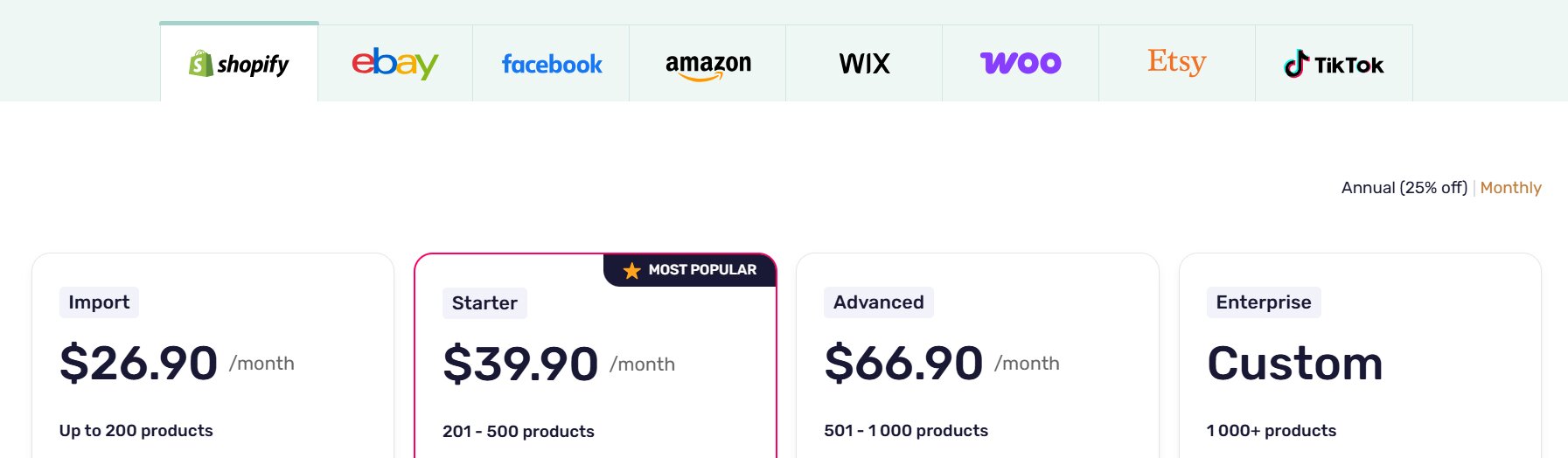
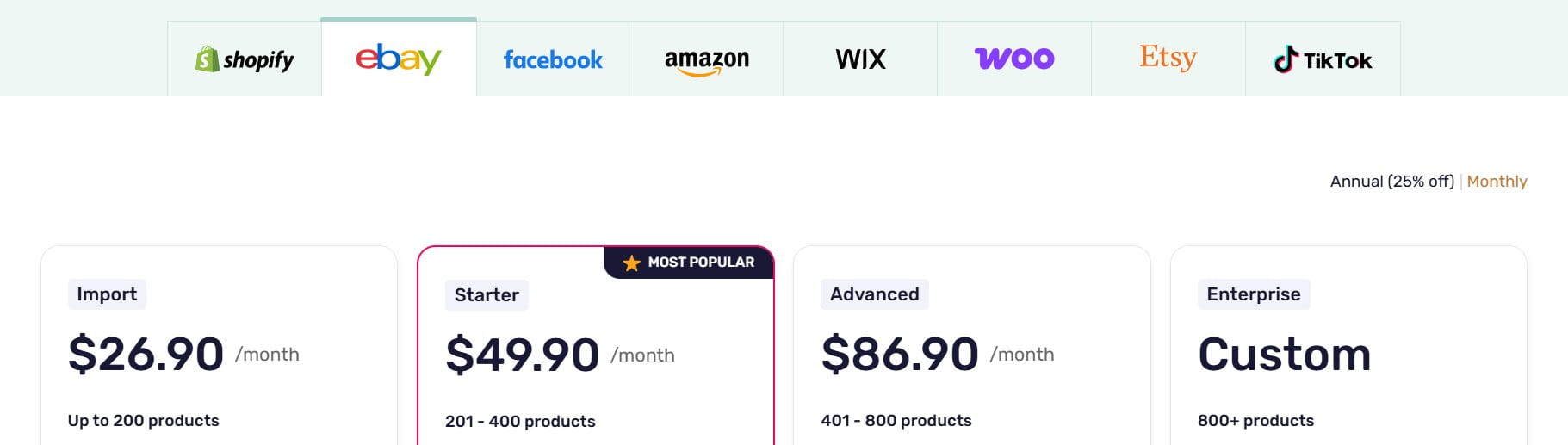
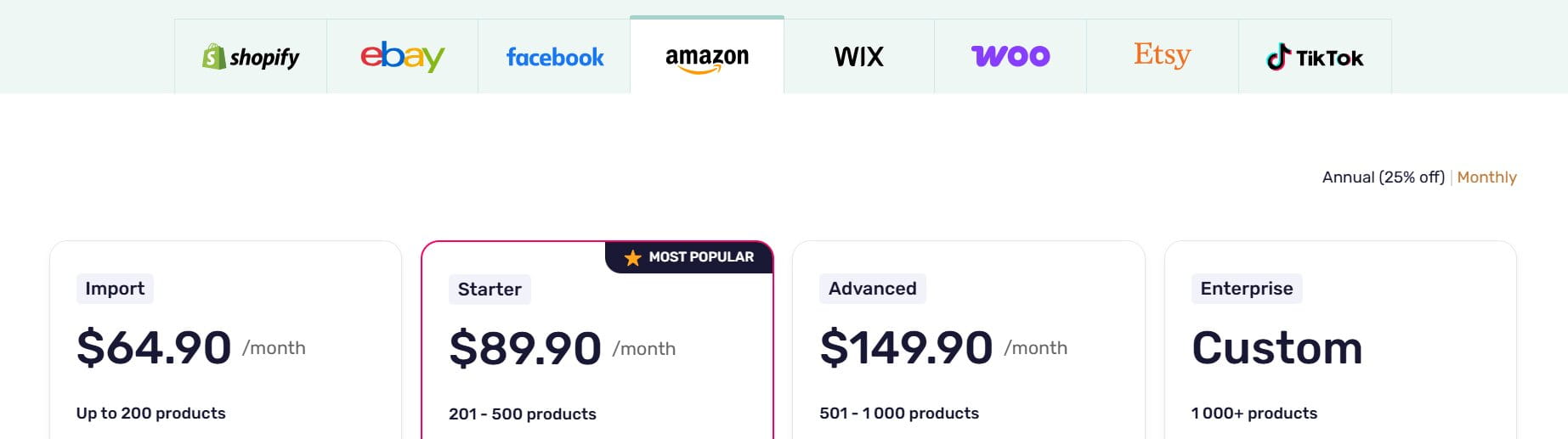
The variation limit, Starter-only tracking updates and the $9.90 auto ordering add-on described above all sit on top of these rates. AutoDS advertises annual billing as 25% off, but the actual saving ranges from about 20% to 26% depending on the tier and channel.
Selling on two channels means paying two subscriptions, so an eBay and Shopify seller on Starter tiers pays $89.80 a month before the add-on. New accounts get a 3-day trial for $0.99. For the full breakdown of tiers and trial terms, see our AutoDS review and pricing breakdown.
Pros
- AutoDS marketplace of registered suppliers
- Fulfilled by AutoDS
- Eight selling channels
- Built-in VeRO protection for eBay
- Bulk product import
- Price and stock monitoring
- 24/7 support
Cons
- Each selling channel is a separate subscription
- Automatic ordering costs $9.90 a month extra
- Plan limits count variations as well as products
- No automatic tracking updates on the entry plan
DSers
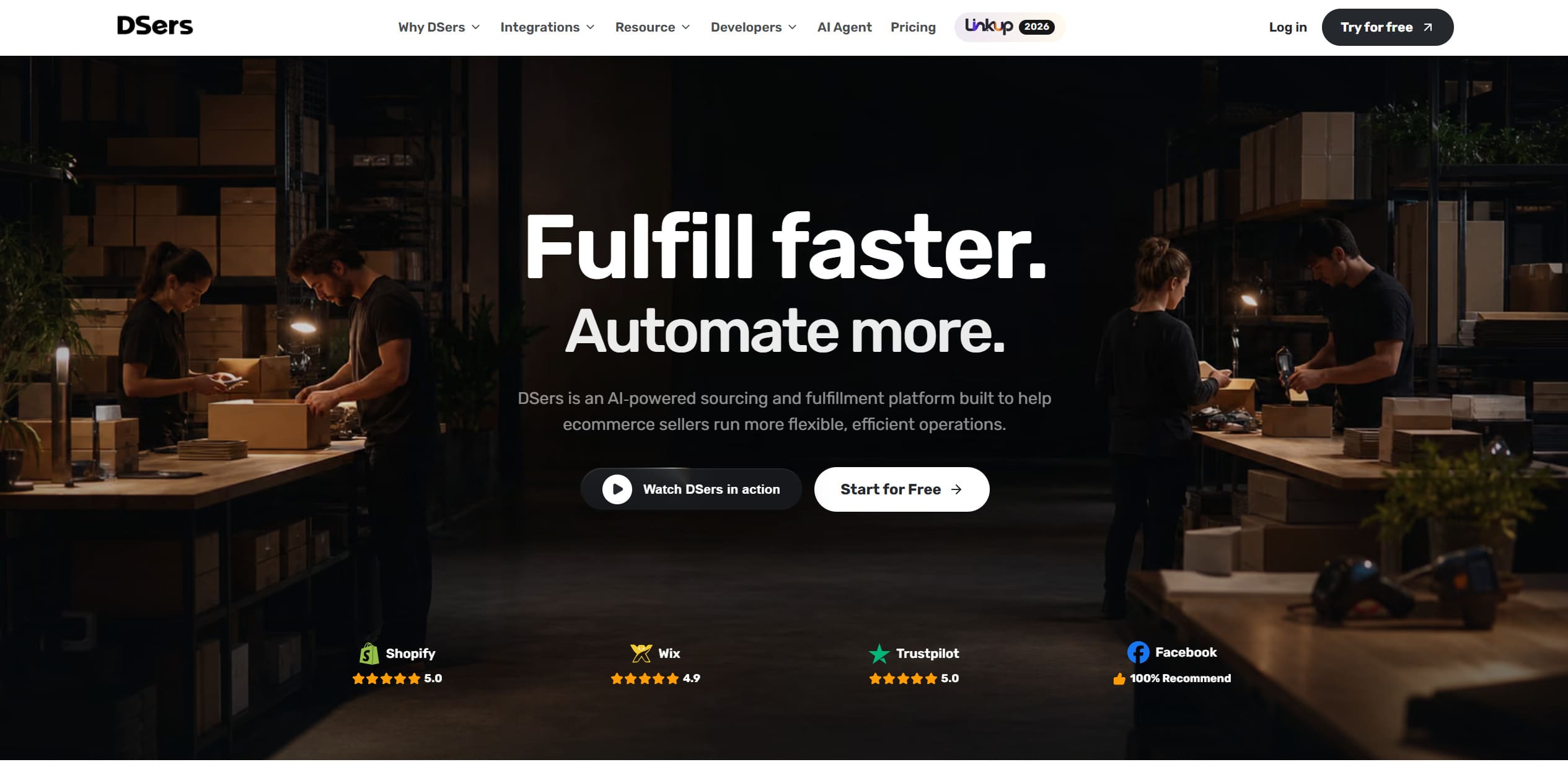
DSers is the official AliExpress dropshipping partner, and the app Shopify moved Oberlo users to when it discontinued Oberlo in 2022. It handles product import from AliExpress, 1688 and Alibaba, bulk ordering and tracking sync, and it now connects to marketplaces as well as hosted stores: Shopify, Wix, WooCommerce, eBay, TikTok Shop, Amazon, Walmart, BigCommerce, Squarespace, Ecwid, Square, Magento and several smaller platforms, plus CSV workflows.
The main features are:
- Supplier Optimizer and image search for finding cheaper or faster suppliers of the same product.
- Bulk ordering to AliExpress, so hundreds of orders go out in one pass. You still pay for each AliExpress order, and fully automatic order placement by rules works with Alibaba and DSers agent suppliers rather than AliExpress.
- Tracking number sync to your store on every plan, so the store can send the shipping confirmation. Package tracking and a branded tracking page are paid features.
- Automatic price and stock updates on paid plans. The free plan has manual pricing tools only.
- Variants mapping with backup suppliers, product splitting and bundles.
- Multiple stores: 3 on the free plan and up to 50 on Enterprise.
DSers has four plans, and every paid plan comes with a 14-day free trial. Basic is free with 3 stores and 3,000 products. Advanced costs $19.90 a month for 10 stores and 20,000 products, Pro $49.90 for 25 stores and 75,000 products, and Enterprise $499.90 for 50 stores and 100,000 products. Annual billing takes 20% off, which brings Advanced to $15.90 a month and Pro to $39.90.
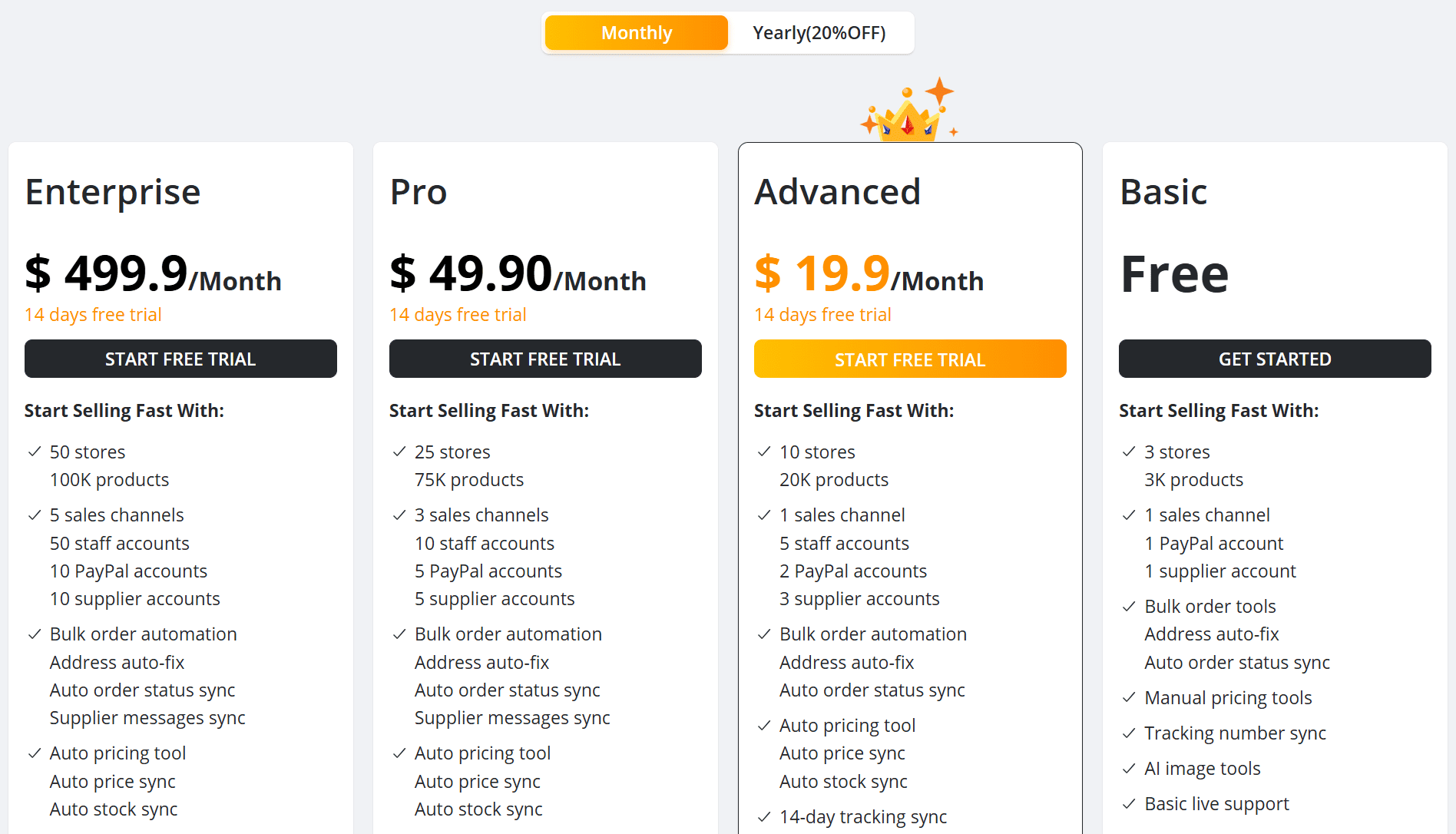
The sales channel limit is the detail to read twice. DSers’ pricing table lists it separately from the store limit: Basic and Advanced include one sales channel, Pro three and Enterprise five, so selling on both Shopify and eBay from one DSers account takes the Pro plan. Pro also extends tracking sync from 14 to 21 days and adds AI product optimization credits.
How a Long-Term DSers User Runs His Store
Long, who runs the Ecom Zone YouTube channel and has used DSers for about four years, gives a useful view from the inside in a 2025 walkthrough. His niche store carries more than 2,000 products, which is why he stays with AliExpress instead of moving to a private agent: buying that many SKUs in bulk is not practical, and after years with the same supplier he gets branded tags and custom packaging. In four years he has never needed anything above the Advanced plan. He also leaves DSers’ automatic price and stock changes switched off and relies on a 2-3x markup to absorb supplier price movements.
Pros
- Free plan with 3 stores and 3,000 products
- Official AliExpress partner
- Supplier Optimizer and image search
- Bulk ordering and automatic address correction
- Tracking number sync on every plan
- Product splitting, bundles and multi-supplier mapping
Cons
- One sales channel on Basic and Advanced
- No automatic price or stock updates on the free plan
- AliExpress orders are placed in bulk but paid one by one
- Tied to AliExpress shipping times and seller quality
- Marketplace integrations cover orders, not listing tools or competitor repricing
- No own warehouses
CJdropshipping
CJdropshipping is a sourcing marketplace with a full fulfillment service attached. Because it runs its own catalog and warehouses, it often comes up as the main alternative to AliExpress.
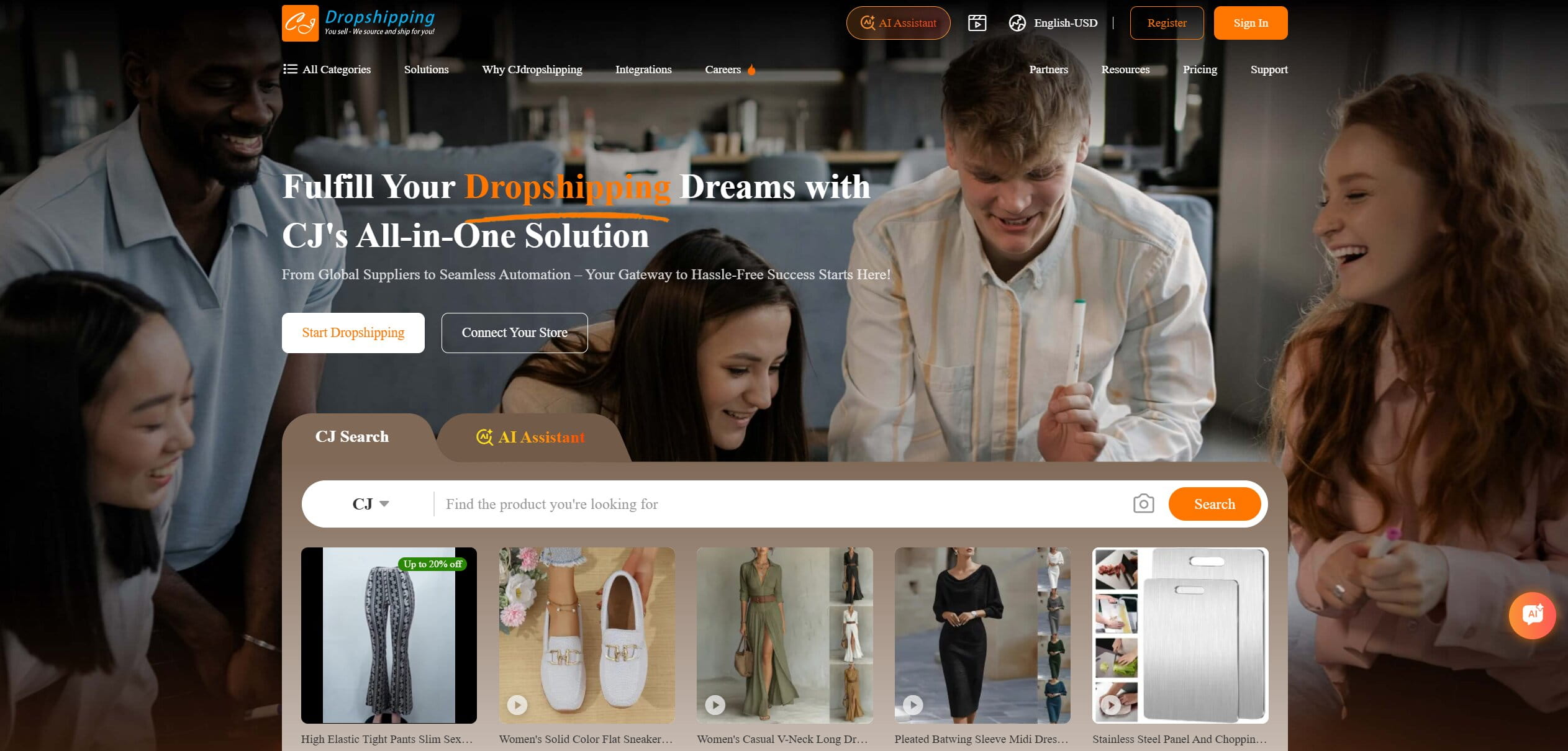
For automatic order processing you authorize a store on CJ (Shopify, eBay, WooCommerce, Etsy, Wix, TikTok Shop and other store types are supported) and connect products in that store to CJ’s catalog. Orders for connected products sync to CJ, and anything unconnected waits until you handle it. Synced orders that are not paid straight away sit in Awaiting Payment, where CJ reserves the stock for 24 hours. Sellers without a store can create orders manually.
CJdropshipping’s main features are:
- Warehouses in the USA, Germany, Australia, Canada, Britain, France, Italy and China.
- Trending product discovery by category and new arrivals.
- Sourcing requests when a product cannot be found through keyword search.
- Print on demand.
- CJ’s own CJPacket shipping lines alongside postal and express carriers.
- Inventory sync to connected stores and bulk price setting.
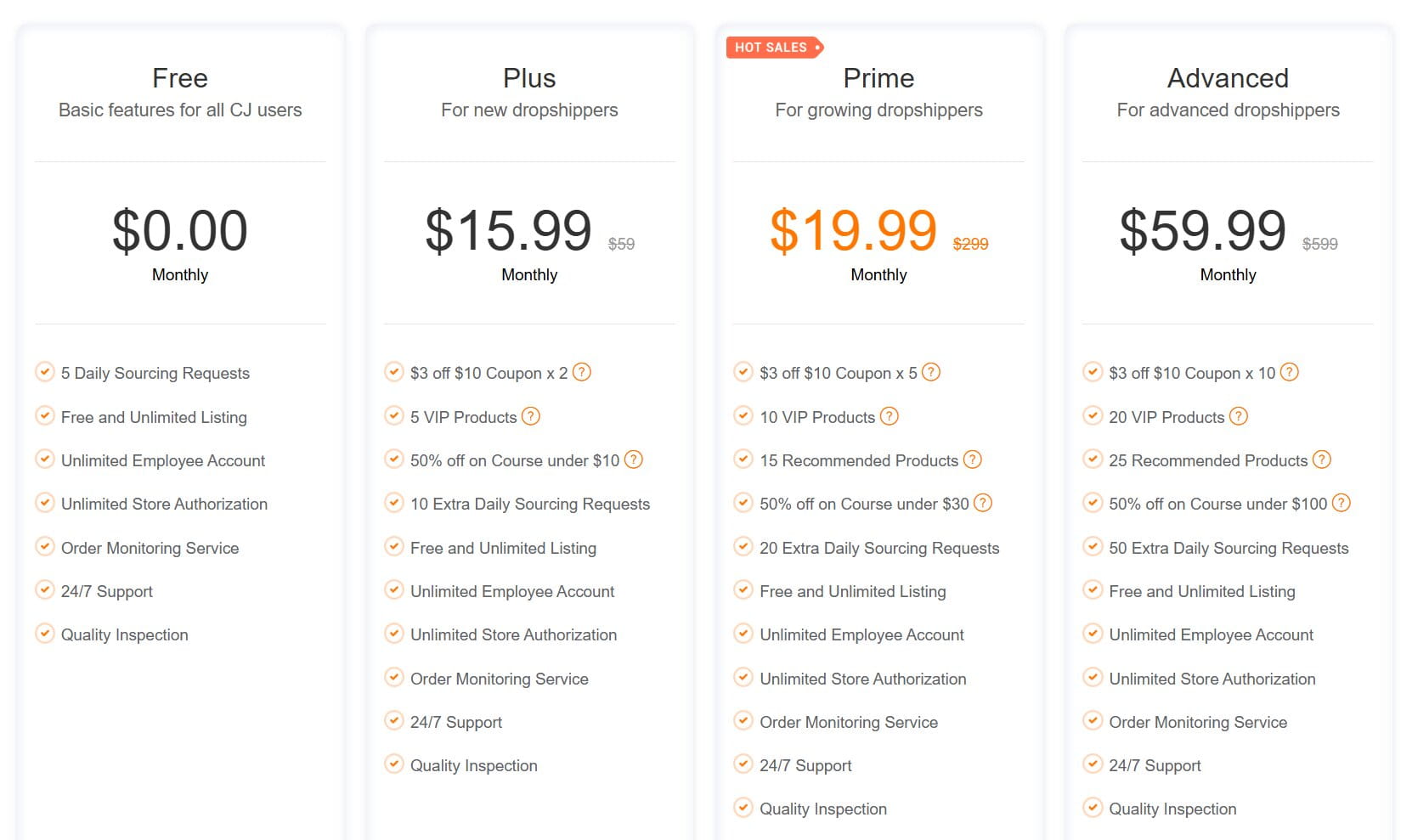
The free membership already includes unlimited listing, unlimited store authorizations, unlimited employee accounts, order monitoring, quality inspection, 24/7 support and 5 sourcing requests a day. Paid memberships buy more of the same, not different software: Plus at $15.99 a month adds 10 extra daily sourcing requests, 5 VIP products and coupons, Prime at $19.99 adds 20 extra requests, 10 VIP products and recommended products, and Advanced at $59.99 adds 50 extra requests and 20 VIP products. The real spend goes on the goods: product, shipping and warehouse fees depend on where the stock sits.
Pros
- Free membership with unlimited store authorizations
- Own warehouses on several continents
- Custom packing with your own logo
- Product search by image
- Customization and sourcing requests to suppliers
- Agent support for sourcing and orders
Cons
- Coupons and VIP products sit in the paid tiers
- Custom packaging must be bought in advance, and some private inventory has minimum quantities
- Limited product uniqueness
- Unit prices often higher than AliExpress
- No repricing against competing eBay listings
Zendrop
Zendrop is a supplier and fulfillment network built to get a store live quickly. It handles sourcing, shipping and automated order fulfillment from one dashboard, with branding options designed to build repeat purchases.
Zendrop’s main features are:
- More than 1 million products, with US-stocked items unlocked on paid plans.
- Automated fulfillment on Pro and Plus for orders synced from connected stores.
- Fulfillment from Zendrop’s own warehouse in China, which ships worldwide, and from US-based suppliers that ship only within the US.
- Delivery in roughly 2 to 8 days for US-stocked products, after 1 to 3 business days of processing.
- Custom branding on paid plans.
- A free replacement or a refund when an order arrives damaged or runs more than five days past its delivery estimate.
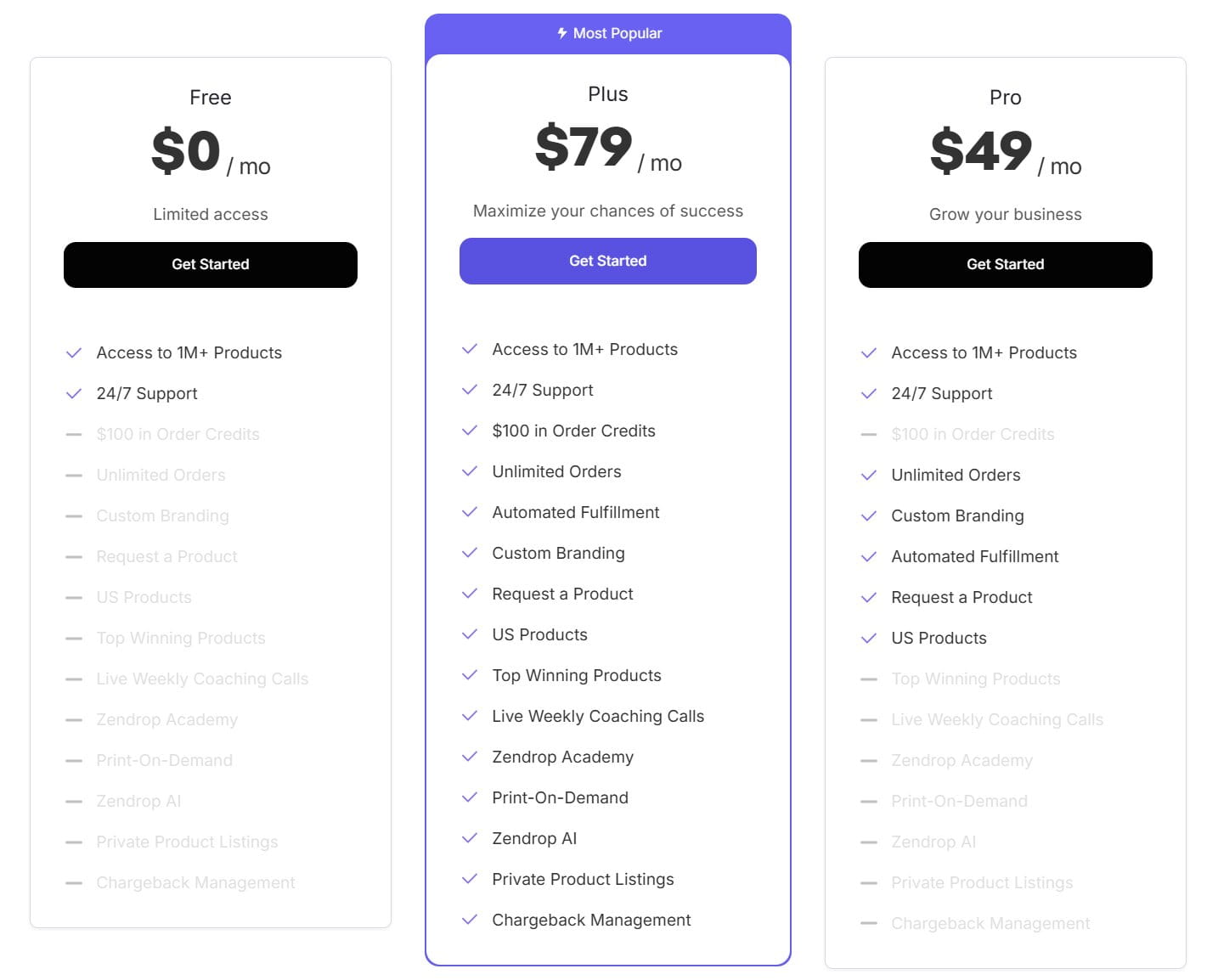
Zendrop publishes three plans: Free, Pro at $49 a month or $399 a year, and Plus at $79 a month or $549 a year. Free gives catalog access and 24/7 support and nothing else. Pro unlocks unlimited orders, automated fulfillment, custom branding, product requests and US products. Plus adds $100 in order credits, top winning products, weekly coaching calls, Zendrop Academy, print on demand, Zendrop AI, private product listings and chargeback management.
New users who sign up through Shopify or Wix are billed differently. Under Zendrop’s usage-based billing, the monthly charge follows the highest number of products linked during the billing cycle: $29 for 1 to 20 products, $49 for 21 to 100 and $79 for 101 or more. Unlinking products mid-cycle does not lower that cycle’s bill. More detail is in our Zendrop review.
Sellers weighing cj dropshipping vs zendrop usually decide on channels and billing. Zendrop is simpler to price for a Shopify store, while CJdropshipping is free to join and authorizes more store types, eBay included.
Pros
- US-stocked products
- Simple flat pricing on direct plans
- Unlimited orders from Pro
- Custom packaging and branded inserts
- Free replacement of damaged products
Cons
- Only three native integrations: Shopify, TikTok Shop US and ClickFunnels
- No eBay or Amazon integration
- Order credits, coaching and print on demand sit in the Plus tier
- Usage-based billing charges on peak linked products
DSers vs AutoDS: Comprehensive Feature and Price Comparison
Quick answer: DSers is an AliExpress order manager priced from free to $499.90 a month, with one sales channel on its free and $19.90 plans. AutoDS is a multi-supplier automation platform with a separate plan for each selling channel from $26.90 a month, plus $9.90 for automatic ordering. Choose DSers if AliExpress is your supply and you sell on one platform. Choose AutoDS if you source from US retailers or need monitoring across many suppliers.
The dsers vs autods question used to come down to channel coverage, and that gap has narrowed. DSers spent years as a Shopify-side tool and now connects to eBay, Amazon and Walmart too. What still separates them is the supply side, and that holds however you spell it, AutoDS or Auto DS vs DSers: DSers routes everything back to AliExpress, while AutoDS sits above 25+ suppliers and eight selling channels and charges accordingly.
On sourcing, DSers gives you AliExpress plus 1688, Alibaba and agent suppliers. AutoDS adds US retailers such as Amazon, Walmart and Home Depot, plus CJdropshipping and its own marketplace, which matters if you want US-based stock and delivery in days instead of weeks from China.
Automation depth still favors AutoDS. With the auto ordering add-on it places orders through your buyer accounts or Fulfilled by AutoDS, monitors supplier prices and stock, and pushes tracking back to the marketplace. DSers covers the AliExpress ordering step and tracking, with price and stock sync on paid plans. On eBay both now connect, and the difference shows up after the connection: AutoDS reacts to the source price, while DSers marks up from supplier cost by rules.
The DSers user quoted above shows why that difference matters more on some stores than others. With a 2-3x markup, small supplier price changes disappear into the margin, so automatic repricing is optional on a Shopify brand store. It is harder to live without on eBay, where buyers compare near-identical listings on price and a stale stock count turns into a cancelled order.
AutoDS vs DSers on Price: What Changes as You Add Channels
Both tools now charge more as you add channels, but in different steps: AutoDS bills per channel, while DSers bills per account and caps channels by plan. A seller on Shopify or eBay alone pays $19.90 a month on DSers against $26.90 to $59.80 on AutoDS, and a seller on Shopify and eBay pays $49.90 on DSers Pro against $89.80 or more on AutoDS. Anyone weighing autods vs dsers on cost alone lands on DSers. The reason to pay more is what AutoDS does on the supply side: US suppliers, faster delivery windows and monitoring across many sources.
AutoDS vs Zendrop: Automation Platform vs Supplier Network
Quick answer: AutoDS is software that lists, monitors and orders products from 25+ suppliers across eight selling channels. Zendrop is a supplier with its own catalog, warehouses and branding program that connects to Shopify, TikTok Shop US and ClickFunnels. Choose Zendrop for a branded Shopify store with simple pricing. Choose AutoDS if you sell on eBay, Amazon or several channels at once.
The autods vs zendrop decision starts with what you are buying. AutoDS sells automation on top of other people’s catalogs, so your product range is whatever its suppliers carry that day. Zendrop sells the goods themselves along with the fulfillment, which gives you US stock, branded inserts and custom packaging, but only from its own catalog.
Pricing lands closer than it looks. Zendrop Pro costs $49 a month and includes unlimited orders, automated fulfillment and custom branding. A Shopify seller on AutoDS Starter pays $39.90, or $49.80 with automatic ordering. The difference is in what each price covers: Zendrop’s covers one supplier’s products on its supported stores, while AutoDS’s covers monitoring and ordering from many suppliers on one channel.
On channel support, zendrop vs autods stops being close. AutoDS sells dedicated eBay and Amazon plans. Zendrop has no eBay or Amazon integration, and its help center says orders from those marketplaces have to be entered manually, which in turn requires one of its supported stores to be connected. Zendrop also notes that some of its products cannot be sold on third-party marketplaces like eBay because of supplier restrictions.
Both tools tie the bill to catalog size in their own way. AutoDS counts products and variations per plan. Zendrop’s usage-based billing, used for Shopify and Wix sign-ups, counts the peak number of linked products during the billing cycle. Sellers who test many products and prune them later should check which model punishes that habit less.
DSers vs CJdropshipping: Sourcing, Fulfillment and Shipping Speeds
Quick answer: DSers is software that places orders on AliExpress and owns no inventory. CJdropshipping is a supplier that owns warehouses on several continents and fulfills orders itself. With DSers you get AliExpress prices and AliExpress shipping times. CJdropshipping trades a higher unit price for local-warehouse delivery, custom packaging and a model where the money goes into each order, with no required subscription.
The dsers vs cjdropshipping decision is a question of what you are buying: automation on top of thousands of independent AliExpress sellers, or the goods and logistics from one company, with the software attached at no required cost.
Shipping is the sharpest difference. AliExpress orders routed through DSers ship from Chinese sellers on whatever service the seller selected, and delivery to the US typically takes one to three weeks. CJ holds inventory in US, EU, UK, Canadian and Australian warehouses, so items already in local stock arrive in a few days. Products that are not in a local warehouse ship from China and land in a similar window to AliExpress, which is the part sellers often miss when they compare advertised delivery times.
Cost works in the opposite direction. AliExpress unit prices are frequently lower than CJ’s, since CJ builds warehousing, quality control and its agent service into the price. Sellers running cheap impulse products on thin margins often find AliExpress plus DSers cheaper per unit. Sellers running a repeat-purchase brand usually find CJ cheaper overall once refunds and lost parcels are counted.
For anyone choosing dsers or cj dropshipping for branding: CJ offers custom packaging, private inventory storage, print on demand and product photography as standard services. DSers can only pass along what the individual AliExpress seller is willing to do. For most sellers that is nothing, but not always: the long-term DSers user quoted earlier gets branded tags and custom packaging from a supplier he has worked with for years.
Platform reach used to be the widest part of the cj dropshipping vs dsers gap, and it has mostly closed. DSers now lists eBay, Amazon and Walmart among its selling channels, and CJ authorizes most major store platforms, eBay included. One difference remains: DSers limits sales channels by plan, while CJ’s free membership includes unlimited store authorizations. Some sellers run the two side by side, using DSers for AliExpress test products and CJ for anything that proves itself and needs faster shipping.
If you are still weighing cjdropshipping vs dsers, the short version is that DSers is the right tool for validating products cheaply, and CJ is the right supplier for scaling the ones that work.
AutoDS vs CJdropshipping: Retail Automation vs Direct Fulfillment
Quick answer: AutoDS is paid automation software that sources from 25+ suppliers and manages listings, monitoring and fulfillment across eight selling channels. CJdropshipping is a free-to-join supplier that fulfills from its own warehouses. They solve different problems, and AutoDS can use CJ as one of its supply sources.
The autods vs cjdropshipping comparison confuses people because both platforms claim to handle fulfillment. AutoDS handles the buying side: it watches supplier prices, updates your listings, places orders and returns tracking numbers to the marketplace. CJ handles the physical side: it stocks the product, picks it, packs it with your branding if you ask, and ships it.
Cost structures reflect that. AutoDS charges a subscription and gives you supplier variety in return. CJ lets you join for free and takes its margin on product cost, shipping and warehousing, with optional paid memberships that mostly buy extra sourcing requests. A seller doing low volume pays less with CJ. A seller running thousands of listings across several marketplaces gets more from AutoDS, because the monitoring engine is what keeps that many listings from losing money.
On product control, CJ pulls ahead. You can order samples, request custom packaging, store private inventory in a CJ warehouse and set up print on demand.
For anyone comparing cj dropshipping vs autods on eBay specifically, both work, with different weak points. CJ’s eBay authorization syncs orders and can sync inventory, but it does not reprice against competing listings. AutoDS monitors source prices, places orders automatically with the add-on and protects listings with its VeRO list. Neither removes the need to think about eBay’s own policy on dropshipping from another retailer.
Plenty of stores run both. AutoDS lists CJdropshipping as a supported supplier, so you can source CJ products and let AutoDS handle listing management and monitoring on top, which is the usual answer when cjdropshipping vs autods turns out not to be an either-or choice.
Can You Use DSers or Zendrop on eBay?
Quick answer: DSers yes, Zendrop no. DSers has an official eBay integration that syncs orders, places AliExpress orders in bulk and pushes tracking and stock levels back to eBay. Zendrop integrates only with Shopify, TikTok Shop US and ClickFunnels, so eBay orders have to be entered in Zendrop by hand. Neither reprices against competing eBay listings, so retail arbitrage sellers still need a tool built around eBay.
The Reality of DSers eBay and Zendrop eBay Compatibility
DSers now lists eBay among its selling channels, alongside Amazon, Walmart, TikTok Shop and a long list of hosted store builders, and it describes the eBay connection in an official integration announcement. Older reviews that say DSers has no eBay support are out of date. Adding eBay to an existing Shopify setup does mean moving to the Pro plan, since the cheaper plans include one sales channel.
The zendrop ebay situation ends in a different place. Zendrop’s own documentation lists three native integrations: Shopify, TikTok Shop US and ClickFunnels. You may still list Zendrop products on eBay, Amazon or Facebook and place each order manually in the Zendrop dashboard, but that requires a connected supported store, and Zendrop itself says manual entry does not scale to high order volumes. At a handful of orders a week it works. At thirty orders a day it becomes a full-time job, and the manual step is exactly where mis-shipped addresses and late tracking uploads come from, both of which damage eBay seller metrics.
Zendrop sellers sometimes try to bridge the gap with a listing tool on one side and the supplier app on the other. That setup gives you two dashboards, two sources of stock data, and no single system that knows both what eBay owes the buyer and what the supplier has on the shelf. Inventory drift follows, then cancellations, then defect rates.
What the DSers eBay Integration Does and Does Not Cover
DSers describes the eBay integration in terms of four jobs: bulk order processing of 100+ orders at a time, supplier recommendations, automatic tracking sync to eBay and real-time inventory updates from suppliers. Setup takes four steps: sign up, connect the eBay store, import products and start selling.
That covers the order side of an eBay business properly. What sits outside it matters just as much, especially if you came to eBay through retail arbitrage and not through AliExpress.
Supply is the first limit. Everything DSers fulfills comes from AliExpress, 1688, Alibaba or agent suppliers, so the goods arrive on the timelines those suppliers offer. eBay shows buyers an estimated delivery date and measures you against it, and a one to three week transit is a hard thing to build a marketplace business on.
Pricing is the second. DSers pricing rules work upward from supplier cost: you set the markup and it is applied when a product is pushed to the store. Automatic price updates on published listings are a paid-plan feature, and manual bulk price refreshes come with a monthly quota, from once a month on Basic to ten times on Advanced. An eBay catalog where source prices move daily needs pricing that recalculates on its own schedule.
The third gap is listing work. The integration moves products and orders. Title structure, item specifics, category mapping and refreshing live listings against a source retailer remain your job or another tool’s.
None of that makes DSers wrong for eBay. A seller whose products genuinely come from AliExpress, and whose buyers are willing to wait, now has a cheap, official way to run that store, and the free plan makes testing it costless. A seller doing Amazon to eBay is solving a different problem, and the DSers integration does not reach it.
Which AutoDS Alternatives Actually Work on eBay
If you are leaving AutoDS because of eBay, the filter is simple. The tool has to connect natively to eBay, keep prices and stock in step with the source supplier on its own schedule, and place orders without you touching them.
Zendrop drops out on the first condition, since it has no eBay connection. DSers clears the connection and falls down on the other two, for the supply and pricing reasons above. CJdropshipping stays in as a supplier with eBay authorization and inventory sync, though it does not reprice against the market. AutoDS qualifies, with per-channel pricing that adds up if you also sell on Shopify or Amazon. Easync qualifies too, repricing eBay listings against the source every 30 minutes and placing Amazon orders automatically. VeRO protection matters on top of that, since a single takedown can hit an imported catalog hard; our eBay VeRO guide explains how the list works.
Anyone evaluating these tools should also look at what happens after the sale. Tracking number conversion, buyer-facing tracking that does not expose the source retailer, and frequent tracking refreshes affect eBay’s late-shipment metrics more than any product research feature does.
Easync
Easync is an Amazon to eBay dropshipping tool that also covers AliExpress to eBay and Amazon to Shopify. It suits sellers looking beyond Amazon-only dropshipping, or adding eBay or Shopify as an extra channel, who need prices, stock and orders kept in step automatically.
On eBay listings, Easync reprices against the source every 30 minutes with custom strategies and monitors stock, so an item that runs out or loses its margin at the source stops selling at a loss. When an Amazon-sourced order comes in, auto ordering buys the item and fills in the buyer’s details, and instant tracking and tracking number conversion push a usable number back to the store. Every plan includes Fulfillment by Easync, multiple store management and VeRO protection.
Plans are sized by listings and orders, not by marketplace. Basic costs $49.99 a month for 2,000 repricing listings and 200 automatic orders, Progressive $65.99 for 3,000 and 300, Advanced $89.99 for 4,000 and 400, and Expert $219.99 for up to 1,000 automatic orders. The price is the same whether you sell on eBay or Shopify, and there is a 7-day trial with no credit card. Current plans are on the Easync pricing page.
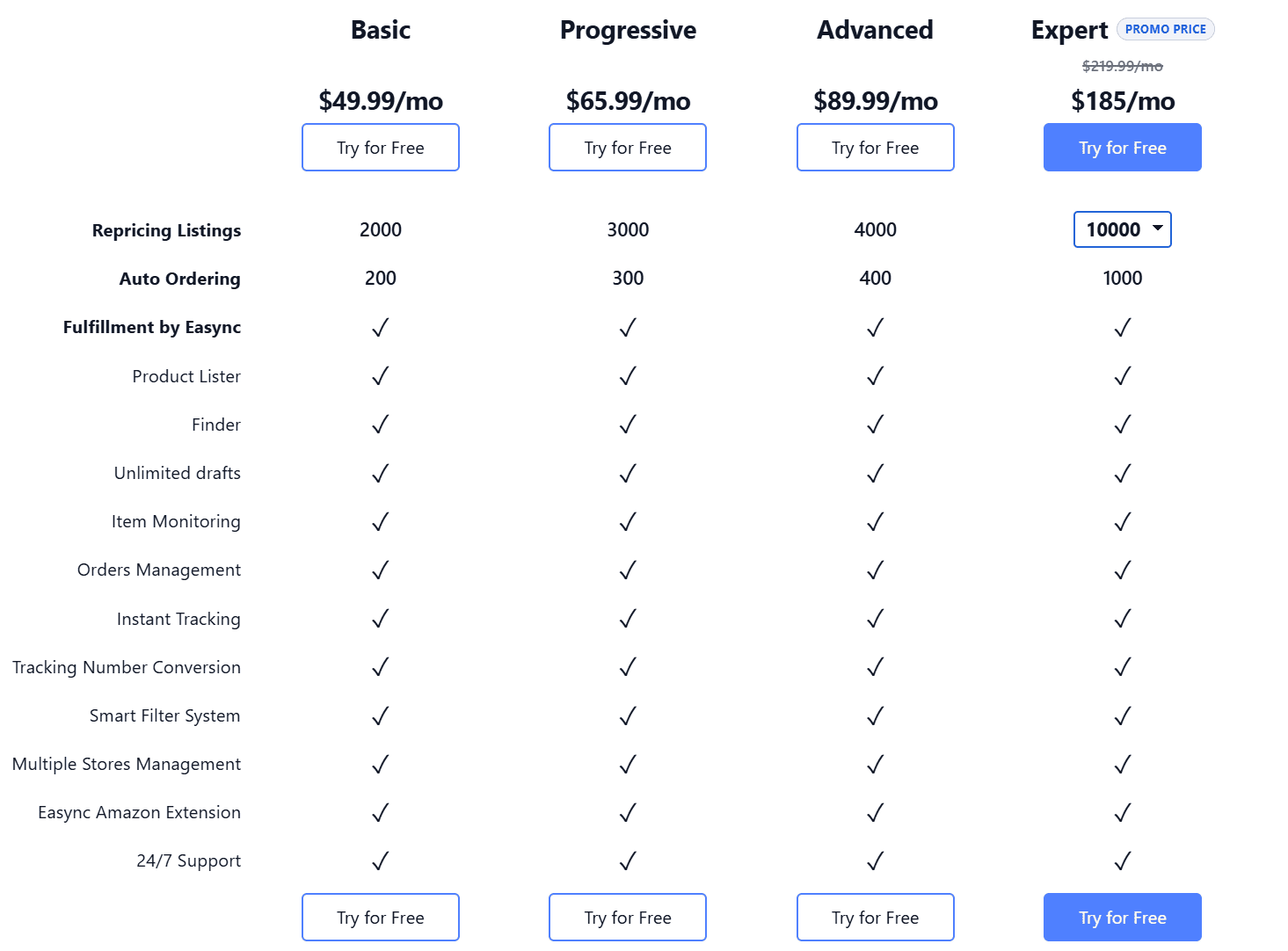
Easync vs AutoDS comes down to breadth against focus. AutoDS covers eight channels and 25+ suppliers; Easync covers fewer routes but includes auto ordering in the plan and does not charge per marketplace. For 200 eBay orders a month the two land close on price, as the comparison table shows, but Easync’s plan also covers 2,000 repricing listings.
Like every retail arbitrage tool, Easync works in a model eBay restricts: eBay’s dropshipping policy does not allow buying an item from another retailer after the sale and shipping it straight to your buyer. Sellers handle that in one of two ways. Some buy from Amazon and hold the stock before listing, which ties up cash and storage but keeps the goods in their possession. Others ship directly to the buyer, which needs no stock and no warehouse but carries account risk if eBay reviews the supply chain. Easync’s price and stock tracking supports both routes and helps keep the account running without disruptions, while auto ordering serves the second.
Frequently Asked Questions
What is the best AutoDS alternative?
It depends on what you use AutoDS for. For eBay sellers sourcing from Amazon, Easync covers repricing, automatic Amazon ordering and tracking in one plan without per-marketplace pricing, and it also supports AliExpress to eBay listings. For AliExpress sellers on one platform, DSers is the cheapest option. For branded Shopify stores, Zendrop and CJdropshipping replace the supply side of AutoDS with their own warehouses.
Is there a free alternative to AutoDS?
Yes, two. DSers has a free Basic plan with 3 stores, 3,000 products, bulk ordering and tracking sync, though automatic price and stock updates need a paid plan. CJdropshipping’s free membership includes unlimited listing and store authorizations, and you pay only for products and shipping. AutoDS itself has no free plan, only a 3-day trial for $0.99.
Does DSers work with eBay?
Yes. DSers has an official eBay integration covering order sync, bulk ordering, tracking updates and live inventory, and it also connects to Amazon and Walmart. On the Basic and Advanced plans you get one sales channel, so running eBay alongside another platform takes the Pro plan. Older comparisons saying DSers has no eBay support are out of date.
Is the DSers eBay integration enough for retail arbitrage?
No. It fulfills from AliExpress, 1688, Alibaba and agent suppliers, and its pricing rules calculate a markup from supplier cost rather than repricing against the market. Sellers sourcing from Amazon need a tool built for that route, such as Easync or AutoDS.
DSers vs CJ Dropshipping: which one is better?
DSers is better for cheap testing of AliExpress products, especially on a single store platform. CJdropshipping is better once a product sells consistently and you need faster local-warehouse shipping, custom packaging or fulfillment across several store platforms.
Which is cheaper, AutoDS or DSers?
DSers, in almost every setup. On Shopify or eBay alone, DSers Advanced costs $19.90 a month against $26.90 to $59.80 for AutoDS, depending on the tier and the $9.90 auto ordering add-on. On two platforms, DSers Pro costs $49.90 because Basic and Advanced allow only one sales channel, while AutoDS charges a separate subscription per channel, $89.80 for eBay and Shopify on Starter tiers. What the extra money buys on AutoDS is US suppliers and monitoring across many sources.
Can I use Zendrop for eBay dropshipping?
Only manually. Zendrop has no eBay integration, so orders received on eBay must be entered in the Zendrop dashboard one by one, and manual orders require a connected Shopify, ClickFunnels or TikTok Shop US store. Some Zendrop products are also restricted from third-party marketplaces like eBay.
Zendrop vs CJdropshipping: which is better?
Both are suppliers with their own warehouses and branding services. Zendrop suits Shopify sellers who want flat pricing, US products and unlimited orders from $49 a month. CJdropshipping suits sellers who want a free membership, more store platforms including eBay, and warehouses on more continents, at the cost of a more hands-on setup.
DSers vs Zendrop: which is better?
DSers is the cheaper option for AliExpress sourcing, with a free plan and support for marketplaces such as eBay and Amazon. Zendrop costs more but ships from its own China warehouse and from US suppliers, with custom branding, and it connects only to Shopify, TikTok Shop US and ClickFunnels. Choose DSers for low-cost testing across platforms and Zendrop for a branded Shopify store.
Which tool is best for eBay dropshipping in 2026?
Easync and AutoDS are the two with full eBay automation covering listing, repricing, auto ordering and tracking. CJdropshipping works as a supplier with eBay authorization and inventory sync but no repricing. DSers connects to eBay and suits sellers whose supply is AliExpress. Zendrop has no eBay integration.
What about Oberlo, Spocket and Dropship.io?
Oberlo, the AliExpress dropshipping app that Shopify acquired in 2017, stopped working on June 30, 2022, and Shopify moved its users to DSers. The oberlo.com site still exists with free business tools and guides, but it no longer imports products or processes orders. Spocket is a supplier marketplace built around US and EU suppliers, closer to Zendrop and CJdropshipping than to AutoDS, and its Amazon and eBay support starts on the Empire plan; see our Spocket review. Dropship.io is a product research tool that analyzes Shopify stores and does not place or fulfill orders, so sellers use it alongside the tools above rather than instead of them.
Conclusion
This comparison of Easync vs. AutoDS vs. Zendrop vs. DSers vs. CJdropshipping covers five dropshipping tools that solve overlapping but distinct problems. All of them help find products, import listings, fulfill orders and track delivery. What separates them is the sales channel they support, who holds the stock and how the bill grows as you add channels and orders.
Among the AutoDS alternatives, DSers is the cheapest route for AliExpress sellers on one platform, Zendrop and CJdropshipping suit sellers building a branded store with faster shipping, and Easync suits eBay and Shopify sellers sourcing from Amazon who want repricing and automatic ordering in one plan, with AliExpress to eBay covered as well. On eBay, the question has moved from who connects to who reprices, who sources locally and who ships fast enough for a marketplace delivery estimate. Try the free plans and trials before committing, since the right answer depends on your niche, your order volume and where your buyers already are.