
- articles
Is AutoDS Worth It? Pricing, Fees & Real Reviews 2026
Quick Answer: AutoDS is an all-in-one dropshipping automation tool covering product research, importing, price and stock monitoring, and order fulfillment across eBay, Shopify, Amazon and five more channels. It has no permanently free version and no support phone number, and each selling channel is billed separately. Easync.io is the closest full-featured alternative for eBay sellers who want one predictable monthly bill.
The capabilities of AutoDS and its best alternative Easync will improve your dropshipping business on eBay, making it efficient, growing and competitive. However, choosing the best one can be difficult, so in this article we’ve compared Easync and AutoDS to help you choose the platform that best suits your business in 2026.
Overview of Easync.io and AutoDS
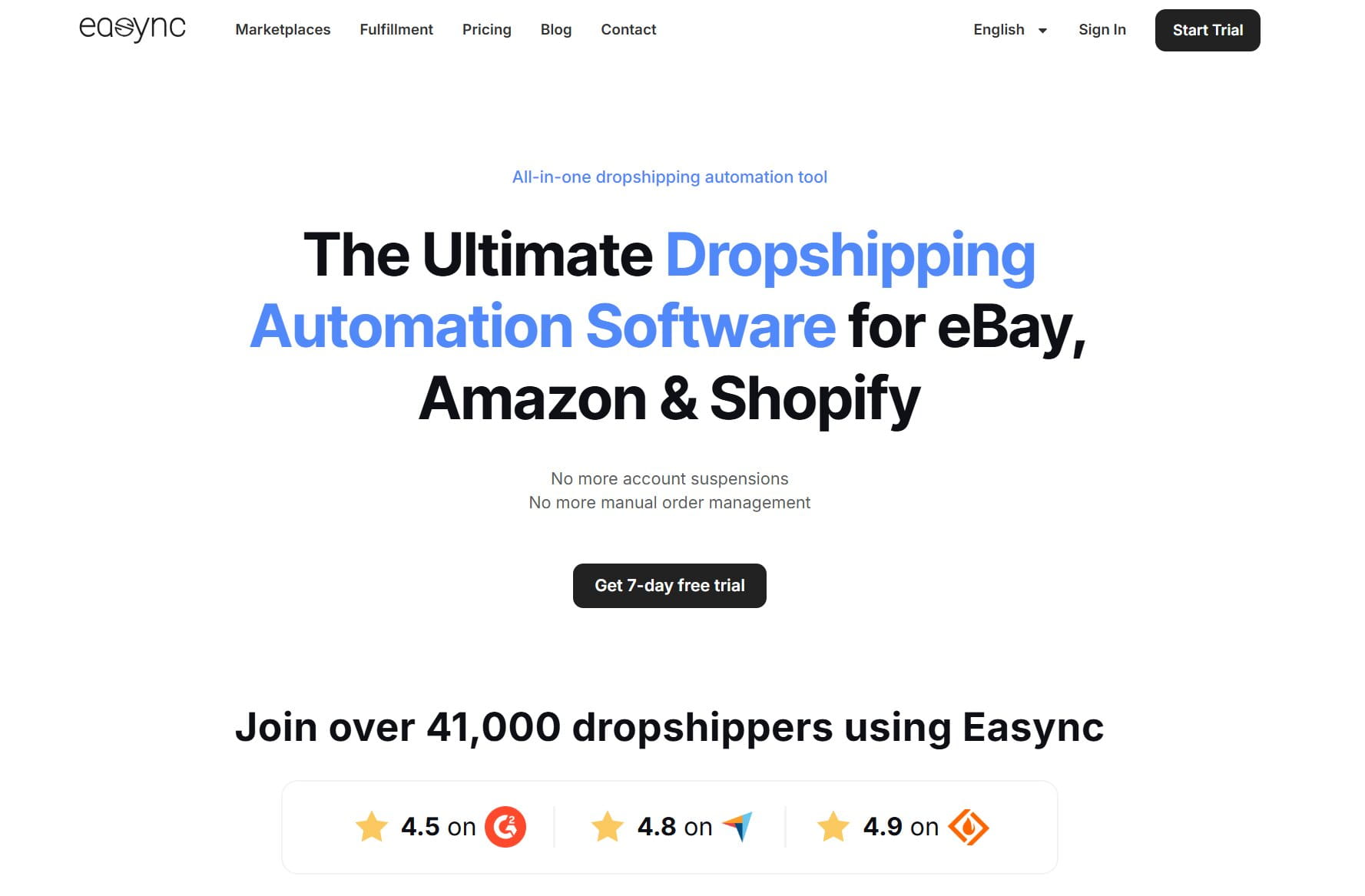
Among the automation solutions for eBay dropshipping, Easync ranks at the top. It facilitates product sourcing so that users can put up online stores across various selling platforms like eBay, Amazon and Shopify, where Easync now ships a dedicated app for merchants. By going through all the necessary stages of organizing one’s dropshipping business, Easync.io becomes an invaluable tool. Through it, you can identify leading products, automate sales activities, and optimize suppliers while making the most profit possible.
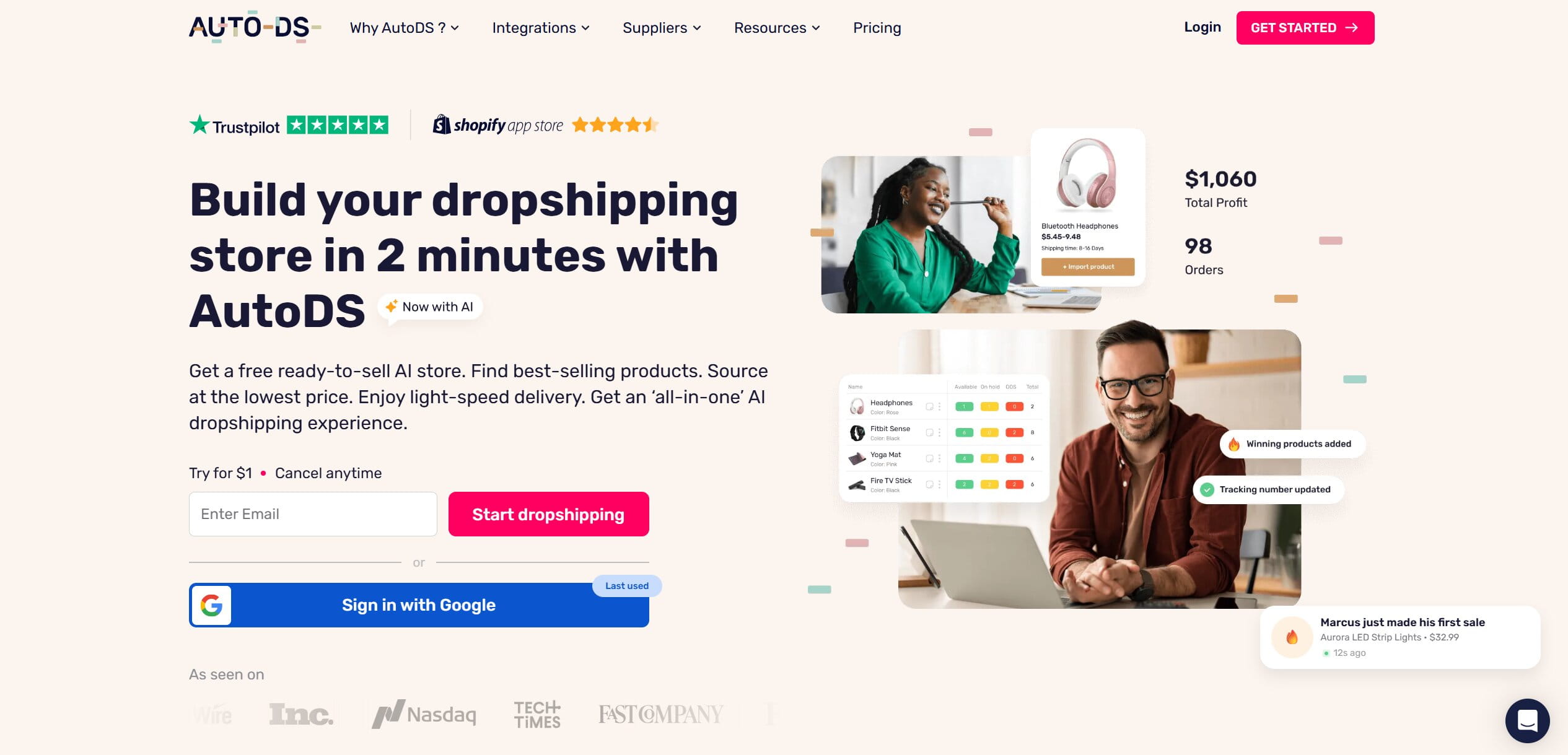
AutoDS is the most widely used dropshipping automation platform on the market and the benchmark most sellers compare everything else against. It launched in 2016 under the name Automatic Dropshipping System, was co-founded by Lior Pozin and Michael Royf, and was later acquired by Fiverr, which answers the recurring question about the AutoDS owner. It still operates under its original leadership.
The platform, written variously as auto-ds, auto.ds or auto ds, connects eight selling channels to supplier catalogs on AliExpress, Amazon, Walmart, Costway, Banggood and its own marketplace. As an all-in-one AutoDS dropshipping tool it covers finding items, importing them, monitoring supplier prices and processing orders, though not all of those sit inside the base subscription.
Easync.io vs. AutoDS: Quick Comparison
The table below sets the two platforms against each other on the points that decide most purchases: what it costs to try them, how the billing is structured, and what is included before you start adding extras.
| Parameter | Easync.io | AutoDS |
|---|---|---|
| Free trial | 7-day trial, no credit card required | No free trial. $0.99 for 3 days, non-refundable, converts automatically to a paid plan |
| Pricing model | One subscription per account, flat monthly rate by listing volume, same price on any marketplace | Separate subscription per selling channel, priced by product variation limit |
| eBay support | Core focus, including non-API workflows and multi-store management | Supported, with its own eBay plan tiers and pricing |
| Shopify support | Supported through the Easync Shopify app | Supported, priced as a separate Shopify subscription |
| Tracking automation | Instant tracking and tracking number conversion on every plan | Automatic tracking number updates on all plans |
| Order automation | Included in every plan | Requires the Orders Processor add-on |
| Support channels | Help Center plus live chat inside the account with a human agent | Ticket system and in-platform chat. VIP chat is reserved for higher tiers |
| Hidden or extra fees | No paid add-ons for core automation | Orders Processor, Product Finding Hub, VA Users, Mentorship and UGC tools billed separately |
What is AutoDS and how does it work?
Anyone searching for what is AutoDS and how does it work is usually asking about the order lifecycle rather than the feature list. So how does AutoDS work in practice? The AutoDS how it works sequence starts inside the AutoDS app, where you connect a store and select source suppliers from AliExpress, Amazon, Walmart, Costway, Banggood and the platform’s own marketplace.
Once listings are live, the monitoring layer takes over, checking supplier pages for price and availability changes. That part matters more than beginners expect, because a supplier price change you miss for two days can wipe out a week of margin. The entry-level Import plan is positioned for testing rather than for running a live catalog.
When an order arrives, AutoDS can place it with the supplier and push the tracking number back to your buyer. The auto ds dropship model itself has not changed, only which parts of it you pay extra for. The AutoDS extension is how most sellers get products in, since the browser tool pulls items from supplier sites into your drafts with one click.
Easync.io vs. AutoDS: Feature Comparison
Easync.io concentrates on deep eBay automation across more than 99 supported marketplaces, with a fulfillment service attached. AutoDS spreads wider, covering more selling channels and a large in-house product marketplace, with several of its tools sold as add-ons.
Easync.io Features
- Smart Product Identification. The Finder tool on Easync.io scans source marketplaces for products that are actually moving, filtered by price band, category and margin, so you are working from demand data rather than from a hunch. You can add source markets and tighten the filters across several passes, which is how most sellers narrow a broad category down to a niche they can defend on price.
- Dropshipping Supplier Analysis and Order Processing. Once source and target markets are set, Easync.io helps you judge suppliers on the things that cause disputes later: stock depth, delivery windows and how the vendor behaves when an item runs out. Orders go to the right vendor in one click. The practical payoff is catching a supplier whose handling time has quietly slipped before the marketplace flags it against your account.
- 24/7 Automated Updates. Inventory, pricing, orders and tracking refresh around the clock. When a supplier moves a price, the Easync.io repricer follows it inside the rules you set instead of leaving you to sell at last week’s margin, and items that go out of stock at the source get pulled before a buyer can order one. Overselling a dead SKU is one of the fastest ways to collect a defect on eBay, and this closes that hole.
- Access to Extensive Marketplaces. Support for more than 99 source and target marketplaces matters for one specific reason: it lets you source outside the crowded lanes where every other seller is listing the same items at the same margin. Easync.io covers the obvious sources and a long tail of regional ones, which is where sellers tend to find products that have not already been repriced to the floor.
- Order Fulfillment Tracking and Profit Monitoring. Fulfilled order counts and daily profit sit in the Easync.io dashboard, per store, with several stores under one login. The number worth watching is net profit per order, because that is the figure you divide your tool cost by to know whether automation is paying for itself.
- Centralized Shipment Organization. Shipping every order through one channel gives buyers a consistent delivery experience, which is what feedback scores actually measure. Easync.io handles that side, and from there you can layer on the things that produce repeat buyers: tighter delivery windows, branded packaging and the occasional extra in the box.
AutoDS Features
- Product Research. The AutoDS marketplace draws on private and retail suppliers across more than twenty supported sources, and AutoDS puts its own catalog at over 800 million products. The curated list of winning products chosen by the AutoDS team sits in the Products Finding Hub, which is an add-on at $14.97 per month rather than part of the subscription.
- Automated Order Fulfillment. The AutoDS order fulfillment feature means that whenever a client buys from your dropshipping store, you don’t have to manually send the order details to the supplier, as this is done automatically. After that, the supplier mails the orders to your clients and provides confirmation of deliveries and tracking numbers. Note that this feature now requires the Orders Processor add-on rather than being included in the subscription.
- Product Importer. Your products can be easily imported from the supplier to your store. It is possible to upload products in bulk or schedule imports, so there is no need for you to spend much time creating product listings manually. A wide array of customizable print-on-demand products can be sourced and imported the same way, with a single click.
- Price and Stock Monitoring. Ensure that you maximize your profits by staying ahead of your pricing. AutoDS keeps track of your product prices and updates them whenever it detects any changes on the supplier’s website. This is available from the Starter tier upwards, not on the Import plan.
- AutoDS Chrome Extension. Adding products to your dropshipping store is made easier by the AutoDS Chrome Extension. It enables you to import products from different supplier sites easily and quickly straight to your store.
- Automatic Tracking Number Updates. Tracking numbers update themselves as the supplier releases them. Paired with the stock, price and inventory monitoring and the automated title and description generation, this takes a further slice of manual work out of day to day store management.
- AI Store Builder. Users can have a fully functioning Shopify store constructed by AutoDS automatically, and the company states the build takes about two minutes. The intent is to move the seller’s attention to product selection while the software handles the setup.
Easync.io vs. AutoDS: Pricing and Plans
The two platforms answer the pricing question in different units, which is why comparing entry numbers alone will mislead you. Easync.io sells capacity: four plans from $49.99 to $219.99 a month, sized by how many listings you run, with every automation included at every level. AutoDS sells access per marketplace, a separate subscription for each selling channel, sized by product variations, with several automations sold alongside it. The sections below take each in turn.
Easync.io Pricing Plans
- 7-day trial with no credit card needed
- The lowest priced plan is Basic for $49.99/month
- The highest standard plan is Expert, listed at $219.99/month
- Plans differ by capacity, not by feature access or by selling channel
| Plan | Price | Repricing Listings | Auto Ordering |
|---|---|---|---|
| Basic | $49.99/month | 2,000 | 200 |
| Progressive | $65.99/month | 3,000 | 300 |
| Advanced | $89.99/month | 4,000 | 400 |
| Expert | $219.99/month list price | 10,000, adjustable | 1,000 |
Included on every plan: Fulfillment by Easync, Product Lister, Finder, Reports, Item Monitoring, Orders Management, Instant Tracking, Tracking Number Conversion, Smart Filter System, Multiple Stores Management, the Easync Amazon Extension and 24/7 support.
Above the Expert tier the plans stop being a menu. Sellers who need more listings than the top package allows can have a custom plan built by the sales team, with private support attached to it, which is the route most high-volume eBay operations end up taking.
There is also an API layer worth knowing about if you have your own systems. Easync exposes fulfillment through its API, so you can place Amazon orders and receive valid tracking from your own marketplace, CRM or internal workflow rather than working inside a dashboard. That matters for sellers who have already built their own tooling and want automation underneath it instead of another interface on top.
AutoDS Pricing: What Each Selling Channel Costs
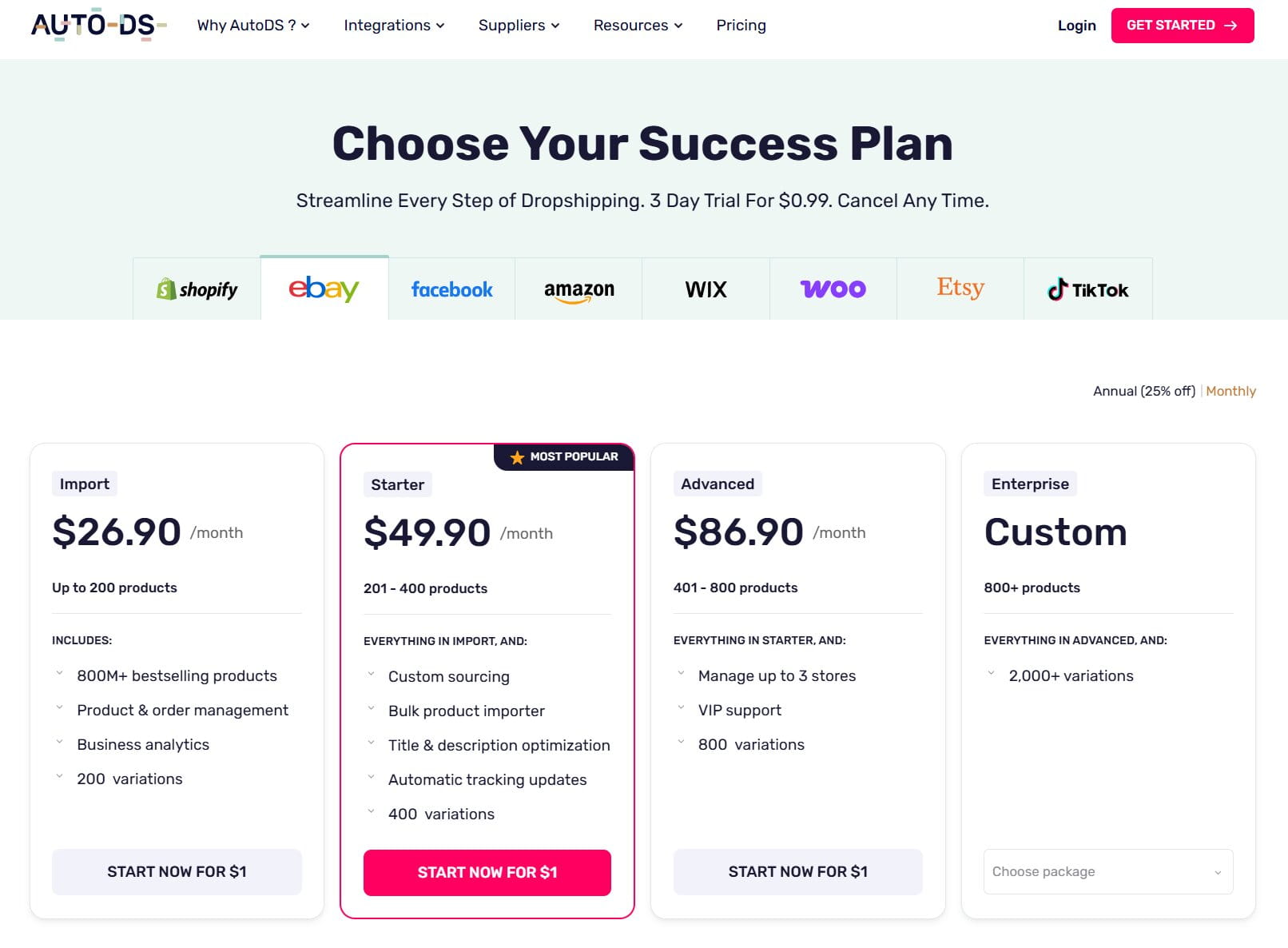
The AutoDS pricing structure changed shape rather than simply going up. There are now four tiers per selling channel: Import, Starter, Advanced and Enterprise. The number attached to each plan caps product variations rather than products, so a shirt in three sizes and three colors consumes nine slots. Everything below is the monthly rate, which is what the pricing page shows by default.
The detail that catches people out is that the same tier carries a different price depending on where you sell. Import 200 is the entry plan on every channel, but what you pay for those identical 200 variations depends entirely on the marketplace.
AutoDS pricing for eBay
- Import 200: $26.90 a month, 200 product variations
- Starter 400: $49.90 a month, 400 variations
- Advanced 800: $86.90 a month, 800 variations, up to three stores and VIP support
- Enterprise: custom pricing, from 2,000 variations upwards
eBay is the channel most readers of this article are on, and it is also the one where the variation caps are tightest. Starter tops out at 400 where the same tier on other channels allows 500.
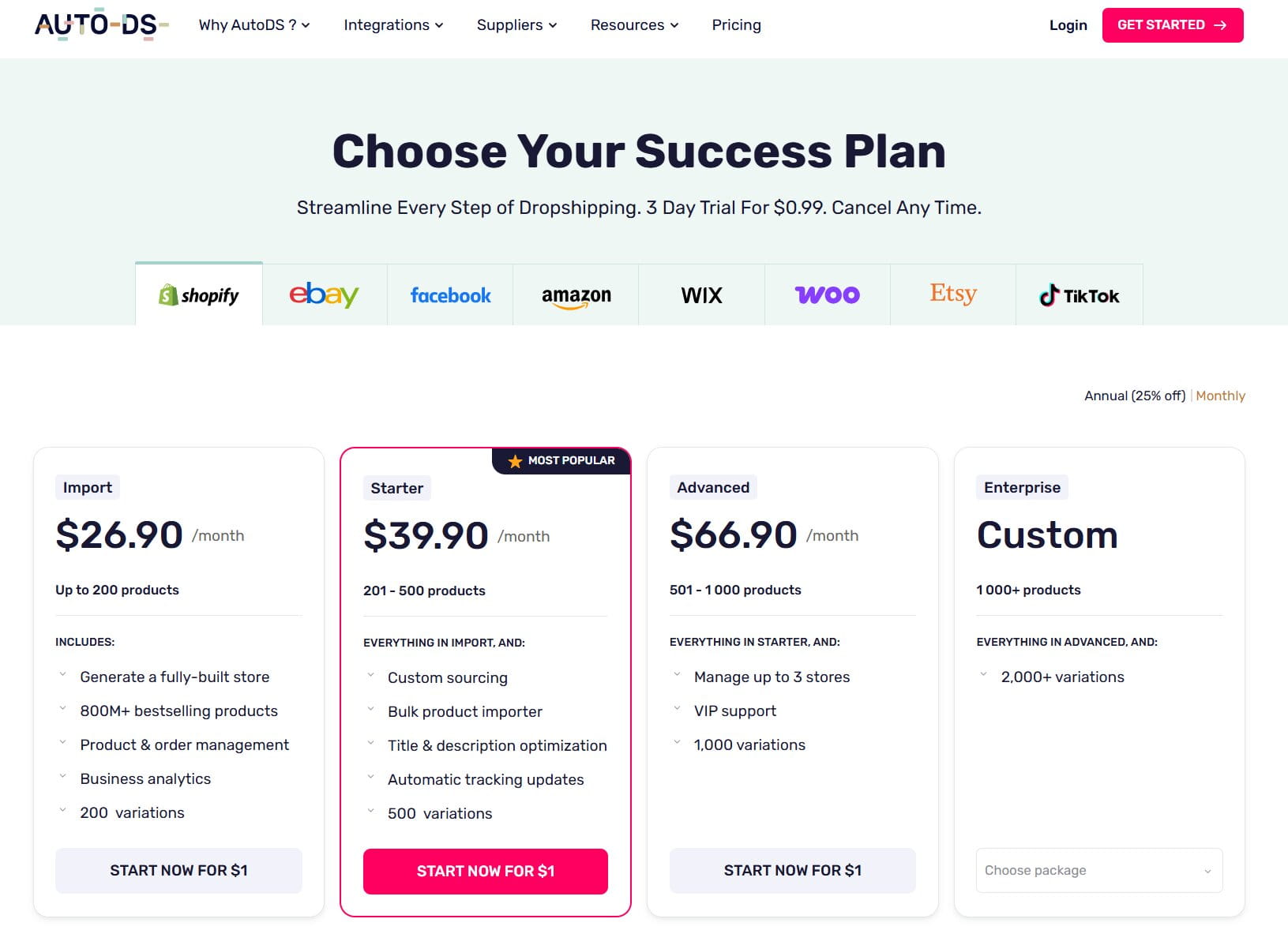
AutoDS pricing for Shopify
- Import 200: $26.90 a month, 200 variations
- Starter 500: $39.90 a month, 500 variations
- Advanced 1K: $66.90 a month, 1,000 variations, up to three stores and VIP support
- Enterprise: custom pricing, from 2,000 variations upwards
Shopify shares the same entry price as eBay but gets cheaper from Starter upwards, and the caps are more generous at every paid tier. The Import plan on Shopify also includes the AI store builder, which is the one feature that differs meaningfully between channels at this level.
AutoDS pricing for Amazon
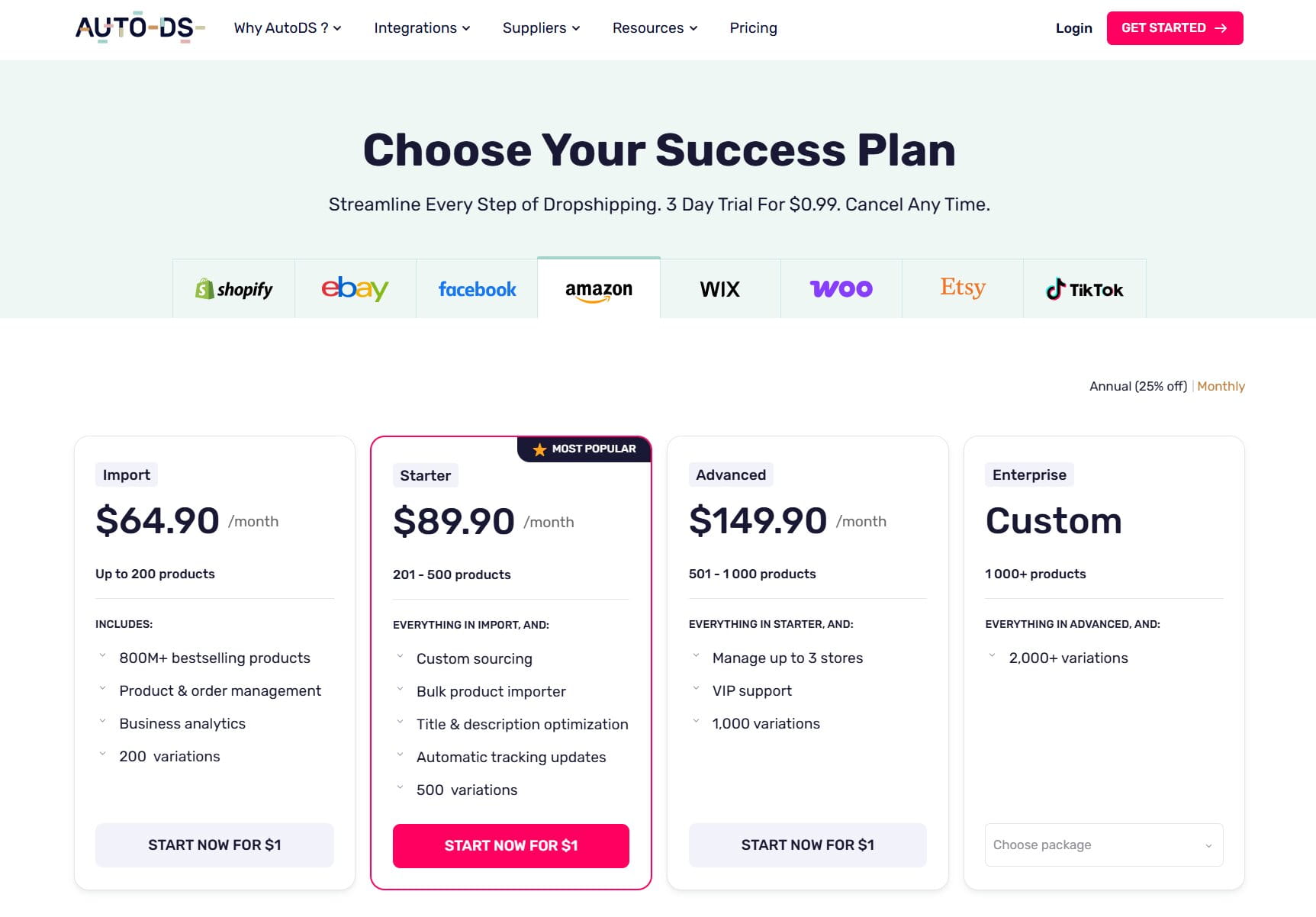
- Import 200: $64.90 a month, 200 variations
- Starter 500: $89.90 a month, 500 variations
- Advanced 1K: $149.90 a month, 1,000 variations, up to three stores and VIP support
- Enterprise: custom pricing, from 2,000 variations upwards
Amazon is the expensive channel throughout. Its entry plan costs roughly two and a half times the eBay equivalent for the same 200 variations, and Advanced 1K is more than double what the comparable Shopify plan costs.
Which selling channel costs the most?
Line the channels up and the pattern is clear. Amazon carries a premium at every tier. Between eBay and Shopify the gap runs the other way from what most sellers assume: eBay Starter costs ten dollars more than Shopify Starter and gives a hundred fewer variations, and eBay Advanced costs twenty dollars more while capping at 800 against Shopify’s 1,000. Of the two mainstream channels, an eBay seller is paying the higher rate per variation.
Annual billing takes 25% off every plan above, charged as a single payment covering twelve months. Features like the Draft Manager, Order Manager, Product Variation Support, Full Insights Dashboard, Print on Demand and 24/7 support run across all pricing plans on every channel, so they are not what separates the tiers.
The comparison worth making is what happens when you sell in more than one place. Two channels mean two subscriptions at full price, and if one of them is Amazon the second bill is the larger one. Easync.io prices differently: plans are sized by listing volume, not by marketplace, so Basic costs $49.99 whether you are selling on eBay, Amazon or Shopify, and adding a second marketplace does not add a second subscription. Which model works out cheaper depends entirely on how many channels you actually run, and that is the number worth checking before you compare entry prices.
Auto ds fees beyond the subscription
Some of the auto ds fees sit outside the plan price. Order automation is a monthly add-on, as are the winning-products research hub, virtual assistant seats, the mentorship program and the AI video tool. Bought together, the three main add-ons come as a discounted bundle. The model is modular by design, so the useful exercise is to price the specific combination you need rather than the entry tier alone.
AutoDS UK and Europe
AutoDS publishes in US dollars regardless of where you sell, so AutoDS UK sellers and German sellers searching for AutoDS Kosten see the same rates with their own bank’s conversion on top. Currency conversion charges are a real line on the statement for non-US accounts.
Is there an AutoDS free version?
There is no AutoDS free version, and no free trial in the usual sense either. Getting in requires a card and a $0.99 charge for a 3-day AutoDS trial period, which is non-refundable and renews into a paid subscription on its own.
Searches for AutoDS free, auto ds free, auto ds free trial and AutoDS free trial all land on the same reality. The trial is short and paid. It gives full access to your chosen tier, so it is not a crippled demo, but three days is barely enough to see a monitoring cycle play out.
- The trial belongs to the store, not the account. Cancelling and re-registering does not reset eligibility.
- Changing your plan during the trial ends it immediately and triggers the full charge.
- If you selected annual billing at signup and forget to cancel, the entire year is billed in one transaction.
- The $0.99 charge itself is non-refundable under the AutoDS terms of service.
- Signing up through an affiliate or partner link can change the terms, so the length and price you see may differ from the standard offer.
Easync.io runs a 7-day trial that starts without a credit card, which is the practical answer for anyone hunting for an AutoDS alternative free of an upfront commitment.
Easync.io and AutoDS: Customer Service
Easync.io and AutoDS are well-known for their proper client support services. They both give priority to the satisfaction of their users through timely and complete help provided to customers but in a different manner. Here is an overview:
Easync.io Customer Service
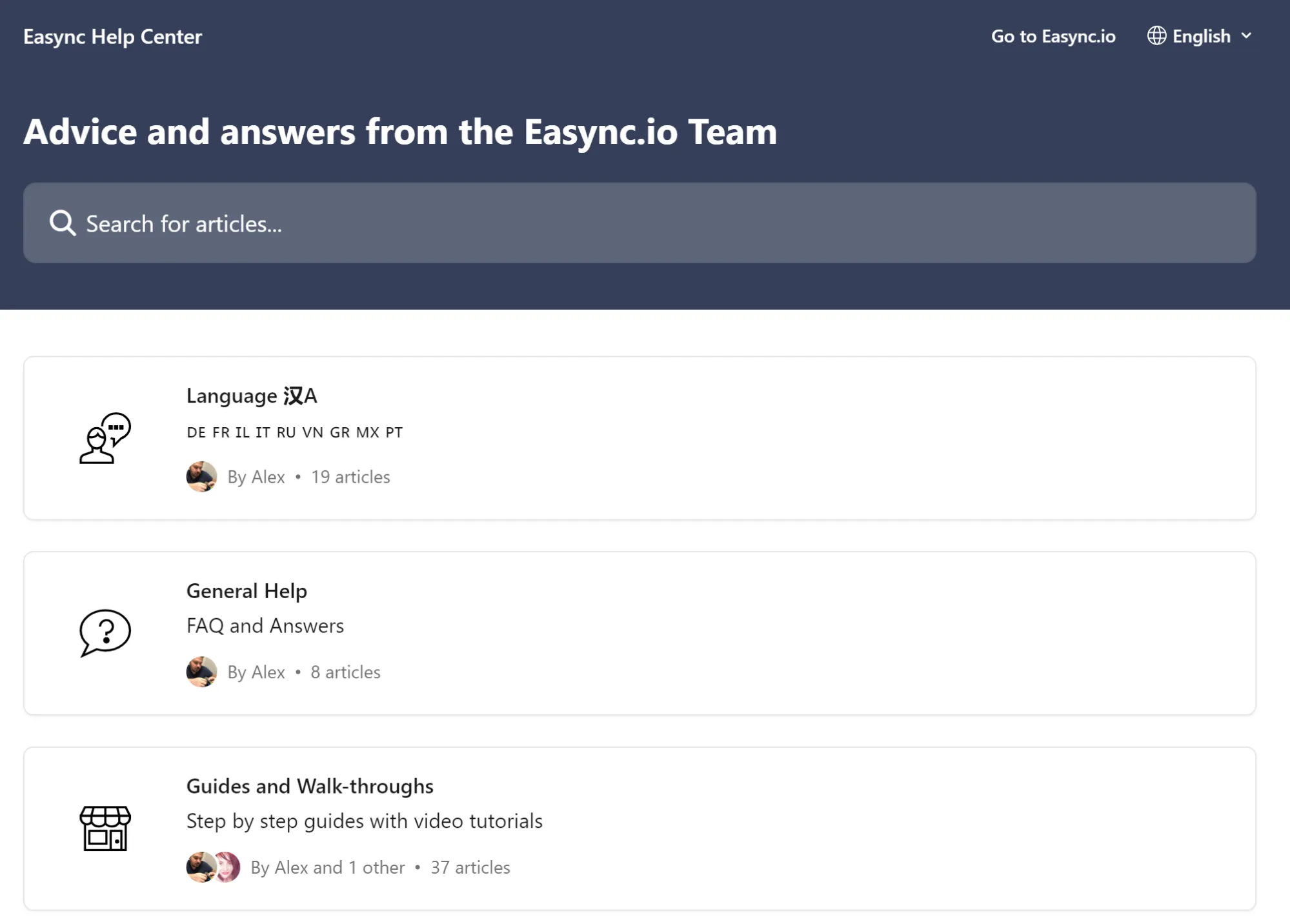
Easync.io Help Center: At the Easync.io Help Center, users will find important information provided by the Easync.io Team such as tips and solutions. This is the first place you come to whenever you experience any problem or would like some instructions about using the platform properly and keeping in touch with all updates and improvements. The Help Center is meticulously curated to address a good selection of topics so you have access to the information you need, precisely when you need it.
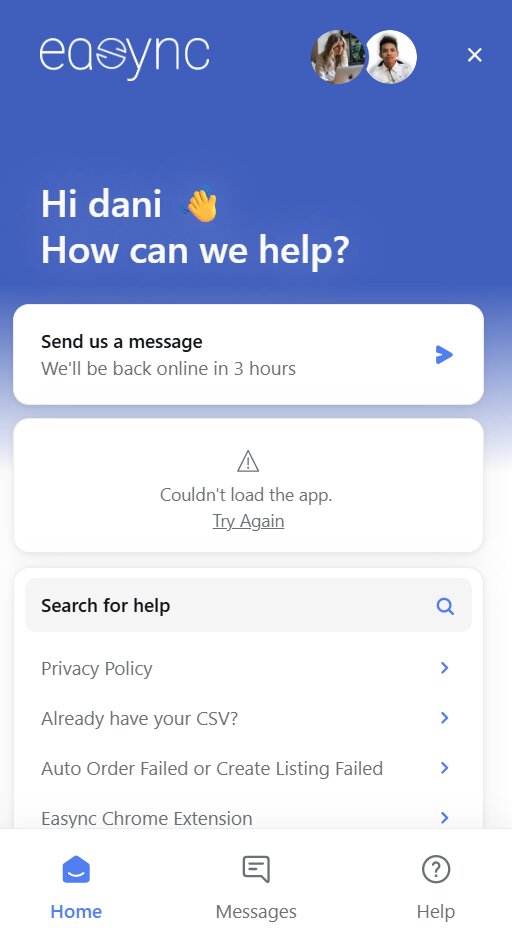
Live Chat Support: Live chat support is available instantly on your Easync.io account for any urgent requirements. By using the live chat function, you can communicate with the Easync.io customer service representative instantly, so that your questions will be answered without delay. It takes less than 20 minutes for the team to get back to you with the assurance of keeping your work flow at a minimum disturbance.
AutoDS Customer Service
What you get from AutoDS customer service depends on the plan you are on, and the difference is position in the queue rather than access.
On Import 200 and Starter you file a ticket. The queue runs around the clock, so a seller in Europe is not waiting for California to wake up, but you are in line behind everyone else on those tiers.
Advanced and Enterprise add VIP Live Chat. VIP AutoDS customer support means one thing in practice: same team, same channels, your ticket sits further forward. That is the whole of it, and for a seller whose store is down it can be the difference that matters.
Before you write in, the knowledge base is worth a look. AutoDS publishes courses and blog guides next to the help articles, and a good share of what sellers open tickets about is already written down.
One point worth stating plainly, because it is among the most searched questions about the platform. There is no AutoDS phone number to call. Everything runs through tickets and the in-platform chat, where the first line is Orin, the AutoDS AI assistant. The company’s help documentation suggests describing your issue to Orin directly rather than asking for an agent, which for common questions is genuinely faster. It is worth knowing before a billing question, though, since refund windows are one day for monthly plans and seven days for annual ones.
Easync vs. AutoDS: User Reviews
A feature list tells you what a tool can do. Reviews tell you what it is like to live with, which is a different question and usually the one that decides things. Reading AutoDS and Easync.io reviews side by side surfaces the friction that never appears on a pricing page, and for eBay dropshipping that friction is where the money leaks.
Easync Reviews
Two themes repeat across Easync reviews. Order management is the first: sellers who switched from other tools describe orders that stop needing supervision, which is the entire reason anyone pays for automation. The Finder is the second, singled out for turning up items that are genuinely moving rather than items that photograph well.
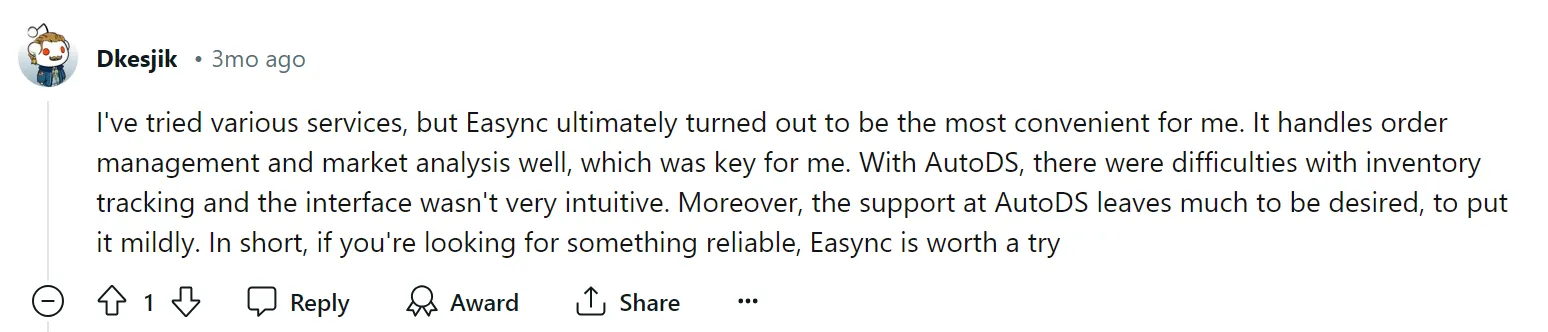
Support comes up more often than software support usually does in reviews, and users call it reliable. In this category that word tends to mean somebody answered while the case clock was still running. Inventory tracking and the interface draw noticeably fewer complaints than competitors like AutoDS collect, and that quiet is its own kind of verdict.

AutoDS Reviews
The AutoDS review pattern splits cleanly in two. Almost nobody claims the tool fails at its job. What sellers push back on is everything arranged around it.
Payment options come up constantly, since auto-fulfillment leans on Payoneer and plenty of sellers would rather run it through PayPal. The settings menu is the second theme, capable but dense enough that people misconfigure something and learn about it a week later. Third, and loudest in auto ds reviews, is the annual charge that lands once the trial closes. Anyone reading up on how to cancel an AutoDS subscription should treat it as a planned operation, because cancelling removes the store data tied to that plan straight away.
That last point explains why searches for auto ds scam exist at all. The terms are published and nothing is concealed, but the gap between a $0.99 entry price and an annual charge three days later surprises first-time sellers who move quickly through checkout. The pattern in auto ds reviews is frustration with the billing structure rather than allegations of fraud, and the fix on the seller side is simply to note the renewal date.

AutoDS pros and cons
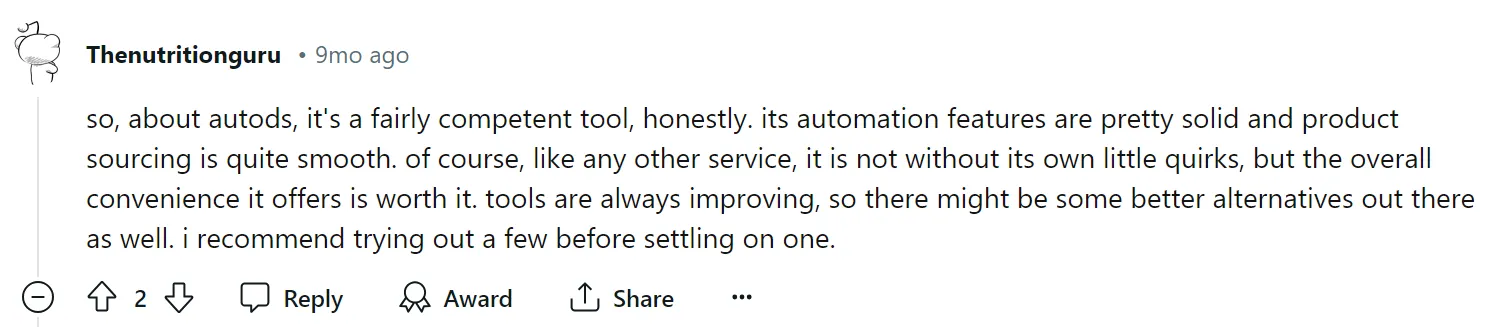
Where AutoDS delivers: monitoring is the feature that justifies the subscription, and for a store carrying a few hundred products it removes several hours of weekly checking. The importer and browser extension are quick once the workflow clicks. Channel coverage is the widest in the category, so a seller who genuinely runs four storefronts gets a single dashboard instead of four logins, which for that seller is worth the four subscriptions it takes.
Where AutoDS asks more of you: the entry price covers one channel without price monitoring or order automation, so the working configuration usually costs more than the first number suggests. Support is ticket-based and response priority follows plan tier. The interface carries a lot of settings, several of which affect billing, so the learning curve is real for a first-time seller.
Is AutoDS safe? Policy and account risk
AutoDS is a legitimate company rather than a scam, and the platform itself is not where the risk sits. The risk is in configuration, because automation software does not make a non-compliant sourcing model compliant, and any consequence lands on your seller account rather than on the software. A few specifics are worth knowing before switching anything on:
- eBay restricts sourcing from another retailer and shipping directly to the buyer. Suspensions do happen, and no tool changes that calculus.
- Automating purchases through a personal Amazon buyer account conflicts with Amazon’s terms of service. Volume buying patterns from a consumer account are detectable.
- Supplier images and delivery estimates carried over automatically are still your representations to the buyer.
This is one area where the platform choice affects exposure. Easync built its eBay tooling around this problem, including non-API listing workflows and the Fulfillment by Easync service, so order placement does not depend on running a consumer buyer account at volume. The Aquiline Tracking system exists for the same reason.
Is AutoDS worth it? Working out your break-even
Add your subscription, every add-on you actually need, and a second channel subscription if you run one. Divide that total by your average net profit per order. If your stack costs sixty dollars a month and you clear four dollars on a typical order, you need fifteen orders a month before the software has paid for itself.
The money break-even usually arrives earlier than people expect, which is why it is rarely the deciding number. The harder question is whether you have enough repetitive work for the software to take off your hands. A seller placing a handful of orders a week can still do it manually and is buying convenience. Once supplier prices need checking daily across a few hundred listings, the manual route starts costing sales rather than saving money, and that is the point where automation shifts from convenience to capacity.
AutoDS alternatives and competitors
AutoDS competitors fall into two groups that get mixed up constantly. On one side are full automation platforms like Easync.io, which list, monitor and fulfill. On the other are research-only tools such as Dropship.io and Niche Scraper, which find products but cannot process a single order. Most comparison searches conflate the two, which is how people end up buying the wrong thing.
AutoDS or Dropship.io. Dropship.io is a store and product intelligence tool. It tracks Shopify stores, estimates sales volumes, and surfaces products that are moving. It does not import listings to eBay, monitor your suppliers, or place orders. Deciding between AutoDS or Dropship.io really means deciding whether your bottleneck is finding products or running them.
AutoDS or Niche Scraper. The same logic applies. Niche Scraper is a research and validation tool with a handpicked product feed and a store analyzer, and it sits upstream of the automation layer. Plenty of sellers run a research tool alongside an automation platform, which is a stack of two products rather than a choice between them.
AutoDS alternatives free of add-on pricing. For sellers looking at AutoDS alternatives free from the per-channel and per-add-on model, Easync.io is the practical option in the eBay-first segment. One subscription covers repricing, automatic ordering, instant tracking and tracking number conversion, with Fulfillment by Easync on every plan rather than gated behind a higher tier.
What’s new in 2026
Four developments define AutoDS as it stands in 2026, and only one of them is a feature.
1. Consolidation of the eBay Tooling Market
The biggest change is ownership. AutoDS was acquired by Fiverr in July 2024. It then absorbed Salefreaks in March 2025, and in January 2026 Fiverr acquired Yaballe and folded it in under AutoDS as well. Three tools eBay sellers used to compare separately now sit inside one group, which gives AutoDS considerable resources behind its roadmap. It also means that a shortlist of AutoDS competitors is shorter than it looks, so it is worth checking which names on your list are still separate products.
2. Wider Channel Coverage and a Restructured Bill
TikTok Shop, Etsy and Wix joined the older eBay, Shopify, Amazon, WooCommerce and Facebook lineup. For a seller testing a new channel that breadth is real value, as long as the second subscription is budgeted. Anyone following AutoDS news should also note that cancelling a plan deletes the associated store data immediately rather than at the end of the paid period.
3. The Trial Got Much Shorter
For years the entry offer was fourteen days for a dollar, and most comparison articles still describe it that way. The current offer is three days for $0.99. The practical consequence is that the evaluation window no longer covers a full monitoring and fulfillment cycle, so if you are testing AutoDS against another tool, plan the test before you start the clock rather than after. Anything you read that still says fourteen days was written before this change.
4. AutoDS Inside AI Assistants
The most interesting development is the Claude MCP connector, launched in mid 2026. It links an AutoDS account to Anthropic’s Claude assistant so that searching the catalog, auditing listings, generating margin reports, importing drafts and publishing products can be done in conversation instead of in the dashboard. It runs on the Model Context Protocol, an open standard, and connects through Claude’s own connector directory. AutoDS documented it in June 2026. One limitation is worth knowing before you plan around it: the connector works only with whichever store is currently set as active in your account, so it is not a way to supervise several storefronts at once.
This matters beyond novelty. Sellers increasingly work inside an assistant rather than inside eight browser tabs, and the tools that make themselves reachable from there get used more. It is a genuine point in AutoDS’s favor, and worth weighing if you already run your day through an AI assistant.
Which Platform is Better?
The two platforms are built on different bets. AutoDS bet on breadth: eight channels, its own product marketplace, and a bill assembled from the pieces you switch on. Easync bet on depth in one place, putting repricing, auto ordering, tracking and fulfillment behind a single price for sellers whose business lives on eBay.
Neither bet is wrong, and the deciding question is which one your invoice agrees with. A seller working three channels and opening the AutoDS marketplace every morning is getting value a flat rate cannot match. A seller on eBay and nothing else is paying for optionality they never use, and for that seller Easync is the better alternative to AutoDS.
If you run auto ds for eBay only, or you are evaluating an AutoDS alternative because the add-on stack keeps growing, Easync gives you a shorter invoice and a chat window with a person on the other end.
How to cancel autods subscription?
If you decide not to use the AutoDS service, you can unsubscribe from the service by following the instructions below. The AutoDS cancel subscription flow now lives in your account settings rather than in a support request.
To unsubscribe from AutoDS, follow these steps:
- Sign in at the AutoDS platform.
- Open Settings from the left sidebar, then Plans & Add-ons at the top of the page. Every channel you pay for appears as its own card.
- Find the card for the channel you are dropping and click Cancel.
- Read the warning before you agree to it. It counts the stores, product variations and orders attached to that plan, and all of them go with it.
- Work through the prompts. AutoDS asks why you are leaving and may offer a discount to keep you, so keep clicking until the flow finishes. People stop halfway here and assume they have cancelled.
- Check the status back in Plans & Add-ons and keep the confirmation email.
Two things to plan for. Cancelling a plan is not the same as cancelling your account, and each channel must be cancelled separately. Because the data linked to that plan is deleted on confirmation, export your reports before you start. Add-ons are cancelled separately, in the same menu.
FAQ
Is Autods good for dropshipping?
For a store with steady order flow, yes. AutoDS takes over the repetitive layer: listing products, watching supplier prices, pushing orders to the supplier. The dashboard carries enough numbers that decisions rest on evidence instead of instinct.
For someone still hunting a first product that sells, it is a cost before it is a help. The value tracks how much repetitive work you already have, not how many features the plan includes.
How much does AutoDS cost per month?
On eBay, AutoDS runs from $26.90 per month for Import 200 to $86.90 for Advanced 800, billed monthly. Other channels are priced on their own scales, so the same Advanced tier is $66.90 on Shopify and $149.90 on Amazon. Annual billing cuts roughly 25% but arrives as one upfront payment for twelve months, and add-ons such as the Orders Processor sit on top of whichever plan you pick.
Does AutoDS have a phone number?
AutoDS does not publish a phone number. All support runs through tickets and in-platform chat, and there is no AutoDS customer service number to call.
Is AutoDS safe to use?
The company has traded since 2016 and now belongs to Fiverr, so the software itself is not a scam. The risk lies in configuration, because automating orders through a personal buyer account and sourcing from another retailer can conflict with Amazon and eBay policy.
Does AutoDS work with Shopify?
AutoDS integrates with Shopify and supports importing, monitoring and order automation on that channel. A Shopify subscription with AutoDS is separate from an eBay one, so a seller running both pays for two plans rather than one.
Is Easync.io or AutoDS better for beginners in dropshipping?
Easync.io gets running faster, and while you are learning that matters more than feature count. AutoDS goes deeper and ships a large library of courses, but its settings menu defeats plenty of first-time sellers well before the courses rescue them.
Can I integrate Easync.io and AutoDS with multiple e-commerce platforms?
Both connect to several e-commerce platforms and let you run stores on more than one from a single login, which is how sellers reach buyers who never shop on the other marketplace.
Can I try Easync.io and AutoDS before committing to a subscription?
Both let you in first, on very different terms. What people call the AutoDS free trial is not free: $0.99 buys three days, the charge does not come back, and the plan starts billing unless you cancel inside the window. Easync.io gives you seven days and does not ask for a card, so there is nothing to forget to cancel.
Can I use both Easync.io and AutoDS simultaneously?
You can, and some sellers do it for a few weeks while moving from one to the other. Beyond a migration you are paying twice for the same automation. Pick the one that matches the channels you actually sell on and close the other account.
Choosing between these two comes down to arithmetic you can do in ten minutes. List the channels you actually sell on, count the automations you cannot run without, and price both platforms with those inputs rather than with the number on the landing page. For an eBay seller who needs monitoring and automatic ordering rather than importing alone, the total tends to land in Easync’s favor, and the 7-day trial costs nothing to check.