
- Amazon Dropshipping
- articles
How to Start Amazon to eBay Arbitrage & Dropshipping in 2026
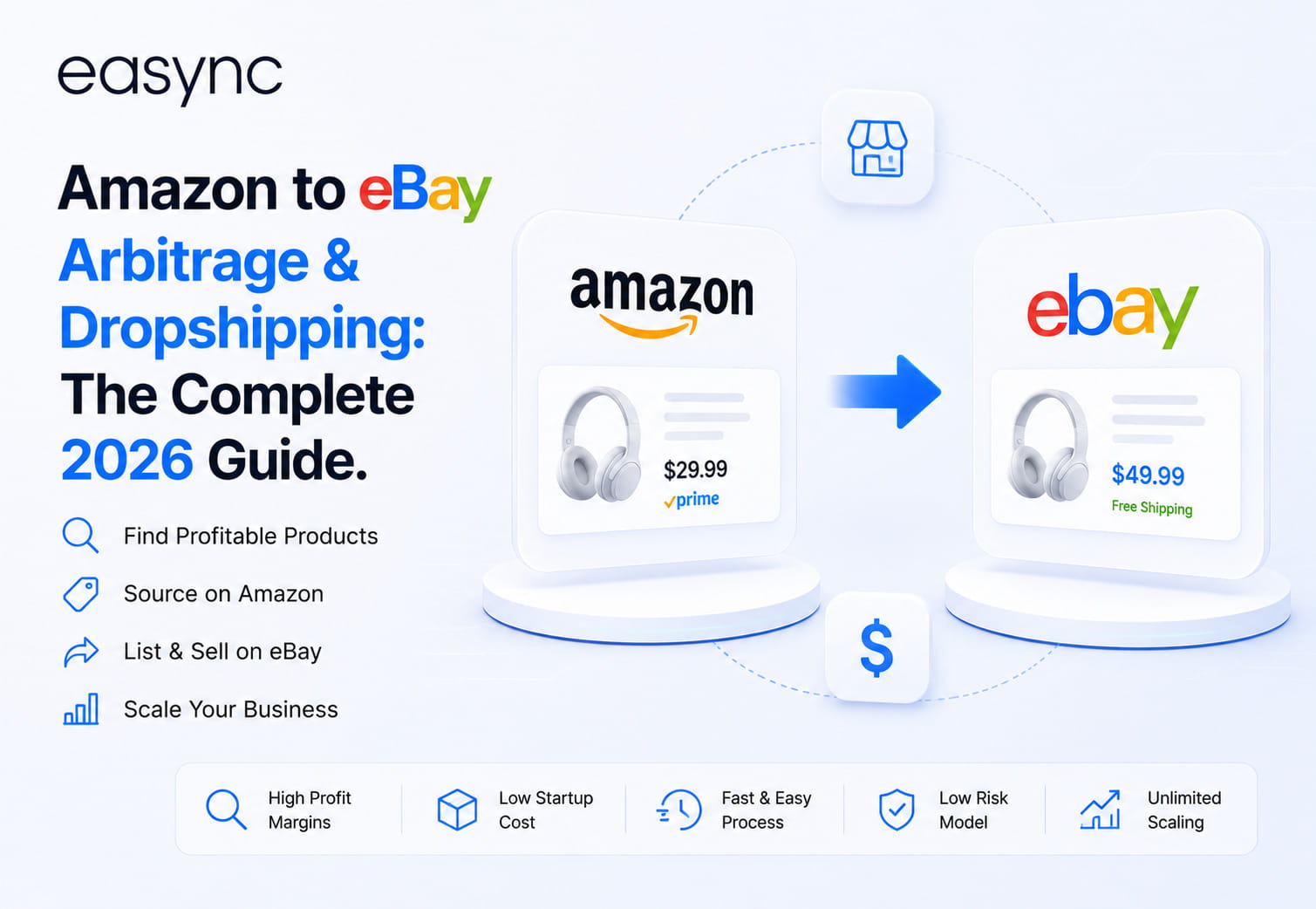
Quick answer: Amazon to eBay arbitrage means listing an Amazon product on eBay at a higher price and buying it on Amazon only after an eBay buyer has paid. It’s legal, but it runs against eBay’s sourcing rules and Amazon’s terms for regular accounts, so the model carries real account risk. After eBay’s 13.6% final value fee and sales tax, a $40 sale usually nets $4 to $6, which is why the sellers who make it work run hundreds or thousands of listings with automation.
Every month, new sellers search for “how to start Amazon to eBay dropshipping.” Most of them get halfway through a tutorial, get scared by the policy warnings, and quit before they list a single product.
Some sellers get their accounts banned within weeks, while others run stores with tens of thousands of listings without a single suspension. The difference is rarely luck. It comes down to knowing exactly how the model works, where the real risks are, and which tools take the routine work off your plate.
This guide covers what eBay and Amazon actually allow in 2026, how to find products that sell, how to work out your real margin once fees and sales tax are in, and how to automate the process so you’re not repricing listings at midnight.
If you want to sell online without holding stock, Amazon to eBay arbitrage is one of the simplest models to start with. Your job is to win the order. Your supplier ships it.
What Is Amazon to eBay Arbitrage?
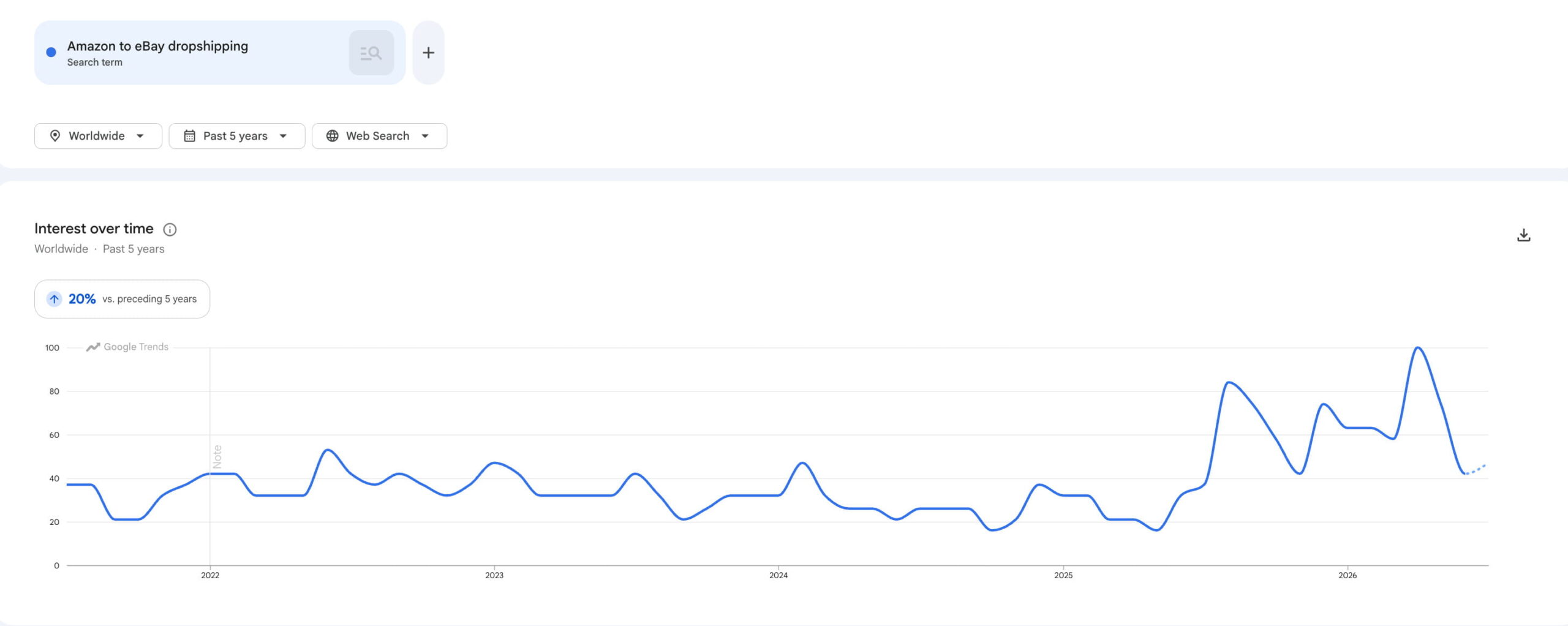
Amazon to eBay dropshipping, also called Amazon to eBay arbitrage, is a reselling model where you list a product on eBay for more than it costs on Amazon. When a buyer pays on eBay, you order the same item on Amazon with the buyer’s shipping address. Amazon delivers it, and you keep the difference minus fees.
Here’s how a typical order flows:
- You find a product on Amazon priced at $28.00
- You list it on eBay for $39.99
- A buyer purchases it from your eBay store
- You order it on Amazon using the buyer’s address
- Amazon ships directly to the buyer
- You keep roughly $4 to $6 after eBay’s fees and sales tax (the full math is further down)
The appeal is simple. You never touch the product, never rent a warehouse, and never pay for stock before you’ve been paid.
In the wider sense, eBay arbitrage is any price gap you exploit between eBay and another market. Amazon is the most common source because its prices are pushed down by constant seller competition, while many eBay buyers will pay more for convenience, a familiar store, or simply because they never checked Amazon.
Three Ways to Run It
Not every version of the model works the same way, and eBay treats them very differently.
| Model | How it works | Cash needed upfront | eBay policy status | Main drawback |
|---|---|---|---|---|
| Direct dropshipping | You buy on Amazon after the eBay sale, and Amazon ships to your buyer | None, you buy after you’re paid | Not allowed: a retailer ships to your buyer | Account risk and Amazon-branded boxes |
| Buy and hold (online arbitrage) | You buy on Amazon first, receive the item, then list and ship it yourself | Full cost of the stock | Allowed: you own the item | Storage, packing, and unsold stock |
| Amazon FBA with Multi-Channel Fulfillment | You buy stock, send it to Amazon’s warehouses, and Amazon ships your eBay orders | Stock plus fulfillment fees | Allowed: you own the inventory | Highest capital and planning |
Most of this guide is about the first model, because that’s what most people mean by Amazon to eBay dropshipping. The research, pricing, and listing steps work for all three. If you just want to sell Amazon products on eBay without the policy risk, the second and third routes are the compliant ones. The third got easier in 2026: Amazon is rolling out multichannel selling tools in Seller Central that let US sellers connect an eBay account and fulfill those orders from Amazon inventory, with tracking sent back automatically.
The difference between dropshipping and arbitrage in this context: people use the terms interchangeably, but arbitrage describes hunting for price gaps, while dropshipping describes the fulfillment method. Most sellers in this model do both at once.
eBay and Amazon Rules: Is It Allowed in 2026?
This is the question that stops most beginners, so here’s a straight answer. Reselling Amazon products isn’t illegal. The friction comes from the platforms’ own rules, and they’re stricter than many tutorials admit.
What eBay’s Policy Actually Says
eBay’s drop shipping policy allows dropshipping when you fulfill orders directly from a wholesale supplier. The same page says that listing an item and then buying it from another retailer or marketplace that ships straight to your customer is not allowed. That wording has been there for years, so this isn’t a new crackdown.
eBay accepts dropshipping when:
- You work with a wholesale supplier who has agreed to fulfill your orders, or you own the item before you list it
- You’re the seller of record, responsible for the sale and the buyer’s satisfaction
- The item arrives within the time frame stated in your listing
When activity breaks the policy, eBay can remove listings, issue warnings, restrict selling, or suspend the account. The stores that get hit are rarely random. They’re the ones with late deliveries, cancellations, and buyers complaining about Amazon boxes. Running the model sloppily is a bigger risk than the model itself.
What Amazon’s Rules Say
Amazon has no dropshipping rule for buyers like eBay’s, but its terms point the same way. Amazon’s Conditions of Use give a regular customer account a license for personal, non-commercial use, and the Prime terms go further: Prime isn’t available for purchases made for resale and can’t be used to ship products to your customers. Running this model through an ordinary Amazon account sits outside Amazon’s terms as well, just less explicitly than on eBay.
Enforcement happens through accounts. A personal account that suddenly ships to dozens of different addresses, often paid with gift cards, is the pattern that gets buying accounts locked.
Plenty of sellers still place eBay orders through their own Amazon accounts, many of them with Prime for the fast, free delivery. That puts the buying account at risk, the same way the eBay rule puts your store at risk. In practice there are three setups:
- Your own Amazon account with Prime: the fastest and cheapest per order, and the most exposed, since it breaks the Prime terms on top of the general ones
- Your own account without Prime: less exposed, but free shipping only starts at $35 per order
- A managed purchasing service such as FBE, which keeps your personal accounts out of it
The Bottom Line
The model sits in a gray area, and people still make real money in it. The risks are concrete, and each one has a fix:
| Risk | How to reduce it |
|---|---|
| eBay restrictions or suspension | Keep delivery times, tracking, and cancellations clean, and sync stock and prices automatically |
| Amazon account locks | Avoid sudden order spikes on one buying account, or use a managed purchasing service such as Easync FBE instead of your personal Amazon account |
| Amazon-branded packaging | Order as a gift so no prices or invoice go in the box. The Amazon branding on the box itself stays |
| Late delivery defects | Promise delivery windows your Amazon setup can actually meet, and order within minutes of each sale |
| Price spikes on Amazon | Use a repricer that updates your eBay price when the Amazon price moves |
| Cash held by eBay | New sellers’ payouts are often held until delivery, so keep enough cash to fund Amazon orders in the meantime |
The sellers who get banned are usually the ones doing this by hand. When you’re manually placing 50 orders a day, you will eventually miss a price change, forget a tracking number, or ship three days late. Automation closes most of those gaps.
Pros and Cons of Amazon to eBay Dropshipping
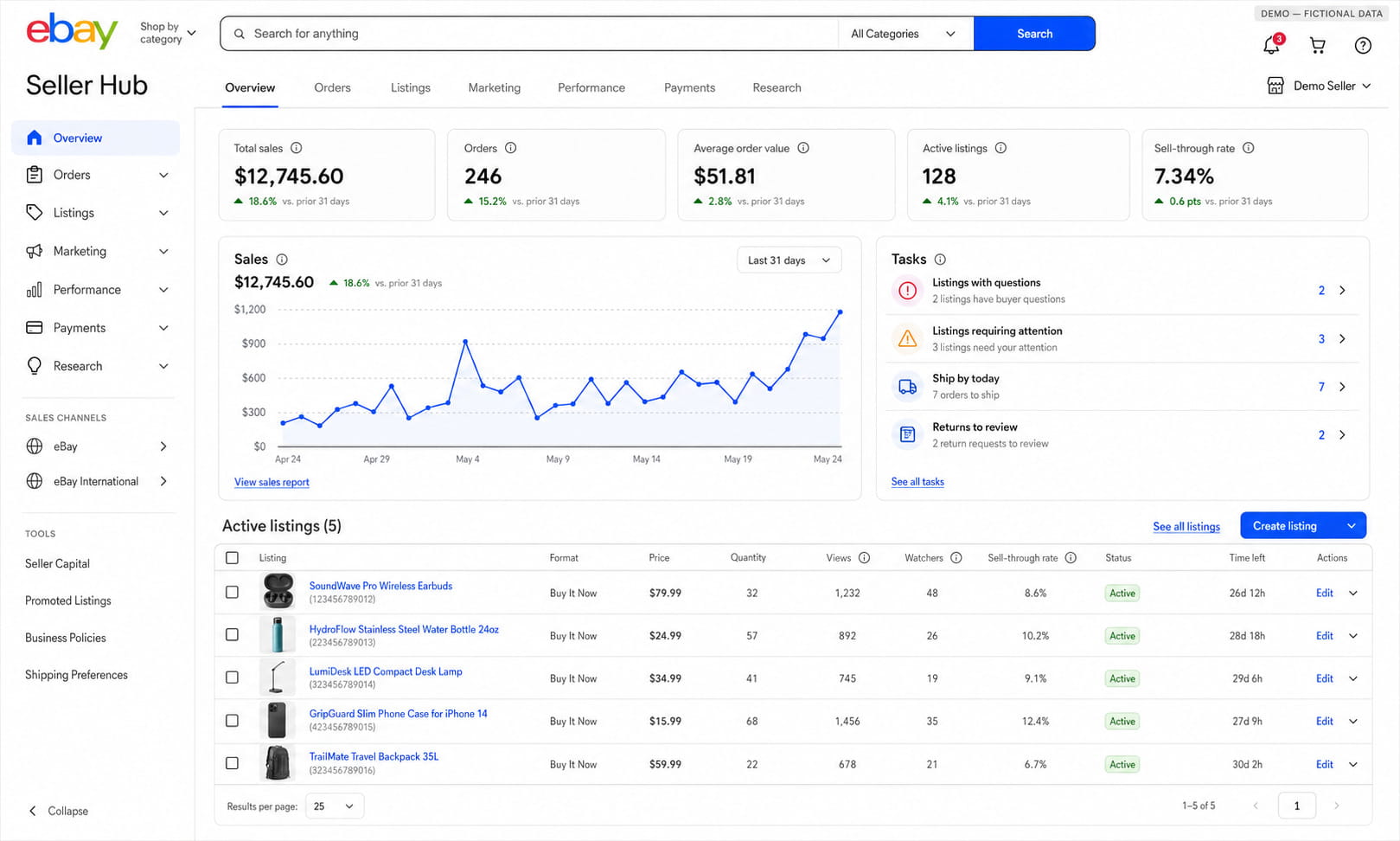
Before you start, know what you’re signing up for. Amazon to eBay drop shipping works because of a structural gap: Amazon’s marketplace forces sellers into constant price competition, so many generic products sit well below what eBay buyers routinely pay. eBay, on the other side, brings buyers who already intend to buy. According to eBay’s Q3 2026 results, the company has 147 million active buyers including its recently acquired apps, and 136 million on the core marketplace.
✅ Pros
- No upfront inventory.
You buy only after a buyer has paid, so there’s no warehouse, no bulk order, and nothing collecting dust in your garage. Your startup budget goes to tools and fees. - A catalog you can test endlessly.
You can try a gardening niche on Monday and pet supplies on Wednesday from the same supplier, with no minimum orders and no supplier negotiations. - Fast, reliable delivery.
Amazon’s US network usually delivers within a week even without Prime, with working tracking and a predictable returns process. Buyers who get their order quickly leave better feedback without being asked. - A low barrier to entry.
Opening an eBay account is free, and you don’t need a website or a developer. Your first listing can be live within an hour of signing up. - Free organic traffic.
You don’t build landing pages or test Facebook ads. You list a product, optimize the title for eBay search, and buyers find you. Within a couple of weeks you usually know whether a product has demand. - It can be automated.
With the right tools, orders are placed, tracked, and repriced without you. Sellers run stores with thousands of listings in a couple of hours a day.
❌ Cons
- eBay’s retail dropshipping rule.
This is the big one, covered in the rules section above. Every other downside is manageable. This one is a risk you accept. - Thin margins.
You’re buying close to retail. After the 13.6% fee and sales tax, a $40 sale usually leaves $4 to $6. You make money across hundreds of transactions, not on any single one. - Price volatility.
Amazon prices can change several times a day. If you manage listings by hand, a $28 product becomes $38 overnight and you’ve just sold it at a loss. - Cash flow in the first months.
eBay often holds new sellers’ funds until the buyer receives the item, while Amazon charges you the moment you order. Your first few weeks need a cash buffer. - Returns run across two platforms.
The buyer returns to you on eBay, while the refund you need comes from Amazon. Keeping the two in step takes attention, and fragile or sized items make it harder.
How to Calculate Amazon to eBay Arbitrage Profit
This is where most beginners make their first mistake. They see a $12 gap between Amazon and eBay and assume it’s profit. It isn’t.
eBay charges its final value fee on the whole amount the buyer pays, sales tax included, and adds a per-order fee on top. Then there’s the sales tax Amazon charges you when you place the order, unless you’re registered for an exemption. Here’s how that plays out on one product.
The Full Fee Breakdown
| Line item | Paying sales tax on Amazon | With a tax exemption |
|---|---|---|
| eBay sale price | $39.99 | $39.99 |
| Sales tax eBay collects (7%, passed to the state) | $2.80 | $2.80 |
| Total the buyer pays | $42.79 | $42.79 |
| Amazon purchase price | – $28.00 | – $28.00 |
| Sales tax on the Amazon order (7%) | – $1.96 | $0.00 |
| eBay final value fee (13.6% of $42.79) | – $5.82 | – $5.82 |
| eBay per-order fee | – $0.40 | – $0.40 |
| Net profit | $3.81 | $5.77 |
| Margin | 9.5% | 14.4% |
Note: 7% is a round number for the example, and real rates depend on the buyer’s state. The 13.6% rate plus $0.40 per order applies to most categories, and some categories pay more or less. The table also assumes the Amazon order ships free. Insertion fees only kick in after your free monthly listings, and Top Rated Plus listings get 10% off the final value fee. Check your category on eBay’s fee page before listing.
The tax line is the one most guides skip. Registered resellers with a valid resale certificate can enroll in the Amazon Tax Exemption Program and stop paying sales tax on qualifying orders. The exemption covers items sold by Amazon and by third-party sellers who take part in the program, so it won’t apply to every listing you source from.
Shipping on the Amazon side is the other cost to check. With Prime, eligible items ship free at any order size. Without Prime, Amazon’s free shipping applies to orders of $35 or more, so a cheaper item comes with a delivery fee that can wipe out a small margin. If you don’t use Prime, either source products priced at $35 and up or add the delivery fee to your cost.
The Rule Every Arbitrage Seller Needs to Know
If you pay sales tax on Amazon, you need roughly a 45% markup to clear 10% net. With an exemption, about 35% does it. Both figures assume the Amazon order ships free.
Quick Mental Math Formula
Tax-exempt:          eBay price = Amazon price × 1.35
Paying Amazon tax:   eBay price = Amazon price × 1.45
For the $28 product, that means about $37.80 with an exemption and $40.60 without one. At $39.99 you’re comfortably in business with an exemption, and right at the edge without one.
How to Widen Your Margin
The tax exemption is the biggest lever. A few smaller ones add up on top of it.
Once you have volume, an eBay Store starts paying off. With a Basic Store or higher, the final value fee in most categories drops from 13.6% to 12.7%, according to eBay’s Store fees page. On the $39.99 example that’s about 39 cents more per sale, which pays for the subscription quickly once you’re selling a few hundred items a month.
Amazon deals help too, if you handle them carefully. Coupons, Lightning Deals and seasonal sales can cut your cost for a while. Treat them as a temporary bonus. When the deal ends, your eBay price has to move back up, or the next sale loses money.
Promoted Listings are the cost people forget. They can push a new listing into view, but you pay the ad rate you choose as a percentage of each sale that comes through the ad. At 5% on a $40 item, roughly $2 of your $4 to $6 profit goes to eBay, so check the numbers before you switch it on.
Use the Easync eBay Fee Calculator
Rather than doing this math every time, run the numbers through the eBay Fees Calculator. It shows the fees and your breakeven price for any product in a few seconds.
How to Start Amazon to eBay Dropshipping, Step by Step
Dropshipping Amazon to eBay comes down to six steps. If you’re wondering how to dropship from Amazon to eBay without wrecking a brand-new account, go through them in order. Skipping the boring ones (policies and metrics) is how most new stores get into trouble.
Step 1: Set Up Your eBay and Amazon Accounts
Your eBay seller account is the foundation of everything. Get this part right and the rest of the setup is straightforward.
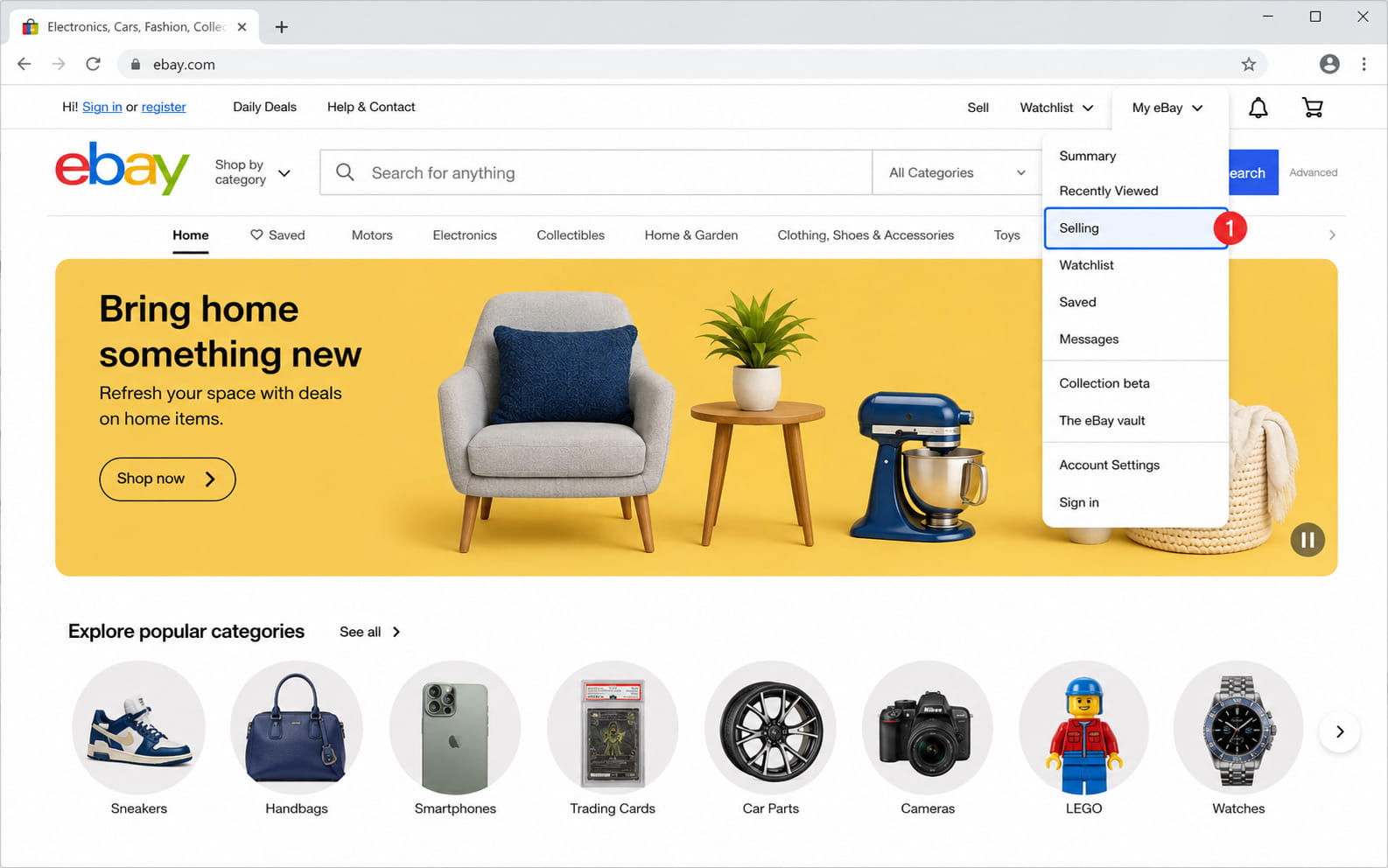
Go to ebay.com, open My eBay, choose Selling, and click Create an account. You’ll pick between a personal and a business account.
Personal account: the right choice if you’re starting out, testing the model, or operating as a sole trader in the US. You get all selling features, and you can upgrade to a business account later without losing your history or feedback.
Business account: required if you’re registering as a company or plan to sell at volume from day one. It lets you show a business name on your store, and in the UK it’s the right setup for this model anyway, because buying to resell counts as trading.
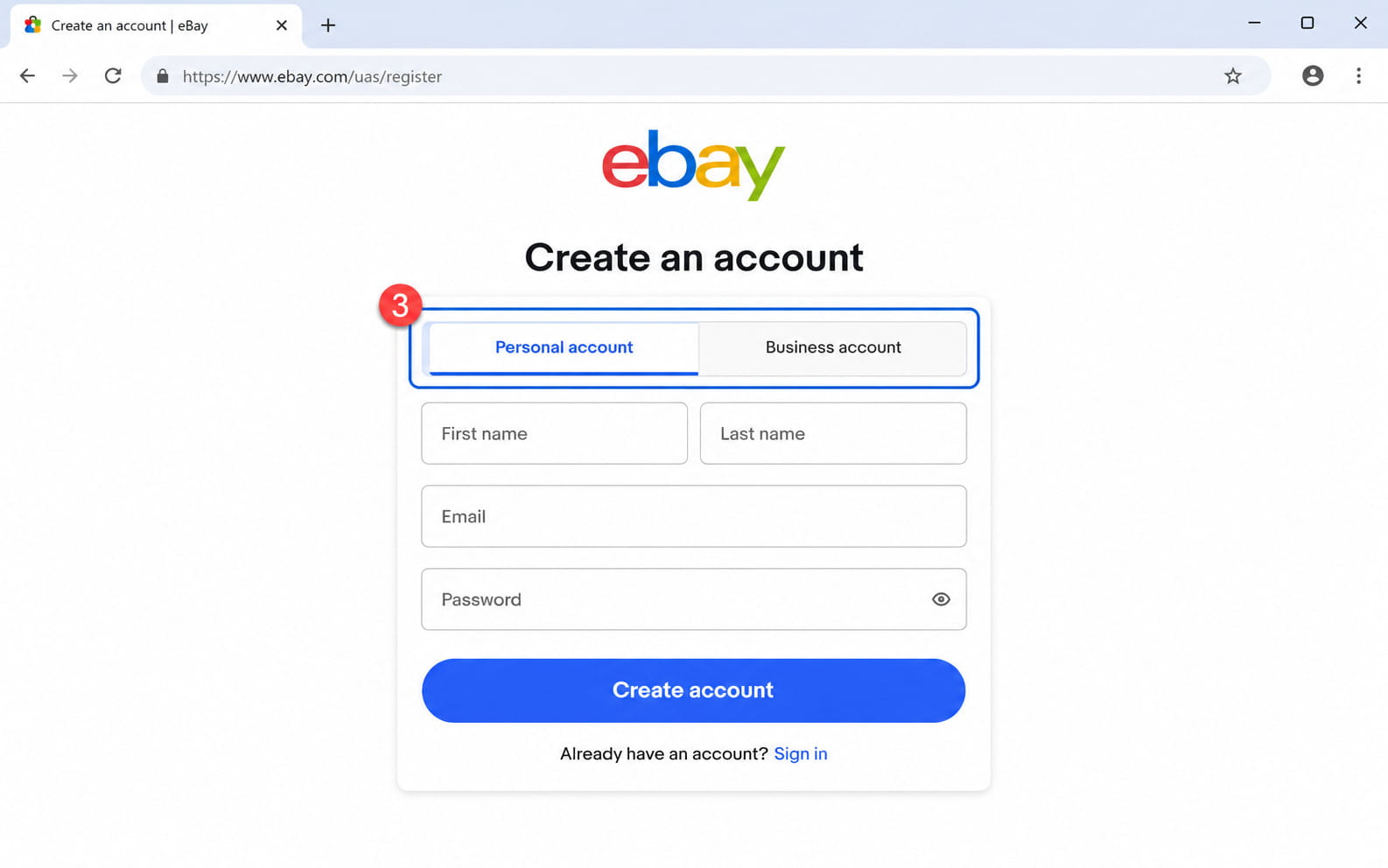
What you’ll need to register:
- Full legal name (or business name)
- Email address
- Phone number for verification
- Bank account for payouts (eBay handles payments directly, no PayPal needed)
Once registered, do these three things before listing a single product:
1. Verify your identity. eBay asks for identity confirmation before you can withdraw funds. Do it right away so your first payouts don’t get stuck.
2. Set up payouts, and plan for holds. Link your bank account in Seller Hub under Payments. Then read eBay’s payment holds page: new sellers typically have funds held while they build a track record, usually until after the buyer receives the item. You’ll be paying Amazon days or weeks before eBay pays you.
3. Know your selling limits. New accounts start with low limits on how many items and how much value they can list each month. Your current limits are in Seller Hub. Once you have a run of on-time sales and clean feedback, ask eBay for an increase.
The buying side needs a decision too. Pick one of the three Amazon setups from the rules section, pay with a regular card rather than gift cards, and if you’re a registered business with a resale certificate, set up the tax exemption from the start rather than after your first hundred orders.
New seller tip: Your first 30 days on eBay matter more than any other period. Focus on fast shipping, quick replies, and your first 10 to 20 positive feedbacks. A single late shipment in week one hurts far more on a young account than it would later.
Step 2: Set Up Your Shipping and Return Policies
Most new sellers skip this step and pay for it later in bad feedback. Your policies set buyer expectations, and mismatched expectations cause most eBay disputes.
In Seller Hub, open Listings, then Settings, then Business Policies, and create a policy.
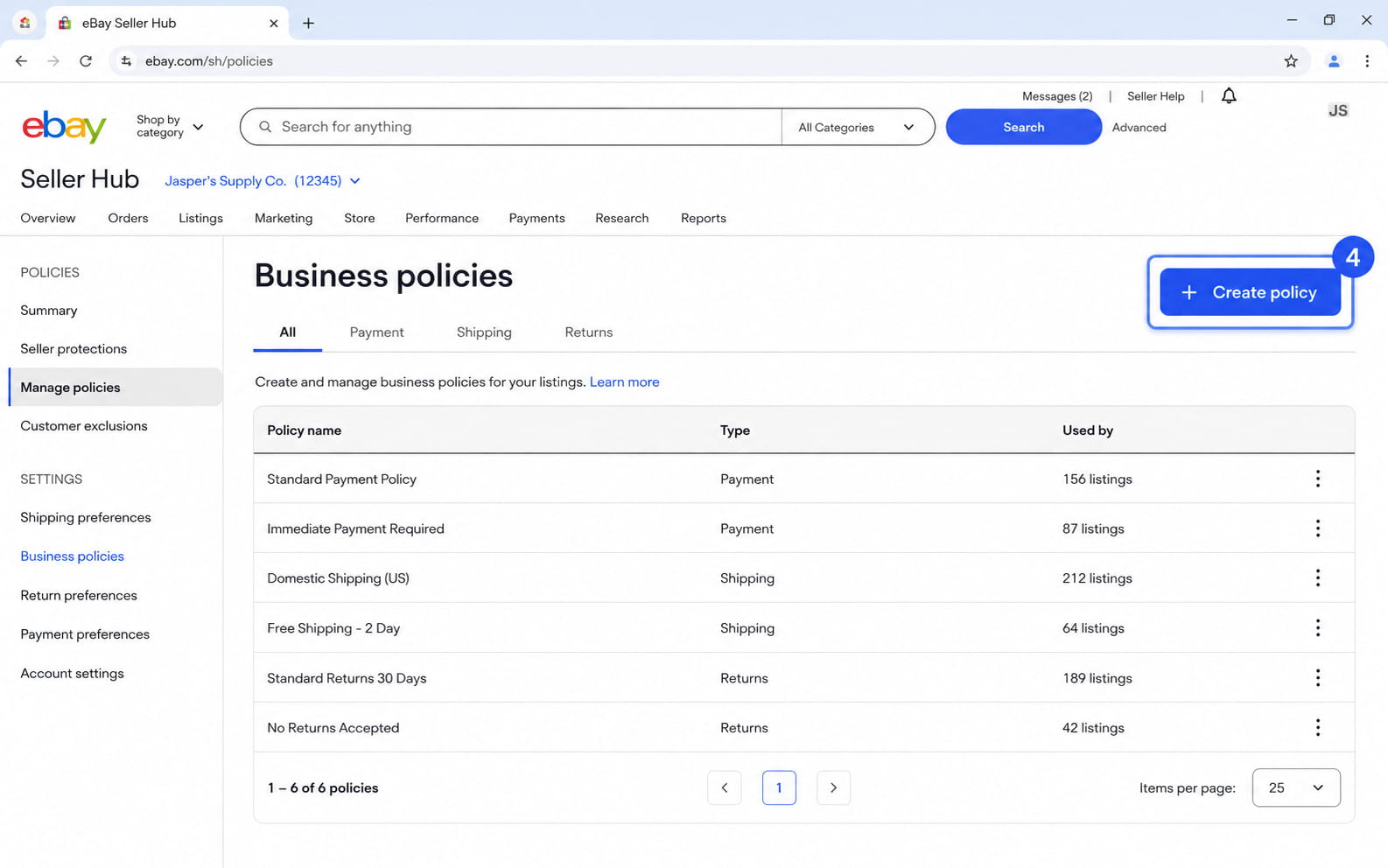
Shipping Policy: What to Set
Handling time: 1 business day. It’s what buyers expect, and if a tool like Easync places the Amazon order within minutes of the sale, it’s achievable.
Shipping service: Choose “Economy Shipping (7–14 business days)” or “Standard Shipping (5–8 business days)” depending on how fast your Amazon orders actually arrive, which differs with and without Prime. Promising 3-day delivery on standard Amazon shipping is the fastest way to pile up late shipments.
Free shipping vs. charging for shipping: Free shipping wins more sales. Build the cost into your price instead.
Ship with eBay: eBay is rolling out Ship with eBay, a managed shipping option for some US personal accounts, where eBay sets the shipping and hands you a prepaid label after the sale. That label is useless when Amazon ships the order. Accounts registered as businesses, or using business policies or Seller Hub, aren’t eligible, so setting up business policies keeps you out of it.
International shipping: Start with US buyers only until your metrics are stable. Add Canada and the UK once you have a solid sales history and near-perfect feedback.
Return Policy: What to Set
Return window: 30 days. It lines up with Amazon’s standard return window, so a return can run back through your Amazon order.
Who pays return shipping: “Buyer pays” is standard. Free returns cost you more, but 30-day free returns plus 1-day handling are what make a listing eligible for Top Rated Plus and its fee discount, so they’re worth it on higher-margin products.
Condition for returns: “Item must be returned in original condition.”
One thing most tutorials miss: Your handling time and shipping service together form the estimated delivery date eBay shows buyers. Base it on Amazon’s actual delivery in your buyers’ regions, not on best-case speeds.
Step 3: Find Products Worth Listing
Product research is where Amazon to eBay arbitrage either works or doesn’t. The method below is the one that keeps producing results.
Method 1: Start on Amazon, Validate on eBay
This is the most straightforward approach.
- Open Amazon’s Best Sellers list in any category
- Filter for non-branded, generic items (branded items carry VeRO risk on eBay)
- Note the Amazon price on anything that catches your eye
- Switch to eBay and search for the same product
- Filter eBay results by Sold Items, which shows what buyers actually paid, not what sellers are asking
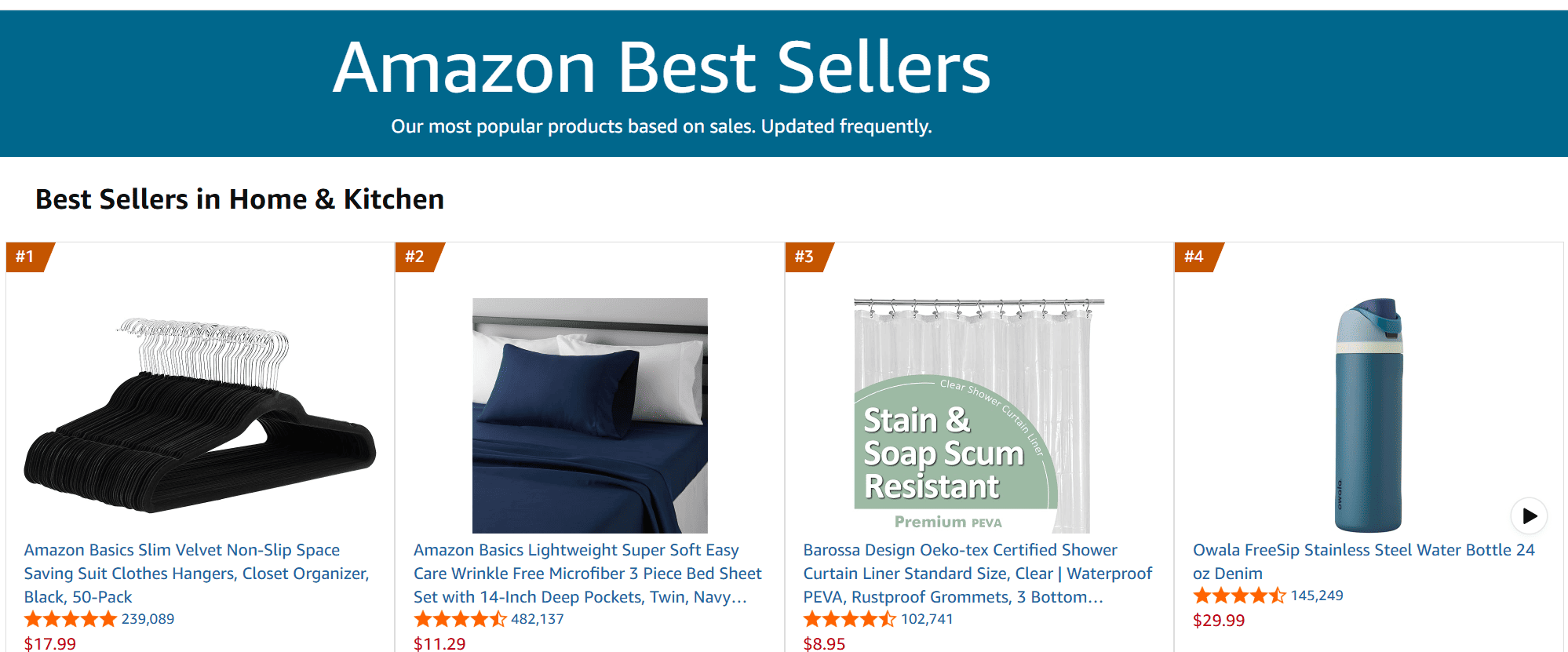
Best Sellers isn’t the only list worth checking. Amazon’s New Releases, Movers & Shakers, and Most Wished For pages show what’s gaining momentum before it peaks. On the eBay side, Product Research in Seller Hub (the tool formerly called Terapeak) is free for every seller and shows sold prices and sales history from millions of eBay transactions. Sourcing Insights, which points to categories with strong demand and thin supply, comes with a Basic Store or higher.
If eBay sold prices clear the markup from the rule above (about 35% to 45% over the Amazon price) and several sellers are making sales, you’ve found a product worth testing.
What Makes a Product Worth Listing
- Sold 10+ times on eBay in the last 30 days at your target price
- At least 3 different sellers making sales, which shows demand isn’t tied to one store
- No single brand owner dominating the results (a sign of VeRO risk)
- Stable Amazon stock, not “only 2 left” or frequently unavailable
- Before you scale a product, order one to yourself and check the quality and how long delivery really takes with your setup
Method 2: Reverse Research (Start on eBay, Source on Amazon)
Experienced sellers prefer this method because you start from proven demand.
- Search eBay for any product category
- Filter for sold items and sort by “Best Match” or by price
- When you find a listing with 20+ sales, copy the product name or identifiers
- Search Amazon for the same product
- If the Amazon price leaves the markup you need, list it
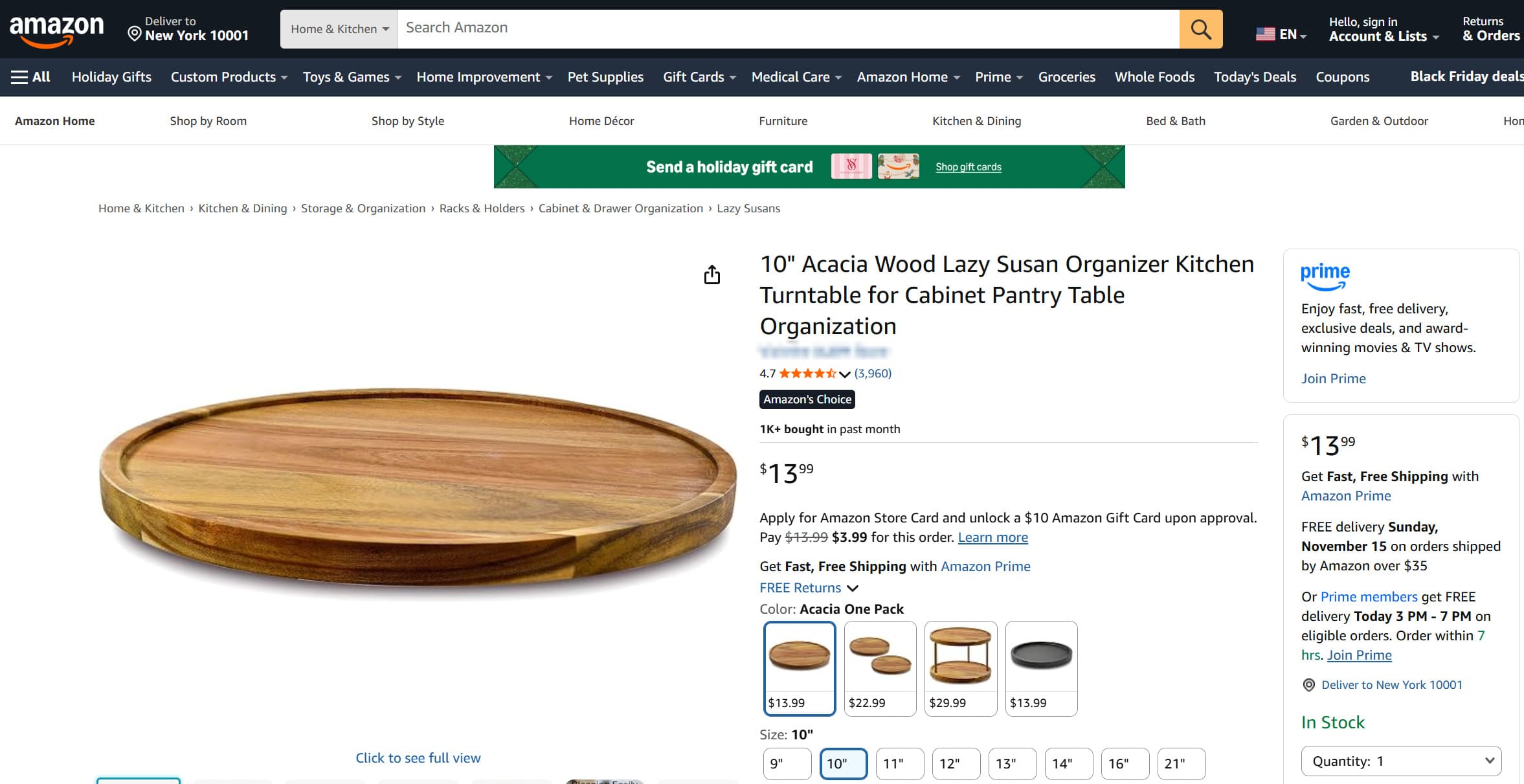
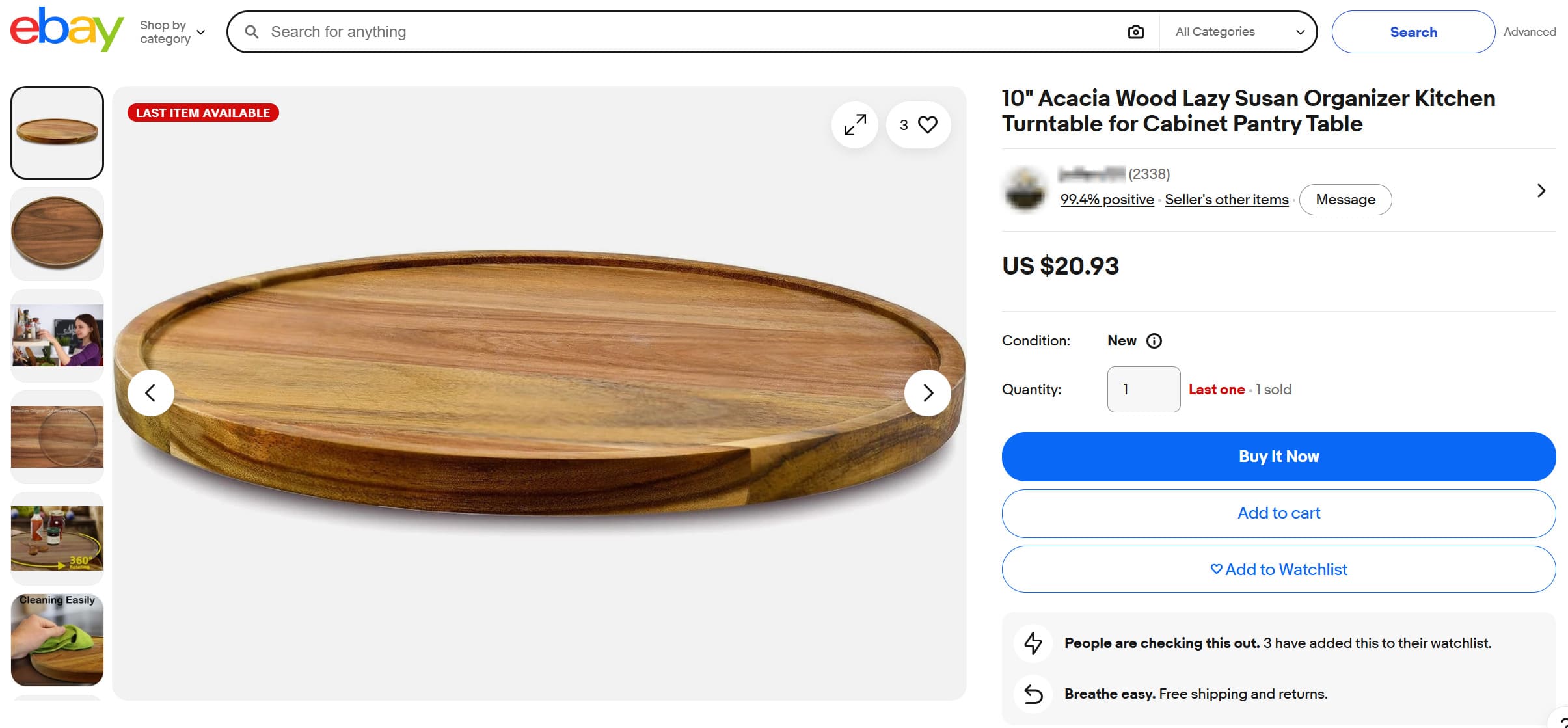
A real example from November 2026: a 10-inch acacia wood lazy Susan sells on Amazon for $13.99, and the same item, with the same product photos, sold on eBay for $20.93 with free shipping. With sales tax at 7%, eBay’s fees on that sale come to about $3.45. Ordered with Prime, which ships it free, you keep $3.49 with a tax exemption or $2.51 paying tax on the Amazon order. Without Prime the order is under $35, so Amazon adds a delivery fee that eats most or all of that margin. Small amounts like these are normal in this model.
What this looks like in practice: a November 2026 check of eBay sold listings for “2 tier under sink organizer” shows prices from $8.78 to $126.99 within a few weeks. Part of that gap is pack size, since single organizers, 2-packs and 3-packs all show up under the same search. Part is brand, with known names listed right next to generic ones. And one generic listing sold twice in a single week at about $48, through two different stores. Before you compare prices, match the exact product and the pack size.
Multiply that across 500 products and you see why volume is the whole point.
Method 3: Use Easync Finder for Scale
Manual research tops out at a few dozen products an hour. Easync’s Finder tool scans whole Amazon subcategories and flags items where the Amazon price sits below what the product sells for on eBay.
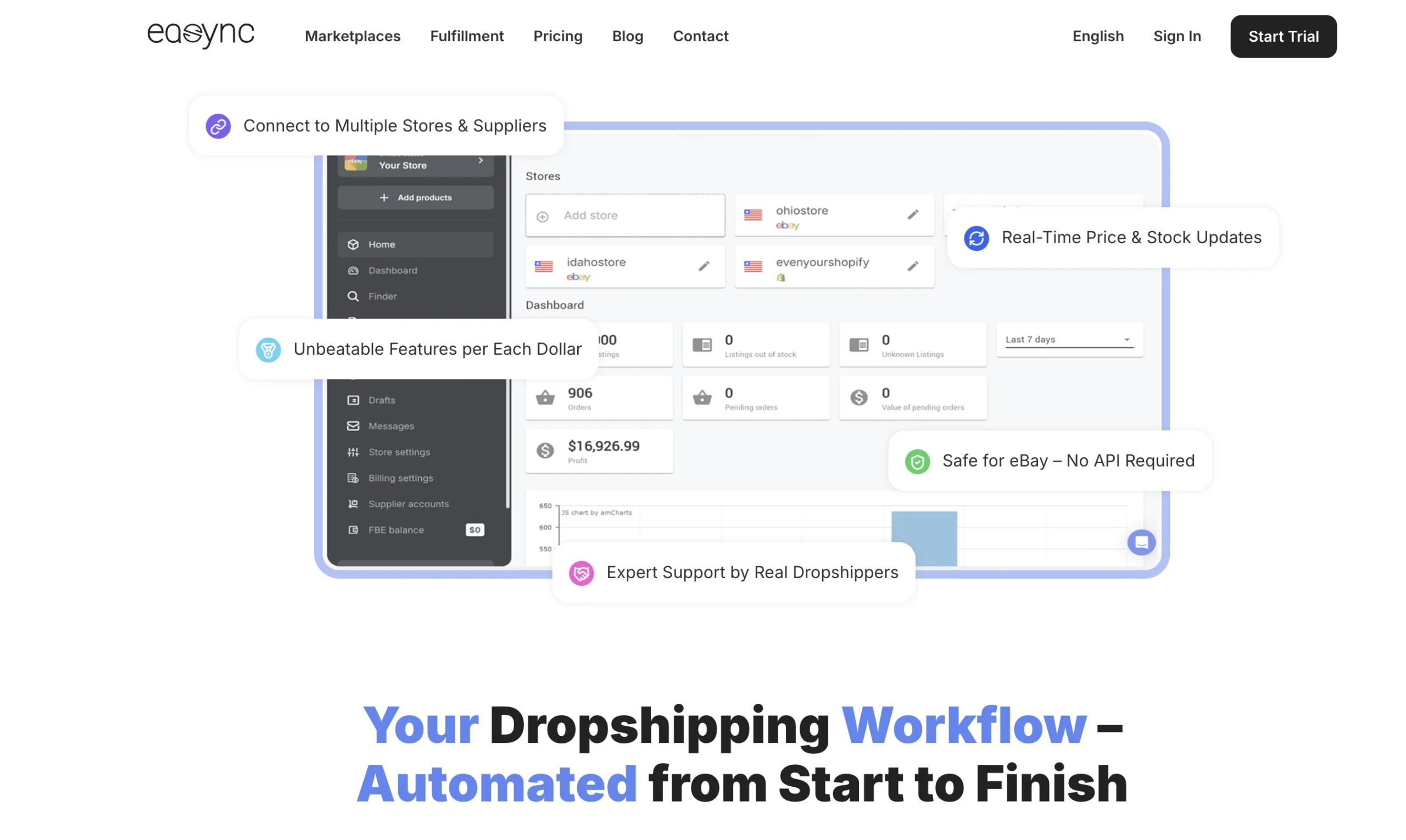
Instead of searching product by product, you review a shortlist.
Products to Avoid
Not every Amazon product is a good candidate. Avoid:
- Branded items from Apple, Nike, Sony, or any company registered in eBay’s VeRO program. Your listing will be removed and your account flagged
- Items with fewer than 10 eBay sales: unproven demand means a dead listing for weeks
- Fragile items, because damage claims eat your margin and your metrics
- Items that sell for under $15 on eBay, where fees leave almost nothing
- Electronics with serial numbers, a favorite target for return fraud
- Hazardous materials and loose batteries, which come with shipping restrictions and packaging rules
- Supplements, anything people eat, and recalled products, where safety and compliance problems land on you as the seller
- Prime-exclusive items, which you can’t buy at all without Prime
Step 4: Optimize Your eBay Listings for Visibility
Listing a product is easy. Listing it so eBay’s search engine, Cassini, shows it to buyers is the skill that separates stores that sell from stores that wonder why nothing moves.
Write Titles That Match How Buyers Search
eBay gives you 80 characters for a title. Use them. Think about what a buyer types, not what a marketer would write.
Bad title: Premium Rain Shower Head for Modern Bathrooms | High Quality | Best Price
Good title: Rain Shower Head 8 Inch Stainless Steel Rainfall High Pressure Chrome Bathroom
The good title hits the exact words buyers type. The bad one burns characters on adjectives nobody searches for.
Title formula:
[Product Name] + [Key Spec 1] + [Key Spec 2] + [Material/Color] + [Use Case]The Easync eBay Title Builder helps you pick the keywords buyers search for most in your category.
Fill Out Every Item Specific
eBay uses Item Specifics (brand, material, size, color, MPN, UPC) to match your listing to filtered searches. Someone filtering for an 8-inch chrome shower head won’t see your listing unless the size and finish fields are filled in.
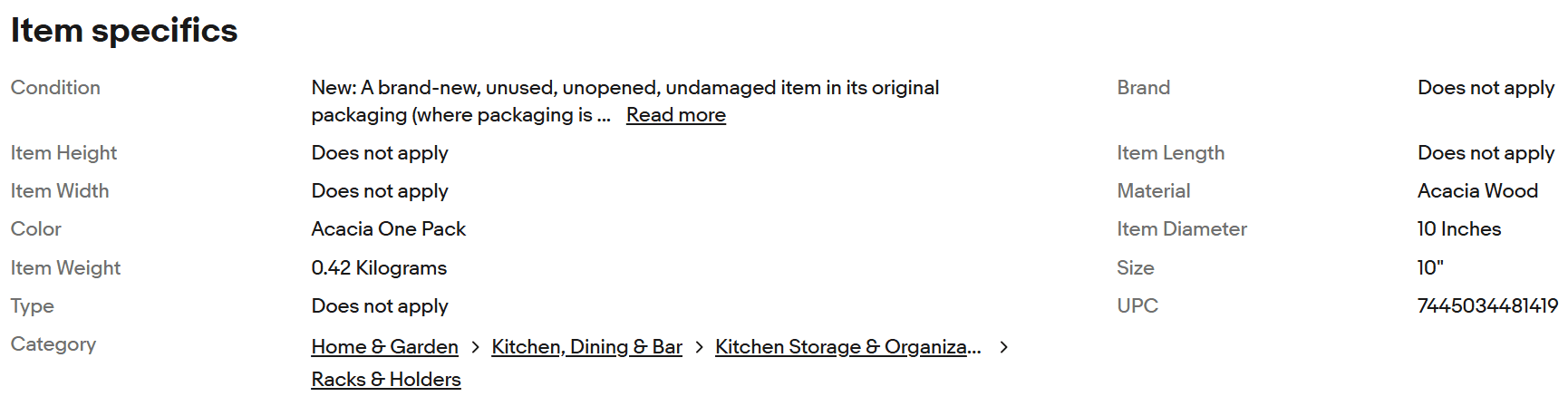
It takes a few extra minutes per listing and decides whether you show up when buyers narrow their search. A large share of eBay shoppers browse that way.
Write a Description Buyers Can Scan
Don’t paste the Amazon description as is. Rewrite it in a simple order buyers can scan in a few seconds:
- Key features
- What’s in the box
- Specifications (size, weight, material, compatibility)
- Shipping and returns
If the same product comes in several colors or sizes, list it as one listing with variations rather than five separate ones. Buyers pick their option on one page, and all the sales history builds up on a single listing.
Images: Quality and Quantity
Amazon’s product images are usually professional. Use them if they’re at least 500 pixels on the longest side, which is eBay’s minimum. eBay lets you add up to 24 photos, so include:
- A main shot on a white background, with the product filling most of the frame
- Several angles: front, back, side
- Close-ups of any important feature (connector type, material texture)
- A size reference next to a common object
- A lifestyle image if one exists
Skip images with watermarks, text overlays, or borders. eBay’s image rules don’t allow them, and buyers trust clean photos more anyway.
Pricing: Be Competitive, Not the Cheapest
Beginners default to undercutting everyone. That destroys your margin, and it doesn’t guarantee visibility either, because eBay weighs seller performance and listing quality alongside price.
Price within 5% to 10% of the median sold price for the product. Always check sold listings: anyone can ask any price on an active listing, while sold listings show what buyers actually paid.
Step 5: Place the Order, Upload Tracking, Handle Returns
Fulfillment is where the model either earns good feedback or collects defects.
Place the Amazon order fast. The sooner the Amazon order goes in after the eBay sale, the less chance the price moves or the item sells out. Double-check the buyer’s address as you enter it, because a typo here is entirely your problem.
Mark every order as a gift, so Amazon leaves the price and invoice out of the box. The box is still Amazon-branded, and nothing changes that, so if a buyer asks, answer quickly and plainly.
Tracking needs one extra step. Many Amazon orders ship with Amazon Logistics tracking numbers that start with TBA, and eBay can’t track those directly. Sellers convert them into Aquiline tracking numbers, which eBay accepts, and upload them within the handling time.
Returns usually run through your Amazon order: start the return on Amazon, pass the return label to your eBay buyer, and refund on eBay once the item is on its way back.
Step 6: Watch Your Seller Metrics
eBay’s seller performance standards judge you mainly on your transaction defect rate and on cases closed without seller resolution. To stay above standard, your defect rate has to stay at or below 2%.
Top Rated status asks for more: a defect rate at or below 0.5%, a late shipment rate at or below 3%, and valid tracking uploaded on time for 95% of US transactions, according to eBay’s Seller Center.
Out-of-stock cancellations count as defects. That alone makes stock sync essential in this model.
“Even your supplier’s mistake counts as yours.” Steve Chou, a seven-figure store owner who teaches ecommerce, makes this point in a 2026 post on dropshipping. His friend John Rampton built a seven-figure Amazon dropshipping business, then lost it when his supplier ran out of stock over the holidays without warning. He had to cancel orders, and Amazon shut the account down.
That story comes from selling on Amazon, but the mechanics are the same on eBay: when your source runs dry and you cancel, the defect is yours. Check your dashboard in Seller Hub under Performance at least weekly in the first three months.
Best Product Categories for Amazon to eBay Arbitrage in 2026
The products that hold up best in this model are generic, unbranded, light, hard to break, and sell for more than $15. These six categories consistently fit that profile for Amazon-sourced products:
| Category | Product ideas | Why it works | Watch out for |
|---|---|---|---|
| Home & Kitchen | Organizers, small kitchen gadgets, shower heads | Huge generic selection and steady eBay demand | Glassware and bulky appliances |
| Tools & Home Improvement | Hand tools, hardware kits, work lights | Lots of non-branded items with low VeRO exposure | Heavy items that ship slowly |
| Sports & Outdoors | Resistance bands, yoga mats, camping accessories | Seasonal spikes and wide price differences | Oversized gear |
| Pet Supplies | Automatic feeders, grooming tools, toys | Repeat purchases and loyal buyers | Anything with health or food claims |
| Health & Personal Care | Hair tools, grooming kits, personal care accessories | Fast-moving SKUs and price-sensitive buyers | Supplements and regulated items |
| Toys & Games | Generic puzzles, outdoor toys, craft kits | Strong Q4 demand and endless variety | Licensed characters and recalled products |
Demand inside each category shifts through the year, so check which products are trending before a seasonal push.
What to avoid on eBay.com: electronics (high return fraud), designer fashion (a VeRO minefield), and anything with a dominant brand presence on Amazon. Stick to generic products in the categories above while you’re learning.
Amazon to eBay Arbitrage Software: What to Automate
If you decide to start an Amazon to eBay dropshipping business, you won’t be listing items one by one forever.
Software can make all the difference to an arbitrage seller. Amazon prices move constantly, and if you don’t track them, you end up selling at a loss. At that point you either take the hit and place the order, or cancel it and damage your eBay metrics. Neither is a good choice.
Margins in Amazon to eBay arbitrage are thin, so the money is in bulk listings, and checking prices by hand stops being practical past a few dozen products. If you’re comparing the best Amazon to eBay dropshipping software, judge each tool on these seven jobs, whether it’s sold as Amazon eBay arbitrage software or as a dropshipping tool.
1. Repricing When Amazon Prices Change
List items by hand and you risk the Amazon price rising after your eBay sale. An eBay repricer like Easync changes your eBay price automatically when the Amazon price moves, and updates stock when the item runs out.
2. Bulk Listing
Even if you found a thousand profitable items by hand, creating a thousand listings by hand isn’t realistic. Most tools import items from a CSV and mass-list them to eBay.
3. Finding Items to Sell
To make money dropshipping from Amazon to eBay, you need scale. A store with 100 listings rarely makes much, while thousands of listings give you thousands of chances to sell. Finding that many products takes software. Tools like Easync include a Finder that scans entire Amazon subcategories in a few clicks.
4. VeRO and Blacklist Filtering
Checking every item against eBay’s VeRO program by hand takes forever, and it’s easy to miss a protected brand. Established dropshipping software keeps a list of protected brands and blocks those items before they go live. Easync has this built in as VeRO and blacklist protection.
5. Auto-Ordering
The longer you wait to place the Amazon order, the bigger the chance the item sells out. That’s why your eBay dropshipping software should include auto-ordering: it watches for eBay sales and places the matching Amazon order within minutes.
If you’d rather keep your own Amazon account out of it entirely, Fulfillment by Easync (FBE) places orders through managed accounts instead.
6. Tracking Upload
Once Amazon dispatches the order, the tracking number has to reach eBay within your handling time. Good software picks it up, converts TBA numbers where needed, and uploads valid tracking without you touching it, which keeps your on-time tracking rate where Top Rated status needs it.
7. Store Cleanup
Listings that never sell still cost you insertion fees once you pass your free allowance, and they make the store look stale. Use filters to find listings with no sales in 60 days or almost no views, and end or replace them on a regular schedule.
Amazon to eBay Dropshipping in the US and UK
Selling in the USA 🇺🇸
The US is the largest and most competitive eBay market, and it’s where most sellers build the model first. Amazon.com’s domestic network delivers quickly almost everywhere, and the price gap between the two platforms stays wide across hundreds of categories.
On sales tax, every US state with a sales tax now requires marketplaces like eBay to collect and remit it for their sellers, so you don’t file sales tax separately for those eBay sales. If you have a physical presence in a state (an office, a warehouse, employees), you may have extra obligations there. Once you’re doing real volume, talk to a US tax advisor, and use the same conversation to sort out a resale certificate for tax-free buying on Amazon.
Selling in the UK 🇬🇧
The UK gets far less attention in most guides, and for sellers already on eBay.co.uk or thinking about expanding, the basics are the same with a few important differences.
For UK buyers, source from Amazon.co.uk. UK deliveries from Amazon.co.uk arrive quickly and keep your feedback competitive. Cross-border shipping from the US is slower, pricier, and brings customs problems you don’t want as a new seller.
Fees work differently in the UK. Private sellers pay no final value fee on most domestic sales, but buying stock to resell is trading, so this model runs on a business account. eBay’s UK business seller fees combine a category rate (up to 12.9% in most categories), a 0.35% regulatory operating fee, and 30p or 40p per order, with VAT charged on top of the fees. Model your margins in pounds with the Easync eBay Fee Calculator UK before listing.
Then there’s VAT. A UK-established business must register for VAT once taxable turnover passes £90,000 in any rolling 12 months, according to HMRC guidance on GOV.UK. That threshold doesn’t apply to businesses established outside the UK: if you’re a US seller targeting eBay.co.uk, you need to register from your first taxable UK sale.
Once your first store runs smoothly, the same playbook works on eBay.co.uk, eBay.ca, or eBay.com.au, with the local Amazon store as your source. Many sellers end up running several regional stores off the same research process.
UK opportunity: many niches on eBay.co.uk have fewer active sellers than the same niche on eBay.com, so a well-optimized listing can stand out faster. Check sold listings before you assume it, because some categories are just as crowded.
Amazon vs. Other Suppliers: When to Use What
Amazon isn’t your only option. As you scale, spreading sourcing across suppliers protects your margins and lowers policy risk. The table compares the main options honestly.
| Supplier | eBay policy risk | Delivery to US buyers | Typical margin | Best for |
|---|---|---|---|---|
| Amazon.com | High (retailer) | Fast, days | Thin | Volume, speed, reliability |
| Walmart.com | High (retailer) | Fast, days | Thin | A second retail source |
| AliExpress | Medium (depends on whether the seller acts as a wholesale supplier) | Slow, weeks | Wider | Lower prices, patient buyers |
| Alibaba | Low (with a wholesale agreement) | Slow by air, weeks | Wider | Small wholesale buys for top sellers |
| CJ Dropshipping | Low (acts as your supplier) | Days to weeks | Moderate | A balance of speed and compliance |
| Domestic wholesalers | None (with an agreement) | Days | Moderate | Full eBay compliance |
The Blended Approach (What Experienced Sellers Actually Do)
Successful sellers rarely rely on a single source. A common setup looks like this:
- Amazon for fast-moving, proven products where speed matters
- AliExpress or CJ Dropshipping for products where buyers will wait two to three weeks for a lower price
- Alibaba for your top 20 products: buy small wholesale quantities, hold local stock, and take sourcing risk off the table
Spreading your catalog this way means one platform’s policy change, price swing, or stock-out can’t take down the whole store.
How to Scale: From 100 to 10,000 Listings
The Amazon to eBay model pays off once you build systems that keep running without you. The four stages below show what changes as you grow.
Stage 1: Validation (1–100 listings)
Goal: find your first 10 profitable SKUs and prove the model works for you before you automate it.
Manual research is fine here. Spend a few hours a week with Amazon Best Sellers and eBay sold listings, and stay in one or two categories so you build a real feel for prices.
Stage 2: Systematizing (100–1,000 listings)
Goal: hand the routine work to software.
Turn on repricing, auto-ordering, and tracking upload in a tool such as Easync, as described in the software section above. Write message templates for order confirmation and shipping updates, and move product research from manual searches to a scanner.
Stage 3: Scaling (1,000–10,000 listings)
Goal: run several eBay stores across different niches.
At this size, account health is the main risk. Running multiple eBay stores and multiple Amazon accounts by hand multiplies every chance of a mistake, which is where a managed purchasing service like FBE earns its keep. Check your eBay metrics weekly, and start moving your best sellers to the lower-risk suppliers from the table above.
Stage 4: Enterprise (10,000+ listings)
Goal: delegate and systematize everything.
Hire a virtual assistant for customer service, connect fulfillment to your own systems through an API, and consider building a small team around the categories you know best. At this level you’re running a real eCommerce operation, and your edge is operational efficiency more than the price gap itself.
Automating Amazon to eBay Dropshipping with Easync
Easync is an Amazon to eBay dropshipping tool that also covers AliExpress to eBay and Amazon to Shopify, with one plan working across both eBay and Shopify.
On eBay listings, Easync reprices and syncs stock against the Amazon source every 15 minutes, places the Amazon order automatically when an item sells, and converts Amazon tracking into Aquiline numbers that eBay accepts. If you’d rather not use your own Amazon account, FBE places orders through Easync’s managed accounts. Finder and Hot Items help with product research, and Easync helps keep protected brands out of your store.
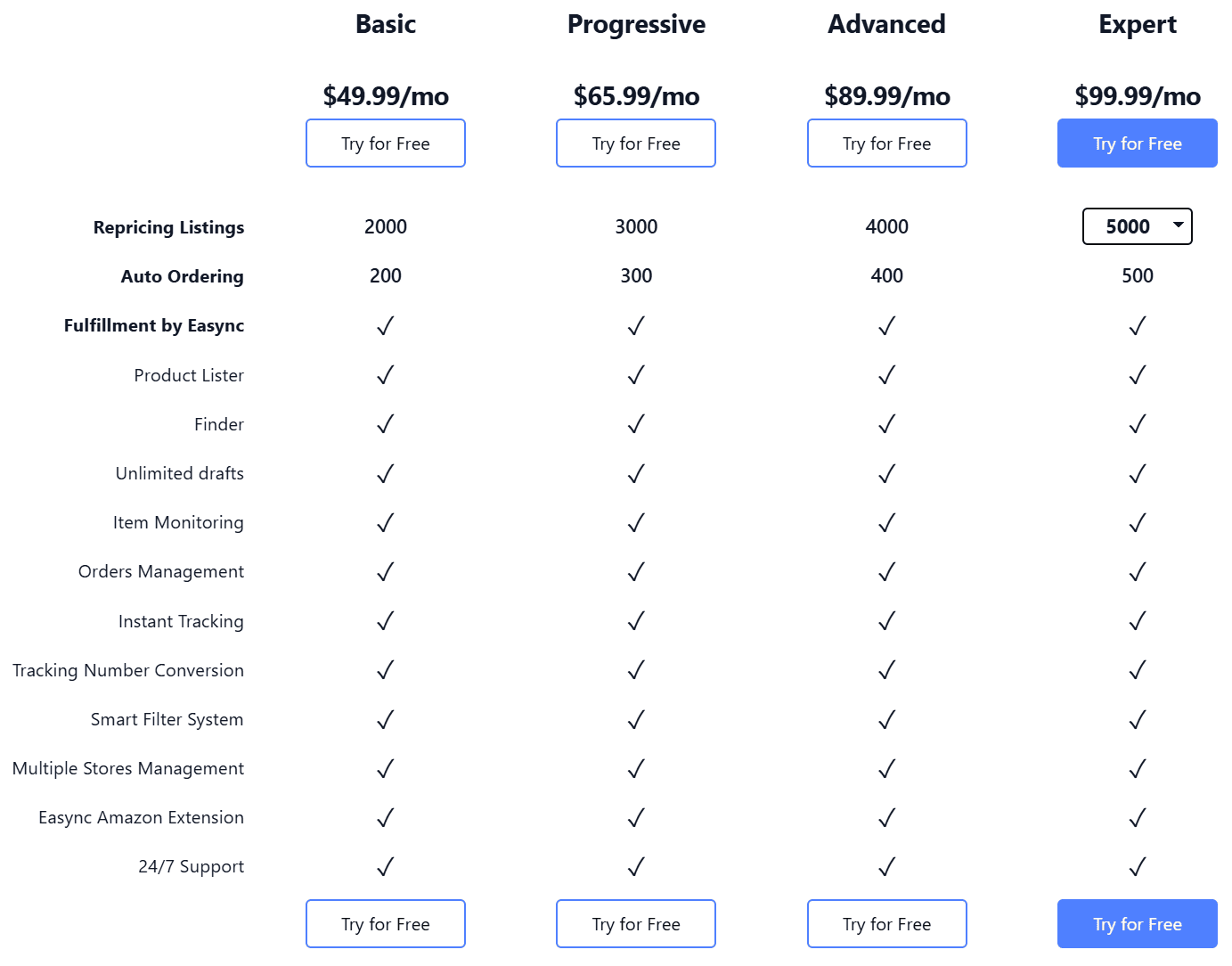
Every Easync plan starts with a 7-day free trial, and no credit card is needed.
FAQ
Is Amazon to eBay dropshipping allowed?
Not under eBay’s rules. eBay permits dropshipping from wholesale suppliers, but not from a retailer like Amazon shipping straight to your buyer. Amazon’s terms for regular customer accounts don’t allow commercial use either. These are platform rules rather than laws, so the consequences are listing removals, selling restrictions, or account suspension. Plenty of sellers still dropship Amazon to eBay and manage that risk with clean metrics and automation, while the buy-and-hold and FBA models avoid the issue entirely.
Is Amazon arbitrage illegal?
No. Buying a product and reselling it for more is legal in the US, the UK, Canada, and most other markets, as long as the goods are genuine and you don’t mislead buyers. The limits come from marketplace terms, such as eBay’s sourcing policy and Amazon’s Conditions of Use and Prime terms, and from brand owners who report listings through eBay’s VeRO program.
How profitable is Amazon to eBay arbitrage?
Expect roughly $4 to $6 net on a $40 sale sourced at $28, as long as the Amazon order ships free, depending on whether you pay sales tax on it. That works out to about 10% to 15%. The money comes from volume: a store with a few hundred selling listings turns those small amounts into steady income, while a store with 20 listings mostly teaches you the process.
Can I make $1,000 a month on eBay with Amazon arbitrage?
Yes, with enough listings. At about $5 net per sale, $1,000 means 200 sales a month. If each listing that sells moves twice a month, you need around 100 active sellers. Since only a fraction of a catalog sells regularly (say 20% to 40%), plan on 250 to 500 live listings to hit that number reliably.
Can I use Amazon Prime to dropship to eBay buyers?
Using Amazon Prime to sell on eBay is against Amazon’s Prime terms, which exclude purchases made for resale and shipping to your customers. Many sellers do it anyway for the free, fast delivery, and the risk is that Amazon cancels the membership or locks the buying account. Without Prime you don’t break the Prime terms specifically, but you pay shipping on orders under $35, and it’s still a personal account used commercially. A managed service like Easync’s FBE places orders through its own accounts, so your personal account isn’t exposed either way.
Can I sell Amazon products on eBay?
Yes, once you own them. Buy the stock, take delivery or store it with Amazon FBA, then list it. You’re the seller of the goods at that point, and eBay’s retail sourcing rule doesn’t apply. What eBay restricts is having the retailer ship directly to your buyer after the sale.
What’s the difference between Amazon to eBay and eBay to Amazon arbitrage?
The direction. Amazon to eBay means Amazon is your supplier and eBay is your store. eBay to Amazon dropshipping flips that, and it runs into Amazon’s own dropshipping policy for sellers, which doesn’t allow buying from another online retailer and having it ship to your Amazon customers. Buying items on eBay, receiving them, and reselling them on Amazon is a different flipping model that works within the rules. If you’re comparing the best eBay to Amazon dropshipping software, check which direction each tool supports. Most are built for one direction only: Easync, for example, runs from Amazon or AliExpress to eBay, and from Amazon to Shopify.
How do I handle Amazon tracking numbers on eBay?
Amazon Logistics shipments come with TBA numbers that eBay can’t track directly. Convert them into Aquiline tracking, which eBay accepts, and upload it within your handling time. Easync does the conversion automatically. Doing it by hand works for a few orders a day, but it gets messy fast.
Ready to automate your dropshipping?
Join 41,000+ dropshippers using Easync.
Start Your Free 7-Day Trial G24.6/5
 Capterra4.8/5SourceForge4.8/5