
- articles
AliExpress Dropshipping Center: Complete 2026 Guide
Quick answer: AliExpress Dropshipping Center (also written as AliExpress DS Center, or found at ds.aliexpress.com) is a free suite of tools built into your AliExpress account that lets you research trending products, check a supplier’s track record, and track real sales volume before you list anything in your store. Most sellers reach it through My Account, then Orders, then the Dropshipping Center link at the bottom of the dropdown, though a new account may need to activate it manually first.
Anyone who has spent a few months sourcing from AliExpress knows the frustration of guessing. You find a product that looks promising, order a sample, list it, and then wait to find out if buyers actually want it. AliExpress built the Dropshipping Center to cut down on that guesswork by handing you the platform’s own order and shipping data instead of leaving you to rely on screenshots from Facebook groups or outdated YouTube tutorials.
AliExpress Dropshipping Center at a glance
| Pros | Cons |
|---|---|
| Free, no subscription, bundled with any AliExpress account | New accounts need to activate it first, and the option isn’t visible by default |
| Data comes straight from AliExpress’s own order and logistics database, not a third-party estimate | The sales volume index is relative, not a literal order count, and misreading it is the most common mistake |
| Covers both product research (Hot Selling, Search by Image, RFQ) and supplier vetting (Product Analysis) in one place | Doesn’t place orders, sync tracking, or reprice listings, so you’ll still need a separate automation tool for that part |
| Discount tiers apply automatically as your dropshipping volume grows, no coupon codes to remember | Shipping filters like ePacket can lag behind what AliExpress actually offers now, since the platform has shifted heavily toward Standard Shipping and Choice |
| RFQ tool lets you negotiate bulk pricing or custom branding directly on the platform | Interface and filter set can feel cluttered until you’ve spent some time in it |
What is AliExpress Dropshipping Center and How Does It Work?
The tool exists because AliExpress has a direct commercial interest in dropshippers succeeding. Every order a dropshipper places is an order AliExpress fulfills, so the platform has built out internal reporting that pulls straight from its own order and logistics database rather than from scraped or estimated figures. That is the main reason the Dropshipping Center tends to be more trustworthy than most third-party AliExpress dropshipping center tools you’ll find advertised online: it isn’t reconstructing sales data from the outside, it already has it.
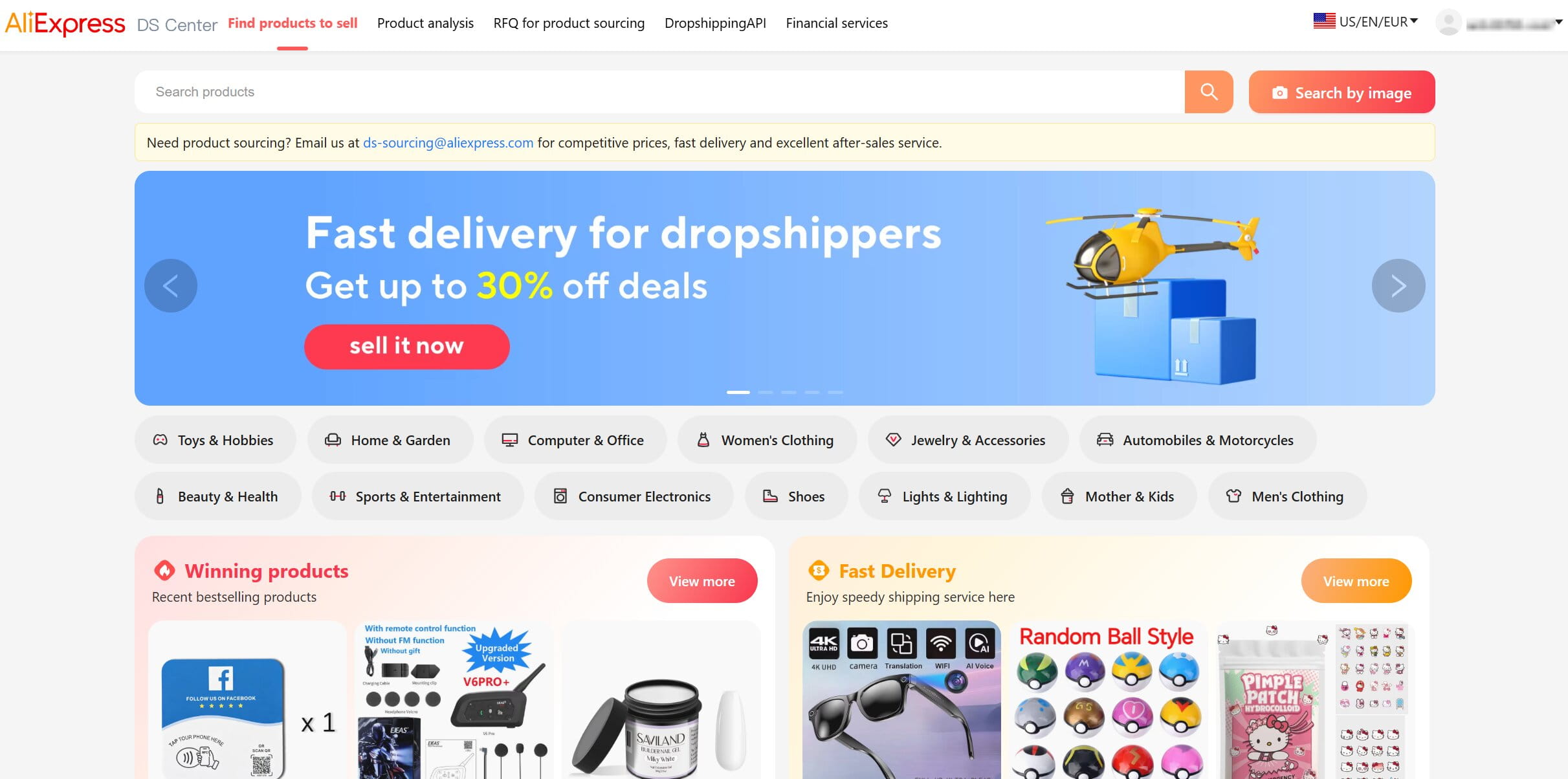
Inside the tool you’re really working with two engines. The product search side lets you browse or filter listings by category, shipping origin, delivery speed and a handful of other variables, and it separates regular buyer orders from orders placed specifically through dropshipping accounts. That distinction matters more than it sounds. A product with a high regular order count might just be popular with everyday shoppers buying one unit for personal use, while a high DS order count tells you other dropshippers are actively reselling it, which is a stronger signal for your own store. There’s also an RFQ option tucked into the tool, letting you submit a sourcing request once you’ve settled on a product and want better pricing or custom branding than the standard listing offers. It doesn’t go to one specific supplier directly, it gets posted for sellers across the platform to respond to, so expect a handful of competing quotes rather than a single negotiation.
The analysis side works differently. You paste in the URL of a specific listing and the tool returns a sales volume index, a rating on the seller’s logistics performance, and historical order patterns. Reading that data correctly takes a bit of practice, since a rising sales index paired with a falling seller rating usually means a product is popular but the supplier is starting to struggle with demand, which is worth knowing before you build a listing around them.
Because both engines draw on AliExpress’s own database rather than an outside estimate, they tend to hold up better over time than tools that infer sales figures from public review counts or search rank, a method that gets less accurate the more a product’s popularity shifts week to week.
How to Access and Activate Dropshipping Center on AliExpress
Most new AliExpress dropshipping center login issues come down to one thing: the feature simply hasn’t been switched on yet for that account. AliExpress doesn’t enable it by default, so a brand new account will not see it sitting in the menu no matter how carefully you look.
Manual activation is the faster route if you haven’t placed any orders yet.
- Log into your AliExpress account as you normally would.
- Go to ds.aliexpress.com. This is now the most reliable entry point. An older dedicated activation link (home.aliexpress.com/dropshipper/ds_center.htm) circulates in a lot of guides, but it’s become inconsistent, sometimes it works, sometimes it just redirects back to your account home, so ds.aliexpress.com is the one worth bookmarking instead.
- Accept the General Agreement and Data Service Authorization terms. Read them once, they’re standard and not particularly restrictive.
- Enter your full legal name when prompted.
- You’ll get a Submitted confirmation, and the Dropshipping Center should appear in your account within a few minutes to a couple of hours.
Automatic activation by orders happens on its own once AliExpress notices consistent dropshipping-style buying behavior on your account, such as shipping repeat orders to different addresses. You’ll usually get a notification when this kicks in, and no manual steps are required.
Once it’s live, you’ll find it under My Account, then Orders, then a Dropshipping Center link toward the bottom of that dropdown menu. It’s worth bookmarking directly, since ds.aliexpress.com is the shortcut most returning users rely on rather than digging through the account menu every time. If you land on a login page or get redirected back to your account home instead of the tool itself, that almost always means the activation step above hasn’t completed yet, so double check step 3 and try again after a short wait.
Mastering AliExpress Product Search: Finding Winning Items
Searching Hot Selling products is where most people spend the bulk of their time. The filter set is fairly deep once you dig in: Ship From and Ship To let you match a supplier’s warehouse location to your customers’ region, which directly affects delivery speed. Delivery Time filters clear out listings that can’t realistically ship fast enough to keep customers happy, and there’s a separate filter for items already discounted at the Exclusive DS Price tier. Worth noting: ePacket has become a lot harder to find on individual listings over the past couple of years, since most sellers have shifted to AliExpress Standard Shipping as the default tracked option, so don’t be surprised if the ePacket filter turns up thinner results than it used to. Standard Shipping is the one to filter by if you want a realistic read on delivery speed today.
The Choice filter deserves a bit more attention than most guides give it. It’s grown from a minor badge into a large chunk of the platform, AliExpress now routes a sizeable share of order volume through it, since Choice listings bundle free shipping over a low order threshold, faster delivery through AliExpress’s own logistics network, and easier returns compared to a random non-Choice seller. For a dropshipper, filtering to Choice-eligible listings is a reasonable way to raise your odds of consistent shipping performance, though it’s still worth checking the individual seller’s own rating rather than assuming the badge alone guarantees product quality.
The column that trips people up the most is the difference between Orders and DS Orders. Orders counts purchases from regular AliExpress retail customers, people buying one item for themselves. DS Orders only counts purchases made through dropshipping accounts. A product with thousands of regular orders but almost no DS orders might just be a popular consumer item that isn’t necessarily easy to resell profitably, while a smaller but steadily growing DS order count often points to something dropshippers are quietly having success with before it gets saturated.
Search by Image solves a different problem. Say you already have a product you’re selling but the original supplier has gone out of stock or their shipping times have slipped. Upload a product photo and the tool returns visually similar listings from other sellers, which is often faster than trying to describe the item in a text search.
Sponsored Products is worth a quick scan on a regular basis too. Sellers generally only pay to promote items they expect to convert well, so browsing the sponsored section is a reasonable way to see what suppliers themselves are betting on.
Using AliExpress Product Analysis to Vet Suppliers and Items
The workflow itself is simple. Copy the URL of a listing you’re considering, drop it into the analysis field, and the tool returns three things worth reading side by side: a sales volume chart, a price history chart, and a logistics reliability score for the supplier.
The sales volume number is the one people misread most often. It sits on a 0 to 100 scale, and it’s tempting to treat it like a literal order count, but it isn’t. It works closer to how a Google Trends score behaves: a relative popularity index rather than a daily unit total. A score of 80 doesn’t mean the supplier sold 80 units, it means the listing shows noticeably stronger activity than something sitting at 20. Use it to compare listings against each other, not to estimate revenue.
The trend behind the number tends to matter more than the number itself. A product with a modest score that’s been climbing steadily over recent weeks is often a better bet than one with a high score that’s already flattening out or sliding, since the second case usually means other sellers found the product months ago and the easy margin is gone. This is also why it’s worth looking at growth rate rather than total order count alone when comparing two listings. Fewer total sales paired with a clear upward trend frequently outperforms a saturated bestseller over the following few months.
The price history chart adds a layer most people skip past too quickly. A sudden price jump right before you’re about to source a product can wipe out a margin you were counting on, and a supplier who adjusts prices constantly is often a sign of thin, unstable stock.
Alongside all of that, the same tool surfaces supplier-level data: shipping consistency, dispute rates, and how reliably the seller has matched the delivery times they promised. A product can look fantastic on the sales chart and still be a poor choice if the supplier behind it has a pattern of late shipments or unresolved disputes, since that risk lands on your store’s reviews, not theirs.
It’s worth pairing this data with a manual check of the seller’s storefront rating and recent buyer feedback, and ideally a small test order before you commit real inventory space to a listing. The analysis tool tells you what has happened historically, a sample order tells you what’s happening right now, including whether the item matches its photos and holds up to the quality a customer will expect.
AliExpress Dropshipping Center Discount Levels & Rewards
The levels are based on dropshipping order volume within a trailing period, generally the most recent 90 days, rather than lifetime spend, so a slow quarter can move you back down a tier just as an active one can move you up. Worth clearing up a common mix-up first: this program is separate from AliExpress’s general buyer loyalty tiers (the Silver, Gold, Platinum and Diamond membership levels tied to reward points on regular purchases). The Dropshipping Center runs its own scheme, officially labeled Normal, C, B and A, based purely on dropshipping order volume rather than points.
- Normal is where every account starts, with no additional discount applied.
- C level kicks in at $1,000 or more, bringing a 2% discount.
- B level kicks in at $2,000 or more, bringing a 4% discount.
- A level kicks in at $5,000 or more, bringing a 6% discount on eligible items.
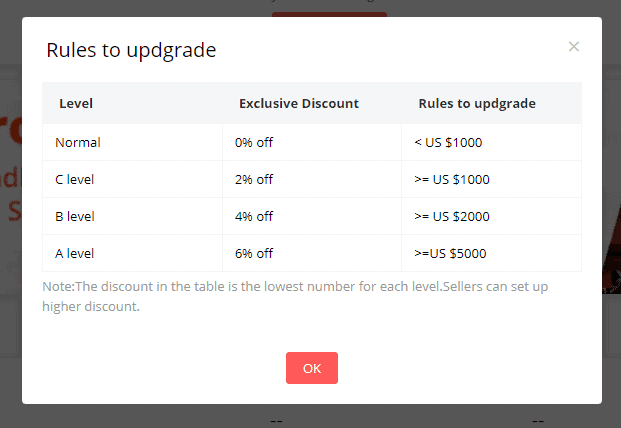
One detail worth knowing: those percentages are the floor for each level, not the ceiling. AliExpress’s own rules page notes that the figures shown are the lowest discount for each tier, and individual sellers are free to set a higher discount on top of it. So a C-level account might see more than 2% off on a given listing if that particular seller chooses to offer it.
None of this requires a separate application or fee. The system tracks your order history automatically and upgrades or downgrades your tier on its own, and the discount applies quietly at checkout on eligible products rather than through a coupon code you need to remember to apply.
A Few Habits Worth Building Before You Commit
The Dropshipping Center hands you good data, but the data still needs a bit of judgment applied to it. A handful of habits separate people who use the tool well from people who just skim it:
- Don’t chase the cheapest listing on the page. The price filter is genuinely useful, but the lowest price in a category is frequently the lowest quality too, and that gap shows up in your reviews, not the supplier’s.
- Read reviews, not just photos and videos. A polished listing image tells you nothing about whether the product held up after two weeks of use. Recent buyer comments usually do.
- Test a supplier’s responsiveness before you rely on them. Send a slightly urgent question before you commit to a listing. How fast they answer, and how well they actually address what you asked, says a lot about how they’ll handle a real customer complaint later.
- Cross-check demand outside AliExpress too. A product with a strong sales index inside the Dropshipping Center is a stronger signal when it’s also showing rising interest on Google Trends or steady search volume in Keyword Planner. Demand that only shows up in one place is easier for a trend to reverse.
- Recalculate your free-shipping math if you sell into the US. Since the de minimis exemption for low-value China-origin shipments was suspended, packages that used to clear customs duty-free regardless of declared value generally don’t anymore. That changes the margin on cheap, free-shipping listings, so it’s worth checking a supplier’s landed cost rather than just their AliExpress price before you commit to a product.
Top Alternatives and Automation Tools
Dropshipping Center answers the question of what to sell and who to source it from. It doesn’t touch what happens after that decision is made. Once you’ve settled on a product, someone or something still has to actually fulfill each order, update tracking information across every sales channel, and adjust pricing when a supplier changes their rate.
Google’s own free tools are worth keeping in the mix at the research stage. Google Trends shows whether interest in a product has been rising or fading over time, and Keyword Planner adds a rough sense of monthly search volume, including by country. Neither replaces the Dropshipping Center, since they don’t show you supplier reliability or actual AliExpress order data, but running a product through both before committing catches cases where AliExpress-side demand doesn’t hold up once you look at the wider market.
On the automation side, the Dropshipping Center itself doesn’t place orders or sync tracking, which is why most active sellers pair it with a dedicated tool. DSers is the option AliExpress integrates with directly, and it’s a reasonable default for straightforward single-supplier workflows. Tools like AutoDS lean further into automated pricing and stock monitoring across a larger catalog. Easync sits in the same category and is built specifically for sellers running multiple storefronts at once, on eBay, Shopify, Walmart and others, since it automates order placement across all of them, keeps tracking numbers synced without manual checking, and reprices listings automatically when a supplier’s cost changes.
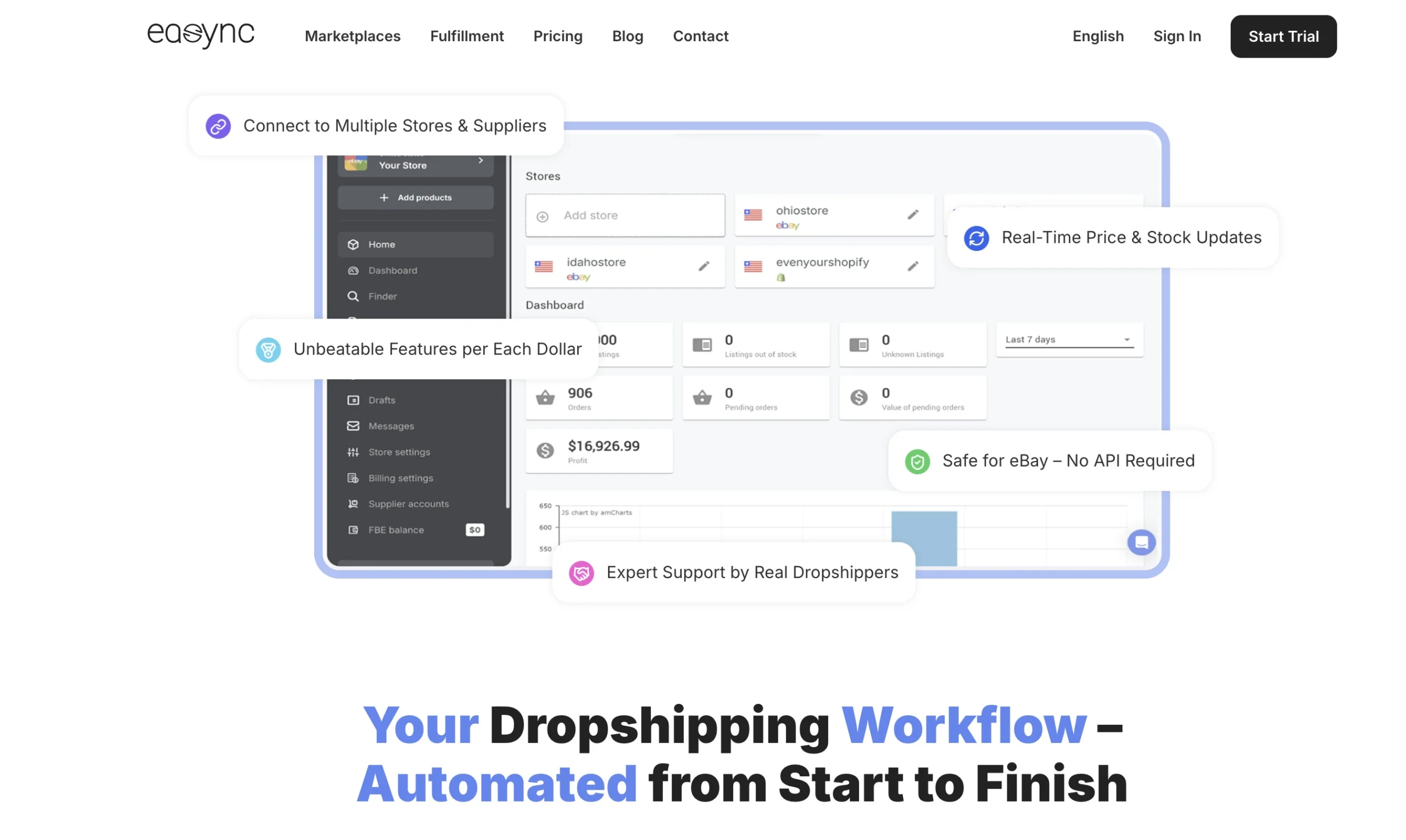
Used together, the pieces cover different halves of the same job. Dropshipping Center and Google’s free tools help you make better sourcing decisions up front. An automation platform takes the repetitive operational work off your plate once those products are actually live in your store, which tends to be the part that eats the most hours as an account scales past a handful of orders a day.
Frequently Asked Questions (FAQ)
Is AliExpress Dropshipping Center free to use?
Yes. There’s no subscription or paywall involved. All the features described here, including product search, product analysis and the discount tiers, come bundled with a standard AliExpress account once it’s activated.
Why can’t I find the AliExpress dropshipping center in my account?
This almost always means the feature hasn’t been activated yet. New accounts without order history need to go through the manual activation link and registration form covered above. If you’ve already done that and it’s still missing, clear your browser cache and try logging in again, since a cached session sometimes shows an outdated version of the account menu.
What’s the direct AliExpress dropshipping center link if I don’t want to dig through the menu?
ds.aliexpress.com is the one to bookmark, both for activation if you’re not set up yet and for everyday access afterward. An older, separate activation URL still circulates in a lot of guides, but it’s grown unreliable over the past year or so, so it’s best avoided in favor of the main link.
Does AliExpress Dropshipping Center replace tools like DSers or automation platforms?
Not really, and it isn’t trying to. Think of it as the research half of the process. It tells you what to sell and gives you supplier data, but placing bulk orders, syncing tracking, and repricing across multiple stores still needs a separate automation tool, which is exactly the gap platforms like Easync are built to close.
Is there a difference between “dropshipping center” and “dropship center” as people search for it?
No meaningful difference. Both, along with variations like AliExpress DS Center or AliExpress dropshipper center, refer to the same tool. AliExpress itself uses “Dropshipping Center” as the official name inside the account menu.
Are the Dropshipping Center’s discount levels the same as AliExpress’s Silver, Gold and Platinum member tiers?
No, and this trips up a lot of people. Silver, Gold, Platinum and Diamond are part of AliExpress’s general buyer loyalty program, earned through reward points on regular purchases, and mostly unlock perks on featured brand promotions. The Dropshipping Center runs a separate system, labeled Normal, C, B and A, based specifically on your dropshipping order volume, and it’s the one that actually discounts your sourcing price.