
- articles
18 Best AliExpress Alternatives for Dropshipping (2026)
Quick answer: The best AliExpress alternatives for dropshipping in 2026 are Easync, Spocket, and CJdropshipping, along with a longer list of niche suppliers covered below. Sellers are moving away from AliExpress because of slower customs clearance, stricter marketplace tracking rules on eBay and Amazon, and the higher chance of a suspended store when packages arrive late. The platforms on this list were chosen for shipping speed, tracking compliance, and how well they protect account health rather than for having the lowest sticker price.
Introduction: Dropshipping Alternatives and Why 2026 Changed the Sourcing Game

For years, AliExpress was the default answer whenever someone asked how to start a dropshipping business. Cheap unit prices, a catalog with almost anything in it, and a one-click import into Shopify made it an easy on-ramp. That model is under real pressure now. The U.S. suspended the $800 de minimis exemption in stages through 2025, and the suspension was made permanent through federal regulation in mid-2026, which means every package from China now goes through formal or informal customs entry and picks up Section 301 duties plus a Section 122 surcharge instead of clearing for free. The European Union followed with its own reform: the €150 duty exemption ended on July 1, 2026, replaced by a flat customs charge per line item, with full duty assessment scheduled to phase in by 2028.
None of this makes AliExpress unusable. It does mean the economics changed. A $6 product that used to land in a customer’s hands in ten days with no import paperwork now competes with suppliers who ship from domestic or regional warehouses, charge a bit more per unit, and never trigger a customs delay. For sellers running stores on eBay or Amazon, there’s a second pressure layer: marketplace tracking policy. eBay requires tracking to be uploaded on time for at least 95% of transactions and a Late Shipment Rate under 3% to keep Top Rated status, and Amazon runs its own Valid Tracking Rate (VTR) requirement above 95% for seller-fulfilled orders. A supplier that can’t generate a scannable tracking number within 24 to 48 hours is no longer just a shipping inconvenience, it’s a policy violation waiting to happen.
That combination, longer customs timelines plus stricter tracking enforcement, is why so many sellers are actively researching dropshipping alternatives that fix these specific problems rather than just offering another product catalog. This guide covers 18 platforms worth considering, what each one does well, and where it falls short. We also cover the underlying reason sellers make the switch: a $4 sourcing advantage on paper often turns into refund requests, chargebacks, and closed marketplace accounts once the real shipping timeline plays out.
Key Takeaways
- AliExpress is still viable for testing new products, but it’s a weaker fit for scaling a compliant, multi-channel store in 2026.
- Reliable AliExpress alternatives cost more per unit or charge a subscription, but they reduce refund rates, dispute volume, and the risk of a marketplace suspension.
- Tracking compliance (eBay’s on-time tracking upload rate, Amazon’s VTR) is now a sourcing decision, not just a shipping detail.
- Cross-border tax changes in the US and EU have narrowed the price gap between “cheap Chinese sourcing” and faster regional alternatives.
Summary Table: Best AliExpress Alternatives for Dropshipping (2026)
Before going deeper into each platform, here’s a side-by-side look at the top aliexpress alternatives and websites similar to AliExpress that sellers are actually using this year. Warehouse footprint and delivery speed vary a lot between them, so match the platform to where your customers actually live before you commit.
| Platform / Supplier | Best For / Primary Niche | Key Strength | Warehouse Locations | Avg. Delivery Time | Integration Type |
|---|---|---|---|---|---|
| Easync | Automated eBay, Amazon & Walmart dropshipping | Sourcing from fast US retailers with built-in tracking sync | US retail network (Amazon, Walmart, eBay sellers) | 2–6 days | Native marketplace automation |
| Spocket | US/EU-based branded products | Curated, vetted suppliers with real inventory | US, Canada, EU | 2–7 days | Shopify, WooCommerce app |
| CJdropshipping | Broad catalog with custom packaging | Hybrid global and local warehouse network | China, US, EU, Southeast Asia | 3–10 days (local stock); 7–15 days (China cross-border) | API, Shopify, WooCommerce |
| BigBuy | European B2B dropshipping | EU-based logistics with VAT-ready invoicing | Spain, France, Poland | 2–6 days (EU) | API, CSV feed, Shopify |
| Zendrop | Branded Shopify stores | Custom packaging and private labeling | China, US 3PL | 3–7 days | Shopify native app |
| AutoDS | Multi-supplier automation | Price and stock monitoring across suppliers | Supplier-dependent | Source-dependent | eBay, Amazon, Shopify automation |
| Inventory Source | Real wholesale distribution | Direct feeds from US wholesalers | US | 3–7 days | API, CSV, Shopify |
| SaleHoo | Supplier research and vetting | Directory of audited wholesalers | Global (directory only) | Supplier-dependent | No native fulfillment |
| Printful | Print-on-demand apparel and goods | In-house production, no minimums | US, EU, Mexico, Australia | 3–7 days | Shopify, Etsy, WooCommerce |
| Printify | Print-on-demand with partner choice | Network of competing print providers | US, EU, global partners | 4–10 days | Shopify, Etsy, WooCommerce |
| Avasam | UK/EU marketplace automation | Aggregated supplier network | UK, EU | 5–10 days | eBay, Amazon, Shopify |
| Syncee | Multi-supplier catalog sync | Automated product and price updates | Global | Supplier-dependent | Shopify, WooCommerce, BigCommerce |
| Modalyst | Premium and branded goods | Higher-end catalog with brand names | US, EU | 3–7 days | Shopify, Wix |
| Wholesale2B | Turnkey wholesale integration | Pre-built store templates | US | 5–10 days | Shopify, eBay, Amazon, WooCommerce |
| DHGate | Bulk B2B purchases | Wholesale pricing at scale | China | 10–25 days (standard); 3–7 with express | Manual ordering, some API access |
| Doba | US-warehouse dropshipping | AI-assisted product recommendations | US (roughly 90% of catalog) | 2–5 days | Shopify, BigCommerce, eBay, Amazon |
| HyperSKU | Private label and product photography | In-house fulfillment centers | China, with regional hubs | 5–12 days | Shopify, WooCommerce |
| Local Wholesale Suppliers | Domestic scaling | Face-to-face accountability, fast regional shipping | Your own country/region | 1–5 days | Manual or EDI |
Delivery estimates above reflect typical carrier transit time. For suppliers shipping direct from China (CJdropshipping’s China warehouse, DHGate, HyperSKU), add potential customs clearance time on top, since formal entry is now standard under the 2026 US and EU import rules. Platforms with US, EU, or domestic fulfillment are less affected because the goods are already inside the destination market.
The 18 Best AliExpress Alternatives, Detailed
1. Easync
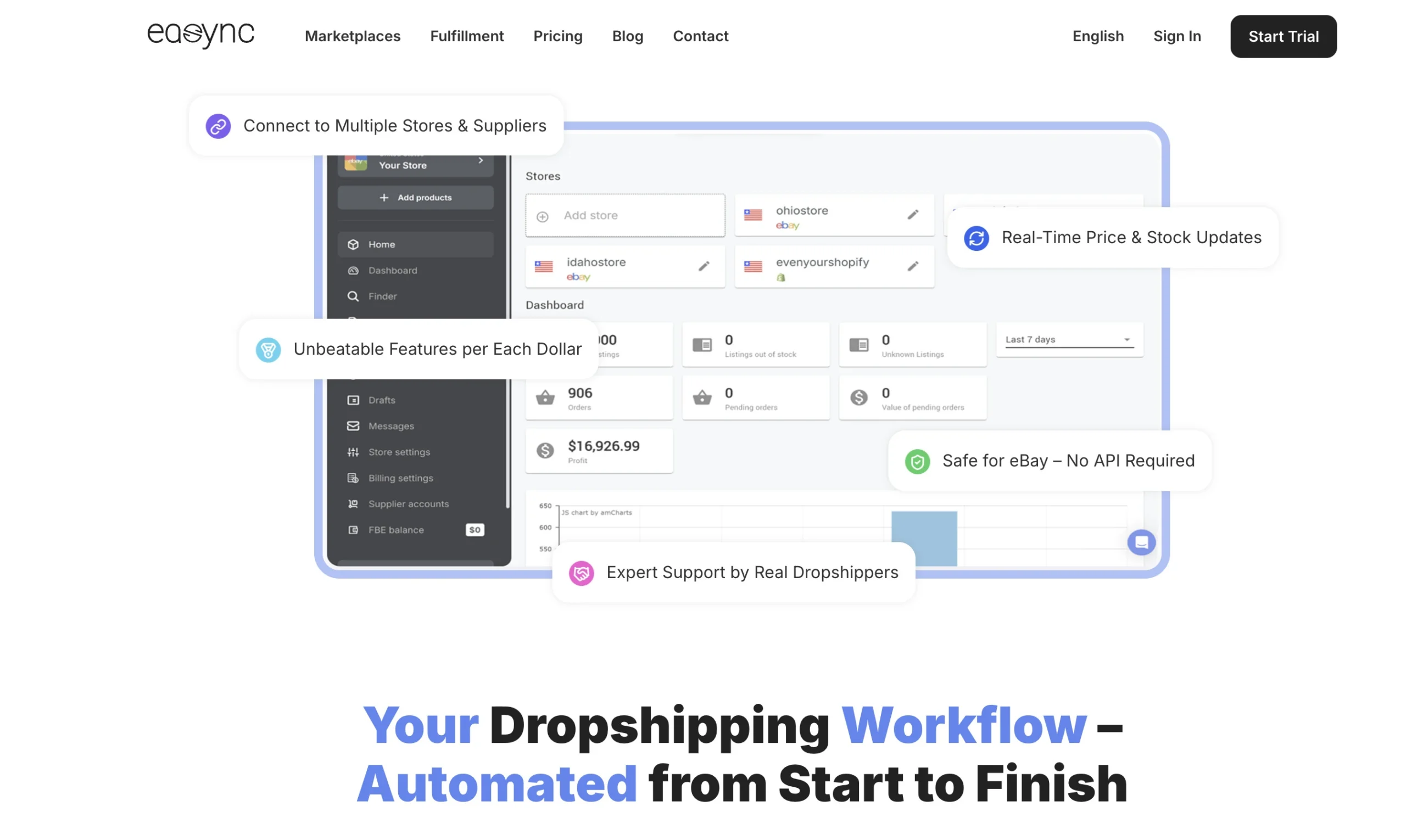
Instead of adding another catalog of mixed-quality Chinese suppliers, Easync approaches the AliExpress problem from a different angle: it connects sellers directly to fast, reliable US retailers, Amazon, Walmart, and vetted eBay sellers, and automates the two things that actually break dropshipping stores, order placement and tracking updates.
That second part matters more in 2026 than it used to. eBay’s tracking-upload requirement and Amazon’s Valid Tracking Rate (VTR) enforcement both mean that a supplier who ships from overseas and can’t produce a carrier scan within your handling window puts your account at risk, regardless of how cheap the product was. Easync’s auto-ordering pulls from suppliers who already ship domestically, so tracking numbers populate fast enough to stay inside marketplace policy windows instead of triggering a defect.
The platform also includes product research tools to help sellers find items with healthy margins before committing to them, and it flags pricing or stock changes automatically so listings don’t go stale. For a seller weighing a $3 AliExpress item against a $9 domestic one, the calculation usually isn’t about the $6 gap, it’s about what happens when the AliExpress order takes three weeks, the customer files an item-not-received case, and the marketplace account takes a defect for it.
Pricing sits on a subscription model, positioned in the middle of the market rather than at the low end. Sellers already running multiple eBay or Amazon storefronts tend to get the most out of it, since the automation scales across listings without adding proportional manual work. Someone running a single test store may not need the full toolset right away, but growth tends to make the case for it quickly.
Pros:
- Sources from domestic US retailers (Amazon, Walmart, vetted eBay sellers), which keeps transit times short and predictable
- Tracking numbers sync automatically, which helps keep eBay’s on-time tracking rate and Amazon’s VTR inside safe thresholds
- Built-in product research tools flag margin potential and trend data before you commit inventory to a SKU
- Pricing and stock changes get flagged automatically, so listings don’t sit stale while a supplier runs out or repriced
- Automation scales cleanly across multiple eBay or Amazon storefronts without adding proportional manual work
Cons:
- Not the cheapest option for sellers specifically chasing rock-bottom, AliExpress-level unit pricing
- Less appealing to sellers who want full manual control over which individual suppliers they work with
- A single low-volume test store may not need the full toolset right away, so the subscription cost feels heavier early on
2. Spocket
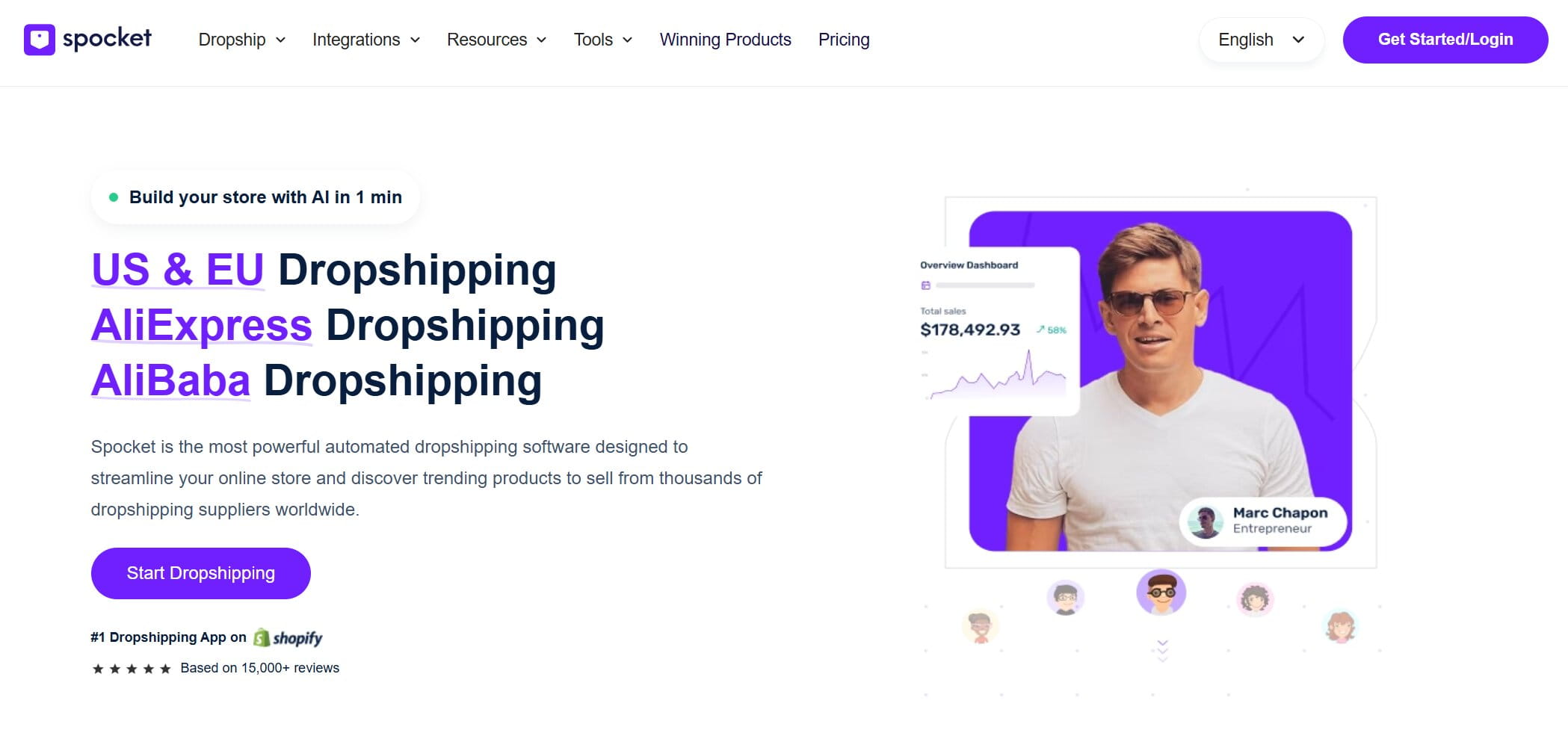
Sellers who ask for sites better than AliExpress usually mean one specific thing: they want suppliers who are physically closer to their customers. Spocket answers that directly. Its network leans heavily on US and EU-based suppliers, with real inventory sitting in regional warehouses rather than everything routing back through mainland China.
The tradeoff is price. Spocket products typically cost more per unit than the AliExpress equivalent. In exchange, delivery windows shrink to a few days instead of a few weeks, and the supplier vetting process filters out a lot of the inconsistent quality that gives dropshipping a bad name with customers. Spocket also runs a print-on-demand branch, letting sellers design custom items that ship under their own branding rather than generic packaging.
For a store built around US or European buyers who expect Amazon-style delivery speed, Spocket closes a real gap that AliExpress structurally can’t.
Pros:
- US and EU-based suppliers cut delivery to a few days instead of a few weeks
- Vetting process filters out much of the inconsistent quality that gives open marketplaces a bad name
- Built-in print-on-demand branch lets sellers ship custom, branded items rather than generic packaging
- Strong fit for stores targeting customers who expect Amazon Prime-level delivery speed
Cons:
- Noticeably higher wholesale prices than AliExpress
- Smaller overall catalog than open marketplaces, so less depth in ultra-niche categories
- Full catalog access requires a paid subscription rather than free browsing
3. CJdropshipping
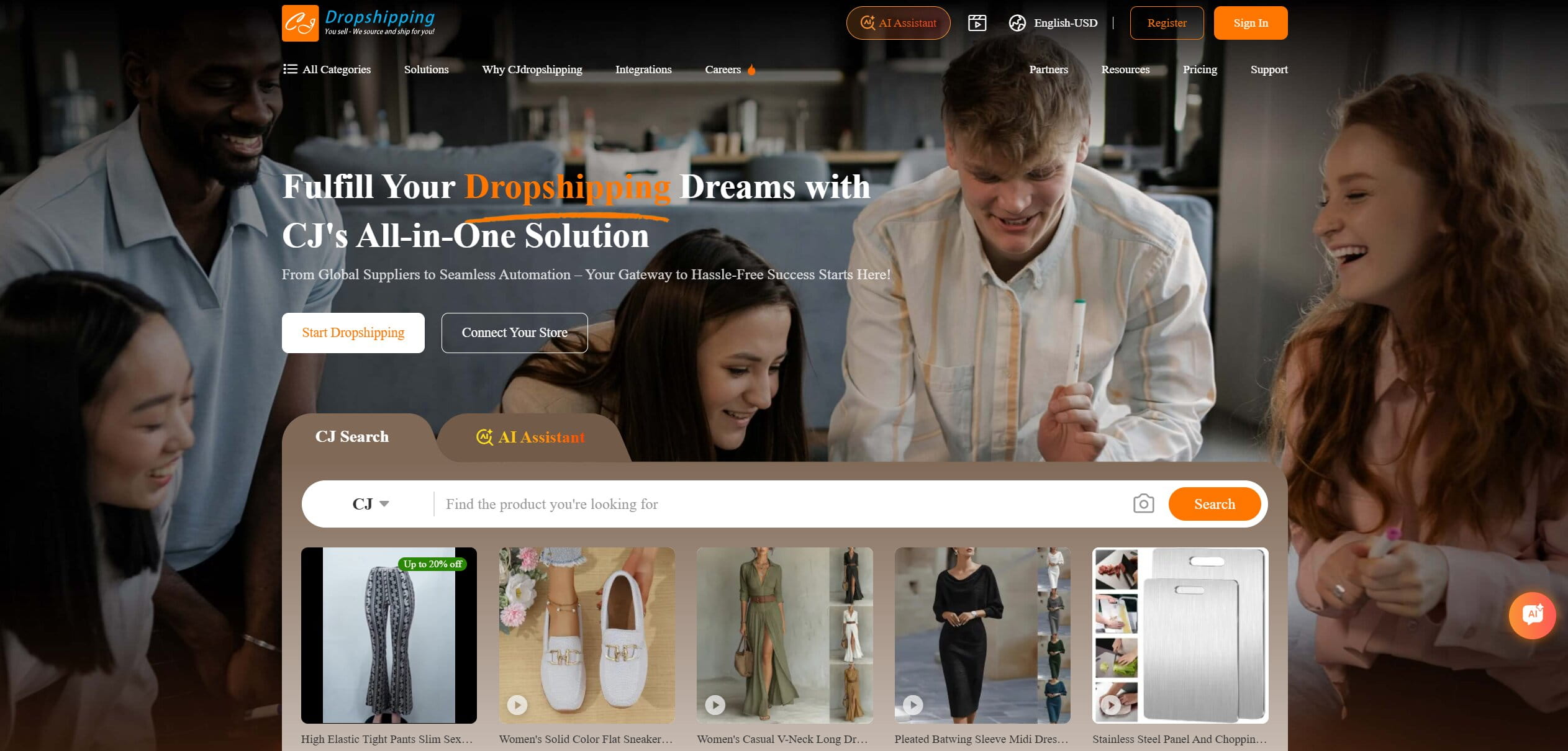
Part marketplace and part fulfillment company, CJdropshipping sits in an unusual spot among aliexpress alternative sites. It maintains its own warehouses in China, the US, and parts of Europe, and it will source, repackage, and even brand products on a seller’s behalf, something AliExpress simply doesn’t offer.
The catalog runs past a million SKUs, so category coverage is rarely the issue. What varies is performance by warehouse. A product shipped from CJ’s US facility can arrive in under a week, while the same item sourced from a Chinese warehouse takes closer to two. Sellers who use CJ successfully tend to check which warehouse a specific SKU ships from before adding it to their store, rather than assuming uniform delivery times across the whole catalog.
Custom packaging and private labeling are available at scale, which makes CJ a common next step for stores outgrowing single-supplier dropshipping and wanting more brand control without switching platforms entirely. The platform’s own sourcing agents will also track down a specific product on request if it isn’t already listed, which fills a gap that pure catalog marketplaces can’t.
New account setup is straightforward, and there’s no subscription fee to browse or place orders, only per-order fulfillment costs. That lowers the barrier for testing CJ alongside an existing AliExpress workflow before committing more volume to it.
Pros:
- Catalog runs past a million SKUs, so category coverage is rarely the limiting factor
- Custom packaging and private labeling are available at scale for stores outgrowing generic dropshipping
- Dedicated sourcing agents will track down a specific product on request if it isn’t already listed
- No subscription fee to browse the catalog or place orders, only per-order fulfillment costs
Cons:
- Delivery times swing significantly depending on which warehouse actually fulfills a given order
- Requires actively checking warehouse location per SKU to avoid accidentally selling a slow China-shipped item
- Product quality still varies by underlying factory, since CJ sources from hundreds of them
4. BigBuy
Anyone selling into Europe and tired of post-reform VAT headaches should take a look at BigBuy. It’s a Spain-headquartered B2B wholesaler with warehouses across the EU, built from the ground up around VAT-ready invoicing and structured product feeds rather than bolted on as an afterthought. That makes it one of the more practical sites similar to AliExpress for EU sellers specifically, since the July 2026 removal of the bloc’s €150 duty exemption raised the cost of shipping directly from China for low-value orders, and sourcing from an EU-based wholesaler sidesteps a chunk of that friction because the goods are already inside the customs union.
Subscription pricing applies and margins land in the moderate range rather than rock-bottom, but what you get in return is shipping consistency across the EU27 and a lot less paperwork than running direct-from-China imports under the new rules. It’s not the platform for sellers chasing the absolute lowest unit cost, but for EU-focused stores that value predictable fulfillment over pennies, the tradeoff works.
Pros:
- Warehouses stay inside the EU customs union, so a good chunk of 2026’s new import friction simply doesn’t apply
- VAT-ready invoicing is part of the platform from the start rather than something bolted on later
- Delivery holds up about the same whether you’re shipping to Poland or Portugal, which isn’t true of every EU supplier
Cons:
- Won’t compete on price if you’re chasing rock-bottom unit costs
- The subscription fee is fixed, so it doesn’t flex down for smaller order volumes
- Doesn’t add much if most of your customers are outside Europe anyway
5. Zendrop
What Zendrop really sells is the ability to look like a real brand instead of a dropshipper. Where AliExpress ships in generic, sometimes mismatched packaging, Zendrop offers custom boxes, inserts, and labeling that make a dropshipped product look like it came from your own warehouse instead of a random overseas supplier.
It backs that up with a US-based 3PL network for faster domestic shipping and, for higher-volume sellers, the option to have Zendrop’s team work directly with factories to produce a genuinely private-label product. There’s also a built-in Shopify store builder, which shortens the setup process for sellers who don’t want to build a storefront from scratch.
Pricing sits above AliExpress, and the supplier pool is narrower than some of the bigger marketplaces on this list, but for a seller trying to build repeat customers rather than one-off sales, the branding tools tend to pay for themselves in fewer refund requests.
Pros:
- Custom boxes, inserts, and labeling replace AliExpress’s generic, sometimes mismatched packaging
- US-based 3PL network gets domestic orders to customers faster
- Higher-volume sellers can access genuine private-label manufacturing through Zendrop’s factory relationships
- Built-in AI store builder shortens the setup process considerably
Cons:
- Pricing sits above AliExpress across most of the catalog
- Supplier pool is narrower than bigger catalog-style marketplaces
- Private-label manufacturing really only pays off once order volume justifies it
6. AutoDS
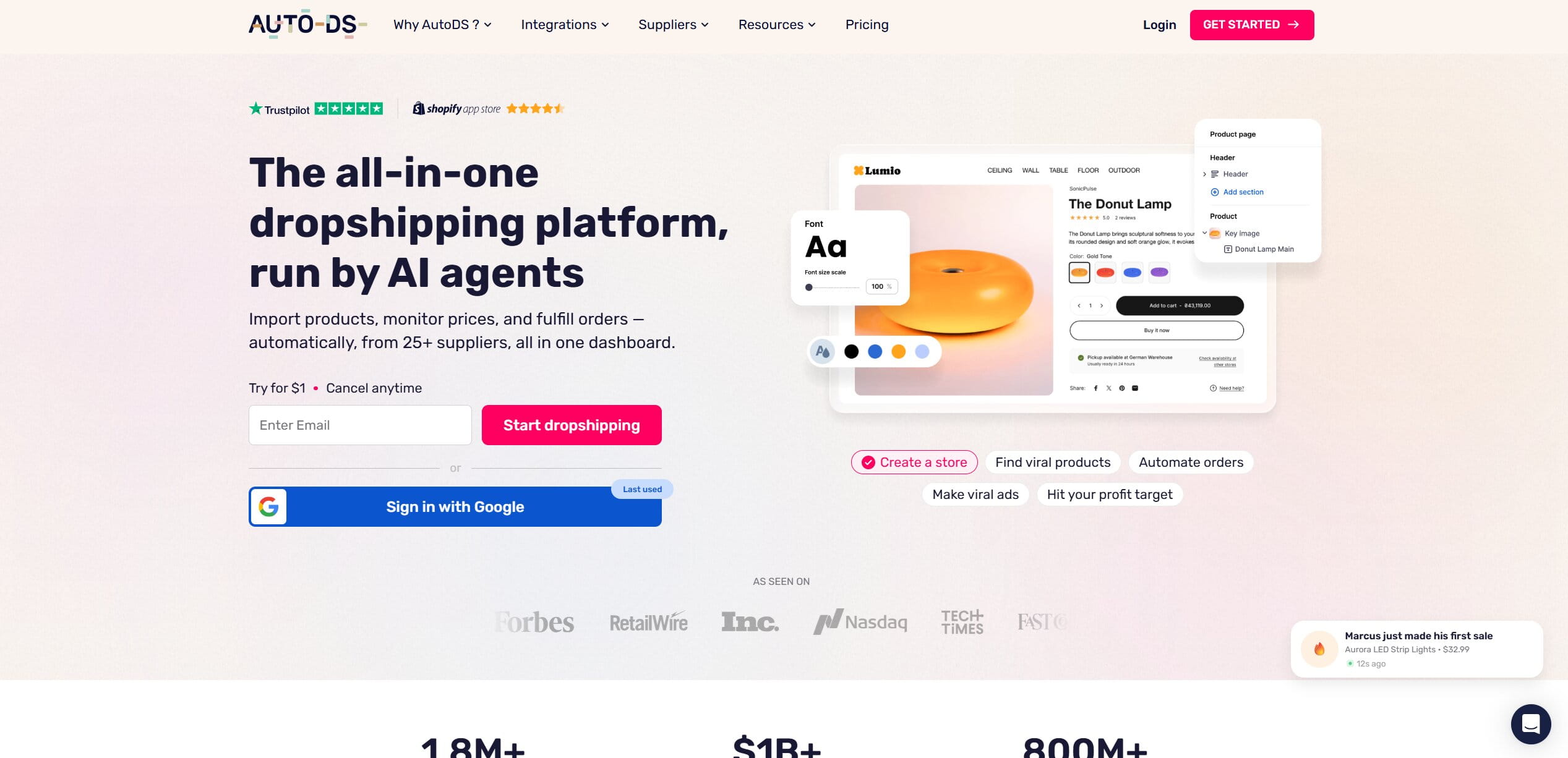
If someone is specifically googling sites like Ali Express that handle automation rather than sourcing, AutoDS is usually the answer they land on. It’s not a supplier itself so much as a control layer that sits on top of multiple suppliers, including AliExpress, monitoring price changes, stock levels, and order status so a seller isn’t manually checking dozens of listings every day.
The automation extends to order placement too. When a sale comes in, AutoDS can auto-order from the correct supplier and push tracking back to the originating marketplace, which matters for the same tracking-compliance reasons covered earlier in this guide. Because it pulls from many supplier sources at once, sellers get some insulation if one supplier goes out of stock or raises prices; the tool can suggest or switch to an alternative automatically.
The learning curve is real. AutoDS has a lot of settings, and sellers who don’t configure pricing rules and supplier priorities carefully can end up with automation that makes mistakes faster than a human would have.
Pros:
- Monitors price, stock, and order status across many suppliers simultaneously, including AliExpress itself
- Automates order placement and pushes tracking back to the originating marketplace automatically
- Provides some insulation if one supplier goes out of stock or raises prices mid-campaign
- Cuts down significantly on daily manual listing maintenance across large catalogs
Cons:
- Steep learning curve, with a lot of settings that need deliberate configuration
- Misconfigured pricing rules or supplier priorities can create automated mistakes at scale, faster than a human would catch them
- Still only as reliable as whichever underlying supplier it happens to be pulling from
7. Inventory Source
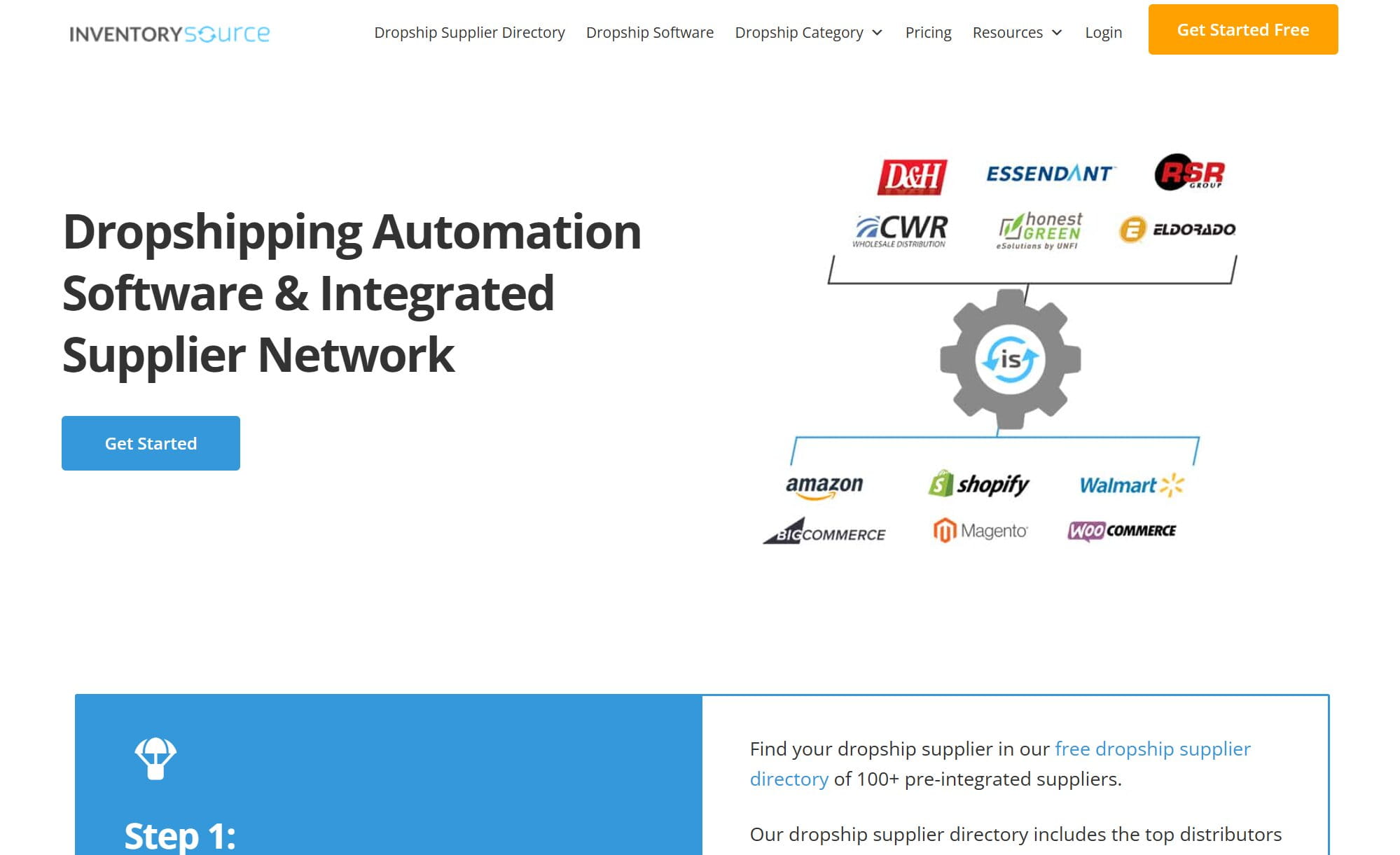
Skipping the marketplace model entirely, Inventory Source connects sellers straight to vetted US wholesale distributors, the kind that already sell to brick-and-mortar retailers rather than independent overseas sellers of varying quality. Automated purchase orders and inventory syncing come standard, so stock counts stay accurate without manual checking, and delivery from domestic distributors typically lands in the three-to-seven day range, a fraction of what most AliExpress shipments take.
Setup and monthly costs run higher than lighter tools, and the catalog moves more slowly than trend-driven platforms since wholesale distributors aren’t chasing viral products. That combination of real wholesale relationships and dependable stock accuracy suits a seller building a stable, long-term catalog far better than someone testing dozens of trending items a month.
Pros:
- Real relationships with established US wholesale distributors rather than independent overseas sellers of variable quality
- Automated purchase orders and inventory syncing keep stock counts accurate without manual checking
- Domestic delivery typically lands in the three-to-seven day range, a fraction of most AliExpress shipping times
Cons:
- Setup and monthly costs run higher than lighter automation tools
- Catalog moves more slowly on trending products since distributors aren’t chasing viral items
- Less flexible for sellers who want to test dozens of new products every month
8. SaleHoo
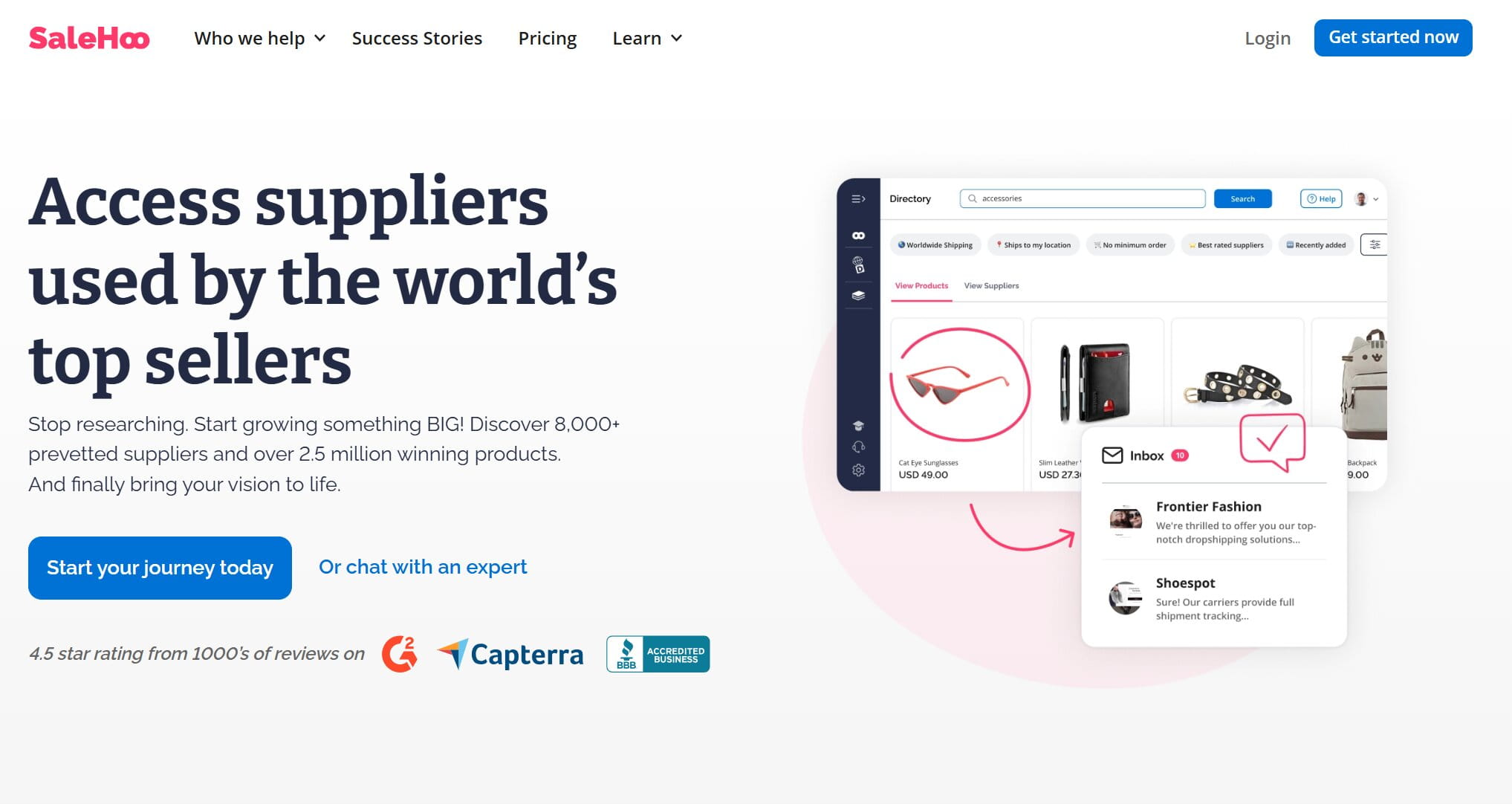
It’s worth being direct about what SaleHoo actually is, because the name gets thrown around loosely: it’s a supplier directory, not a fulfillment platform, with no built-in ordering automation and no warehouse network of its own. What it does offer is a vetted list of wholesalers and manufacturers, which for sellers looking for websites cheaper than AliExpress on a per-unit basis can actually deliver, since you’re buying straight from the wholesaler instead of through a marketplace middleman layer.
Annual membership runs a modest fee, and the site includes educational resources for people still learning how to vet suppliers on their own. The catch is you’ll still need a separate tool, or manual processes, to handle order routing and tracking once you’ve found a supplier, so SaleHoo works best paired with automation software rather than used on its own.
Pros:
- Legitimate, screened directory of wholesalers and manufacturers rather than an open, unvetted marketplace
- Buying straight from the wholesaler can mean genuinely lower per-unit pricing than AliExpress
- Annual membership is a modest, one-time-per-year cost rather than a recurring per-order fee
- Includes educational resources for sellers still learning how to vet suppliers themselves
Cons:
- No fulfillment, order automation, or tracking sync built in
- Requires pairing with a separate automation tool to actually run a store
- Directory quality still depends on the seller doing their own due diligence on each listed supplier
9. Printful
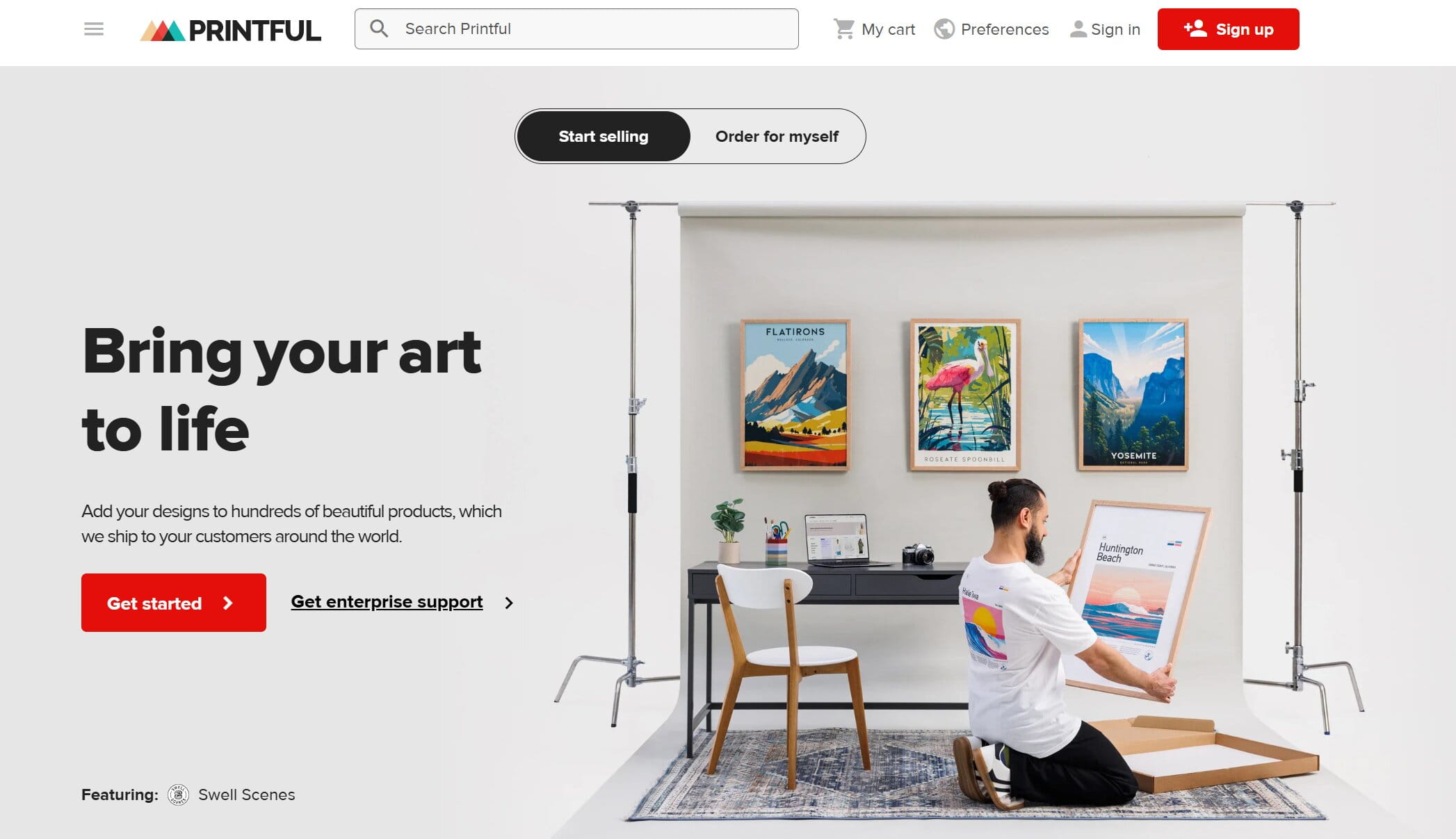
For print-on-demand sellers, Printful is one of the more established aliexpress like stores, though it’s really a different category of business entirely. Instead of sourcing pre-made products, you upload a design, and Printful produces it in-house across facilities in the US, EU, Mexico, and Australia, packages it, and ships it under your branding the moment an order comes in. There’s no inventory risk since nothing gets made until a customer actually orders, and tracking generates automatically at shipment, which keeps marketplace compliance simple.
Per-unit costs run higher than sourcing a blank product from AliExpress and printing it yourself, but for sellers who’d rather not deal with production logistics, that premium buys a lot of operational simplicity.
Pros:
- Production happens in-house across the US, EU, Mexico, and Australia, so quality doesn’t swing as much as it can with outsourced print shops
- Nothing gets made until a customer actually orders it, so there’s no inventory sitting around
- Tracking is generated the moment an order ships, one less thing to manage for marketplace compliance
- You can test a new design with a single unit since there’s no minimum order to clear first
Cons:
- Expect to pay more per unit than sourcing a blank and printing it yourself
- Margins run tighter here than on typical catalog dropshipping
- Works only for print-on-demand goods, not general product sourcing
10. Printify
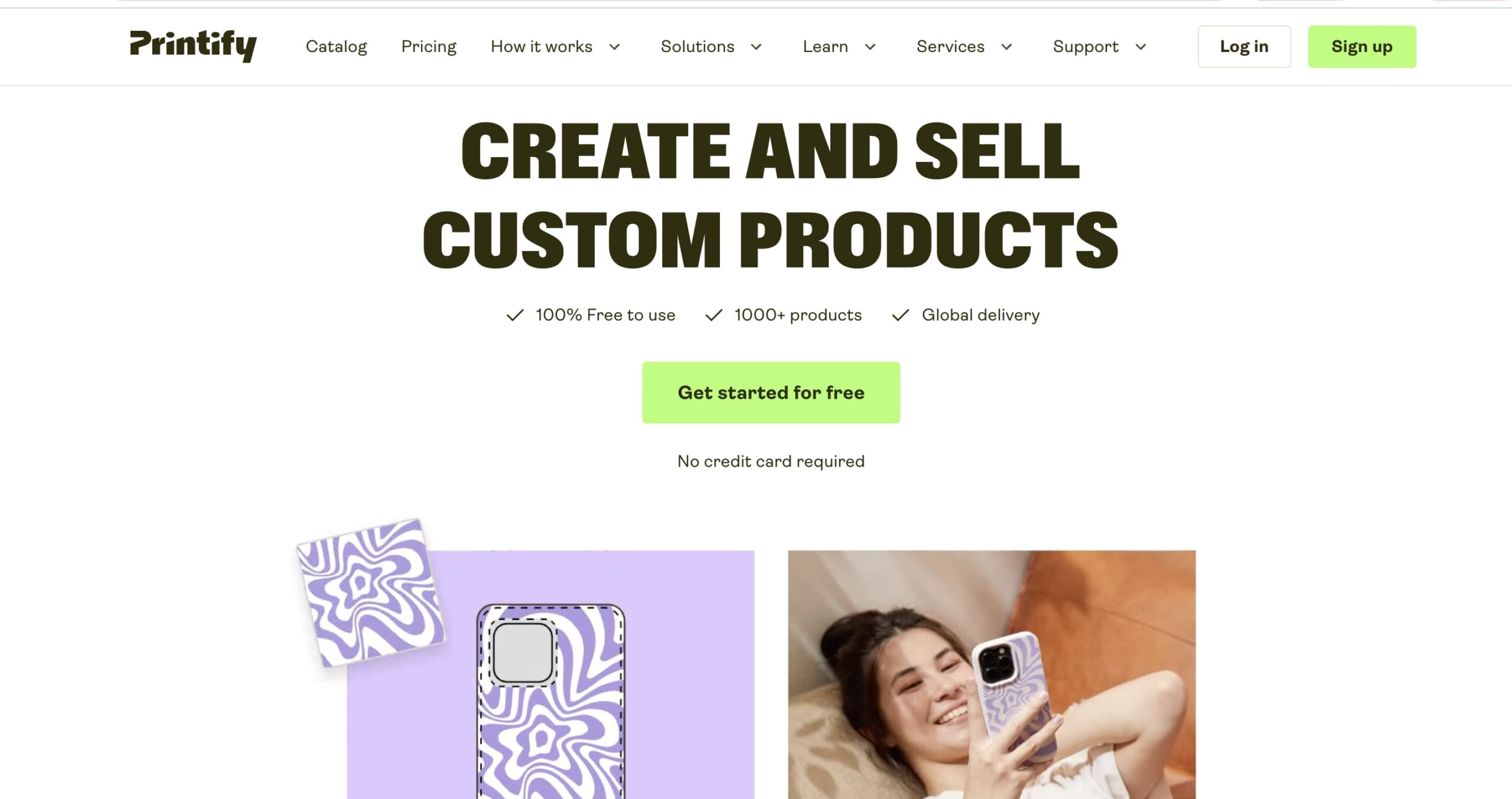
Printify and Printful get compared constantly, and the short version is that Printify trades some consistency for flexibility. Rather than owning its own production facilities, it works with a network of competing print partners, so sellers can pick a provider based on cost, location, or turnaround time for each specific product.
There’s no minimum order quantity, and a free plan lets new sellers test the platform before paying for anything. That accessibility is a big part of why it shows up often in searches for sites like AliExpress with a lower barrier to entry.
Quality control is where it gets shakier. Fulfillment is split across independent print partners, so the same product listing can turn out differently depending on who fills the order, print quality and packaging aren’t guaranteed to match from one partner to the next. Sellers who’ve been burned by this usually order a sample from a new partner before pushing real volume through them.
Pros:
- No minimum order quantity, so sellers can test single units before committing
- Free plan lets new sellers try the platform before paying anything
- Competing print partners give sellers a choice on cost, location, and turnaround time per product
- Lower barrier to entry than platforms with owned production facilities and higher base pricing
Cons:
- Print quality and packaging can vary noticeably between different print partners
- No single point of accountability for quality the way an in-house producer like Printful offers
- Requires testing a partner with a personal order before trusting them with real volume
11. Avasam
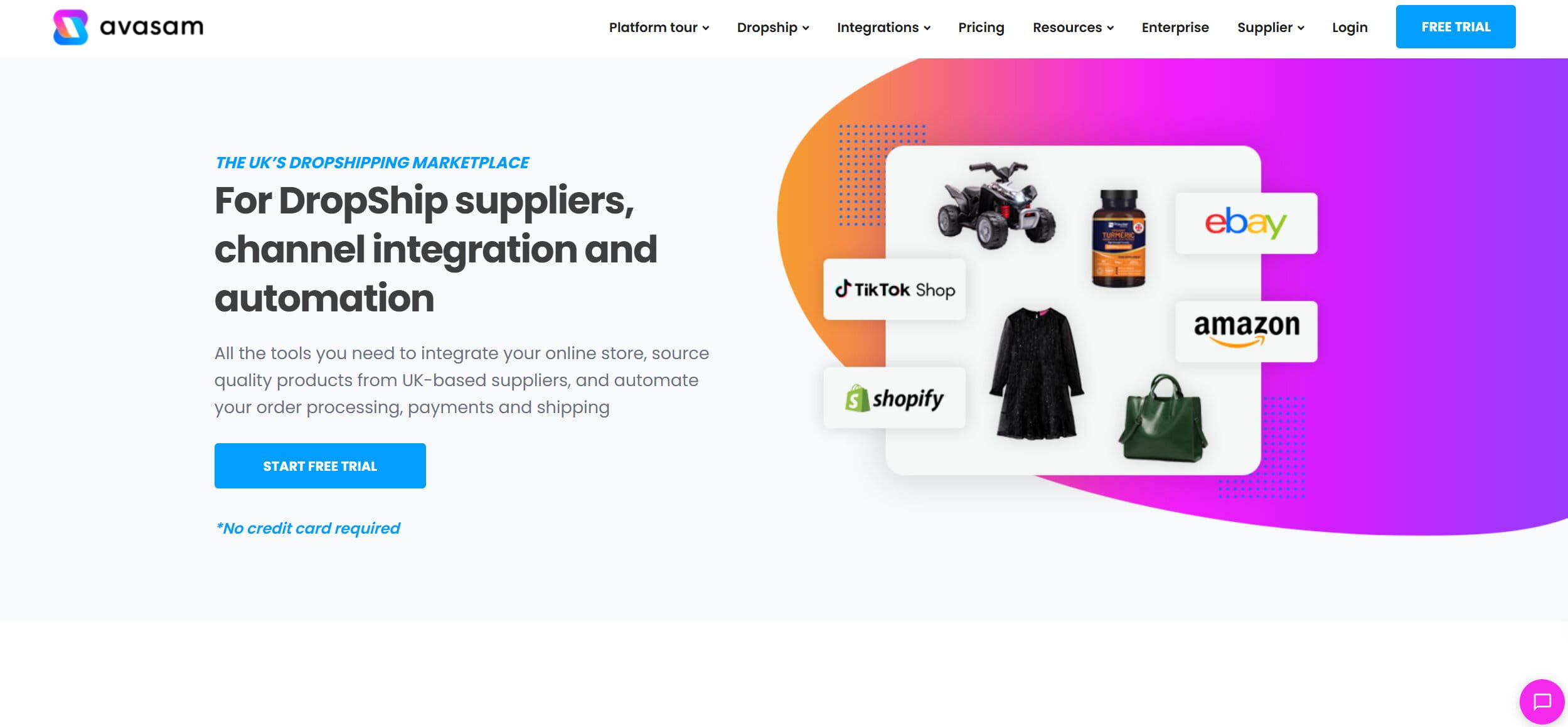
For UK and EU sellers specifically, Avasam aggregates supplier inventory and layers marketplace automation on top, and it’s popular with eBay-focused sellers since it was built with UK selling conventions and VAT handling in mind from the start. Because it pulls stock and pricing data from many underlying suppliers rather than a single warehouse, quality isn’t uniform across the catalog: some categories perform well, others are hit or miss depending on which vendor is fulfilling a given SKU.
As one of the more established aliexpress related sites for UK sellers, it works best treated as a sourcing layer to keep an eye on rather than a set-and-forget catalog.
Pros:
- Built specifically around UK selling conventions and VAT handling
- Aggregates a wide supplier network into one automated marketplace workflow
- Popular and well-tested among eBay-focused sellers specifically
Cons:
- Supplier quality varies by underlying vendor, since inventory comes from many independent sources
- Requires ongoing monitoring rather than a set-and-forget approach
- Smaller geographic reach than global aggregators, since it’s UK/EU-centered
12. Syncee
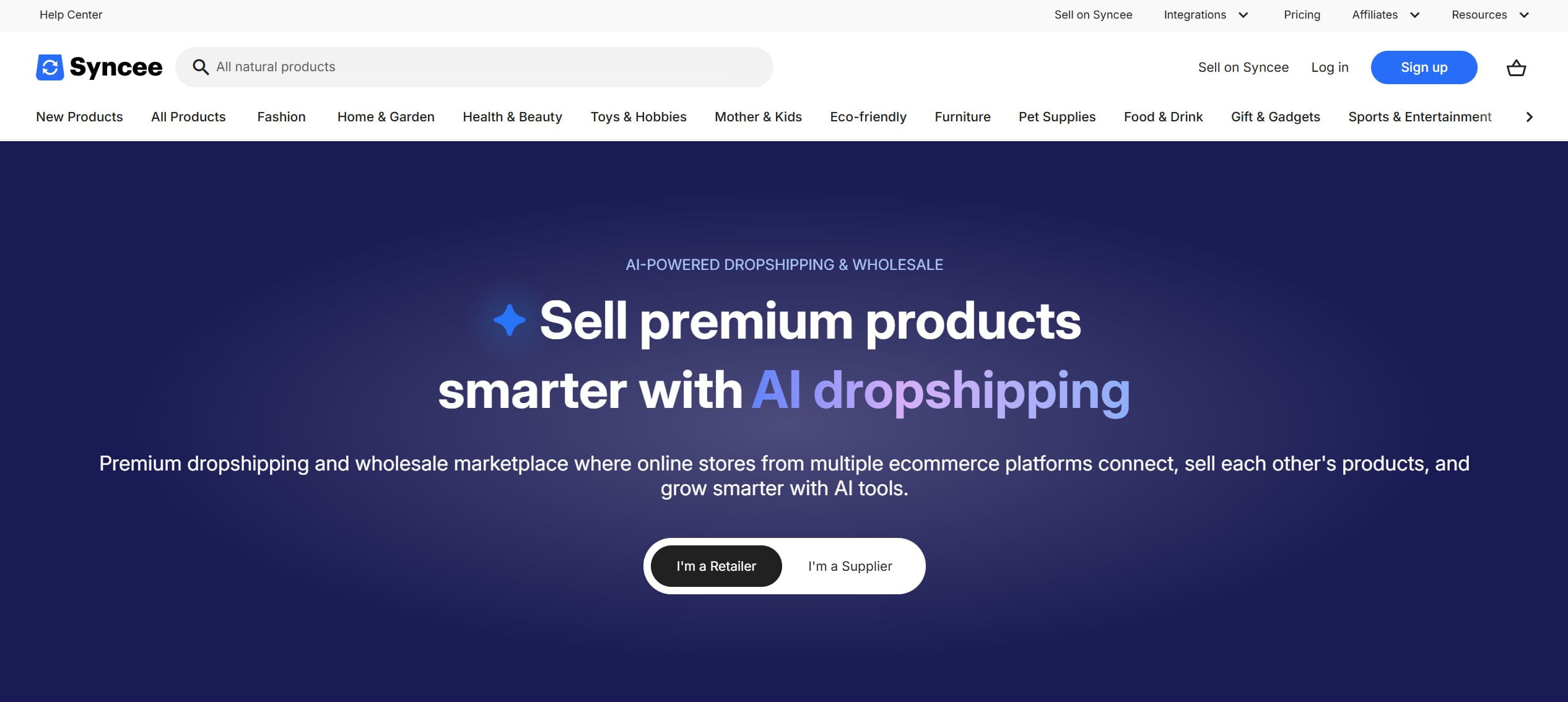
Syncee’s main draw is automation: it connects sellers to a wide network of global suppliers and keeps product data, pricing, and stock levels synced automatically, instead of the manual catalog upkeep that made AliExpress imports painful at scale. It also supports shipping to a broad range of international destinations, useful for stores selling beyond a single country, and integrates cleanly with Shopify, WooCommerce, and BigCommerce.
Because Syncee is essentially a marketplace of independent suppliers rather than a single fulfillment operation, the same caveat applies here as with most aggregator-style aliexpress type sites: vetting individual suppliers still matters, and reviews within the platform don’t replace ordering a sample first. Pricing runs on a subscription tied to catalog size and features used.
Pros:
- A genuinely global supplier network, wider than most single-country marketplaces can offer
- Product data, pricing, and stock levels sync automatically, so you’re not updating listings by hand
- Ships to a wide range of international destinations
- Plays nicely with Shopify, WooCommerce, and BigCommerce out of the box
Cons:
- Being an aggregator rather than one fulfillment operation means supplier standards vary a lot from vendor to vendor
- In-platform reviews are a starting point, not a substitute for ordering a sample yourself
- Larger stores will notice the subscription cost climbing as the catalog grows
13. Modalyst
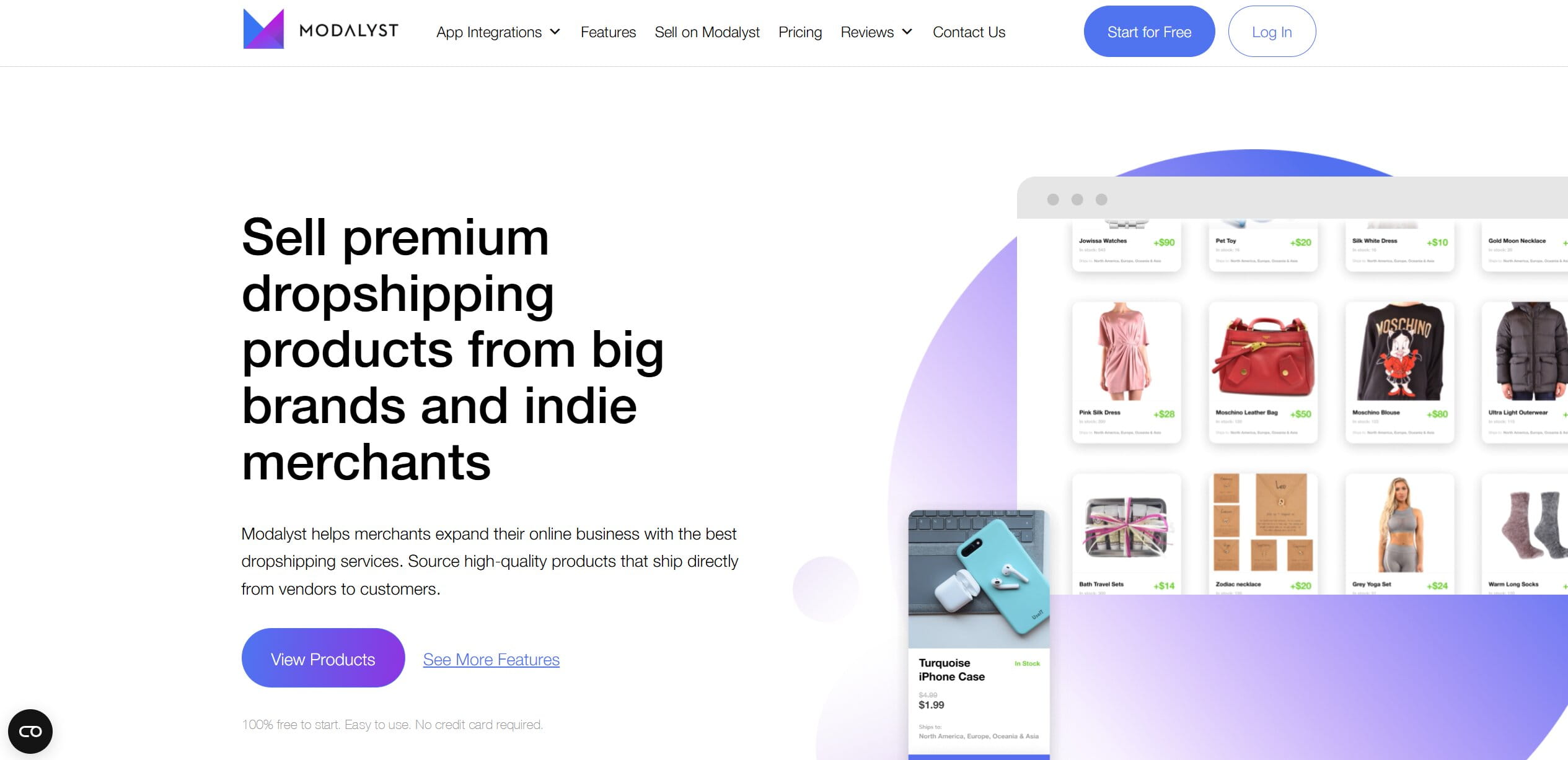
Modalyst plays a different game than most of this list: branded and premium products, not volume or rock-bottom pricing. Its catalog mixes recognizable brand names in with independent suppliers, and that shows up in the price tag too. Expect to pay more than a generic AliExpress equivalent, but the added perceived value can support higher retail pricing and better margins even after the higher wholesale cost. The catalog itself runs smaller than the giant marketplaces on this list, which is really the trade you’re making for going niche and premium instead of broad.
Pros:
- Access to recognizable brand names, which improves customer trust at checkout
- Higher perceived product value can support higher retail pricing without hurting conversion
- Better fit for a store trying to build a specific premium brand identity
Cons:
- Smaller overall catalog than volume-focused marketplaces
- Higher wholesale cost per unit than generic sourcing
- Less suited to a store trying to stock a wide, low-cost general catalog
14. Wholesale2B
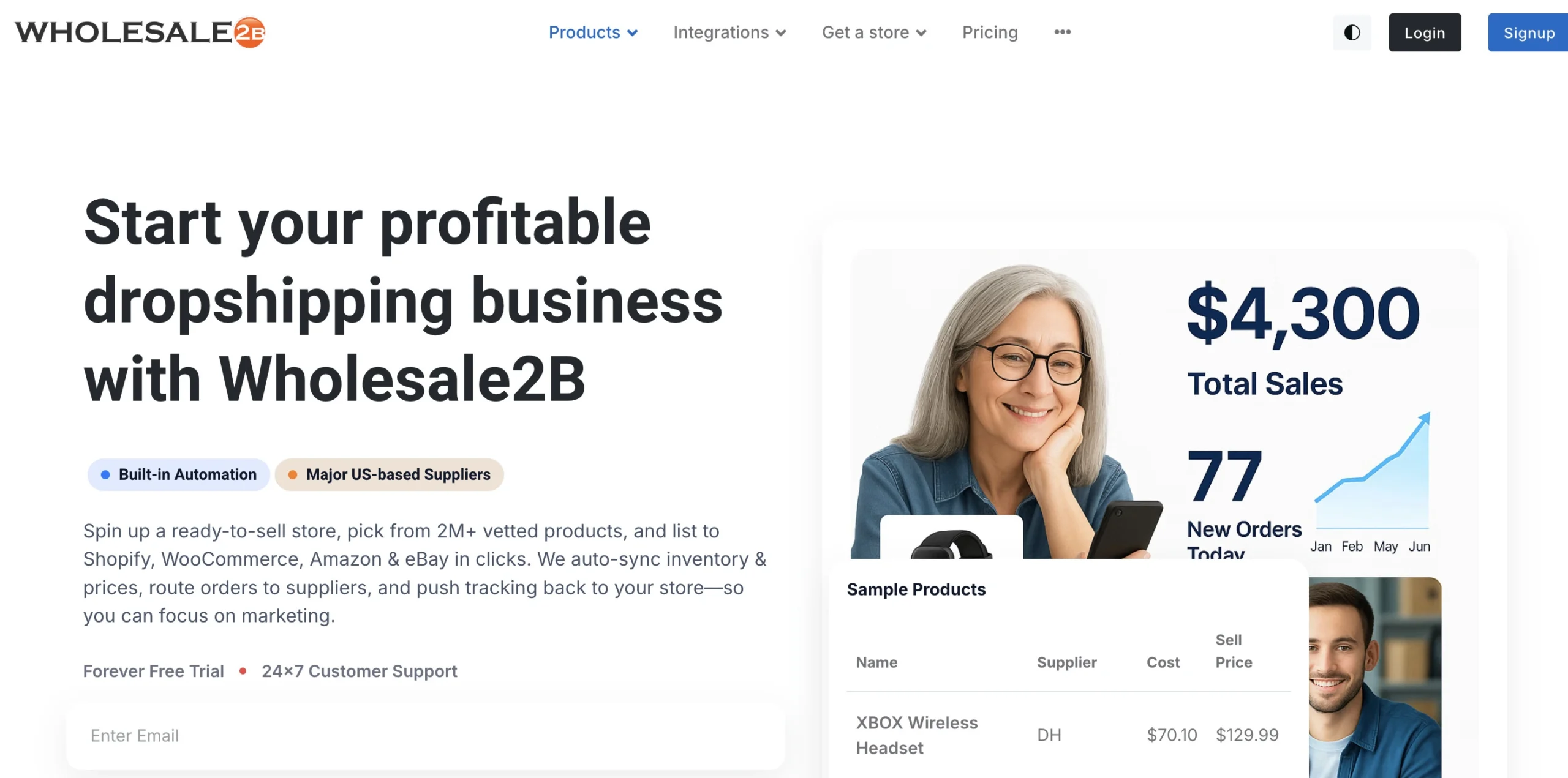
Wholesale2B has been running longer than most platforms on this list, and that shows up in both directions. It has deep integrations with wholesale suppliers and can automate order routing across Shopify, eBay, Amazon, and several other channels from one dashboard, plus pre-built store templates for sellers who’d rather not design a storefront from scratch.
What you notice fast is the interface. It feels like software built for an earlier era of dropshipping, and the learning curve reflects that. Sellers who care more about function than polish get along with it fine; anyone expecting something as slick as a newer SaaS tool might find it clunky. Pricing is subscription-based and scales with how many sales channels you connect.
Pros:
- Long track record with wholesale suppliers means the relationships behind the catalog are already established and stable
- One dashboard handles order routing across Shopify, eBay, Amazon, and other channels, so you’re not juggling separate tools
- Store templates get a new seller to a working storefront in hours rather than days
Cons:
- Menus and workflows show their age next to newer, more polished platforms
- New users typically need longer to get comfortable here than with modern alternatives
- Costs climb steadily as more sales channels get added to the account
15. DHGate
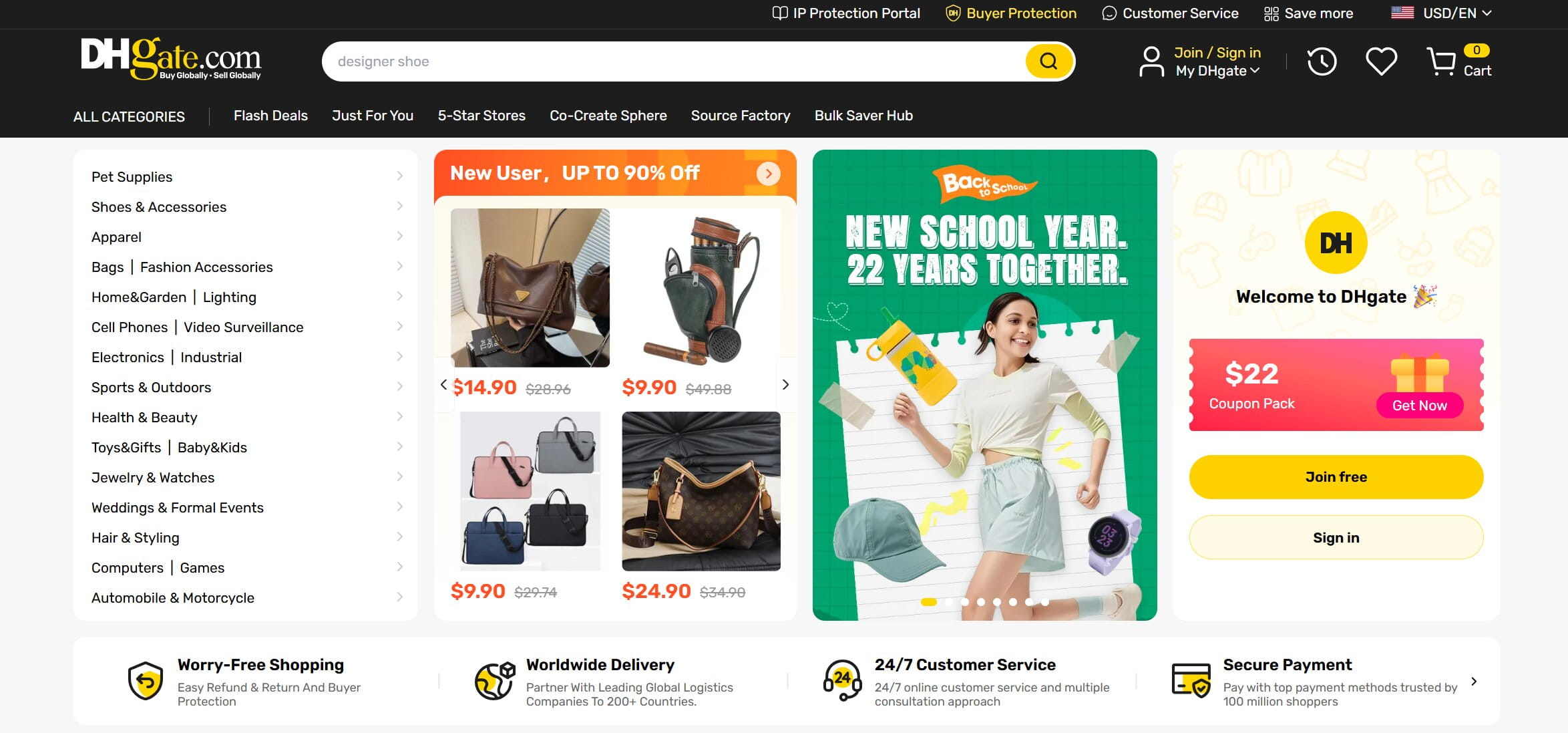
Bulk purchasing, not one-off dropship orders, is DHGate’s whole model, which makes it a slightly different fit than most entries here. It’s a China-based B2B marketplace where sellers who buy in volume, rather than order-by-order, can negotiate meaningfully lower per-unit prices than AliExpress’s individual listing prices, with shipping options including free or discounted rates tied to order volume and payment support covering PayPal, cards, and Western Union.
Buying in bulk on DHGate isn’t free of the tariff conversation, though. The same customs entry requirements now apply to volume orders as to single-unit ones, so a lower sticker price doesn’t automatically mean a lower landed cost. DHGate makes the most sense for sellers who’ve already validated that a product sells and are ready to commit capital to stock ahead, rather than someone testing a new idea unit by unit.
Pros:
- Meaningful price breaks once you’re ordering by the dozen or more, well below AliExpress’s per-unit listing rates
- Multiple payment rails, including PayPal and Western Union, which some China-based marketplaces don’t offer
- A natural next step once a product’s demand is proven and you want margin instead of just speed
Cons:
- Doesn’t suit anyone still testing single units before committing
- Ties up cash in inventory upfront, the opposite of the no-inventory dropshipping model
- Formal customs entry applies regardless of order size now, so the tariff math still has to be done
16. Doba
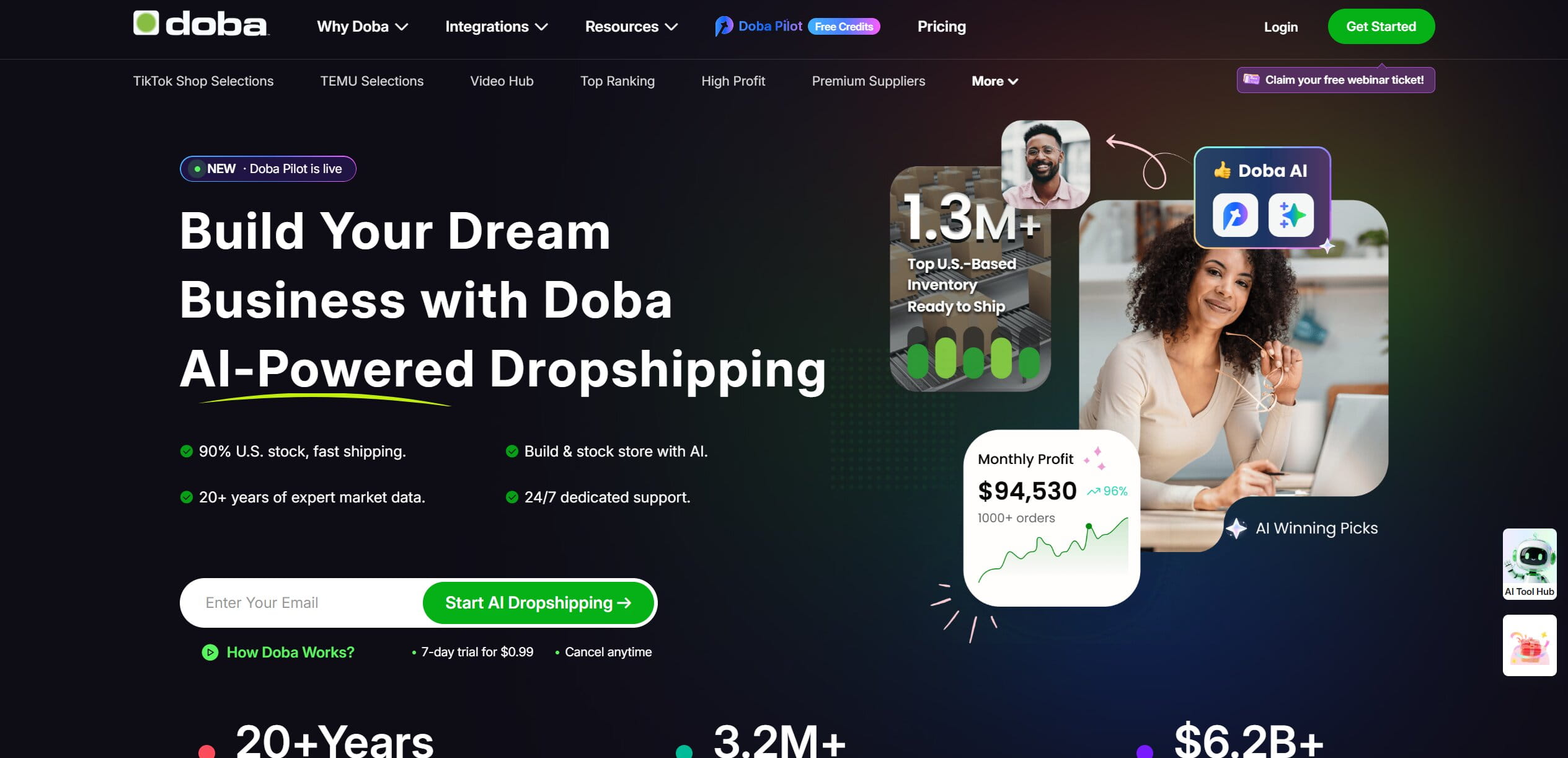
US-based warehouses are what set Doba apart from most direct-from-China platforms, putting it in more direct competition with domestic-focused competitors than with AliExpress itself. Products across categories like apparel, home goods, and fitness gear ship from stateside inventory, cutting delivery times down substantially compared to overseas sourcing.
An AI layer analyzes a seller’s existing store and recommends products likely to perform well, which is a step beyond the manual product research most AliExpress-based sellers do on their own. Direct integrations cover Shopify, BigCommerce, eBay, and Amazon.
Doba runs on a recurring subscription rather than a free-to-browse model, with monthly costs that scale from modest to fairly high depending on the feature tier. That cost structure makes Doba a better fit for an established store than a first-time dropshipper still testing the waters, even with the US warehouse network and AI-assisted product suggestions in its favor.
Pros:
- Roughly 90% of the catalog ships from US warehouses, cutting delivery to 2 to 5 days
- AI layer recommends products likely to perform well based on a seller’s existing store
- Direct integrations with Shopify, BigCommerce, eBay, and Amazon
- Eliminates most customs delays since goods are already inside the US
Cons:
- Subscription cost gets steep at higher feature tiers
- Less suited to complete beginners still deciding on a niche
- Smaller product range than sprawling China-based marketplaces
17. HyperSKU
Private labeling, not generic catalog dropshipping, is where HyperSKU built its reputation. Sellers can request custom branding on existing products or work with its team to develop something closer to a proprietary item, a meaningfully different service than what AliExpress offers.
Product photography is included as well, giving sellers professional-looking listing images without hiring a separate photographer. Over a dozen fulfillment centers across China, along with some regional hubs, keep shipping times reasonable for a supplier still primarily based overseas.
For sellers past the initial testing phase and looking to build a distinct brand identity rather than sell the same generic products as everyone else, HyperSKU fills a specific gap that most catalog-style alternatives don’t address.
Pros:
- Genuine private-label support, including custom branding on existing products
- Professional product photography included, saving sellers a separate cost
- Over a dozen fulfillment centers plus regional hubs keep shipping faster than raw AliExpress sourcing
- Dedicated team can develop closer-to-proprietary products on request
Cons:
- Still primarily overseas-based, so shipping times trail true domestic options
- Fewer platform integrations than more established competitors
- Private-label development takes more lead time than picking a product off a catalog
18. Local Wholesale Suppliers
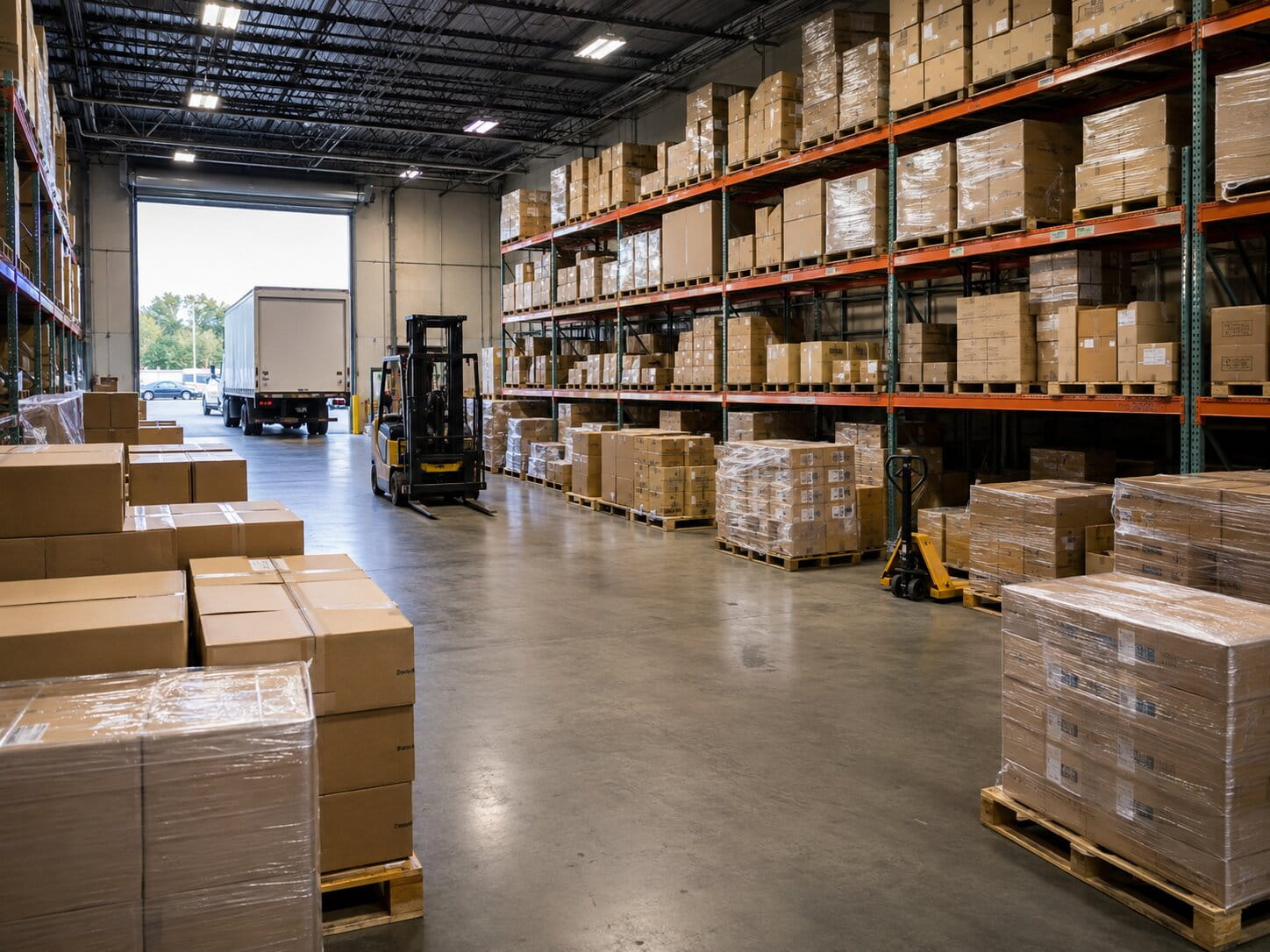
The most overlooked entry on this list isn’t a website at all. Local and regional wholesalers, the kind you find through trade shows, industry directories, or a straightforward web search for your product category plus “wholesale distributor,” offer something none of the platforms above can fully replicate: a real person to call when something goes wrong.
Domestic wholesalers typically ship within your own country, which means delivery in one to five days rather than one to three weeks, and none of the customs complexity that direct-from-China sourcing now involves under the 2026 rules. Pricing is negotiated directly rather than fixed, so established sellers with order volume can often land better margins than any of the similar sites like AliExpress covered above.
Finding them takes a bit more legwork than searching a marketplace. Trade associations, wholesale directories specific to a product category, and even a supplier’s willingness to answer the phone are all reasonable starting points. A short list of five or six regional wholesalers, contacted directly and asked about minimum order sizes and lead times, often turns up better terms than any subscription-based platform on this list.
The downside is scalability. Building relationships with local wholesalers takes more manual effort than clicking “import” on a marketplace catalog, and most don’t offer the kind of API integration that automation tools expect. It’s a strategy that rewards sellers who already know their niche well enough to seek suppliers out directly.
Pros:
- Fastest realistic shipping, since goods ship within your own country
- No customs exposure from the 2026 US and EU import rule changes
- Pricing is negotiable directly with the supplier rather than fixed
- A real person to call when something goes wrong, unlike an anonymous marketplace listing
Cons:
- Takes real manual effort to find and vet wholesalers, unlike browsing a catalog
- Little to no API integration, so automation tools mostly can’t connect to them
- Scalability is limited compared to platforms with thousands of suppliers pre-loaded
How to Evaluate AliExpress Similar Platforms for Your Store
With this many similar websites like AliExpress competing for attention, the decision usually comes down to four practical checks rather than a gut feeling about which catalog looks biggest.
1. Valid tracking generation time. Marketplace rules now expect a scannable carrier tracking number within roughly 24 to 48 hours of an order being placed. Before committing to a supplier, ask directly how fast they generate tracking, and confirm it’s a real carrier scan rather than a placeholder number. This single factor determines whether a supplier is compatible with eBay’s tracking-upload requirement or Amazon’s Valid Tracking Rate enforcement at all.
2. Dispute and return policies. Look for suppliers who commit to automatic reshipment or refund on damaged or lost items, rather than requiring a lengthy claims process for every case. A supplier that resolves disputes in days rather than weeks protects your store’s defect rate and keeps customers from escalating to a marketplace-level complaint.
3. Real-time API inventory sync. Manually checking stock levels doesn’t scale past a handful of SKUs. Platforms with a live API feed prevent the common failure mode of selling an item that’s already out of stock at the source, which is one of the fastest ways to rack up cancellations and account defects.
4. Transparent customs and DDP shipping. With formal customs entry now standard for most cross-border shipments into the US and the EU’s flat customs charge in effect since mid-2026, a Delivered Duty Paid arrangement, where the supplier handles duties upfront, removes a layer of surprise costs and delays that used to be absorbed quietly under the old de minimis rules. Ask any aliexpress similar platform directly whether their listed price already includes duty handling, because that single line item now separates a predictable landed cost from an unpleasant surprise at delivery.
Conclusion: Product Sourcing Beyond AliExpress in 2026
AliExpress hasn’t disappeared, and it still has a place for sellers testing new products before committing real budget to them. But building a dropshipping business meant to last through 2026 and beyond means treating supplier choice as a compliance decision, not just a pricing one. Customs rules on both sides of the Atlantic have tightened, and marketplace tracking enforcement has gotten sharp enough that a slow supplier is now a direct threat to account health, not just a customer complaint.
The platforms on this list, whether it’s Easync automating orders from fast US retailers, Spocket’s vetted regional network, or a local wholesaler you can call on the phone, all solve the same underlying problem in different ways: they get tracking numbers into the system fast enough to keep your store in good standing, and they get products to customers before patience runs out. That’s the actual competitive edge in 2026, not the lowest possible unit price.
If you’re weighing whether a tool like this fits your current setup, Easync’s pricing page lays out the plans and what’s included at each tier.
Frequently Asked Questions
What is the best alternative to AliExpress for dropshipping in 2026?
Easync and Spocket cover most use cases if your customers are in the US or EU, since both prioritize speed and tracking compliance over rock-bottom pricing. Sellers still chasing the lowest possible unit cost, and willing to deal with longer transit times, tend to stick with AliExpress or DHGate instead, just with more customs paperwork than a few years ago.
Are AliExpress alternatives for dropshipping more expensive than AliExpress itself?
Per unit, usually. Most charge more per product or run a monthly subscription on top. What that extra cost buys is fewer refund requests, lower dispute rates, and a much smaller chance of a marketplace suspension from late or missing tracking, savings that don’t show up on the price tag but do show up in the margin over a few months.
Do I still need to worry about customs fees with these alternatives?
That comes down to where the supplier’s warehouse actually sits. Easync, Spocket, BigBuy, Inventory Source, Doba, and local wholesalers all keep goods inside the destination market, so most of the new customs friction doesn’t apply. Anything still shipping primarily from China, AliExpress itself, DHGate, HyperSKU, and CJdropshipping’s China-based warehouse among them, now goes through formal customs entry with duties attached.
Can eBay or Amazon suspend my store for using slow suppliers?
They can, and it happens more often now than it used to. Both platforms track shipping and tracking-upload performance closely, and falling below eBay’s 95% on-time tracking threshold or Amazon’s Valid Tracking Rate requirement on a repeated basis can lead to selling restrictions. This is exactly why sourcing speed turned into a compliance question instead of just a customer-experience one.
Which AliExpress alternative sites are best for beginners?
Easync and Spocket keep the learning curve low with guided setup and automation built in, so a first-time seller isn’t stuck manually chasing tracking numbers or emailing suppliers. AutoDS gets more done once you know what you’re doing, but the setup itself is more involved and probably better suited to someone who’s already run a store.
Is it still worth using AliExpress at all in 2026?
For testing a new product idea before spending real money on inventory or ads, sure. Where it falls apart is at scale: once order volume climbs, slower shipping, inconsistent quality, and the tracking-compliance risk stack up to the point where a faster, more accountable supplier is worth paying more for.