
- articles
Temu Dropshipping Guide: Policy, Risks, Strategy
Quick answer: Temu dropshipping means sourcing products from Temu and selling them through another store or marketplace, but Temu’s terms of service do not officially support this model. There’s no dropshipping API, no blind shipping, and no dedicated supplier program. Sellers who use Temu as a source place orders manually, ship in Temu’s branded packaging, and take on more operational risk than they would with AliExpress or CJdropshipping. That doesn’t make it useless. It makes it a tool for a specific job: testing demand fast and cheap before committing to a proper supplier.
Search interest around dropshipping with Temu has grown steadily since the platform launched in the US in 2022, and for good reason. The catalog is enormous, prices undercut almost every competitor, and new sellers keep asking whether they can turn that into a business. The honest answer sits somewhere between “yes” and “not quite the way you’re imagining.” This guide walks through what Temu dropshipping actually looks like in practice, what the policy says, where reliable suppliers come from, and how to build a workflow that doesn’t collapse the first time Temu flags an account.
What is Temu Dropshipping and How Does It Work?
There are really two ways people talk about dropshipping temu products, and conflating them causes most of the confusion online.
The first is using Temu purely as a research tool. You browse categories, watch which items climb in orders and ratings, and treat the platform as a live feed of what’s selling right now in the US, Germany, Spain, and other markets where Temu has scaled. This is low-risk. You’re not fulfilling anything through Temu, just mining it for signal before sourcing the winning product from a proper supplier.
The second, and the one most people mean when they say “dropshipping on Temu,” is manual fulfillment. A customer buys from your Shopify store or Amazon listing, and you turn around and place that exact order on Temu, entering the customer’s shipping address instead of your own. Temu ships it, the customer receives a package with Temu’s orange branding on it, and you pocket the margin between what you charged and what Temu charged you.

International sellers run into the same model under different names. In Spain and Latin America it shows up in searches as dropshipping con Temu, and the mechanics don’t change: no API, no reseller dashboard, same manual process, just conducted in Spanish-language storefronts and forums. German-speaking sellers search for dropshipping mit Temu for the same reason, since Temu’s presence in Germany and Austria has grown quickly and local sellers are testing the same workaround. The policy risk and the packaging problem apply everywhere Temu operates, not just in English-speaking markets.
Pros and Cons of Temu Dropshipping
Before building a process around Temu, it’s worth weighing what actually works in its favor against what makes it harder to run than a dedicated dropshipping supplier.
Where Temu holds up:
- Prices that regularly sit below $5 on entire categories, which matters when margin is the main lever a small store has to work with.
- A catalog spanning dozens of categories, so most niches have at least some overlap worth checking.
- A 90-day return window that gives buyers confidence at checkout, even though the dropshipper ends up handling the operational side of any return.
- Frequent flash sales and coupons that can be passed along to shoppers to stay competitive on price.
Where it falls short:
- No API and no bulk tools, so every order gets entered by hand, which caps how many a day one person can realistically process.
- Temu’s own branded packaging on every shipment, with no option to disguise or rebrand it.
- Returns route back through the dropshipper’s own account rather than the end customer’s, which means personally receiving, checking, and refunding items instead of pointing the customer back to the original supplier.
- Product and seller quality varies widely across the catalog, and a customer who receives a counterfeit or unsafe item holds the store responsible, not Temu.
- Shipping can stretch past two weeks, and the customs changes in the US and EU have made both landed cost and delivery timing less predictable than they were a couple of years ago.
Weighed together, these points don’t rule Temu out as a source. They mostly mean budgeting for the manual labor and customer service load that a proper dropshipping supplier would otherwise absorb.
Temu vs. Traditional Dropshipping Suppliers
| Factor | Temu (Direct Sourcing) | AliExpress | CJdropshipping |
|---|---|---|---|
| Official support for dropshippers | Not supported, ToS discourages reselling | Supported via AliExpress Dropshipping Center | Fully supported, built for dropshipping |
| Packaging / branding | Temu-branded orange packaging, no white-label option | Blind shipping and custom packaging available on request | Custom branding, inserts, and packaging slips |
| Order automation | None, manual entry required per order | Partial, via third-party apps and browser extensions | Full API integration with Shopify, WooCommerce, etc. |
| Shipping speed | Often 7 to 15 days, sometimes longer | Varies by supplier, typically 7 to 20 days | Faster with US/EU warehousing options |
| Pricing | Very low per-unit cost | Low to moderate, negotiable at volume | Moderate, with wholesale tiers |
| What sellers call it locally | Known as dropshipping con Temu in Spanish-speaking markets, dropshipping mit Temu in German-speaking ones | Terminology is consistent across most language markets | Terminology is consistent across most language markets |
The table makes the trade-off obvious. Temu wins on raw price and product discovery. Everyone else wins on the operational side, which is where most dropshipping businesses actually break down.
Understanding the Official Temu Dropshipping Policy
There’s no shortcut around this part. Temu’s help center is clear that the marketplace exists for personal purchases, not for supplying third-party stores. That’s a different position from AliExpress, which explicitly built a dropshipping-facing product, or CJdropshipping, whose entire business model is fulfillment for other sellers.
In practice, enforcement centers on account behavior rather than individual orders. A personal account placing one or two orders a week rarely draws attention. An account shipping dozens of orders to dozens of different names and addresses looks like a reseller, and Temu has suspended accounts that fit that pattern. There’s no published threshold, which means sellers are operating in a gray zone without a clear line to stay behind.
Cross-border costs have also shifted the math since 2024. The United States removed the $800 de minimis exemption for low-value imports, first for Chinese-origin goods in May 2025 and then for shipments from all countries by the end of August 2025, so orders that used to clear customs duty-free no longer do. The European Union followed a similar path: its €150 duty exemption ended on July 1, 2026, replaced by a temporary flat customs duty of €3 per item while the EU builds out a fuller customs framework through 2028. Either way, the era of frictionless, duty-free cross-border parcels is over on both sides of the Atlantic, and that changes margins for anyone sourcing from Temu, AliExpress, or any other China-based marketplace.
There’s also a reputational layer worth knowing about. Back in May 2026, EU regulators fined Temu roughly 200 million euros under the Digital Services Act, pointing to repeated failures to keep counterfeit and unsafe products off the platform — earlier testing had already flagged baby toys and electronics as problem categories before the fine came down. It’s a reminder that product legitimacy checks matter as much as fulfillment logistics when sourcing from any low-cost marketplace.
How to Find Reliable Temu Dropshipping Suppliers
Temu’s catalog is a mix of sellers with wildly different fulfillment setups, and the platform doesn’t always make that obvious upfront. A few checks are worth doing before treating any listing as a repeatable source:
- Check the seller’s storefront, not just the product page. Scrolling down on any listing shows a seller card with follower count, total units sold, and a separate store-level rating. That number is often different from the product’s own star rating, and it’s the better signal of consistency over time.
- Look for the “Brand Official Store” or “Top Brand” badges. These appear on storefronts run by the actual manufacturer or an authorized seller, and they tend to correlate with more consistent stock, accurate listings, and faster resolution if something goes wrong.
- Note how long the seller has been active. Temu shows a line like “Started to sell on TEMU [X] ago” on the storefront. A seller with a year or more of history and thousands of units sold is a safer bet than a new storefront with a handful of reviews.
- Place a small test order yourself before promising the item to customers. This catches quality issues, mislabeled sizing, and shipping delays before they become customer complaints.
- Watch the review section for repeated complaints about the specific variant you’re planning to sell, since color or size variants on the same listing can come from different production runs.
Even a seller who checks out on every point above can still change stock, pricing, or availability without warning. Treat any given listing as temporary rather than a long-term supply line.
Step-by-Step Guide: How to Start Dropshipping From Temu Safely
Step 1: Find a Product Worth Testing
Start inside Temu’s own Best Sellers and trending categories rather than browsing at random. Cross-reference anything that catches your eye against Google Trends, and if you’re also considering Amazon or eBay as a sales channel, check their own trending pages (Amazon Movers & Shakers, eBay’s trending searches) to see whether interest is showing up in more than one place.
A product worth testing usually checks most of these boxes:
- It isn’t something a shopper can easily grab at a local store, which is most of what makes Temu’s catalog interesting in the first place.
- It solves a specific, narrow problem rather than being a generic gadget with no clear use case.
- It’s small and light enough that shipping cost doesn’t eat into the margin, since anything bulky gets expensive fast once customs duties are added on top.
- It isn’t already saturating every competitor’s ads, which you can gauge with a quick scroll through TikTok or Facebook’s ad library for the product name.
- It isn’t on Temu’s restricted or prohibited items list, and it isn’t a counterfeit or trademark-infringing version of a branded product, since that risk lands on you as the seller, not on Temu.
At this early stage, it’s also worth a quick glance at the seller behind the listing, using the storefront checks covered later in this guide. A product can look promising and still be sourced from a seller with a thin track record, which is a bad combination to build a test around.
Step 2: Pick a Sales Channel
This decision shapes almost everything downstream, including which products are even worth testing.
Selling on Amazon puts your listing in front of built-in traffic, but Amazon’s Drop Shipping Policy is specific: you must be the seller of record, your business name has to appear on all packing slips and invoices, and any third-party branding must be removed from the package before it reaches the customer. Temu ships everything in its own branded packaging, with no option to swap it out, which makes Temu-sourced products genuinely difficult to fulfill compliantly on Amazon without repackaging the item yourself before it goes out. On the fee side, Amazon’s Individual plan charges $0.99 per item sold with no monthly fee, which works out cheaper under roughly 40 sales a month. Past that volume, the Professional plan’s flat $39.99 monthly fee usually costs less overall and adds bulk listing tools and advertising access.
Selling on eBay carries lighter branding restrictions than Amazon, which makes it a more forgiving fit for Temu-sourced products in their branded packaging. Most sellers get 250 free listings a month before insertion fees kick in, and eBay’s final value fee runs in the 13 to 14 percent range on the total sale amount (item price plus shipping), on top of a small per-order fee. An eBay Store subscription lowers both the insertion fee threshold and the final value fee rate for anyone listing in volume.
Running your own store on Shopify starts at $39 a month billed monthly, or around $29 a month with annual billing, plus standard payment processing fees on each transaction. A personal store sidesteps Amazon’s branding rule entirely, since there’s no marketplace policing what shows up in the box, though it also means no built-in audience. You’re responsible for all of your own traffic from day one.

Many sellers start where the audience already exists, then move toward their own store once a handful of products have proven themselves and repackaging or rebranding becomes worth the extra effort.
Step 3: Build and Price the Listing
Write a clear, keyword-relevant title and use real product specifications rather than copying Temu’s listing description word for word, since duplicate content can hurt visibility on both search engines and marketplace algorithms. Set a delivery estimate that reflects actual shipping time from Temu, not a generic “2 to 5 business days” that will generate complaints the moment an order runs past a week.
For pricing, work from the full cost stack rather than the product’s sticker price: the Temu purchase price, the customs duty that now applies to most cross-border parcels under the post-de minimis rules, any marketplace referral or payment processing fees from Step 2, and the margin you actually need to make the time worthwhile. A product that looks profitable at its Temu price alone can turn into a break-even sale once all four of those are added in.
Step 4: Get the Listing in Front of Buyers
Organic content on TikTok and Instagram still drives a meaningful share of first sales for physical products, especially anything with a visual “wow” factor that demonstrates itself well on video. A short demo clip usually outperforms a static product photo for this kind of item. Paid social ads move faster but cost money upfront, so testing with a small organic push first is a reasonable way to gauge interest before spending on ads.
If you’re selling on a marketplace, layer its built-in advertising tools on top of organic content rather than relying on either one alone: Amazon’s Sponsored Products ads and eBay’s Promoted Listings both put a new listing in front of buyers who are already searching for similar items. For a personal store, basic on-page SEO (clear titles, real product descriptions, decent page speed) matters for anyone planning to rely on search traffic long-term, though it takes longer to pay off than paid channels and won’t move the needle during an initial test.

Step 5: Validate Demand Before Committing Further
Run a limited ad campaign or a short organic push using the listing built in Step 3, and treat the first batch of orders as a signal rather than a target. A handful of real sales, with real customers following through to checkout, tells you more about whether a product will work than any amount of speculation about trends or competitor activity.
If a product doesn’t get traction within a reasonable test window, move on rather than continuing to push ad spend at something the market has already answered.
Step 6: Fulfill the First Orders Manually, On Purpose
Once a product starts moving, place the order directly on Temu using the customer’s shipping address exactly as it appears in your store, not your own address. Keep a simple record of which Temu order number maps to which customer order, since there’s no automated system linking the two and reconciling this by memory gets unreliable fast once you’re handling more than a few orders a day.
This stage is deliberately manual. The point isn’t efficiency, it’s confirming that the product performs once a real customer receives it and uses it, not just once they see it in an ad. Quality issues, sizing problems, and packaging complaints tend to surface here, before you’ve committed to sourcing the item at scale.
Step 7: Handle Customer Service Proactively
Temu’s branded packaging and shipping windows that can run past two weeks make customer questions more likely than they would be with a supplier built for dropshipping. Message customers with tracking updates before they have to ask, and be upfront about expected delivery time at checkout rather than defaulting to an optimistic estimate.
If a product arrives late or doesn’t match its listing, resolve it directly rather than pointing the customer back to Temu. Since the customer bought from your store, they hold you responsible for the outcome, not the platform behind the fulfillment.
Step 8: Move the Winner to an Automated Supplier
Once a product has proven itself over a real sample of orders, look for the same or a comparable item on CJdropshipping or through AliExpress’s Dropshipping Center rather than continuing to place manual Temu orders. Matching the exact product isn’t always possible, so compare specifications and photos carefully, and order a sample from the new supplier before switching your live listing over to make sure quality holds up.
This is the step most people skip, and it’s the one that actually determines whether the business can handle more than a handful of orders a day. Automated suppliers connect to Shopify or WooCommerce through an app or API, which removes the manual entry bottleneck from Step 6 and, for suppliers with US or EU warehouses, usually cuts shipping times as well.
Step 9: Rebuild Your Margins Around the New Customs Costs
With de minimis exemptions gone in both the US and EU, the cost stack from Step 3 needs revisiting on a recurring basis, not just once. As an illustration: a product that landed at $6 all-in a couple of years ago, before duties applied to low-value parcels, might land closer to $8 or $9 today once the flat EU duty or the reinstated US tariffs are factored in. Whether that still leaves room for profit depends entirely on the sale price and the fees from whichever channel you picked in Step 2, which is exactly why this needs to be recalculated per product rather than assumed to still hold from an earlier test.
Where a Tool Like Easync Fits In
Once a product moves past the testing phase described above, the manual side of this process starts costing more time than it saves. Tracking which items are trending, watching for pricing or stock changes across sourcing platforms, and knowing when a product has proven itself enough to move to an automated supplier are all things that get harder to manage by hand as a catalog grows.
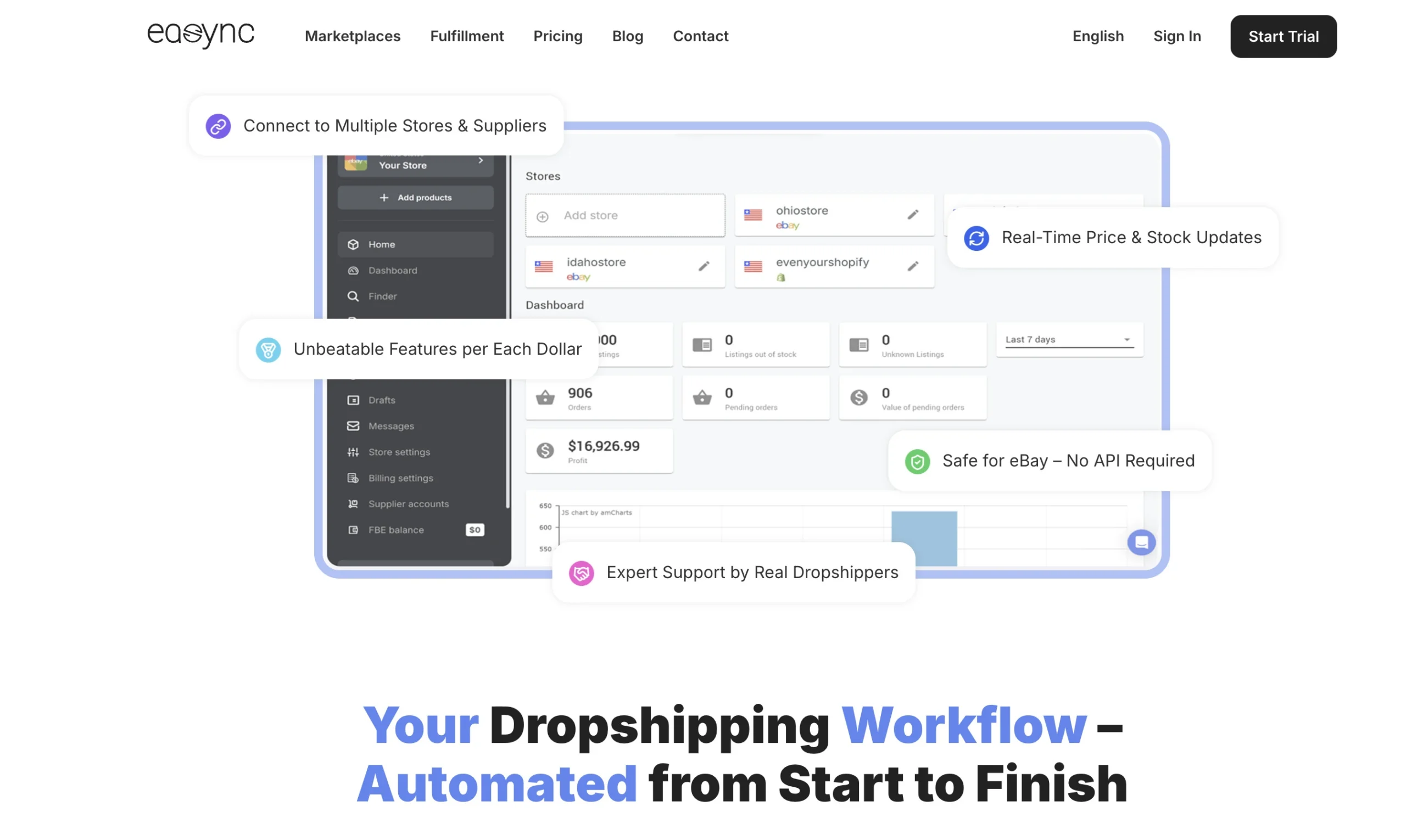
A platform like Easync is built to fill exactly that gap. Rather than automating Temu orders directly, which isn’t possible given the lack of an API, it works alongside the workflow above: helping sellers spot trending products earlier, keep pricing consistent across multiple suppliers, and manage the transition from manual testing to automated fulfillment without losing track of what’s actually working. For sellers running more than a handful of products at a time, that kind of visibility tends to matter more than any single supplier choice.
Best Alternatives to Temu Dropshipping
AliExpress remains the closest thing to an industry default. Its Dropshipping Center gives sellers access to shipping time estimates, supplier ratings built specifically around dropshipper needs, and integrations with most major storefront platforms.
CJdropshipping goes further on the fulfillment side, with warehousing in the US and parts of Europe that cuts delivery times well below what direct-from-China shipping can offer. It also supports custom packaging and branded inserts, which solves the exact problem Temu can’t: a customer who receives an unbranded package has no easy way to cut you out and order directly from the source next time.

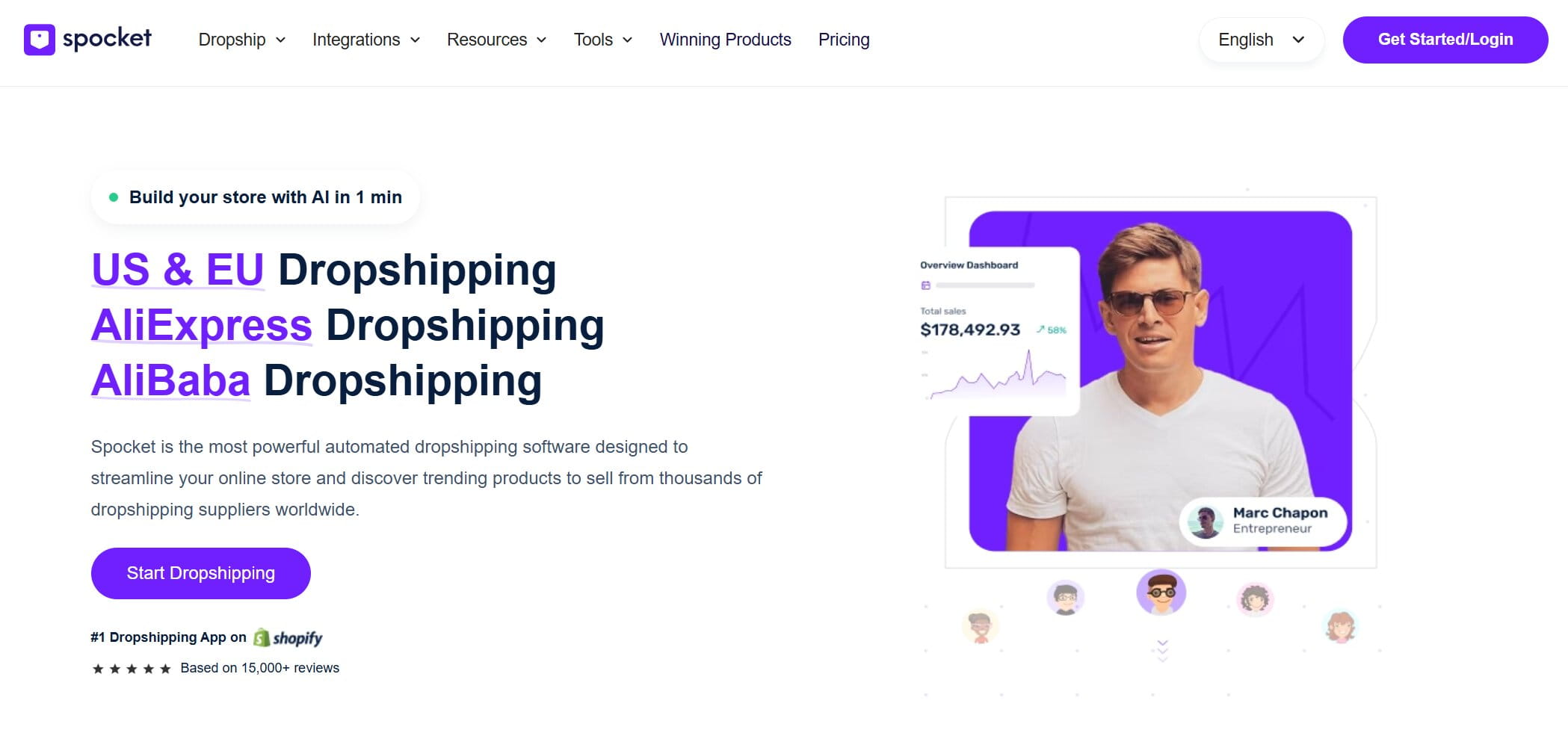
Spocket leans into suppliers based in the US and EU specifically, with blind shipping built in by default and API connections that sync inventory and orders automatically. It costs more per unit than Temu or AliExpress in most categories, but the trade-off is speed and reliability that’s harder to guarantee otherwise.
None of these fully replace Temu’s prices. What they replace is the operational fragility that comes with sourcing from a platform that was never built for resellers in the first place.
Frequently Asked Questions
Is dropshipping from Temu legal?
Reselling something you legally purchased isn’t illegal in most jurisdictions. The issue is contractual, not criminal: Temu’s terms of service prohibit using the platform to fulfill orders for a separate business, and violating those terms can get an account suspended. It’s a policy risk rather than a legal one, but the practical consequence, losing your sourcing account, is still worth taking seriously.
Can I use Temu for Shopify dropshipping?
You can list Temu products on a Shopify store, but there’s no official app connecting the two platforms. Every order has to be entered on Temu by hand, using the customer’s shipping details instead of your own. That works fine at low volume and becomes a real bottleneck once orders pick up, which is usually the point where sellers start migrating winning products to AliExpress or CJdropshipping instead.
Why does my package show Temu’s branding instead of mine?
Temu ships everything in its own packaging, with no white-label or blind-shipping option. Customers who notice this sometimes order directly from Temu next time instead of coming back to your store. Some sellers work around it by using a third-party repackaging service, but that adds cost and time to every order, so it only makes sense once volume justifies it.
How has the removal of de minimis exemptions affected Temu sourcing?
The US ended duty-free treatment for low-value imports in 2025, and the EU followed with its own change in mid-2026, replacing a duty exemption with a temporary flat fee per parcel. Products that used to arrive without customs charges now often carry added cost, which has narrowed margins for anyone building a business around cheap cross-border sourcing, Temu included.
What’s the biggest mistake new sellers make with Temu dropshipping?
Treating it as a long-term supplier rather than a testing ground. Temu is genuinely useful for spotting trends and validating demand cheaply, but building an entire fulfillment operation around manual orders and unpredictable stock tends to fall apart once order volume grows past what one person can handle by hand.
How do returns work when dropshipping from Temu?
The return goes through the dropshipper’s own Temu account, not the end customer’s. That means receiving the item back at your own address (or a forwarding address), checking it, and issuing the customer’s refund yourself before dealing with Temu’s return process separately. It’s more hands-on than returns through a supplier built for dropshipping, where the customer can often return directly to a warehouse.
Is Temu dropshipping actually profitable in 2026?
It can be, mainly on the testing side rather than as a full fulfillment model. Margins on manually fulfilled Temu orders tend to be thin once customs duties and the time cost of manual entry are factored in, which is why most people who make money with this approach use Temu to find winners cheaply and then fulfill them through a supplier that supports automation once volume justifies it.