
- Amazon Dropshipping
- articles
- eBay Dropshipping
- Shopify Dropshipping
Selling on Amazon vs eBay vs Shopify: The Ultimate Dropshipping Guide 2026
Key Takeaways:
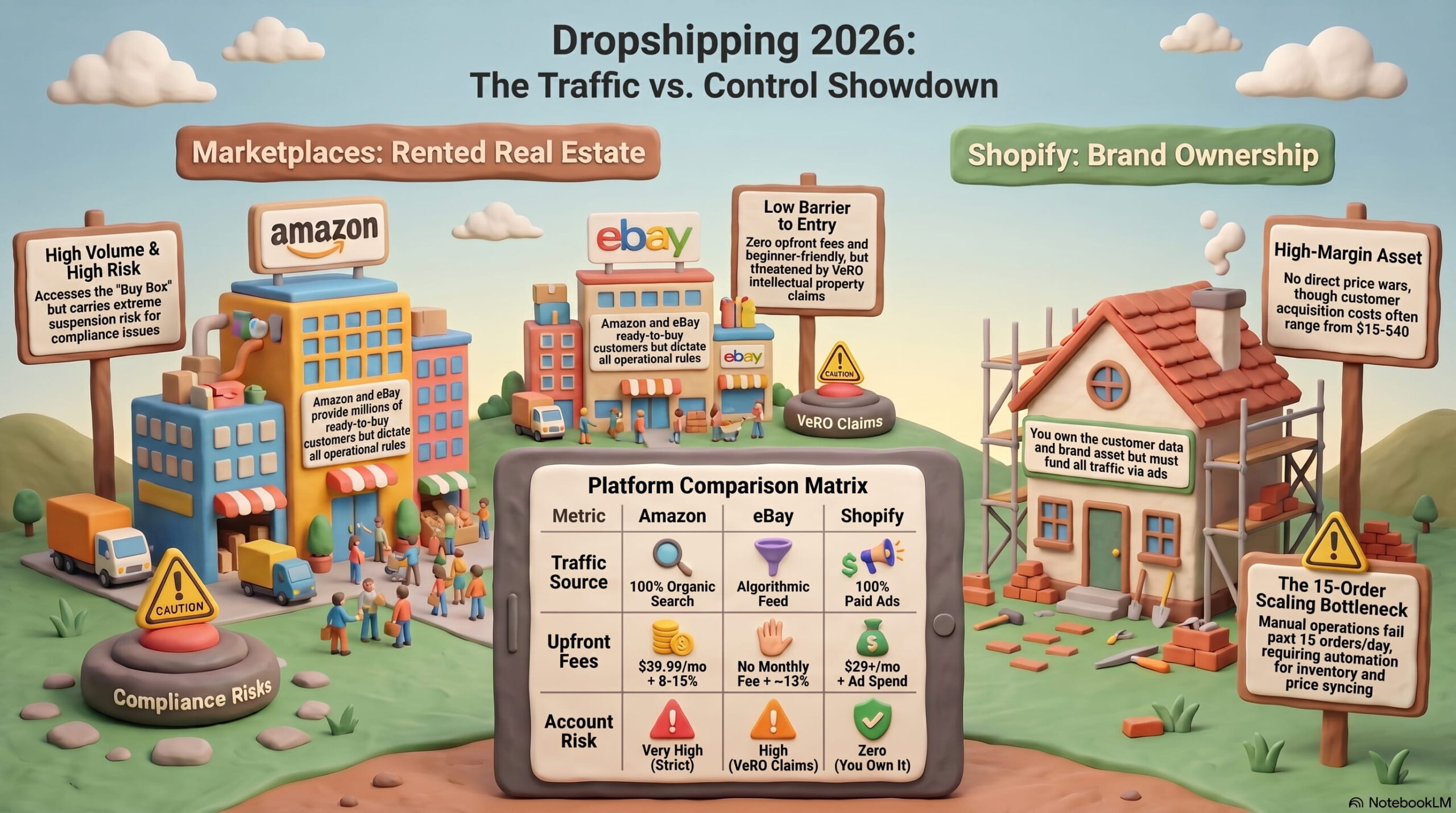
- The Ultimate Trade-off: Traffic vs. Control: Marketplaces (Amazon/eBay) “rent” you their massive, built-in audience but strictly dictate the rules. On Shopify, you fully own your brand and customer data, but you must build and fund all your traffic from scratch through digital marketing.
- Amazon Massive Volume with Extreme Compliance Risk: The platform provides a colossal stream of high-intent buyers (primarily driven by the Buy Box). However, it has the strictest rules: you must be identified as the Seller of Record, or your account will be instantly suspended for retail arbitrage.
- eBay Low Barrier to Entry with Squeezed Margins: It is the most beginner-friendly option due to zero upfront monthly fees and a temporary visibility boost that the algorithm grants to fresh listings. The main downsides are manual listing management and intense price competition.
- The VeRO Program Landmine on eBay: Dropshippers face high suspension risks for listing branded products without direct wholesale invoices. Brand lawyers routinely issue automated intellectual property claims through the Verified Rights Owner (VeRO) program, instantly nuking listings.
- Shopify. High Margins and Independent Asset Building: Running your own storefront eliminates direct on-page competitor comparison and builds long-term value (email lists, retargeting pixels). The profit ceiling is much higher because you sell brand value rather than fighting in pricing wars.
- The Necessity of Automation for Multichannel Growth: Diversifying across multiple platforms is the best insurance policy against sudden account bans. However, managing manual price logs and stock syncs gets messy fast, making automation software (like Easync) a critical technical foundation.
One of the biggest decisions you are going to make around dropshipping is which platform you should use to sell your products. It’s the first decision that can have a huge impact on your success later on.
The answer isn’t as straightforward as it may seem. You can’t just pick the platform that produces the most traffic. The reason being that each platform is a completely different business.
Not to sound dramatic, but when comparing Shopify vs Amazon vs eBay, you’re choosing your entire operational structure, compliance risk profile, and profit ceiling.
Those three platforms dominate the dropshipping conversation. They are very different from the get-go, and the issue with choosing the wrong one is that you can wake up one day to a suspended account, without even knowing why.
These platforms matter because they have transparent compliance rules and lower account ban risks. Let’s cut through the noise and assist you in your decision-making process.
The Infrastructure Divide: Closed Marketplaces vs. Independent Storefronts
There are some big differences that you should know when you’re deciding between selling on Amazon vs eBay or going independent with Shopify.
Amazon and eBay are marketplaces that are rented digital real estate. There are millions of buyers who shop there on a daily basis. Sounds like a no-brainer. But that free traffic comes with strings. You operate inside their rules. Your visibility is based on their algorithm, and you have no ownership of customer data.
Amazon could technically suspend your account overnight over a policy violation that you never knew existed.
With Shopify, you are the landlord. It’s your own storefront. You build the asset, and control everything. No unexpected bans.
The trade-off is that Shopify won’t bring you a single customer. 100% of your traffic must be generated through your own marketing efforts, which can be costly and time-intensive.
Marketplace buyers have immediate commercial search intent. They’re ready to buy right now. Shopify customers come from disruptive social intent. They’re scrolling TikTok and see your ad. One is not inferior to the other. It’s just different buyer psychology.
Before picking a platform, you need to understand that when evaluating shopify vs amazon and eBay, traffic is either brought to you or you have to work for it.
Let’s get into each one.
Dropshipping on Amazon: Unmatched Volume with Extreme Compliance Risk
Amazon’s main benefit is undoubtedly traffic volume. It’s also where your account dies if you miss one compliance detail.
The Amazon Buy Box Reality
On Amazon, most dropshippers don’t create their own product listings. The process goes like this.
- They hunt for products that already exist on the platform (using ASIN).
- Then list themselves as an alternative seller
- Sit back and hope to win the Amazon Buy Box. That converted “add to cart” button that wins 80%+ of sales.
But the problem with this approach is that you are competing on price. With so many sellers fighting for the lowest price, you can imagine how low profit margins get.
People take this approach because the algorithm automatically feeds traffic to the lowest price.
Amazon Cost Structure
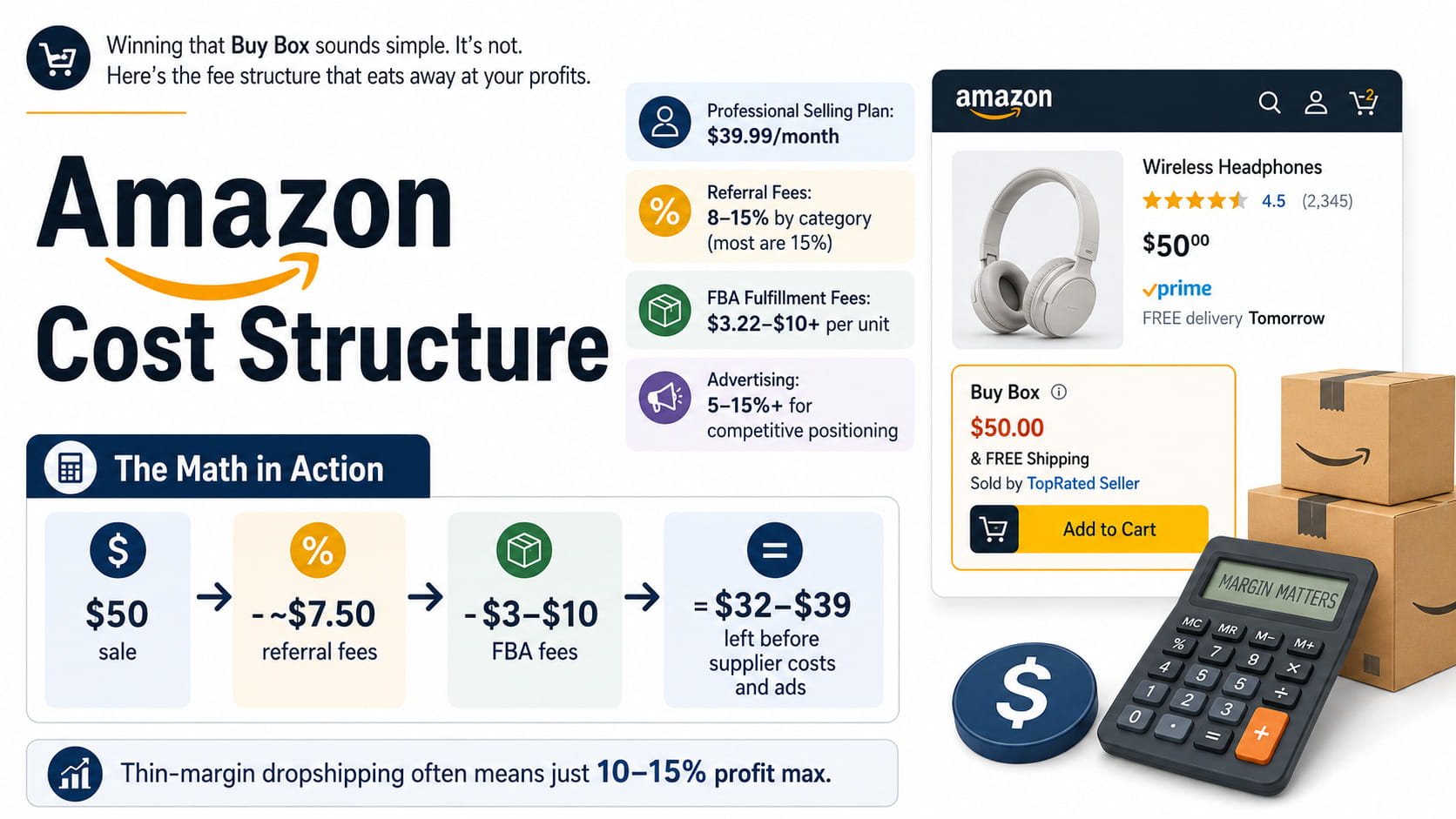
Winning that Buy Box sounds simple, right? It’s not. Here’s the fee structure that eats away at your profits.
- Professional Selling Plans start at $39.99 per month
- Referral Fees are around 8-15% depending on the category (most are 15%)
- FBA fulfillment Fees cost $3.22-$10+ per unit (varies by product weight/size)
- Advertising can reach 5-15%+ for competitive positioning
The Math In Action: A $50 sale costs you $6.50–$7.50 in fees alone. Add supplier costs, and you’re operating on razor-thin margins unless you are selling at volume.
Let’s say you sell a product for $50. That product sale gets hit with ~$7.50 in referral fees. Then an additional $3-10 in FBA fees. This leaves you $32-39 before supplier costs and ads.
This is called thin-margin dropshipping because you’re looking at 10-15% profit max.
The Compliance Bottleneck: Seller of Record
This is where things get tricky. Amazon’s official policy requires you to be identified as the Seller of Record.
In simple terms, your company name needs to appear on every piece of documentation that ships to the customer. This includes all invoices, packing slips, and external packaging.
The reason is that Amazon wants to prevent retail arbitrage (buying from Target, repackaging the product as “new”, and reselling it). The same is applied to dropshippers who source products from AliExpress or other retailers without wholesale agreements. You will receive instant tracking bans, which leads to account reviews via Amazon Seller Central.
You need:
- Wholesale supplier invoices listing you as the buyer
- Your company name on all shipping documentation
- Proof that you’re not just scraping retain inventory
Following these guidelines means you won’t have your store suspended and a hold on your funds.
Dropshipping on eBay: Low Barrier to Entry with Compressed Profit Margins
eBay is the opposite of Amazon in almost every way possible. It’s accessible. And most would tell you that it’s also brutal on margins. If you’re thinking about selling on Amazon vs eBay, remember that eBay’s ease of entry comes with the hidden cost of squeezed profitability.
The Accessibility Advantage
Sometimes getting your foot in the door is one of the hardest steps. The great thing about eBay is that you can start selling with zero monthly fees. There is also no Professional Seller Gatekeeping. New sellers don’t just get buried in competition. eBay actually boosts fresh listings temporarily to test performance.
All you need to do is list your items using fixed-price or auction formats, and you’re live. This is why eBay is great for beginners. Taking the first steps becomes a whole lot easier. But ease of entry doesn’t always mean ease of profit.
eBay’s Fee Structure
No monthly subscription is great, but there are still costs that you need to be aware of before diving in.
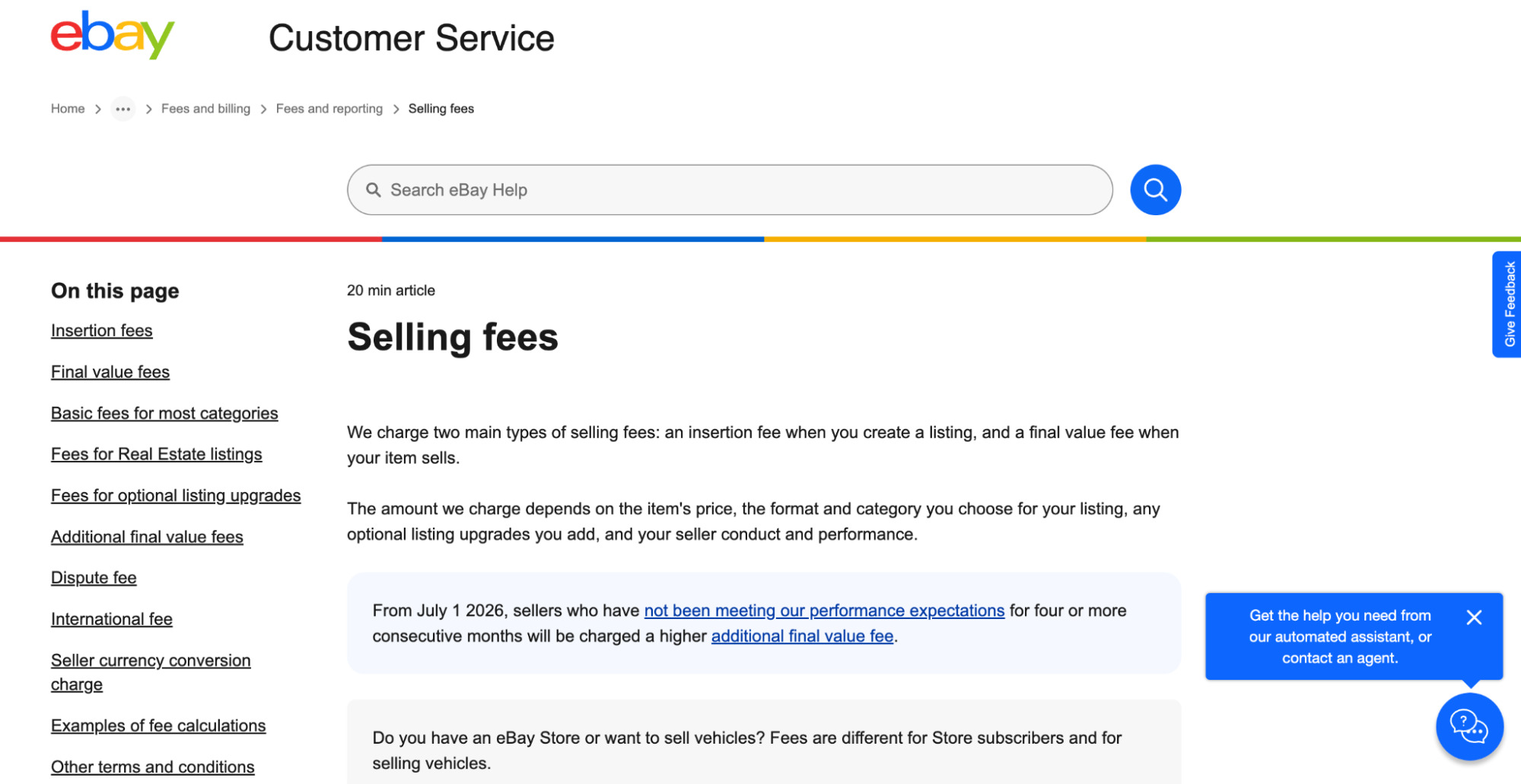
Here’s the fee structure:
- Insertion Fees are $0.35 per listing (after 250 free listings/month)
- Final Value Fee (FVF): 13.25% of sale price (most categories) + $0.30-$0.40 per order fee
- Payment Processing: Including in FVF (no separate charge)
- Optional Promoted listings: 1-4% of the sale price for extra visibility
The Math In Action: A $50 sale costs you ~$7 – $8 in fees alone (13.24% + $0.40). Add supplier costs, and you’re on razor-thin margins. You still need to add in your supplier costs, and you’re on thin margins, so selling at volume becomes necessary.
To calculate all of the seller’s fees, you can use our eBay fee calculator
The VeRO Problem
eBay’s Verified Rights Owner (VeRO) Program is a landmine, and those taking their first steps with eBay need to be careful not to stand on it. This affects dropshippers who want to list branded items (Nike) without direct wholesale invoices from the manufacturer.
VeRO members (usually brand lawyers) file automated intellectual property claims against your listings. What happens next is your listing gets removed. If that happens more than once, your account gets limited or suspended.
Many dripshippers source goods from unvetted suppliers, and in most cases unknowingly list counterfeit or gray-market goods. The positive side is that you wont be going to court, eBay doesn’t investigate like that, they will just nuke your listing on the first report.
You’re responsible for vetting your supplier chain.
Dropshipping on Shopify: High-Margin Asset Building with No Free Traffic
We have officially entered a completely different chat here, as Shopify is fundamentally different from both Amazon and eBay. You are no longer in the rented digital real estate market. You’re building a business asset. Shopify vs Amazon vs eBay comes down to this: Shopify is the only one where you own the outcome.
The Asset Ownership Model
Your brand, your email list, your customer data, your pixel data, your reviews, they all belong to you. No competitor can hijack your best sellers, no algorithm can demote you overnight. You control the customer experience completely.
You might have noticed a lot of “you” in that paragraph, and that’s also the reality of dropshipping on Shopify. In order to create a valuable asset, you have to wear many hats. The do-it-all entrepreneur.
The Financial Reality
Here’s where the chat really shifts. Your platform fees are cheap, but the real costs sit elsewhere. Here’s the breakdown:
- Shopify Subscription: $29-$299+ per month, depending on plan
- Payment Processing Fees: 2.9% + $0.30 per transaction (Shopify Payments)
- Shopify App Store Ecosystem: $10-$100+ per month for tools
- Marketing (The Real Cost): $500-$5000+ per month in paid ads
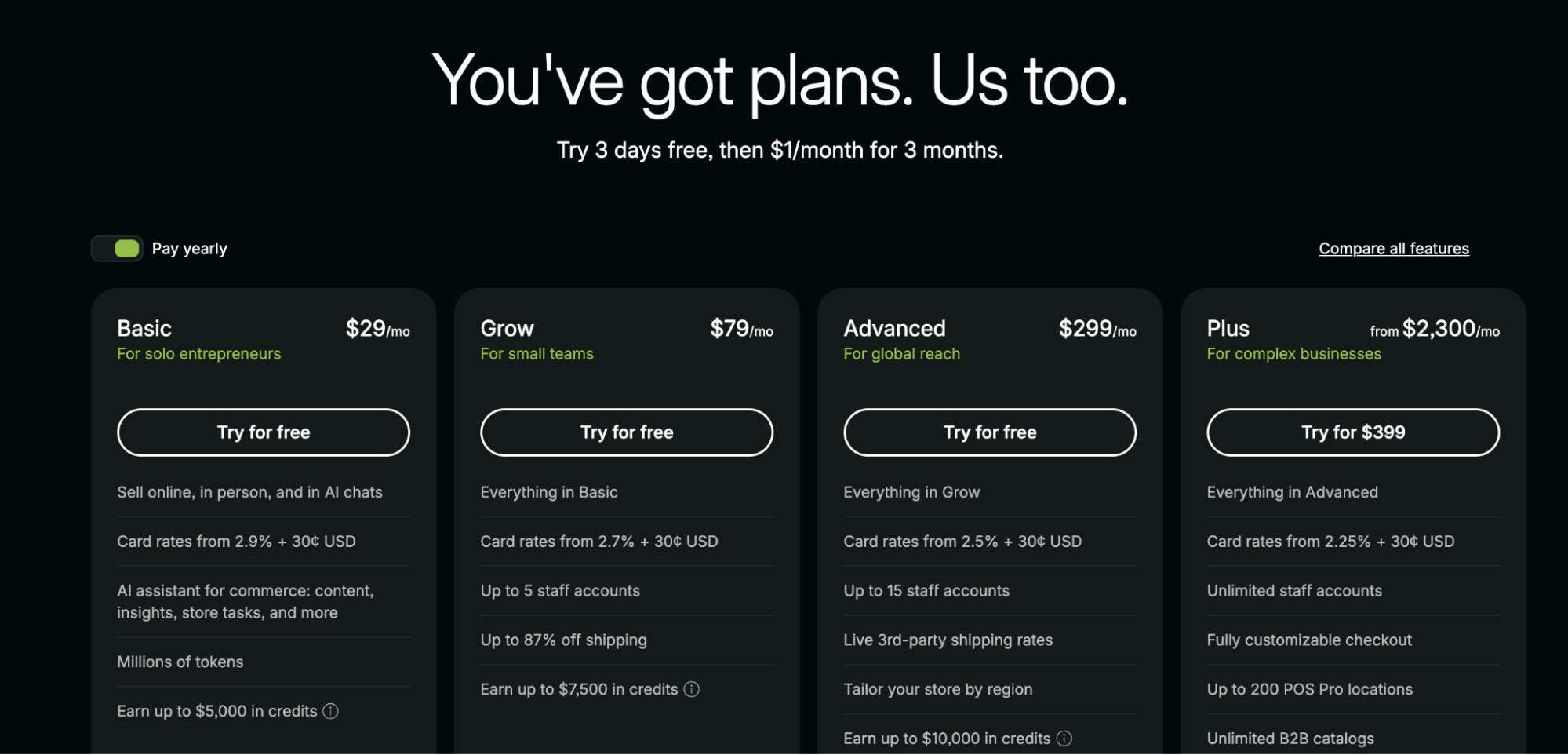
Here’s the truth: Shopify’s platform fees are cheap. The real cost is in customer acquisition. You must run Facebook, Google, or TikTok ads. Which is costly when done wrong.
As a rule of thumb, customer acquisition cost is about $15-$40 per customer. So if you sell a product at $40, you could find yourself losing money.
Shopify’s profit ceiling is much higher than Amazon or eBay once you get your ad strategy correct. The reason being that you control pricing. You’re not competing on $0.50 price differences. You’re selling value and brand.
Shopify vs Amazon vs eBay: Data Matrix & Platform Comparison
So which platform wins? It depends on what you’re going for. But here’s where you can see the trade-offs. Remember, Amazon brings traffic but crushes margins. eBay is accessible but competitive. Shopify is yours to build, but you fund the traffic. This table shows the real numbers:
| Metric | Amazon Dropshipping | eBay Dropshipping | Shopify Dropshipping |
| Traffic Acquisition | 100% Organic (Internal Search) | High Organic (Algorithmic feed) | 100% Paid / Direct (Ads & SEO) |
| Upfront Fees | $39.99/mo + 8-15% Referral fee | Final Value Fee (~13.25%) + Insertion | $29-$39+/mo + Credit Card Fees |
| Price Competition | Extreme (Automated repricing wars) | High (Driven by lowest-price filters) | Low (Value-add branding & bundles) |
| Account Ban Risk | Very High (Strict policy filters) | High (VeRO & retail sourcing flags) | Zero (Platform owner can’t ban store) |
| Operational Scaling | Hard without automated software | Impossible manually past 15 orders/day | Dependent on app integrations |
The Scaling bottleneck: Why manual Operations Lead to Account Death
It’s possible to start small on any platform. The problems generally begin to show themselves at about 10–15 orders per day. At this point, manual operation becomes impossible. This is true regardless of whether you’re running ebay vs shopify dropshipping or managing multiple Amazon accounts. Here’s what happens:
-
Inventory Stockouts
Let’s say your supplier runs out of stock. You have been focusing on other admin tasks and can’t pause your listings in time. Your product will still be active on Amazon or eBay. A customer purchases that specific product. You can’t provide them with the product, so you cancel the order.
You can’t view this as just canceling an order. It destroys your seller performance metrics and trust score. Let this happen often enough, and your Amazon/eBay account will lose its visibility.
-
Price Fluctuations
Just like inventory stockouts, supplies can change their prices whenever they see fit. This happens way more often than you might think. Now, what happens if you haven’t caught it in time?
You end up selling 20 units at 5$ below cost. That’s a $100 loss before you realize it. It may seem easy to stay on top of, but on Amazon, this happens fast enough that you can’t manually adjust pricing across multiple products at once.
-
Tracking Number Red Flags
Marketplaces validate tracking numbers in real-time. Mistakes happen, and if you enter the wrong tracking number or a wrong format, you risk getting flagged as suspicious. Those flags lead to account reviews and possible payment holds.
Most dropshippers try to scale manually. Eventually, they hit one of these walls and watch their account implode. This is why selling on Shopify vs Amazon matters less than the operational infrastructure you put behind it.
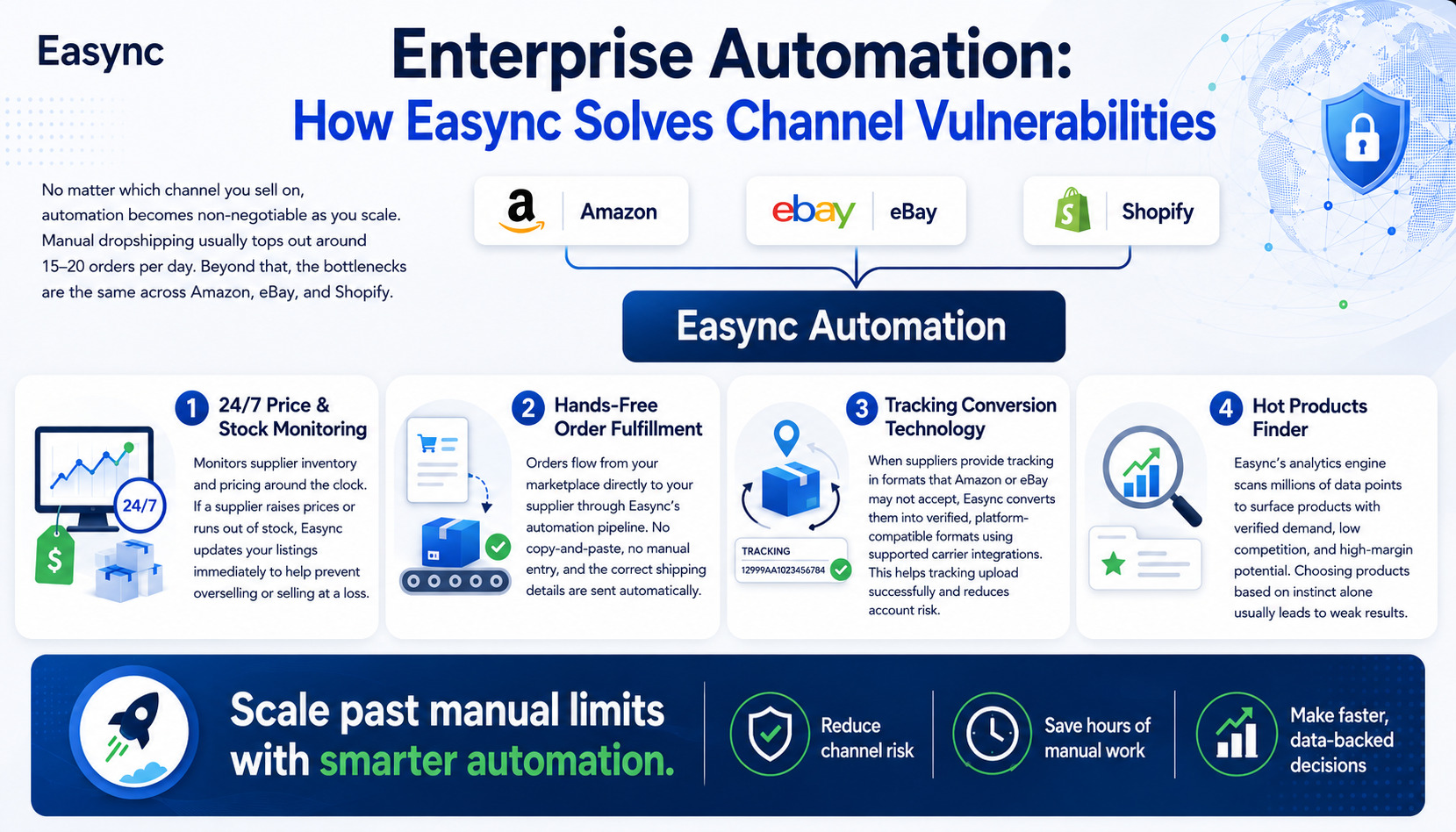
Enterprise Automation: How Easync Solves Channel Vulnerabilities
Regardless of what channel you choose to sell on. You will reach a point where automation becomes a non-negotiable. Manual dropshipping tops out around 15-20 orders per day. Reaching that number means you need software that thinks faster than you can.
And it doesn’t matter if you’re running Shopify vs Amazon vs eBay, the bottlenecks are the same.
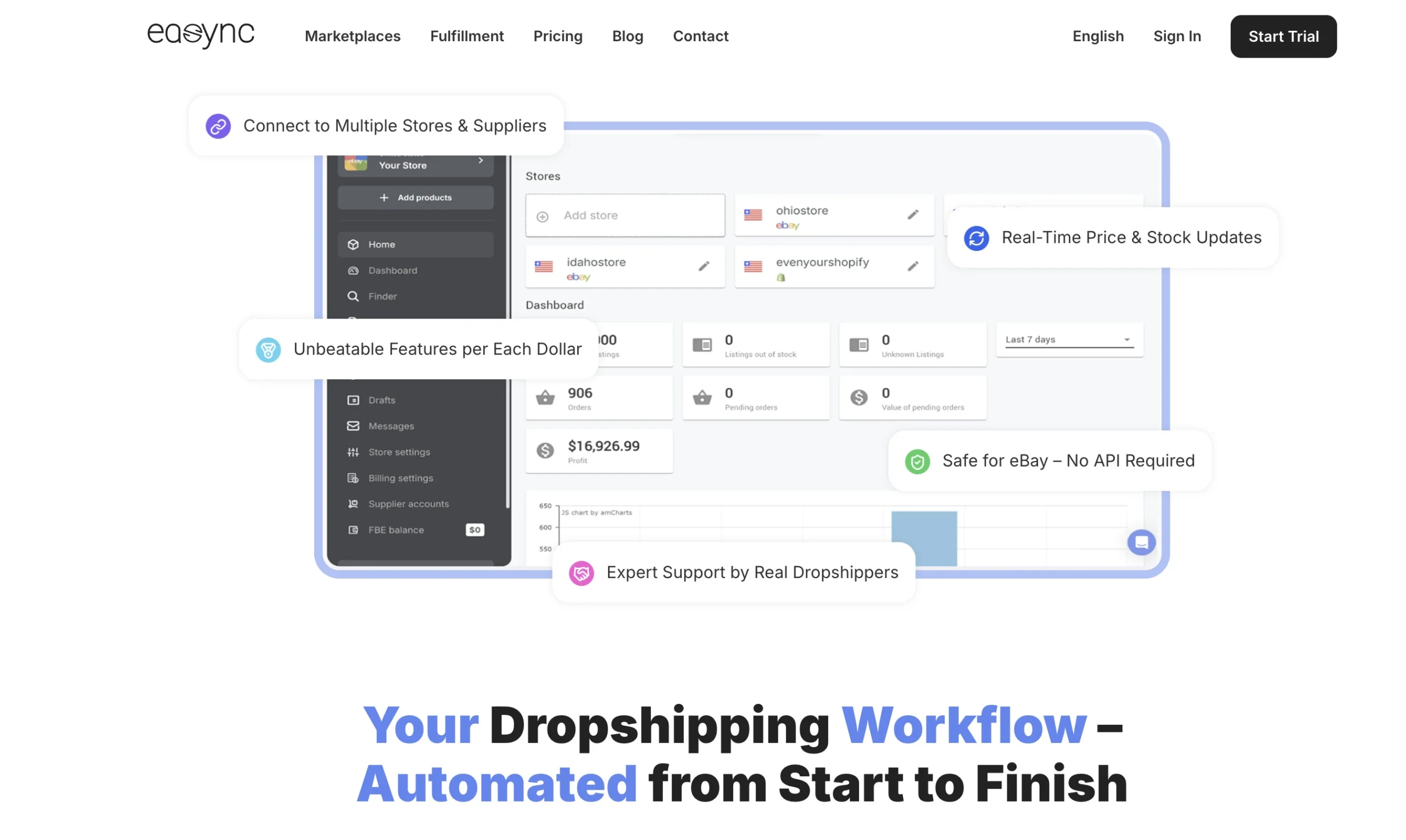
24/7 Price & Stock Monitoring
Easync monitors your supplier’s inventory synchronization and pricing every hour of the day/night. When a supplier raises prices or runs out of stock, Easync modifies your Amazon, eBay, or Shopify listing immediately. This is a safeguard from selling at a loss or overselling inventory you don’t have.
Hands-Free Order Fulfillment
Orders flow from your marketplace directly to your supplier through Easync’s order fulfillment automation pipeline. You don’t have to copy and paste or enter data manually. The system creates the supplier order with the exact information needed for shipping.
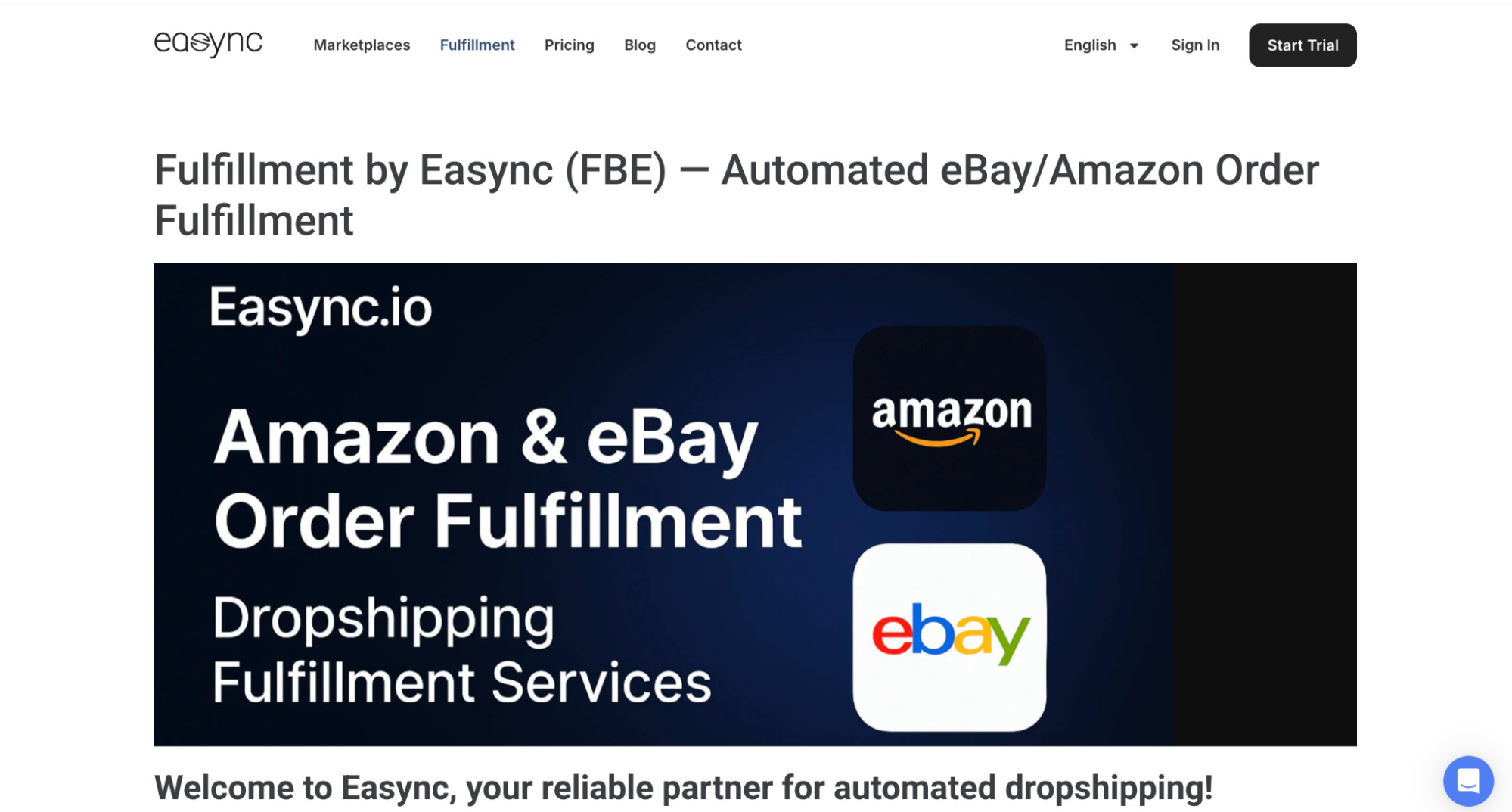
Tracking Conversion Technology
This is critical. When a supplier ships an order, they often provide a tracking number in a format that’s not recognized by Amazon or eBay’s validation systems. Easync converts these unrecognized tracking numbers into verified, platform-compatible formats (using integrations with accepted carriers). This tracking number transformation makes sure that your tracking uploads successfully, and you take out the risk of account bans.
Hot Products Finder
Easync’s analytics engine goes through millions of data points to surface products that:
- Verified demand
- Have low competition
- High-margin potential
Choosing products based on your own preferences almost always leads to a dead end. You need data backing them.
Frequently Asked Questions
Which platform has the lowest fees for dropshipping?
eBay has the lowest upfront fees, as you can start for free. However, no platform is cheaper than the other, they just charge differently.
Is Dropshipping allowed on Amazon and eBay?
Yes, dropshipping is allowed on both platforms. But you must follow strict rules. On Amazon, you must be the seller of record on all documentation. On eBay, you must have wholesale supplier invoices and avoid VeRO-protected brands. Blind-sourcing from retail competitors violates both policies.
Do I need an ad Budget for Shopify dropshipping?
Yes. You can plan to spend around $500- $2000 per month on ads to see meaningful sales.