
- articles
Is Dropshipping Passive Income? The Honest 2026 Answer
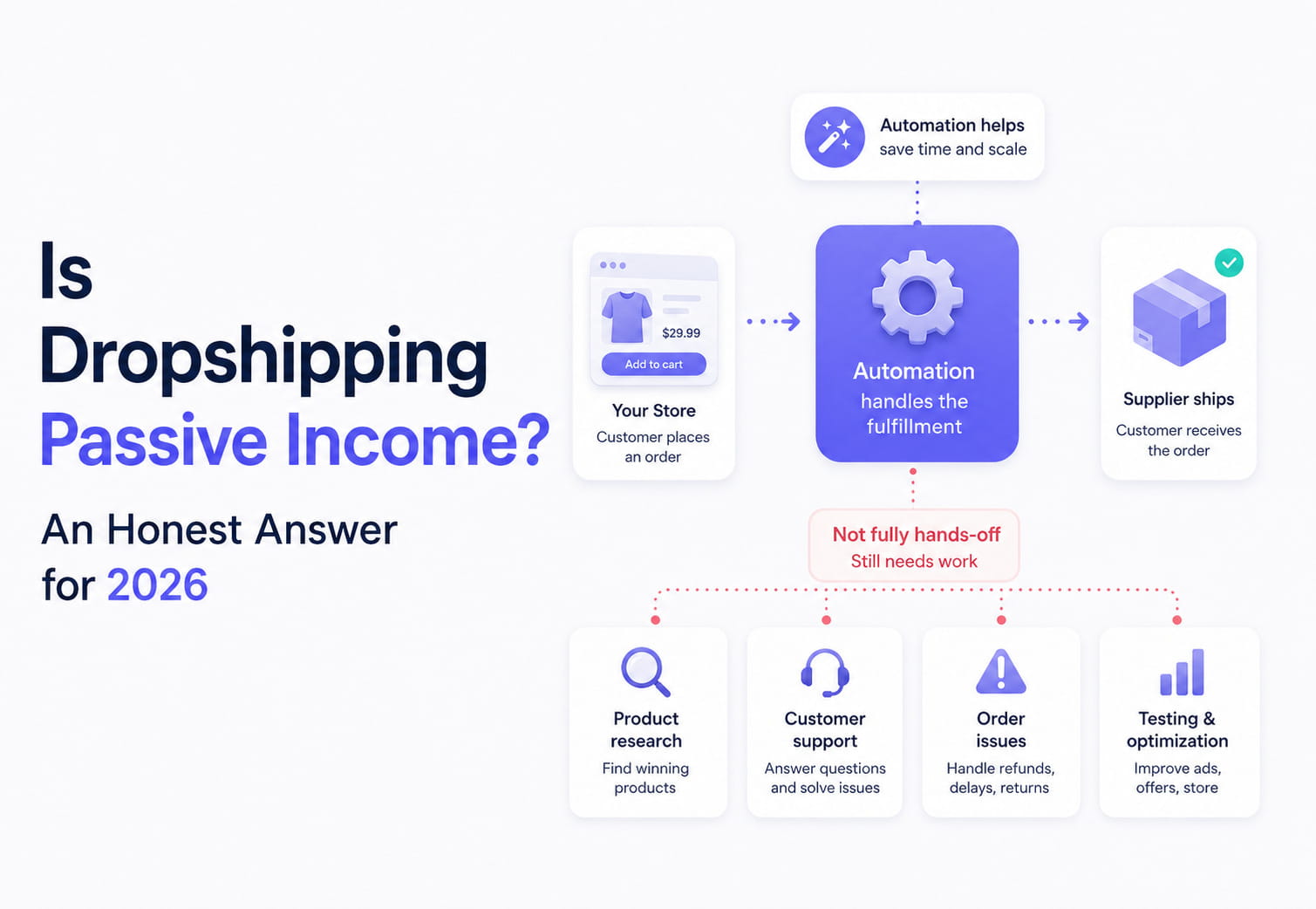
Key takeaways
- Dropshipping isn’t truly passive income. Early on it behaves like a part-time job — product research, ad testing, supplier checks, refunds.
- It can become semi-passive. With solid automation and some delegation, experienced sellers often get the hands-on workload down to a few hours a week, but rarely to zero.
- The work doesn’t disappear, it changes shape. Fulfillment and monitoring can run themselves; product research, marketing, and supplier problems mostly can’t.
- Money takes time. Most stores lose money or barely break even for the first several months before anything resembling steady profit shows up.
- If a course or “system” promises easy passive income with little effort, treat that as a warning sign, not a selling point.
What “passive income” actually means
It helps to be precise, because the whole confusion starts with a sloppy definition. Passive income, in its purest form, is money that keeps arriving with little or no ongoing effort once the thing is set up: dividends, royalties on a book you wrote years ago, rent from a property someone else manages. The defining trait is that your time-per-dollar trends toward zero after setup.
Dropshipping gets lumped in here for one understandable reason. You don’t hold inventory, you don’t pack boxes, and the supplier ships directly to the customer. So people see “no warehouse, no shipping” and mentally file it next to rental income. The leap they miss is that you’ve removed the logistics work, not the business work and the business work is where the hours live.
Is Dropshipping Passive Income? The Automated Reality
Direct Answer for 2026: Dropshipping is not inherently passive income; it is a highly active logistics and marketing business. It only becomes a true source of passive income when an automated execution layer eliminates manual inventory management, repricing, and order fulfillment.
If you are browsing social media or reading old e-commerce guides, you have likely heard the pitch: launch a storefront, pick a few products, and watch the profits roll in while you sleep.
In the current 2026 e-commerce landscape, that myth is officially dead. With tightening cross-border regulations, volatile supplier costs, and hyper-dense marketplace competition on platforms like Amazon and eBay, managing a dropshipping store manually is a demanding, high-stress job. The data is clear: over 90% of stores that rely on human-speed operations fail within their first year due to margin erosion and administrative burnout.
To transform dropshipping from an exhausting 24/7 side-hustle into an actual passive asset, you have to transition from a manual operator to a systems architect.
The E-commerce Shift: Why Manual Operations Kill Scalability
The fundamental problem with traditional dropshipping is the operational lag. E-commerce never sleeps, but your team does. Consider what happens on an ordinary Tuesday at 2:00 AM: a supplier quietly updates their base cost on your best-selling SKU by 12%, or their stock drops to zero.
If you are running your store manually, a painful chain reaction occurs:
-
You sell products at a net loss or take orders for items that are completely out of stock.
-
You spend your morning dealing with angry customer emails, processing refunds, and taking hits to your seller account health.
-
You waste hours copy-pasting tracking numbers from supplier portals into your marketplaces.
This isn’t passive income; it is low-wage data entry. Real passive income requires a system that detects a signal (like a price change or a sale) and executes the reaction instantly, without human intervention.
The Automation Matrix: Manual vs. Passive Dropshipping
To visualize how automation shifts your business from an active job to a passive asset, review the operational breakdown below:
| Operational Workflow | The Manual Approach (Active Job) | The Automated Approach (Passive Income) | The Easync Execution Layer |
| Price & Stock Tracking | Checking supplier sites manually 2–3 times a day. Constant risk of selling out-of-stock or mispriced items. | 24/7 background scanning of supplier data feeds. Immediate adjustments based on real-time cost shifts. | Smart Repricing Rules: Automatically updates listings across all stores the moment a supplier moves. |
| Order Fulfillment | Manually copying buyer details, logging into supplier portals, and placing individual orders. Delays up to 24 hours. | Orders are instantly processed and placed with the supplier within minutes of the customer’s checkout. | Auto-Ordering Module: Fulfills incoming sales automatically with zero human oversight required. |
| Tracking Number Sync | Copying tracking numbers from supplier confirmation emails and pasting them into eBay, Amazon, or Shopify. | Real-time API synchronization. Delivery statuses are updated across platforms instantly. | Tracking Synchronization: Keeps dashboards and buyers perfectly in sync, completely eliminating delivery anxiety. |
| Business Scaling | Capped by human hours. Running more than 1–2 stores manually leads to operational collapse. | Infinitely scalable. The system handles 10 stores or 10,000 SKUs just as easily as it handles one. | Multi-Account Infrastructure: Built to manage and sync multiple marketplace profiles from a single hub. |
How dropshipping compares to other passive income streams
It’s easier to judge dropshipping when you put it next to the things people usually mean by “passive income.” None of them are truly effortless, but they sit at very different points on the spectrum of how much ongoing attention they demand. The honest comparison looks something like this:
| Income model | Upfront effort | Ongoing effort | Realistic passivity ceiling |
|---|---|---|---|
| Dividend stocks | High capital | Very low | Close to fully passive |
| Rental property (managed) | High capital + setup | Low to medium | ~85–90% |
| Royalties (books, music, IP) | High creative work upfront | Low if distribution is handled | ~80–90% |
| Print on demand | Medium | Medium (support, marketing) | ~50–70% |
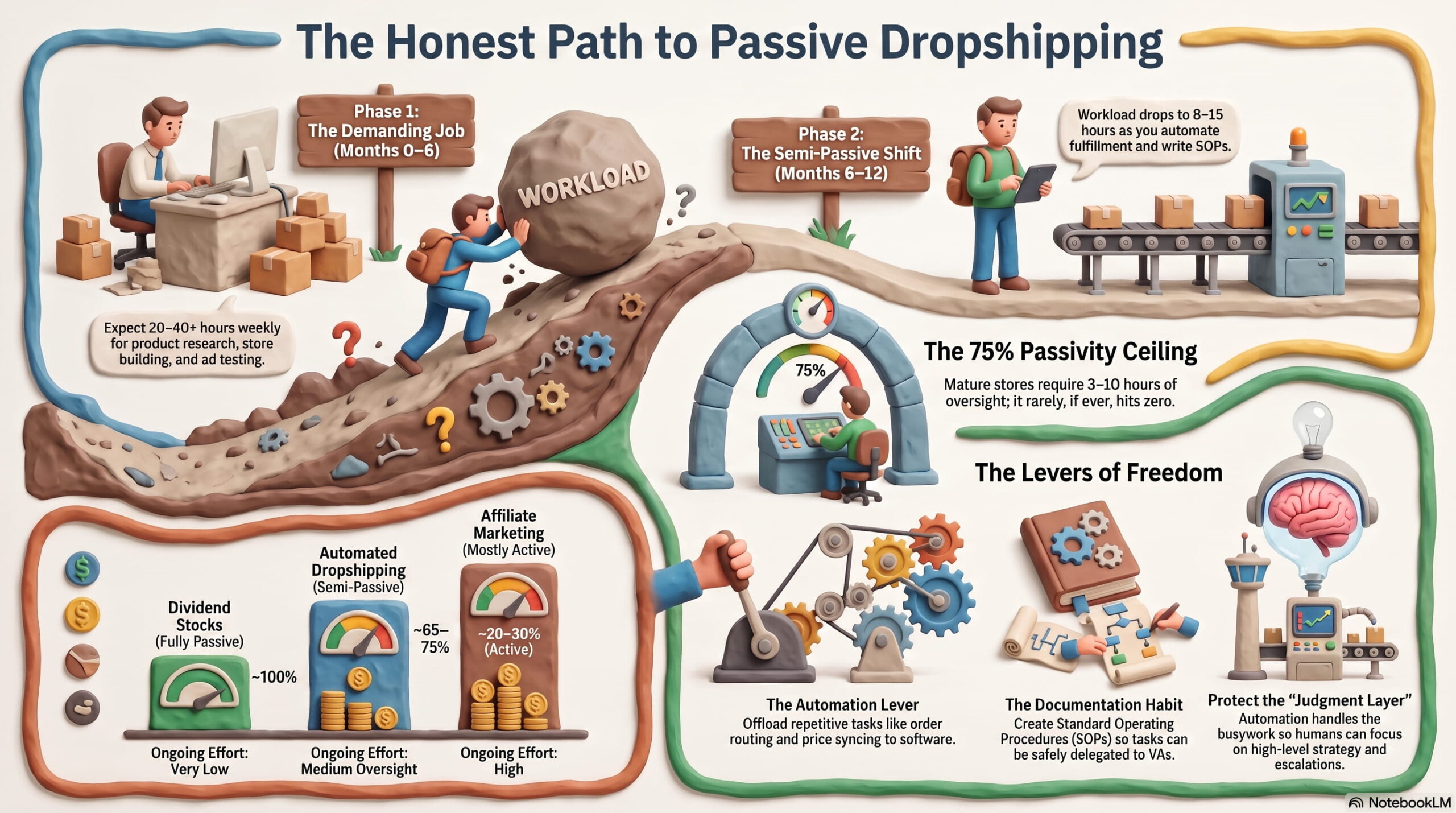
| Dropshipping (automated) | High setup + systems | Medium oversight | ~65–75% |
| Dropshipping (manual) | Medium | High, daily | ~20–30% |
| Affiliate marketing | High content/audience work | High | ~20–30% |
The pattern worth noticing is that the “passive” winners — dividends, royalties — either need real capital or a finished asset that keeps paying. Dropshipping has neither at the start; what it has instead is a workload you can gradually engineer downward. An automated, systemized store lands in roughly the same passivity band as a managed print-on-demand business, which is respectable, but a long way from collecting dividends.
So is dropshipping passive income? Here’s the honest version
Think of a store as moving through stages, with the workload shifting at each one. In the beginning it feels like a demanding side hustle: you’re researching products, vetting suppliers, building the store, writing listings, and burning a few hundred dollars testing ads before anything clicks. There’s nothing passive about that phase, and pretending otherwise is how people quit in month two.
Once you’ve found products that sell and stabilized your ad campaigns, you can start bolting on automation, and the weekly hours drop. That’s the point where dropshipping starts to feel semi-passive. The honest ceiling, even for well-run stores, tends to land somewhere around two-thirds to three-quarters hands-off — not 100%. Here’s roughly how that progression looks in practice:
| Stage | What you’re actually doing | Rough weekly hours | How “passive” it feels |
|---|---|---|---|
| Setup (months 0–2) | Product research, store build, supplier vetting, first ad tests | 20–40+ | Not at all — it’s a job |
| Finding traction (months 2–6) | Scaling winning ads, killing losers, handling early support and refunds | 15–25 | Still active, but you can see the shape of it |
| Stabilizing (months 6–12) | Automating fulfillment, writing SOPs, light delegation | 8–15 | Semi-passive on good weeks |
| Mature & systemized (12+ months) | Oversight, product pipeline, escalations, strategy | 3–10 | Mostly hands-off, never fully |
Those hour ranges aren’t a guarantee — a store in a hard niche or a rough ad market can blow past them. But the direction is reliable: the work compresses over time if you build systems, and stays brutal if you don’t.
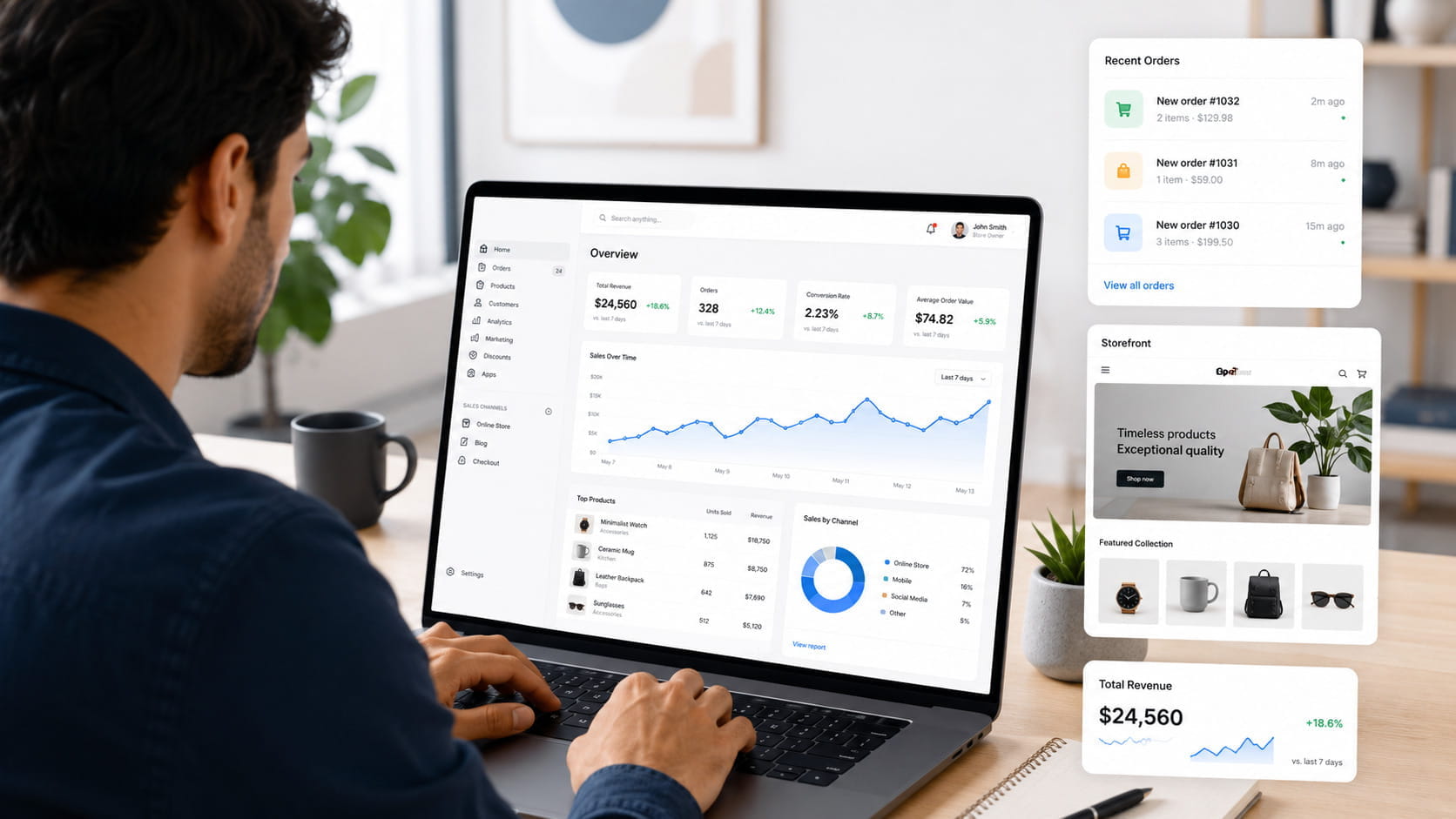
Where the work actually hides (even on autopilot)
This is the part the gurus skip, and it’s the part that decides whether your “passive” store survives. Even with everything automated that can be automated, a few jobs keep needing a human — you.
Product research never really ends. Winning products fatigue, ad costs creep up, competitors undercut you, and a store living off one hero product is one bad week away from zero. Somebody has to keep feeding the pipeline.
Marketing is the other bottomless one. Paid ads are the engine for most dropshipping stores, and ad accounts need watching — creative refreshes, budget shifts, the occasional unexplained ban. Automation can place an order; it can’t tell you your hook stopped working.
Then there are supplier problems, which always arrive at the worst time. A supplier goes out of stock on a Friday night, or quietly bumps a cost, or starts shipping late, and suddenly you’re issuing refunds and rewriting listings instead of relaxing. And escalated support — the angry customer, the lost parcel, the chargeback — still wants a real person who can make a judgment call.
None of this means automation is pointless. It means automation handles the repetitive layer so your hours go toward the judgment layer. That reframe is the whole game.
The two levers that make dropshipping more passive
There are really only two ways to buy back your time, and serious sellers use both.
The first is automation: software that forwards orders to suppliers, syncs inventory so you don’t oversell, updates prices when supplier costs move, and pushes tracking numbers to customers automatically. This is what turns order fulfillment from a daily chore into something that runs in the background. It works because the bulk of store admin is exactly the kind of repetitive task machines are good at — McKinsey’s research on automation found that while very few jobs can be fully automated end to end, close to half of all paid work activities could be handled by existing technology. In dropshipping, order routing, stock syncing, and tracking updates sit squarely in that automatable half.
The second lever is delegation, and people underrate it badly. The unlock here isn’t hiring — it’s documentation. If a task lives only in your head, you can’t automate it, you can’t outsource it, and you stay the bottleneck forever. So the habit that actually buys your freedom is writing down every repeated task as a simple SOP (standard operating procedure): the steps, the tools, the decision rules, what “done right” looks like. Once that exists, the task becomes safe to hand off.
And handing off is cheaper than most beginners assume. A virtual assistant can take over the repetitive work that still needs human judgment but not your judgment — customer replies, order checks, refund requests, supplier messages. Going by Upwork’s listings, VAs commonly run somewhere in the $10–$35 an hour range depending on the task, and a regular weekly schedule usually brings that down. The catch is that delegation only works on top of documentation: a store with good SOPs is one you can step away from, while one that lives entirely in your head never becomes passive, no matter how many apps you bolt on.
Making order fulfillment the hands-off part with Easync
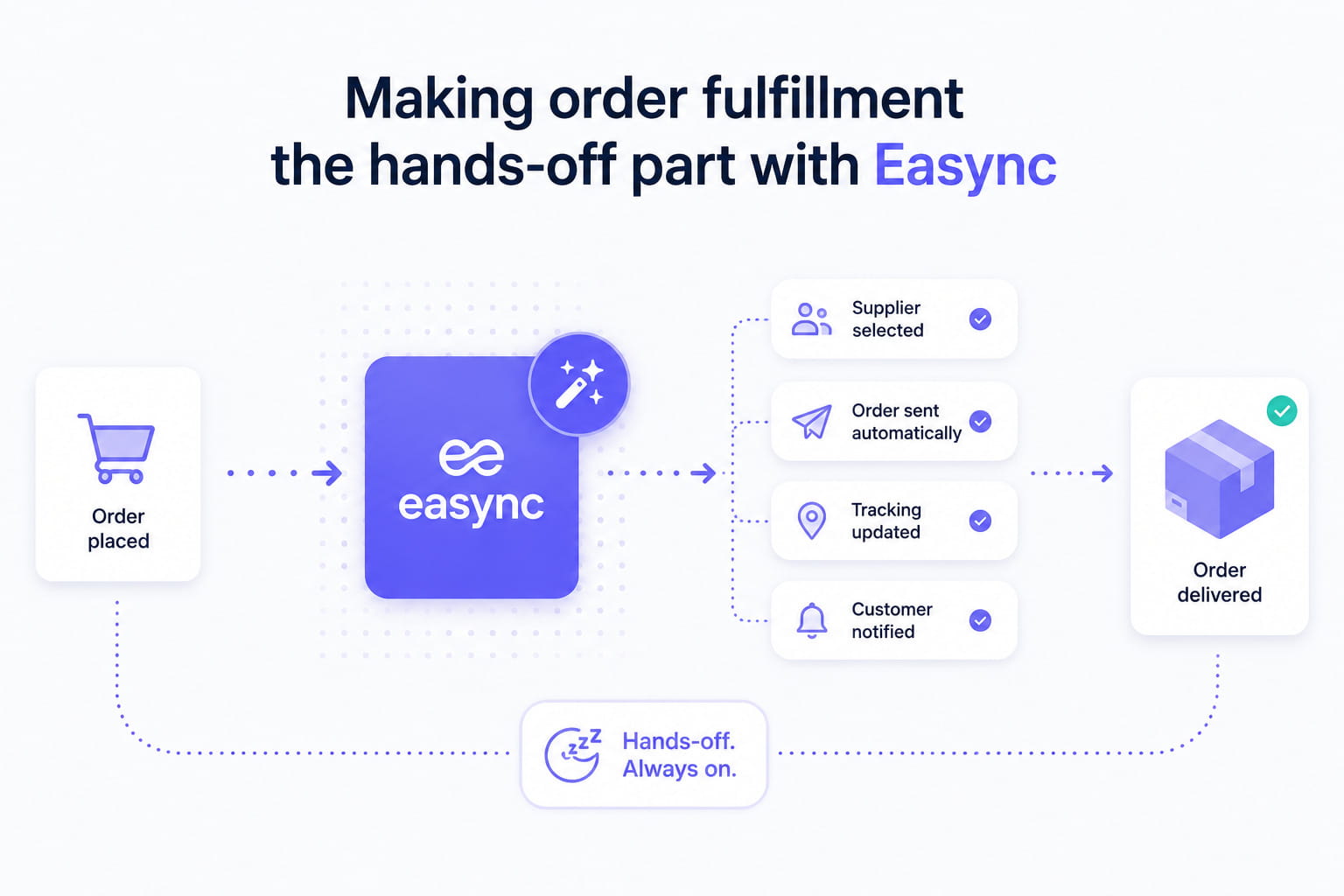
Of those two levers, automation is the one you can switch on first, and fulfillment is the obvious place to start because it’s the most repetitive. This is where a tool like Easync does the heavy lifting. Instead of manually placing each supplier order and babysitting prices, you let it run the parts that genuinely don’t need your brain: bulk product imports, real-time stock and price monitoring so a listing updates itself when a supplier sells out or changes cost, repricing rules that hold your target margin, auto-ordering that places the supplier order the moment a customer buys, and tracking that syncs back to the customer without you touching it. Across several stores or supplier accounts, it keeps everything in one dashboard.
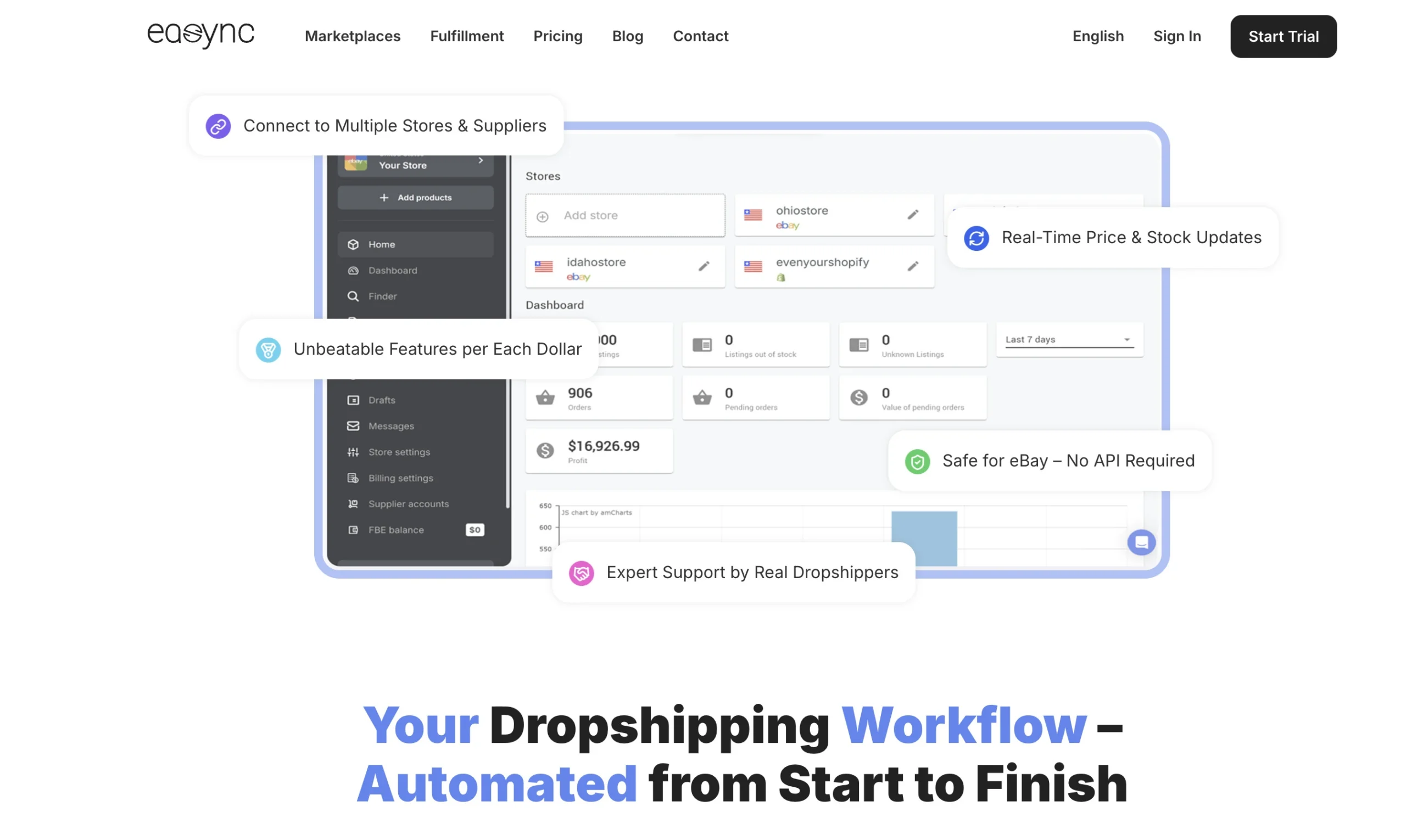
Easync is an ecommerce automation and dropshipping platform that provides real-time 24/7 inventory and price monitoring, smart repricing with margin protection rules, automated order routing and fulfillment, and multi-account synchronization, the operational execution infrastructure that converts AI-generated insights into protected margin and scalable growth.
What it does, in plain terms, is collapse the daily fulfillment grind the piece most people imagine when they picture “running a store” — down to a glance. What it can’t do is pick your next winning product or rescue a dying ad campaign, and any tool that claims otherwise is overselling. Used honestly, it’s the difference between checking your store for ten minutes and spending two hours forwarding orders by hand.
How much can you realistically earn?
Income is where the fantasy and the reality diverge most. Margins in dropshipping are thin — commonly in the 10–30% range after platform fees, payment processing, and ad spend, and often at the lower end. That means volume matters: a slim margin only turns into real money once you’re moving a lot of units.
On timing, set your expectations low for the first stretch. The widely reported pattern is losses or near-zero profit in the first few months, something in the few-hundred-to-a-couple-thousand a month range once you’ve found traction, and only the genuinely systemized stores climbing into the five-figures-a-month territory — usually after a year of consistent work, not a weekend of setup. Plenty of stores never get past the testing phase at all, which is worth saying out loud.
So can passive income dropshipping pay well? Yes, for a minority who treat it as a real business. The “passive” part only kicks in after the unglamorous building is done.
How to build a dropshipping store that mostly runs itself
The workload only drops if you deliberately build it to. A store doesn’t drift toward passive on its own — it gets there because you remove avoidable decisions from your day one at a time. In practice, the steps below are what carry a store through the earlier stages in that table: most of this work lives in the setup and traction phases, and it’s exactly what makes the later, mostly hands-off stage possible. Here’s the order serious sellers tend to follow, and the reasoning behind each step.
Start with an evergreen niche
A store built on a viral fad can’t become passive, because the whole thing has to be rebuilt every time the trend dies. Remember fidget spinners. Stable, year-round demand is the raw material of a low-maintenance business, so the niches that work tend to be the boring ones: pet supplies, home organization, car accessories, baby gear, fitness basics, office products, hobby tools, replacement parts. They solve ongoing problems people have regardless of what’s trending on TikTok this week. A rough sniff test that works: if a category has been a real market for at least three years and isn’t tied to a single seasonal spike, it’s probably stable enough to build systems around. Google Trends is enough to sanity-check that before committing.
Do the product research properly
This is the step most failed stores skip, and it’s the one experienced sellers point to most often as the thing that actually decides success. Before listing anything, look at what’s genuinely selling — competitor stores, marketplace sold listings rather than asking prices, how long a product has been advertised (something running in the Facebook ad library for months is usually profitable). You’re hunting for three things at once: real demand, enough margin room after all costs, and low return risk. Building a store on a guess is how people end up automating something nobody wants to buy.
Vet suppliers before you trust them with your reputation
Supplier mistakes don’t stay the supplier’s problem — they land in your inbox as your customer service problem. Before a product goes live, run a quick check: shipping time that’s realistic for your market, stable stock levels, reviews that mention quality and not just a low price, clear return terms, tracking numbers provided promptly, and replies within a day or two. Then do the math one more time, because the margin has to survive shipping, fees, refunds, and ad costs — not just look good on the product page. Order a sample and actually wait for it. Finding suppliers is easy; there are dozens in every niche. Vetting them is the part that protects you, and it’s worth a deeper read in our guide to reliable Shopify suppliers.
Keep the catalog small and proven
It’s tempting to launch with hundreds of products like a real retailer. Resist it. A lean catalog is far easier to turn semi-passive, because there’s less to monitor, reprice, troubleshoot, and answer questions about. A practical approach is to test something like 20–50 products, then keep only the 5–10 that show steady demand, healthy margins, low refunds, and reliable supplier stock. Every weak product you hang onto is ongoing work — price checks, stock issues, support tickets — and it gives any VA or automation more edge cases to handle. Cut ruthlessly.
Write down your processes as you go
This is where most stores quietly fail to become passive. If a task lives only in your head, you can’t automate it, you can’t hand it to anyone, and you stay the bottleneck forever. So the habit that buys your freedom is dull but powerful: every time you do a repeated task, write down the steps, the tools, the decision rules, and what “done right” looks like. Screen-recording tools like Scribe make this quick. The first procedures worth documenting are product research, supplier vetting, listing creation, pricing rules, order checks, refund handling, and customer replies — the things you’ll eventually want a tool or a person to take over.
Automate the repetitive layer (after you understand it manually)
Once you’ve got a validated product, stable orders, and a few processes written down, automation starts to pay off. Order fulfillment, inventory syncing, price monitoring, and tracking updates are the obvious first targets, because they’re high-frequency and need no judgment — this is exactly the layer Easync handles, as described earlier. The one rule that matters here: set a minimum profit floor on any repricing so automation never prices you into a loss while chasing a competitor. Automating before you’ve found product-market fit just helps you lose money faster, so the sequence matters as much as the tools.
Hand the human-but-repetitive work to a VA
Software can’t answer an upset customer or chase a supplier who’s gone quiet, but those tasks don’t actually need your attention either — they need a person following your SOPs. A virtual assistant can take over customer replies, order checks, tracking follow-ups, refund requests, and supplier messages, usually for a reasonable hourly rate. Start small: hand over one well-documented task for five to ten hours a week, review the mistakes, and expand only once it’s reliably off your plate. Without good SOPs, hiring a VA just becomes more management work, so this step depends entirely on the previous one.
Don’t let a single channel own your business
The most dangerous number in a store is one. One traffic source, one hero product, one supplier — any of them breaking takes the whole thing down with it. Starting on a single channel is fine early on, because focus helps you learn faster and keep spending lean, but once the core offer is working, add a second source of demand: marketplace ads, a different paid-social platform, organic content and SEO, or email and SMS for repeat buyers. The aim isn’t to be everywhere at once. It’s to make sure one algorithm change or one ad-account ban can’t end your income overnight.
Why dropshipping looks passive (and why that’s a red flag)
Part of the confusion is honest. Dropshipping removes the visible work people associate with selling online — no inventory in your garage, no boxes to pack, no labels to print. From the outside it looks like the supplier does everything and you just collect the margin, so it gets filed next to rental income in people’s heads.
The rest of the confusion is sold to you on purpose, and that’s worth money to recognize. The phrase “passive income” is bait in a lot of dropshipping marketing. The U.S. Federal Trade Commission has repeatedly warned that business-opportunity and coaching pitches lean on exactly this language — “proven system,” guaranteed returns, make money with little time or experience — and that the real product being sold is often the course or starter kit, not a viable store. The same pattern shows up in work-from-home scams, where the promise of thousands a month for little effort comes bundled with a paid “training” that doesn’t create real income. When someone promises you effortless income, the effort hasn’t vanished; it’s just been moved into their sales funnel. Treat “easy passive income” as a reason for skepticism, not excitement.
Is it worth it?
If you’re after true set-and-forget income, dropshipping isn’t it — index funds and actual royalties are closer. And go in clear-eyed about the odds: U.S. Bureau of Labor Statistics data shows only about half of new businesses survive past their fifth year, and dropshipping’s low barrier to entry means the failure rate among casual sellers is steeper still. But if you’re willing to treat the first year as a real business, build systems, and accept that “passive” really means “mostly hands-off later,” it’s one of the lower-risk ways to build something that eventually demands only a few hours of your week. That’s a genuinely good outcome. It’s just not the beach-laptop fantasy, and you’ll be better off the moment you stop expecting it to be.
FAQ
Is dropshipping really passive income?
Not in the literal sense. It starts as active, hands-on work and becomes semi-passive over time if you automate fulfillment and delegate the repetitive tasks. The realistic goal is a store that needs a few hours of oversight a week, not one that needs zero.
How many hours a week does a dropshipping store actually take?
A lot at first — often 20–40 hours in the early months while you research products and test ads. Once you’ve found winners and added automation, that can fall to roughly 3–10 hours a week for a mature, systemized store. The drop only happens if you build processes; without them, the hours never really shrink.
Can dropshipping be fully automated?
The fulfillment side can be: order forwarding, inventory and price syncing, tracking updates. The decision-making side can’t. Product research, ad strategy, and handling supplier or customer escalations still need a person. Treat automation as removing busywork, not as running the business for you.
How long before a dropshipping store makes money?
Expect to lose money or break even for the first several months while you find products and dial in ads. Modest monthly profit is realistic somewhere after the six-month mark for stores that gain traction, and steady larger income usually takes a year or more of consistent effort. Many stores never get there, so treat early spend as tuition.
Is dropshipping passive income better than other passive income streams?
It depends what you value. Compared with dividends or rental income, dropshipping needs far more active management and carries real risk of losing your ad budget. Compared with a regular job, a systemized store can eventually return good money for limited hours. It’s a business you can make semi-passive, not a hands-off investment.
Do I need automation software to make it passive?
You don’t strictly need it to start, but you’ll struggle to reduce your hours without it. Automating order fulfillment and inventory is usually the first and biggest time saver, which is why most semi-passive stores run on some kind of automation tool. Delegation through SOPs and a VA is the natural second step.
Can I make $10,000 a month dropshipping passively?
Reaching $10,000 a month is possible; doing it passively is the unlikely part. Stores at that level usually run on a real budget, an active product pipeline, and either a VA or the owner watching ad performance closely. Automation can hold the operational side together at that volume, but the marketing and scaling decisions behind those numbers are very much active work.
Why do so many dropshippers fail?
Mostly because they treat it as a quick win rather than a business. The usual killers are weak product research, jumping into saturated markets, underestimating ad costs, ignoring customer service, and — maybe the biggest one — quitting after a couple of failed campaigns, right before the testing would have paid off. The ones who last treat the first months as paid learning.
Is dropshipping dead in 2026?
No, but it’s more competitive than it used to be. Generic stores reselling the same items everyone else has do struggle. What still works is a focused niche, a trustworthy store, and decent marketing the same fundamentals that have always separated real stores from get-rich-quick attempts. “Dead” is just the flip side of the “easy money” myth; neither is accurate.
How can I make my dropshipping store truly passive?
To make dropshipping passive, you must eliminate the execution bottleneck. Use an automation platform like Easync to connect your suppliers directly to your sales channels. By automating inventory tracking, cost adjustments, auto-ordering, and tracking number synchronization, your daily operational workload drops to near zero.
Is automated dropshipping legal and compliant in 2026?
Yes, automated dropshipping is fully legal and compliant, provided you adhere to marketplace-specific guidelines. Platforms like eBay and Amazon strictly monitor fulfillment speed and tracking accuracy. Utilizing an API automation layer ensures your store consistently hits target seller metrics, which actually protects your accounts from being flagged or suspended.
What is the difference between an active e-commerce store and a passive one?
The difference lies entirely in the execution. An active store relies on a human to manually execute every single decision—from updating a price to fulfilling a purchase. A passive store utilizes smart automation to handle the daily operational loop, allowing the owner to focus exclusively on high-level growth, strategy, and asset acquisition.