
- articles
Generative AI in Ecommerce: Real Use Cases for 2026
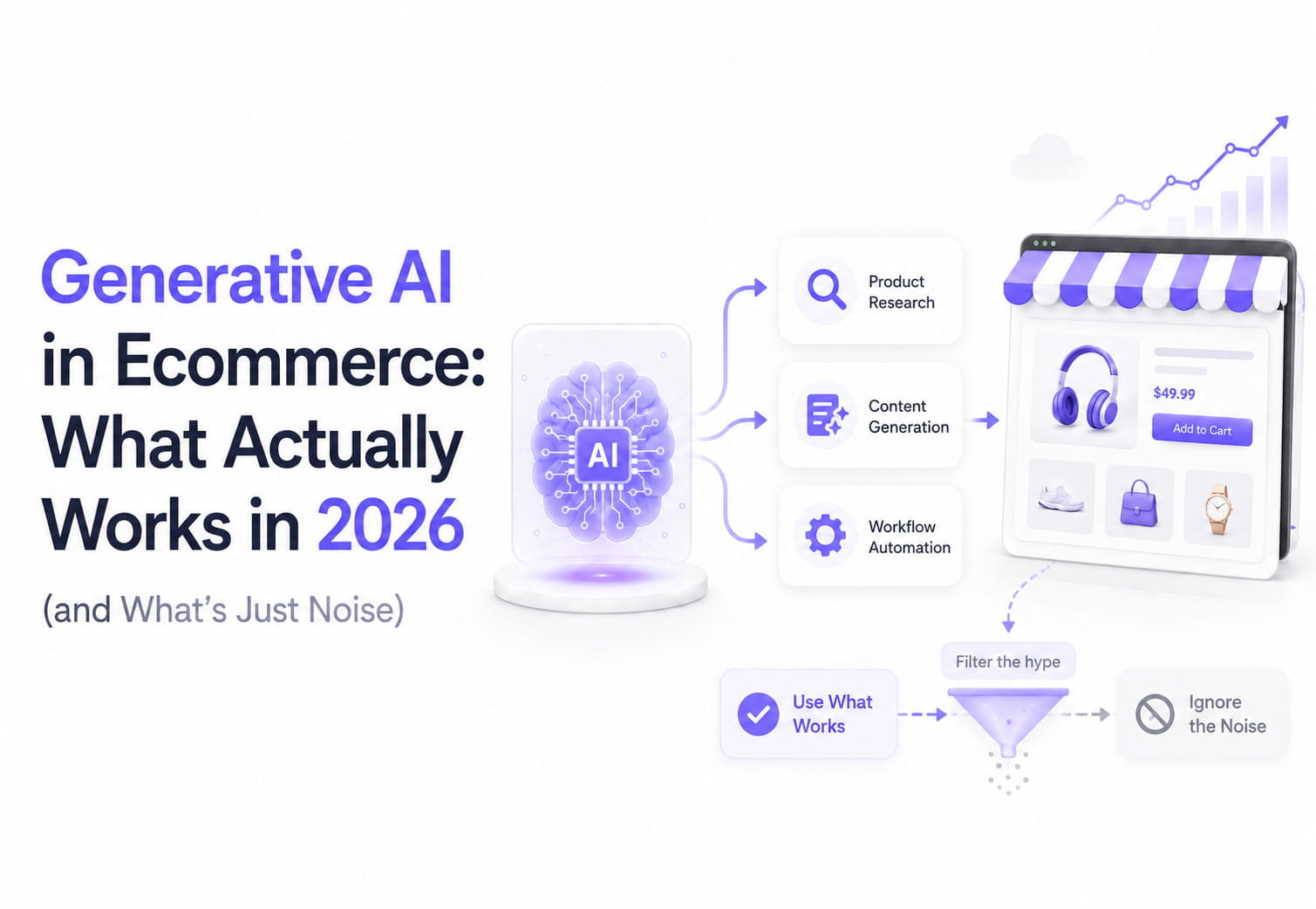
What is Generative AI in Retail and Ecommerce?
Generative AI in retail and ecommerce refers to Large Language Model (LLM)-powered systems that can create, interpret, and act on unstructured data, including natural language, images, and supplier documents — to automate tasks that previously required human judgment.
The distinction from earlier “AI” matters architecturally. Pre-2022 ecommerce AI relied on rule-based systems: keyword matching for search, rigid decision trees for chatbots, and collaborative filtering for recommendations (if the user bought X, suggest Y). These systems worked within explicitly programmed constraints and broke the moment a query fell outside their defined taxonomy.
Modern generative AI, built on transformer-based LLMs like OpenAI’s GPT-4o, Anthropic’s Claude 3.5 Sonnet, and Google’s Gemini 1.5 Pro, operates on semantic understanding through vector embeddings. Instead of matching the query “waterproof parka” to indexed keywords, the model understands contextual intent: warmth rating, fit, activity type, and price bracket — inferred from a single natural language sentence. That shift from keyword matching to intent-mapping has structural implications for how search, merchandising, and operations are built.
In practical terms, generative AI in ecommerce applies across three functional layers:
- Synthesis: Generating product copy, email sequences, ad variants, and catalog descriptions from raw supplier data.
- Understanding: Parsing natural language queries, customer reviews, and return notes to extract actionable signals.
- Action: Triggering pricing rules, reordering workflows, and fulfillment logic based on AI-interpreted conditions.
The third layer action is where most merchants are still underinvested. It is also where the greatest financial leverage lives.
A couple of years ago, “we use AI” was a headline. Now it’s table stakes, and honestly, half the stores bragging about it are using it to write product descriptions nobody reads. The interesting stuff is happening quietly in the back office, where the gap between spotting a problem and fixing it has shrunk from days to minutes.
This piece is less about the hype and more about where generative AI in ecommerce is genuinely earning its keep — and where it’s still a solution looking for a problem.
Key takeaways
- Generative AI’s biggest payoff in 2026 isn’t flashy storefront features — it’s compressing the time between a data signal and the action you take on it.
- The highest-ROI use cases are boring and repetitive: review summaries, content enrichment, support triage, and margin protection.
- AI gives you recommendations; you still need an execution layer (automation) to act on them at scale, or the insight just sits in a dashboard.
- Start with one measurable, low-risk workflow. Clean your data first. Keep a human on anything involving money or legal risk.
- The brands that win won’t be the ones with the most AI features they’ll be the ones that wired AI into their actual operations.
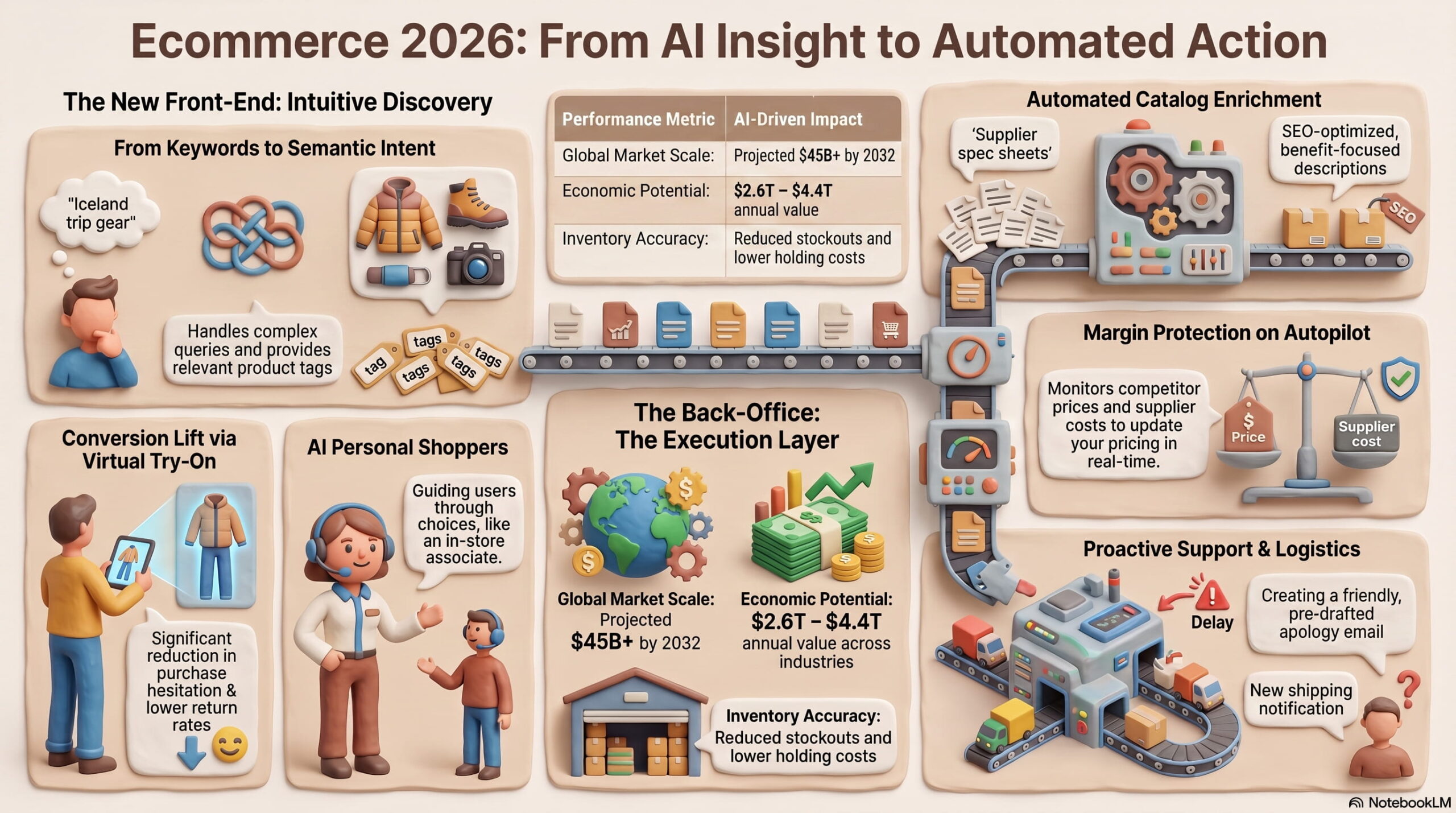
Key Market Statistics: The Operational ROI of GenAI in Commerce
The business case for generative AI in retail and ecommerce is no longer speculative, it is measured in documented revenue lift, labor cost reduction, and margin protection across production deployments.
According to McKinsey’s research on generative AI’s economic potential, the technology could unlock $2.6 trillion to $4.4 trillion in annual value across industries, with retail and consumer goods among the highest-impact sectors. Within retail, AI-driven personalization — now powered by generative models rather than collaborative filters — is consistently identified as one of the primary value drivers, with measurable conversion improvements in A/B tested deployments across major merchants.
On the consumer side, the expectations have shifted sharply. Salsify’s annual Consumer Research consistently demonstrates that product pages with complete, enriched content accurate dimensions, use-case descriptions, comparison attributes — dramatically outperform sparse listings in conversion rate and return rate. Separately, EMARKETER has tracked rapid growth in AI-assisted search behavior, documenting a rising share of online shoppers who now initiate product discovery through conversational AI interfaces rather than traditional keyword search bars. That behavioral shift accelerated significantly through 2024 and 2025 as tools like Perplexity, ChatGPT Shopping, and Google AI Overviews entered mainstream consumer use.
Market scale data underscores the depth of institutional commitment. Analysts including Grand View Research and MarketsandMarkets project the global AI in retail market will exceed $45 billion by 2032, growing at a compound annual rate above 18%, as merchants move from experimental deployments to production-scale systems embedded in their core tech stack.
Three operational metrics capture where that ROI is materializing most consistently:
- Conversion rate — improved by semantic search and personalized recommendations that reduce zero-result searches and decision friction.
- Inventory accuracy — improved by AI-driven demand forecasting that reduces both stockout events and excess holding costs.
- Gross margin — protected through real-time repricing that responds to supplier cost changes before human operators would typically detect them.
Top Generative AI Use Cases in Ecommerce
Generative AI use cases in ecommerce span the full customer journey from initial product discovery through post-purchase support — with each touchpoint representing a measurable conversion and retention lever.
1. Next-Generation Product Search and Semantic Discovery
Semantic search powered by generative AI allows shoppers to query in natural language and receive contextually relevant results, replacing rigid filter-and-keyword navigation with intent-aware product matching.
The difference in user experience is stark. Legacy search requires shoppers to already know the right taxonomy: category, then subcategory, then filter by color, material, and price range in the correct sequence. A query like “waterproof jacket for a February trip to Iceland under $150” fails in most keyword-based systems because no indexed field contains that exact phrase structure, and no filter combination maps cleanly to its implicit requirements.
Generative AI search engines trained on both the product catalog and natural language intent — parse that query into its component signals: cold-weather performance, precipitation resistance, a specific price ceiling, and implicit urgency. Amazon’s Rufus AI assistant, launched in 2024, operates on this principle: it allows shoppers to ask comparison and recommendation questions and receive synthesized, catalog-aware responses rather than a list of blue links. Constructor ASA, a search and product discovery platform used by enterprise retailers, similarly applies ML and NLP to transform how product ranking and filtering operates, using revenue-per-search as its core optimization metric rather than a simple query match rate.
The commercial implication is direct: merchants using semantic search consistently report improved sessions-to-purchase rates, particularly on mobile, where the friction of navigating filter menus is highest and where query abandonment has historically been the most costly.
2. AI Personal Shoppers and Conversational Commerce
AI personal shoppers are conversational agents embedded in the shopping experience that guide customers through product selection using preference-matching, contextual questions, and inventory-aware recommendations — functionally replicating what a knowledgeable in-store associate does.
Shopify Sidekick, Shopify’s AI commerce assistant, represents one implementation of this model on the merchant operations side — helping store operators query their own data through natural language: “What were my top-margin products last month?” or “Which SKUs have had more than three returns this week?” On the shopper-facing side, conversational commerce tools built on GPT-4o or Claude APIs embed as guided selling interfaces that reduce decision paralysis.
A shopper uncertain between two technical products — say, two models of a standing desk — benefits from an agent that can ask “Do you need motor memory presets? Will you raise and lower it more than ten times a day?” and route to the correct SKU based on the answers. That guided selling capability, previously only scalable with trained floor staff, scales digitally through generative AI at essentially zero marginal cost per conversation.
The conversion impact compounds: when shoppers receive relevant guidance rather than a wall of search results, average order value tends to increase alongside conversion rate, because the agent can surface accessories, compatibility add-ons, and higher-tier options that match the stated use case.
3. Automated Product Description Enrichment at Scale
AI-powered product description enrichment transforms raw supplier spec sheets into structured, conversion-optimized product pages, eliminating the content bottleneck that slows catalog expansion and suppresses organic search visibility.
Incomplete product information is among the most documented causes of ecommerce friction. The Baymard Institute’s extensive cart abandonment research identifies insufficient product detail and unclear descriptions as consistent drivers of abandonment across virtually every product category. Salsify’s Consumer Research reinforces this finding: product content quality — attribute completeness, relevance of copy to search intent — directly correlates with retailer conversion rates and, for brands, with retail buyers’ willingness to carry and feature the product.
For dropshippers and multi-supplier operators, this represents a specific operational challenge: supplier data arrives in inconsistent formats, often lacking SEO-relevant copy, use-case framing, or benefit-focused language. Generative AI models, given a structured prompt template and a supplier spec sheet as input, can output a fully formatted product description, structured bullet point set, and meta description in seconds maintaining brand voice consistency across thousands of SKUs simultaneously.
Output quality depends heavily on two factors: prompt engineering quality and the validation layer that follows generation. Best-practice implementations run AI-generated descriptions through a grounding check against the supplier spec to flag potentially hallucinated specifications, a real risk addressed in the Implementation Challenges section and route exception cases for human review before publishing.
4. Virtual Try-On Experiences and Visual AI
Visual AI and virtual try-on tools use generative image models to let shoppers preview products on themselves or in their environment before purchasing, directly addressing purchase uncertainty and reducing return rates in high-hesitation categories.
Sephora’s Virtual Artist, one of the earliest and most thoroughly documented visual AI deployments in retail, allows shoppers to test makeup shades in real time using their smartphone camera. The downstream effect extends beyond novelty — it changes the purchase confidence calculus in a category where return rates are structurally high and online conversion has historically lagged in-store performance. When a shopper has already “tried” a product, the purchase decision becomes a confirmation rather than a leap of faith.
Birkenstock’s mobile experience implemented AR-based fit visualization to address the same challenge in footwear: a category where fit uncertainty drives both hesitation at the point of purchase and elevated post-purchase returns. The operational value of reduced return rates compounds across the full P&L — return processing, restocking labor, and refund costs all decrease when the initial purchase decision is grounded in a simulated product experience.
Beyond try-on, generative image models including those built on diffusion architectures such as Stable Diffusion, DALL-E 3, and Midjourney’s API, are increasingly used to generate lifestyle product imagery at scale, placing products into multiple scene contexts without a physical photo shoot. For catalog operators managing thousands of SKUs, this reduces creative production costs while improving the visual richness that drives engagement.
Generative AI in Ecommerce: Capability and Impact Matrix
| Business Area | GenAI Use Case | Core Metric to Watch | Real-World Example / Tech Stack |
|---|---|---|---|
| Product Discovery | Semantic & conversational search | Sessions-to-purchase rate | Amazon Rufus, Constructor ASA |
| Customer Experience | AI personal shopper / guided selling | Conversion rate, average order value | Shopify Sidekick, ChatGPT API |
| Catalog Operations | Automated product description enrichment | Content completeness score, organic rank | GPT-4o API, Claude 3.5 Sonnet |
| Visual Commerce | Virtual try-on and AR fit visualization | Return rate, purchase confidence score | Sephora Virtual Artist, Birkenstock AR |
| Inventory Management | Demand forecasting and stockout prevention | In-stock rate, inventory turnover ratio | Custom LLM + ERP/WMS integration |
| Pricing & Margin | Real-time dynamic repricing with margin rules | Gross margin %, Buy Box win rate | Easync Repricer, rule-based AI triggers |
| Supplier Operations | Unstructured supplier data parsing & risk alerts | Lead time variance, supplier risk score | LLM-powered monitoring via API |
| Customer Support | Generative AI support agents | CSAT score, first-contact resolution rate | Anthropic Claude API, Intercom AI |
| Marketing & CRM | Personalized email and ad copy generation | Email CTR, ROAS, repeat purchase rate | ChatGPT API, Jasper AI, Persado |
Why this matters more in 2026 than it did in 2023
The first wave of ecommerce AI was obsessed with text generation. Fine. But the real shift is about speed of reaction.
Ecommerce was never short on data. The bottleneck was a human team trying to read that data fast enough to do something useful before the moment passed. What changed is that generative models can now read messy, unstructured stuff — chat logs, reviews, product images, supplier PDFs about as easily as they read a clean spreadsheet.
Here’s why that matters in practical terms. In a fast-moving store, a 24-hour delay in updating a price or pausing a broken listing can quietly cost you a few thousand in margin. Multiply that across a catalog and a quarter, and the “small” delays are the whole problem.
A few examples of how this plays out on a normal Tuesday:
- A courier hub gets snowed in. The AI reads the tracking delays and drafts proactive “your package is running late, here’s the new estimate” emails before the support tickets start landing.
- A new dropship supplier sends a catalog with 40% of the spec fields blank. Instead of someone manually filling them, the model reads the supplier’s raw text manuals and backfills dimensions and compatibility.
- A supplier nudges their base cost up. The AI flags the margin risk, checks whether competitors have room for you to raise prices too, and proposes a repricing rule.
None of these are sci-fi. They’re just chores that used to wait in a queue for a person.
Where the money actually is
If you’re adopting AI to say you adopted AI, you’re lighting cash on fire. The returns show up in high-volume, repetitive workflows where you can point at a number and say “that went up” or “that went down.”
Here’s a rough map of where generative ai use cases in ecommerce are paying off right now, and which metric to watch for each:
| Area of the business | What the AI is doing | Metric to watch | Why it’s worth it |
|---|---|---|---|
| Product discovery | Conversational search and intent-based filtering | Conversion rate, bounce rate | Shoppers describe what they want instead of fighting 50 sidebar checkboxes |
| Product pages | Content enrichment, localized FAQs, review summaries | SEO traffic, PDP conversion | Copy answers the buyer’s real objection right before “Add to Cart” |
| Personalization | Dynamic layouts and predictive bundling | Average order value, repeat purchase | Relevant “complete the setup” packages instead of random upsells |
| Customer support | Agents wired into your order and returns data | First-contact resolution, CSAT | Clears most of the “where’s my package” volume on its own |
| Pricing | Competitor tracking and margin guarding | Revenue, gross margin | You react to competitor stockouts and price drops without human lag |
| Inventory | Demand summaries and reorder triggers | Stockouts, overstock | Less capital frozen in dead stock |
| Fraud and risk | Risk profiling and order summaries | Chargebacks, manual review time | Catches suspicious orders before fulfillment |
Notice that almost none of these are “write me a poem about my socks.” The wins are operational.
The workflows worth understanding
To see how generative ai in retail and ecommerce works on the ground, it helps to walk the journey from a shopper landing on your site through to the package arriving.
Product discovery and shopping assistants
Think about how people actually search. Nobody types “Brand: X, Color: Navy, Fabric: Polyester.” They type the problem: “waterproof jacket for a February trip to Iceland under $150,” or “small desk lamp, warm light, fits a minimalist bedroom.”
Old keyword engines choke on that and dump a hundred near-misses on the page. An AI assistant reads the intent — the budget, the climate, the vibe — and hands back three or four genuinely good matches. Less friction, higher conversion. The shopper doesn’t burn twenty minutes clicking filters.
A small example that stuck with me: a home-goods store I looked at had a “shop by room” filter buried three clicks deep, and almost nobody used it. They swapped the search bar for an intent-based one, and the most common query turned out to be some version of “something to make my apartment feel less empty.” No filter on earth captures that. The assistant could — and the products it surfaced for that query converted noticeably better than the old browse path. The lesson wasn’t “AI is magic.” It was that people had been telling the store what they wanted all along, in plain language, and the old search just couldn’t hear it.

Copy that’s written at scale but doesn’t read like it
We can all smell the generic stuff: “Our premium, high-quality backpack is crafted from luxury materials for your maximum comfort.” That’s filler, and it sells nothing.
Done properly, AI takes a chaotic supplier spec sheet and turns it into copy that answers the questions buyers actually have. Will a 15-inch laptop fit? Is the base okay in the rain? Where do you hide a passport? It does this across thousands of SKUs at once while folding in your SEO keywords, comparison tables, and localized buying guides. The trick is feeding it good source material and editing the output — not shipping the first draft.
Review summaries
Nobody reads 400 reviews on a pair of earbuds. A good summary pulls the signal out: most buyers love the bass and battery, a handful find the ear tips tight, sizing runs true. Putting that honestly on the product page builds trust faster than a five-star average ever could, and it stops the doom-scrolling that ends in an abandoned cart.
Personalization that doesn’t feel like surveillance
Old recommendation engines lived on “frequently bought together.” Generative models layer in context — where the visitor came from, the season, how price-sensitive they seem, what’s actually in stock. So instead of a random upsell, you get a bundle that makes sense, or a “this one ships to your area fastest” nudge that the shopper is glad to see.
Support that doesn’t make people scream “AGENT”
We’ve all yelled at a decision-tree bot. Modern agents are different because they’re plugged into your CRM, your logistics, and your return policy. They check real order status, explain the fine print, generate a return label — and hand off to a human the moment things get complicated or cross a money threshold you set. The point isn’t to hide that it’s a bot. It’s to make the bot useful enough that people don’t mind.
Post-purchase, where anxiety lives
The stretch between “Buy” and “Delivered” is where customers get nervous. Rather than make them click a broken tracking link, the AI turns raw courier data into a plain-English update: stuck at customs, here’s the realistic new date, here’s what we’re doing. For cross-border and dropshipping, where tracking is famously flaky, this alone can dam up a flood of tickets.
The part people skip: you still have to act on the insight
Here’s the trap. You can have the sharpest AI in the world flagging opportunities all day, but if a human has to manually execute every single recommendation, you’ve just bought yourself a very expensive to-do list. The thinking gets faster; the doing stays slow. The insight has to land somewhere that can act on it automatically, or it just decorates a dashboard.
That gap — between what the AI decides and what your store actually does — is exactly where an execution layer earns its place. In dropshipping especially, where you’re juggling suppliers, multiple stores, and prices that move under you, that layer is the whole game.
How Easync Helps You Run Generative AI in Dropshipping
If you’re serious about generative ai in ecommerce, the smartest insight engine in the world is only half the setup — you still need something to carry out what it recommends. This is where pairing your AI layer with Easync automation turns recommendations into revenue, because it covers the entire execution chain in one place instead of leaving you to stitch it together by hand.
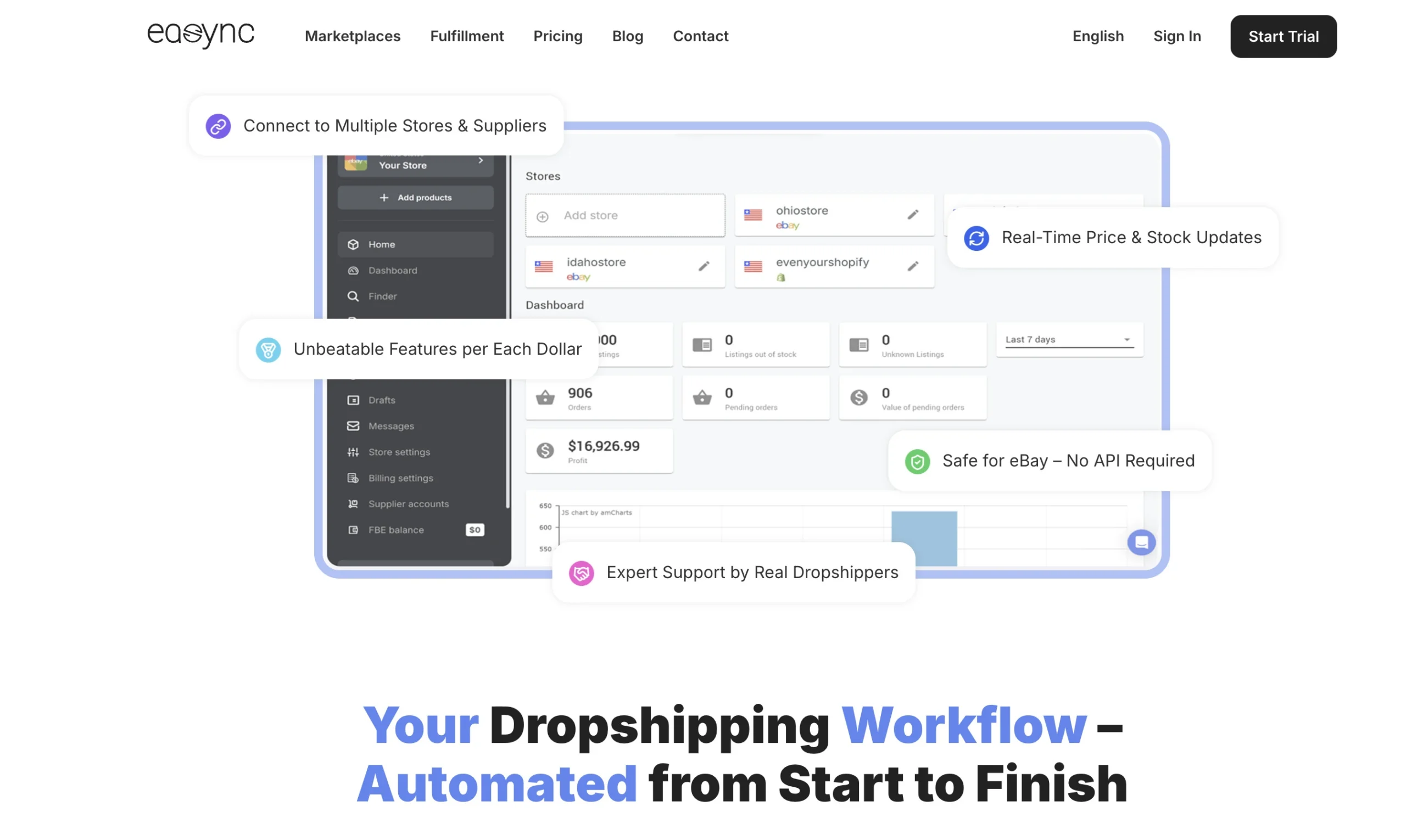
Walk through what that looks like. Say your AI spots a sudden demand spike in a niche product. Without automation, someone now has to find a supplier, pull the images, write the listings, push them to each store, and babysit stock and price levels — and by the time that’s done, the trend has cooled off. With Easync wired in, the operational heavy lifting just happens.
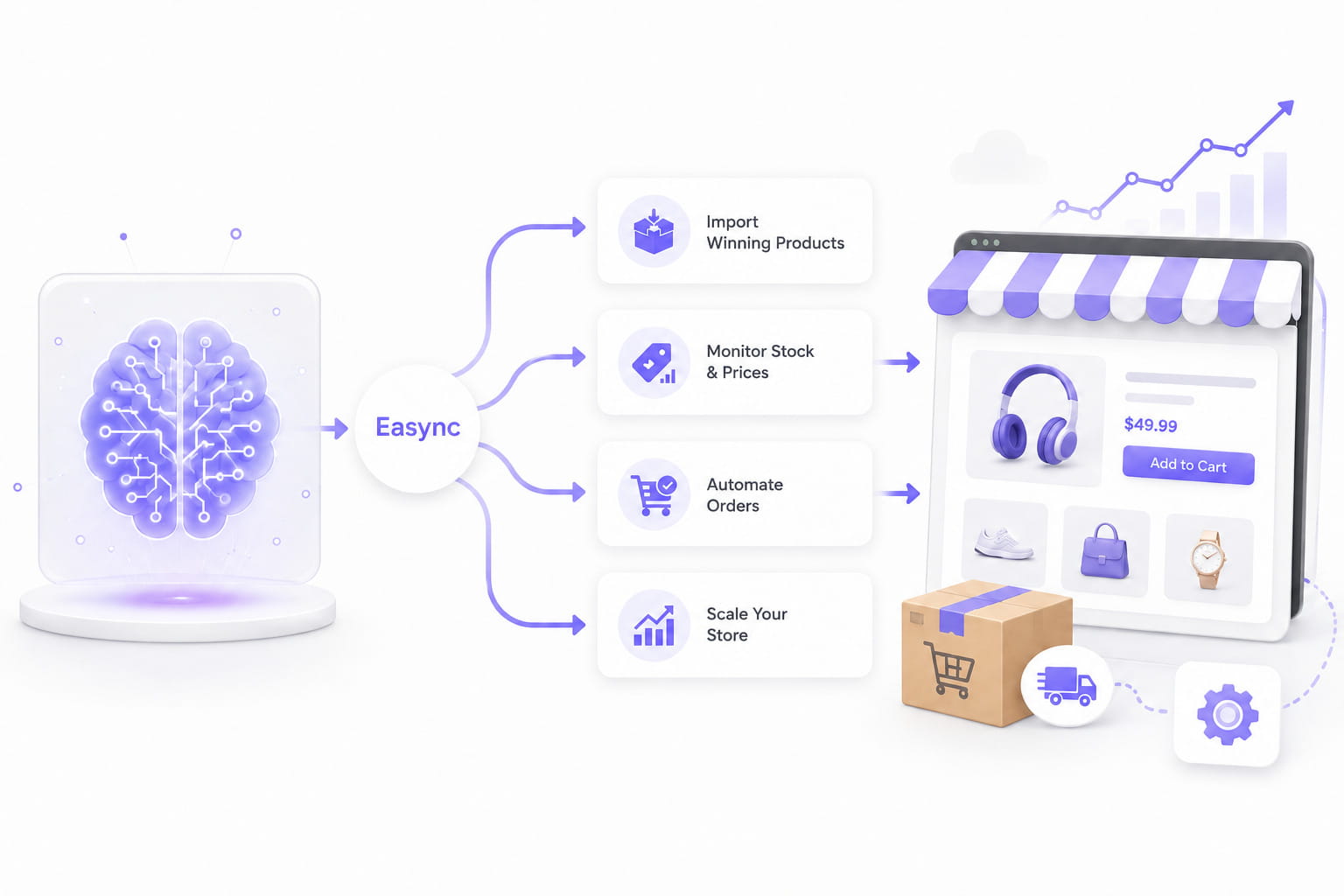
Here’s what it actually handles for you:
- Rapid product importing — pulls items into your stores in minutes instead of an afternoon of copy-paste, so you can ride a trend while it’s still hot.
- Real-time stock and price monitoring — watches your suppliers around the clock, so you’re never caught selling something that’s quietly gone out of stock or had its cost changed.
- Smart repricing rules — adjust your prices automatically the moment a competitor moves or a supplier’s cost shifts, protecting your margin without anyone refreshing tabs all day.
- Auto-ordering — fulfills incoming sales on its own, placing the supplier order the instant a customer buys, so nothing waits in a queue.
- Multi-account tracking synchronization — keeps order statuses and tracking numbers consistent across every store and marketplace you run, so your dashboards and your customers stay in sync.
The split is clean: the AI decides what should happen, and Easync is the muscle that makes it happen across all your stores at once. That’s the difference between an insight sitting in a report and a result hitting your bank account.
A worked example: one signal, start to finish
Abstract benefits are easy to nod along to and hard to act on, so let me trace a single, ordinary event all the way through — the kind that happens to a mid-sized store a dozen times a week.
It’s 2 a.m. A supplier quietly raises the cost on one of your better-selling SKUs by 7%. Nobody on your team is awake, and even if they were, this one line item wouldn’t jump out among the thousands you carry. Yesterday’s version of this story ends with you selling that product at a loss for three days until someone notices the margin report looks off.
Here’s how it goes with the pieces working together. The cost change hits your supplier feed. Your monitoring catches it immediately and flags the SKU as a margin risk. A generative model reads the surrounding context — your minimum margin on that item, how fast it’s selling, what three competitors are charging for the same thing right now — and works out that the market actually has room: two competitors are already priced higher. It drafts a recommendation: raise the price 9%, which restores your margin and still undercuts the field.
Now the fork in the road. If the change sits inside the guardrails you’ve set, automation just does it — the new price goes live and your listings update across every store before you’ve had your coffee. If it’s outside the rules, say it would push the price past a ceiling you care about, it lands as a clean approval ticket instead, with the reasoning attached, so you can say yes or no in ten seconds.
Either way, the loop that used to take three days and a painful margin report took about ninety seconds and zero human attention. That’s the entire pitch for generative ai in ecommerce in one story: not robots writing poems, but the lag between something changed and we handled it collapsing toward zero.
AI agents vs. chatbots — the difference that matters
The word “agent” gets thrown around loosely, so here’s a clean line: a chatbot answers a question, an agent runs a multi-step job inside rules you’ve set.
In the back office, an agent doesn’t just ping you that a competitor dropped their price. It checks your minimum margin, looks at how fast that item is moving, decides whether a price match is safe, and then either pushes the change live or drops a tidy approval ticket on your merchandiser’s desk. You’re not building an unsupervised black box — you’re building guardrails so your team only touches the edge cases and the high-stakes calls.
Back-office wins worth stealing
Marketing drafts without the blank page. Instead of your marketer writing five versions of an abandoned-cart email from scratch, the AI hands over tailored first drafts — one angle for price-sensitive shoppers, one for first-timers, one for people who bailed on a premium item. Your team spends its time testing and choosing, not typing.
Feedback you didn’t know you were collecting. Complaints live everywhere: support logs, emails, social replies, return reasons. Pointed at all of it, AI surfaces patterns you’d otherwise miss — returns spiking because a supplier quietly swapped a fabric, or checkouts dying on a confusing shipping-fee screen. Now you can fix the cause instead of treating symptoms.
Margin protection on autopilot. In dropshipping, a supplier raising their cost 5% without telling you can erase your profit overnight. Repricing rules fed by competitor pricing, ad costs, and supplier data keep you competitive when the market’s friendly and pause listings or bump prices when margins get squeezed.
A sane way to roll this out
Don’t try to reinvent the whole business overnight — that’s how you break things.
- Pick one measurable problem. Automate your FAQ generation, or review summaries, or enriching missing product tags. One thing.
- Clean your data first. Garbage catalog in, garbage AI out. Fix your titles, supplier feeds, and shipping rules before the model touches them.
- Set hard guardrails. Spell out what runs autonomously and what needs human eyes. AI can draft a refund reply; a person clicks send on anything over, say, $50.
- Tie it to a number. Handle time dropping? Add-to-cart climbing? If you can’t measure it, it’s a cost, not an asset.
Mistakes that’ll bite you
- Shipping AI output unedited. It’s a great first-drafter and a lousy final editor. Brand voice, accuracy, and compliance still need a human.
- Automating high-risk calls too early. Keep people in the loop on legal complaints, big disputes, and supplier contracts.
- Letting your tools live in silos. If your AI can’t talk to your inventory, fulfillment, and automation stack, you’ve just created more disconnected manual work.
Questions worth asking before you buy anything
Most AI tooling demos beautifully and disappoints quietly. A few questions tend to separate the two:
- Where does the data come from, and what happens when it’s missing? A tool that confidently fills gaps with invented data is worse than one that leaves them blank and tells you.
- How does it connect to what I already run? If it can’t talk to your store platform, your supplier feeds, and your automation layer, you’re buying another silo.
- What can it do on its own, and what can I force through review? You want to set that line yourself, not inherit someone’s defaults.
- How do I turn it off mid-action? Anything that touches pricing or ordering needs a fast, obvious kill switch.
- What does it actually cost at my volume? Per-action API pricing looks tiny in a demo and adds up fast across a real catalog.
If a vendor can’t answer those plainly, that’s your answer.

Where it still falls flat (the part vendors won’t tell you)
I’d be lying if I said this all just works. A few honest caveats, because the demos never show these.
Hallucinated specs are the scary one. If your source data is thin, a model will happily invent a dimension or a compatibility claim that sounds plausible and is flat wrong. In a product description that’s a returned order and a one-star review waiting to happen. The fix isn’t clever prompting — it’s refusing to let the model fill a field it doesn’t actually have a source for, and flagging low-confidence output for a human instead of publishing it.
Tone in support is harder than it looks. AI handles “where’s my order” beautifully. It’s much worse at reading the room when someone is genuinely upset — it can stay relentlessly cheerful at exactly the wrong moment, which makes an angry customer angrier. That’s why your handoff threshold matters more than the bot’s raw smarts.
Pricing automation can spiral if you’re not careful. Two competitors both running aggressive repricers can chase each other to the floor over an afternoon. Hard margin minimums aren’t optional here; they’re the thing standing between you and quietly selling at a loss while a bot congratulates itself for “staying competitive.”
And the unglamorous truth: most of the value is gated behind clean data. Teams want to skip to the magic and end up automating their mess faster than before. If your catalog is a swamp, drain the swamp first. The AI will still be there next month.
None of this is a reason to sit it out. It’s a reason to keep a human watching the edges and to roll things out one workflow at a time instead of flipping every switch on launch day.
Where this is heading
The endgame is AI becoming invisible. Brands will stop advertising “machine learning on our storefront” the same way nobody advertises “we use electricity.” Expect multimodal search that mixes voice, text, and images naturally, virtual try-on that finally looks real, and operational copilots stitched deep into the back end. The winners won’t be the ones sprinkling AI on every surface — they’ll be the ones who connect it to automated workflows, defend their margins, and keep a human hand on the strategy.
FAQ
What should a mid-sized brand budget for AI in year one?
Skip the six-figure “AI transformation” consultant. Budget for specific software integrations, some team training, and API fees for a couple of targeted pilots support triage, say, or content generation. Grow the budget only after a pilot proves it saves real hours or lifts conversion.
What skills does my team need?
Not a roomful of data scientists. You need data-literate operators and product managers who get system integrations, workflow logic, and clean approval chains. Your marketing and merchandising people mostly need to learn to guide and audit AI output instead of doing the manual typing.
Can a small store do this without a technical team?
Yes, and you shouldn’t build from scratch. Lean on the AI features already shipping inside your ecommerce platform, helpdesk, and email tools, then pair them with plug-and-play automation like Easync for the operational heavy lifting. That’s how a small store competes with a big one without hiring engineers.
How do I add AI support agents without annoying customers?
Be honest that it’s a bot, give an obvious one-click path to a human, and let the AI handle clear-cut policy questions. Save your people for empathy and the genuinely messy problems. Trying to disguise a bot as a human is how you lose trust.
How fast will I see results?
For content generation, review summaries, and basic support triage, a few weeks. The deeper integrations — fully automated dynamic pricing, predictive reorder triggers — take a few months of testing to dial in safely. Anyone promising instant transformation on the hard stuff is selling something.
Will AI-written product copy hurt my SEO?
Only if you ship it unedited and identical across pages. Search engines don’t penalize AI assistance — they penalize thin, duplicate, unhelpful content, which humans produce plenty of too. Used well, AI lets you write genuinely useful, differentiated copy across thousands of SKUs and weave in the keywords and buying-guide context that earn rankings. The edit pass is what keeps it on the right side of that line.
Do I need to tell customers when AI is involved?
For support chat, yes — be upfront it’s a bot and offer an easy human path. For things like AI-summarized reviews or generated descriptions, disclosure is less of a trust issue and more about accuracy: the obligation is to make sure what’s published is true, not to slap an “AI-generated” label on everything. When in doubt, transparency rarely costs you anything.
How does generative AI improve product search in retail?
Generative AI improves product search by replacing keyword-matching algorithms with semantic understanding the ability to interpret what a shopper means, not just what they typed. A traditional search engine requires shoppers to know the right category taxonomy and filter terms, and returns no results, or irrelevant ones when the query doesn’t map cleanly to indexed product attributes.
A generative AI search engine like Amazon Rufus or a Constructor ASA-powered retail search implementation can process a query like “running shoes for wide feet, trail use, under $120, in neutral colors” and return highly relevant results even if no product is tagged with that exact phrase combination. The model understands the intent behind the query and maps it to the relevant product attributes in the catalog using vector embeddings rather than exact-match logic.
The practical outcomes of this shift: significant reduction in zero-result searches, improvement in sessions-to-purchase rate (especially on mobile, where filter navigation is highest-friction), and a material increase in catalog depth — shoppers discover products that would never surface in a keyword search because they aren’t described in the terms shoppers happen to use.