
- articles
How to Start AI Dropshipping with Zero Money in 2026
Every year, thousands of aspiring entrepreneurs scroll through courses and tools with four-figure price tags and quietly close the tab. The assumption that you need a loaded credit card before you earn your first dollar has killed more businesses before launch than any algorithm change ever could.
In 2026, the emergence of genuinely capable free-tier AI tools, combined with marketplace-based selling and zero-cost traffic channels, has created a workable framework for launching an AI dropshipping operation without an upfront budget. While it is absolutely real, it requires disciplined execution, realistic expectations, and at a certain point the right automation infrastructure to prevent it from collapsing under its own weight.
This guide maps the exact zero-budget path from setup to first sale, and explains with total transparency where the floor of “free” eventually meets its ceiling.
Definition: AI dropshipping for free is a low-barrier e-commerce model where entrepreneurs use free-tier artificial intelligence tools to automate sourcing, store design, and organic customer acquisition with zero upfront capital. It is the operational framework this guide is built around.
Is It Actually Possible to Start AI Dropshipping for Free?
Yes, but with one important asterisk. The infrastructure to launch costs nothing, but you will need a credit card or short-term cash buffer to purchase products from your supplier after a customer pays you, because marketplace payouts take 1–7 business days to clear.
Let’s break down what a genuine zero-dollar starting point looks like across three layers:
Free storefront: Both eBay and Amazon allow free seller account creation. Shopify offers a three-day free trial (extendable to a low-cost $1/month introductory period), meaning your hosting and storefront infrastructure costs nothing on day one.
Free AI generation tiers: ChatGPT-4o’s free plan, Google Gemini, and Microsoft Copilot all provide enough capability to handle product description writing, niche research, supplier vetting queries, and basic customer service drafting without a paid subscription.
Free organic traffic loop: TikTok, Instagram Reels, and YouTube Shorts do not charge a cent for posting content. A single well-produced short-form video reviewing a product you’re dropshipping can drive thousands of impressions organically.
The one component that misleads people is the cash flow gap. When a customer buys a $45 item from your eBay listing, your marketplace payout takes between 1 and 5 business days to process, but you still need to purchase that item from your supplier today to hit the shipping window. You need a credit card, debit card with available funds, or a small cash reserve to bridge that gap. It is not startup capital in the traditional sense, but it is a real operational requirement you should plan for before your first order arrives.
Step 1: Choosing a Free-to-Start E-Commerce Platform
Your platform choice determines your audience reach, fulfillment strictness, and how quickly you can make your first zero-cost sale. For a zero-budget launch, you have two legitimate entry gates.
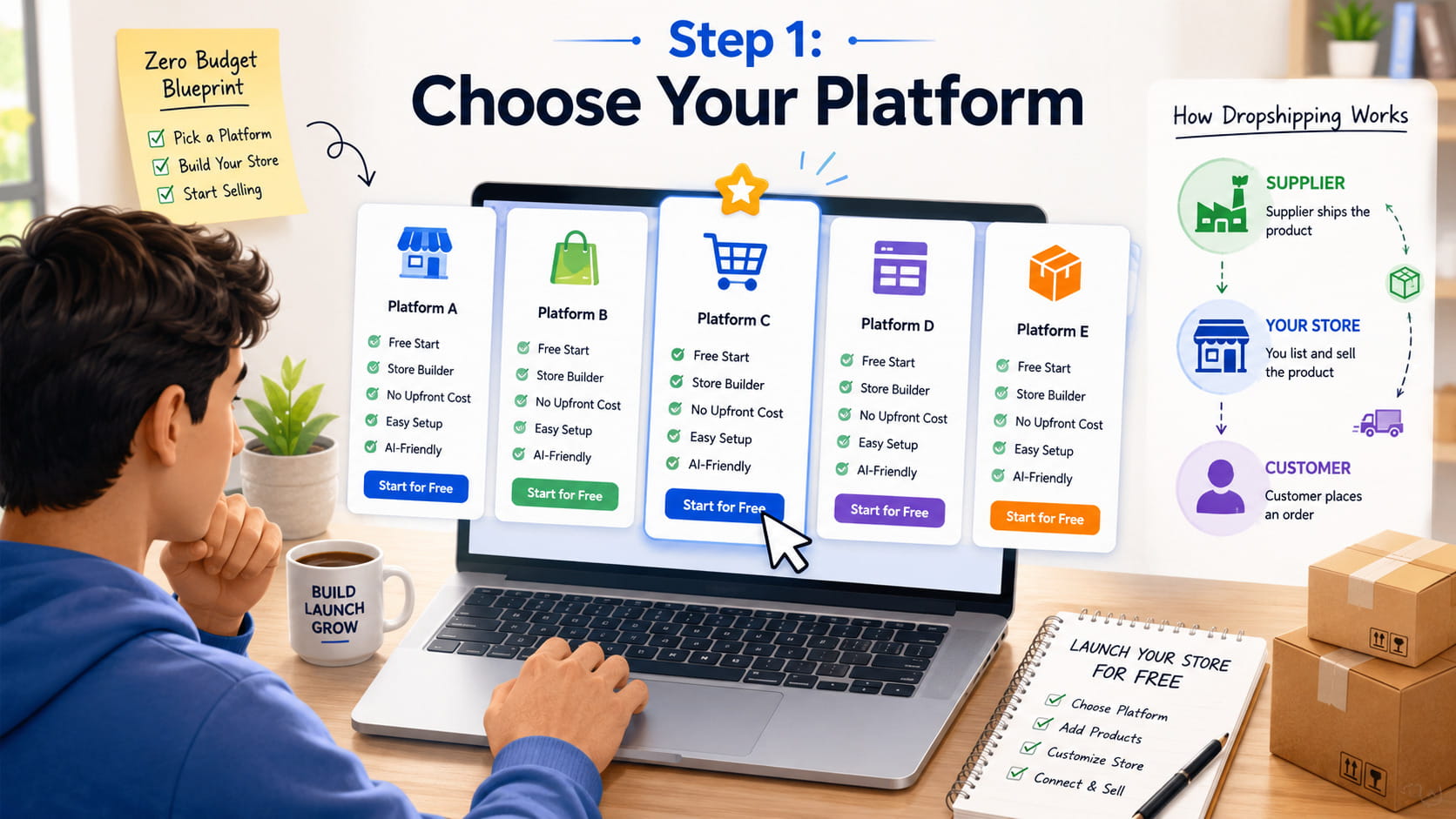
Marketplace Dropshipping (eBay and Amazon)
eBay and Amazon give you access to millions of active buyers on day one, with no hosting fees, no domain registration, and no design overhead making them the fastest path to a first sale for a zero-budget operation.
eBay’s managed payments system deducts seller fees from your payouts rather than billing them separately, removing the friction of upfront processing costs. Creating a basic eBay seller account is completely free, and with the right product selection you can have a live listing in front of buyers within an hour of account creation.
Amazon’s Individual Selling Plan charges $0.99 per item sold rather than a monthly subscription, another valid zero-upfront option for testing low-volume product concepts. The tradeoff is strict fulfillment requirements; Amazon’s shipping windows are less forgiving than eBay’s, and consistent misses will damage your seller health score quickly.
The core advantage of marketplace dropshipping is built-in buyer intent. People on eBay and Amazon are actively shopping. The core disadvantage is that you’re building on rented land, your brand equity is minimal, and both platforms can suspend listings at their discretion.
Independent Storefronts (Shopify Free Trial)
Shopify’s free trial lets you build a fully branded storefront, configure your product catalog, and begin accepting payments before spending a single dollar on infrastructure.
The Shopify Free Trial gives you access to the full store-building environment theme customization, product pages, checkout flow, and basic analytics before your first transaction occurs. During the trial window, you can connect a domain, install essential free apps, and configure your payment gateway at zero cost.
The tradeoff compared to marketplaces is traffic. An independent Shopify store has zero built-in audience; every visitor must come through your own organic content efforts. This makes the Shopify path most effective when paired with a dedicated social content strategy from day one (covered in Step 4).
To accelerate setup without any coding or design experience, pair the Shopify free trial with a free AI storefront builder. Tools like PagePilot AI offer trial-tier access to automated product page generation the platform uses AI to write conversion-optimised listing copy, pull in supplier images, and configure a complete store layout from a single product URL input. This compresses what would otherwise be several hours of manual Shopify editing into minutes of AI-generated output, a meaningful advantage when you are launching in a competitive niche on a zero-dollar timeline. Combining Shopify’s native free trial infrastructure with an AI landing page layer gives you a fully stocked, professionally structured storefront before a single dollar leaves your account.
For most zero-budget beginners, the optimal approach is to start on eBay for immediate buyer access while simultaneously building a Shopify storefront during the trial period, using early eBay revenue to eventually fund the monthly subscription.
Step 2: Leveraging Free AI Tools for Niche Market Sourcing
Free large language models like ChatGPT-4o and Google Gemini can replace expensive product research tools entirely in the early stages, if you know how to prompt them precisely.
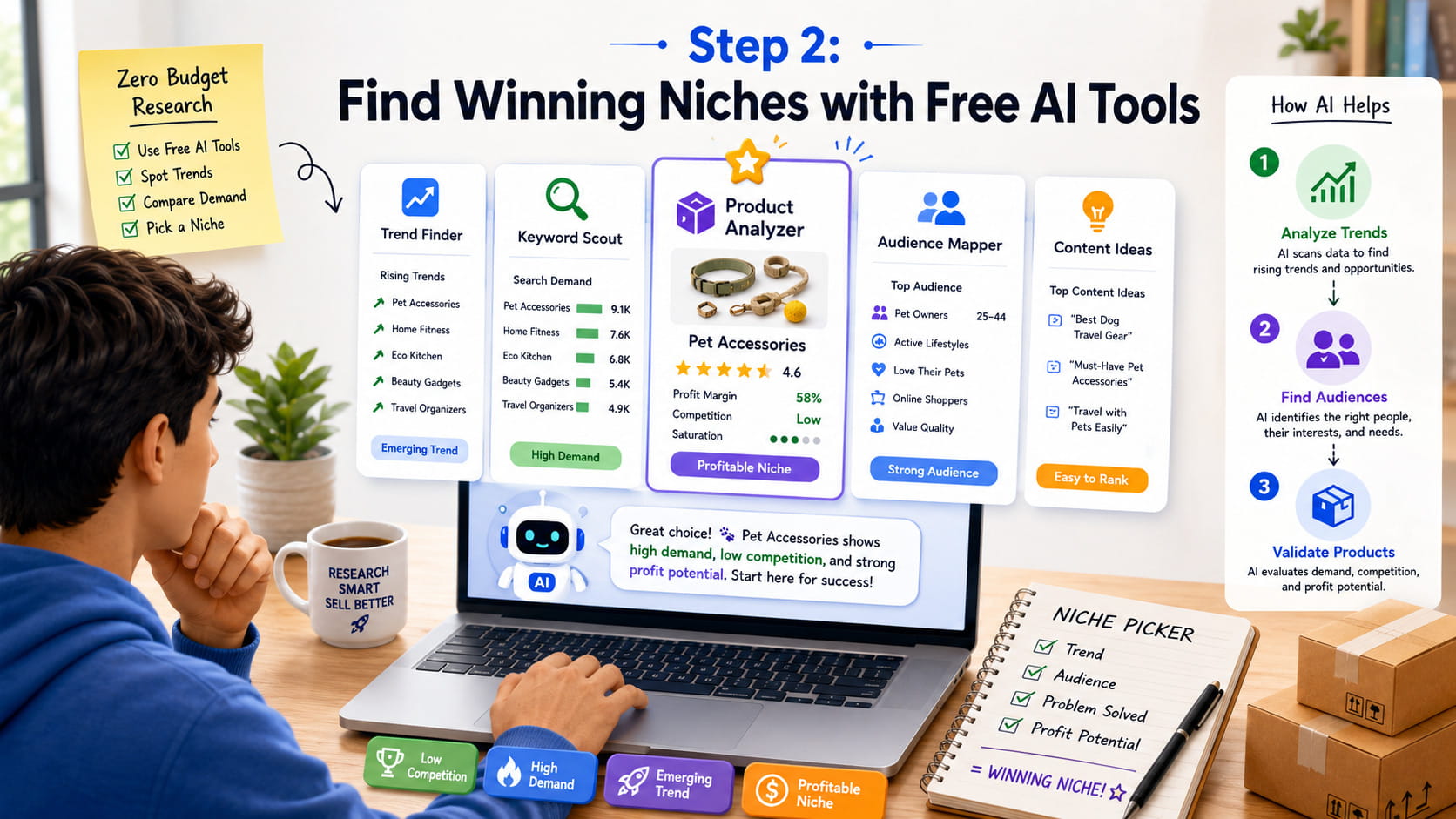
Product-spy software platforms typically charge $50–$200 per month for data you can approximate with intelligent AI prompting at zero cost. Open ChatGPT-4o (free tier) and use structured prompts like:
“Give me 10 high-margin home decor products priced between $8 and $25 wholesale with domestic US suppliers on AliExpress or CJDropshipping, that have consistent search demand and minimal brand competition on eBay. Include estimated retail price ranges and a one-line value proposition for each.”
Cross-reference suggested products by searching completed eBay listings (Advanced Search → Sold Listings) to verify items are actually selling not just listed. For supplier discovery, try:
“List five US-based dropshipping suppliers for pet accessories that offer direct eBay or Shopify integrations with no minimum order quantity.”
Canva’s free tier handles product image editing, background removal, and listing banner creation. CapCut’s free version covers short-form video editing for product demonstrations. Together, these tools complete the content production stack at no cost.
The discipline required here is iteration. Free-tier AI models produce directional insights, not guaranteed winners. Test two or three product concepts simultaneously, use eBay’s 30-day sales data to identify which listings generate the most watchers, and double down on what’s working.
One financial filter to apply before committing to any niche: target products that carry a gross profit margin of 20% to 30% per unit. That band provides enough cushion to absorb eBay’s final value fee (approximately 13.25%) and Amazon’s referral fee (typically 8–15% depending on category), while leaving meaningful per-transaction profit that compounds as order volume grows. Any niche falling consistently below 20% gross margin turns a promising store into a break-even exercise the moment a supplier raises their wholesale price by a dollar.
Step 3: Automating Your Backend Workflows for Zero Upfront Cost
Manual dropshipping operations copying supplier links by hand, checking stock levels daily, tracking orders across multiple accounts in a spreadsheet scale to approximately 10–15 orders per day before they collapse. Automating your backend from the start using Easync.io’s trial period eliminates this ceiling before you hit it.
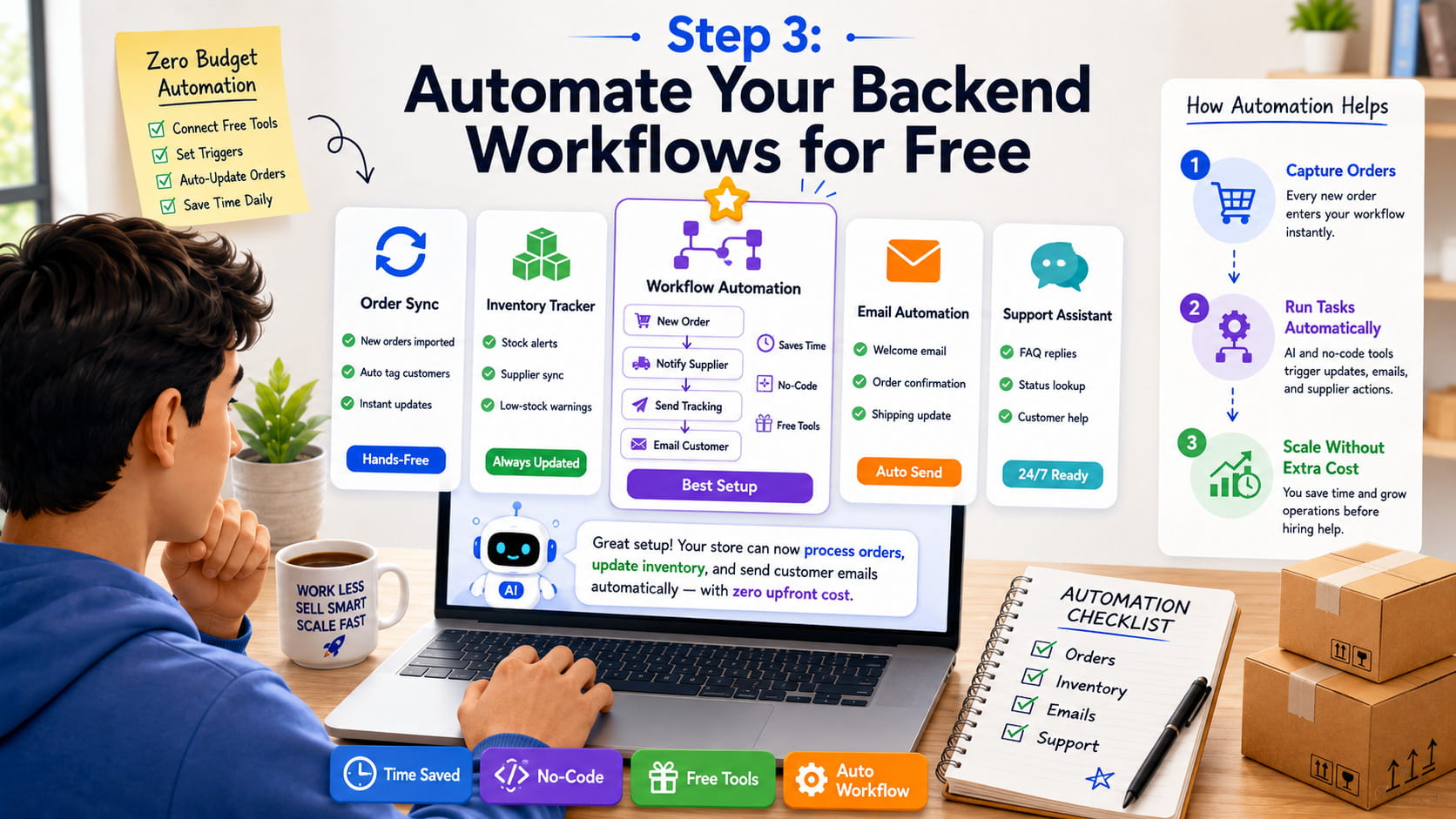
Here is the operational reality most “free dropshipping” guides skip entirely: the part of the business that fails is rarely the storefront. It is the invisible backend the moment a supplier goes out of stock while your eBay listing stays live, the moment a price increase erodes your margin before you catch it, the moment you have 30 open orders and you are copy-pasting tracking numbers into five different dashboards at midnight.
Easync.io is a dropshipping automation platform built specifically for eBay, Amazon, and Shopify operations. Its core capabilities include:
- Rapid product importing — pull supplier product data, images, and pricing directly into your listings without manual copy-paste entry.
- 24/7 automated stock and price monitoring — Easync continuously watches your supplier listings and adjusts your store pricing or pauses listings automatically when stock runs out or costs change.
- Auto-ordering — when a customer places an order on your store, Easync can trigger the supplier purchase automatically, removing the manual fulfillment step entirely.
- Multi-account synchronization — manage eBay, Amazon, and Shopify simultaneously from a single dashboard, with tracking numbers automatically pushed back to the correct order on each platform.
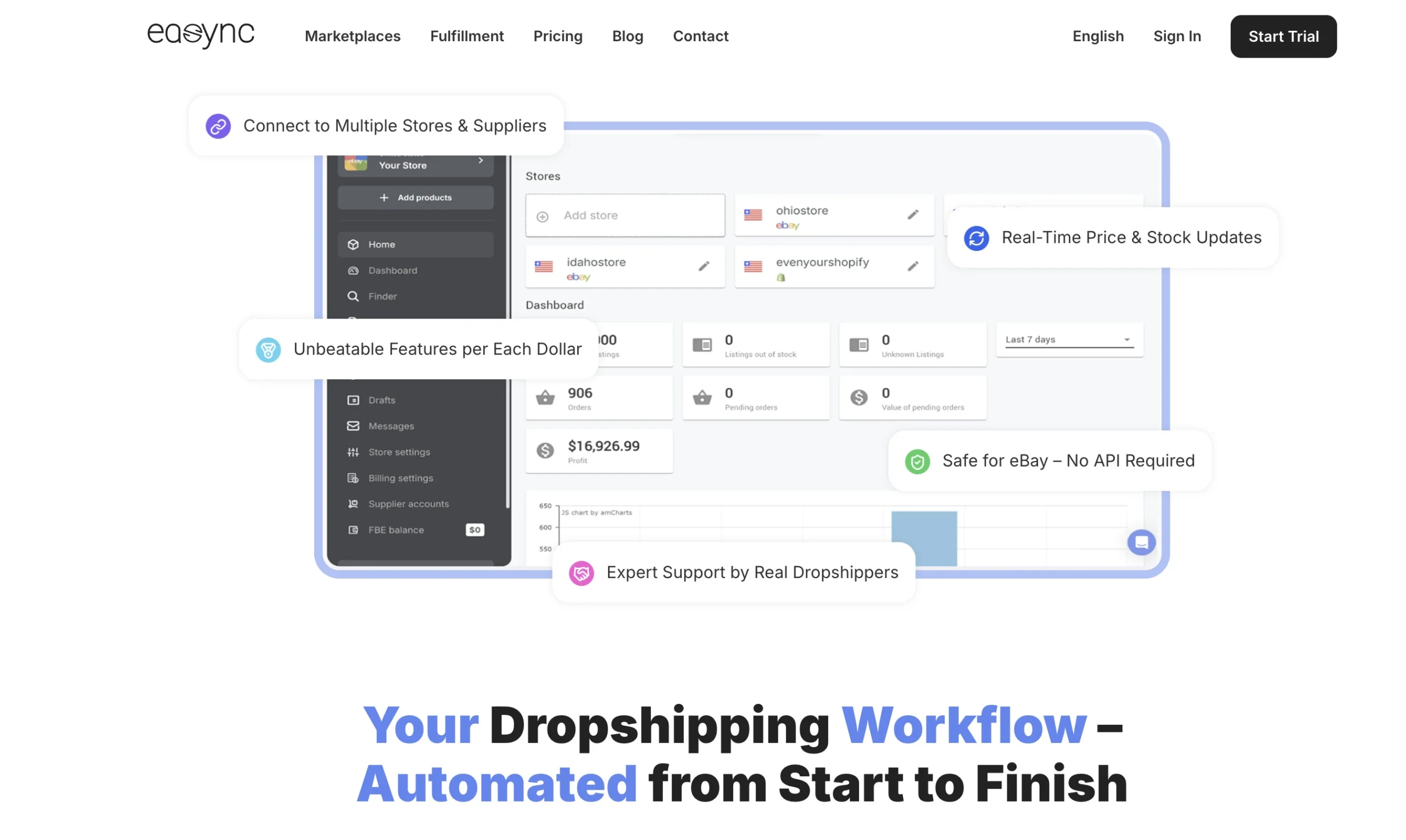
The critical point for a zero-budget operator is timing. Easync offers a Start Trial period that lets you connect your accounts, import products, and configure your automation workflows before committing to a paid plan. This means you can build the automated operational infrastructure during the exact same window you’re generating your first organic traffic and testing your first product listings without paying a separate subscription fee during the learning phase.
Treat the trial period as a setup sprint: import your full initial product catalog, configure price rules, test one complete auto-order cycle with a real purchase, and validate that tracking is flowing correctly to your storefront. By the time the trial ends, your store should be generating enough transaction volume to make the subscription cost a direct line-item against revenue rather than a speculative investment.
Step 4: Generating Free High-Intent Traffic via Organic AI Content Loops
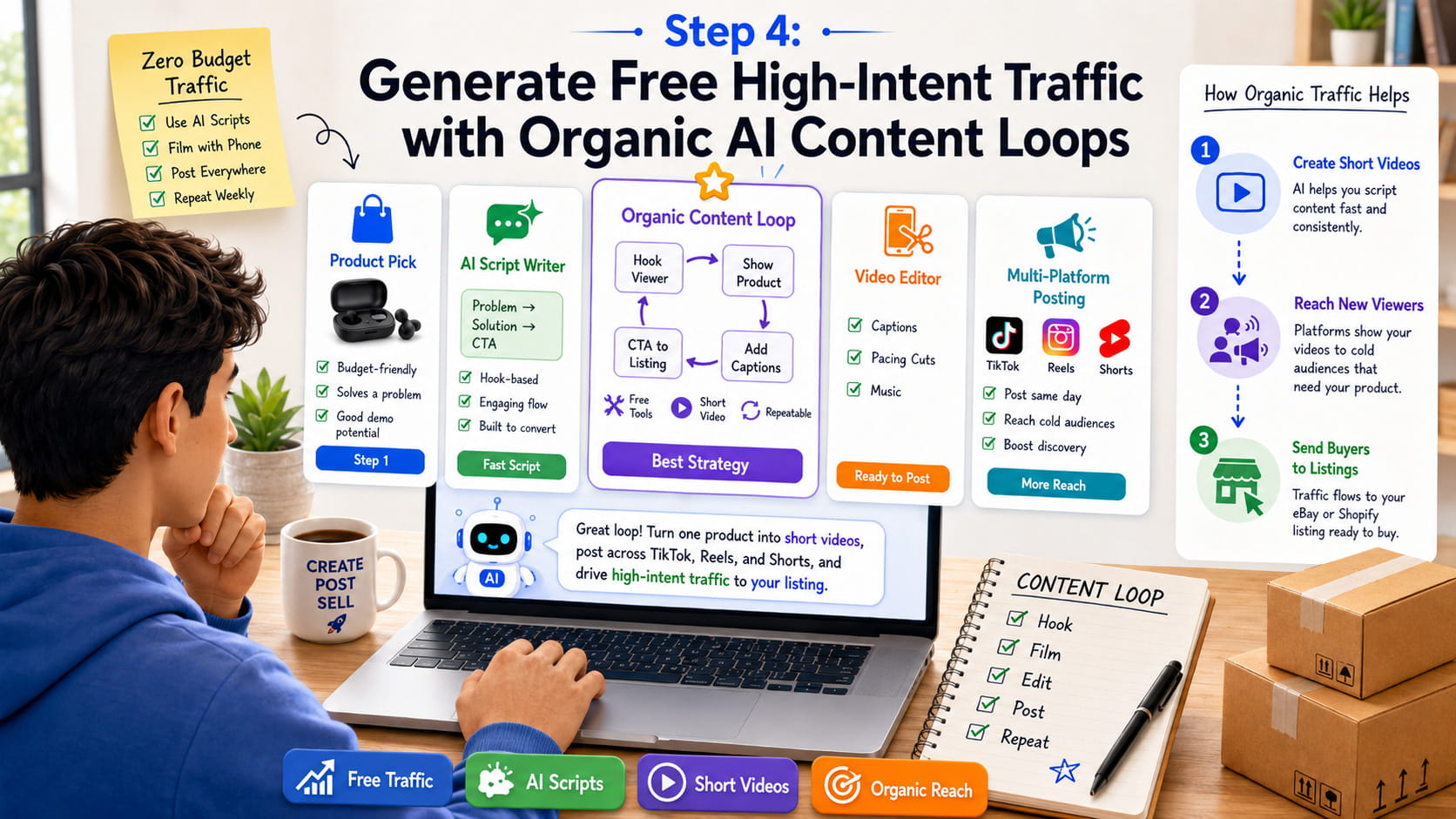
With zero paid advertising budget, your only traffic engine is organic short-form video content and free AI scripting tools make consistent output achievable even with no prior content creation experience.
Paid Facebook and Google ads are not viable on a zero-dollar budget any guide suggesting “running a few small test ads” as a startup tactic is describing a path to spending money you don’t have.
The organic alternative is built on three platforms: TikTok, Instagram Reels, and YouTube Shorts. All three algorithmically surface new content to cold audiences, meaning a brand-new account with zero followers can generate thousands of views on its first post if the format resonates.
The content loop works as follows:
- Identify your product using the AI research method from Step 2
- Use ChatGPT-4o to generate a 30–60 second hook-based video script: “Write a TikTok script for a 45-second video reviewing [product], targeting budget-conscious homeowners. Open with a problem, show the solution, and end with a CTA to the eBay listing.”
- Film the content using only a smartphone, no studio or professional lighting required
- Edit with CapCut (free tier) for captions, pacing cuts, and music
- Post to all three platforms within the same 24-hour window to maximize initial distribution
The compounding effect is real: a product video that gains traction on TikTok drives traffic to an eBay listing with early sales history, which boosts its internal eBay search ranking, generating additional marketplace traffic independent of your content. The two loops reinforce each other. Consistency matters more than production quality, three videos per week over 60 days within a focused niche will outperform one polished video per month on every relevant algorithmic metric.
Operations Comparison: Manual Bootstrap vs. Automated Scale
| Operational Segment | Zero-Dollar Manual Route | Automated AI Route | Easync Optimization |
|---|---|---|---|
| AI Product Sourcing | Manual keyword searches across Amazon, eBay, and AliExpress; no competitive data layer | Free LLM prompts (ChatGPT-4o, Gemini) generate niche shortlists, margin estimates, and supplier leads at zero cost | Easync’s supplier catalog surfaces high-velocity, in-stock products primed for instant cross-platform import |
| Product Importing | Copy-paste titles, images, and pricing from supplier pages by hand; hours per batch | AI-assisted bulk listing via CSV templates or browser extension tools; still manual in trigger | One-click supplier import pushes fully formatted listings directly into eBay, Amazon, or Shopify in seconds |
| Cost & Stock Tracking | Manual daily check of supplier pages; a single missed price change causes margin collapse or overselling | Spreadsheet-based alerts with significant lag time; human must action every change | 24/7 automated price and stock monitoring with real-time listing adjustments and auto-pause on stockout |
| Order Fulfillment | Manual purchase on supplier site per order; tracking number copied and pasted into each platform individually | Semi-automated with browser extensions; still requires human confirmation at each step | Full auto-ordering triggers on every sale; tracking numbers synchronise automatically back to the buyer |
| Multi-Account Growth | Separate browser logins, separate spreadsheets, separate mental overhead per channel; does not scale | Third-party tool stacks with limited native integration across platforms | Unified dashboard managing eBay, Amazon, and Shopify simultaneously from a single operational view |
The Human Bottleneck: Why “100% Free” Has a Ceiling
The zero-dollar model works at low order volume, but every manual task that takes three minutes at five orders per day takes three hours at sixty, and that arithmetic ends in marketplace suspension, not profitability.
At 5 to 10 orders per day, manual dropshipping is inconvenient but functional. A dedicated operator can manage stock checks, purchase orders, and tracking uploads in roughly 60 to 90 minutes of daily admin work. At 20 to 30 orders per day, a modest success threshold, not a scaling milestone, that same manual process expands to 4 to 6 hours of repetitive data entry. Errors multiply. A supplier goes out of stock and you miss it. A price increase erodes a margin before you catch it.
On eBay, late shipment rates above 3% and defect rates above 2% trigger account-level warnings that can end in selling restrictions. On Amazon, the threshold is even less forgiving. A permanently banned account cannot be fixed with any amount of money or appeals it simply ends the business.
This is precisely why automation is not a luxury for a growing dropshipping operation, it is the mechanism that keeps the entire structure standing under load. The window between “manual is fine” and “manual is dangerous” closes faster than most new sellers expect. Starting with Easync’s Start Trial during your setup phase means the automation layer is already embedded before your order volume tests your capacity. That is the correct sequencing.
Frequently Asked Questions (FAQ)
How to start dropshipping for free with ai?
Create a free eBay seller account or use Shopify’s free trial as your storefront. Use ChatGPT-4o’s free tier for product research, niche identification, and listing copy. Source products from no-minimum-order suppliers like CJDropshipping or AliExpress. Generate traffic organically through TikTok and Instagram Reels using AI-generated video scripts edited in CapCut.
Connect Easync.io during its trial period to automate product importing, stock monitoring, and order fulfillment. The sequence is: platform setup → AI product research → listing creation → organic content → backend automation.
Do I need a credit card to start AI dropshipping with no money?
You do not need a credit card to build your store, create listings, or generate organic content. However, you will need a card or debit account with available funds to fulfill your first customer orders. In dropshipping, the sequence is: customer pays you → you purchase from the supplier → supplier ships to customer.
Your marketplace payout takes 1 to 7 business days to clear, which means you need a short-term funding source to bridge that window. A credit card used responsibly purchasing only what you’ve already been paid for, is the standard operational tool for managing this cash flow gap.
Can I run a passive dropshipping business completely for free long-term?
Not sustainably. Free-tier tools and trial periods are entry points, not permanent infrastructure. Shopify’s trial expires. eBay’s free listing allowances have monthly caps. The realistic path to a passively managed business requires a paid automation platform and a funded storefront subscription. The zero-dollar model is a validated proof-of-concept engine: generate enough transaction data and initial revenue during the free phase to fund the paid infrastructure that makes the business sustainable.
A store doing 15 to 20 orders per month generates enough gross margin to cover an automation subscription and a basic storefront plan. Treat “free” as a funded runway, not a permanent operating model.