
- articles
What Is AI Dropshipping? The 2026 Guide to Automated Success
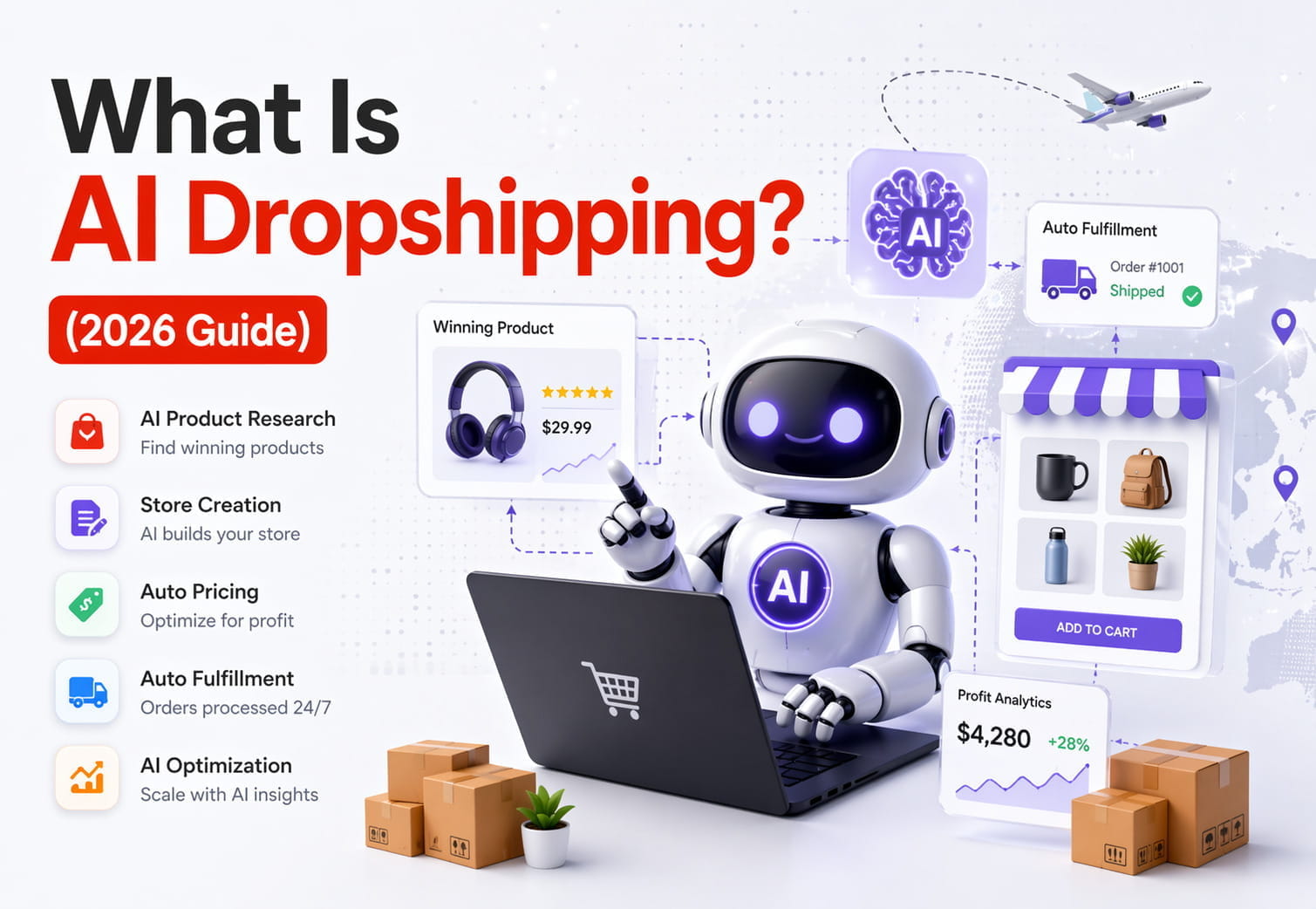
Quick answer: AI dropshipping is the practice of running a dropshipping store, meaning you sell products without holding inventory, while artificial intelligence tools handle product research, pricing, listing creation, and order fulfillment. In 2026 this combination lets a single seller manage a large catalog with far less manual work than the traditional model required.
Table of Contents
- Key Takeaways
- What Is AI Dropshipping?
- How AI Fits Into the Dropshipping Workflow
- Why AI Dropshipping Matters in 2026
- Core Benefits of AI Dropshipping
- Practical Ways to Use AI in a Dropshipping Store
- Using Easync Automation for AI Dropshipping
- Where AI Helps Most vs. Where You Still Need Human Judgment
- AI Dropshipping vs. Traditional E-Commerce and Dropshipping
- Comparison: Pros and Cons of E-commerce vs. Dropshipping
- Best Ways to Start with AI Dropshipping in 2026
- Common Mistakes to Avoid with AI Dropshipping
- Profitable AI-Friendly Product Ideas in 2026
- Is AI Dropshipping Worth It in 2026?
- FAQ
Key Takeaways
AI dropshipping means pairing artificial intelligence with the classic no-inventory retail model so that product research, pricing, content, and daily operations run with much less manual effort.
Most sellers who are still profitable in 2026 use some form of dropshipping ai in their workflow, whether that’s a research tool that surfaces trending products or a full automation stack that manages orders end to end. The technology finds patterns in marketplace data faster than a person scrolling through supplier listings ever could.
AI does not replace strategy, though. Choosing a niche, building a brand people remember, and handling a frustrated customer still come down to human judgment.
Automation platforms like Easync handle the operational layer: importing products, watching stock and prices in real time, forwarding orders to suppliers, applying repricing rules, and keeping multiple sales channels in sync. That layer is what makes ai powered dropshipping realistic for someone running the business alone.
The rest of this guide walks through how AI fits into each stage of the workflow, compares e-commerce and dropshipping side by side, and gives a practical starting path for anyone launching a store this year.
What Is AI Dropshipping?
What is ai dropshipping, in plain terms? It’s dropshipping, selling products without warehousing them yourself, run with AI tools doing the heavy analytical work: finding products, writing listings, suggesting prices, and helping manage fulfillment.
The ai dropshipping meaning becomes clearer once you compare it to how the business used to run. A seller would browse supplier marketplaces, copy over descriptions by hand, set prices based on a rough guess at what felt competitive, and track stock in a spreadsheet that was often a day behind reality. AI dropshipping replaces that manual grind with systems that process the same information faster and with fewer mistakes.
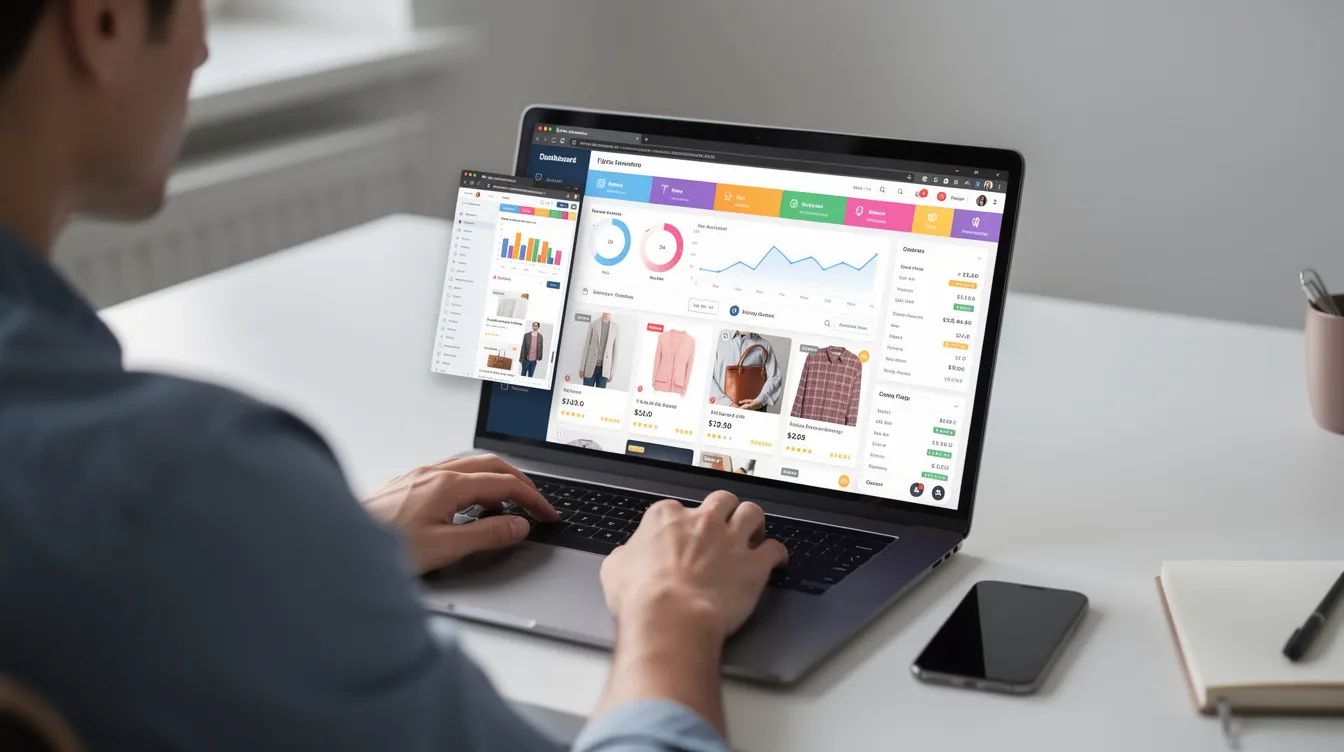
In practice, you tell the system what niche or category interests you, and it returns products with real demand signals attached: rising sales velocity, decent review sentiment, competition that isn’t oversaturated. From there it can draft descriptions, propose a price, and help manage the order once a customer buys.
Artificial intelligence dropshipping tools do this by processing large volumes of marketplace data that would take a person days to review manually. They look at sales trends, review patterns, and advertising activity across platforms, then flag the products worth testing.
Laid out side by side, the difference between the manual approach and an AI-powered setup like Easync becomes easy to see across the core tasks of running a store.
Most sellers don’t run one AI tool, they run a small stack, with a different tool handling each job. Here’s how those jobs typically split up.
| Job | What the AI does | Tool type | Common examples |
|---|---|---|---|
| Product research | Scans sales velocity, reviews, ad data | Trend finder | Sell The Trend, Dropship, Minea |
| Listing copy | Drafts titles and descriptions | Content generator | Shopify Magic, Copy.ai, ChatGPT |
| Store setup | Builds pages and layouts from keywords | AI store builder | Shopify Sidekick, Dropship templates |
| Pricing | Tracks competitors, protects margin | Repricer | Easync, AutoDS |
| Order fulfillment | Routes orders, syncs tracking | Automation platform | Easync, AutoDS |
| Customer support | Handles routine shipping and return questions | Chatbot | Tidio, Gorgias |
No single tool covers all six well, which is why most stores end up combining a research tool with an automation platform. Easync handles the two operational rows — pricing and fulfillment — across eBay, Amazon, Shopify, and WooCommerce from one dashboard. For a deeper breakdown of research tools specifically, see our guide to AI dropshipping tools.
A few things this looks like day to day:
A new seller launching a home office accessories store can go from idea to a working storefront over a weekend rather than several weeks of manual setup.
Product discovery that once took an entire afternoon of browsing now takes a few minutes, because the scanning of sales velocity, reviews, and competitor ads happens automatically in the background.
Store setup gets faster too. AI can generate product titles, clean up product images, and assemble optimized product pages without someone building each one from scratch.
How AI Fits Into the Dropshipping Workflow
AI sits on top of the platforms you already use, Shopify, WooCommerce, eBay, Amazon, TikTok Shop, and speeds up each stage of the workflow rather than replacing the platforms themselves.
The dropshipping workflow moves through familiar stages: product research, supplier selection, store setup, listing creation, pricing, marketing, fulfillment, and customer support. Automated dropshipping ai tools plug into that existing structure at nearly every stage.
Here’s where it tends to make the biggest difference:
Product research gets faster because the tools scan a wide range of SKUs looking for rising sales velocity and positive review sentiment, something that would take a person far longer to do by hand.
Store and page creation benefits from AI generating themes, product pages, and mobile-friendly layouts based on a handful of niche keywords you provide.
Listing creation is largely automated too. Tools import products directly and write descriptions with search intent in mind, so you’re not starting from a blank page for every item.
Pricing adjusts in something closer to real time, with algorithms watching competitor prices and nudging your own to protect margin without you checking a spreadsheet every morning.
Order processing can run without manual intervention. Auto-ordering forwards a customer’s purchase straight to the supplier the moment it comes in.
Customer support gets a first layer of coverage from chatbots that handle routine questions about shipping windows and returns any time of day.
By 2026, most mainstream commerce platforms already have some AI features built in, and dedicated automation tools connect to those platforms to handle the operational side at scale.
Why AI Dropshipping Matters in 2026
Rising ad costs, thinner margins, and customers who expect fast, personalized shopping have made ai dropshipping less of an optional upgrade and more of a baseline requirement for staying competitive.
The landscape today looks noticeably different from just a couple of years ago. Advertising on platforms like Meta and TikTok has gotten more expensive, and sellers report tighter margins as a result. Guesswork that used to be tolerable now costs real money, because a wrong pricing decision or a missed trend can eat into a thin margin fast.
Market research firms have tracked steady, strong growth in AI adoption across retail and e-commerce over the past several years, and dropshipping has followed that same trajectory. That growth reflects a simple reality: sellers who can react to demand shifts quickly tend to outperform those who are still updating spreadsheets by hand.
A few reasons AI matters more now than it did a few years back:
Faster reaction to trends means catching rising demand before a product becomes saturated with competitors, which matters more when ad costs are high and there’s less room for a failed test.
Fewer operational mistakes come from automated stock sync preventing overselling and repricing rules holding margins steady without someone watching prices all day.
Lean team operation is possible in a way it wasn’t before. A solo seller can manage a large catalog without the workload scaling in proportion to catalog size.
Personalization at scale, things like tailored product recommendations and targeted follow-up emails, tends to lift conversion and repeat purchases, though the exact impact varies a lot by niche and execution.
Agentic commerce is also starting to reshape discovery. AI shopping assistants on major platforms are changing how customers find products, and stores with clean product data and competitive pricing are better positioned to adapt as that shift continues.
None of this means AI guarantees success. It means the sellers ignoring it are working with a real disadvantage.
Core Benefits of AI Dropshipping
The main benefit of ai for dropshipping is shifting from reactive firefighting, chasing trends and fixing pricing mistakes after the fact, toward proactive decisions based on current data.
Smarter product decisions come first. Rather than scrolling through supplier catalogs hoping something looks promising, AI scans sales data, reviews, and ad engagement across marketplaces and flags products showing early demand before the market gets crowded.
Operational efficiency follows close behind. Tasks that used to take a chunk of every day, updating listings, checking stock, adjusting prices, get compressed into a short review of automated rules and any flagged exceptions.
Customer experience improves in ways that are easy to overlook. Personalized product recommendations based on browsing behavior tend to increase engagement, and chatbots answering routine shipping and return questions around the clock free up time while keeping response times short.
Scaling gets easier too. A bigger catalog, more sales channels, and higher order volume don’t automatically mean more hours at the desk once automation is handling tracking, fulfillment, and supplier coordination. Stores that would once have required a small team can often run with one person overseeing the system.
None of these benefits arrive automatically just by turning a tool on. They show up when the automation is set up carefully and checked regularly, which is a theme worth keeping in mind through the rest of this guide.
Practical Ways to Use AI in a Dropshipping Store
AI can support product research, store building, content writing, pricing, fulfillment, and marketing testing, and most of these tools connect directly to platforms like Shopify, WooCommerce, eBay, or Amazon Seller Central.
Product research is usually the first place people bring AI into their store. Instead of manually reviewing thousands of SKUs, a research tool can narrow that down to a shortlist worth validating by hand, checking things like shipping times and supplier reputation yourself before committing.
Store and page creation can be handled largely by AI as well. Store builders generate themes, pages, and full listings from a set of niche keywords, saving what would otherwise be days of manual design work.
Content and SEO benefit from tools that draft product descriptions with relevant keywords baked in, giving you a solid starting point rather than a blank page for every single product.
Pricing and margins stay healthier when rules continuously compare your prices against competitors and adjust automatically, rather than you checking manually every few days.
Fulfillment automation removes one of the more tedious parts of the job. Orders get forwarded to suppliers, tracking numbers sync back to the customer, and none of it requires you to sit at a screen copying order details by hand.
Marketing and testing improve when AI helps identify which products are actually converting from ad tests, so budget goes toward what’s working instead of what simply looked promising on paper.
Most of these tools are built for plug-and-play integration, so a seller can realistically start layering AI into an existing store within a week using just one or two platforms.
Using Easync Automation for AI Dropshipping
Easync connects the AI side of dropshipping, knowing what to sell and at what price, with the day to day execution of actually listing, updating, and fulfilling orders.
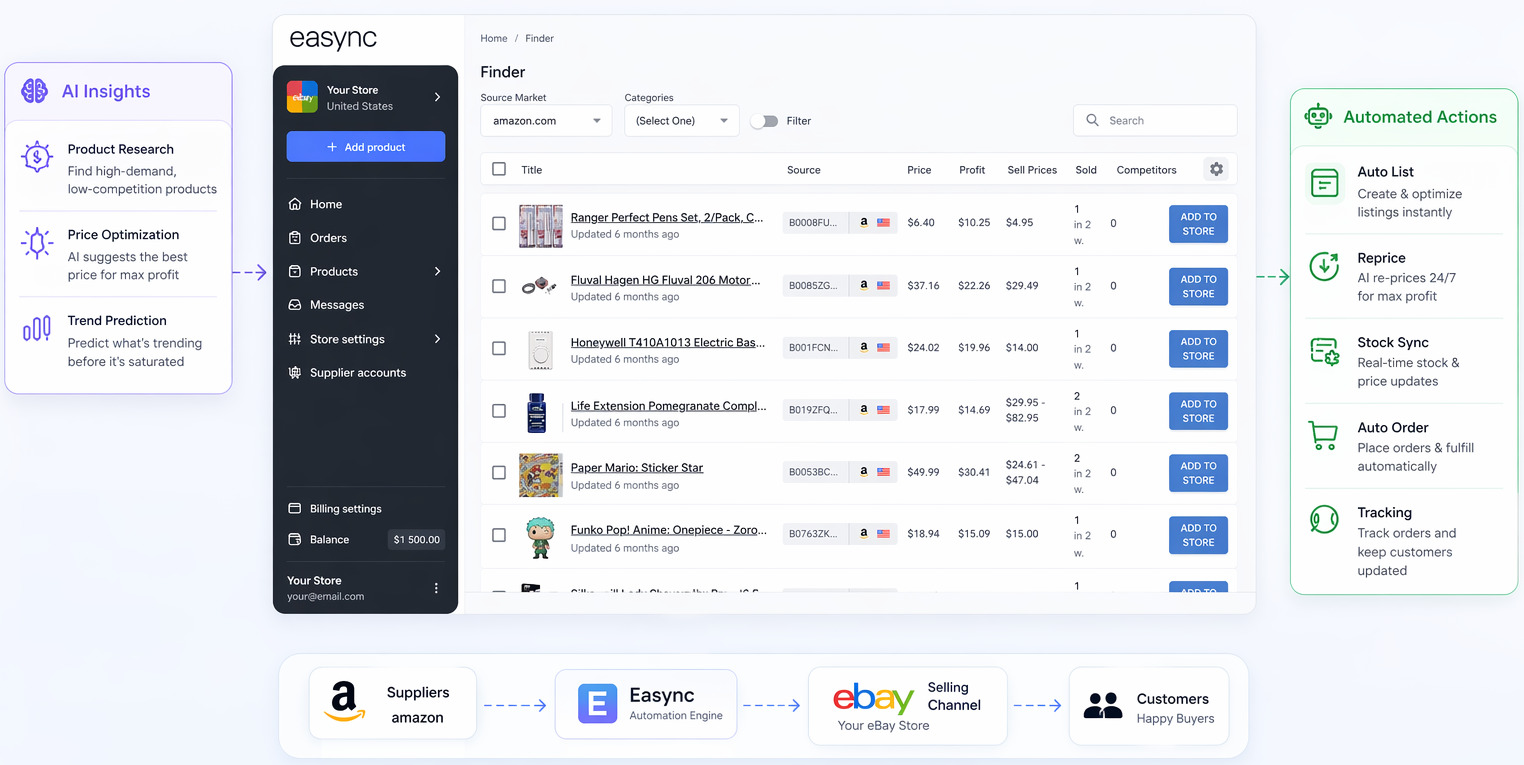
Knowing what to sell is only half the job. Turning that insight into a running store, keeping listings current, prices competitive, and orders moving, is where a lot of sellers get stuck. This is the gap Easync is built to close.
A few of the pieces that make this work:
- Automated product importing. Items get pulled from major marketplaces straight into your store, so you’re not typing out product data by hand for every single listing.
- Real-time stock and price monitoring. The system catches a competitor’s price change or a sudden stockout as it happens, not two days later when you finally check.
- Auto-ordering. Set the rules once and customer purchases get forwarded to vetted suppliers on their own. You stop being the person manually clicking “place order” fifty times a day.
- Repricing. Margins get protected through ongoing, rule-based price adjustments instead of someone eyeballing spreadsheets every night.
- Tracking sync. Customers see current shipment status without you lifting a finger, and support tickets asking “where’s my order” tend to drop off as a result.
- Multi-account workflows. Running three eBay stores or a handful of marketplace listings at once stops meaning three or four separate logins to babysit. It’s one dashboard.
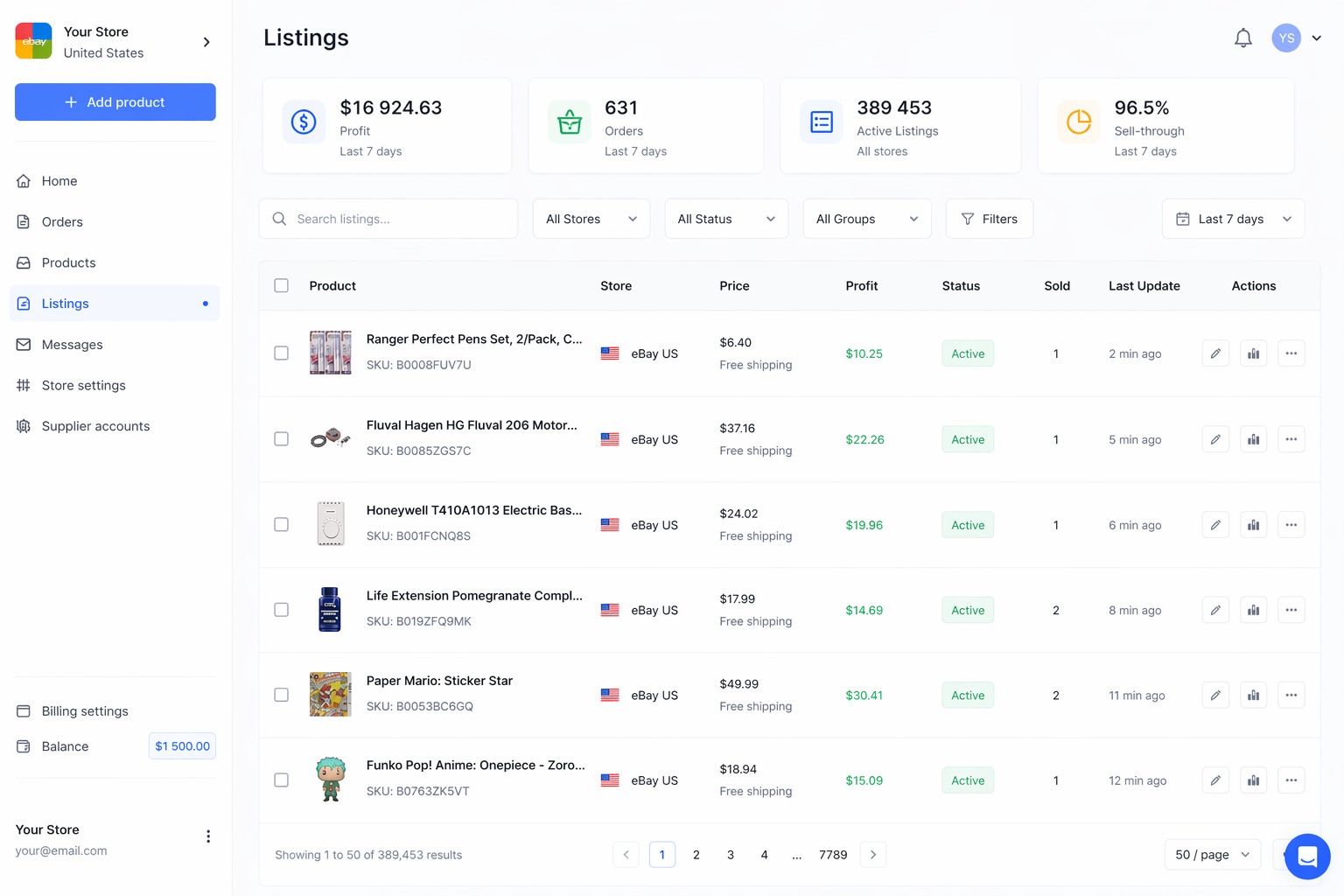
Picture a seller running three eBay accounts and working with four different suppliers. Without automation that’s a stretch of daily manual updates. With multi-account workflows in place, it becomes a short weekly review of exceptions and edge cases instead.
Whether you’re on Shopify, WooCommerce, or selling across several marketplaces at once, Easync can serve as the operational backbone that makes ai automated dropshipping something you can actually run day to day, not just a concept on a webinar slide.
Where AI Helps Most vs. Where You Still Need Human Judgment
Automation is good at the data-heavy, repetitive side of the business. It’s not so good at the judgment calls that come with running a brand. Here’s roughly where that line sits.
AI is genuinely strong at a handful of things: spotting a trending product across marketplaces before you’d notice it yourself, keeping prices in line with competitors and margin targets without you checking daily, plowing through the routine grind of imports and stock updates and order forwarding, catching patterns in ad performance data, and getting a first draft of listing copy or ad text on the page fast.
There are things you should still own yourself. Niche selection and the long-term direction of your brand come down to your judgment, not an algorithm’s. Creative differentiation, the angles, bundles, and offers competitors can’t easily copy, comes from you. Supplier relationships need a human check too; a tool can miss a slow-shipping supplier that only shows up as a problem once you place a real test order. Complex customer issues that require empathy and a judgment call are still better handled by a person. And decisions about when to scale, pivot, or drop a product line deserve real thought, not just a dashboard signal.
Here’s a caution worth taking seriously. Chasing an AI-flagged “hot” product without checking shipping times or supplier reviews can backfire quickly. A product doing well on social media but shipping in three weeks from a supplier with a poor track record will generate refunds and bad reviews faster than it generates profit. Data can surface an opportunity, but it can’t tell you everything about whether that opportunity is actually sound.
AI Dropshipping vs. Traditional E-Commerce and Dropshipping
Traditional e-commerce means holding your own inventory, traditional dropshipping means no inventory but manual processes, and ai drop shipping adds an automation layer on top of the no-inventory model.
These terms get thrown around loosely, so it’s worth pulling them apart. Traditional e-commerce means you buy stock and hold onto it. Traditional dropshipping skips the inventory, but you’re still doing the pricing, listing, and order work by hand. AI dropshipping is the same no-inventory setup, just with most of that manual work taken off your plate.
That fixes some of dropshipping’s oldest problems. Stock and pricing used to lag behind reality because someone had to remember to update a spreadsheet; now that syncing happens closer to real time. Orders used to get forwarded by hand, which meant the occasional typo or missed order; automation handles that part now. And reacting to a demand shift used to depend on whether you happened to have a free hour that day. It doesn’t anymore, because the scanning runs continuously in the background.
You can bolt AI tools onto traditional e-commerce too, sure, but you’re still stuck with inventory risk, warehouse costs, and logistics that get more complicated as you grow. That’s a big part of why AI-powered dropshipping has become the more attractive starting point for people entering the space in 2026 without much capital to work with.
The comparison below lays out the trade-offs in more detail, which should help before you decide which model fits your situation before adding AI on top.
Comparison: Pros and Cons of E-commerce vs. Dropshipping
| Dimension | Traditional E-commerce | Dropshipping |
|---|---|---|
| Inventory Risk | You buy stock upfront and carry the risk of it not selling | None, since the supplier holds the inventory |
| Startup Capital | Generally higher, since inventory has to be purchased in advance | Generally lower, mostly covering platform fees and initial ad tests |
| Profit Margins | Often stronger due to wholesale pricing | Usually thinner, offset by not tying up capital in stock |
| Shipping Control | Full control over speed and packaging | More limited, and dependent on supplier location and reliability |
| Brand and Packaging Control | Complete control over unboxing and custom packaging | Limited, and dependent on what suppliers are willing to support |
| Scalability | Requires warehouse space, staff, and logistics investment | Scales across channels without needing to hold more stock |
| Operational Complexity | Higher, with warehousing, shipping, and returns to manage directly | Lower overall, and even lower with AI handling stock sync, repricing, and tracking |
| Supplier Dependency | Lower, since you control your own inventory | Higher, since reliability depends on supplier performance |
| Trend Flexibility | Slower to pivot when stuck with existing stock | Faster, since new products can be tested without a stock commitment |
Automation tools including Easync reduce a lot of the operational downsides on the dropshipping side of this table. Stock errors, delayed pricing, and manual order forwarding stop being daily headaches once the right setup is in place.
Best Ways to Start with AI Dropshipping in 2026
Starting with ai dropshipping doesn’t require a large budget or a technical background, just a niche, a platform, and a small set of automation and research tools connected from day one.
Here’s a realistic sequence, roughly in order:
- Pick a niche where AI can actually find good data to work with. Tech accessories, home office gear, and eco-friendly products tend to fit this well.
- Choose a platform. Shopify and WooCommerce are the usual starting points, and which one fits depends mostly on your budget and how comfortable you are tinkering with settings.
- Connect an automation tool. Something like Easync for importing products, watching stock, and auto-ordering.
- Bring in a research tool and narrow things down to a handful of products actually showing demand, not just ones that look interesting.
- Test small. A few weeks of modest ad spend on a handful of products tells you more than filling an entire catalog on day one ever will.
- Check your results on a regular schedule. Keep what’s working, cut what isn’t, and don’t wait a month to notice a product is dead weight.
- Write down your process somewhere, even a basic Notion page. Future you will want to tweak it, or hand pieces of it off once things get busy.
Budget expectations vary by platform and tool choice, but a lean starting setup typically covers a store platform subscription, a modest monthly fee for research or automation tools, and enough ad spend to properly test a handful of products. No coding is required for any of this. Most modern dropshipping tools are built around visual dashboards and straightforward integrations, so the barrier to entry is lower than it looks from the outside.
Common Mistakes to Avoid with AI Dropshipping
Automation amplifies both good and bad decisions, so the most common mistakes involve setting rules and forgetting them rather than any flaw in the tools themselves.
Over-automation without checking results is a frequent trap. Repricing rules get set once and then ignored for weeks, until someone notices prices have drifted below cost because a supplier quietly raised fees.
Ignoring shipping times and product quality causes real damage too. A tool can flag a product as a strong performer on paper while the actual shipping window runs several weeks and reviews sit at two stars, a combination that leads straight to refunds.
Relying only on trending dashboards without checking supplier reliability or compliance is another common misstep. Something can look hot in the data and still be a poor fit if the supplier can’t deliver consistently or the product runs into legal restrictions.
Neglecting branding is easy to fall into as well. AI-generated content is a fine starting point, but a store that never goes beyond generic descriptions and templates tends to blur together with dozens of competitors.
Underestimating customer support matters more than it seems. Chatbots handle routine questions well, but a customer with a genuinely complicated issue needs a person, and skipping that step damages trust quickly.
A few habits go a long way here:
- Check your automation rules on a set schedule. Don’t just flip them on and walk away for a month.
- Order a sample from any new supplier yourself before you scale up volume with them.
- Try AI-written descriptions on a handful of products first, see how they perform, then roll them out wider if they hold up.
- Test pricing rule changes on a small batch before applying them storewide.
- Watch what customers are actually saying. It’s the fastest way to catch an automated decision that’s quietly gone wrong.
Profitable AI-Friendly Product Ideas in 2026
Categories with frequent trend shifts and comparable products across multiple suppliers tend to work best with ai for dropshipping, since there’s more data for the tools to work with.
Smart home and tech accessories such as LED strips, security camera mounts, and cable organizers tend to show rising engagement early, which AI research tools can catch before the category gets crowded.
Hybrid-work gear like laptop stands, desk organizers, and ergonomic accessories continues to see search interest that’s fairly easy to track through the right research tools.
Eco-friendly home products, things like reusable bags, bamboo organizers, and sustainable kitchenware, benefit from review sentiment analysis that helps separate genuinely good suppliers from the rest.
Pet accessories including automatic feeders, travel water bottles, and grooming tools tend to show up clearly in ad performance data as demand shifts.
Travel and outdoor essentials such as anti-theft backpacks, compact organizers, and portable chargers follow fairly predictable seasonal patterns that market data can help anticipate.
Across all of these categories, AI is helpful for spotting demand before a market saturates, reading review patterns for quality signals, and tracking ad performance across platforms. It’s still worth double-checking legal and platform compliance yourself. A product can look like a clear winner in the data and still get a store suspended if it turns out to be restricted or unsafe.
Is AI Dropshipping Worth It in 2026?
Short answer: yes, if you’re willing to actually learn the tools and stick with testing long enough to see results. It’s not a business that runs itself, whatever the ads for these tools might imply.
What’s in its favor:
- Lower capital needed than traditional e-commerce
- A lot less time lost to repetitive manual tasks
- Faster product testing, since you’re not doing everything by hand
- Solo operation is genuinely realistic once automation is set up properly
What’s working against you:
- Competition is fierce, and ad costs keep climbing in most niches
- There’s a real learning curve to setting tools and integrations up correctly
- You’re leaning on third-party suppliers and marketplaces, which means some risk you don’t control
- Margins usually run thinner than a model where you hold your own stock
Set your expectations accordingly. Finding a product that actually holds up tends to take several months and a handful of failed tests along the way, not one lucky launch out of the gate. The sellers still around after six months are usually the ones who kept testing, kept a couple of clear goals in view, and put profits back into the business instead of pulling everything out early.
Agentic commerce and AI shopping assistants aren’t going away, and sellers who are already comfortable working with AI internally will probably adjust faster as buying behavior shifts. Starting now beats waiting until it’s the only option left.
FAQ
How much money do I need to start AI dropshipping in 2026?
Honestly, a modest budget is enough to start testing, enough to cover a store subscription, a basic automation or research tool, and some ad spend to see if a product actually sells. AI tools cut down on wasted time, not on the testing budget itself, so give yourself a stretch of experimentation before you expect steady profit. And resist the urge to spread that budget thin across five unproven niches. One store with a handful of products, tested properly, beats that every time.
Do I need technical or coding skills to use AI for dropshipping?
No, and that’s probably the biggest myth floating around about this space. Most 2026 tools run on visual dashboards and plain-language rule setups, built for people who’ve never opened a code editor in their life. Being comfortable clicking around software helps. Knowing how to code doesn’t come into it for the typical setup. If you’re unsure, just try a free trial or watch a short tutorial first, that’s usually all it takes to feel comfortable before paying for anything.
Can AI really launch a dropshipping store for me automatically?
It can get you most of the way there quickly, generating a store theme, importing products, drafting descriptions, and setting initial prices, sometimes within a single afternoon. What it won’t do on its own is check that your branding feels right, confirm your suppliers are reliable, or make sure your shipping and return policies actually make sense for your niche. Treat an AI-generated store as a strong head start rather than a finished business ready to run unattended.
How are returns and customer issues handled in AI dropshipping?
Returns still route through the supplier or marketplace behind the sale. What automation adds is syncing tracking information, updating order status automatically, and giving chatbots a first pass at routine support questions. You’re still the one responsible for a clear return policy and for stepping in when a customer’s situation needs more than a scripted answer. It’s worth testing your own returns process with a small order before you’re relying on it at scale.
Will AI replace human dropshippers in the future?
It’s unlikely, at least not in the sense of removing the need for a person entirely. AI will keep taking over repetitive, data-heavy work, but choosing a market worth entering, building a brand people trust, and handling the messier parts of customer relationships still depend on a person making judgment calls. As AI shopping assistants become more common on the buyer’s side, the sellers who do well will likely be the ones feeding these systems good product data and competitive offers while still doing the strategic thinking themselves. It’s more accurate to think of AI as something that multiplies what one person can manage, not something that removes the person from the equation.