
- Amazon Dropshipping
- articles
Online Arbitrage on Amazon in 2026: Complete Guide
Quick answer: Online arbitrage on Amazon is buying stock cheaply from other online stores and reselling it on Amazon, normally through FBA. You are allowed to do it. The first-sale doctrine gives you the right to resell a genuine product you own, and Amazon’s rules only ask that the goods are authentic, that you are cleared to sell the brand, and that your name is on the paperwork as the seller of record.
Key takeaways
- Two fee changes landed this year. FBA fulfillment fees went up by an average of $0.08 per unit on January 15, 2026, and since April 17 Amazon has been adding a 3.5% fuel and logistics surcharge on top.
- The low-inventory-level fee still starts at 28 days of supply, but it now catches bulky products too and is calculated for each FNSKU separately.
- Being legal and keeping your account are different problems. The law covers the first; distributor invoices and gating checks cover the second.
- A Professional selling plan is $39.99 a month. On the Individual plan there is no subscription and you pay $0.99 for each item sold.
Brand new to Amazon or sharpening an existing store? This guide zeroes in on Amazon online arbitrage as it works in 2026. Retail arbitrage is the in-store sibling of the model, where you scan shelves first and ship afterwards. Here the focus is on the online version: what it is, whether it is allowed, what it costs after this year’s fee changes, and how to run it step by step.
We’ll also track Amazon fee changes that hit online arbitrage sellers hardest and show how to pick deals that stay profitable once every line item is counted.
What is online arbitrage on Amazon?
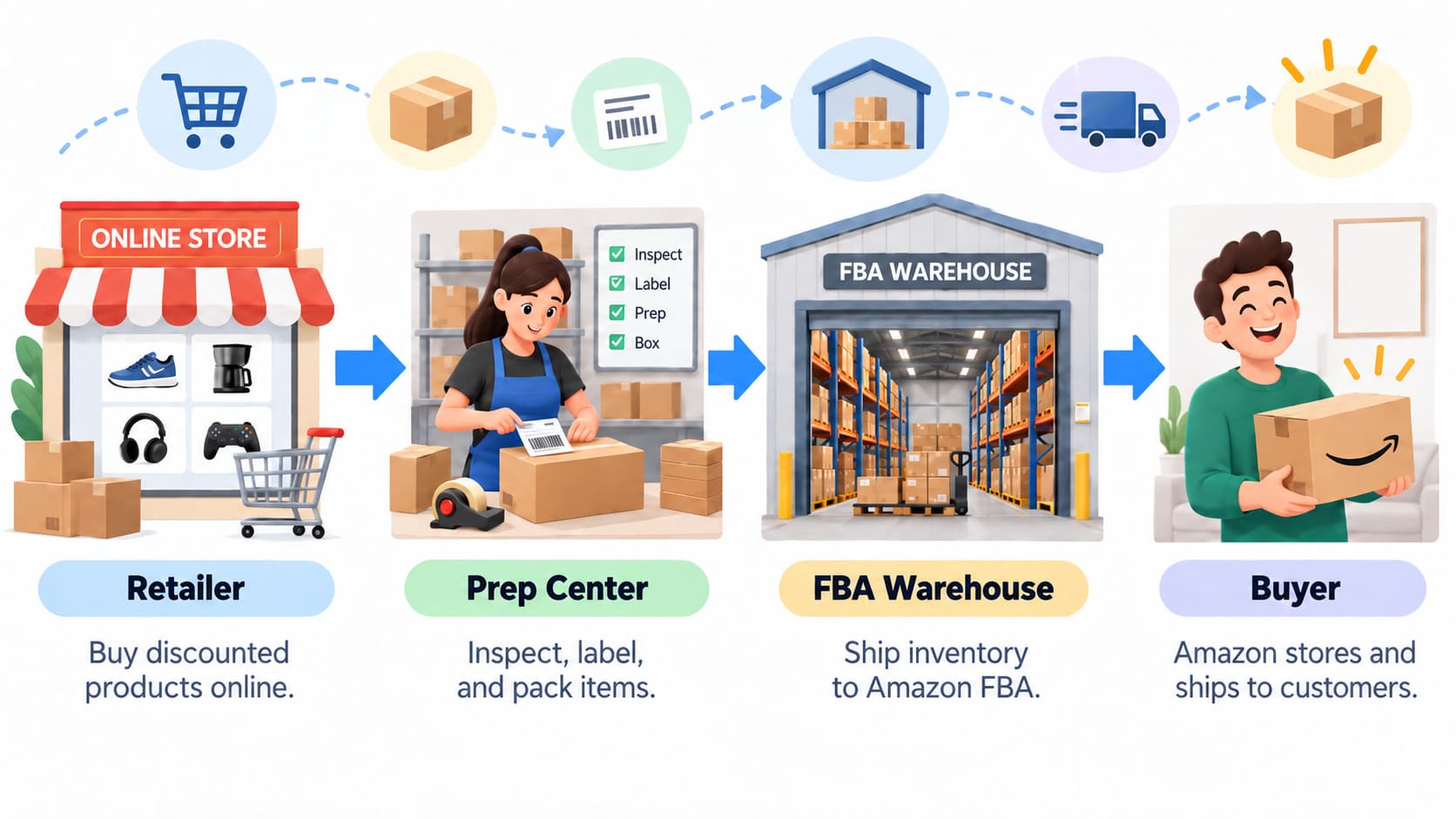
Online arbitrage (OA) is the practice of buying a product from one online store at a lower price and reselling the same product on Amazon at a higher one. The gap between the two prices, minus Amazon’s fees and your shipping and prep costs, is the profit. You never manufacture anything and you rarely create a listing from scratch, because the products you buy usually already exist in Amazon’s catalog.
Some people call this ecommerce arbitrage, since both the buying and the selling happen on ecommerce platforms. Others simply say they do arbitrage online. Whatever the label, the mechanics are the same: a Walmart clearance page, a Target markdown, a Best Buy open-box deal, or a niche retailer’s overstock becomes inventory that you send to Amazon’s warehouses and sell under an existing ASIN.
It helps to know the size of the pond. Marketplace Pulse estimates that active Amazon sellers fell from 2.4 million in 2021 to 1.65 million by the end of 2025, while only about 165,000 new sellers launched a first listing in 2025. The same research found that monthly traffic per active seller grew 31% between 2021 and 2025. Fewer sellers competing for a stable pool of buyers is good news for anyone entering now, as long as the unit economics hold up after fees.
Online arbitrage vs wholesale, private label, and dropshipping
Online arbitrage is one of four ways to put products in front of Amazon buyers, and it pays to know what you are not choosing. Wholesale means buying in bulk from an authorized distributor. The purchase orders are bigger, the invoices are exactly what Amazon wants to see in an authenticity review, and the same products can be reordered month after month, but it takes capital and supplier relationships that a beginner rarely has. Private label means creating your own branded product from a manufacturer. It offers the most control and the highest ceiling, and also the slowest path to a first sale, with months of samples, design, and launch advertising before any revenue.
Dropshipping means holding no inventory and having a supplier ship after the sale; how Amazon polices it is covered in the next section. Online arbitrage sits between these models: you own the stock, so you stay compliant, but you buy small quantities of proven products, so the cash and the risk stay small too. Many wholesale sellers started with OA, learned how BSR, fees, and the Buy Box behave, and moved up once they had capital and a category.
Is online arbitrage legal on Amazon?
Yes. In the United States the right to resell a genuine product you have legally bought is protected by the first-sale doctrine, codified for copyrighted goods in 17 U.S.C. § 109 and applied to trademarked goods through decades of case law. Once a manufacturer has sold an item, it cannot control what the buyer does with that specific unit, including reselling it on a marketplace. Most other countries have a similar exhaustion principle.
Amazon itself does not ban resale of products sourced from retailers. What its policies do require is that the product is authentic and in the stated condition, that you hold approval for any gated brand or category before listing, and that you appear as the seller of record on invoices and packing slips. The Amazon dropshipping policy is the document most OA sellers misread: it does not stop you from buying at Walmart and selling on Amazon, but it does stop you from having Walmart ship the order straight to your Amazon buyer with Walmart’s paperwork inside.
Legal and safe are two different bars. The first-sale doctrine protects you in court. It does not protect your seller account when Amazon asks for a supplier invoice and you only have a store receipt. That operational side, the documentation and the gating checks, is covered in the compliance section further down.
Online arbitrage vs retail arbitrage on Amazon
Both paths work, and plenty of sellers run them side by side under the broad label of online retail arbitrage. The decision comes down to how you like to source, whether you can travel, and how you plan to scale. Online arbitrage suits people who want to work remotely with filters and repeatable systems. Retail arbitrage through Amazon rewards speed, local knowledge, and fast flips from clearance aisles.
The grid below shows where the two models diverge, including where the 2026 fee changes bite:
| Dimension | Online arbitrage | Retail arbitrage on Amazon |
|---|---|---|
| Channels | Online retailers, clearance pages, deal newsletters, price alerts. Ships to you or a prep center, then FBA. | In-store clearance, regional chains, manager markdowns, local liquidation. Buy, then ship. |
| Tools | Keepa, SellerAmp SAS, Tactical Arbitrage, Easync for eBay cross-listing, BuyBotPro, BrickSeek for online stock checks. | Amazon Seller app or Scoutify, Keepa mobile, handheld scanner, BrickSeek for store stock and price drops. |
| Startup capital | Moderate. Bulk orders and repeat buys. Watch retailer order limits and sales tax. Prep center fees apply. | Lower to start. Cash cycles can be fast. Travel, fuel, and time add real cost. |
| Throughput | Scales with sourcing filters, VA research, and automated watchlists. Work from anywhere. | Capped by store hours and routes. Speed comes from experience and local intel. |
| Risks | Order throttles, cancellations, brand gating, listing competition. | Stock variance by store, damaged packaging, seasonal swings, return spikes. |
| 2026 fee exposure | Batch shipments make it easier to dodge inbound placement and low-inventory fees. Surcharge applies to every FBA unit. | Small, frequent shipments are common, so low-inventory and placement fees hit more often. Same surcharge on FBA units. |
| Scaling with VAs and prep | VAs run scans, vet leads, and place orders. Prep center handles intake and labeling. Highly systematized. | Hire shoppers and set routes. Centralize prep and shipping. Standardize checks at the cart. |
What changed for Amazon arbitrage in 2026
2025 was a quiet year: Amazon held its US referral and FBA fees flat and sellers mostly wrestled with the fees introduced in 2024. 2026 has been noisier. In its 2026 fee announcement, Amazon raised FBA fulfillment fees by an average of $0.08 per unit sold, effective January 15, 2026, while promising no new fee types. The standard referral rate for most categories is still 15%, which you can confirm on Amazon’s pricing page.
Then fuel prices moved. On April 2, 2026 Amazon announced a 3.5% fuel and logistics-related surcharge on FBA fulfillment fees in the US and Canada, live from April 17, 2026. It is calculated on the fulfillment fee, not on your sale price, and Amazon put the average at about $0.17 per unit. No end date was given. On a $5.50 fulfillment fee that is roughly $0.19, which sounds like nothing until you multiply it across a few hundred units a month.
The main FBA and referral fee schedule is where you should read the details, but the change that matters most for arbitrage sellers is the low-inventory-level fee. The threshold did not move: if both your 30-day and 90-day historical days of supply fall under 28, you pay extra on every unit sold until you restock. What did move is scope. Since January 2026 the fee also applies to small and large bulky products, and it is measured per seller FNSKU instead of per parent ASIN, so a single variation running low can trigger it even when the listing as a whole looks healthy. Amazon keeps a list of exemptions on the same help page, including one for sellers in their first year of FBA, so check your status before you budget for it.
Inbound placement works the same way it has since 2024. If you want Amazon to receive your shipment at one or two locations and distribute it, you pay a placement fee. If you let Amazon split the shipment across five or more fulfillment centers, the fee drops to zero. For OA sellers the practical answer is still the same: fewer, larger shipments beat many small ones.
Compliance pressure has not eased either. Amazon continues to request invoices less than a year old from distributors or manufacturers when authenticity is questioned. A receipt from a big-box store often does not satisfy the reviewer. The line between online arbitrage and dropshipping has not moved either, and it is drawn in the legal section above.
Fee items that affect OA in 2026
| Item | Why it matters | Where to confirm |
|---|---|---|
| Fulfillment fee increase | Average $0.08 more per unit since January 15, 2026. Recalculate every SKU priced on 2025 assumptions. | 2026 fee announcement |
| Fuel and logistics surcharge | 3.5% of the FBA fulfillment fee since April 17, 2026, about $0.17 per unit on average. | Surcharge announcement |
| Low-inventory-level fee | Triggers when 30-day and 90-day days of supply both drop under 28. Now per FNSKU and including bulky items. | Seller Central help |
| Inbound placement | Pay to keep shipments together, or split across five or more locations to avoid the fee. | Inbound placement service |
| Storage | Monthly rates rise in Q4, and slow movers tie up capacity and age into surcharges. | FBA fee overview |
How to do online arbitrage on Amazon: 8 steps
If you want Amazon arbitrage step by step, here is the loop that experienced OA sellers run every week. Before touching any tool, write down three rules: the minimum margin you will accept, the ROI percentage that fits your capital, and a Best Seller Rank (BSR) cutoff per category. A new seller might only look at toys with at least 30% ROI and a BSR under 100,000. The numbers are yours to set. Having them on paper is what stops the emotional buy.
Step 1: Open the right seller account
Amazon offers two selling plans. The Individual plan has no monthly fee and charges $0.99 per item sold. The Professional plan is $39.99 a month with no per-item charge and unlocks Buy Box eligibility, bulk listing tools, and advertising. If you expect to sell more than about 40 units a month, Professional pays for itself. Registration asks for a government ID, a bank account, tax information, and usually a short video verification call.
Step 2: Define Buy Box and ROI rules
The Buy Box is where most Amazon sales happen. If you cannot compete for it, your profit stays theoretical. Turn your written rules into a short checklist: minimum ROI, margin threshold, how many FBA competitors you tolerate on a listing, and whether you buy when Amazon itself is a seller. Keepa graphs help with the last two.
Step 3: Source your leads
There are two ways to fill the pipeline. Automated tools such as Tactical Arbitrage scan more than a thousand retail sites and return matched Amazon listings with profit estimates. Manual sourcing means browsing clearance pages, deal newsletters, and Facebook groups yourself. Most sellers mix both, using automation for volume and manual browsing for the odd deal no scanner catches.
Step 4: Evaluate with price history and competition
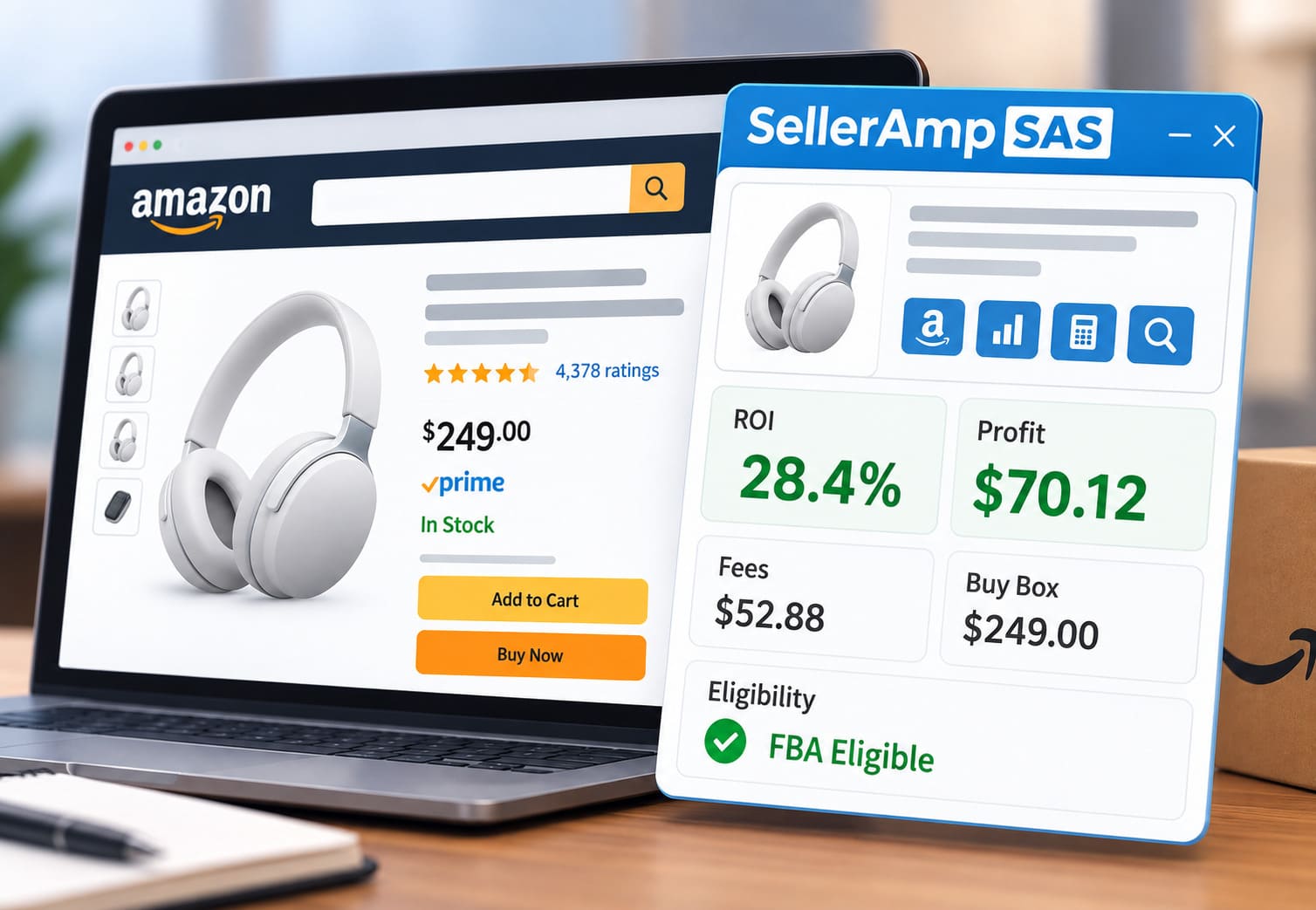
Keepa shows price and sales rank history, so you can tell whether the Buy Box price is stable or on its way down. Pair it with the SellerAmp SAS Chrome extension to calculate profit after fees, see competition data, and run eligibility checks in the same window. Together they filter out most of the noise.
Step 5: Check restrictions and brand gating
Some brands and categories are “gated”, meaning you cannot list them without approval from Amazon. Check before you buy. SellerAmp flags gated items, but confirm in Seller Central because a gated purchase you cannot list turns into stranded inventory and tied-up cash.
Step 6: Compliance checkpoint
Ask one question at this stage: if Amazon requests proof of authenticity for this item, can you produce it? Keep every invoice from suppliers, and treat retailer receipts as a backup rather than the main document. Never ship directly from the store to your Amazon buyer. Amazon requires you to be the seller of record, so packaging and paperwork must carry your details.
Step 7: Purchase and logistics
Decide where the stock lands first. Some sellers ship to their own address, inspect, and apply FNSKU labels at the kitchen table. Others send everything to a prep center that handles intake, labeling, and carton building. Prep fees add cost per unit, but they buy you time and let you batch bigger shipments, which is exactly what the inbound placement and low-inventory fees reward.
Step 8: List and reprice
Once inventory reaches FBA, list it under the correct ASIN. Then decide how pricing will be managed. Manual repricing is fine for a handful of SKUs. For FBA listings, most sellers move to a dedicated Amazon repricer once they pass a few dozen ASINs. For anything you cross-list on eBay, Easync handles repricing and stock sync on that channel.
Running the numbers: an Amazon arbitrage fee example for 2026
It is hard to judge a product without running the math first. Fees pile up, and what looks like a healthy margin can shrink to almost nothing once storage, shipping, and this year’s extras are counted. The example below uses illustrative dollar amounts for the size-based fees and the actual percentages Amazon charges.
Say you buy a small kitchen item for $10. It sells on Amazon for $28, so on the surface that $18 spread feels comfortable. Here is how it breaks down:
- Referral fee (15%): $4.20
- FBA fulfillment fee (based on size and weight): $5.50
- Fuel and logistics surcharge (3.5% of the fulfillment fee): $0.19
- Inbound placement cost: $0.35
- Storage and prep combined: $0.50
- Low-inventory-level fee (if you are not exempt): $0.40
Total fees come to $11.14, so your net is about $6.86 per unit. That is roughly a 69% ROI on the $10 buy cost. Still a good deal, but a long way from the $18 you first saw, and the surcharge line alone did not exist on the same deal in early 2025.
Written out, the formula is: ROI = (Amazon sale price − buy cost − all Amazon fees − prep and inbound shipping) ÷ buy cost × 100. Margin is the same profit divided by the sale price instead, and it is worth tracking both, because a high-ROI deal on a $6 item can still leave you with $2 of profit per unit. As for the floor, the 30% ROI used in the workflow above is a common starting rule among OA sellers. Newer sellers often demand more, closer to 50%, because returns, a competitor undercutting by a dollar, or a surprise low-inventory fee will take a bite out of any deal, and the thinner the starting margin, the sooner it turns negative.
The takeaway: run every deal through a calculator before buying. Amazon has updated its own Revenue Calculator for the surcharge; check that any third-party calculator you rely on has done the same.
Best online arbitrage tools in 2026: the OA stack that matters
There are plenty of OA tools promising the world, and you do not need all of them. What you need is a stack that covers the basics:
- Price and sales history
- Profitability and eligibility checking
- Product sourcing at scale
- Stock verification at the retailer
Once those are covered, add extras when volume justifies them. Below are the five tools that keep earning their place in 2026.
Must-haves
Keepa: a time machine for any ASIN. It shows price history, Buy Box movement, and sales rank drops, so you can tell whether a deal is steady or a trap. For most OA sellers it is the first paid subscription they take out.
SellerAmp SAS: a profit calculator that pulls what it needs straight from the Amazon product page. It shows ROI, fees, whether the product is gated, and whether you are restricted from the brand, with quick red and green signals. It now works across seven Amazon marketplaces, which matters if you sell in the UK or the EU as well as the US.
Tactical Arbitrage: sold as part of the Seller 365 bundle from Threecolts, this is the heavy lifter. It scans more than 1,400 retail sites, matches products to Amazon listings, and pulls the real FBA fee for each one rather than estimating it. Use it for long lead lists, reverse searches from an Amazon category back to cheaper sources, and wholesale catalog analysis.
Nice-to-haves
BuyBotPro: one-click deal analysis that checks ROI, sales rank, hazmat flags, and IP complaint risk. Its most useful trick for OA sellers is auto-ungating: it checks your eligibility for a gated product and files the approval application for you if you are not.
BrickSeek: built for in-store deal tracking but still valuable online. Use it to check whether a retailer really has the stock it claims and whether a sale price is live before you spend an hour analyzing a listing you cannot buy.
Product picking for online arbitrage: the targets and the red flags
Finding good online arbitrage deals is not luck. Certain categories keep working year after year, especially when the items are small, light, and easy to ship. Consumables like supplements, craft supplies, non-hazmat beauty and personal care, pet supplies, office goods, and kitchen items all fit. Toys are another classic, though demand peaks and fades with the season.
Some categories look tempting and carry hidden risk. Big-name electronics and luxury brands attract IP complaints. Fragile and oversized items eat margin through higher FBA fees and, since January 2026, through the low-inventory fee that now covers bulky sizes. They also generate more customer service work than they are worth at OA volumes. And if Amazon itself dominates a listing, your odds of holding the Buy Box are slim.
Then there is brand gating. Many popular brands require approval before you can list them. Getting ungated usually means providing invoices from authorized distributors, submitting product photos, or sometimes paying an approval fee. If you plan to build a long-term presence in one category, going through ungating once is worth the effort.
Where to source online arbitrage deals
The retailer matters as much as the category, because each type of store marks down in its own rhythm:
- Big-box and department stores: Walmart.com, Target.com, Kohls.com, Macys.com. Deep clearance sections and stackable rewards. Watch per-order quantity limits, since these sites often cap how many units one account can buy.
- Consumables specialists: CVS.com, Walgreens.com, Ulta.com, Petco.com. Frequent buy-one-get-one promotions and loyalty credit on small, light products that suit FBA.
- Electronics and home improvement: BestBuy.com and HomeDepot.com. Open-box and end-of-line clearance with good spreads, and a higher share of brands that trigger IP complaints, so check the brand first.
All of these sites are covered by Tactical Arbitrage’s scanner, so the same list works for manual browsing and for scheduled scans. Cashback portals and store cards come later, once volume is steady.
Once you know what to buy and where, the remaining question is when. Post-season clearance is the classic window: holiday decor in January, outdoor and pool items in September, school supplies in October. Buy when the retailer is clearing, and hold for the next peak if the storage math allows it.
Compliance and account health for online arbitrage sellers
It is the least glamorous side of Amazon online arbitrage, and it is the side that ends businesses. Fees eat into profit, while a suspension ends the business altogether, so documentation deserves the same attention as sourcing.
Authenticity documentation kit
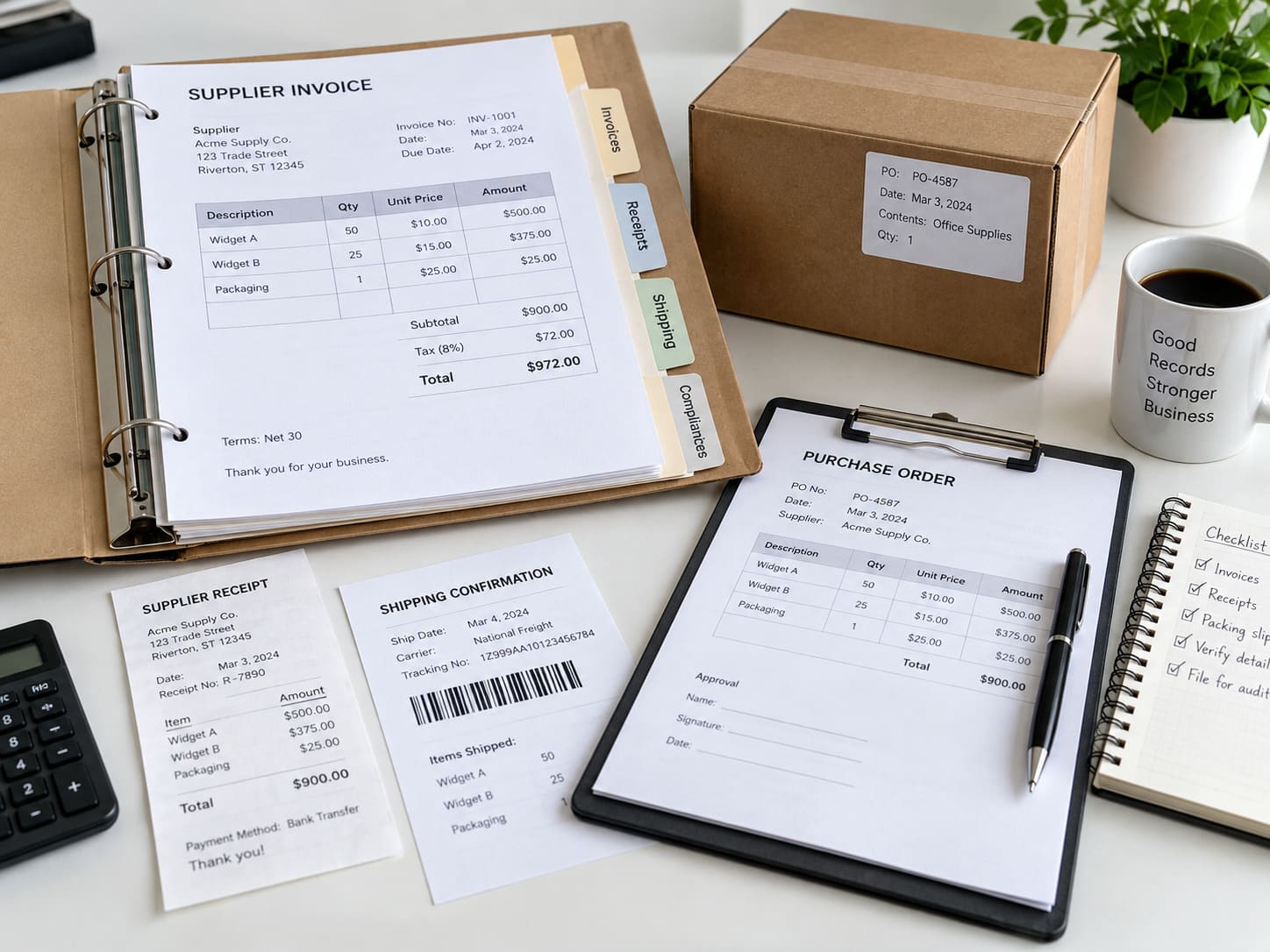
The gold standard when Amazon questions authenticity is an invoice issued within the last 365 days by an authorized distributor or the manufacturer. It needs to show:
- Your business name and address, matching your seller account
- Supplier name and contact details
- Product identifiers (UPC or ASIN) that match the listing
- The exact quantity you purchased
Retail receipts usually fail in appeals because they do not establish a supply chain, only a purchase. Keep invoices organized by ASIN so you can pull one within an hour of a request.
IP and brand complaints
Even with clean invoices, intellectual property complaints happen. Prepare the paper trail before an issue arises: save invoices, keep copies of packaging, and photograph what you send in. If a complaint lands, respond quickly, ideally within 24 hours, with supplier details and clear images ready. A fast, accurate reply often stops the escalation.
Dropshipping pitfalls
Avoid anything Amazon deems non-compliant fulfillment. Sending an item directly from Walmart or Target to a buyer with the retailer’s packing slip inside the box is one of the fastest ways to lose selling privileges permanently. If you fulfill orders yourself, your name goes on the paperwork and on the box. Most OA sellers stick with FBA precisely because it removes this risk.
Compliance quick-check
- Store supplier contact details alongside each invoice.
- Photograph packaging and labels before shipping to FBA.
- Reply to IP or brand complaints within 24 hours with proof attached.
- On FBM orders, confirm you are the seller of record and remove any third-party slips.
- When in doubt, default to FBA.
Your first 10 online arbitrage leads: a repeatable weekly recipe
Getting started does not mean chasing random deals. A simple routine fills an online arbitrage sourcing list with solid options every week. Here is a version you can run in a few hours:
- Pick three to five retailers you trust. Walmart, Target, and the office supply chains are a reasonable first set.
- Pull their clearance pages and the current weekly ad.
- Feed those pages into Tactical Arbitrage with your ROI and sales rank filters switched on.
- Export the top 50 or so results.
- Open each one in Keepa. You are looking for a Buy Box price that has held for months, not one that spiked last week.
- Check the survivors in SellerAmp SAS for restrictions, then run the profit numbers with the surcharge line filled in.
- Give what is left a last pass in BuyBotPro for IP and hazmat flags.
- Put the final list on a Keepa tracking list with price alerts, so a drop or a restock reaches you without another scan.
- Order a few test units and route them to yourself or a prep center for labeling.
- Do it again next week. If a retailer comes up empty twice, swap it out.
Example: 3 starter leads
The figures below are illustrative, with fees rounded to include the 2026 surcharge:
| Category | Buy price | Amazon price | Est. fees | Est. ROI |
|---|---|---|---|---|
| Beauty accessory | $9.50 | $24.99 | $7.30 | 86% |
| Office supply | $6.00 | $17.99 | $5.25 | 112% |
| Pet consumable | $11.00 | $27.49 | $8.10 | 76% |
Scaling online arbitrage on Amazon: systems, VAs, and prep
Once the model works for you, growth depends less on finding deals and more on building something repeatable. Start with short written SOPs for four things:
- How leads are vetted
- Who approves a purchase and on what numbers
- How shipments are created and when they go out
- What triggers a restock, with the 28-day supply floor in mind
Clear rules cut mistakes, and they are what you hand to a virtual assistant (VA): a remote freelancer, usually paid by the hour, who runs sourcing scans and vets leads against your criteria so you are not the bottleneck. A lightweight KPI dashboard in Google Sheets or Excel is enough to give you a weekly pulse check. Track these five metrics:
- Sell-through rate
- Average ROI
- Buy Box percentage
- Stranded inventory
- Authenticity flags
The result looks something like this and tells you where margin is slipping or where capital is stuck:
| Metric | Value | Status |
|---|---|---|
| Sell-through % | 72% | On track |
| Average ROI % | 34% | On track |
| Buy Box % | 85% | Strong |
| Stranded inventory (units) | 12 | Needs attention |
| Authenticity flags | 1 | Critical |
Team structure comes last. A VA on sourcing and a prep center on intake and labeling cover most of the manual work. Add a weekly audit of shipments and invoices and you can raise volume without losing control of the account.
Mistakes that cost new online arbitrage sellers money
Gating and retail receipts have already come up, so this list skips them. These are the errors that show up in the first few months even when the sourcing rules are followed.
The first is shipping in dribs and drabs. Sending twelve units this week and eight next week feels prudent, and under the 2026 fee structure it is expensive. Each small shipment can pick up an inbound placement fee, and a slow trickle of stock keeps days of supply hovering near the 28-day line where the low-inventory-level fee starts. Consolidate at a prep center and let the stock build before you send it.
The second is forgetting the costs that sit between the two prices. Sales tax at checkout, the prep center’s per-unit charge, shipping from the retailer to you, and the odd return all sit outside the Amazon fee estimate. A deal that clears 35% ROI in SellerAmp can land at 25% once those are added. Put them in the calculator as fixed lines rather than remembering them later.
Matching the wrong ASIN is the third. A two-pack listed under a single-unit ASIN, a 2024 model matched to a 2025 revision, or a color variation that differs from the photo will generate returns and, in the worst case, an inauthentic complaint. Compare UPC, pack count, and model number before every purchase, not just the product title.
Letting inventory age is quieter but just as costly. Stock that sits in FBA for more than 180 days picks up the aged inventory surcharge on top of monthly storage, and the surcharge steps up again at twelve months. If a SKU has not moved in 90 days, reprice it or pull it out with a removal order. Waiting for the price to recover rarely works out.

The last one is spending the profit. OA is a working-capital business. The sellers who scale in their first year put most of the early profit back into inventory, so that when a strong lead appears they can buy the quantity the deal deserves instead of three units.
Amazon to eBay arbitrage as a second channel
Once you understand Amazon’s price data, a second channel opens up: selling the same or similar products on eBay. Amazon to eBay arbitrage comes in two shapes, and sellers run both.
The first is classic arbitrage with the direction reversed. You buy on Amazon, often from Amazon Warehouse, lightning deals, or clearance from third-party sellers, receive the goods yourself, and list them on eBay. You own the stock before you sell it, so this sits comfortably inside eBay’s drop shipping and product sourcing policy, and the compliance profile is the same as any other reseller.
The second is the model most people mean when they say Amazon to eBay dropshipping: list on eBay first, buy on Amazon when the item sells, and have Amazon ship straight to the eBay buyer. It needs almost no capital and no storage, which is why it stays popular. It also runs against the same eBay policy, which says that purchasing an item from another retailer or marketplace that ships directly to your customer is not allowed. Sellers who run this route accept that eBay can restrict listings or the account, and they usually manage it by keeping metrics high and handling returns themselves. Read the policy in full before choosing.
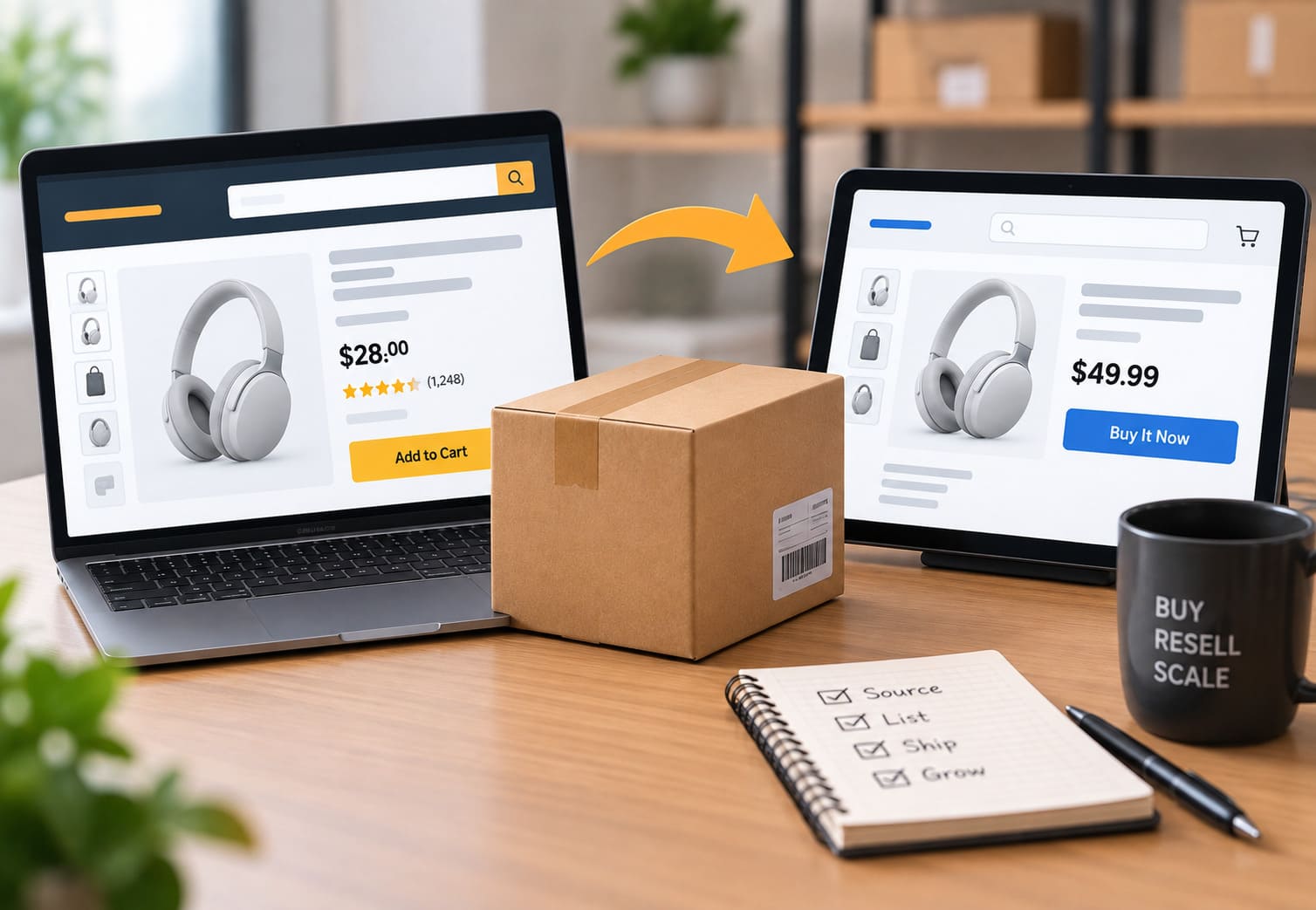
Either way, the work is the same: match listings across two marketplaces, keep prices in step with Amazon, and process orders and tracking without doing it by hand.
Where Easync fits
Known mainly as an Amazon to eBay dropshipping tool, Easync is worth a look when your plans go beyond FBA online arbitrage, whether that means selling Amazon-sourced stock on eBay or running an AliExpress to eBay store alongside it. For the Amazon to eBay route it works as Amazon to eBay arbitrage software: it monitors price and stock at the source, reprices, and can place orders and push tracking automatically.
It is not a substitute for Keepa or SellerAmp on the Amazon side, and it does not reprice FBA listings. If you also sell on eBay, our guide to Amazon-to-eBay flips walks through the setup, and Easync plans start with a free trial.
Online arbitrage FAQ
Is online arbitrage still profitable in 2026?
Yes, for sellers who recalculate. The fuel surcharge, the fulfillment fee increase, and the wider low-inventory-level fee have each shaved something off the typical small-item deal compared with 2025, and a deal that barely cleared your ROI floor last year may fall under it now. Sellers who work from written rules and a tool stack that shows fees accurately are still finding plenty above their threshold.
How much money do you need to start online arbitrage on Amazon?
A few hundred dollars in inventory is enough to run a first test loop, plus the $39.99 monthly Professional plan if you want Buy Box eligibility from day one, and a Keepa subscription. Sourcing software such as Tactical Arbitrage can wait until manual sourcing stops producing enough leads.
Do I need a Professional seller account for online arbitrage?
Not to make your first sale, but you will want one quickly. The Individual plan works for testing, and its $0.99 per-item fee is cheaper below roughly 40 units a month. Above that the $39.99 Professional plan costs less, and it is the only plan eligible for the Buy Box, which is where most arbitrage sales happen.
Are retail receipts acceptable for Amazon authenticity checks?
Rarely. When Amazon challenges authenticity it typically asks for invoices dated within the past 365 days from an authorized distributor or manufacturer, showing your business details, the supplier, the product identifiers, and quantities. A store receipt proves you bought something; it does not show where the retailer got it. The current requirements are on Amazon’s official site.
Can you do online arbitrage on Amazon without FBA?
You can fulfill orders yourself as FBM and skip the fulfillment fee, the surcharge, the placement fee, and the low-inventory fee entirely. In exchange you lose the Prime badge, handle storage and shipping yourself, and must make sure every package and packing slip carries your name as the seller of record. FBM makes the most sense for oversized items or small test quantities.
Where to go from here
Run a small test loop first: a handful of leads from the weekly recipe, checked against the fee example, shipped through a prep partner with your ROI floor written down. Scale once the wins repeat. And if eBay is on your roadmap as a second channel, you can test the cross-listing workflow with a free trial of Easync.