Quick Answer: Spocket helps dropshippers find suppliers, import products into their stores, and handle orders from one dashboard. Its strongest appeal is the combination of US/EU sourcing and a large product catalog, although running several stores or moving into the higher product limits can make the subscription considerably more expensive.
Spocket Pros and Cons
| Spocket Pros | Spocket Cons |
|---|---|
| Large catalog with US, EU, and global sourcing options | Higher product limits require more expensive plans |
| Suppliers in Spocket’s own network go through a vetting process | Shipping cost and delivery time vary from one product to another |
| Premium Products, Winning Products, and product filters help with research | Premium Product allowances depend on your plan |
| Samples are available before you commit to selling an item | Regular catalog products are added to the Import List individually |
| Branded invoicing and private-label options are available | Every additional connected store needs its own subscription |
| Works with major ecommerce platforms and marketplaces | Some integrations, including eBay, require higher plans |
Spocket currently advertises a catalog of more than 100 million products. The figure comes from Spocket itself, so it is better read as a vendor-reported catalog size than an independently audited count.
Catalog size is only a starting point. A useful product still needs a supplier you are comfortable working with, reasonable fulfillment terms, and enough room between your costs and the price customers are willing to pay.
What Is Spocket? How Spocket Dropshipping Works
Spocket sits between your online store and the supplier. You find a product, bring it into your storefront, set the retail price, and make it available to customers.
With Spocket dropshipping, there is no need to purchase inventory before you make a sale. After an order comes in, you process it through Spocket and the supplier handles fulfillment. The supplier sends the item directly to your customer.
The usual workflow looks like this:
- Connect your store.
- Search for products and suppliers.
- Add a product to the Import List.
- Edit the listing and set your price.
- Push it to the store.
- Process incoming customer orders.
Spocket’s Help Center describes the same import flow: select the product, move it to the Import List, customize it, and then push it to the connected store.
If you want a separate setup-focused walkthrough, Easync also has a guide to dropshipping with Spocket.
Spocket Products: Catalog, Suppliers and Product Discovery
The Spocket products catalog is broader than the old perception of Spocket as little more than a directory of US and European suppliers.
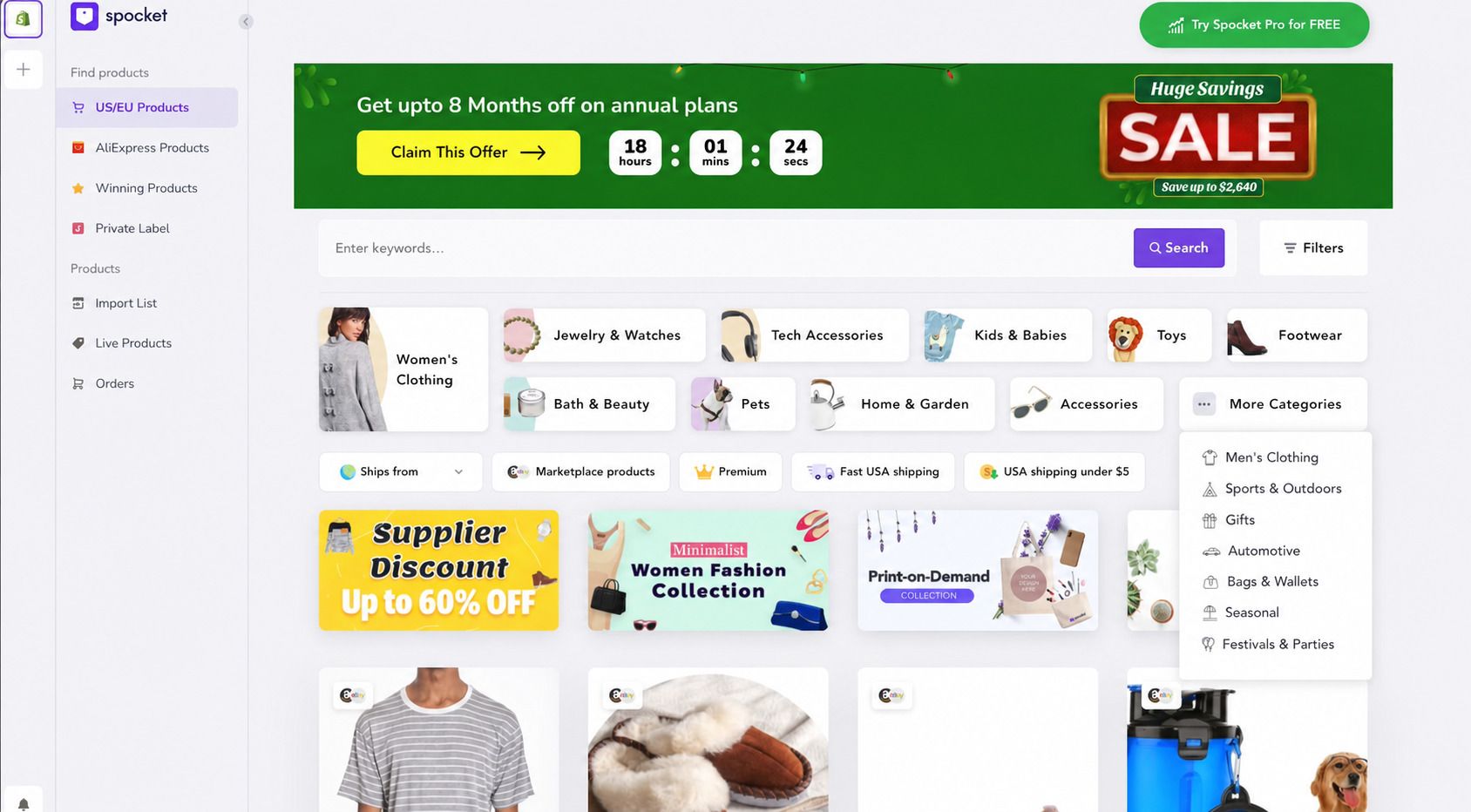
The current dashboard gives product discovery its own routes:
- US/EU Products
- AliExpress Products
- Winning Products
- Private Label
Premium listings can also be pulled out of the wider catalog with the Premium filter. Spocket describes these as a curated selection from suppliers on its platform.
The catalog covers the usual ecommerce territory, including clothing, beauty, pet supplies, tech accessories, footwear, home and garden, toys, sports, gifts and seasonal items. Spocket’s public site still puts US, EU and global sourcing at the center of its product offering.
How to Search Spocket Products More Effectively
The current catalog includes quick filters for where products ship from, marketplace products, Premium items, fast USA shipping, and products with US shipping under $5.
Start with the country where the customer lives rather than scrolling through products until something looks interesting. A lower supplier price is not especially useful if shipping wipes out the margin or the delivery window is a poor fit for the store.
Once an item looks promising, open it and check the supplier, shipping destination, shipping charge, variants and fulfillment timing.
Supplier profiles deserve a look too. Spocket rates accepted suppliers using processing time, shipping time and product quality. It does not currently provide equivalent reviews for individual products. You can read more about this in Spocket’s supplier and product review documentation.
How Long Do Spocket Products Take to Ship?
There is no single shipping window that accurately describes the whole catalog.
Each supplier sets fulfillment details for its own products. Spocket separates processing time from shipping time, and the two need to be considered together when estimating how long an order will take. The destination can change the estimate as well. Spocket explains the distinction in its processing and shipping guidance.
This is why product-level delivery information is more useful than assuming every US/EU listing arrives within the same number of days.
Spocket’s local-shipping filters can still be valuable, particularly for a US-facing store. They simply do not eliminate the need to check the individual listing.
What Are Spocket Premium Products?
Premium Products are a curated section of the Spocket catalog. Access requires a paid subscription, and the number you can import depends on your plan.
The current allowances are:
- Professional includes up to 25 Premium Products.
- Empire raises the limit to 10,000.
- Unicorn allows up to 25,000.
These limits appear on Spocket’s current pricing page.
A Premium tag is useful for narrowing a huge catalog. It cannot tell you what customer acquisition will cost, how many returns you will get, or what retail price buyers in your niche will accept.
What Are Spocket Winning Products?
Winning Products is aimed at product research rather than being another supplier tier.
The section currently surfaces AliExpress products and lets users narrow results for the United States, UK, Europe, Canada and Brazil. Products can also be sorted by price or rating and moved into the Import List once you want to investigate them further. Spocket explains the feature in its Winning Products guide.
It can save time when you need ideas. The results are still candidates, not evidence that a product will sell profitably in a particular store.
For a wider look at product research and automation software, see Easync’s best dropshipping tools guide.
Can You Order Samples From Spocket?
You can order a sample straight from a Spocket product listing.
The current limit is five units of the same item in one sample order, and Spocket does not support bulk sample orders.
Sampling makes the most sense for items you expect to sell seriously. You get to inspect the product yourself, take your own photos if needed, and see what the fulfillment experience feels like before a paying customer goes through it.
Spocket Integrations: Shopify, Amazon, eBay, AliExpress and More
Spocket is not limited to Shopify.
Its public integrations page currently shows:
- Shopify
- WooCommerce
- Amazon
- Squarespace
- eBay
- BigCommerce
- Ecwid
- AliExpress
- Wix
- Square
- Alibaba
Those names do not all represent the same type of connection. Shopify or WooCommerce is where you may run a storefront. AliExpress is also a sourcing route. Amazon and eBay bring marketplace selling into the picture.
Keeping those roles separate makes the integration list much easier to understand.
How Does AliExpress Work With Spocket?
Spocket uses AliScraper for importing from AliExpress.
You can import a single product, while AliScraper can also handle bulk imports from AliExpress collections. The products then move into the Spocket workflow before publication. Spocket documents the process in its AliExpress import guide.
This differs from the standard Spocket catalog. Regular Spocket products still need to be added to the Import List individually.
What About Alibaba?
Alibaba appears in Spocket’s current integration directory.
That does not make Alibaba the same thing as Spocket’s native supplier catalog. It is better viewed as another sourcing connection within the wider ecosystem.
Does Spocket Integrate With Temu?
Temu does not appear in Spocket’s current integration directory.
If Temu is part of your sourcing plan, it should be treated as a separate workflow rather than assuming it behaves like the AliExpress connection. Easync has a dedicated Temu dropshipping guide if you are researching that route.
Spocket Review: What You Actually Get in the Dashboard
The basic dashboard does not take long to learn. Product discovery, the Import List, live products and orders each have their own place, so it is usually clear what the next action should be.
The details become more important once the store starts growing.
Importing and Editing Products
A regular Spocket product first goes into the Import List. Before publishing it, you can change the title, description, variants, images and price. Spocket covers those options in its product customization guide.
Adding regular catalog products to the Import List is still an item-by-item process.
Once several products are already there, however, Spocket lets you publish the current page together with its bulk push option. That distinction matters: you cannot bulk-add ordinary Spocket products to the Import List, but you can bulk-publish products that have already reached it. Spocket explains the limitation in its bulk import documentation.
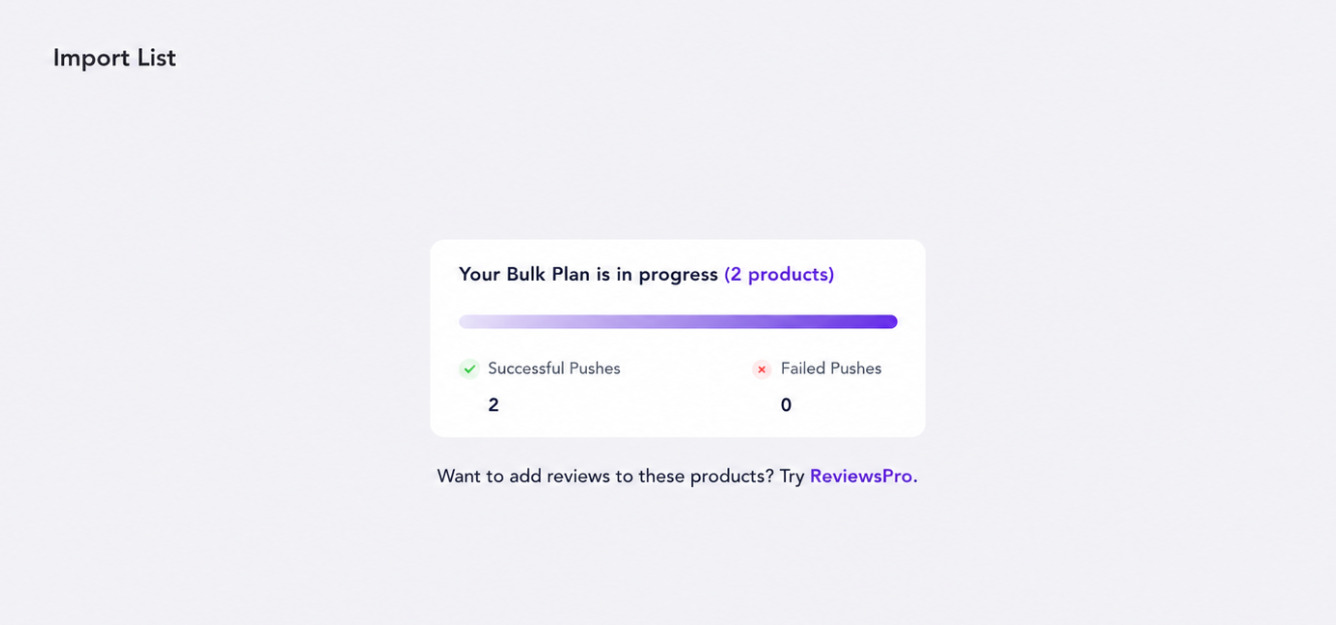
For a carefully curated store, this may hardly matter. It becomes much more noticeable if your business model depends on publishing large quantities of listings.
Global Pricing Rules
Global Pricing Rules are there to reduce repetitive markup work.
You can use a fixed amount, a multiplier or a percentage. More detailed Advanced Pricing Rules can apply different logic across price ranges. Spocket describes the available options in its Global Pricing Rules guide.
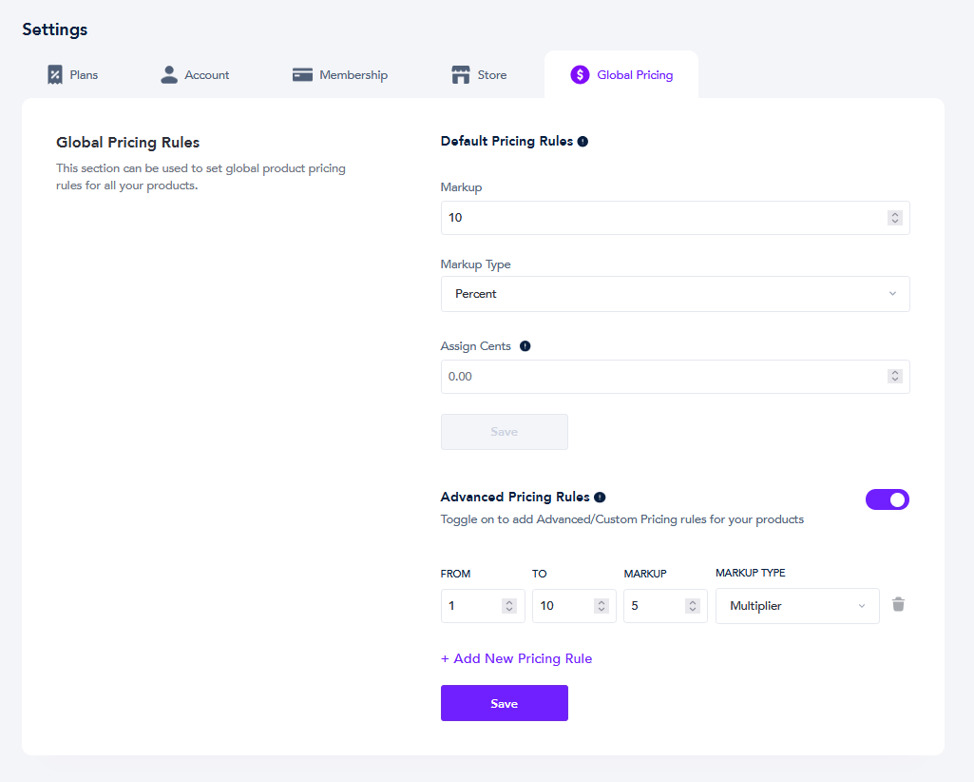
There are two details worth understanding before relying on them.
Shipping is not part of the listing price used by the rule. If shipping costs $8, that $8 still has to be accounted for somewhere in your retail-price calculation.
The other limitation appears after products have already been imported. Global Pricing Rules apply to new products entering the Import List; they do not go back and recalculate products already there or live in the store.
Supplier price changes are similar. Spocket notifies the retailer when a supplier changes a price, but the existing retail price does not automatically move with it. Spocket explains how those updates work in its product-price adjustment guide.
If continuous repricing is central to your business, Easync’s dropshipping automation platform approaches pricing and stock changes differently.
Supplier Vetting
Suppliers that join Spocket’s own network go through an application and review process.
Spocket requires them to manufacture their products or keep their own inventory rather than operate as inventory-free resellers. Suppliers must also meet their published processing and shipping commitments and offer discounted pricing compared with retail. You can see the requirements in Spocket’s supplier vetting policy.
This gives you a useful screening layer. It does not make a supplier’s individual products, delivery record or return terms irrelevant.
Branded Invoicing Is Not Branded Packaging
Spocket’s branded invoice settings let paid users add a company logo and personalized note. The Help Center also warns that branded invoicing is not available from every supplier. See Spocket’s branded invoicing guide.
Packaging follows different rules.
Suppliers in Spocket’s network are expected to use brand-neutral packaging without their own promotional materials. A manufacturer’s tag or branding can still be present on some products. Spocket explains this in its packaging policy.
So a branded invoice is not a promise of fully customized boxes, bags or packaging for your own brand.
Private Label, Print-on-Demand and AI Tools
Private Label is visible in the current Spocket interface, while its public site also promotes print-on-demand and AI store creation.
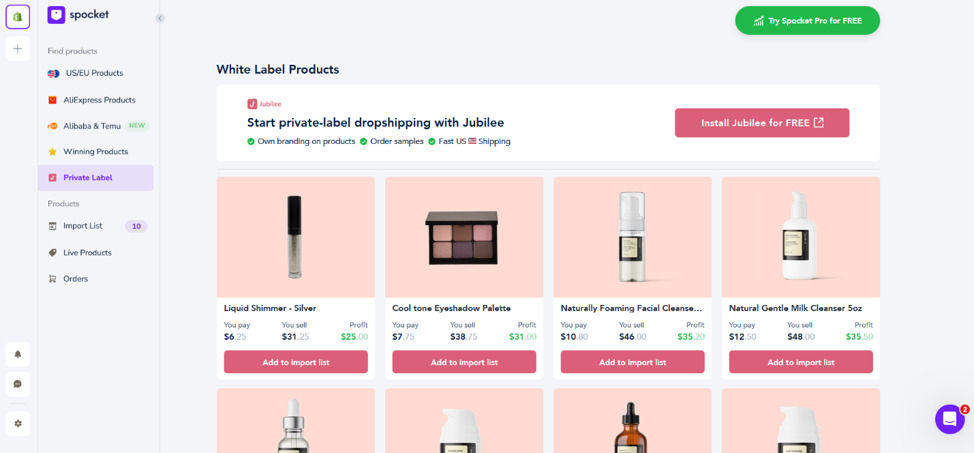
Spocket has built other tools around the core sourcing platform as well, including products such as DropGenius, Smartli, Jubilee and AliScraper.
These are useful additions to the wider ecosystem, but they should not be treated as though every function automatically comes with an ordinary Spocket subscription.
Spocket Pricing in 2026
New accounts get access to a free Basic level that can be used to explore Spocket before choosing one of the four paid plans: Starter, Professional, Empire or Unicorn. Spocket outlines the plan structure in its subscription guide.
The current regular prices are:
| Plan | Monthly price | Annual billing | Unique products | Premium products |
|---|---|---|---|---|
| Starter | $39.99/month | No comparable Starter annual price currently shown | 25 | — |
| Professional | $59.99/month | $24/month, billed $288 annually | 250 | 25 |
| Empire | $99.99/month | $57/month, billed $684 annually | 10,000 | 10,000 |
| Unicorn | $299.99/month | $79/month, billed $948 annually | 25,000 | 25,000 |
Spocket’s live pricing page confirms the regular monthly rates and product limits.
The annual rates are substantially lower on an effective monthly basis. That discount comes with a much firmer billing commitment, which matters because the trial and refund terms are different.
Does Spocket Have a Free Trial?
Paid monthly plans currently come with a seven-day trial.
Cancel during those first seven days and Spocket’s policy says the monthly subscription will not be charged. Once the trial has ended, monthly subscription payments are generally non-refundable. See the current refund and cancellation policy.
Annual subscriptions do not include that trial. Once the annual payment has been processed, the subscription is non-refundable. Renewal charges are also non-refundable once the new billing cycle has begun.
Spocket asks users to cancel at least 24 hours before a scheduled renewal.
Does Spocket Charge Transaction Fees?
Spocket’s pricing page advertises a 0% platform transaction fee on its paid plans.
There is still payment-processing cost on orders.
Spocket uses Stripe to process transactions and currently states that Stripe adds 2.9% + $0.30 to each successful order processed through the platform. Extra processing charges can apply to manually entered cards, international cards and currency conversion.
In other words, “0% transaction fee” refers to Spocket’s platform fee. It does not mean every order is free of payment-processing costs.
Can You Use Spocket for Multiple Stores?
Several stores can be associated with the same Spocket account. They are not covered by one subscription.
Spocket explicitly requires a separate subscription for each store.
That can change the economics quickly. Someone planning three stores should compare the cost of three subscriptions, not the price printed next to one plan.
How to Use Spocket for Dropshipping: Step by Step
1. Create an Account and Explore the Catalog
The free Basic level gives you a chance to look around before paying. Monthly plans add a seven-day trial once you decide to test the paid features.
Use this stage to work out how many products you actually need, whether Premium Products matter to you, and where your customers will be located. There is little point paying for a larger plan before you know which limits are getting in your way.
2. Connect Your Store
Connect the storefront or marketplace you plan to use.
Spocket supports Shopify, WooCommerce, Wix, BigCommerce, Squarespace, Square and Ecwid, with Amazon and eBay also present in its current integration ecosystem.
If you have not settled on a marketplace yet, Easync’s eBay vs. Amazon dropshipping comparison covers the operating differences between those two models.
3. Narrow the Product Search
Set the destination and start filtering.
A good product candidate should survive a closer look at shipping, processing time, supplier details, price and variants. If any of those change the economics too much, move on before you spend time rewriting the listing.
For an important product, a sample is often worth the extra step.
4. Add the Product to Your Import List
For a regular Spocket catalog item, use Add to Import List.
The product appears in the Import List where it can be reviewed and edited before anything becomes public. Regular catalog items still have to be added one at a time.
5. Edit the Listing
Supplier copy does not have to become your store copy.
Spocket allows you to edit titles, descriptions, tags, variants, images and prices before publication. Its Help Center covers the available fields in the product customization guide.
This is also the right point to calculate the real margin. Spocket’s listing and retail prices exclude shipping, so include that cost before deciding what you can afford to charge. Spocket explains the distinction between the two prices here.
Payment processing, advertising and returns sit outside the supplier listing too.
6. Push the Product to Your Store
Once the listing looks right, send it to the store with Push to Store.
Regular Spocket products reach the Import List one at a time. After they are there, you can select multiple listings on the page and publish them together.
7. Process Customer Orders
When someone buys a synced product, the order appears in Spocket.
You process and pay for the supplier-side order, then the supplier takes over fulfillment. Once the shipment goes out, tracking details can be checked from the Orders area. Spocket explains the shipment status process in its order tracking documentation.
For sellers looking for a more automation-heavy fulfillment model, Easync also offers Fulfillment by Easync.
Where Can You Sell Spocket Products?
Spocket’s current retailer policy explicitly allows its products to be sold through:
- Shopify
- BigCommerce
- Wix
- WooCommerce
- Squarespace
- Square
- Ecwid
- Amazon
- eBay
You can see the full list in Spocket’s sales-channel policy.
The same policy prohibits selling Spocket products through Etsy, Wish, Groupon, Facebook Marketplace and Google Shopping.
Those restrictions do not prevent you from advertising on Facebook, Instagram, Pinterest or YouTube and sending the traffic to a supported store.
Does Spocket Work With eBay?
Spocket’s eBay integration is available on the Empire and Unicorn plans.
Supported eBay regions currently include the United States, Canada, Great Britain, Germany, France, Spain and Italy. Spocket maintains the current list in its eBay integration guide.
If eBay listing monitoring and repricing matter more than supplier discovery, Easync has dedicated eBay dropshipping automation tools.
Does Spocket Work With Amazon?
Amazon appears on Spocket’s current integration page and in the retailer policy as an approved place to sell Spocket products.
Amazon’s own dropshipping and seller requirements still apply independently of Spocket.
Easync also has a dedicated Amazon dropshipping automation page.
What Do Spocket Reviews Say in 2026?
Spocket has plenty of satisfied users, but the review distribution is not one-sided.
The Shopify App Store currently shows 579 reviews and a 4.0/5 overall rating. Of those ratings, 79% are five-star and 12% are one-star.
G2 has a smaller review pool: 71 reviews with an average score of 4.2/5.
The positive feedback is not all about the same thing. Ease of use and support appear in favorable Shopify reviews, while lower ratings cover supplier problems, samples, technical issues and billing complaints.
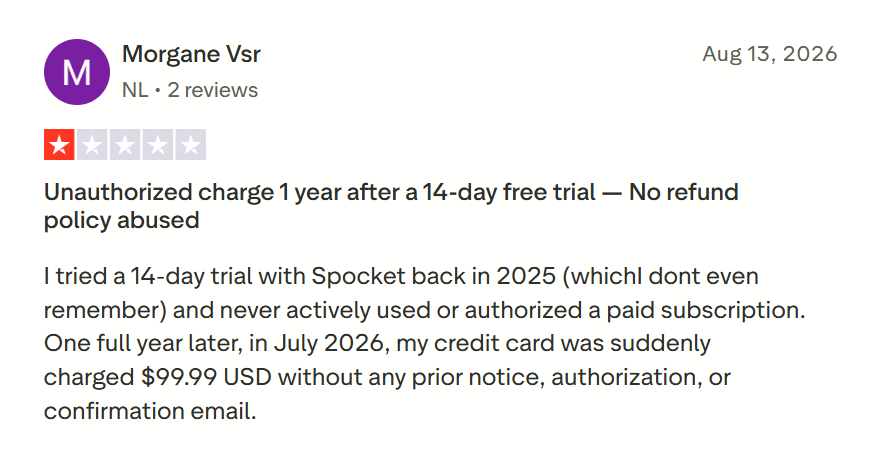
Billing comes up often enough in recent reviews to justify reading the subscription policy before signing up, especially if you are considering annual billing. The complaints themselves are individual customer reports, so they should not be treated as proof that every account will have the same experience.
Spocket Alternative: When Easync Makes More Sense
A useful Spocket alternative depends on which part of the business is causing the most work.
Spocket puts product discovery near the center. You browse its supplier network, use product filters, explore Premium and Winning Products, and can order samples before committing to a listing.
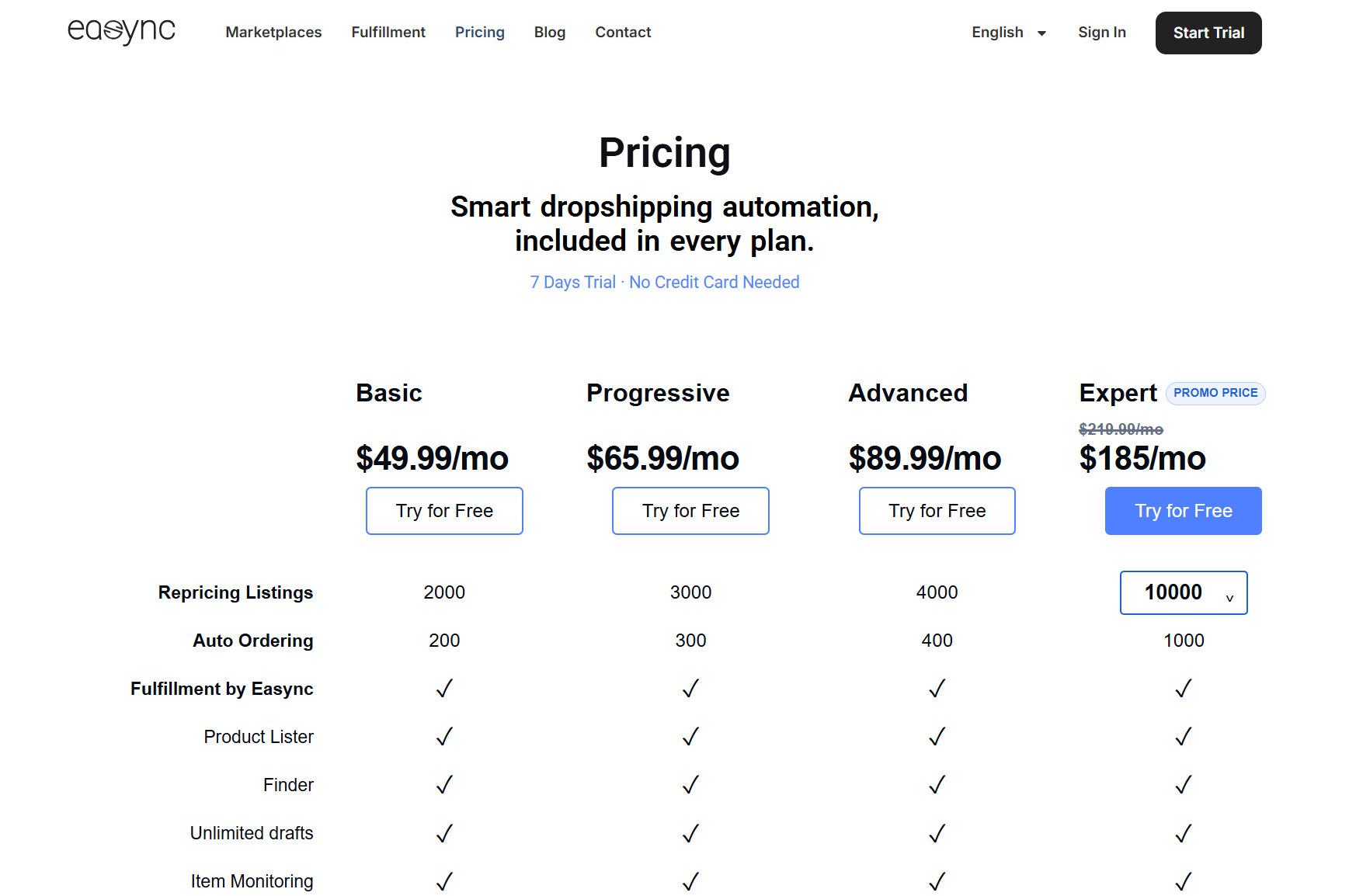
Easync approaches the workflow from the operations side. Its current plans include repricing, Auto Ordering, Product Lister, Item Monitoring, Orders Management, tracking tools and Multiple Stores Management. See the current Easync pricing and features.
One Easync Subscription Can Cover Multiple Stores and Selling Channels
This is an important difference if you operate more than one storefront.
Spocket charges separately for every connected store. Easync’s pricing model is built around one account subscription and listing capacity rather than selling a separate subscription for each supported marketplace. Multiple Stores Management is included in its plan feature set.
For someone running several stores, that difference deserves to be calculated before comparing the two entry prices.
Easync Supports Shopify
Easync is no longer an eBay-only automation option.
Its Shopify integration supports product import, supplier price and stock synchronization, fulfillment and tracking updates. Amazon, Walmart and AliExpress can also be used as supplier sources for a Shopify store.
So a Shopify seller does not have to choose Spocket simply because the store runs on Shopify. The real question is whether the business needs supplier discovery or ongoing store automation more.
See Easync’s current Shopify dropshipping automation platform for the full workflow.
Easync Also Integrates With AliExpress
AliExpress has become a much larger part of Easync during 2026.
AliExpress can be used as a supplier source inside Easync, with product importing, 24/7 stock and price monitoring, automatic ordering and tracking updates.
That gives sellers another sourcing option without losing the repricing and order-management side of Easync.
More information is available on Easync’s AliExpress dropshipping automation page.
Spocket vs. Easync: Which One Fits Better?
Pick Spocket when finding and evaluating suppliers is the larger part of the job. Its native catalog, samples, Premium Products and product-discovery tools are built around that need.
Easync starts to look more relevant once you already have live listings that need to stay in sync. Price changes, stock, orders and tracking can all create repetitive work, especially across several stores.
Shopify is supported by Easync, and AliExpress can serve as a supplier source with automated ordering. Multiple stores can also be managed without purchasing a separate marketplace-specific subscription for each one.
Current Easync pricing starts at $49.99/month for Basic, followed by $65.99/month for Progressive and $89.99/month for Advanced. The pricing page also offers a seven-day trial without requiring a credit card. See Easync pricing for the latest plan details.
For a wider comparison, see Easync’s dropshipping platform comparison.
Is Spocket Worth It in 2026?
Spocket makes the most sense when sourcing is the part of dropshipping you want to simplify.
The catalog, supplier network, samples and product filters give you several ways to find inventory and inspect it before putting it in front of customers. The interface is also approachable enough that building a smaller curated store does not require much time to understand.
Scale changes the calculation.
Higher product limits mean moving up the pricing ladder. Every additional store needs another subscription. Regular catalog items have to enter the Import List individually, and a supplier price increase does not automatically reprice an existing store listing.
Annual billing cuts the effective monthly price considerably, but there is no annual-plan trial and the payment becomes non-refundable after it is processed.
For a store that needs better product and supplier discovery, Spocket still has a clear role.
If the harder job is keeping stock, prices, orders and tracking under control across several live stores, an automation-focused platform may fit the operation better.
FAQs
What is Spocket?
Spocket connects online sellers with dropshipping suppliers and provides a workspace for finding products, preparing listings and handling orders. The retailer does not need to keep the products in stock before a customer buys them.
Is Spocket legit?
Spocket has been operating for years, maintains active ecommerce integrations and has substantial review histories on both Shopify and G2. Shopify currently shows a 4.0/5 rating from 579 reviews, while G2 reports 4.2/5 from 71.
The individual supplier and the subscription terms still need to be checked on their own.
What Spocket products can I sell?
The catalog covers clothing, beauty, pet products, tech accessories, footwear, home and garden, toys, sports, gifts, print-on-demand and seasonal items, among other categories. Product discovery in the current dashboard also includes US/EU Products, AliExpress Products, Winning Products and Private Label, with Premium listings available through filtering.
Does Spocket have a free trial?
Paid monthly subscriptions have a seven-day trial. Cancel during that period and Spocket’s current policy says the monthly subscription will not be charged.
Annual plans work differently: there is no trial, and the payment is non-refundable once it has been processed.
Does Spocket work with eBay?
The eBay integration is available on Empire and Unicorn. It currently supports eBay in the United States, Canada, Great Britain, Germany, France, Spain and Italy.
Can I use Spocket for multiple stores?
You can keep several stores under one Spocket account, but they are billed separately. Every connected store needs its own subscription.
What is a good Spocket alternative for dropshipping automation?
Easync becomes more relevant once the difficult part is no longer finding products but keeping live listings, stock, prices, orders and tracking under control.
It supports Shopify as a selling channel, AliExpress as a supplier source, repricing, stock monitoring, automatic ordering and tracking. Multiple stores can be managed under the same account subscription rather than requiring a separate marketplace-specific subscription for every supported channel.
I searched for “spoket.” Is that the same service?
Yes. Spoket is a common misspelling of Spocket.

Noah Edis is a freelance writer and systems engineer with a wealth of experience in modern hardware and software. When he’s not working on his latest project, you can find him playing competitive dodgeball or pursuing his personal interest in programming. At Easync, Noah helps thousands of sellers optimize their eBay and Amazon businesses by providing automation tools and practical guidance on account health, pricing, and inventory management.

Eugene Stepnov – Author
Eugene is a senior e-commerce strategist with over 10+ years of experience in dropshipping, online arbitrage, and marketplace compliance. At Easync. Eugene has experience in developing multi-account management technologies, such as Gologin and secure browser solutions, providing Easync users with a head start in regulatory compliance and platform changes.