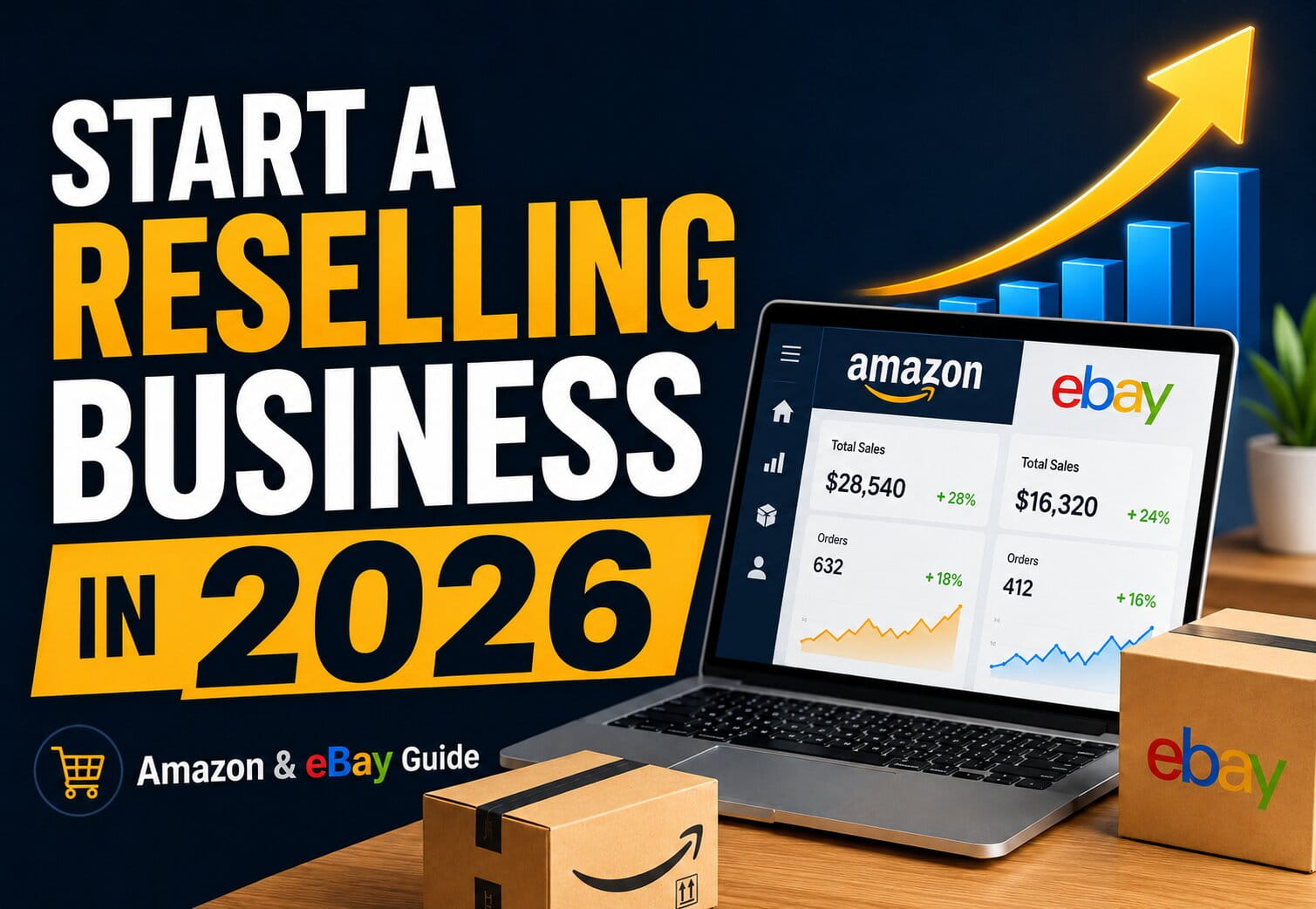
Reselling is one of the fastest ways to make money in e-commerce. You don’t have to invent a product and go through everything that comes with that. Like back and forth with factories.
The business works on pricing. You find a product that’s the wrong price in one place and sell it at the right price in a different place.
Most guides will tell you to get in your car and drive to Walmart. Once you are there, scan a clearance rack and purchase everything in stock. Then load up your car and fill your house with boxes of products. This method has worked for many people, but it’s only one level of reselling. This method, however, caps out on how much one human can achieve in a day.
This guide is going to cover more than the standard method and explain all three. Manual, digital, and hands-free.
What is Reselling in 2026 and How Does It Work?
Reselling is an e-commerce business model where you buy an existing product from an existing brand at a lower price and resell those products for a profit on marketplaces like Amazon, eBay, or Shopify. These products can be purchased from retailers, liquidators, or wholesalers.
There is nothing complicated about it. You are just identifying a price gap.
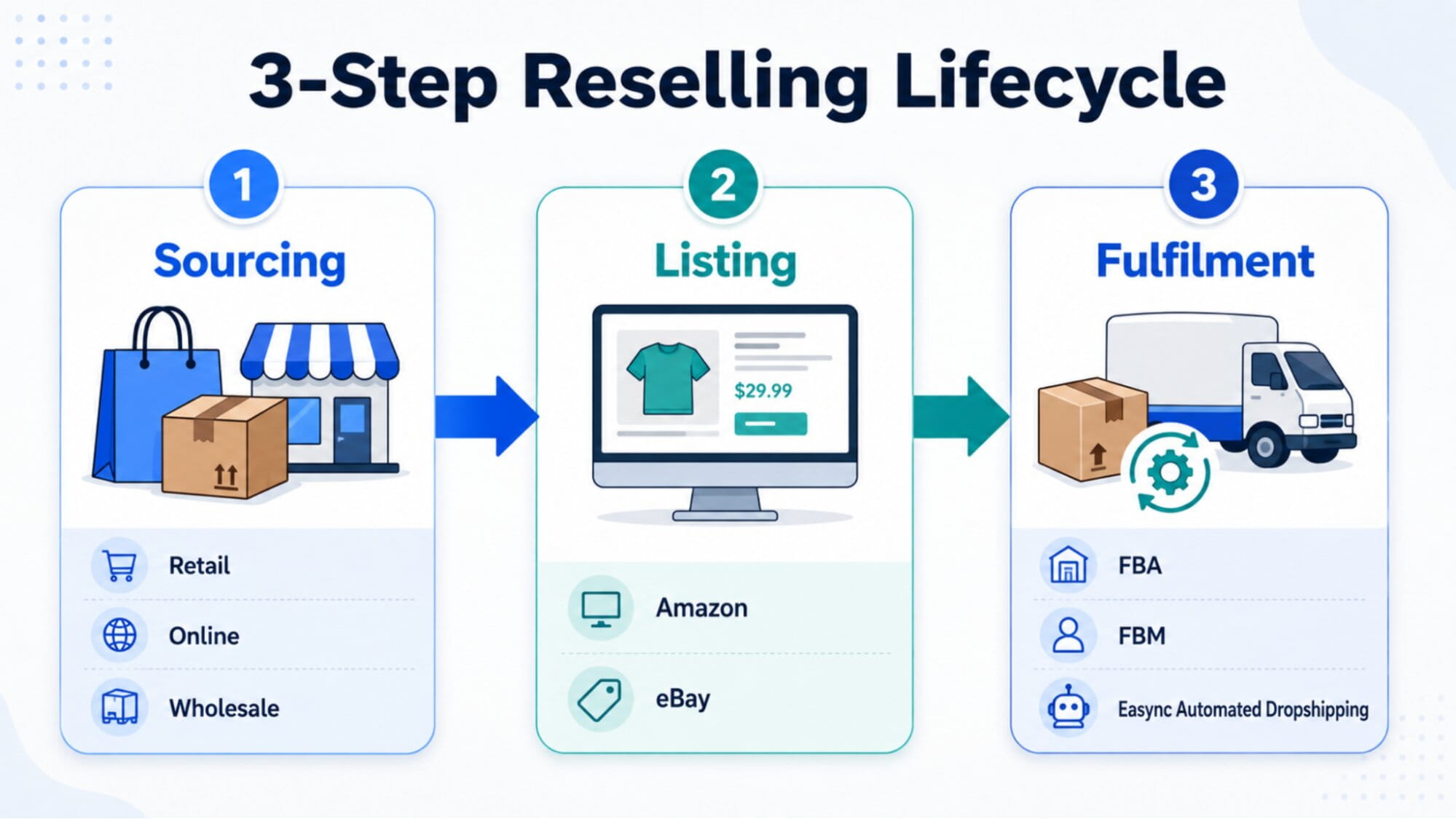
A private label means you actually create and produce a product with a brand attached and hope there is a demand. Reselling is the complete opposite. You aren’t hoping for demand because the demand already exists. You can see the demand in all the reviews and how many people have already bought the product and at what price. You just need to be cheaper and a credible seller on that page to attract the buyers to you.
Before you start reselling anything in 2026, you need to set your expectations. It might seem simple to just price lower than the competitors, but then you could be losing money. Basically, you need to aim for 25% to 30% net margin after all platform fees. Gross margin is great on a spreadsheet, but it’s not going to look the same in your bank account.
Here’s an example of the numbers:
- You buy a toaster for $42 on a retailer’s clearance sale.
- Currently it is selling on Amazon for $79.99.
- Amazon takes a 15% referral fee; that means $12 is gone.
- FBA fulfillment takes about another $6.
- You keep about $20.
That’s a 25% net margin on the sale and roughly 48% return on your $42.
Both numbers in that case are fine. Sellers who only ever run the gross margin ROI calculations are the ones who get a nasty surprise at tax time.
Every one of those deductions is published in your own account. Amazon Seller Central fees change category by category, and they get revised more often than most sellers notice. Pull your own fee schedule before you trust anybody’s blog mat, including this one.
How to Master Reselling on Amazon
Reselling items on Amazon goes like this: List products on existing ASIN detail pages. Then compete for the Buy Box. Then you choose between FBA, FBM, or automated dropshipping fulfillment.
Amazon revolves around volume, and it is the king of volume when it comes to marketplaces. There’s a rulebook attached to that volume, though. Bigger payoff than eBay and a lot less forgiveness for mistakes.
Understanding Amazon ASINs and BSR
Every Amazon listing sits on a shared ASIN page, and Best Sellers Rank is the number that tells you whether that page actually moves stock.
Every product that you see on Amazon has an ASIN. It’s basically a page that is shared amongst sellers. So, for example, 12 sellers can be on 1 ASIN, but 11 of those sellers are just invisible.
Amazon ASIN sourcing is the habit of checking a product before you go and buy a bunch of stock. Not after you have already bought it. What you need to look at first is the Best Sellers Rank. Most sellers aren’t going near any product with a BSR over 50,000 in its main category. This rank is basically telling you how often the product sells. To understand that better, let’s say a BSR of 3,000 in Home & Kitchen might move 20 units a day. A BSR of 400,000 might move one a month, and you just bought 50 of them.
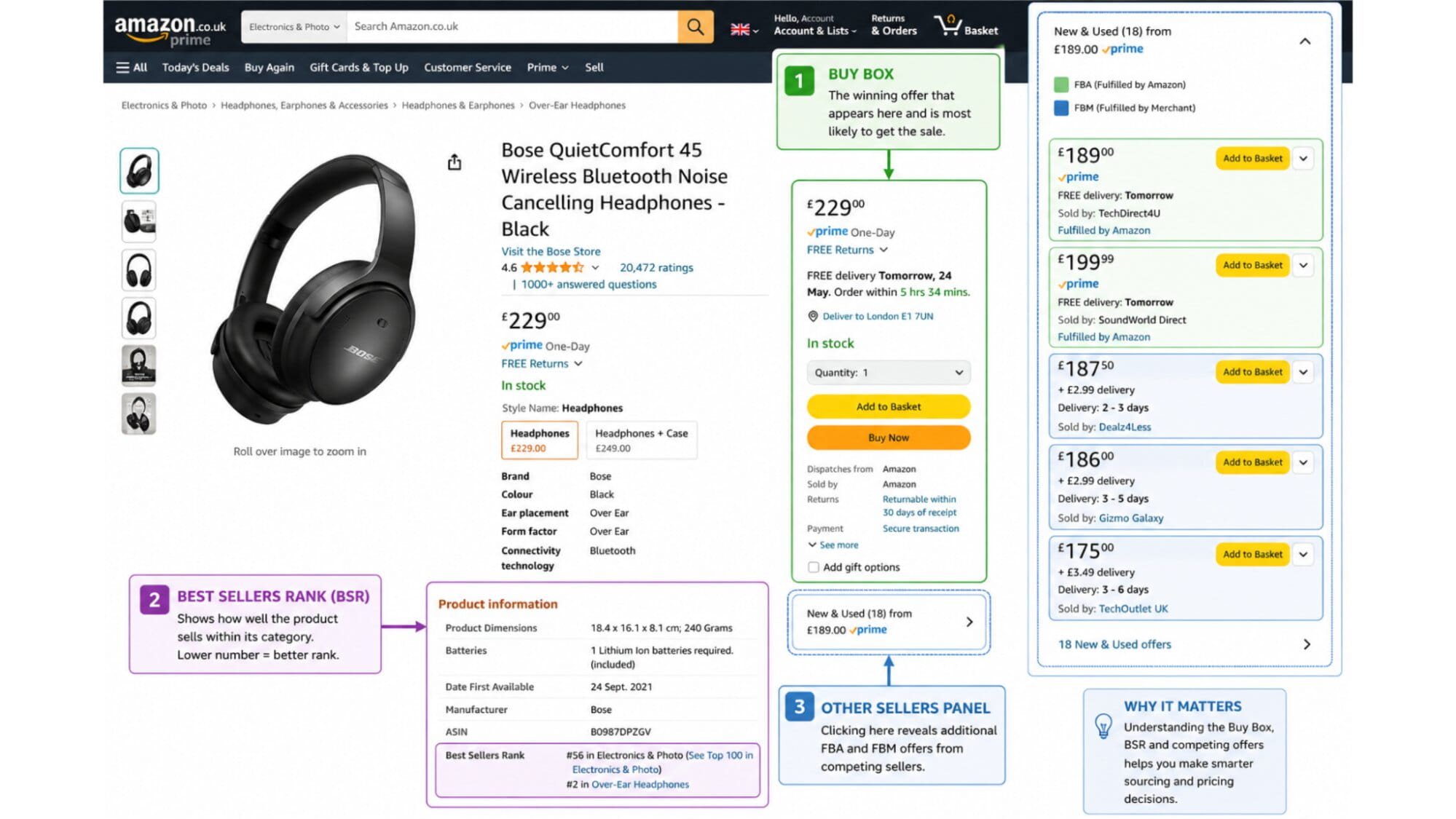
The next thing to understand is the Buy Box rotation. It’s that little add-to-cart button that has an impressive sales conversion rate on any given listing. If one seller holds it permanently, you are buying a very slow inventory problem.
You can see this on software like Keepa. Keepa sales rank charts are how you check both without guessing. The rank line shows real sales history over months. A flat line means no sales and a sawtooth pattern means steady sales.
One thing the charts also expose. If Amazon itself is on the listing as a seller, run. You can’t compete on price with Amazon on Amazon.
FBA vs. FBM vs. Dropshipping
FBA hands storage and shipping to Amazon, FBM keeps both with you, and automated dropshipping removes inventory from the equation entirely.
Three ways to get the product to the buyer, and they suit three different kinds of seller.
| Model | Who stores it | Who ships it | Upfront cash needed |
| FBA (Fulfillment by Amazon) | Amazon warehouse | Amazon | High. You buy stock first |
| FBM (Merchant Fulfilled) | You | You | Medium. Stock plus your time |
| Automated Dropshipping | Nobody | Software, from supplier | Low. You buy after the sale |
FBA gets you the Prime badge and is known to help with conversions. But it does mean you are paying for stock, shipping, and storage. Any product that sits with FBA for longer than 180 days means aged inventory surcharges. Which climbs steeply the longer it sits. Make a mistake on a product, and you lose more money than you’d expect.
FBM gives you a little more control. Your margins are better because you’re not paying anyone to pick and pack for you. But you take on the responsibility.
Automated dropshipping is the only option that gets rid of all inventory risk. You never own the product in the first place,e which means you don’t have to worry about inventory storage and dead stock. The customer buys from you, and then you place the order with the supplier. Simple, right?
Read the policy before you start. Amazon allows dropshipping, but only if you are the seller of record on every document that reaches the customer. Your name on the packing slip, your name on the invoice. Shipping directly from another retailer with that retailer’s branding in the box is a suspension waiting to happen. Check Amazon’s current Drop Shipping Policy in Seller Central before your first order.
Navigating Brand Gating and IP Alerts
Brand gating blocks you from listing restricted brands until you supply valid distributor invoices, and IP alerts are complaints from brand owners that Amazon actions before it investigates.
This happens plenty. Get excited over an amazing deal, you list it, and then you get told you can’t sell that specific product. That’s brand gating.
Amazon restricts entire categories and thousands of individual brands. Getting ungated means you need to prove where you got the goods. Amazon ungating invoices have to come from a legitimate distributor. These invoices typically need to show around 10 units of the item and be dated within the last 90 days.
Retail receipts won’t work. A Target receipt is not a wholesale distributor invoice regardless of how many units are on it.
This is one of the most common reasons that new sellers hit the wall, and it’s why wholesale distributor accounts are worth setting up early on.
IP alert protection is the other half of brand gating compliance. A brand owner can file a complaint about your listing. The issue arises because Amazon acts first and asks questions later. Get a few of those complaints, and you risk a ban on your account.
There are three things you can practice to keep your account in the green:
- Don’t sell anything you can’t invoice
- Never use a manufacturer’s own photos in your listing copy
- Check your ASINs against the restricted brand list before you spend your money
How to Build a Profitable Store Reselling on eBay
Reselling products on eBay means you get a little more flexibility compared to Amazon. You are able to list brand-new, refurbished, or dropshipped items on fixed-price or auction formats.
eBay is the forgiving sister of Amazon. You don’t have to share pages with other sellers, so you’re not fighting directly with eleven other sellers just to get a button. Your listing is your listing.
Because of the flexibility, you see more vintage and refurbished flipping on eBay. You will see odd single items or discontinued models because eBay just wants to make sales and Amazon wants clean catalog data.
The fee side is pretty simple. Most categories run a 13.6% final value fee plus a per-order fee of $0.30 on orders up to $10 and $0.40 above that. Payment processing is already baked into that percentage, so there’s no separate cut.
There is a part that catches people with the fees, though. It’s the fee base. That 13.6% applies to the total sale of the product. That means the shipping the buyer paid and the tax. A $30 item with $6 shipping is charged on $36, not $30.
Optimizing for the eBay Cassini Algorithm
Cassini ranks listings on sales performance and data completeness, so filled item specifics and valid MPN/UPC identifiers matter more than keyword density.
Cassini is eBay’s search engine. Unlike Google, it doesn’t reward keyword stuffing. It rewards listings that sell.
Item specifics optimization is the highest-value work you can do here. Those are the structured fields under your title. Normally it’s the brand, model, size, color, and style. Cassini uses those fields to match what buyers are filtering. If your listing has half its specs empty, it simply won’t appear when a buyer narrows their search.
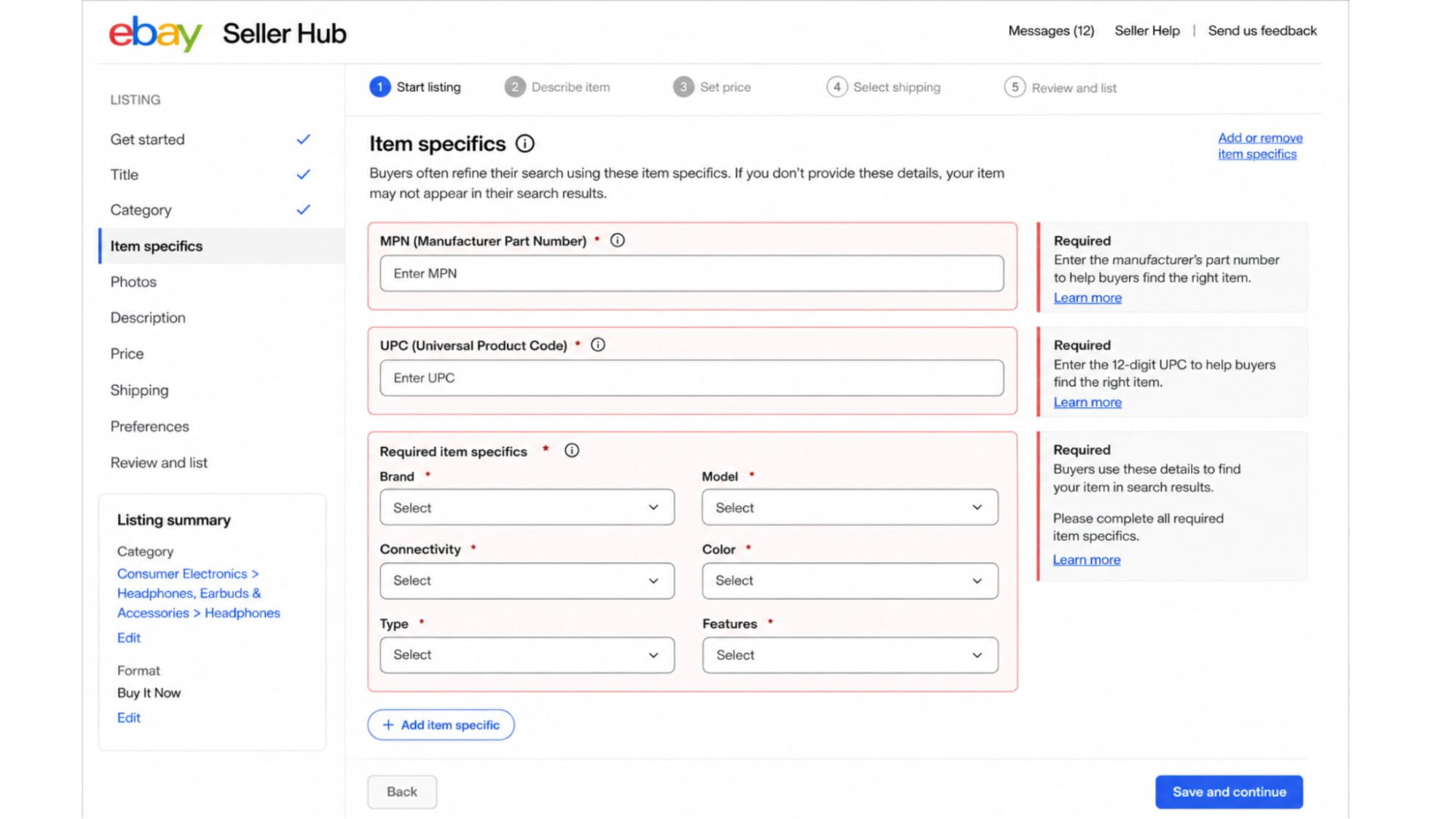
MPN and UPC identifiers matter for the same reason. The MPN is the manufacturer’s part number, and the UPC is the barcode. Fill both in,n and eBay can match your item to its catalog, which pulls you into comparison results you’d otherwise never show up in.
Your title gets 80 characters. Use all of them, and use them for words a buyer would actually type. “L@@K RARE NEW” wastes eleven of them and helps nobody.
Read more here on How to SEO Optimize eBay Listing for Cassini Algorithm.
eBay Seller Hub promotions are the last lever. Promoted Listings sits inside Seller Hub and lets you set an ad rate, which typically runs 2% to 10%. You only pay when the promoted listing converts. Just remember that a 5% ad rate on top of a 13.6% final value fee is 18.6% before you’ve paid for anything else.
Choosing Between Fixed Price and Auction Listings
Use Buy It Now when the market price is already known, and auctions when the ceiling is genuinely uncertain.
If you know what your product is worth, then this is an easy choice.
Use fixed pricing if you know. Commodity goods or anything with fifty comparable sold listings already. You know the number, so set that number.
Auctions are for when the market decides. Rare items, collectibles, or anything where the ceiling is not easy to figure out. A seven-day auction ending on Sunday evening will find the real price better than you can.
Suppose your plan is to sell at volume. You want the Buy It Now button. Auctions eat time, and turnover is what pays you.
Sourcing Strategies: Retail Arbitrage, Online Arbitrage, and Dropshipping
Resellers source inventory through retail arbitrage (clearance shelves), online arbitrage (digital price gaps), or automated dropshipping (fulfilling orders straight from supplier feeds without holding stock).
Retail arbitrage is the general starting point. It’s the tried and tested method of walking aisles, pulling out one of the retail arbitrage scanning apps, and checking barcodes against live Amazon prices. Basically, you buy the ones that clear your margin.
Clearance aisle sourcing does work and has worked for thousands of people. But the ceiling is obvious. Physically, a human can only visit four stores in a good day and burn the hours on driving. Every unit you buy has to live somewhere, and this is normally a corner of your house. Then you have to sort and pack orders by hand.
Online arbitrage lifts the driving off you. Online arbitrage software scans thousands of retail sites against marketplace prices and surfaces the gaps while you drink your coffee at home. You get way better leads and way more of them. And you don’t have petrol costs.
Cross-platform arbitrage is the version most people land on eventually. You buy where the price is soft, and you sell wherever the demand sits that week, which usually means running Amazon and eBay side by side rather than picking one.
But online arbitrage still leaves you with one problem from retail arbitrage. You are still buying stock upfront,t and it still leaves you with boxes in your house. You removed the driving but not the warehouse problem.
| Reselling Model | Sourcing Method | Inventory Storage | Order Fulfillment | Scalability Limit |
| Retail Arbitrage | Physical store clearance racks | Home / Garage / Warehouse | Manual packing & shipping | Capped by physical hours & driving |
| Online Arbitrage (FBA) | Online retail sites | Amazon FBA Warehouse | Handled by Amazon FBA | Capped by upfront inventory capital |
| Automated Dropshipping | Digital supplier feeds / Marketplaces | Zero Physical Inventory | 100% Automated via Easync | Virtually Infinite (Cloud API) |
Scaling Beyond Physical Stock: Automating Your Reselling Business with Easync
Automated dropshipping software removes the two ceilings that cap manual reselling: physical storage and manual order processing.
Level three is where the business stops being a job.
Easync.io is dropshipping automation software for eBay, Amazon, and Shopify. It exists for the reseller who has proven the model works and has now hit the wall where admin eats the whole day.
You know the wall when you’re standing at it. Copying a buyer’s address into a supplier checkout. Refreshing eight tabs to see whether anything went out of stock overnight. Pasting tracking numbers into a marketplace form at 11 pm.
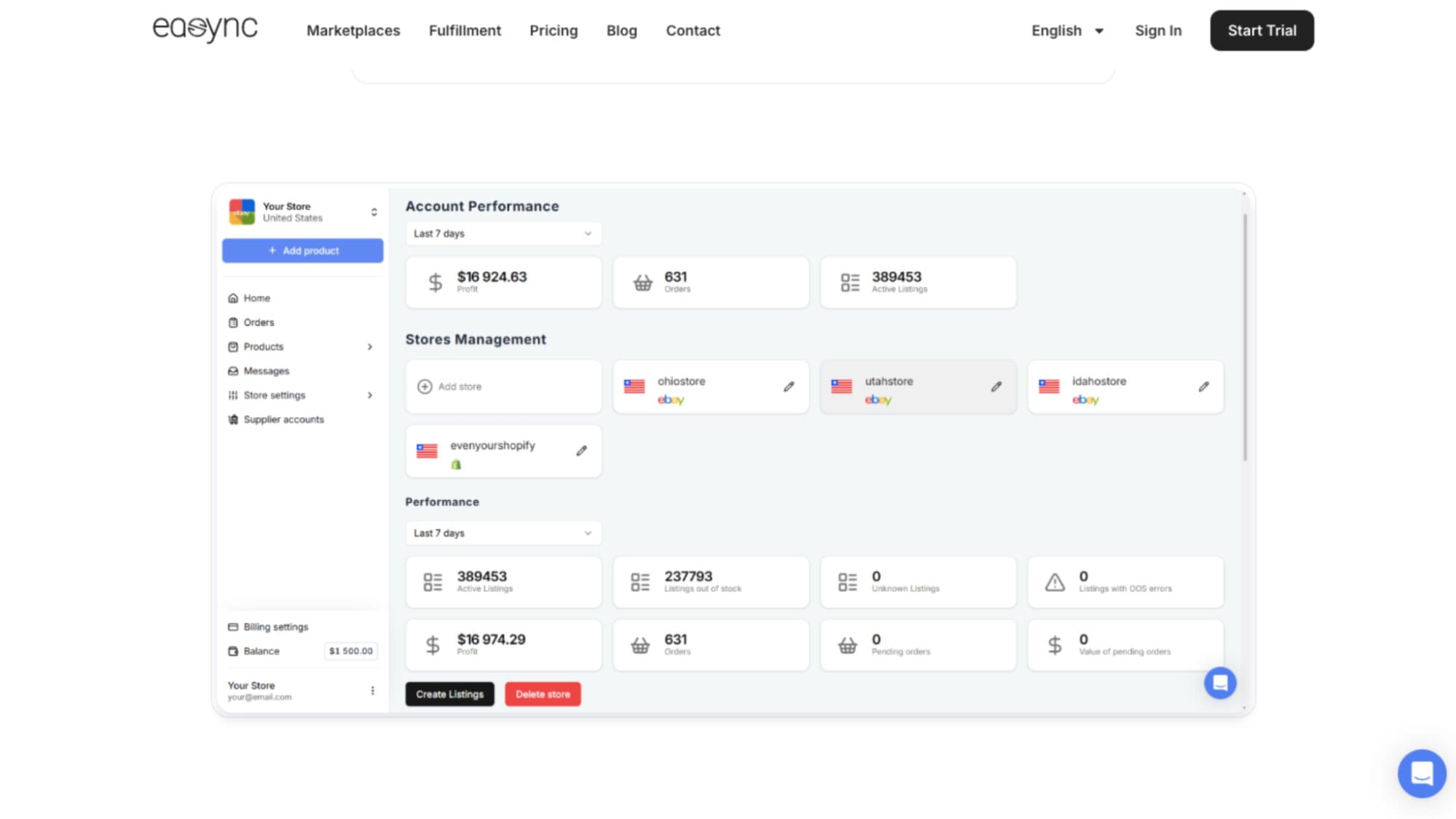
Here are the things it takes off your desk:
- 24/7 dynamic repricing. You set rules once across thousands of listings. The repricing engine will hold whatever margin floor you decided on.
- Automated inventory monitoring. When supplier stock runs dry, Easync takes down your listing before somebody buys an order you can’t fill.
- 1-click bulk ASIN and product importing. A catalog that took a weekend now fills out over an afternoon.
- Cloud-based auto-ordering. A sale lands, and the order gets placed with your source market in the background. No copy-paste.
- Multi-channel order sync. Tracking synchronization runs both ways. Tracking numbers are pulled from the supplier and pushed back to the right marketplace on the right account without you doing anything.
This is what zero physical inventory dropshipping actually looks like in practice. No shelves, no boxes, no dead stock write-offs in January.
Think about why this makes a difference. Manual processing can take anywhere between 8 and 15 minutes per order. Do that for over 50 orders, and you’re already more than 7 hours of your time gone. And in the best-case scenario, 300 orders a month becomes a full-time job that you didn’t really sign up for.
You can test the engine without committing anything. Easync runs a Start Trial tier with no credit card needed.
Frequently Asked Questions
Is reselling items on Amazon legal in 2026?
Yes. The First Sale Doctrine means that once you legally buy a product, you can resell it. Legal and allowed are two different things, though, so you still have to respect brand gating and IP restrictions on the platform itself.
How much money do you need to start reselling on eBay or Amazon?
Manual retail arbitrage or FBA realistically needs $500 to $2,000 for upfront inventory. Automated dropshipping needs very little inventory capital, because you only buy the item after the customer has paid for it.
Can you automate a reselling business completely?
Close to it. Tools like Easync.io handle inventory monitoring, price adjustments, auto-ordering, and tracking sync. Sourcing decisions and supplier relationships still need you.
The Short Version
Reselling rewards the person who removes their own labor from the process fastest.
Start at level one if you have to. Walk the clearance aisles, learn what sells, get the feel for margin. Just don’t stay there, because the ceiling in that model is your own body.
Move to online arbitrage software when the driving stops making sense. Move to automated dropshipping when the packing does.
The sellers doing real numbers in 2026 aren’t working harder than you. They handed the repetitive parts to software and kept the parts that need a decision.

Kaylin Bailey is an experienced e-commerce strategist and content writer specializing in dropshipping, automation, and online retail growth. At Easync, she focuses on helping entrepreneurs streamline their stores with data-driven insights, practical guides, and software solutions that optimize product sourcing, pricing, and order fulfillment. With years of hands-on experience in digital commerce and platform integrations, Kaylin’s articles offer actionable advice grounded in real-world testing, helping sellers stay competitive in a rapidly evolving marketplace.

Eugene Stepnov – Author
Eugene is a senior e-commerce strategist with over 9 years of experience in dropshipping, online arbitrage, and marketplace compliance. At Easync. Eugene has experience in developing multi-account management technologies, such as GoLogin and secure browser solutions, providing Easync users with a head start in regulatory compliance and platform changes.