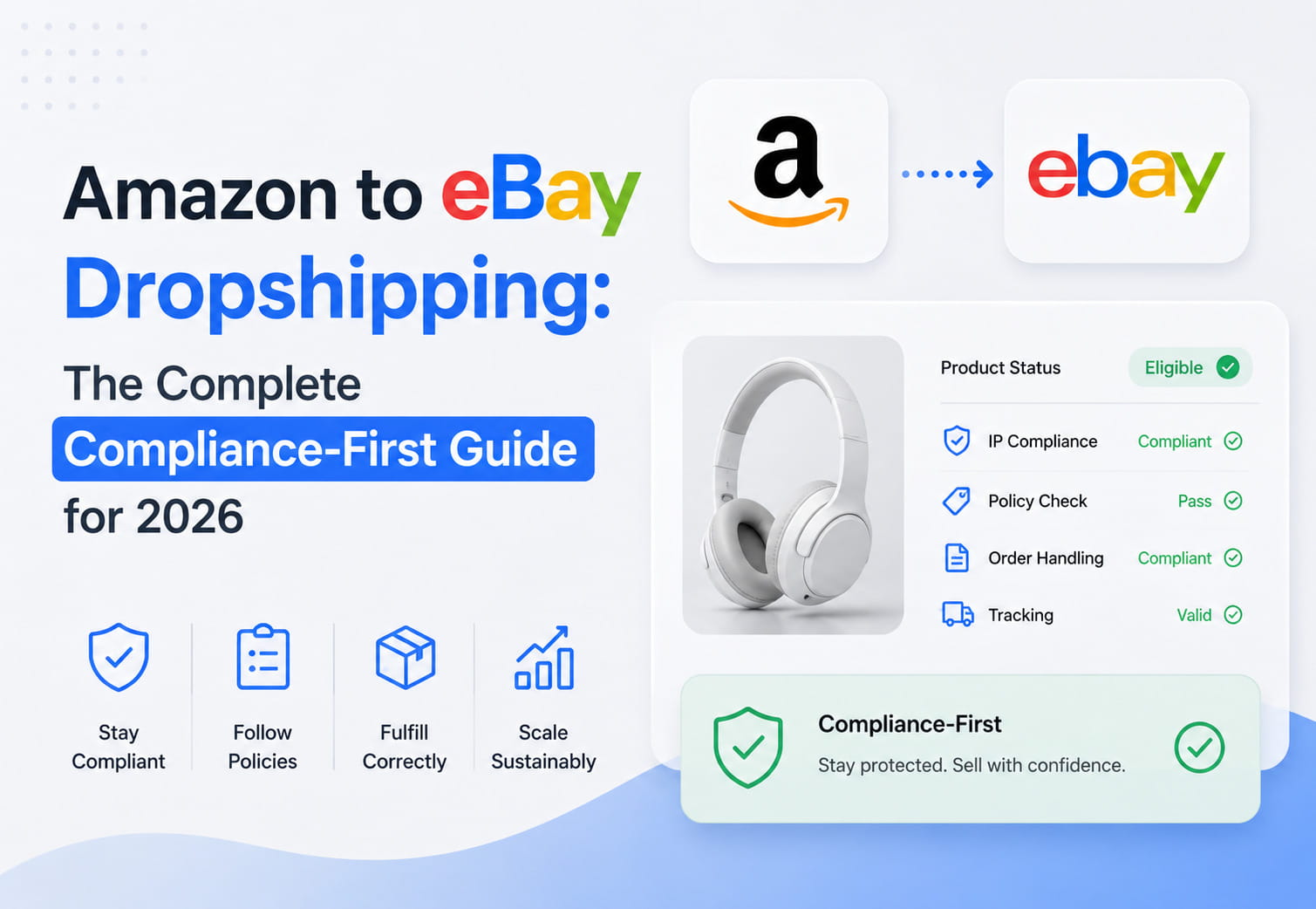
The concept behind amazon to ebay dropshipping is deceptively simple: source a product cheaper on Amazon, list it on eBay at a markup, and keep the difference, without ever touching inventory. In practice, the model has evolved from a hobby side-hustle into a policy-sensitive, data-intensive operation that demands precision automation to remain profitable and compliant in 2026. This guide covers everything from eBay seller policies and eBay Cassini algorithm mechanics to the technical trap of Amazon TBA tracking numbers and explains exactly how professional-grade amazon to ebay dropshipping software eliminates every major bottleneck at scale.
What is Amazon to eBay Dropshipping?
Amazon to eBay dropshipping is an online retail arbitrage model where a seller lists Amazon products on eBay at a higher price, then purchases the item from Amazon only after a confirmed buyer pays, using the buyer’s address as the delivery destination, without ever holding or shipping stock.
The profit formula is straightforward. If a kitchen gadget costs $28 on Amazon and sells for $40 on eBay, your gross margin is $12. After eBay’s final value fee (approximately 13.25% for most categories in 2026) and Managed Payments processing (~2.9% + $0.30 per transaction), a competitive seller nets between 5% and 12% per sale. Multiplied across thousands of active listings, those margins compound into a serious revenue stream.
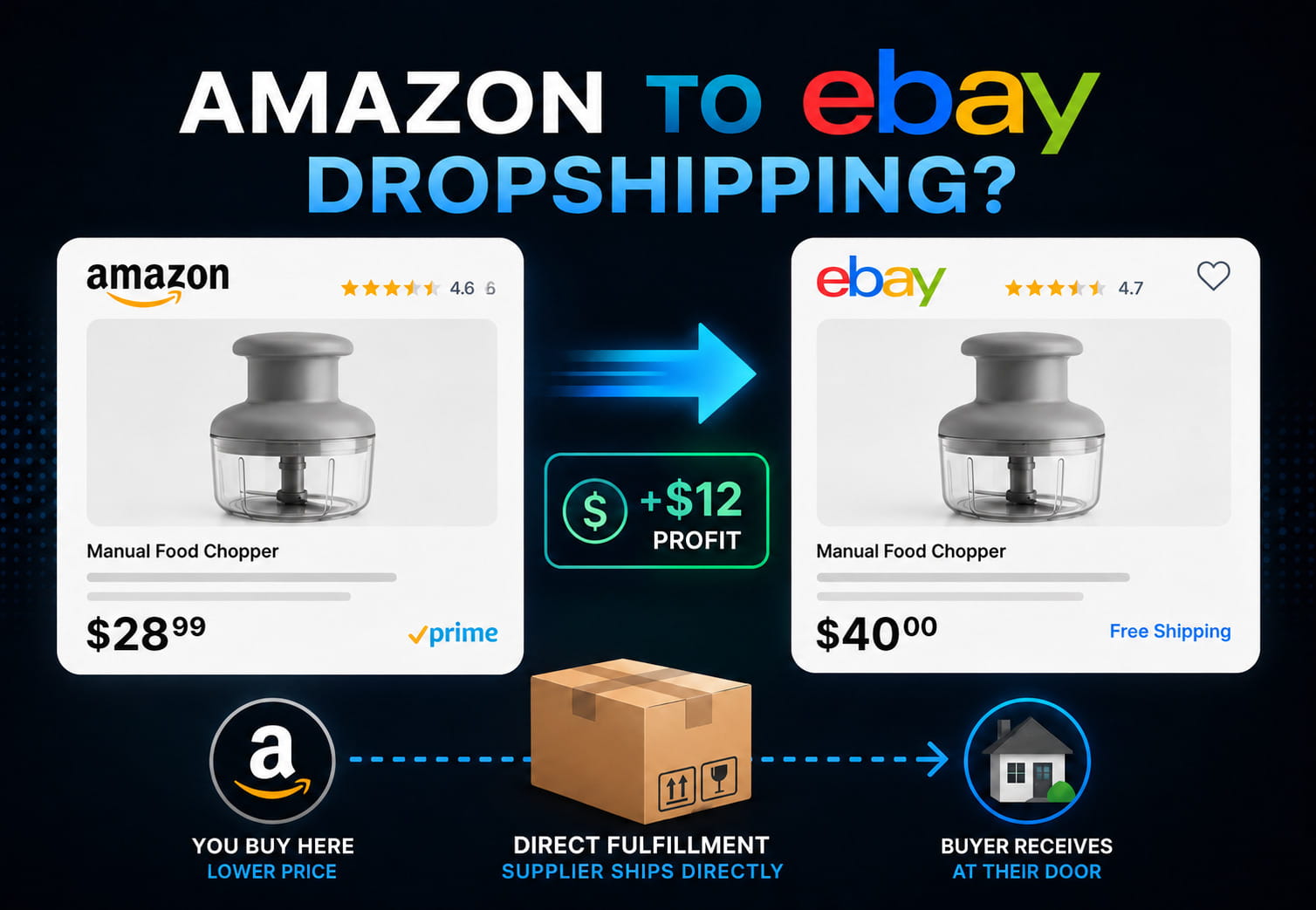
The operational cycle works like this:
- A buyer completes a purchase on your eBay listing.
- You (or your automation software) immediately places the corresponding order on Amazon using the buyer’s shipping address.
- Amazon ships the product directly to your eBay customer.
- You upload a valid tracking number to eBay to close the transaction cleanly.
The critical insight for 2026: steps 2, 3, and 4 are no longer manual tasks for competitive operators they are fully automated, compliance-monitored machine functions. Every minute of manual delay in this chain is a liability.
Is Dropshipping from Amazon to eBay Allowed in 2026?
eBay explicitly prohibits “retail dropshipping” in its Seller Policies defined as purchasing from a retail marketplace and having that retailer ship directly to your buyer, but sellers who operate within the Seller of Record framework and deploy compliant automation software materially reduce their platform risk and can run sustainable, scalable operations.
This is the most important policy nuance every seller must internalize. eBay’s rule is not designed to kill the business model it is designed to eliminate low-effort, non-compliant execution that degrades the buyer experience on the platform. Understanding where the line sits is the difference between a store that scales and one that gets restricted.
Understanding eBay’s Seller of Record Policy
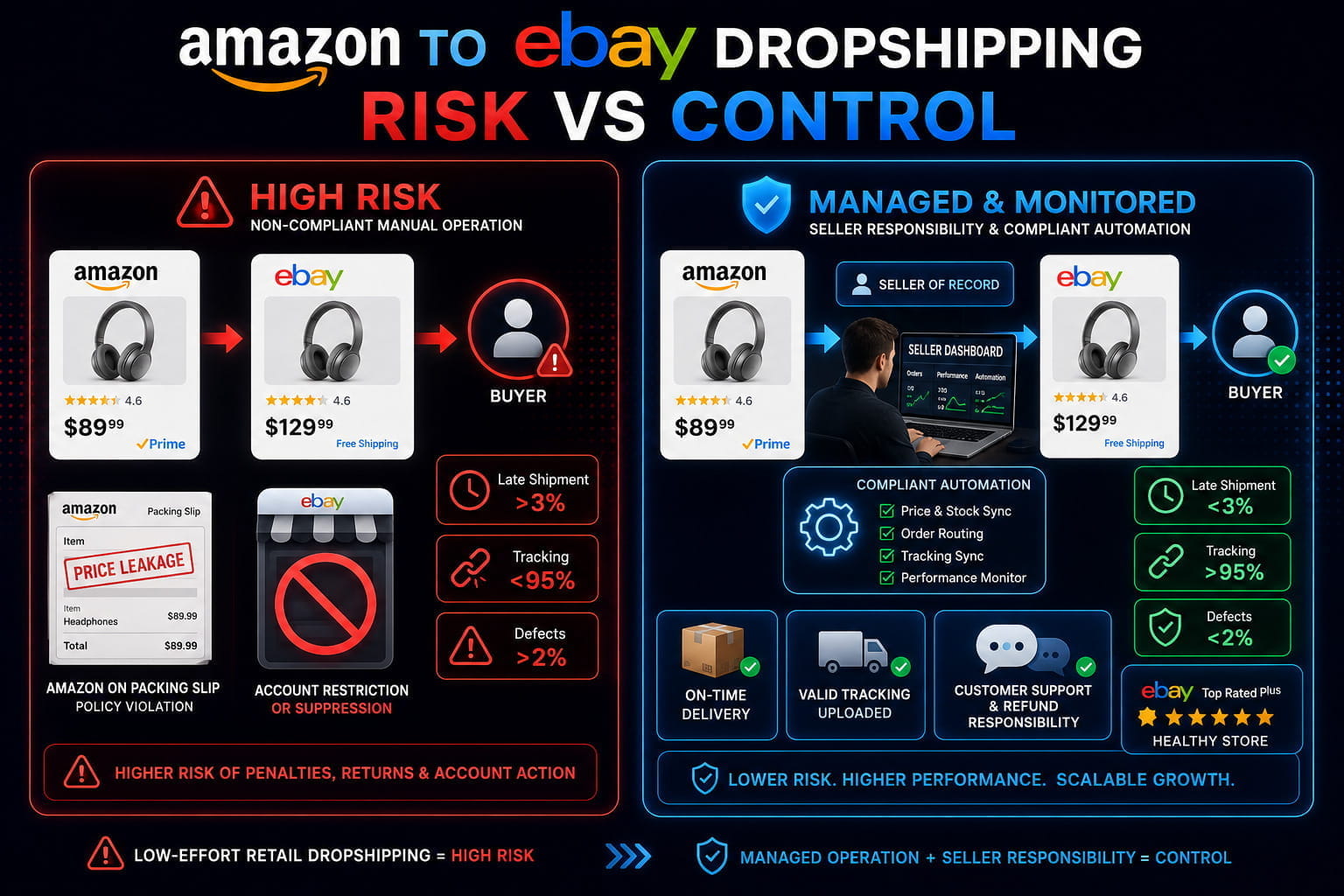
eBay’s Seller of Record policy requires that you not Amazon are the legally named seller responsible for the buyer’s complete end-to-end experience, including delivery deadlines, accurate tracking, correct item representation, and all post-sale dispute resolution.
When you publish a listing on eBay, you contractually represent yourself as that product’s seller. This imposes three binding obligations:
- Delivery timelines are your liability. If Amazon’s logistics network runs late, eBay’s performance algorithm records a defect against your account not against Amazon. Late Shipment Rates above 3% trigger listing suppression and can lead to account-level restrictions.
- Packaging must contain no Amazon invoices, packing slips, or Prime branding that reveals the source retailer to the buyer. An Amazon-branded box alone is not automatically a violation, but a packing slip listing the Amazon purchase price is grounds for an “item not as described” dispute and can flag your store for policy review.
- Tracking must be eBay-verifiable. This is where Amazon’s proprietary TBA tracking numbers create a serious compliance failure, a problem covered in precise technical detail in a dedicated section below.
Sellers who operate with full transparency using automation to manage stock levels, hourly repricing, and fulfillment consistently maintain the Top Rated Seller metrics that the eBay Cassini algorithm uses to award organic search visibility. Sellers who ignore the policies face progressive listing suppression, then account restriction, then permanent suspension.
What eBay’s Retail Dropshipping Policy Means in Practice
The practical conclusion is that amazon to ebay dropshipping is fully viable in 2026 when executed as a managed, automated business where the seller owns the customer experience end-to-end and it is not viable as a manual, passive copy-paste operation.
eBay’s enforcement patterns in 2025–2026 target specific measurable failure signals: Late Shipment Rate above 3%, Tracking Uploaded On Time below 95%, and Transaction Defect Rate above 2%. Professional amazon to ebay dropshipping software addresses all three metrics simultaneously and continuously which is the legitimate, defensible path to a compliant store.
How to Start Amazon to eBay Dropshipping: A Step-by-Step Guide
The fastest path to a profitable amazon to ebay dropshipping operation involves five structured steps: product research, profitability validation, eBay listing creation with Cassini optimization, automation configuration, and ongoing performance monitoring.

Follow this sequence precisely to build a store that is both profitable and policy-compliant from day one:
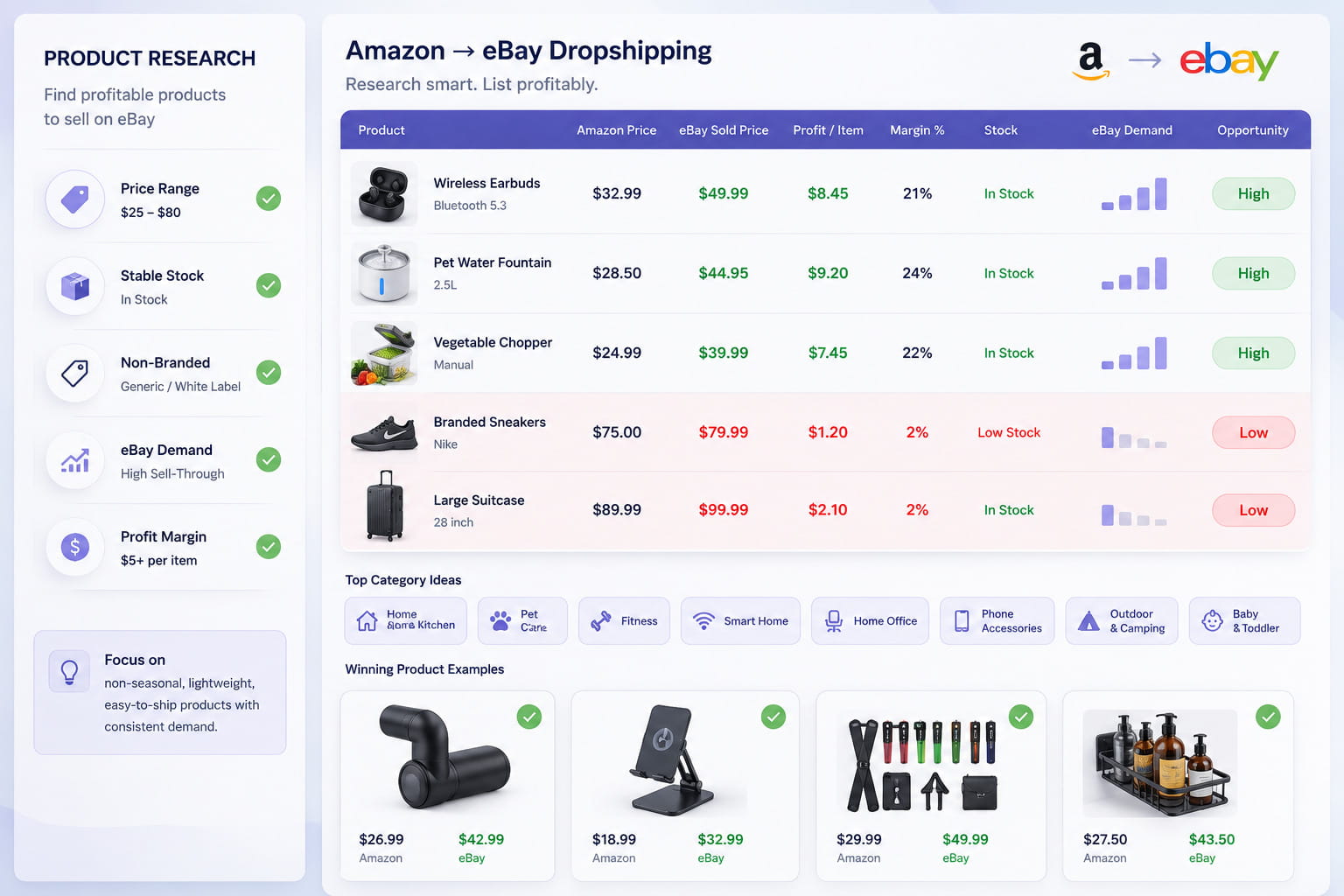
Step 1 — Product Research. Use Easync Finder to scan Amazon subcategories for products with strong eBay sell-through velocity. Filter for non-branded, non-VeRO items with at least 15–20 eBay completed sales in the past 30 days and a price delta of $5 or more between the Amazon buy price and the median eBay sold price. Avoid any item covered by eBay’s VeRO (Verified Rights Owner) program — Nike, Apple, LEGO, and thousands of similar brands will have listings automatically removed.
Step 2 — Profitability Validation. Run every candidate through an eBay fee calculator before listing a single product. Target a minimum net margin of 8% to absorb Amazon price fluctuations; listings below 5% net margin are statistically likely to generate losses within 30 days as Amazon’s algorithm reprices the source product.
Step 3 — eBay Listing Creation with Cassini Optimization. Import the product using your amazon to ebay dropshipping software. Lead the listing title with the highest-volume keyword for that product category, followed by key item attributes (brand-free model descriptors, colour, size, compatibility). Fill every available Item Specifics field the eBay Cassini algorithm uses these structured data points to match listings to buyer search queries. Incomplete listings receive materially lower organic placement.
Step 4 — Automation Configuration. Connect your eBay store to software that monitors Amazon pricing and stock on an hourly cycle. Configure repricing rules so your eBay price adjusts automatically when the Amazon source price moves protecting your margin on every transaction without manual intervention.
Step 5 — Performance Monitoring. Review your Seller Dashboard daily, particularly in the first 90 days. Maintain Late Shipment Rate below 3%, Tracking Uploaded On Time above 95%, and Transaction Defect Rate below 2%. These are the three primary levers the Cassini algorithm uses to determine whether your listings rank or are suppressed.
How to Choose the Best Products to Dropship from Amazon to eBay
The most consistently profitable products for amazon to ebay dropshipping in 2026 are non-branded, non-seasonal items priced between $25 and $80 on Amazon, with stable stock availability, documented eBay sell-through velocity, and a margin gap of at least $5 between the Amazon cost and the median eBay selling price.
Steer clear of fragile, oversized, or hazardous materials (hazmat-classified) products these generate disproportionate return rates, carrier complications, and eBay dispute volumes that erode both profitability and seller metrics. Similarly, avoid items where a single brand dominates the entire eBay category; those markets are defended by VeRO and by established sellers with thousands of positive feedbacks.
Top Product Categories for Amazon to eBay Arbitrage in 2026
The highest-margin categories in 2026 share a common characteristic: buyer demand on eBay materially exceeds Amazon’s own marketplace penetration, creating natural price arbitrage opportunities that persist even as Amazon’s algorithm optimizes its own pricing.
Focus your product research on these proven verticals: Home & Kitchen tools and gadgets, Pet care accessories and feeders, Fitness & Wellness equipment, Smart home peripherals and sensors, Ergonomic home-office accessories, Phone and tablet accessories, Outdoor and camping gear, and Baby & Toddler safety equipment. Within each category, prioritize generic or white-label products where no single brand dominates eBay search, these are the listings where a keyword-optimized title, fully completed Item Specifics, and competitive price can realistically claim top placement in Cassini results.
The Technical Bottleneck: Handling Amazon TBA Tracking Numbers
Amazon’s proprietary TBA (Tracking By Amazon) tracking codes are not recognized by eBay’s carrier validation system meaning eBay automatically treats TBA-tracked orders as untracked shipments, triggering “Late Delivery” defects and damaging seller performance metrics even when the package physically arrives on time.
This is the single most underestimated technical failure point in amazon to ebay dropshipping, and it is the primary operational reason why manual sellers progressively lose Top Rated Seller status while automated sellers using compliant software maintain it. Understanding the mechanics is non-negotiable.
Why Amazon TBA Numbers Break eBay’s Tracking System
eBay’s platform validates tracking numbers against a curated whitelist of recognized carrier codes; Amazon Logistics the internal fulfillment network that generates TBA numbers is not on that whitelist, so any order fulfilled via Amazon’s own last-mile delivery is invisible to eBay’s tracking verification engine.
When eBay’s system cannot confirm delivery through a recognized carrier, it defaults to treating the shipment as unverified. The platform records this as a tracking defect against the seller’s account regardless of whether the buyer received the item the following day. An accumulation of these defects reduces your Detailed Seller Ratings, removes your eligibility for Top Rated Seller discounts (which provide a 10% Final Value Fee reduction), and triggers Cassini’s listing suppression mechanism. At sufficient defect volumes, eBay issues formal warnings and can restrict or permanently close the store.
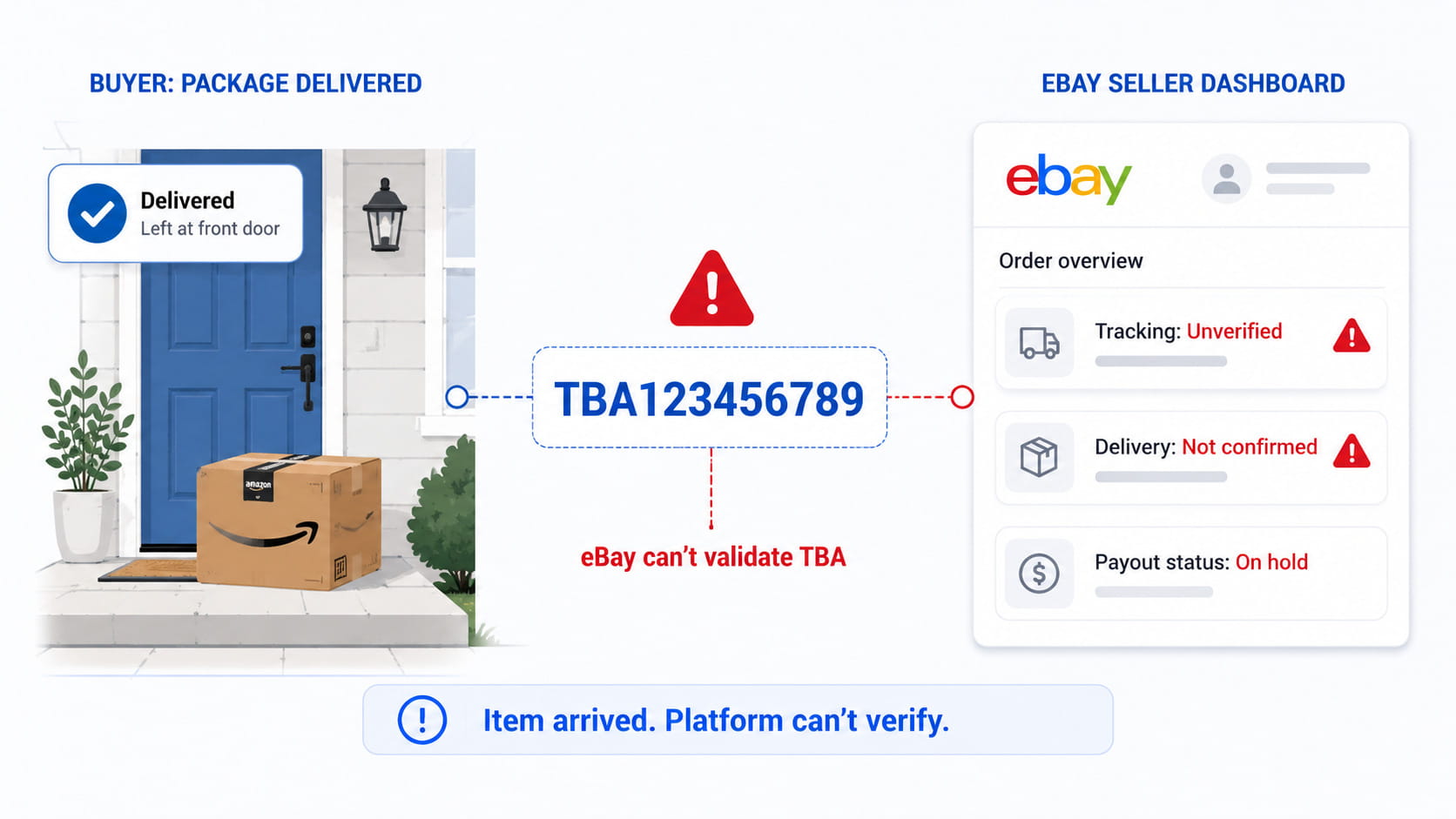
Amazon fulfills a significant and growing proportion of its US and UK orders through its internal TBA logistics network, particularly for Prime-eligible items in major metro areas. This is not a marginal edge case it is a mainstream fulfillment channel that amazon to ebay dropshipping sellers encounter daily.
How Automation Software Resolves the TBA Problem
Professional amazon to ebay dropshipping software resolves the TBA tracking problem by automatically detecting TBA carrier codes the moment Amazon generates them, converting them into valid, eBay-recognized third-party carrier numbers, such as BlueCare Express codes and uploading the compliant tracking data to eBay before the platform’s upload deadline.
This conversion pipeline runs entirely in the background. The seller takes no action. The moment Amazon’s fulfillment system generates a TBA number and attaches it to a dispatched order, Easync intercepts the code, maps it to a compliant carrier format, and submits the valid tracking entry to the corresponding eBay order. The result is that your Tracking Uploaded On Time rate remains at 98–100%, your defect rate stays clean, and your listings continue to receive the ranking benefit that the Cassini algorithm assigns to consistently compliant shippers. This single automated function is worth more to long-term store health than almost any other software feature in the stack.
Why Easync is the Best Amazon to eBay Dropshipping Software
Easync is purpose-engineered for the compliance and automation demands of professional amazon to ebay dropshipping in 2026, delivering real-time price monitoring, intelligent bulk listing with Cassini optimization, fully automated order fulfillment, and automated TBA tracking resolution in a single integrated platform.
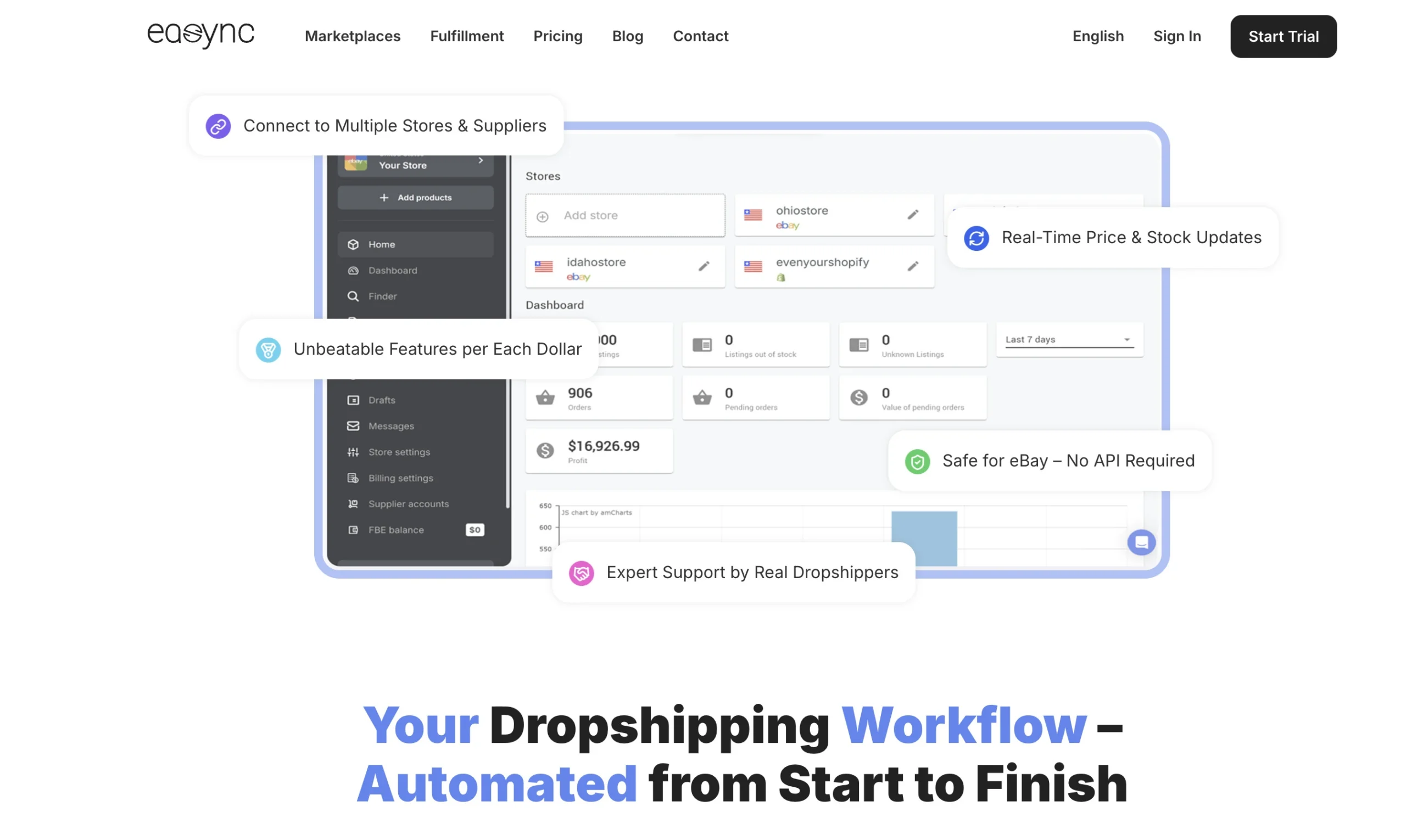
For sellers managing hundreds or tens of thousands of listings, the difference between a profitable, growing store and a suspended one comes down to the precision of the backend infrastructure operating beneath every transaction. Here is what Easync’s core feature architecture delivers:
- 24/7 Automated Hourly Price & Stock Monitoring. Easync checks every Amazon source product’s price and stock status on an hourly cycle not daily, not every four hours. When Amazon’s price increases above your profitability floor, Easync immediately raises your eBay listing price or ends the listing entirely to prevent a below-cost sale. When Amazon’s price drops, Easync can reprice your eBay listing downward to maintain competitive ranking. This real-time synchronization is the primary defense against the margin leakage that destroys manual sellers during Amazon price fluctuations, lightning deals, and supply shocks around peak trading periods.
- One-Click Bulk Product Importing with eBay Cassini Optimization. Easync’s importer does not simply clone Amazon titles into eBay listings. It processes each product’s data to generate keyword-structured eBay titles, populates all available Item Specifics fields with correctly formatted attribute data, and applies listing templates that meet eBay’s 2026 content quality standards. A fully populated, keyword-optimized listing ranks higher in Cassini results, converts at a higher rate, and generates fewer “item not as described” disputes all of which feed positively back into your seller metrics.
- True Background Auto-Ordering. When a buyer completes a purchase on your eBay store, Easync automatically places the corresponding order on Amazon within minutes using the buyer’s exact shipping address, marking the order as a gift to suppress Amazon invoices and pricing information, and selecting the fastest available free shipping tier. The entire transaction executes without any seller input. This eliminates the manual data-entry bottleneck that causes order processing delays, human addressing errors, and the late-shipment defects that accumulate under high listing volume.
- Automatic TBA Tracking Conversion. As detailed in the section above, Easync intercepts Amazon TBA tracking codes and converts them to eBay-compliant carrier formats before submitting them to eBay’s order management system protecting your on-time tracking rate and Top Rated Seller status automatically and continuously.
- Automated Three-Stage Customer Messaging & Feedback Sequencing. Easync sends a structured three-message sequence to every buyer: a purchase acknowledgement, a shipping update containing the valid tracking number, and a post-delivery feedback request. Consistent positive feedback velocity is a direct input into the eBay Cassini ranking algorithm stores with higher feedback scores receive greater organic search exposure, which compounds listing visibility over time.
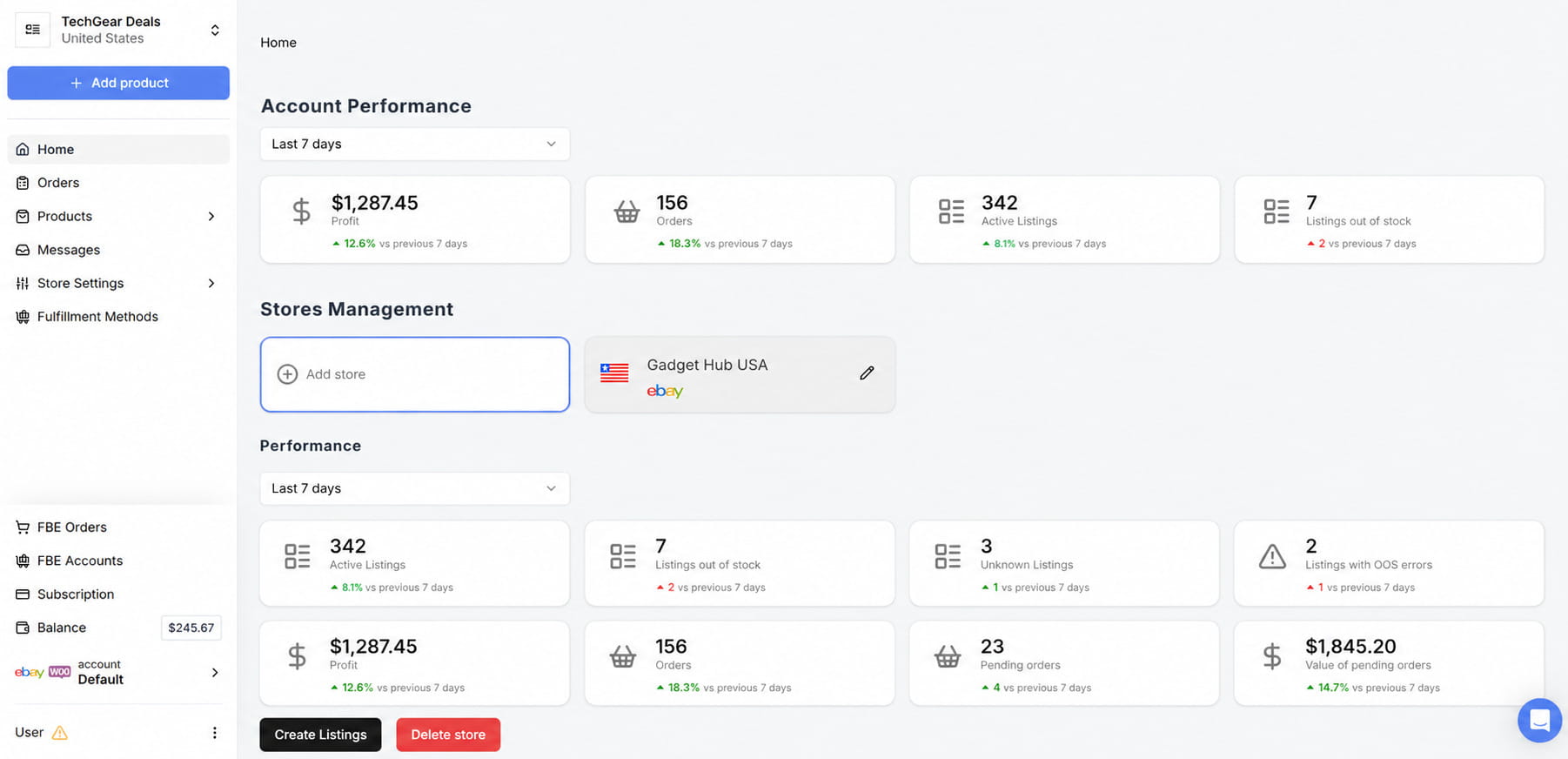
Over 170,000 eBay stores are currently running on Easync’s infrastructure. If you’re ready to eliminate manual bottlenecks and operate a fully compliant, automated amazon to ebay dropshipping store, Start Trial and connect your eBay account in under 10 minutes.
Amazon to eBay Dropshipping: Frequently Asked Questions
How does Easync handle Amazon TBA tracking numbers on eBay?
Easync automatically detects when Amazon assigns a TBA tracking code to a dispatched order and converts it into a BlueCare Express or equivalent eBay-recognized carrier number, then uploads the compliant tracking entry to the corresponding eBay order before the platform’s upload deadline fully automatically, with no seller action required.
The conversion happens at the API level the moment Amazon’s fulfillment system marks an order as dispatched. The converted tracking number is submitted to eBay within the required window, preventing any “tracking not uploaded on time” defect from registering against your seller account. Because the eBay Cassini algorithm factors tracking compliance rates directly into listing visibility scores, maintaining near-100% valid tracking upload rates is one of the highest-leverage actions a seller can take to protect and improve organic search placement and Easync handles it entirely in the background.
How often does Easync check Amazon product prices?
Easync monitors Amazon product prices and stock availability on an hourly cycle across all connected Amazon marketplaces, including amazon.com, amazon.co.uk, amazon.de, amazon.fr, amazon.ca, and additional regional storefronts.
Hourly monitoring is the competitive benchmark in 2026. Amazon’s pricing algorithm reprices millions of products multiple times per day particularly for high-demand items, items in Flash Deal windows, and products experiencing supply chain variability. A software tool checking prices once or twice per day exposes sellers to multi-hour windows where they are either selling at a loss (if Amazon’s cost increased) or missing revenue (if Amazon’s cost dropped and competitors repriced downward first). Easync’s hourly cycle keeps every eBay listing price aligned with the current Amazon source cost in near real time, eliminating both scenarios.
Can I dropship from Amazon Prime to eBay?
Using a personal Amazon Prime account to fulfill commercial eBay orders violates Amazon’s Prime Terms of Service which explicitly prohibit using Prime membership benefits for resale or third-party fulfillment and simultaneously creates a Seller of Record compliance risk on eBay when Prime-branded packaging or documentation reaches the buyer.
This is a two-sided compliance exposure that new sellers frequently underestimate. On the Amazon side, systematic high-volume use of a personal Prime account for eBay fulfillment triggers Amazon’s commercial fraud detection systems. The outcome is Prime account suspension, a potential permanent restriction on the associated email and payment method, and possible recovery of Prime benefits credited to fulfilled orders. On the eBay side, Prime fulfillment orders frequently arrive in Amazon-branded packaging, sometimes with packing slips referencing Amazon or Prime, a clear signal to buyers and eBay’s trust-and-safety teams that the Seller of Record policy is being violated, which can generate “item not as described” claims at scale.
The compliant and sustainable path is to use standard Amazon checkout flows through a non-Prime commercial account, or to engage a fulfillment service operating through verified business channels. Easync’s auto-ordering system is configured to execute all purchase flows through standard Amazon checkout not Prime accounts ensuring your fulfillment activity remains within Amazon’s acceptable use parameters while fully satisfying eBay’s Seller of Record requirements.
Is eBay dropshipping profitable in 2026?
Yes, amazon to ebay dropshipping remains a profitable business model in 2026 for sellers who operate at catalog scale with automation software, targeting 5–12% net margins across inventories of 1,000 to 100,000+ active listings.
Profitability is a function of volume, efficiency, and margin discipline not individual listing profit. A store maintaining 10,000 active listings with an average sell-through of 2 transactions per listing per month at $6 net profit each generates $120,000 in monthly gross profit. The automation infrastructure to run that store at Easync’s pricing tier costs a small fraction of that revenue. The business model works at scale, but only with software managing repricing, ordering, tracking, and customer communications in real time. Manual operation above a few hundred listings is economically unsustainable.
How do I calculate Amazon to eBay arbitrage profit?
The accurate profitability formula for amazon to ebay dropshipping is: Net Profit = eBay Sale Price − Amazon Purchase Price − eBay Final Value Fee (13.25% for most standard categories).
Managed Payments Processing Fee (~2.9% + $0.30) − Any Shipping Differential between the eBay shipping promise and Amazon’s delivery cost.
Sellers should validate every candidate product with this formula before listing and target a minimum net margin of 8% as a buffer against Amazon price increases. Use the Easync eBay Fee Calculator to run accurate fee scenarios across multiple eBay marketplaces including the US, UK, Australia, Canada, and Germany. Listings with less than 5% calculated net margin carry a high statistical probability of generating losses within 30 days as Amazon’s dynamic pricing algorithm adjusts source costs.

Noah Edis is a freelance writer and systems engineer with a wealth of experience in modern hardware and software. When he’s not working on his latest project, you can find him playing competitive dodgeball or pursuing his personal interest in programming. At Easync, Noah helps thousands of sellers optimize their eBay and Amazon businesses by providing automation tools and practical guidance on account health, pricing, and inventory management.

Reviewed by: Louis Profits
Louis is a marketplace dropshipping practitioner and educator specializing in eBay and Facebook Marketplace. He turns complex ops into simple, repeatable playbooks—covering winning-product frameworks, listing hygiene, pricing levers, and post-sale workflows.
At Easync, Louis contributes field-tested guides you can ship the same day: eBay launch checklists, FBM research sprints, and automation blueprints that tie directly into Easync (stock/price sync, auto-ordering, tracking updates, and KPI safeguards). Expect concise steps, screenshots, and templates geared to help you scale responsibly and protect your metrics.