
- articles
- Shopify Dropshipping
20 best US/UK dropshipping suppliers for Shopify in 2026
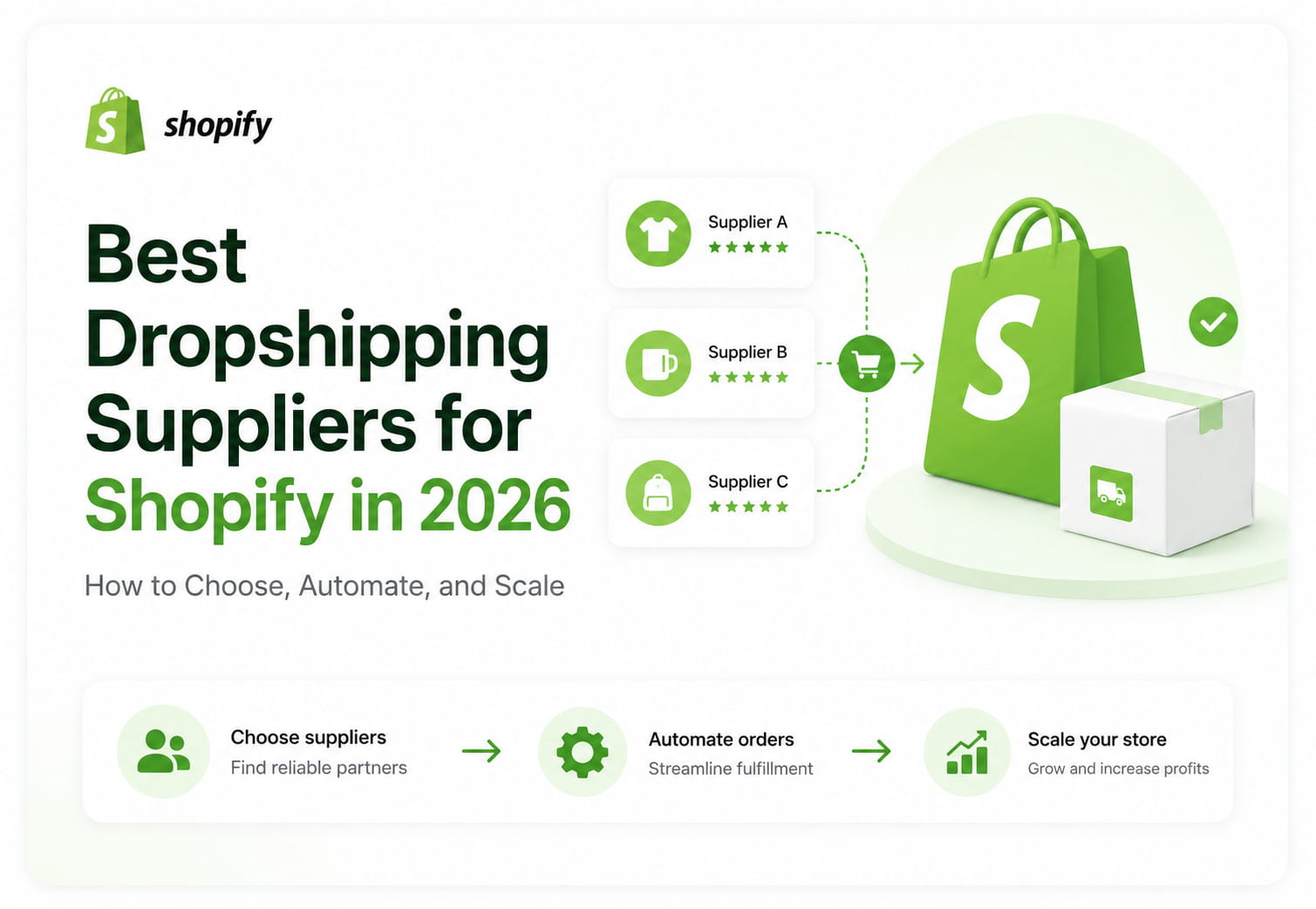
Quick answer: For US stores, Spocket (2–4 day US/EU delivery) and CJ Dropshipping (free, huge catalog, US warehouse) are the safest starting points, with Zendrop if you want branded packaging. For UK stores, Avasam and AppScenic keep fulfillment domestic and skip post-Brexit customs. For print-on-demand, use Printful for brand control, Printify for base cost, or Prodigi for UK-printed art and homeware.
Most “best supplier” lists read like they were copied off each other, and honestly a lot of them were. The truth is messier: the best dropshipping suppliers for Shopify aren’t a fixed top ten you bookmark once. They’re whoever ships fastest to your customers, carries your category, and doesn’t quietly wreck your margins when their costs move. A premium US apparel supplier that’s perfect for one store is dead weight for another selling bulky home goods to UK buyers.
So instead of crowning one winner, this is how I’d actually go about it — what to measure, which of the twenty Shopify dropshipping suppliers below are worth your time right now, and how to run several of them without turning fulfillment into a second job.
Key takeaways
- The best Shopify suppliers in 2026 share four traits: genuinely fast shipping (2–5 days domestically), stock levels you can trust, native Shopify automation, and pricing with no surprise fees.
- If you sell to US or UK buyers, a domestic warehouse is the single biggest lever you have on delivery speed — and delivery speed is what kills or saves your repeat-purchase rate.
- Almost nobody scales on one supplier. A realistic setup mixes a US source, a UK source, something from China for testing, and a print-on-demand partner.
- Prices moved this year. Printify’s monthly Premium plan went from $29 to $39 in February 2026, while annual billing held at $299 — the kind of shift that quietly changes your break-even point if you’re not watching.
- Once you’re juggling several feeds, automation stops being optional. Easync handles imports, repricing, stock sync, and order routing from one place so the admin doesn’t eat your week.
- There’s no single best supplier. For most US stores Spocket, CJ Dropshipping, and Zendrop cover the bases; for the UK, Avasam and AppScenic; for print-on-demand, Printful, Printify, or Prodigi.
What’s the best dropshipping supplier for Shopify?
There’s no single winner here, and that isn’t diplomatic hedging — “best” resolves differently depending on which constraint binds hardest for you. There are only three that usually matter.
If delivery speed is the constraint — you’re running paid traffic and need the parcel to land before the customer forgets they ordered — buy your way to a domestic warehouse. That’s Spocket, Zendrop, or Trendsi in the US, Avasam or AppScenic in the UK, and it costs roughly $39–$79 a month.
If budget is the constraint and you’re still validating products, don’t pay a subscription at all. CJ Dropshipping, Trendsi, and the print-on-demand platforms cost nothing until an order comes in. They’ll tell you whether a product sells before you commit money to faster fulfillment.
If category is the constraint, the general platforms stop mattering and the specialists take over: Trendsi or Modalyst for fashion, AppScenic for furniture and high-ticket, Prodigi for art prints and homeware, and a supplier that can produce compliance paperwork for anything electrical or cosmetic.
Most stores hit the speed constraint eventually. The expensive mistake is paying for speed during validation, before you know which products deserve it.
The 20 best Shopify dropshipping suppliers at a glance
| Supplier | Primary region | Key category | Shopify integration | Free plan? | Avg. domestic shipping |
|---|---|---|---|---|---|
| Spocket | US, EU | General, apparel, beauty | Native app | No — $1 trial | 2–4 days |
| Zendrop | US + China | General, custom branding | Native app | Yes | 2–5 days (US stock) |
| CJ Dropshipping | China + US/EU warehouses | General, gadgets, POD | Native app | Yes, fully free | 4–7 days (US warehouse) |
| Trendsi | US (Los Angeles) + Asia | Women’s fashion | Native app | Yes | 2–5 days |
| Doba | US | General merchandise | App + feeds | No — paid trial | 3–7 days |
| Wholesale2B | US | General merchandise | Native app | Browse only | 3–7 days |
| Modalyst | US, EU | Fashion, boutique, indie | Native app | Yes, limited | 3–8 days |
| Printful | US, EU, UK, global | POD apparel, home, merch | Native app | Yes — pay per item | 3–5 days after production |
| Printify | Global print network | POD apparel, drinkware, home | Native app | Yes — pay per item | 2–7 days |
| Shopify Collective | US, UK, Canada, Australia + expanding | Branded goods from Shopify stores | Native sales channel | Yes, fully free | Set by supplier |
| Avasam | UK (+ US) | General, gifts, home | Native app | Browse only | 4–5 days |
| Syncee | EU, UK, US, global | General, fashion, home | Native app | Yes, limited | 3–4 days |
| AppScenic | UK, EU, US, CA, AU | General, furniture, high-ticket | Native app | Browse only | 2–5 days |
| BigBuy | Spain, EU-wide | General, electronics, home | Paid connector | No | 3–6 days (EU) |
| Inkthreadable | UK | Eco POD apparel, homeware | Native app | Yes — pay per item | 1–5 days |
| Prodigi | UK + 10 countries | POD art prints, apparel, homeware | Native app | Yes — pay per item | 2–4 days after production |
| TheWholesaler.co.uk | UK | Clothing, gifts, home | Directory / CSV | Free to browse | Varies by supplier |
| eSources | UK | Clothing, home & garden, gifts | Directory only | Yes, basic tier | Varies by supplier |
| SaleHoo | UK, US, global | General merchandise, research | Directory + Dropship app | No | Varies by supplier |
| Hertwill | EU | Independent European brands | Native app | Yes, limited | 3–7 days |
Read that table for shape rather than for a winner. The pattern worth noticing: the free options cluster around China-sourced or print-on-demand stock, while everything with a genuine 2–5 day domestic promise charges a subscription. That trade-off is the real decision, and it’s why the sections below split by region rather than by rank.
What actually makes a supplier worth using
The market has gotten big enough — one projection puts Shopify-adjacent dropshipping at around US$401 billion in 2026 — that “they have cheap products” no longer clears the bar. Four things matter, roughly in this order.
Shipping speed comes first, because it touches everything downstream. A supplier with US, UK, or EU warehouses can land a package in 2–5 days; the same item shipped from China routinely takes 15–25. That gap matters more than it sounds. Statista data shows a large share of online shoppers now expect delivery within two to three days, and once you blow past that, cart abandonment climbs and repeat orders dry up. Tracked shipping is the baseline — if a supplier still pushes untracked economy post, walk away.
Then quality and returns handling, which is harder to see from a product page. Dispute rates tell the real story: vetted US and EU suppliers tend to run very low, while generic AliExpress sourcing sees noticeably more chargebacks and “not as described” complaints. Any supplier worth trusting will let you order samples before you commit, and you should — it’s the cheapest insurance in this business. Pay attention to who owns the return, too. Some platforms centralize it; on Spocket and Syncee, returns are handled by each individual supplier, which means your policy is only as consistent as the vendors you picked.
Automation is third, and it’s where beginners underestimate the cost of getting it wrong. A supplier with a proper native Shopify app — automated inventory sync, auto-ordering, tracking pushed back to the customer — saves hours every day. One that needs manual CSV wrangling quietly drains that time instead. Four of the twenty Shopify suppliers here are directories rather than platforms, and that distinction matters more than their price tag.
Last is reliability at scale: orders processed within 24–48 hours, catalogs that don’t randomly delist your bestseller, support that answers in under a day. Watch pricing stability as part of this. Printify raising its monthly plan by a third in February 2026 didn’t break anyone’s store, but sellers on month-to-month billing absorbed a 34% increase on a fixed cost they’d already modeled.
These four lenses — shipping, quality, automation, reliability — separate the best dropshipping suppliers for Shopify from the ones that merely look good in a directory, and they’re what every supplier below is measured against.
10 US Shopify dropshipping suppliers, reviewed
If you’re selling into the US, this is the shortlist for fast domestic fulfillment. It spans general merchandise, fashion, niche categories, and print-on-demand, and the entry costs run from nothing to three hundred dollars a month — so read the pricing lines as carefully as the descriptions.
1. Spocket — fast US and EU shipping, at a price
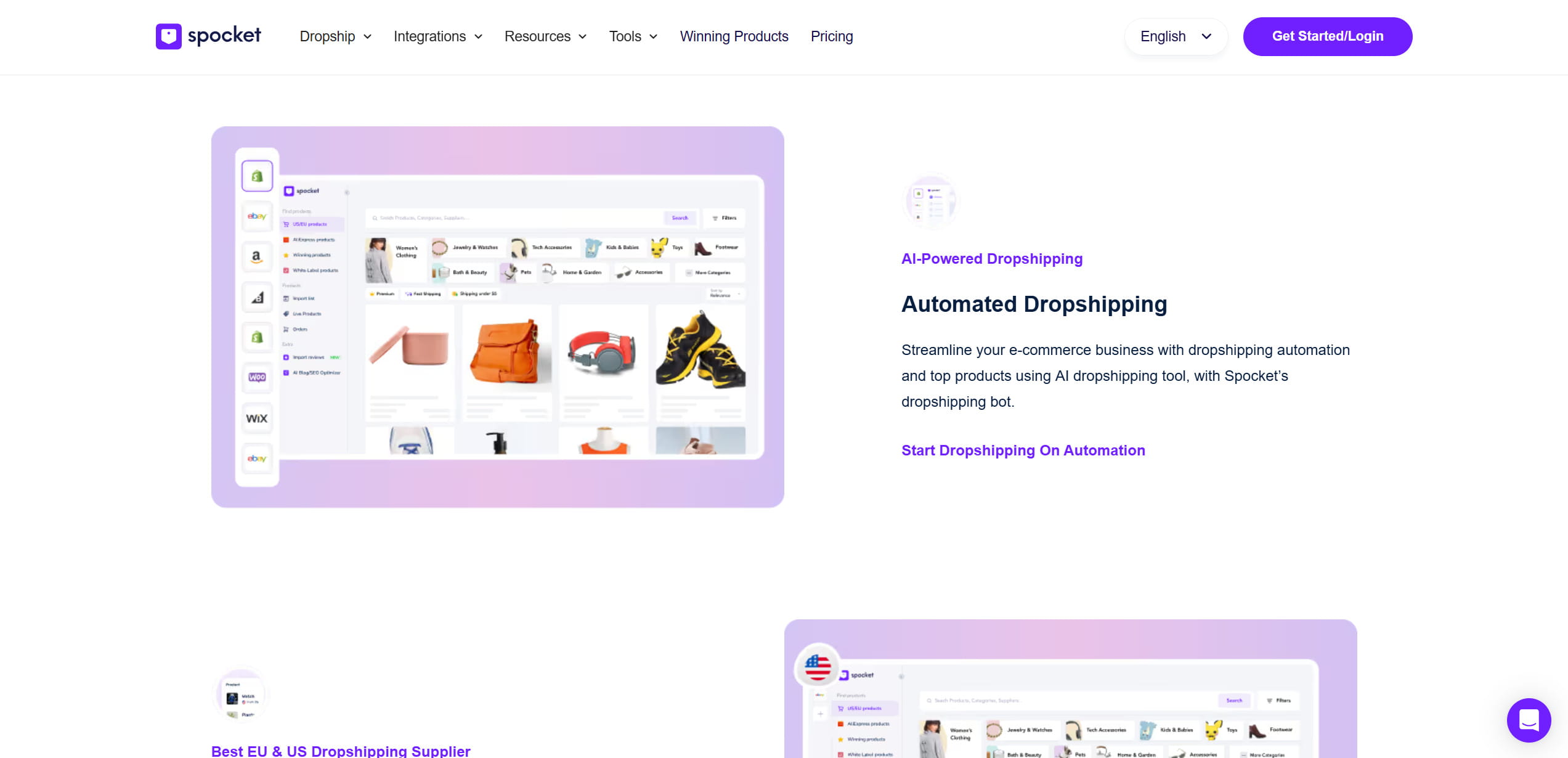
Spocket curates suppliers rather than aggregating them. Around 80% ship from US or EU warehouses, which is why 2–4 day delivery here is a realistic expectation rather than marketing copy. The catalog leans apparel, accessories, beauty, and home goods — far fewer SKUs than CJ or Wholesale2B, but vetted, with sample ordering built into the app so you can check quality before committing. Tiers are gated by how many products you can keep active rather than by features, branded invoicing is included even on the entry plan, and there are no per-order transaction fees on any tier.
Who it’s for: US and EU stores in fast-moving niches where two-to-four-day delivery is what closes the sale, run by owners willing to pay a premium for it. Not for bargain hunters competing on price, where the product cost alone will price you out.
Pros
- Genuine 2–4 day US and EU delivery across most of the catalog.
- Sample ordering built in, so you can verify a supplier before you list.
- No per-order transaction cut on any plan.
- Branded invoicing and 24/7 chat support included from the entry tier.
Cons
- Starter’s 25-product cap is restrictive for anything but a tightly curated store.
- Product costs run high, so margins are thinner than CJ or AliExpress.
- No custom packaging or private labelling at all.
- A minority of suppliers marked “US” quietly ship in 8–11 days.
The pricing quirk nobody points out: Pro billed annually works out to $24 a month, which is cheaper than Starter at $39.99 while giving you ten times the product allowance and access to premium products on top. Starter is the only tier with no annual option, which means the entry plan is the worst value on the page. If you’re reasonably confident you’ll stay past a couple of months, go straight to annual Pro and skip Starter entirely.
Pricing
Standard monthly rates below. The upper three tiers drop steeply on annual billing; Starter has no annual option.
- Starter: $39.99/month — 25 unique products, billed monthly only. A tight allowance suited to testing a narrow line rather than running a catalog.
- Pro: $59.99/month, or $24/month billed annually — 250 products plus 25 premium products and Winning Products access. Where most serious stores land.
- Empire: $99.99/month, or $57/month annually — 10,000 products, for a broad catalog with steady volume.
- Unicorn: $299.99/month, or $79/month annually — 25,000 products with bulk checkout, for high-volume operations.
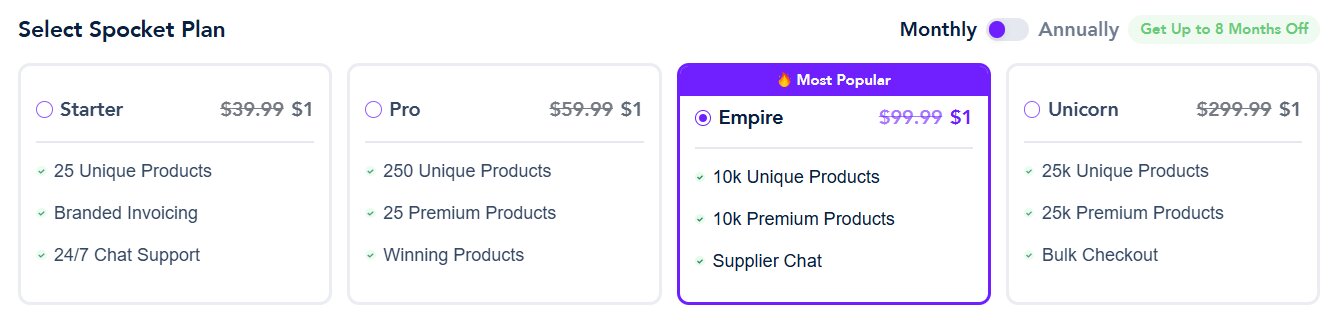
Every tier starts with a $1 trial rather than a free one, and checkout upsells Winning Products at $19 after a further 7-day trial.
Shipping and returns
- 2–4 business days domestically in the US and EU, with 1–2 days processing.
- Returns are handled by each supplier individually rather than centrally, so your return policy is only as consistent as the vendors you picked.
2. CJ Dropshipping — free, enormous, and awkward to use
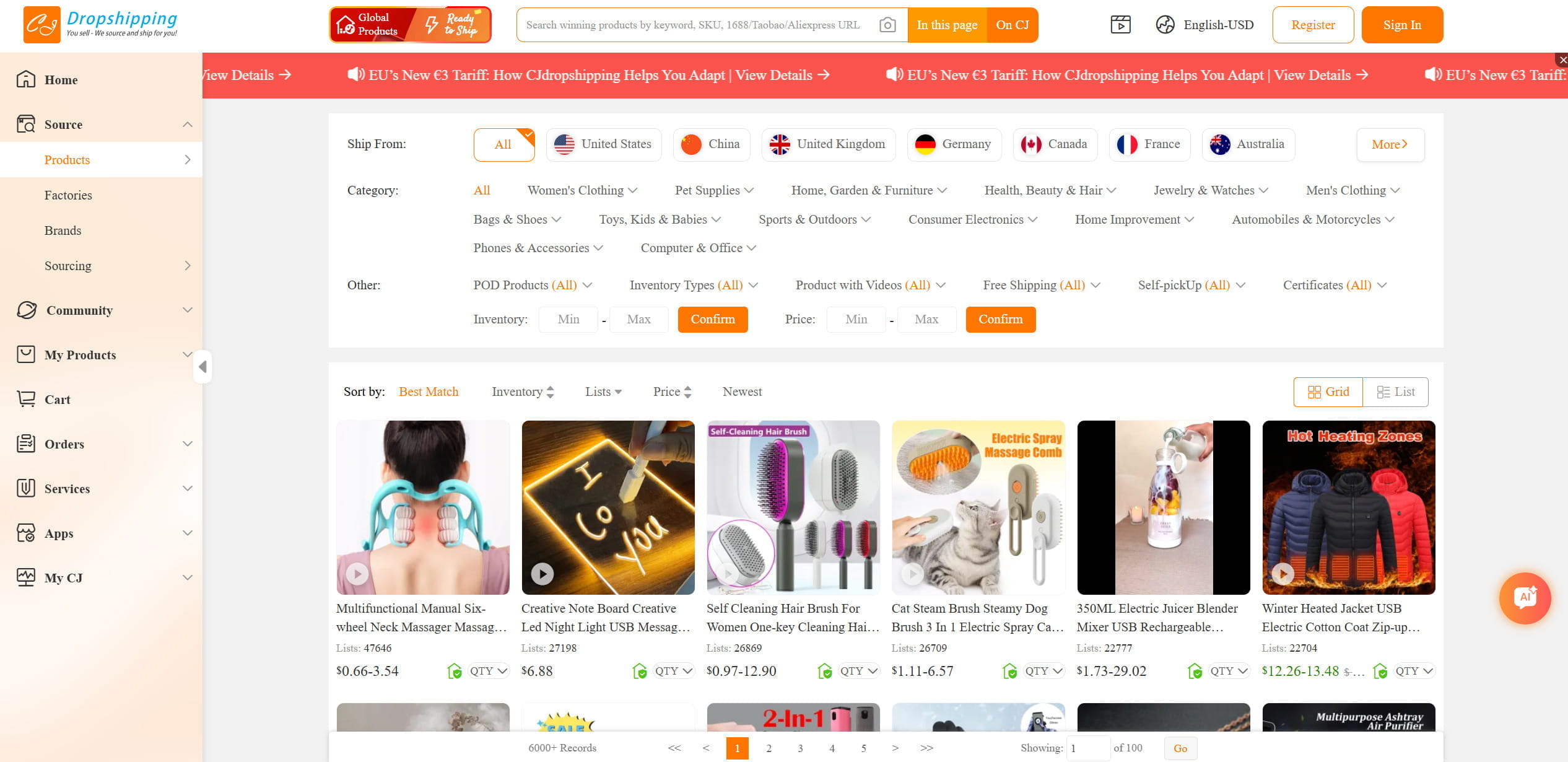
If you don’t want a monthly bill, CJ is hard to argue with. The base account costs nothing — you pay product and shipping cost only — and the catalog runs well past a million SKUs. CJ operates its own shipping lines, including CJPacket, plus warehouses in the US, Europe, and Asia, so orders routed through US stock turn around in roughly 4–7 days instead of the 15–25 you’d get shipping direct from China. The underrated feature is the sourcing service: submit a product CJ doesn’t stock and their team will try to find a factory for it, which makes the effective catalog larger than what you can browse. You can also warehouse your own inventory in CJ’s US or EU facilities once a product proves itself.
Who it’s for: hands-on sellers who’ll tolerate a clunky interface in exchange for free sourcing and an optional domestic warehouse. A poor fit for beginners who need polish and fast human support.
Pros
- No subscription, setup, or storage fees on the base account, with unlimited listings and unlimited connected stores even on the free plan.
- Over a million SKUs, plus a sourcing service for anything missing.
- US and EU warehouses cut delivery to 4–7 days on stocked items.
- Around 4.9 stars on the Shopify App Store.
Cons
- The interface is cluttered and genuinely dated.
- Quality swings noticeably between suppliers, since the vendor base is open.
- Most of the catalog still ships from China at 10–20 days.
- English-language support leans on template replies.
The cost of CJ isn’t dollars, it’s hours. Budget an afternoon to get comfortable with the interface and expect to re-explain problems to support more than once. For someone who already knows what they’re doing it’s a cheap, powerful backend worth tolerating. For a first-time seller it’s a steep usability curve at exactly the moment you have the least patience for one.
Pricing
- Free: $0/month — unlimited listings, unlimited connected stores, unlimited team accounts, 5 daily sourcing requests, order monitoring, quality inspection, and 24/7 support.
- Plus: $15.99/month — 10 extra daily sourcing requests, 5 VIP products, and coupon credits.
- Prime: $19.99/month — 20 extra sourcing requests, 10 VIP products, and 15 recommended products. The tier CJ pushes hardest.
- Advanced: $59.99/month — 50 extra sourcing requests, 20 VIP products, and 25 recommended products, for high-volume sourcing.
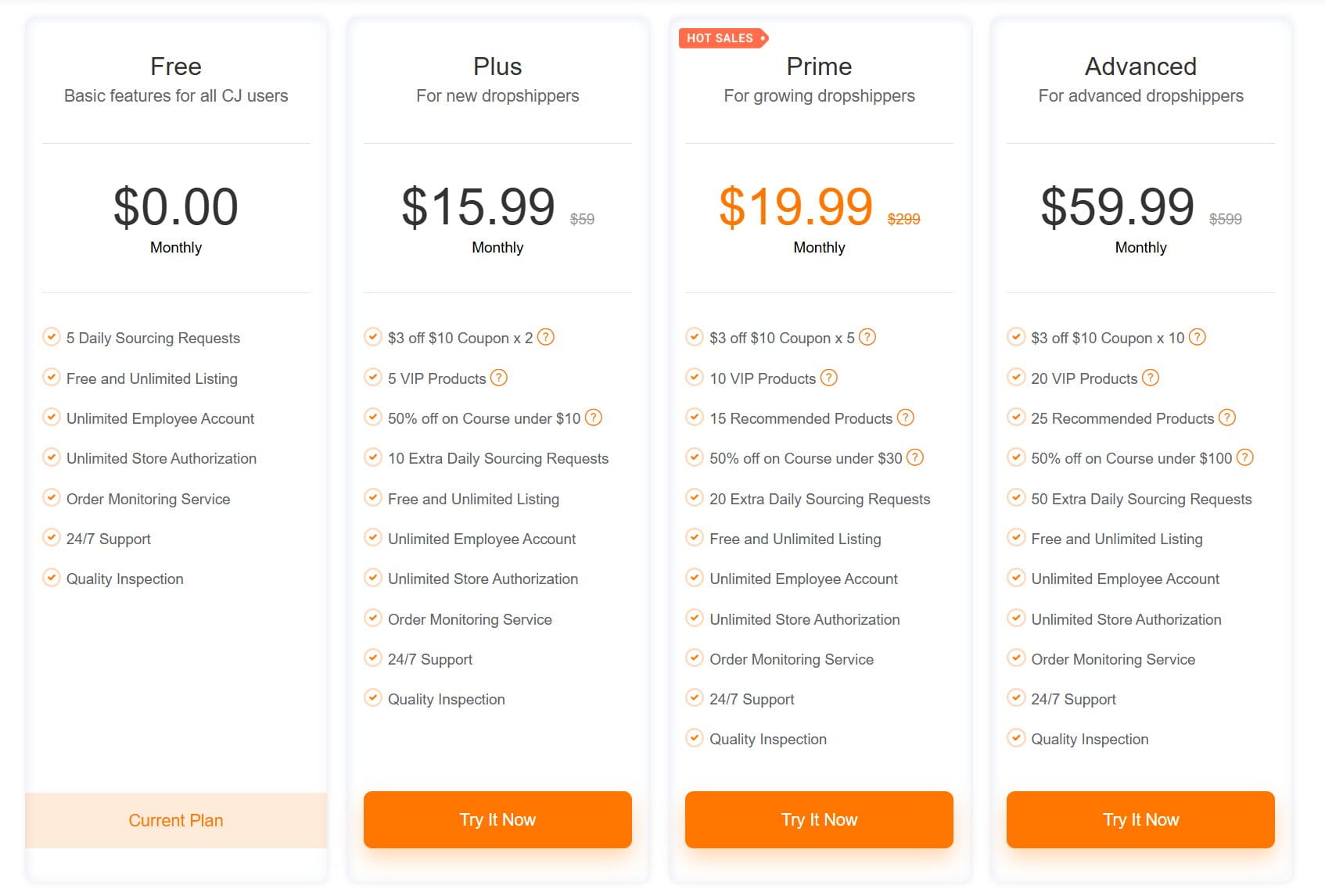
Every paid tier buys sourcing capacity and perks rather than functionality — the core feature set is already on the free plan, which is more generous than most paid tiers elsewhere. Ignore the crossed-out “$59 / $299 / $599” anchor prices on the pricing page; they aren’t prices anyone has paid. On every tier you pay product cost plus shipping per order, with no platform commission.
Shipping and returns
- 4–7 business days from the US warehouse; 10–20 days on CJPacket from China, depending on line and destination.
- Processing is usually same-day or next-day.
- Returns go back to a CJ warehouse — workable domestically, painful internationally.
3. Zendrop — the branded unboxing, for a fee
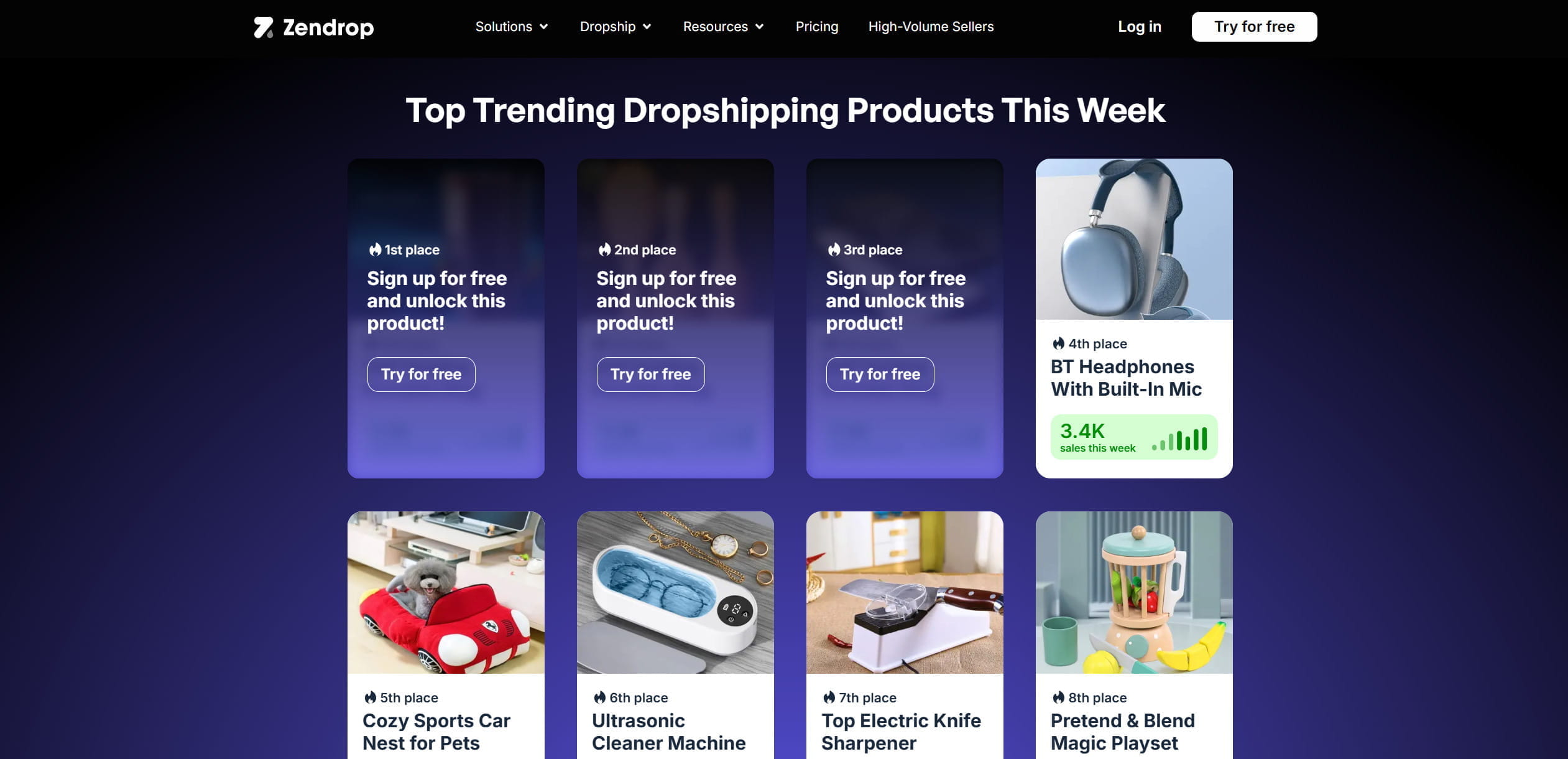
Zendrop is built for sellers who want the order-to-delivery experience to feel like a real brand rather than a dropship. Custom packaging, printed thank-you cards, US fulfillment on eligible stock, 24/7 support, and a clean onboarding flow — the app sits around 4.6 stars and setup takes minutes rather than an afternoon. One detail worth understanding: even when you import a product via an AliExpress link, Zendrop fulfills it through its own vetted network rather than straight off AliExpress, which is where the faster shipping and steadier quality come from — and where the higher product prices come from too.
Who it’s for: first-time store owners who want a guided, professional-looking setup and will pay for the training and branding that comes with it. A weak fit for margin-obsessed sellers pushing cheap products.
Pros
- The least intimidating setup on this list for a genuine newcomer.
- Own supplier network means more consistent quality than raw AliExpress.
- Branding options that make a first store look legitimate.
- 24/7 support, which most suppliers on this list don’t offer.
Cons
- The free plan is research-only and can’t fulfill live orders.
- Default China-sourced items average 8–10 days.
- Product prices run above sourcing the same goods yourself.
- Integrates with Shopify and CommerceHQ only.
The number that isn’t on the pricing page: Zendrop takes a processing fee of around 10% on vendor payouts. On a product with a fifteen-dollar margin that’s a meaningful bite taken before you’ve spent a cent on ads, and it does the most damage precisely on the low-ticket items beginners start with. Run that 10% through your unit economics before you scale anything cheap.
Pricing
- Free: $0/month — catalog access and 24/7 support, nothing else. Unlimited orders, automated fulfillment, and custom branding are all locked, so you’ll be on a paid tier before your first real sale.
- Pro: $49/month — unlimited orders, automated fulfillment, custom branding, US products, and product requests. The tier where the store actually starts running itself.
- Plus: $79/month — everything in Pro plus print-on-demand, Zendrop AI, chargeback management, private product listings, Top Winning Products, the Academy with weekly coaching calls, and $100 in order credits.
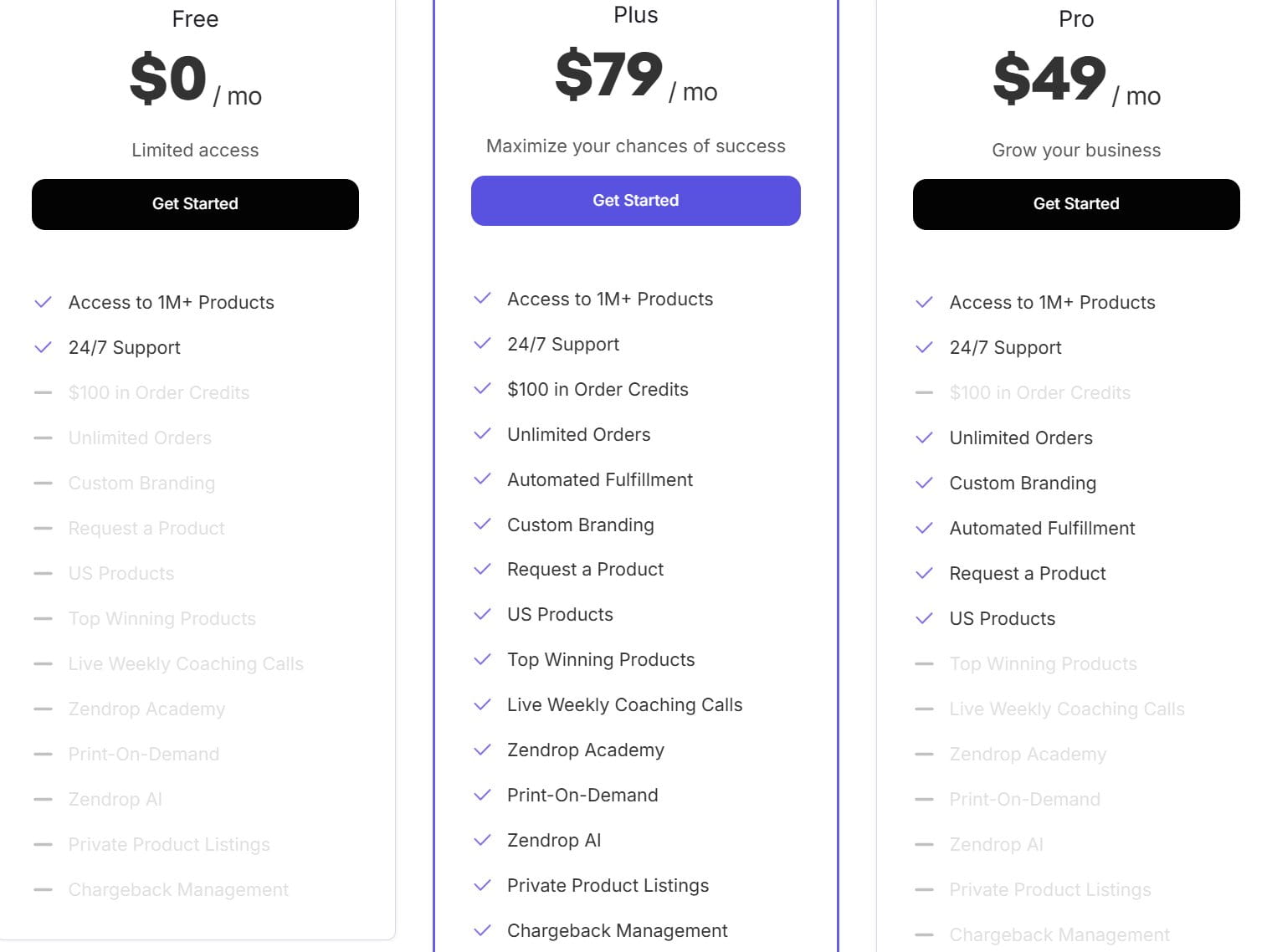
On top of the plan price, Zendrop takes roughly 10% in processing fees on vendor payouts, at every tier.
Shipping and returns
- 2–5 business days on US-stocked items; 8–10 days on average for China-sourced products.
- Orders process within 1–2 days.
- Returns are handled through Zendrop support rather than individual suppliers — a real advantage over marketplace-style platforms.
4. Trendsi — US fashion with no subscription
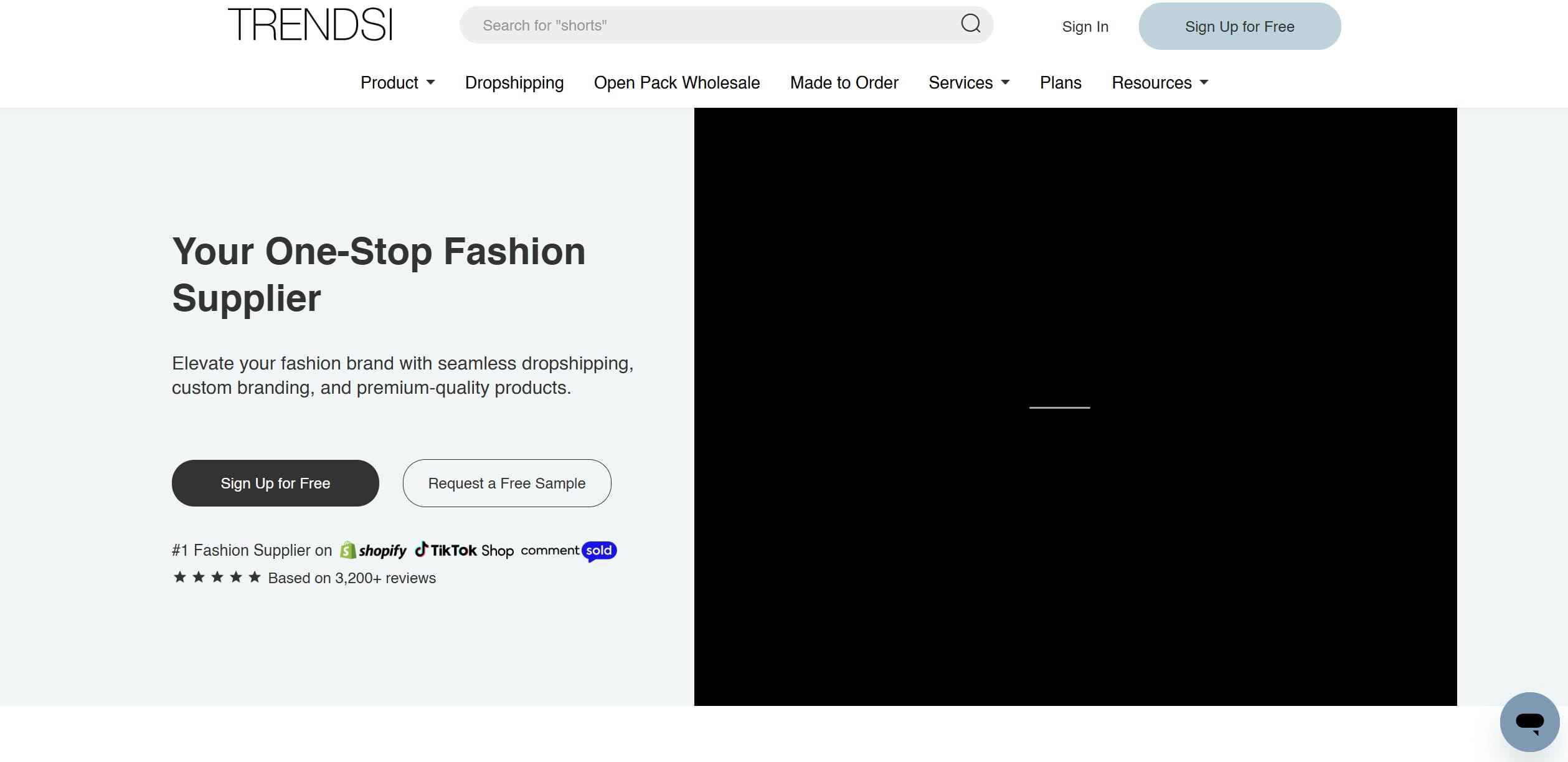
Trendsi is fashion-only, runs a Los Angeles warehouse alongside overseas sourcing, and costs nothing — you pay wholesale cost plus shipping when an order comes in, at any volume. For a Shopify boutique that’s the strongest combination on this list: US-warehoused apparel at 2–5 day delivery with zero fixed cost. The catalog runs to 40,000-plus best-selling products weighted toward women’s clothing, shoes, bags, and accessories, and what sets it apart operationally is the content — in-house photography and video on most listings, which saves a fashion store either a photoshoot or an evening of scraping supplier images. Branded invoices and sewn-in labels are available, and customer returns are free within seven days of delivery, which is rare in apparel dropshipping and worth real money in reduced support load.
Who it’s for: women’s fashion boutiques wanting fast US shipping and free product photography without holding stock. Useless outside apparel, and no help at all if your buyers are in the UK or EU.
Pros
- Genuinely free, with no subscription at any order volume.
- LA warehouse delivers in 2–5 business days.
- Professional photography and video included on most listings.
- Seven-day free customer returns, plus branded invoicing and sewn-in labels.
Cons
- Women’s fashion only.
- Ships to the US, Canada, Australia, and New Zealand only.
- Stock reliability suffers during peak periods.
- Quality sits at the affordable end rather than premium.
The trap in this category is stock-out speed. Fashion trends turn over in days, and the exact item you built a paid campaign around can sell out of the LA warehouse mid-flight, leaving your ads pointing at something you can’t fulfill. Check inventory every morning on anything you’re actively advertising and be ready to swap creative the same day. No amount of automation protects you from the trend cycle.
Pricing
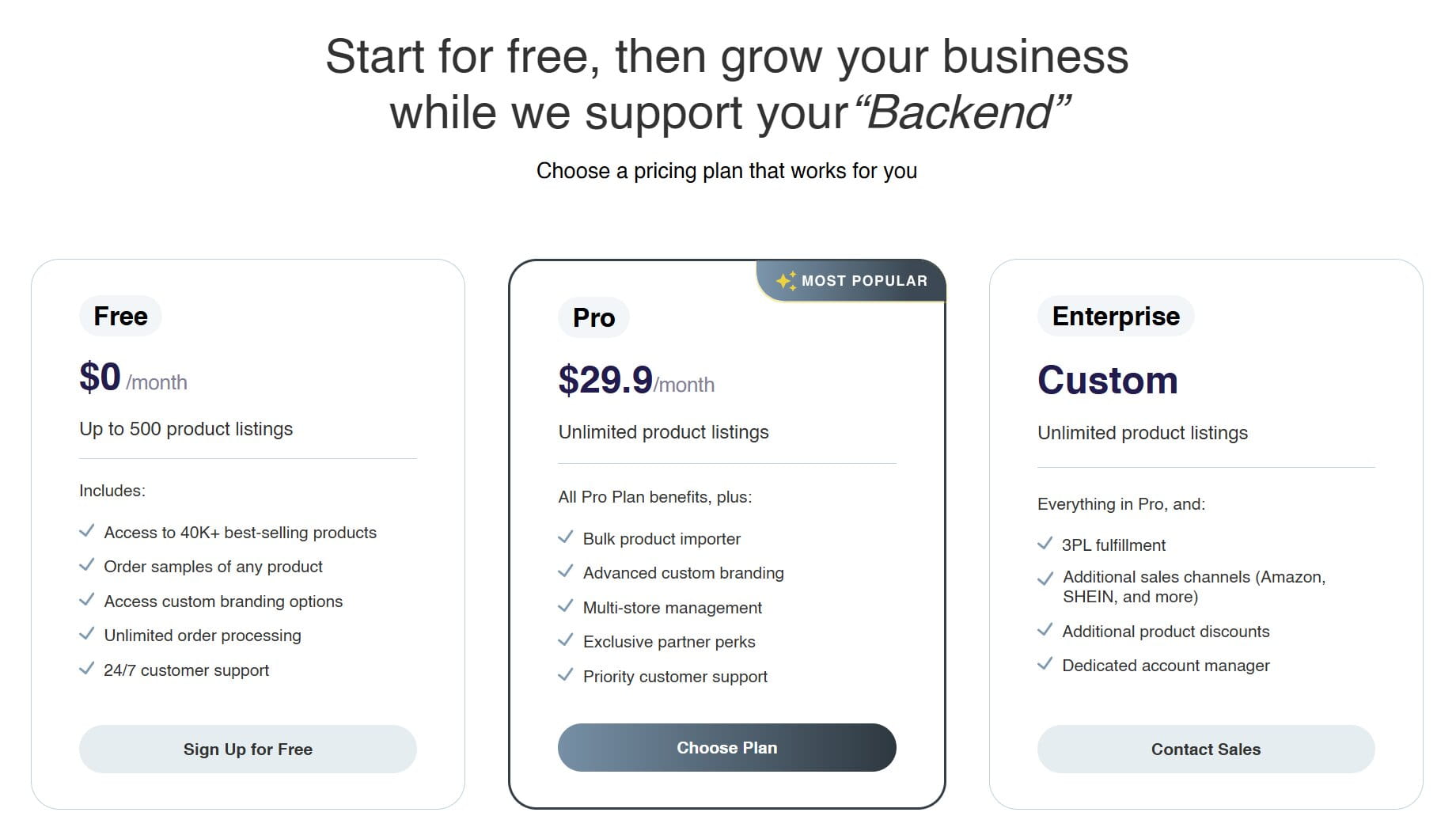
- Free: $0/month — 500 product listings on one store, unlimited order processing, samples, custom branding, and 24/7 support. Open-pack wholesale at a 6-unit minimum and made-to-order manufacturing are included here too, not held back for paid tiers.
- Pro: $29.90/month — unlimited listings, unlimited stores, bulk importing, advanced custom branding, partner discounts, and priority support. Makes sense once you outgrow the 500-listing cap or run more than one store.
- Enterprise: custom pricing — adds 3PL fulfillment, selling on Amazon, SHEIN and TEMU, volume-based product discounts, and a dedicated account manager.
Shipping and returns
- 2–5 business days from the US warehouse.
- 5–10 days on overseas-sourced items; 8–16 days to Canada, Australia, and New Zealand.
- Free customer returns within seven days of delivery, handled by Trendsi rather than by you.
5. Modalyst — curated boutique and indie brands
Modalyst sits in the curated-marketplace category alongside Spocket, with a sharper focus on fashion, accessories, and design-led independent brands. Suppliers span the US, UK, EU, Canada, and Australia, and the platform leans on brand curation rather than catalog size — you’re picking from vendors onboarded individually rather than from an open marketplace. That curation is both the value and the limitation: for a boutique store where the product needs to look like it came from somewhere specific, Modalyst’s vendor list beats a general aggregator, but step outside fashion and home goods and the catalog thins out quickly.
Who it’s for: boutique and design-led stores that care more about which brands they carry than how many SKUs they can list. Not for general merchandise stores that need breadth.
Pros
- Curated, brand-led vendor list rather than an open marketplace.
- Suppliers across the US, UK, EU, Canada, and Australia.
- Free tier available for testing before committing.
- Sample ordering supported.
Cons
- Thin catalog outside fashion, accessories, and home.
- The Hobby tier caps you at 25 products, which is a testing allowance rather than a store.
- Product prices sit at the higher end, squeezing margins.
- Supplier product descriptions are minimal.
Budget time for copywriting. Modalyst suppliers routinely provide little more than a product title and a few images, so “import and publish” isn’t a workflow that exists here — you’ll write descriptions for every listing yourself. That’s fine at thirty products and a serious drag at three hundred, which is worth knowing before you plan your catalog size.
Pricing
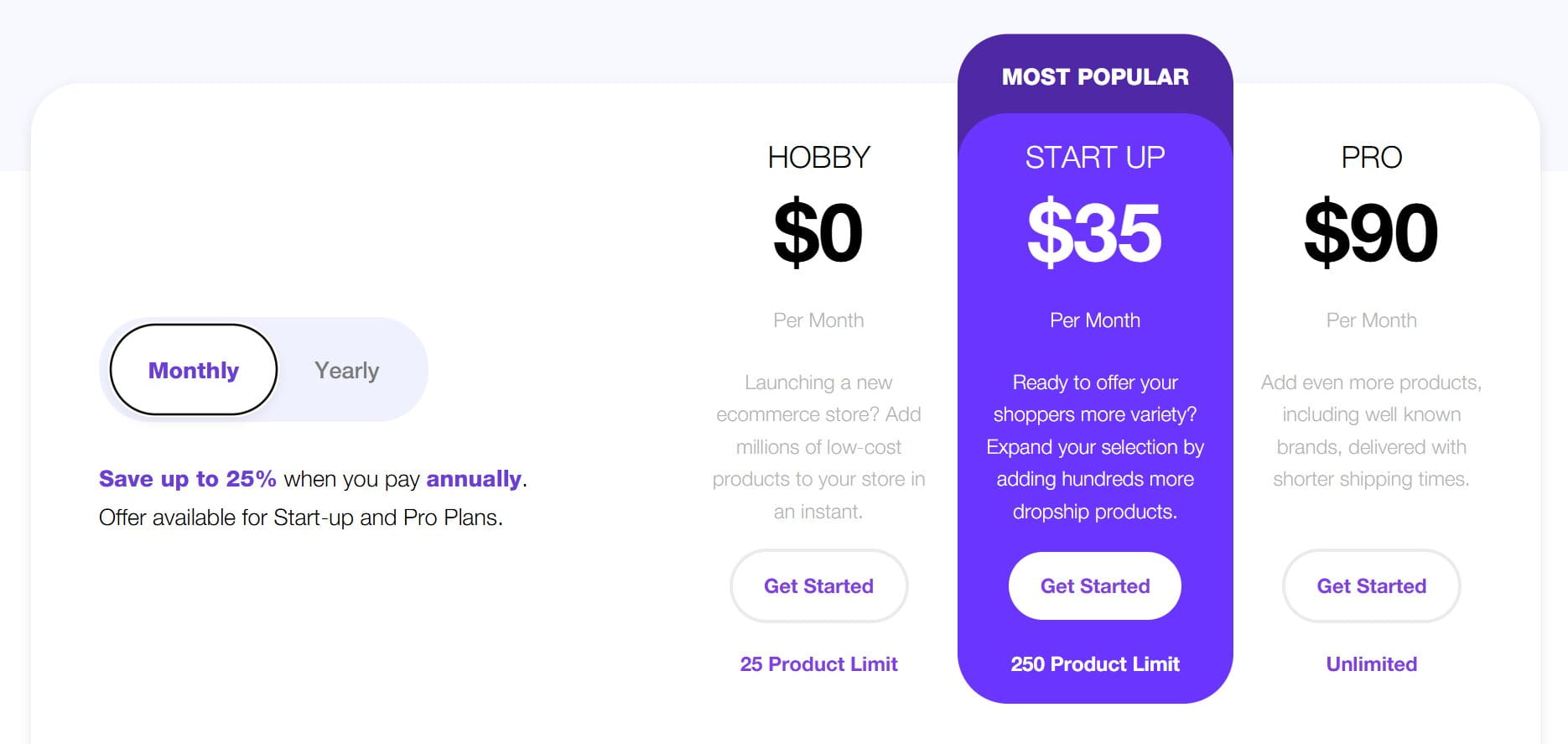
- Hobby: $0/month — 25 products. Enough to test the platform and the vendor quality, not to run a catalog.
- Start Up: $35/month — 250 products, the tier most boutique stores land on.
- Pro: $90/month — unlimited products, plus better-known brands with shorter shipping times.
Annual billing saves up to 25%, but only on Start Up and Pro. Every tier gets the full automation set — one-click imports, real-time inventory updates, variant mapping, automated markups, and the profit calculator — so you’re paying purely for catalog size, not features.
Shipping and returns
- 3–8 business days depending on where the supplier sits relative to the customer.
- Returns run on Modalyst’s pre-negotiated supplier contracts with a standardised 14-day policy, so your return terms are consistent across vendors. Handling times still vary by supplier.
6. Printful — print-on-demand for brand control
For merch, apparel, and décor, Printful is the one to trust on quality. It prints in its own facilities across the US, EU, and elsewhere, and that in-house control is the whole pitch: consistency a distributed network can’t promise. There’s no mandatory subscription — you pay per item as orders come in — and the Shopify app is the most polished in print-on-demand, with mockup generation, variant mapping, and hands-off fulfillment once configured. The white-label side is what justifies the premium: custom labels, embroidery, branded packing slips, pack-ins — nothing in the box announces the order was dropshipped.
Who it’s for: brand-focused sellers who’d rather pay more per blank for reliable quality and strong branding. A poor fit for price-war niches where a dollar of blank cost decides the sale.
Pros
- Consistent print quality, because one company controls the presses.
- Strong branding built in: custom labels, inserts, branded packing slips.
- No mandatory subscription — pay per item only.
- Excellent Shopify app with built-in mockup generation.
Cons
- Blank costs run noticeably above Printify’s.
- No use whatsoever for general merchandise.
- Production adds 2–5 days before shipping starts.
- Available garment brands depend on which facility fulfills the order.
The higher blank cost forces a higher retail price to keep a workable margin, and in a crowded apparel niche that gap quietly costs you sales to a Printify-based competitor selling the same design. Printful earns its premium when your brand can justify it. It hurts when you’re competing on price in a saturated category — and most t-shirt categories are saturated.
Pricing
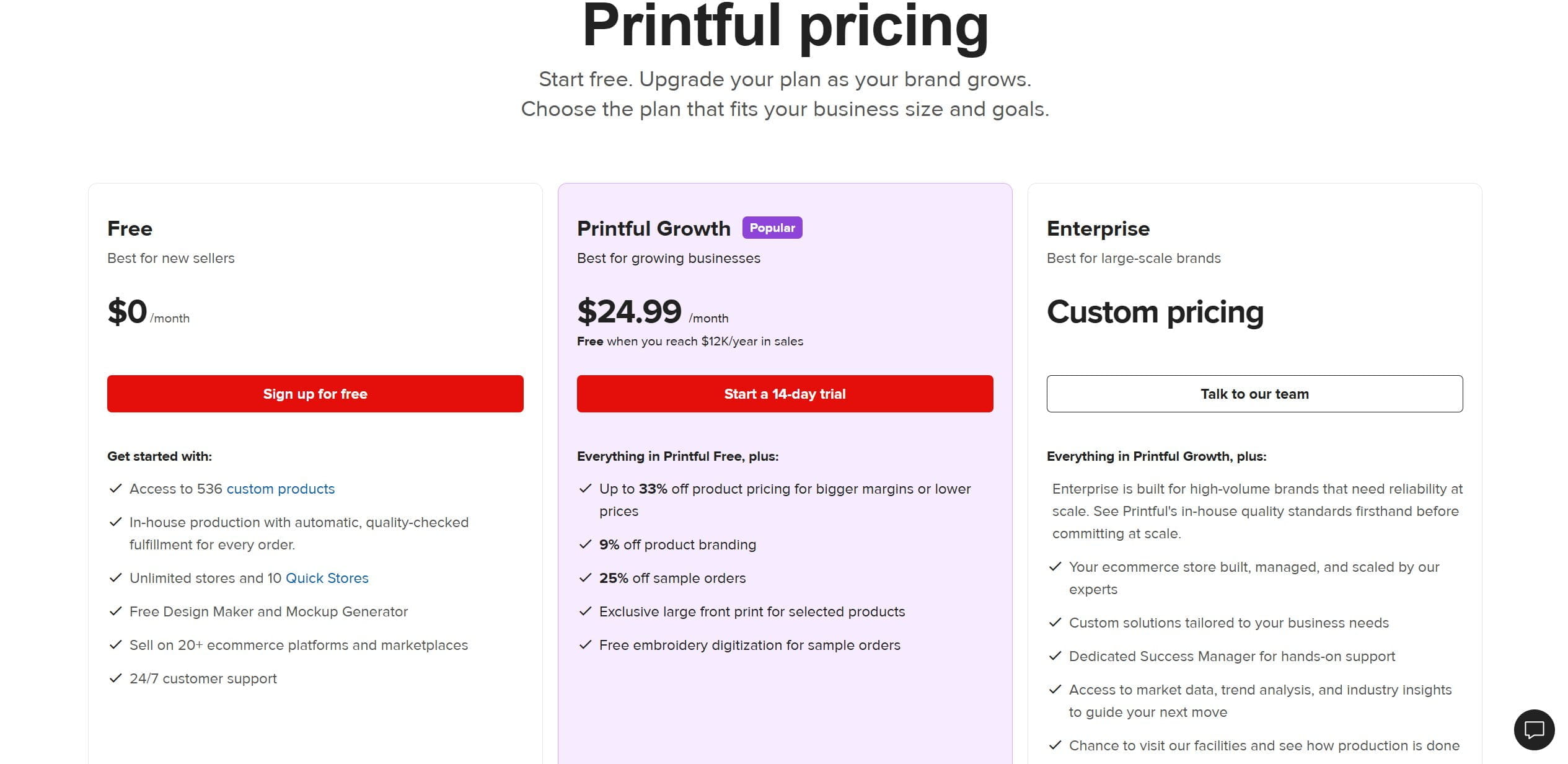
- Free: $0/month — all 536 custom products, in-house production with quality checks on every order, unlimited connected stores plus 10 Quick Stores, the Design Maker and Mockup Generator, and selling across 20+ platforms. You pay per item as orders come in.
- Printful Growth: $24.99/month with a 14-day trial — up to 33% off product pricing, 9% off branding, 25% off sample orders, free embroidery digitisation on samples, and exclusive large front prints. The fee is waived entirely once your store passes $12K/year in sales, so at real volume it costs nothing.
- Enterprise: custom pricing — a dedicated success manager, your store built and managed by Printful’s team, market and trend data, and facility visits.
Shipping and returns
- 2–5 business days production, then 3–5 days domestic delivery in the US, UK, or EU depending on routing.
- Printful handles reprints for defects and misprints directly, at no cost to you.
7. Printify — print-on-demand for margin
Printify works the opposite way to Printful: rather than owning facilities, it’s a network of 90+ independent print providers, and you choose which one fulfills each product. That’s the source of both its advantages. Base costs are lower because providers compete, and you can pick a provider near your customers — a UK printer for UK buyers, a US one for US buyers — cutting both shipping time and cost. It’s also the source of the main risk, because quality is only as good as the provider you picked and two providers listing the same blank can differ noticeably in print and finish.
Who it’s for: print-on-demand sellers who prioritise margin and catalog range and will vet providers themselves. Not for anyone who needs guaranteed uniform quality without doing that homework.
Pros
- Lower base costs than Printful, improving margin per unit.
- 90+ providers and 2,000+ products mean you can fulfil locally in the US, UK, or EU.
- Free plan with no time limit or catalog restriction.
- Premium’s discount reaches 33% and covers custom branding, so it pays for itself at around $120 of monthly product spend
Cons
- Quality varies by provider — sample each one you plan to use.
- Mixed-provider orders incur separate shipping charges per provider.
- Branding options are weaker than Printful’s.
- Monthly Premium rose 34% in February 2026.
Two things to watch. First, pricing moved this year and most guides haven’t caught up: Premium went from $29 to $39 a month on 17 February 2026, while annual billing held at $299. That gap is now wide enough that monthly billing is hard to justify past the first couple of months. Second, mixed-provider orders quietly wreck bundle economics — if a customer buys two items fulfilled by different printers, each charges its own shipping. Group your bundles by provider or don’t offer them.
Pricing
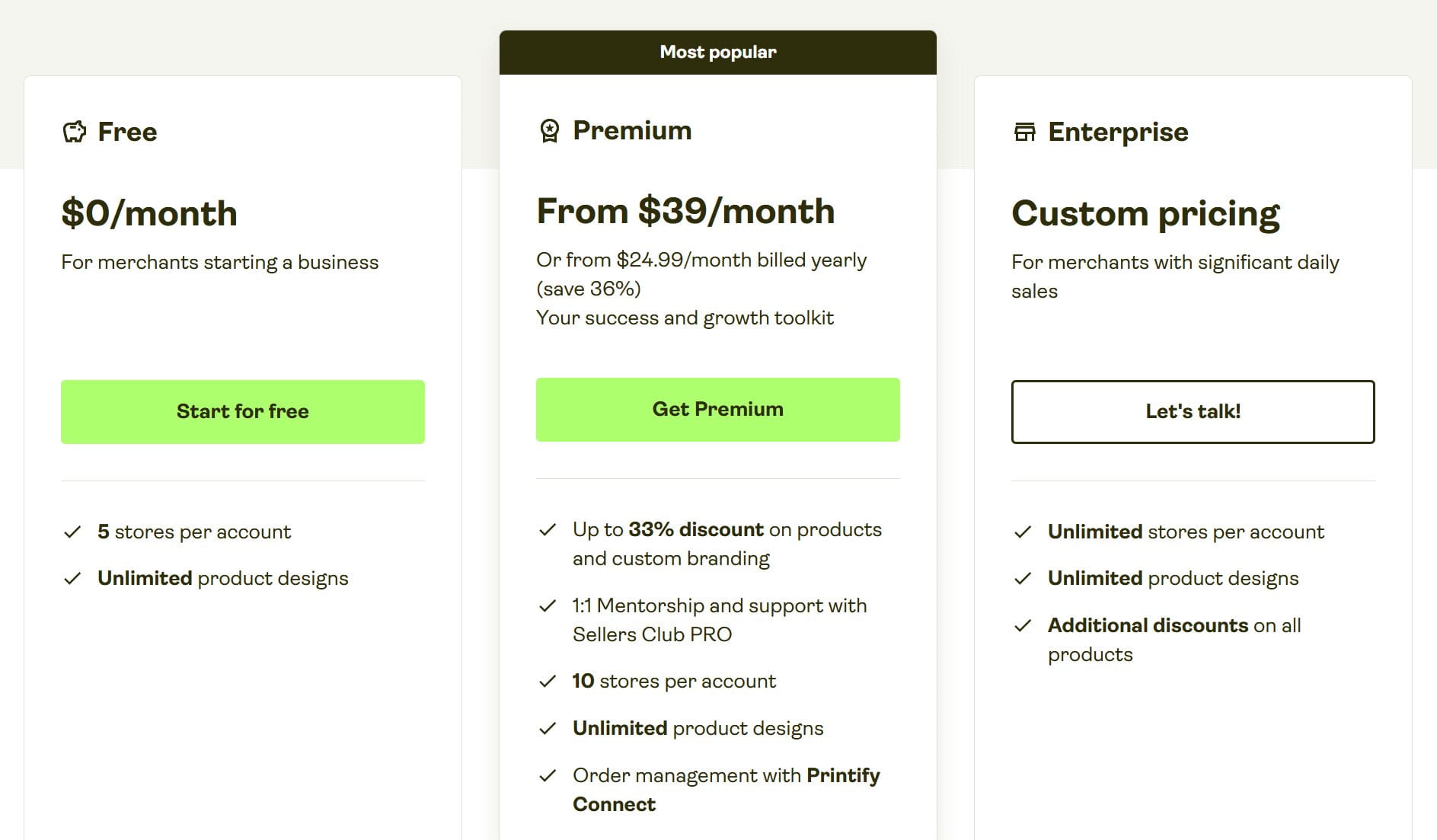
- Free: $0/month — the full 2,000-product catalog, mockup tools, unlimited product designs, and 5 stores per account. Enough to launch and make your first sales before paying anything.
- Premium: from $39/month, or $24.99/month billed yearly (a 36% saving) — up to 33% off both products and custom branding, 10 stores per account, order management through Printify Connect, and 1:1 mentorship via Sellers Club PRO.
- Enterprise: custom pricing — additional discounts on all products, unlimited stores, and unlimited designs, aimed at merchants with significant daily sales.
On every tier you pay product cost plus shipping per order — the subscription only buys the discount.
Shipping and returns
- 2–7 business days after production, which typically runs 2–5 days.
- Delivery speed depends entirely on which provider you selected relative to the customer’s location.
- Reprints for defects are handled by the provider, with Printify mediating.
8. Wholesale2B — breadth over polish
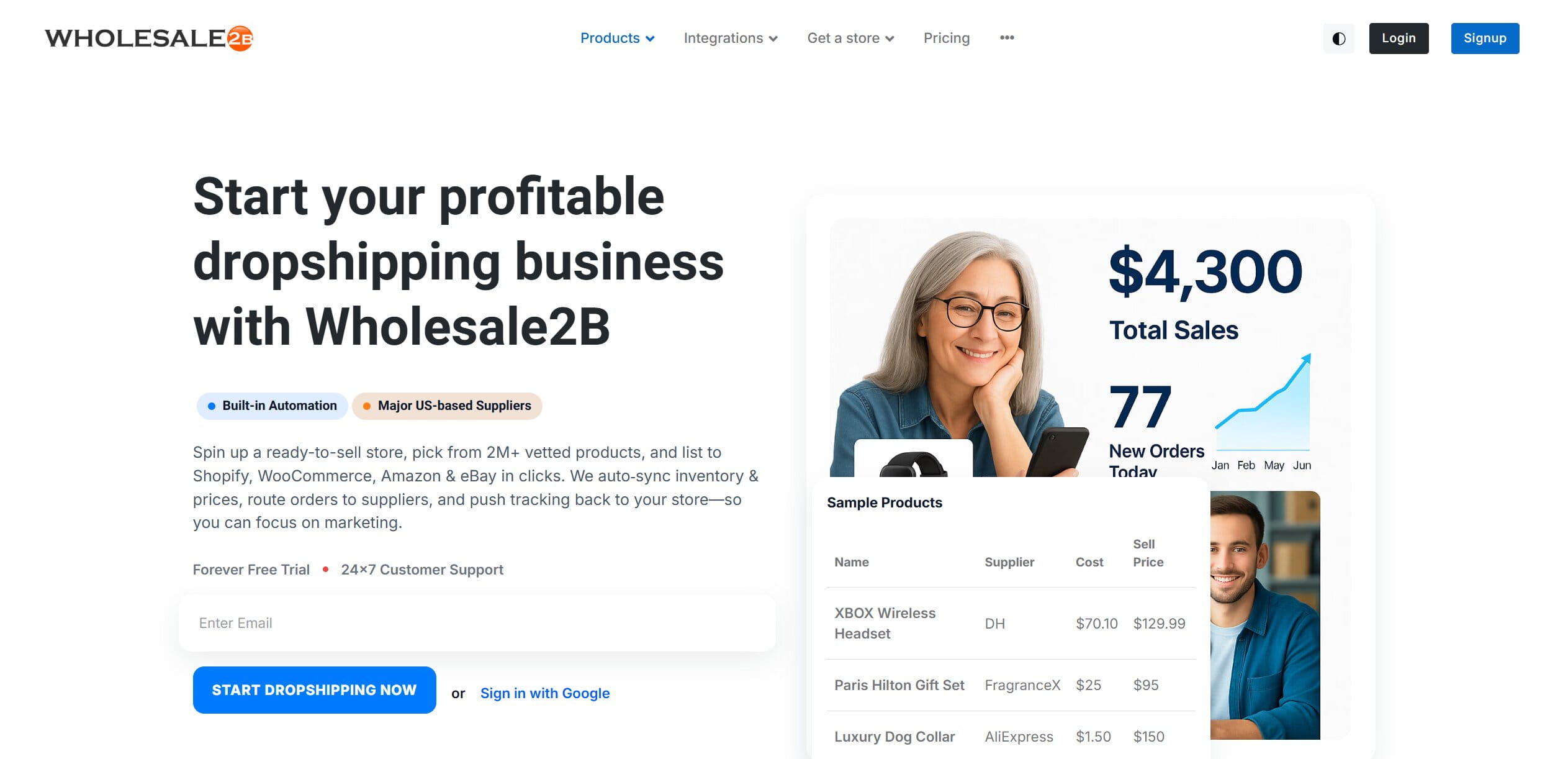
Wholesale2B has been running for two decades and its pitch is volume: over 1.5 million products aggregated from a large supplier base, pushed into Shopify with inventory and order sync. If your store’s proposition is variety — a general merchandise catalog where customers arrive expecting to find something specific — this beats a curated app like Spocket on raw coverage.
Who it’s for: general merchandise and multi-channel sellers who need catalog breadth and will accept variable quality to get it. Not for brand-led stores where every SKU has to feel chosen.
Pros
- Over 1.5 million products across broad general merchandise.
- Two decades of operation with a mature Shopify integration.
- Inventory, order, and tracking sync plus price-change alerts on every plan.
- Wholesale2B processes orders and handles returns on your behalf, on every plan.
Cons
- Inconsistent quality control across the aggregated supplier base.
- A 2,500-item import cap on the standard plans, upgradable only at extra cost.
- Interface and product data feel dated.
- Some suppliers ship far slower than the platform implies.
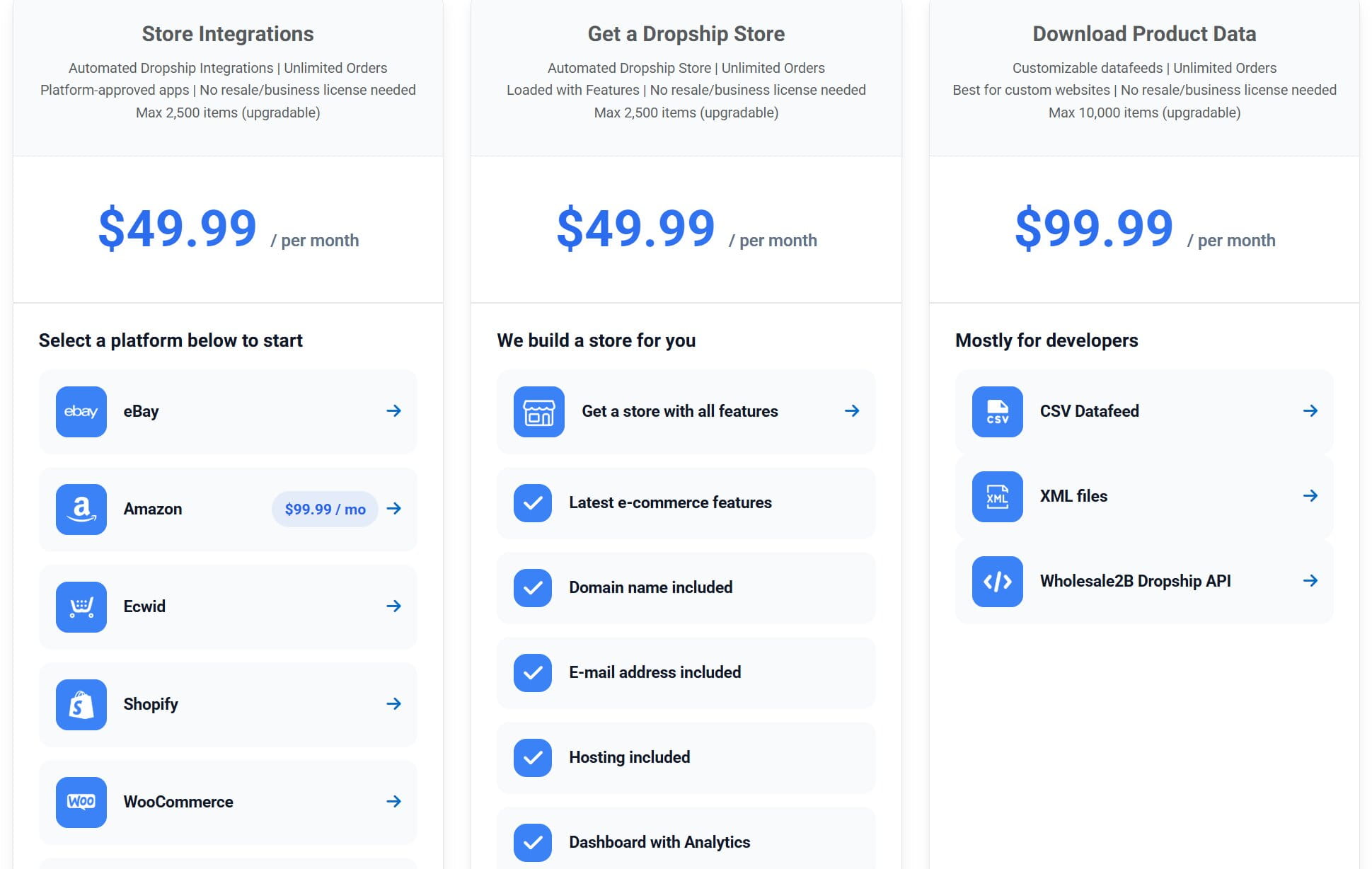
The pricing catches people out because it’s split by product type rather than tiered by volume, and the plan you need depends on whether you already have a store. There’s no free tier and no cheap entry point — $49.99 is the floor. Two specifics to check before subscribing: the standard plans cap you at 2,500 imported items, upgradable only for more money, and Amazon costs $99.99 rather than the $49.99 every other platform charges. If Amazon is in your channel mix, your real bill doubles.
Pricing
- Store Integrations: $49.99/month — automated dropshipping into a store you already run, across Shopify, WooCommerce, BigCommerce, Wix, eBay and 15+ others. Capped at 2,500 items. Amazon is the exception at $99.99/month.
- Get a Dropship Store: $49.99/month — Wholesale2B builds the store for you, with domain, hosting, email, themes, analytics, and payment gateways included. Also capped at 2,500 items.
- Download Product Data: $99.99/month — CSV and XML datafeeds plus API access for custom-built sites, capped at 10,000 items.
Yearly billing takes 25% off any plan, and no resale or business licence is required to open an account.
Shipping and returns
- 3–7 business days domestically in the US, varying widely by supplier.
- Wholesale2B handles returns centrally rather than leaving you to negotiate with each supplier — a genuine advantage over the marketplace-style platforms.
9. Doba — consolidated US wholesale
Doba aggregates 100+ suppliers and roughly 1.5 million SKUs into a single catalog and a single order flow. Instead of managing separate relationships and feeds, you deal with Doba. It charges no per-order transaction fees, and for certain regulated or brand-sensitive categories it supplies distributor documentation — which is worth more than it looks if you’re selling anything where authenticity gets questioned.
Who it’s for: sellers in regulated or brand-sensitive niches who value certified US distributors and paperwork over rock-bottom pricing. A poor choice for generic price-war categories.
Pros
- Single consolidated catalog across 100+ certified US suppliers.
- No transaction fees on any plan.
- Compliance documentation available for regulated goods.
Cons
- No free plan, and the $0.99 trial covers only two of the four tiers.
- Wholesale prices are high, so you’ll be undercut in generic categories.
- Heavy catalog overlap with Wholesale2B.
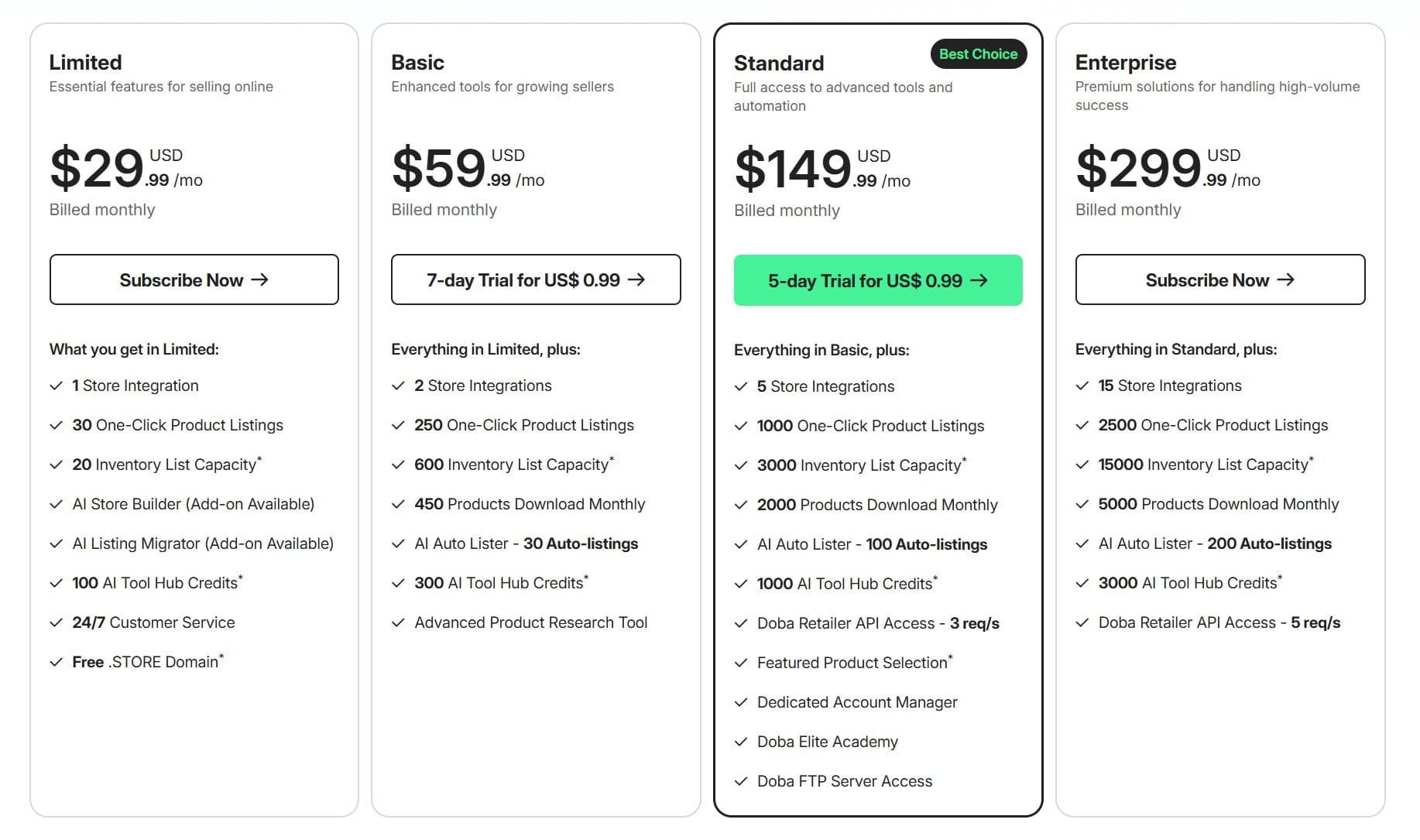
Read the listing caps before you read the prices. The $29.99 Limited plan allows 30 one-click product listings and an inventory list capacity of 20 — that’s a demo account, not a store. The first tier that can hold a real catalog is Basic at $59.99, so treat that as Doba’s actual entry price rather than the headline figure. The $0.99 trial is available on Basic and Standard only; Limited and Enterprise you buy blind.
Pricing
- Limited: $29.99/month — one store integration, 30 one-click listings, 20 inventory slots, 24/7 support, and a free .STORE domain.
- Basic: $59.99/month — two integrations, 250 listings, 600 inventory slots, 450 monthly product downloads, and the advanced product research tool. Comes with a 7-day trial for $0.99.
- Standard: $149.99/month — five integrations, 1,000 listings, 3,000 inventory slots, API access, a dedicated account manager, and FTP server access. Comes with a 5-day trial for $0.99.
- Enterprise: $299.99/month — 15 integrations, 2,500 listings, 15,000 inventory slots, and the highest API rate limit.
Quarterly billing takes 5% off and annual billing 15%, so the discounts are shallower than most platforms on this page.
Shipping and returns
- 3–7 business days domestically, set by the individual supplier.
10. Shopify Collective — Shopify’s own supplier network
Collective isn’t a third-party app, it’s a native sales channel inside your admin. It connects your store to other Shopify brands: you list their products, they ship directly to your customer, and Shopify splits the payment automatically. There’s no subscription, no commission, and no platform markup beyond the wholesale price the supplier sets. The structural advantage is vetting — every supplier is a real Shopify brand with its own storefront, reviews, and reputation you can inspect the way a customer would, which is a far better signal than a line in a directory.
Who it’s for: established Shopify stores with some sales history, on a paid plan with Shopify Payments, that want genuine branded products instead of generic catalog stock. Not a starting-line tool — and no use at all if you run a different payment gateway.
Pros
- Completely free — no subscription, setup fee, commission, or markup.
- Native to Shopify, so real-time inventory sync and payment splitting need no third-party connector.
- Suppliers are real brands with public storefronts, not anonymous catalog entries.
- Shopify dropped the old $50,000 revenue minimum in late 2025, so eligibility itself is no longer gated by size.
Cons
- Shopify Payments is mandatory — any other gateway disqualifies you outright.
- You and the supplier must be in the same country using the same currency.
- Brands vet who they partner with, so a new store with no traffic will get declined.
- Suppliers can disconnect with little notice, and there’s no SKU-level pricing control.
- No digital products or gift cards, and the Pause and Build plan isn’t supported.
The barrier here isn’t money, it’s approval. Established brands are reluctant to hand their reputation to a store with no traffic and no track record, so realistically you need sales history and a credible-looking storefront before the good ones say yes. Eligibility is also rechecked on a recurring basis: if payouts lapse or your plan changes, you can’t connect with new suppliers or activate price lists until it’s fixed, though existing orders keep flowing. Two setup steps catch people off guard — an ID verification with a selfie check, and enabling Shopify Network Intelligence in your privacy settings. Margins typically land at 20–40%, and under 30% struggles to cover marketing once you’ve paid for the traffic.
Pricing
- Free: $0/month — no subscription, setup fee, or commission on any plan.
Standard Shopify Payments fees apply to orders, but you’d pay those anyway. The real cost is setup, not dollars: an active paid Shopify plan, Shopify Payments fully verified with active payouts, ID verification, Network Intelligence enabled, and a supported country and currency. UK and EU stores also need Shopify Tax, Basic Tax, or a third-party tax app — a manual tax setup disqualifies you. Coverage started at US and Canada and expanded with the Winter ’26 release, so check the current supported list before planning around it.
Shipping and returns
- Set by each supplier individually, but since they’re domestic brands shipping from their own warehouses, delivery usually matches what that brand offers its own customers.
- Returns are handled directly with the supplier. Collective routes orders and payments but doesn’t run a central returns desk.
UK dropshipping suppliers for Shopify: 10 domestic options
If your buyers are British or European, a domestic warehouse moved from nice-to-have to necessary after Brexit. Shipping into the UK from a US or Chinese warehouse adds customs friction, import charges the customer often discovers at the door, and delays you can’t predict or explain. The Shopify dropshipping suppliers UK stores can actually rely on are the ones holding stock inside the country — or, for EU coverage, inside the customs union.
The list below splits into three types, and the distinction matters more than price: full platforms with native Shopify apps, print-on-demand services, and directories where you find suppliers yourself and wire them up manually.
1. Avasam — the default for UK-based sellers
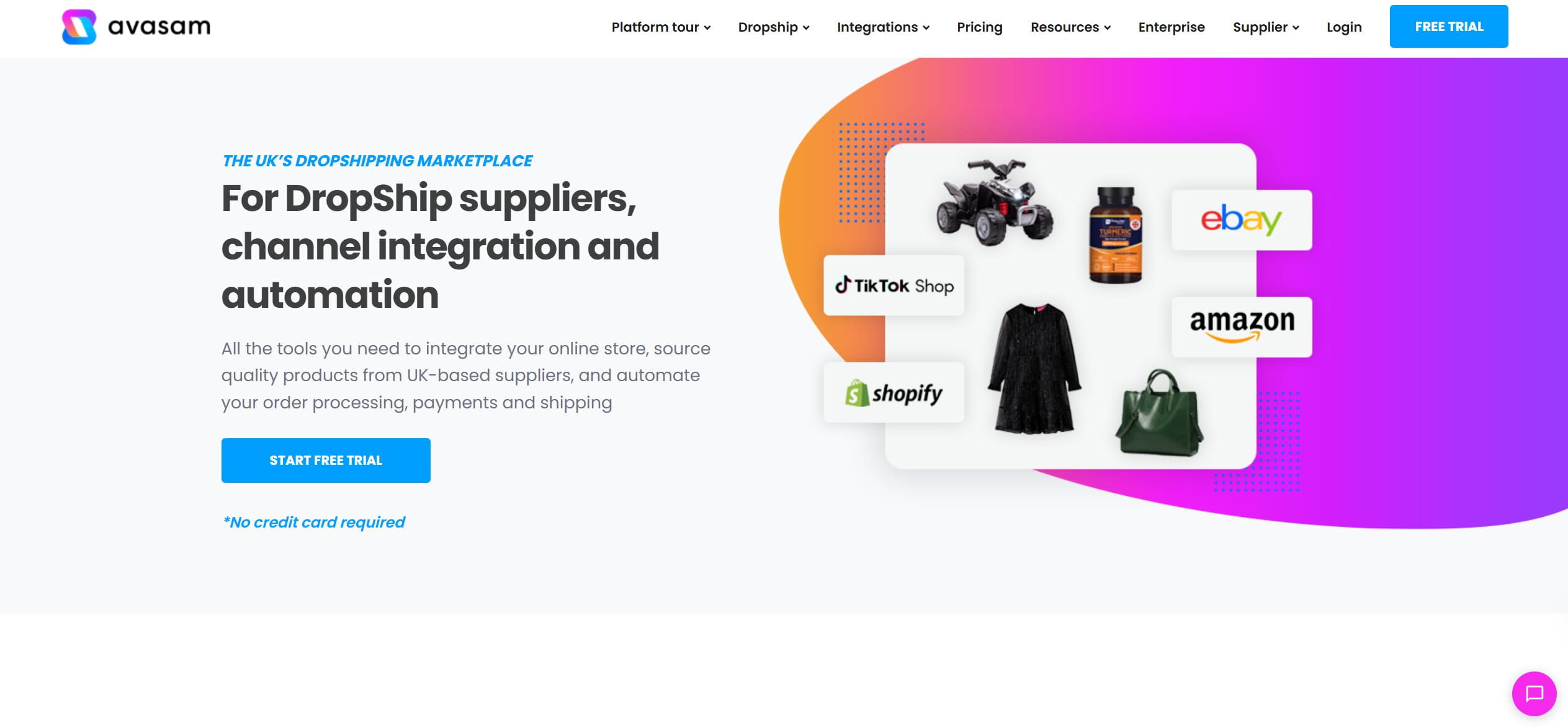
Avasam is London-based and built entirely around verified UK suppliers, with full automation, 60+ ecommerce integrations, and around 4.9 stars on the Shopify App Store — a rating driven mostly by its support team, which reviewers mention more than any feature. Domestic stock lands in roughly 4–5 days. It has recently added 20,000-plus products from US and Chinese suppliers, but the UK base remains the reason to use it.
Who it’s for: UK stores that want verified domestic suppliers and genuine automation, and will pay a subscription for both. The free tier lets you look at the catalogue, but nothing ships until you’re on a paid plan.
Pros
- Verified UK suppliers through a proper vetting programme, not an open marketplace.
- 4–5 day domestic delivery with full order and stock automation.
- Unlimited orders, listings, and marketplace integrations from the entry paid tier up.
- 0% transaction fees on every paid plan, and support quality is what reviewers mention most.
Cons
- The free tier is browse-only — you can’t place an order until you’re paying.
- Doesn’t accept PayPal for paying suppliers — you’ll need a card on file.
- The catalog is smaller than the big aggregators.
- Product sourcing is capped by tier, and jumping from 250 to 10,000 means going from £49.99 to £99.99.
The VAT line catches people out. Avasam’s advertised prices are quoted excluding VAT, so a £24.99 plan actually bills at around £30 once VAT is applied — and the same applies at every tier, meaning the £199.99 plan is closer to £240. That’s not a hidden fee so much as a British pricing convention, but if you’re comparing it against a US platform quoting tax-inclusive dollars, you’re not comparing like with like.
Pricing
- Free: £0 — browse the catalogue and raise support tickets. No ordering.
- Starter: £24.99/month + VAT — unlimited orders, listings, and marketplace integrations, 25 product sourcing slots, 100 AI credits, auto stock and price sync, dynamic pricing, and the eBay listing tool.
- Advanced: £49.99/month + VAT — 250 sourcing slots, 1,000 AI credits, plus live chat and telephone support.
- Business: £99.99/month + VAT — 10,000 sourcing slots, TikTok Shop setup and account management, extra product discounts, and an onboarding call.
- Guru: £199.99/month + VAT — 50,000 sourcing slots and 50,000 AI credits, for large-scale operations.
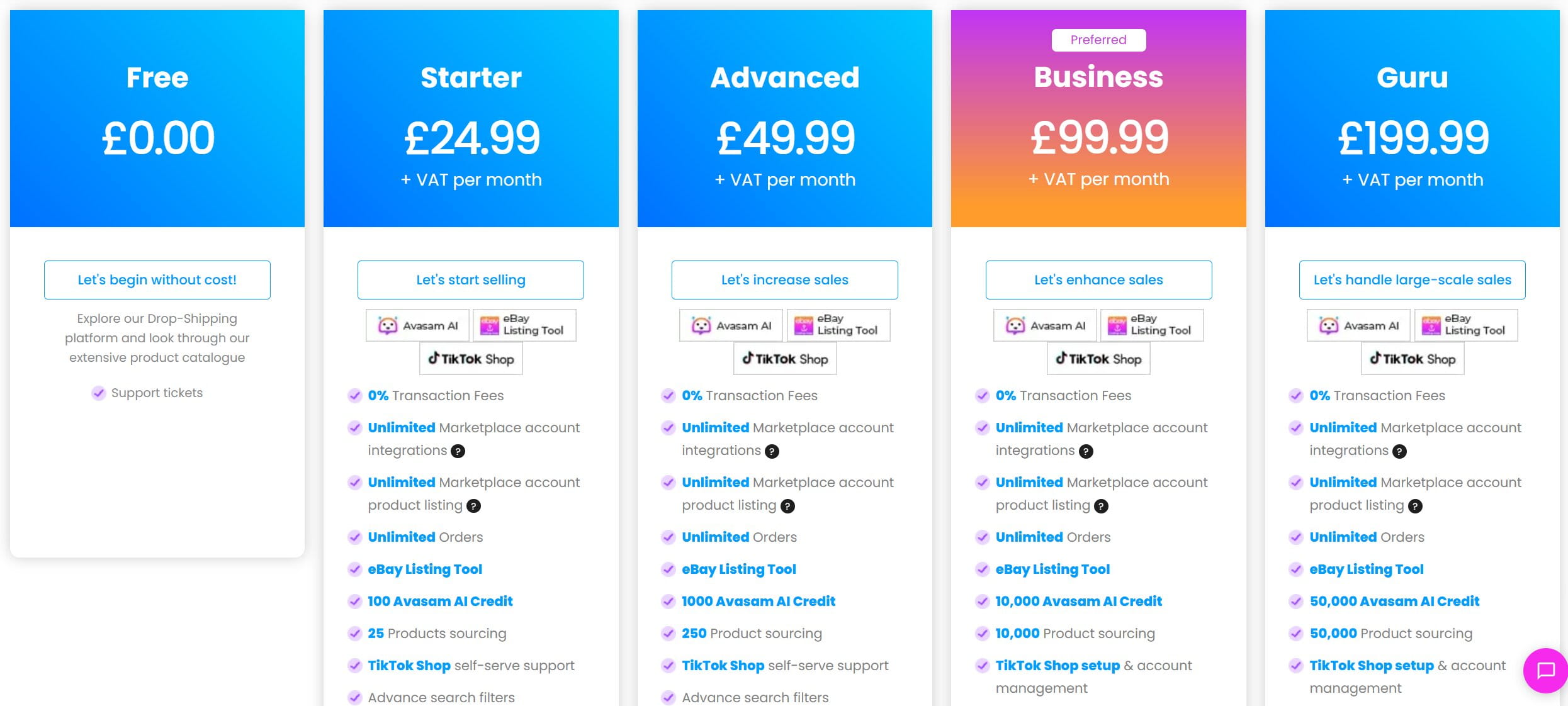
Every tier is quoted excluding VAT, so add roughly 20% to each figure above.
Shipping and returns
- 4–5 business days on UK-warehoused stock.
- Returns are managed through Avasam’s platform rather than direct with each supplier.
2. Syncee — the broadest European supplier network
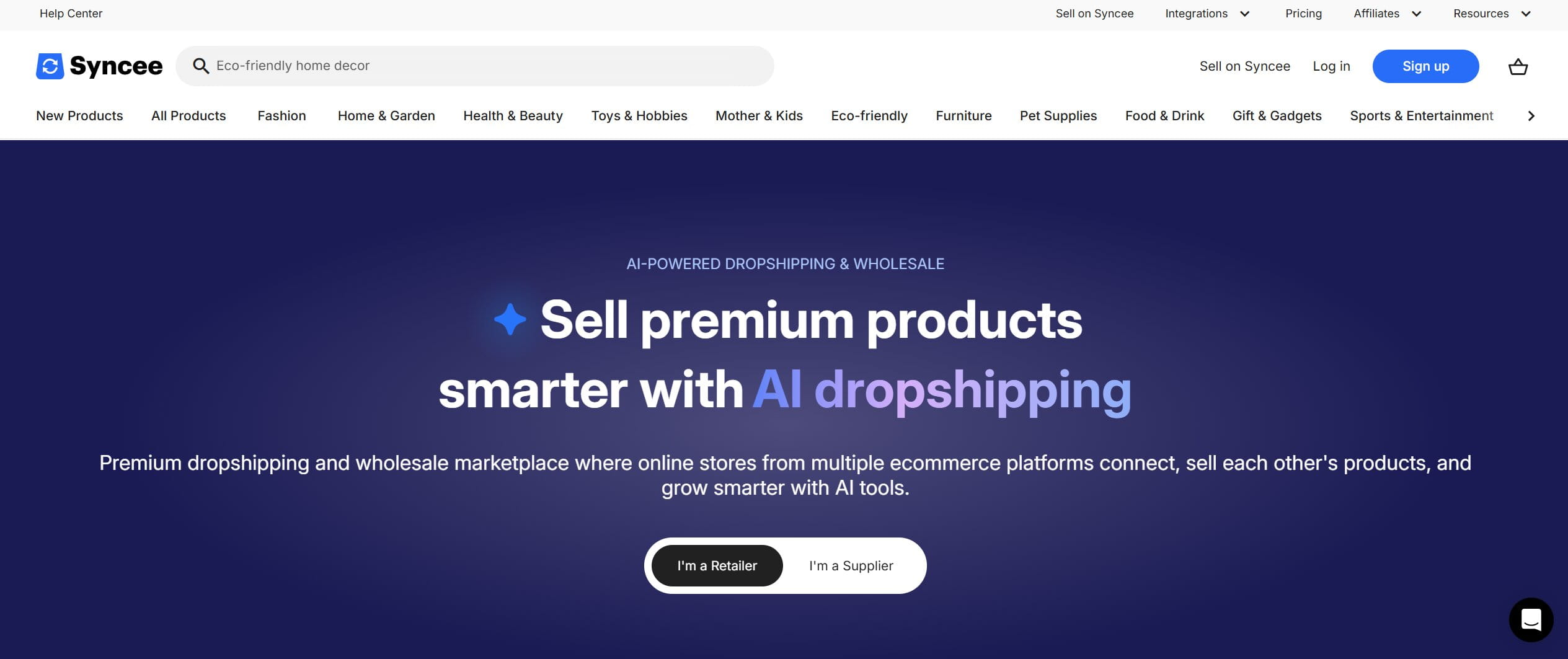
Syncee is a B2B marketplace connecting stores to thousands of manually vetted suppliers across the EU, UK, US, Canada, and Australia, with a location filter that lets you pull only suppliers shipping from where your customers are. It added an AI sourcing agent in 2026 where you describe what you want to sell and it returns matched suppliers — more useful than it sounds when you’re staring at an empty catalog. In-app messaging lets you question a supplier before committing, which no directory-style competitor offers.
Who it’s for: stores that want a broad vetted supplier base across several regions, or that already have wholesale relationships to plug in via data feed. Less suited to someone who just wants the cheapest possible route.
Pros
- Genuinely broad vetted supplier base across five regions with a location filter.
- In-app supplier chat before you commit to a vendor.
- Automated stock and price sync with auto-ordering.
- No transaction fees on any tier.
Cons
- The free tier can’t import a single product — it’s a catalogue viewer, not a trial.
- Basic locks you to one supplier, so multi-sourcing starts at $59.99.
- The UK-specific supplier pool is smaller than a dedicated UK platform’s.
- Pricing is split across three separate products, and the trial is only 3 days.
The split-product problem is the thing to check before subscribing. DataFeed Manager — the tool that imports and continuously syncs wholesalers you bring yourself via XML, CSV, or JSON — is a separate subscription, not part of the marketplace plans. People sign up for a marketplace tier expecting feed sync and find it’s a second line item on the bill.
Pricing
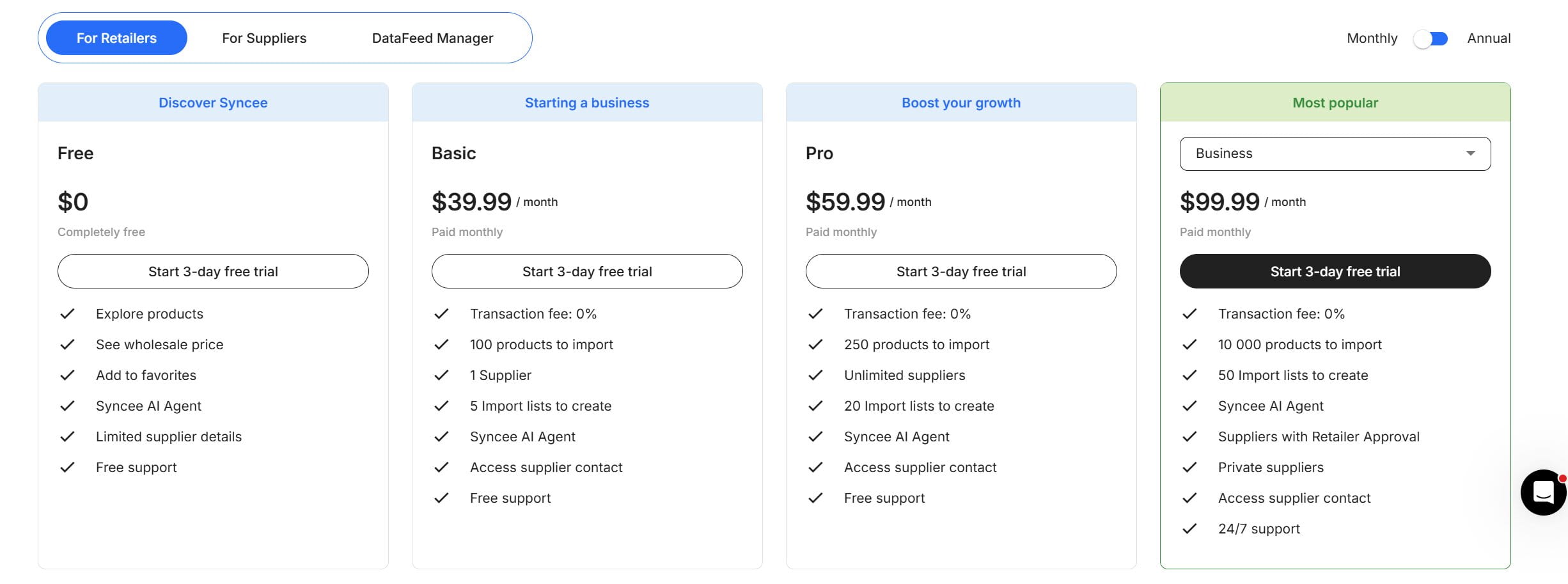
- Free: $0/month — explore the catalogue, see wholesale prices, save favourites, and use the AI agent. No importing at all, and supplier details are partially hidden.
- Basic: $39.99/month — 100 products imported, 5 import lists, supplier contact details, and 0% transaction fees. Capped at one supplier.
- Pro: $59.99/month — 250 products, 20 import lists, and unlimited suppliers. The first tier where you can actually build a multi-source catalogue.
- Business: $99.99/month — 10,000 products, 50 import lists, 24/7 support, and access to private suppliers and those requiring retailer approval.
DataFeed Manager is billed separately on its own tiers — free, then $19 for 500 products, $29 for 1,000, and $69 for 5,000. Every marketplace tier comes with a 3-day free trial, among the shortest on this page — Spocket gives 14 days and AppScenic 7. Plan what you’re testing before you start the clock.
Shipping and returns
- 3–4 business days when you filter for suppliers local to your customer.
- Return policies are set per supplier, not centrally by Syncee.
3. AppScenic — high-ticket UK and EU sourcing
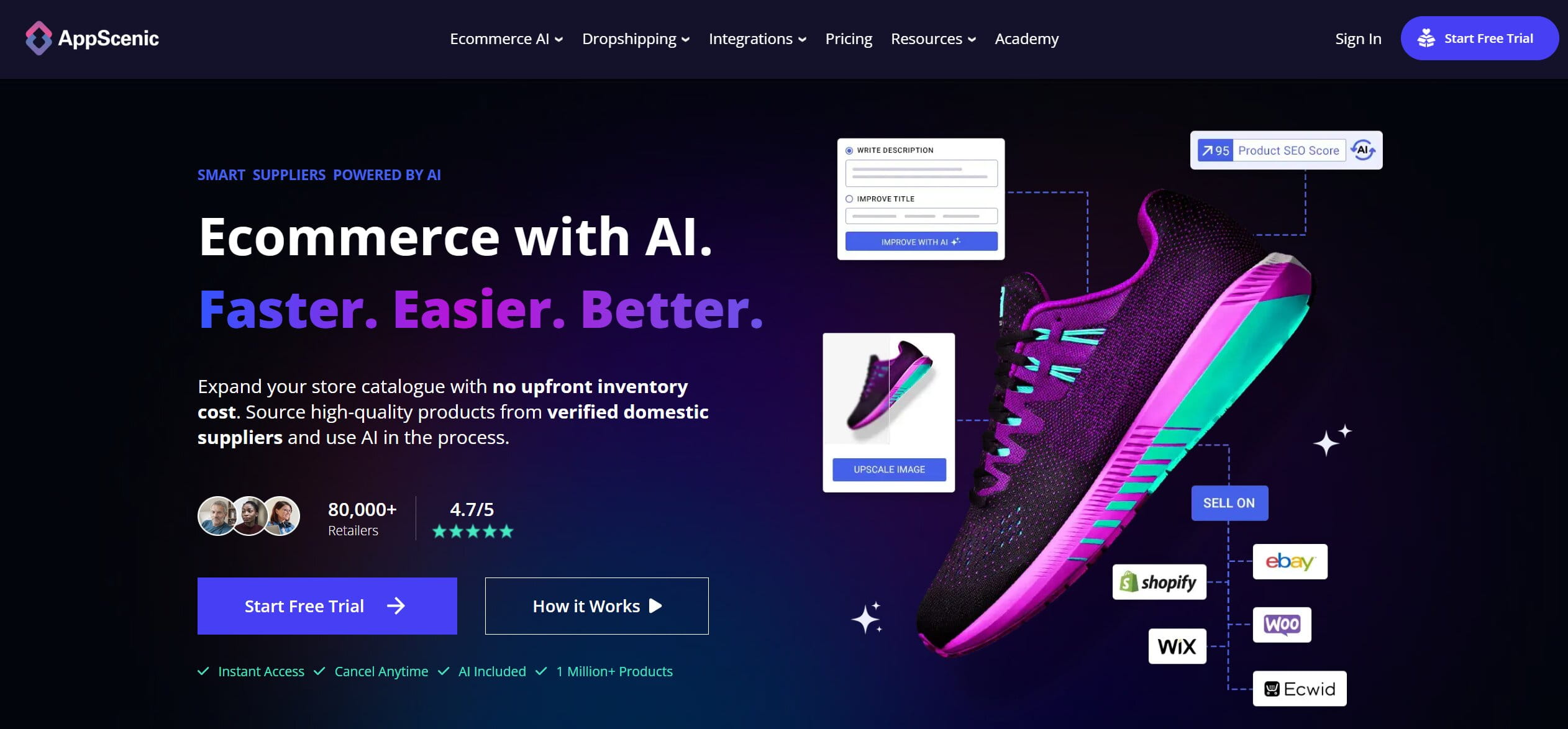
AppScenic is a UK company, registered in Huddersfield, running a catalog of over a million products from domestic suppliers across the UK, EU, US, Canada, and Australia. Delivery on local stock is 2–5 days. Its distinguishing feature is depth in high-ticket categories most platforms don’t touch — furniture, designer décor, expensive electronics — plus a wallet-based payment system with auto-funding and automated returns handling, which matters enormously when the returns in question are heavy and expensive.
Who it’s for: UK and EU sellers with working capital targeting high-ticket categories where a single sale is worth having. Not for shoestring beginners, and not for anyone who needs a free tier to place real orders.
Pros
- Strong coverage of high-ticket categories with real margin per unit.
- 2–5 day delivery from domestic suppliers across five regions.
- Automated returns, which is not a small thing on a £900 sofa.
- Instant price and stock sync with automatic ordering.
Cons
- The free tier disables ordering, sync, and tracking — it’s a shop window, not a trial.
- The Shopify App Store rating sits around 3.3, with recurring billing complaints.
- High-ticket demands working capital most beginners don’t have.
Read the reviews before you commit a card. AppScenic’s App Store rating is notably lower than everything else on this list, and the negative reviews cluster around two things: billing that continued after cancellation or after a promised pause, and out-of-stock products being pushed into stores. Neither is universal — plenty of merchants report clean automation and responsive support — but the pattern is consistent enough that you should start on the trial, watch your billing, and verify stock accuracy on a small batch before scaling.
Pricing
- Free: $0/month — one connected store and catalogue browsing, no card required. No product pushing, no orders, no price or stock sync, no tracking import.
- Standard: $39/month — one store, 100 pushed products, automatic ordering, instant price and stock sync, tracking import, and 20 AI tokens a day. No premium products.
- Pro: $79/month — three stores, 5,000 pushed products, 500 AI tokens a day, and the first tier with premium products unlocked.
- Elite: $99/month — ten stores, 20,000 pushed products, and 2,000 AI tokens a day. Custom plans are negotiable above this.
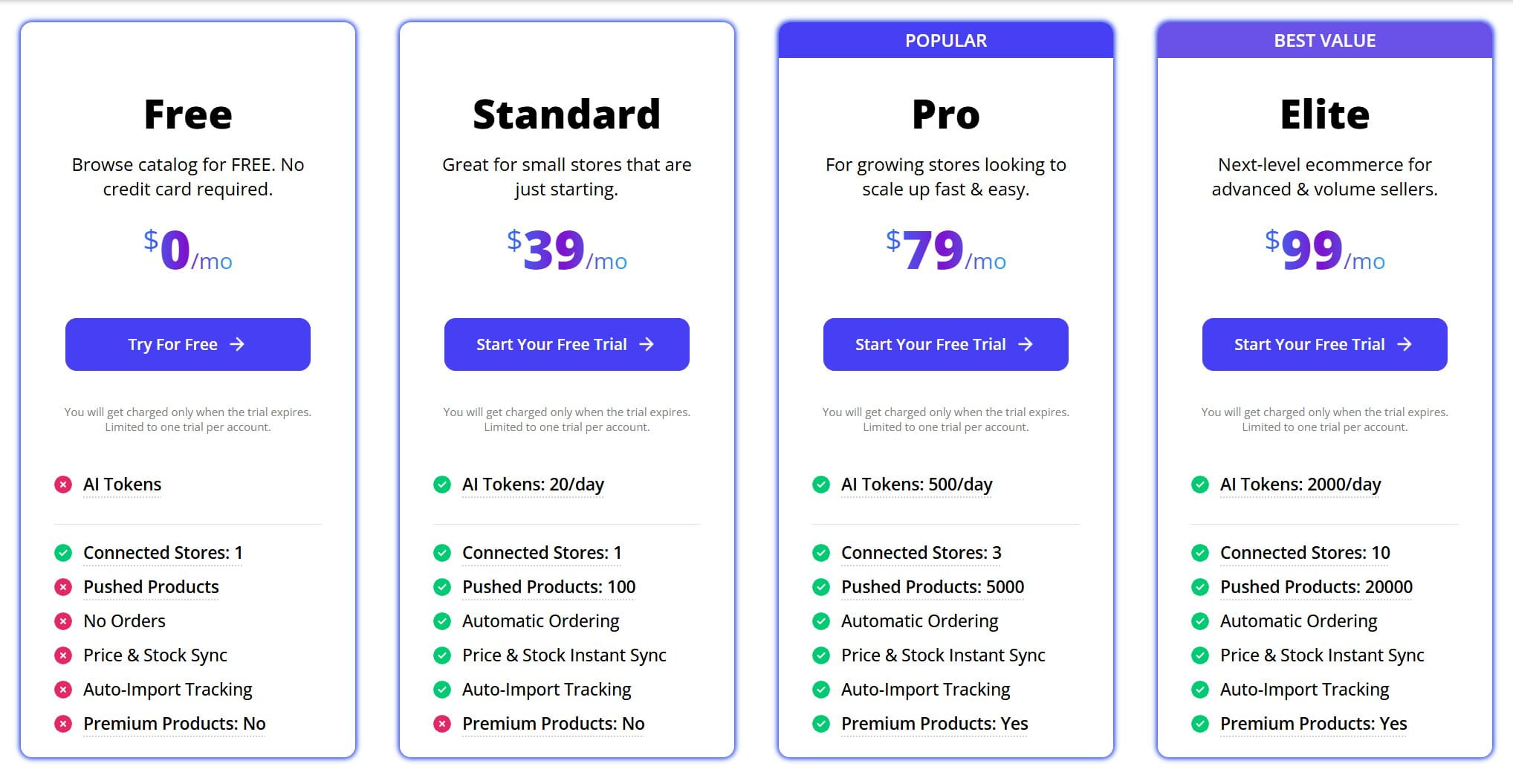
Annual billing takes 33% off every tier, which is the deepest discount of any platform here. All paid tiers come with a 7-day trial, limited to one per account, and you’re only charged when it expires.
Shipping and returns
- 2–5 business days from domestic suppliers in the UK and EU.
- Returns are automated through the platform, including collection logistics on bulky items.
4. BigBuy — the largest EU catalog, with a real entry cost
BigBuy is a Spanish wholesaler and the largest dedicated dropshipping supplier in the European market, with over 400,000 references across two dozen categories, no minimum order, and a catalog available in 24 languages. It ships across the EU in roughly 3–6 days, offers white-label packaging with your branding, and connects to Shopify through a separately purchased connector, with a multi-channel platform that also pushes to Amazon, eBay, Kaufland, Fnac and other European marketplaces.
Who it’s for: established EU-facing stores that want one large domestic catalog and can absorb an upfront cost before selling anything. A poor fit for UK-only sellers post-Brexit, and a poor fit for anyone testing an idea cheaply.
Pros
- The deepest genuinely European catalogue on this list, at 400,000+ references.
- No minimum order quantity despite being a wholesaler.
- White-label packaging with your branding included.
- Real-time stock and price sync via the Shopify connector.
Cons
- An €89 setup fee applies to every pack, including the free one.
- Post-Brexit, EU-warehoused stock still crosses a customs border into the UK.
- Margins are thinner than sourcing direct, because BigBuy is a middleman.
- The Shopify connector is a separate purchase even on the €89/month pack.
Work out the real number before you commit, because three costs stack. Every pack carries a one-off €89 setup fee, including the free B2B Pack. Shopify integration requires the Ecommerce Pack at €89 a month, because the free tier has no access to the integration platform at all. And the connector itself is an additional purchase on top of that — the pack grants the right to add one, not the connector. That makes BigBuy comfortably the most expensive way onto this page, and a scale-up decision rather than a way to test an idea.
Pricing
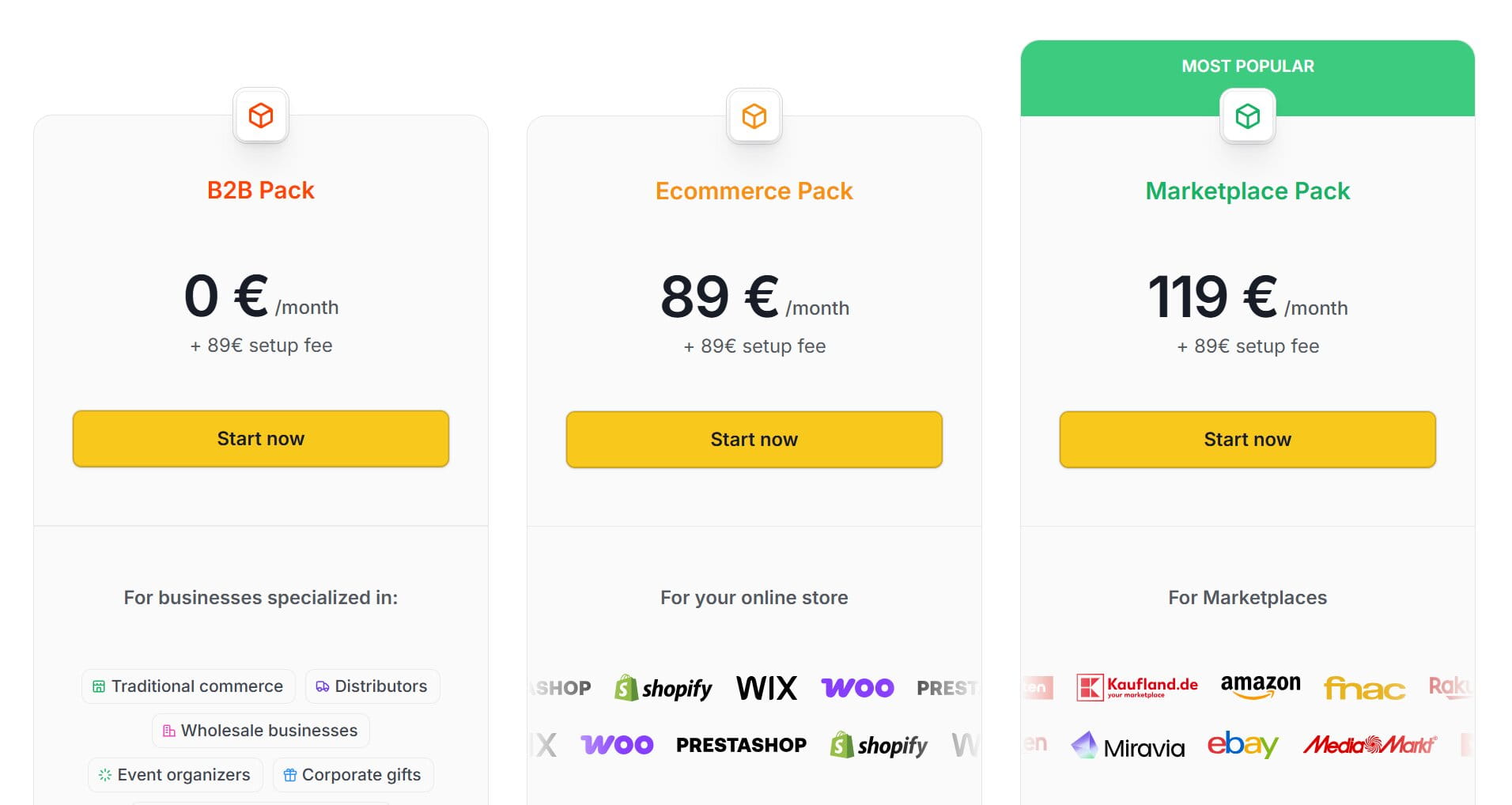
- B2B Pack: €0/month + €89 setup — the full catalogue at wholesale prices, but no integration platform, no connectors, and no ready-made stores. Aimed at physical retailers and distributors, not online sellers.
- Ecommerce Pack: €89/month + €89 setup, or €74.17/month billed annually — adds the Multi-channel Integration Platform and the ability to add Shopify, PrestaShop, WooCommerce, and Wix connectors. The tier a Shopify store actually needs.
- Marketplace Pack: €119/month + €89 setup, or €99.17/month billed annually — everything above plus marketplace connectors for Amazon, eBay, Kaufland, Fnac, Miravia, and others.
Annual billing saves 20%, there’s no lock-in and you can cancel any time — but connectors and the ready-made 360º Dropshipping Stores are billed as additional services on every pack.
Shipping and returns
- 3–6 business days across most of the EU from Spanish warehouses.
- Shipping cost tables are published per carrier and country, and are quoted with VAT included.
5. Inkthreadable — UK eco-friendly print-on-demand
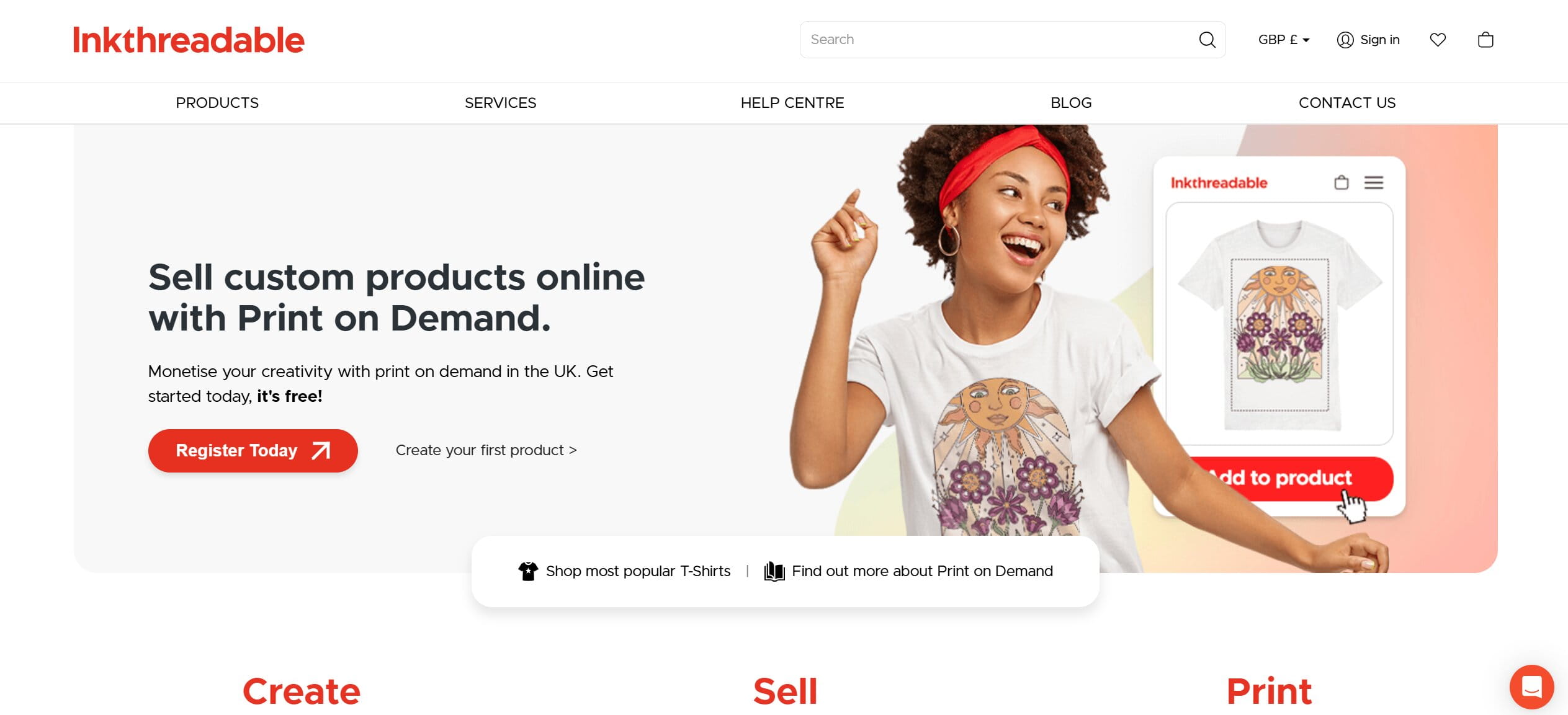
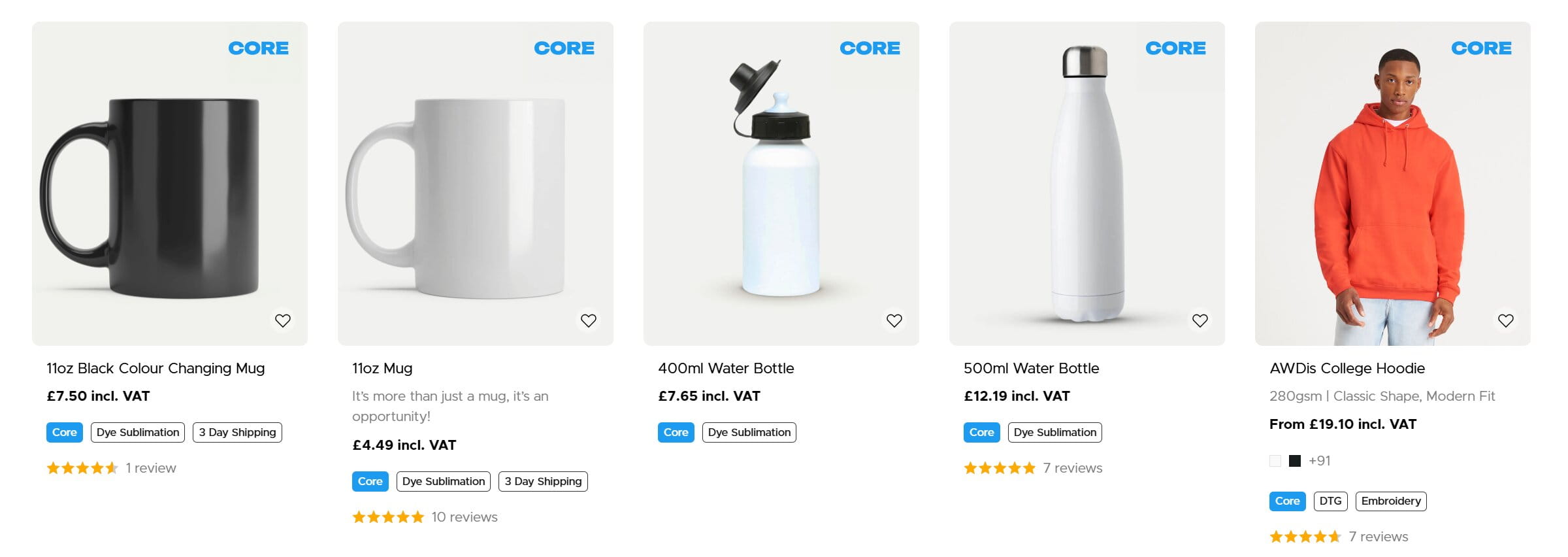
Inkthreadable is the UK print-on-demand service to reach for if sustainability is part of your brand rather than a line in your about page. It prints apparel, homeware, mugs, and prints from a single UK facility using eco-conscious materials and processes, delivers domestically in 1–5 days, and includes white-label packing slips so nothing in the parcel points back to them. It’s free to use — you pay per item as orders arrive — and the Shopify app handles fulfillment automatically.
Who it’s for: UK brands where sustainability genuinely matters to the customer and the premium is defensible. Not for stores serving US buyers, and not for anyone competing on price.
Pros
- Genuinely eco-conscious materials and processes, not greenwashing.
- 1–5 day UK delivery, the fastest POD option for British customers.
- Free to use, paying per item only.
- White-label packing slips included as standard.
Cons
- A single UK facility means slow, expensive delivery to the US.
- Base costs sit above overseas print-on-demand.
- The product catalog is narrower than Printful’s or Printify’s.
- No multi-region routing — every order prints in the same place.
Single-facility production is the structural constraint, and it cuts both ways. For a UK customer it’s the fastest option here. For an American customer it means an international parcel with the transit time and potential import charges that implies, which quietly turns your fastest supplier into your slowest. If your traffic is split across the Atlantic, run Inkthreadable for UK and EU orders and route US orders through Printful or Printify instead — the whole point of print-on-demand is that you can.
Pricing
- Free to use: £0/month — no subscription, no minimums. You pay the base product cost plus shipping per order.
Shipping and returns
- 1–5 business days within the UK, longer for EU and considerably longer internationally.
- Reprints for defects are handled directly by Inkthreadable.
6. Prodigi — UK print-on-demand for art and homeware
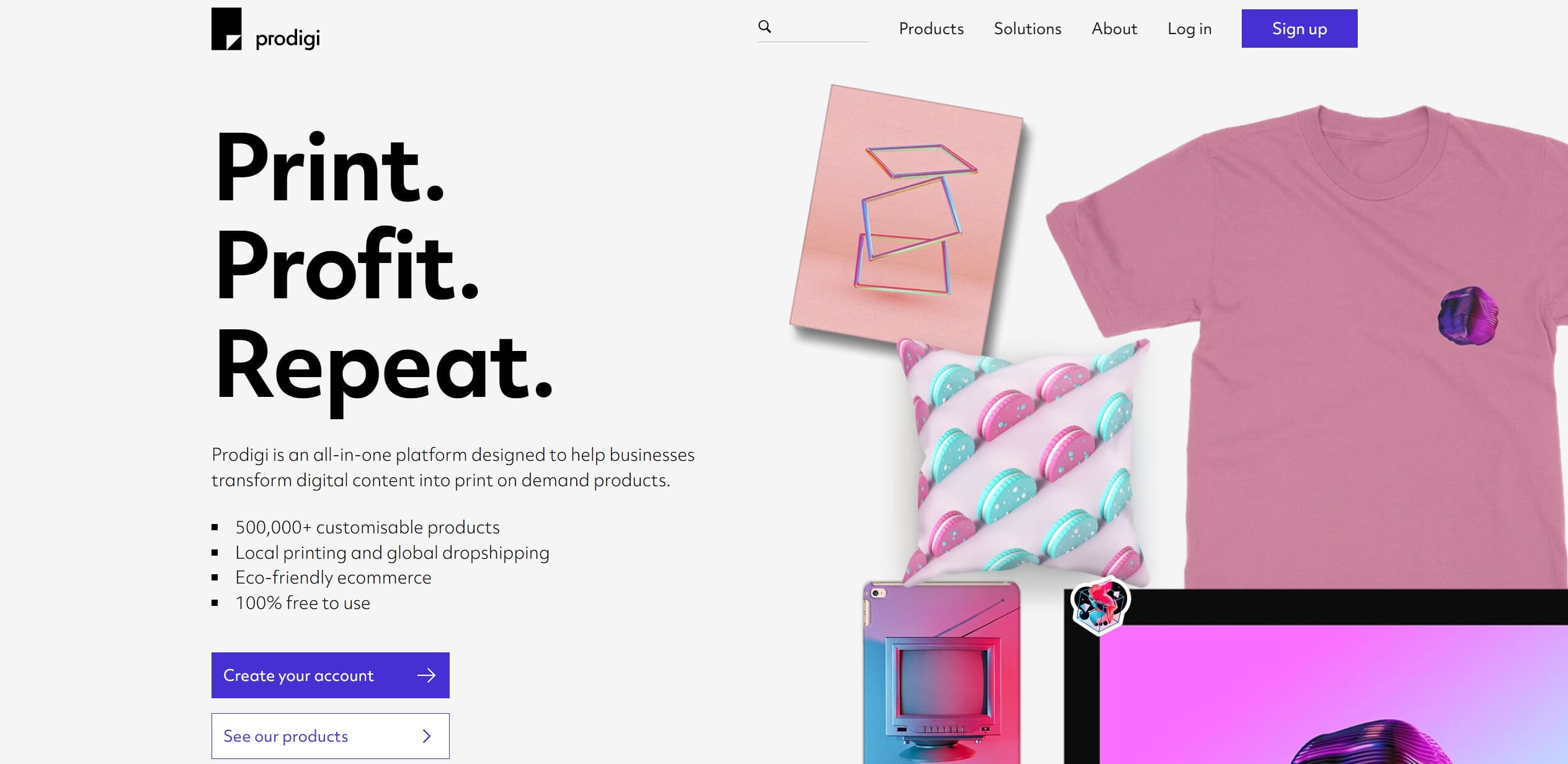
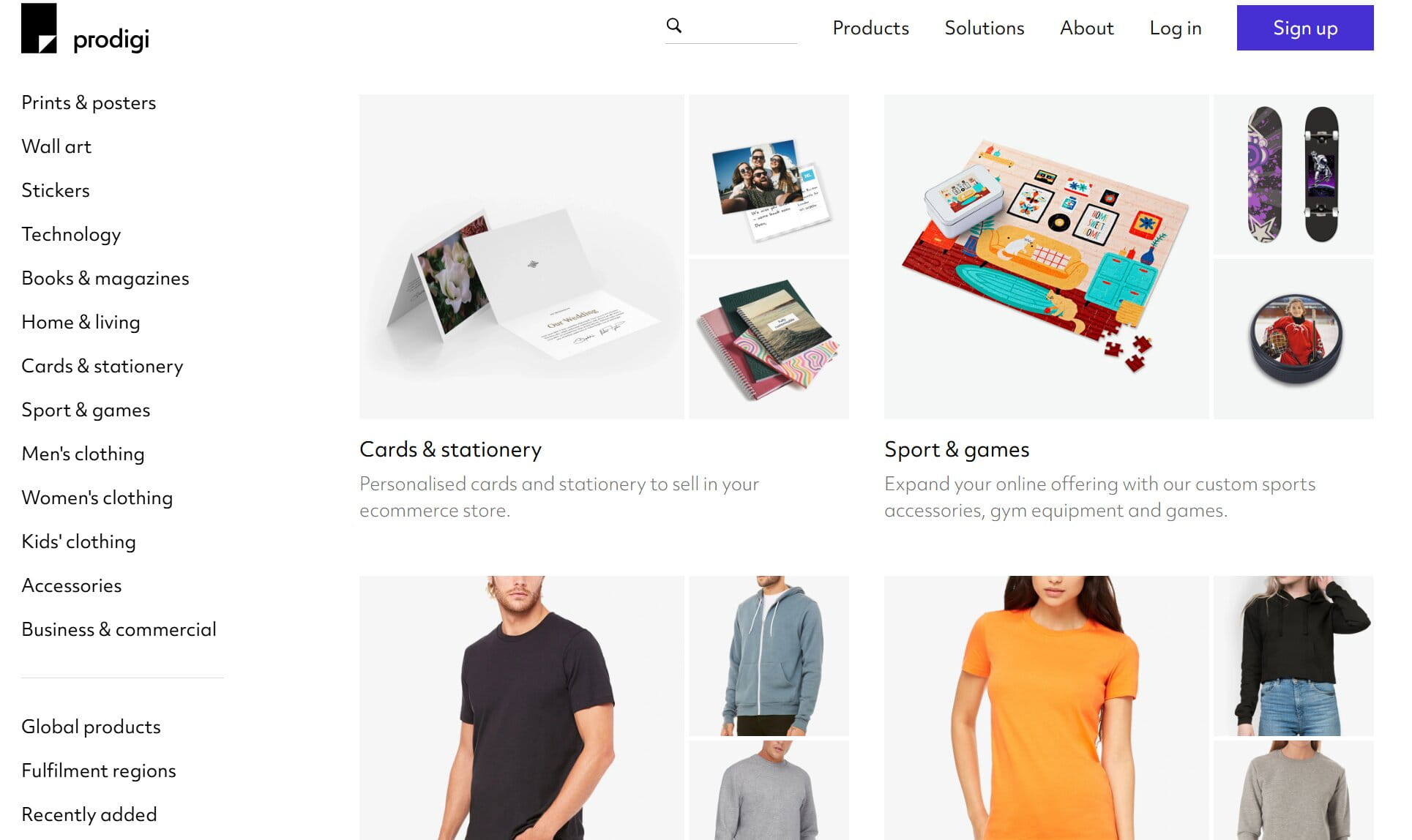
Prodigi is a Cambridge-based print-on-demand platform with a network of 50+ labs across ten-plus countries, and a catalog of more than half a million products weighted toward fine art prints, canvases, framed work, and homeware rather than apparel. There’s no subscription and no setup fee, over 80% of orders are produced within 24–48 hours, and all packaging is white-label. Print quality is the selling point — galleries and professional artists use it — and base costs generally land between Printify’s and Printful’s.
Who it’s for: artists, photographers, and homeware brands selling prints, canvases, and wall art who care about colour reproduction. A weaker fit for a t-shirt brand, where the apparel catalog is thinner than the specialists’.
Pros
- No subscription, setup fee, or monthly cost of any kind.
- 50+ labs in ten-plus countries means genuinely local production.
- 80%+ of orders produced within 24–48 hours.
- Print quality trusted by galleries and professional artists.
Cons
- You can’t create products inside the platform — listings must be built in Shopify first.
- The dashboard is dated and bulk product management is manual.
- Documentation is inconsistent and often out of date.
- Apparel selection is thin next to Printful or Printify.
The workflow is backwards from every other POD platform, and reviewers say the help guides don’t warn you. On Printify or Printful you design inside the platform and push a finished product to Shopify. On Prodigi you create the listing manually in Shopify first, then configure it in Prodigi to link the artwork to the fulfilment. It works fine once you understand it, but people arrive expecting the standard flow, import their whole catalog by accident, and lose an afternoon. Set up two products by hand before you commit to the platform.
Pricing
- Free: $0/month — no subscription, no setup fees, no minimums. You pay the base product cost plus shipping per order, billed in USD.
Shipping and returns
- Production in 24–48 hours for the large majority of orders, then 2–4 days for UK delivery from a UK lab.
- International orders fulfilled from a distant lab cost more to ship, so route by customer location.
7. Hertwill — European brands with a sustainability angle
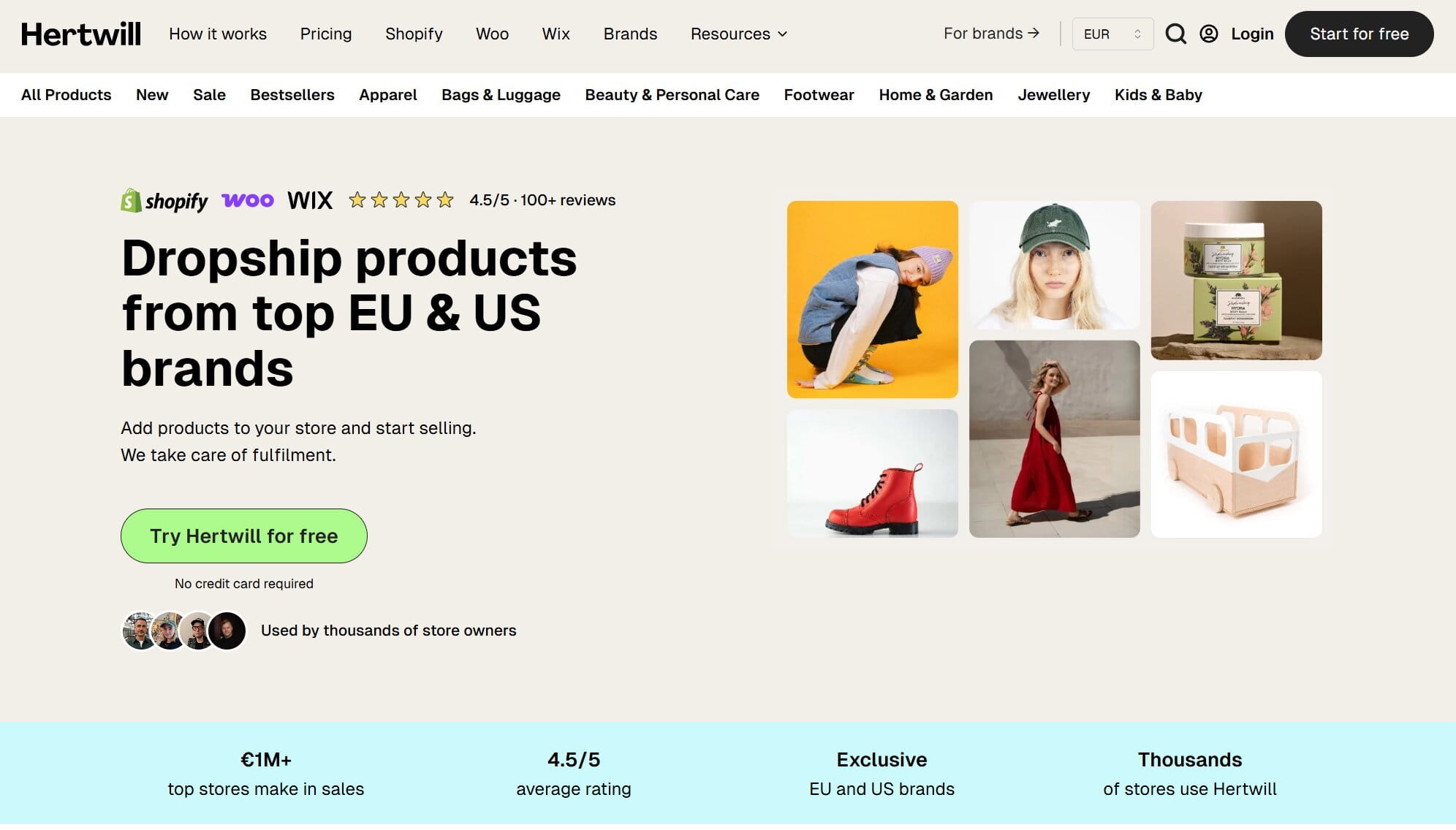
Hertwill is a European supplier platform offering access to independent brands whose products are almost entirely manufactured in Europe rather than imported and relabelled. Everything is warehoused in the EU for fast regional delivery, the catalogue spans apparel, footwear, bags, jewellery, beauty, home and garden, and kids’ products, and products carry a two-year warranty — a level of backing you simply don’t get from an aggregator. It sits around 4.9 stars on the Shopify App Store and the entry tier lets you start free.
Who it’s for: EU-facing stores building a brand around European manufacturing and product quality. Not for anyone who needs catalog breadth or the lowest possible unit cost.
Pros
- Around 95% of products manufactured in Europe, not imported.
- Two-year warranty on products, which is rare in dropshipping.
- Free tier lets you list your first products without paying.
- EU warehousing gives 3–7 day regional delivery.
Cons
- Most products carry another brand’s logo, limiting your own branding.
- The catalog is medium-sized and won’t support a general store.
- Product prices are high, reflecting European manufacturing.
- UK delivery crosses a customs border post-Brexit.
The branding constraint is the honest limitation. Because you’re reselling real European brands rather than white-label stock, the product arrives with someone else’s name on it. That’s a feature if your positioning is “curated European goods” and a problem if you’re trying to build a house brand — you’re a retailer here, not a label. Decide which one you are before you build a store around it.
Pricing
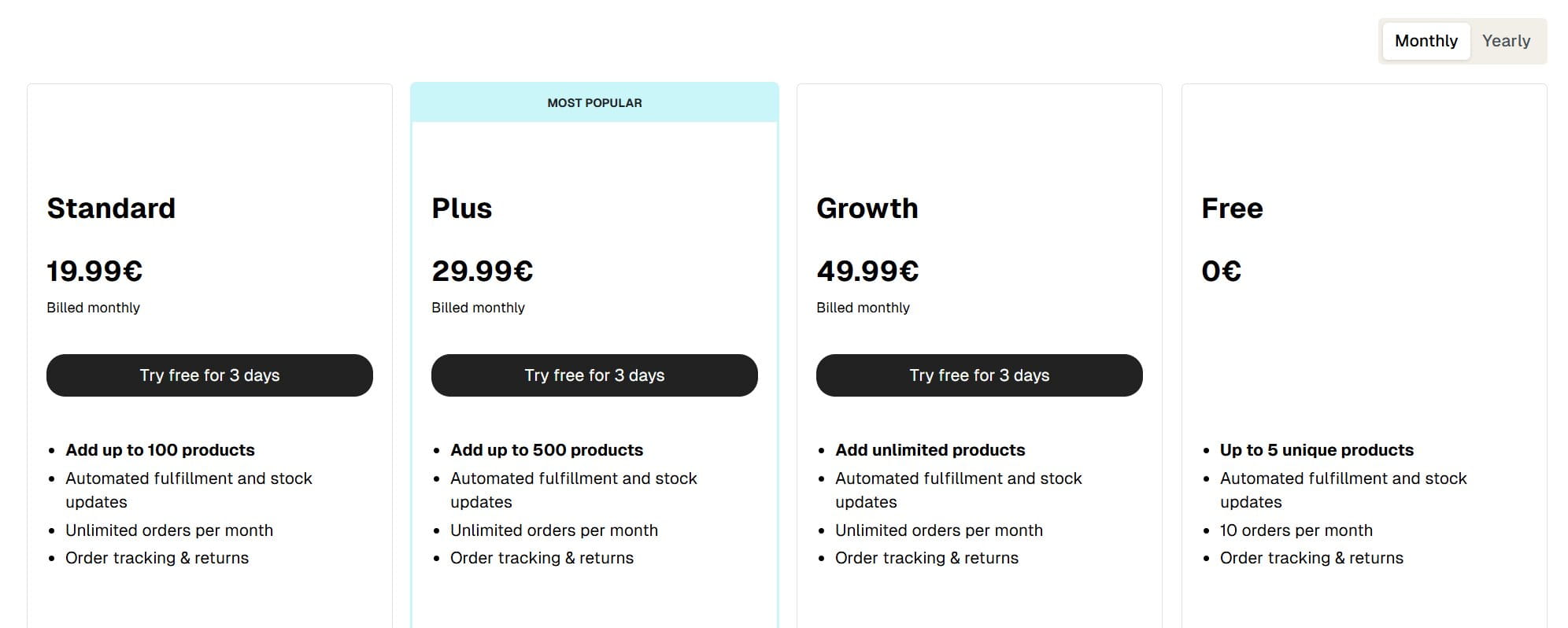
- Free: €0/month — 5 unique products and 10 orders a month, with automated fulfilment, stock updates, and order tracking included. A genuine free tier, but the order cap makes it a test rather than a business.
- Standard: €19.99/month, or €12.99 billed yearly — 100 products and unlimited orders.
- Plus: €29.99/month, or €17.99 billed yearly — 500 products and unlimited orders.
- Growth: €49.99/month, or €32.99 billed yearly — unlimited products and unlimited orders.
Yearly billing saves 34–40% depending on tier, and every plan starts with a 3-day free trial. The paid tiers differ only in how many products you can list — fulfilment, stock sync, tracking, and returns are identical on all of them, including the free one.
Shipping and returns
- 3–7 business days within the EU from European warehouses.
- Two-year product warranty, handled by the brand rather than by you.
8. SaleHoo — supplier research, not a supplier
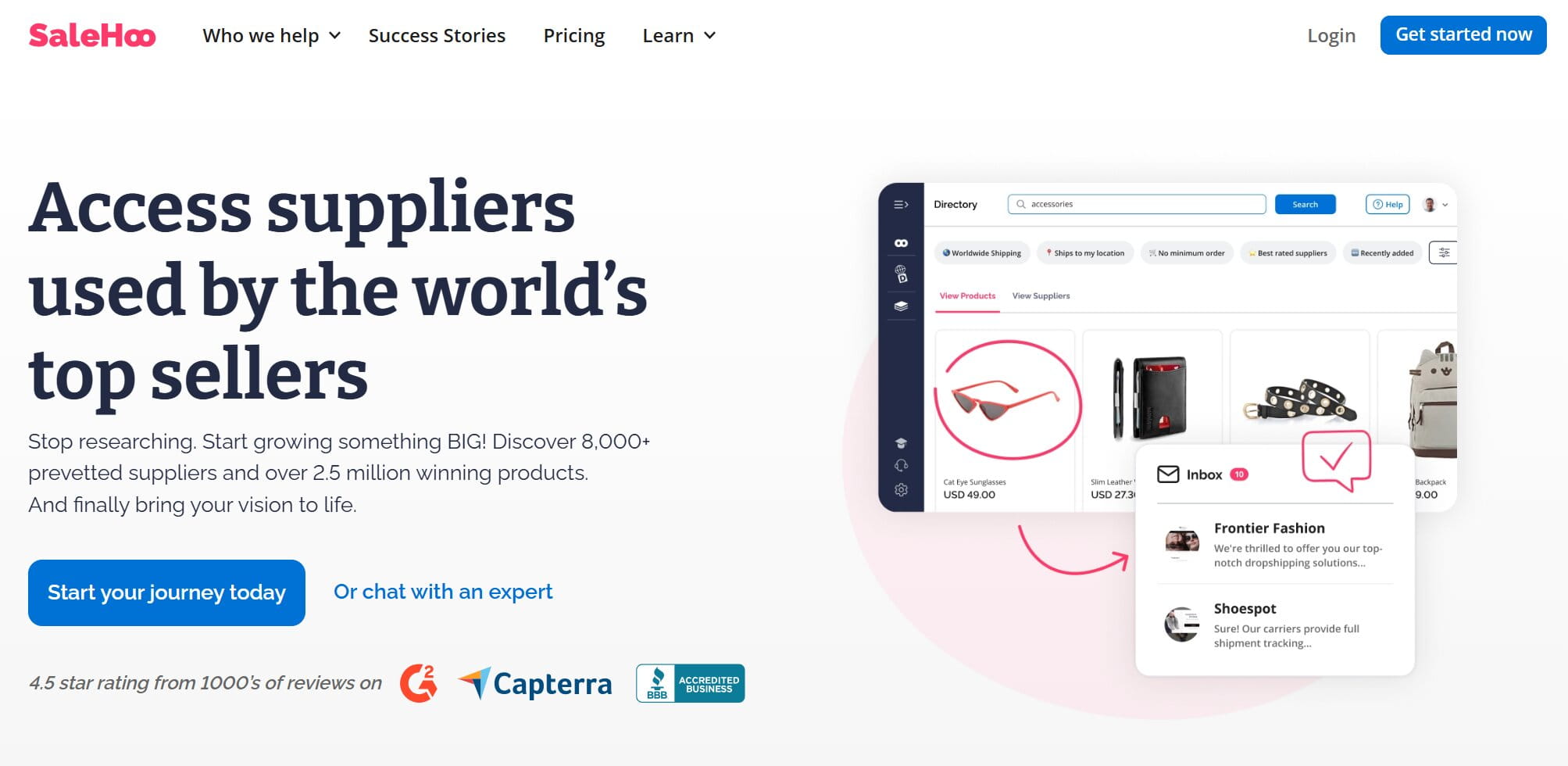
SaleHoo started as a supplier directory and has since grown into something closer to a platform: 8,000-plus vetted suppliers and 2.5 million products, searchable by location and category, with Shopify integration and monthly product imports built into every tier. The research side is still the strongest part — a market insights tool for checking demand before you commit, pre-generated supplier reports, and a profit calculator — and at $9 a month it’s the cheapest thing on this page by a wide margin.
Who it’s for: sellers who want to build direct relationships with suppliers, including UK wholesalers who don’t run Shopify apps. Not for anyone expecting plug-and-play automation.
Pros
- $9/month is the lowest entry price of any platform here, by a factor of four.
- 8,000+ suppliers vetted before listing, which cuts scam risk substantially.
- Market research tools for validating demand before sourcing.
- A lifetime option saves 60% against annual billing if you plan to stay.
Cons
- Supplier contacts are capped at 100 a month on Starter, and imports at 200.
- Only one connected Shopify store on Starter; three on Pro.
- Supplier depth varies considerably by category.
- Fulfilment still runs through each supplier — SaleHoo connects you, it doesn’t ship.
The monthly figures are annual-billing prices, which is the thing to notice. Starter at $9 means $108 charged upfront for the year, not nine dollars to try it — there’s no monthly option on the page at all. The alternative is the lifetime toggle, which saves 60% against annual and makes sense only if you’re confident you’ll still be sourcing through SaleHoo in two years. Neither route lets you spend a small amount to find out whether the supplier list suits your niche.
Pricing
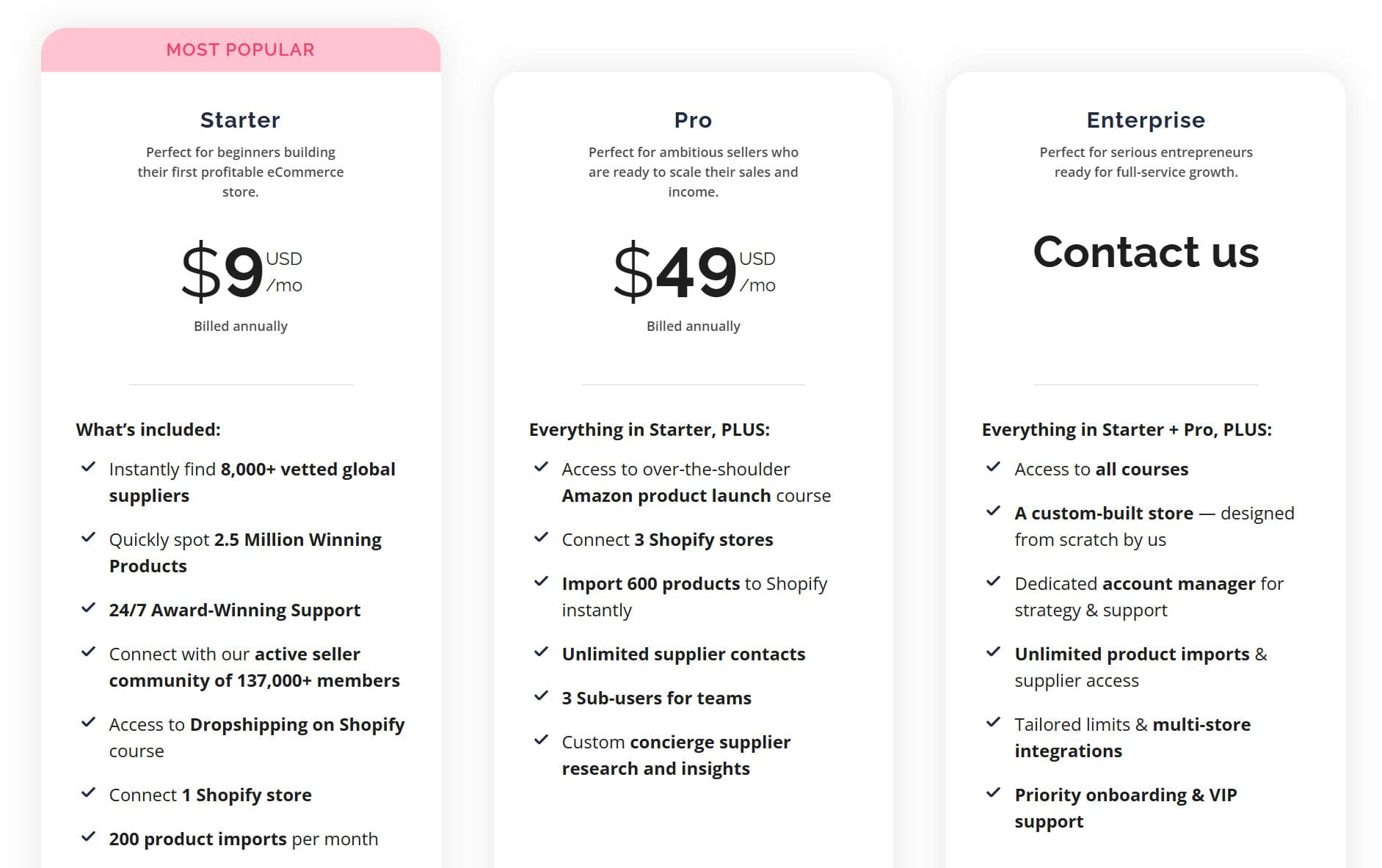
- Starter: $9/month billed annually — 8,000+ vetted suppliers, 2.5 million products, one connected Shopify store, 200 product imports and 100 supplier contacts a month, the Shopify dropshipping course, market insights, and a profit calculator.
- Pro: $49/month billed annually — three Shopify stores, 600 product imports, unlimited supplier contacts, three sub-users, the Amazon launch course, and concierge supplier research.
- Enterprise: custom pricing — a store built for you from scratch, a dedicated account manager, unlimited imports and supplier access, multi-store integrations, and VIP support.
A lifetime plan is available in place of annual billing at a 60% saving, and every plan is cancellable at any time.
Shipping and returns
- Set entirely by the supplier you choose — SaleHoo connects and imports, but doesn’t fulfil or handle returns.
9. TheWholesaler.co.uk — the free UK directory
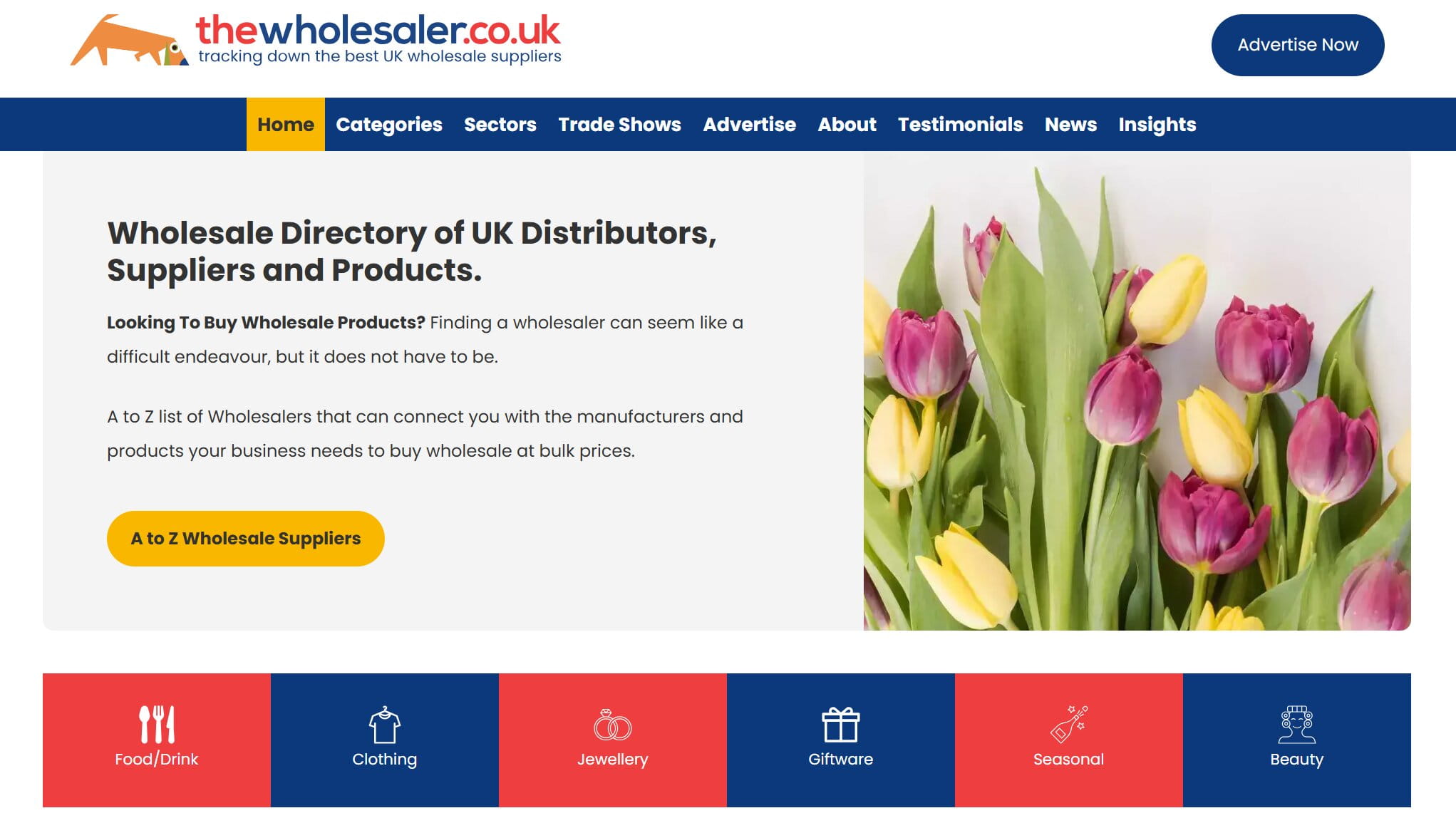
TheWholesaler.co.uk is a long-running free directory of UK wholesalers and dropshippers, organised by category — clothing, gifts, homeware, accessories. There’s no app, no sync, and no automation: you browse listings, contact suppliers directly, and set up whatever arrangement you can negotiate. Its value is finding genuinely small British suppliers who will never appear on Spocket or Syncee, which is exactly what you want if you’re trying not to sell the same products as everyone else.
Who it’s for: UK sellers hunting for distinctive domestic products and willing to do manual sourcing work to get them. Not for anyone who needs their catalog running this week.
Pros
- Free to browse, with no subscription at all.
- Genuinely UK-focused, including small suppliers absent from the platforms.
- Good category organisation for niche hunting.
Cons
- No Shopify app, no stock sync, no order automation.
- Listings vary in quality and freshness, and some suppliers are inactive.
- You vet every supplier yourself, with no platform protection.
- Manual CSV work or a third-party tool is required to keep stock accurate.
Pricing
- Free to browse and contact suppliers. The £25–£395 pricing listed on the site is what suppliers pay to get listed and promoted in the directory — not something you pay to use it.
Shipping and returns
- Negotiated individually with each supplier.
10. eSources — UK wholesale directory with a paid tier
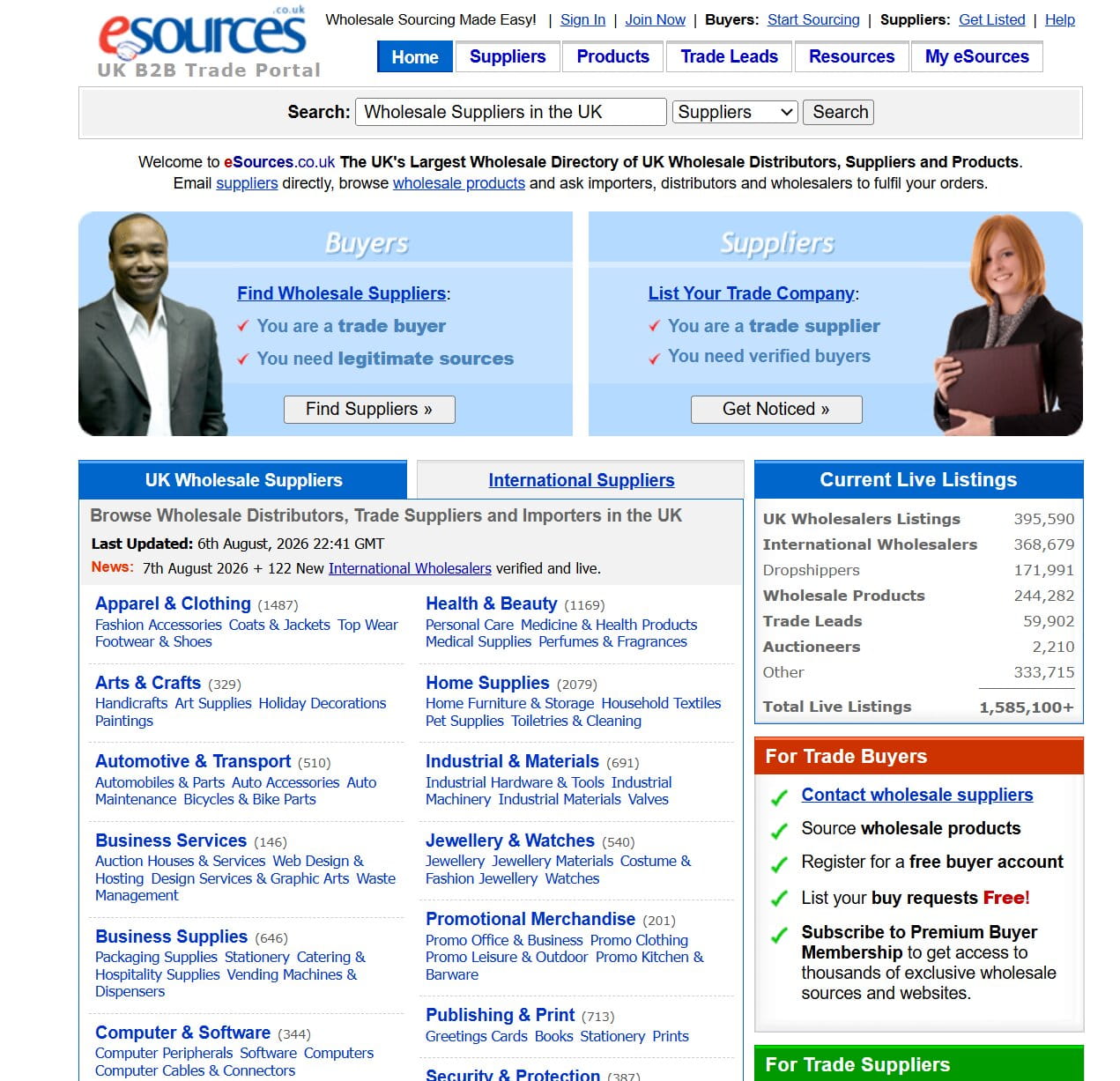
eSources is one of the largest UK-focused wholesale and dropship directories, covering clothing, home and garden, gifts, and general merchandise. The basic tier is free with limited access; a paid subscription unlocks full supplier contact details and verified listings. Like TheWholesaler, it’s a research tool rather than an operational one — there’s no integration, and everything after the introduction is your job.
Who it’s for: sellers doing serious supplier research in the UK who want verified contact details and will handle integration themselves.
Pros
- Large UK-focused supplier base with verified listings on the paid tier.
- Free basic access for initial research.
- Covers wholesale as well as dropship, useful once you graduate to buying stock.
Cons
- No automation whatsoever — directory only.
- Full contact details require a paid subscription.
- Listing quality is uneven and vetting is on you.
- Nothing about the interface has changed in years.
Pricing
- Free: basic buyer or supplier registration, with limited access either way.
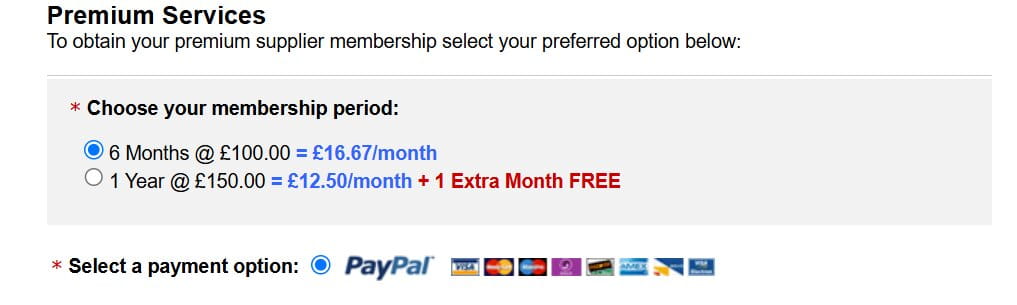
- Premium Supplier membership: £100 for 6 months (£16.67/mo) or £150 for the year (£12.50/mo, plus a free extra month) — confirmed on the registration page.
- Premium Buyer access, which is what unlocks full supplier contact details, has historically run around £20–25/month or £75/year, though eSources doesn’t display current buyer pricing until you register — worth double-checking before committing.
Shipping and returns
- Negotiated individually with each supplier.
Picking a supplier by what your store optimises for
There isn’t one best supplier, there’s a best supplier for the thing you’re trying to win at. This table is the shortcut.
| What you’re optimising for | Worth starting with | Why |
|---|---|---|
| Fast US shipping | Spocket, Zendrop, Trendsi | Domestic warehouses with 2–5 day delivery and native Shopify apps |
| Fast UK shipping | Avasam, AppScenic, Inkthreadable | UK-warehoused stock that skips post-Brexit customs entirely |
| Lowest entry cost | Shopify Collective, CJ Dropshipping, Trendsi | No subscription at all — you pay only when an order comes in |
| Print-on-demand | Printful, Printify, Prodigi | Printful for quality, Printify for base cost, Prodigi for art and homeware |
| Fashion and boutique | Trendsi, Modalyst, Avasam | Curated clothing and accessories with photography included |
| High-ticket and furniture | AppScenic, BigBuy | Real margin per unit, plus automated returns on bulky items |
| Broad product testing | CJ Dropshipping, Syncee, Wholesale2B | Large catalogs for validating a niche before narrowing down |
| Beginners | Zendrop, Spocket, Syncee | Easiest to connect and the least manual supplier management |
| EU coverage | Syncee, BigBuy, Hertwill | Stock held inside the customs union, so no border on every parcel |
| Sustainability positioning | Inkthreadable, Hertwill | Eco materials and European manufacturing that survives scrutiny |
| Niche UK sourcing | TheWholesaler.co.uk, eSources, SaleHoo | Directories surface small British suppliers the platforms never list |
Global marketplaces: AliExpress, Alibaba, and where they fit
These stay central to sourcing despite the slow shipping, because nothing beats them on catalog breadth or per-unit price. That makes them the right place to test ideas, not necessarily to build a brand on.
AliExpress is the obvious one: an enormous catalog at rock-bottom prices, with shipping to the US typically running 15–25 days and dispute rates noticeably above domestic sourcing. DSers is the tool most people use to pull products into Shopify — it’s the official successor to Oberlo, handles variant mapping and bulk ordering, and will auto-swap to a backup supplier when your primary runs dry on a variant. Its free tier covers three stores and up to 3,000 products, which is genuinely enough to validate a product before spending anything. Use AliExpress to find out whether something sells. Don’t anchor a premium store to it.
Alibaba plays a different role entirely. It’s wholesale and private-label territory: higher minimum orders, much lower per-unit cost at volume, and the ability to put your own branding and packaging on the product. This is where you graduate a proven winner, not where you start. It suits an established store with cash to commit upfront and a product it already knows sells.
CJ Dropshipping sits between the two, which is why it appears in the US list rather than here — broad catalog, branding options, and warehouses in the US and Europe that turn a China-sourced operation into something closer to domestic on your best SKUs.
The way to combine them: keep your core, ad-spend products with a fast domestic supplier, and reserve the global marketplaces for experiments and unique SKUs your local suppliers don’t stock. When something proves itself, move it local — or private-label it through Alibaba — for better margins and speed.
Vetting a supplier before you trust your store to it
Rushing this is one of the more expensive mistakes in ecommerce, because a bad supplier doesn’t cost you a few orders. It costs you reviews, repeat buyers, and every pound of ad spend you burned driving traffic to a product that arrived late or wrong.
Shortlist properly. The Shopify App Store is a decent first filter — sort by rating and read the recent reviews rather than the summary, since platforms change and a 4.8 average can hide a bad six months. Cross-check against directories like SaleHoo and eSources, and against what people are actually saying in dropshipping communities.
Contact and test. Ask the unglamorous questions: average handling time, return policy, who pays return shipping, whether they’ll do branded packaging or custom invoicing, and what happens when something arrives damaged. Then order one or two samples before a single product goes live. Check the postmark, not just the box — it’s the fastest way to catch a supplier claiming domestic shipping while fulfilling from overseas.
Confirm the technical fit. Native Shopify app, API, or at minimum a CSV or XML feed, and check it works with whatever automation you’re running for stock and price sync. A supplier with great products and no reliable feed is a manual job pretending to be a partnership.
Do the maths before you commit. Landed cost is product plus shipping plus customs and duties plus packaging, measured against your realistic selling price — not your hoped-for one.
As a beginner, lean on one to three solid suppliers for stability. Add depth later, when you have the processes and automation to handle five or ten without things slipping.
Red flags that should make you slow down
- Vague or unspecified shipping times, or delivery promises that seem too good for the price.
- No published return policy, or one that puts every cost on you.
- Mismatched or inconsistent product photos, often lifted from other listings.
- No way to order a sample before committing.
- Fees that only appear at checkout or after you’ve subscribed.
- Support that takes days to answer a pre-sales question — it will not improve once you’re a customer.
- No stock-update mechanism, meaning you find out about stockouts from your customers.
- Inability to say clearly where products ship from or who handles a damaged item.
If a supplier can’t answer where products ship from, how returns work, and how inventory syncs, treat the non-answer as your answer.
Running several suppliers in one Shopify store
Most stores that survive their second year are running three or four suppliers at once — a domestic source for the products carrying ad spend, an overseas source for testing, a print-on-demand partner, and something regional. That’s normal, and Shopify handles it fine. What Shopify doesn’t do on its own is decide which supplier fulfils which order, and that gap is where the expensive mistakes live.
The mechanics matter before you add a second supplier. Shopify tracks inventory per location, and each supplier app typically registers itself as a location. When two suppliers stock the same SKU, Shopify doesn’t merge those quantities intelligently — it either sums them, which oversells, or you list the product twice, which splits your reviews and confuses your analytics. Neither is what you want. The fix is a routing decision made deliberately, once, per product.
A workable routing logic looks like this:
- Assign a primary supplier per SKU, not per catalog. The same product can have different primaries in different regions.
- Route by customer location first. US orders to the US warehouse, UK orders to the UK supplier, EU orders to whichever supplier sits inside the customs union. This is the single biggest lever on delivery time.
- Set a fallback supplier per SKU for stockouts, with an explicit rule for what happens when the fallback is slower — usually a notice on the order rather than a silent substitution.
- Configure Shopify shipping profiles per product, so the delivery estimate at checkout matches the supplier who will actually ship. A store mixing 2–5 day domestic stock with 10–25 day overseas stock must say so on the product page; hiding it converts slightly better and refunds significantly worse.
- Standardise product data across sources. If one supplier shoots on white backgrounds and another uses lifestyle photos, edit them into one style. A store pulling from five sources should still look like one brand.
Keeping multiple dropshipping suppliers in sync with Easync
Sourcing from one supplier by hand is fine. Running a US apparel supplier, a UK homeware wholesaler, an overseas source for testing, and a print-on-demand partner simultaneously is not, and it fails in specific, expensive ways: a supplier raises a price and you find out after selling at a loss, or something goes out of stock and you keep selling it for two days before anyone notices.
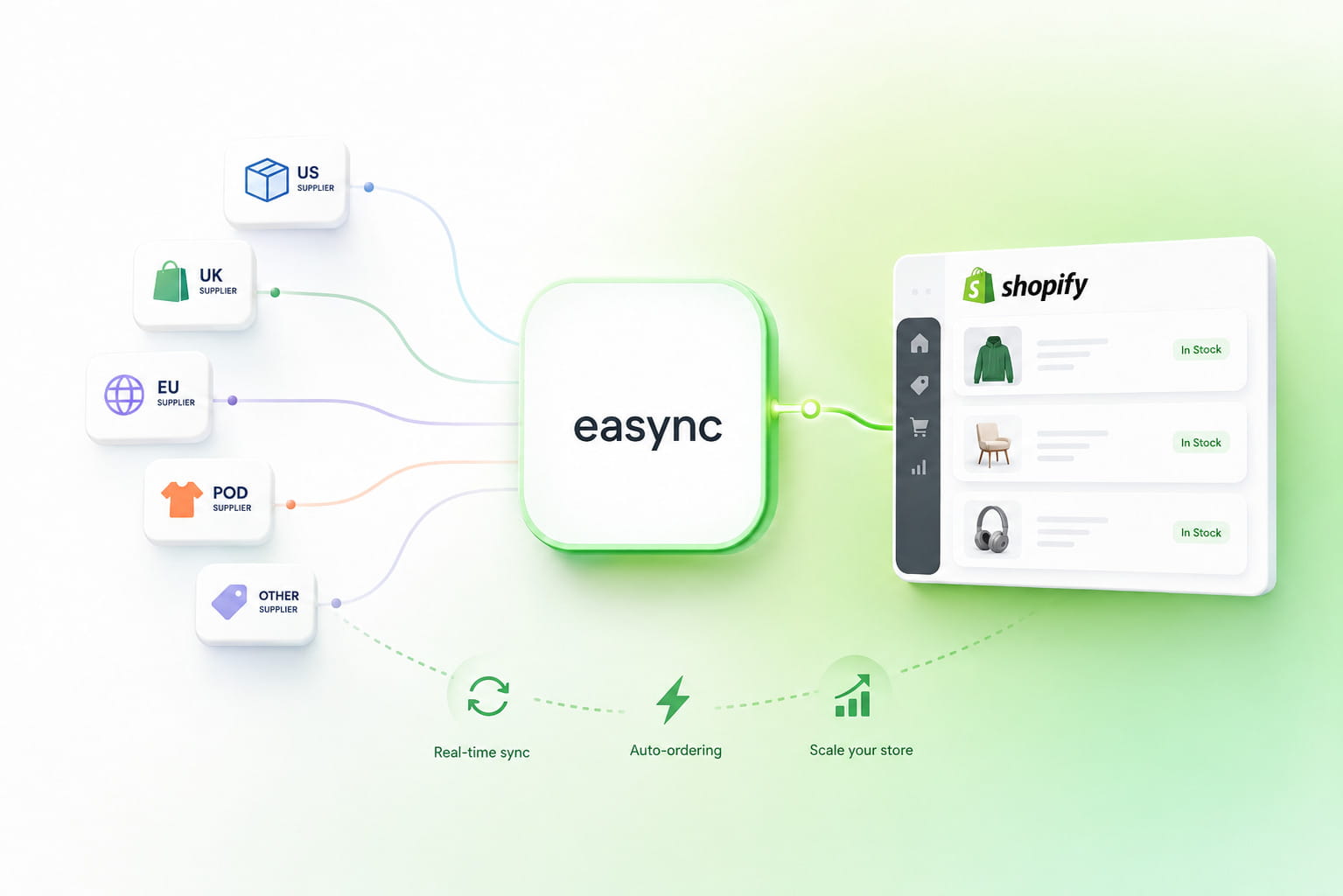
That’s the gap automation software like Easync is built to close. Rather than babysitting each supplier’s catalog, you point it at them and let it carry the repetitive work:
- Bulk imports from different marketplaces and suppliers into Shopify, with formatting unified so your listings don’t look like they came from five different stores.
- Real-time stock and price monitoring, so when a supplier bumps a price or sells out, your Shopify listing updates on its own rather than overselling.
- Auto-ordering with tracking sync — a customer buys, the order goes to the right supplier, and the tracking number is pushed back to Shopify for the customer notification.
- Repricing rules tied to a target margin, so when supplier costs drift your selling price follows instead of quietly eating the difference.
- Separate workflows per supplier account or store, managed from one dashboard.
Put plainly: at a handful of orders a week, skip this. At dozens of orders a day across several suppliers, the difference between a side project and a business is usually whether the imports, stock sync, and order routing run themselves while you work on marketing. The pattern we see consistently is that stores surviving their first scaling spike are the ones that automated stock and price sync before the volume hit, not after they’d oversold something on a Friday night. AutoDS is the other option worth comparing, in a similar price band.
One caveat applies to every tool in this category: automation reduces mistakes, it does not transfer responsibility. You remain the seller of record. The software stops you overselling; it does not answer your customers or absorb your chargebacks.
Learn more: How to Add a Shopify Store in Easync
Working out whether a product can carry your costs
Before you commit to a supplier for a given product, run the stack. Most people calculate product cost plus shipping, compare it to the retail price, and call the difference margin — which ignores roughly a third of what actually leaves your account.
| Line item | Example |
|---|---|
| Retail price | $39.99 |
| Product cost | $14.00 |
| Supplier shipping | $6.50 |
| Duties or import charges, if the parcel crosses a border | $0.00 |
| Packaging or branded insert | $0.40 |
| Payment processing (2.9% + $0.30) | $1.46 |
| Platform subscription ÷ monthly orders | $0.60 |
| Total landed cost and fees | $22.96 |
| Contribution before advertising | $17.03 |
That contribution figure is the number that matters, because it sets your ceiling on customer acquisition. Subtract your target profit from it and you have your maximum viable CPA: aiming for a 15% net margin on this product means keeping about $6.00, which leaves roughly $11.00 to acquire the customer. If your real CPA is $14, the product doesn’t work — and no amount of ad optimisation fixes a structural gap. You change the supplier, the price, or the product.
Two lines catch people out. The subscription line looks trivial at 100 orders a month and becomes significant at 20 — a $59.99 plan is $0.60 per order in the first case and $3.00 in the second, which is why paid platforms punish low volume disproportionately. And duties belong in the table whenever stock crosses a border, including EU-warehoused goods heading to UK customers post-Brexit. Decent stores currently target 15–30% net margin, with the best pushing past 30% through branding, bundling, and delivery speed.
FAQ
What’s the best free dropshipping supplier for Shopify?
Shopify Collective is the only one that costs literally nothing — no subscription, no commission, no markup — but it requires Shopify Payments and a supported country. Beyond that, CJ Dropshipping is the strongest general option: no monthly fee, product and shipping cost only, with a US warehouse and a native app. Trendsi is free too if you sell women’s fashion, and Printful, Printify, and Prodigi cost nothing until an order is placed. Read the fine print though: free platforms often recover the cost through higher per-unit prices, and some “free” tiers, including Zendrop’s and AppScenic’s, can’t fulfil a live order at all.
Do I need a resale certificate to dropship in the US?
In most states, yes, if you want to avoid paying sales tax on goods you’re reselling. A resale certificate tells your supplier you’re buying for resale rather than consumption, so they don’t charge you tax that you’d then also collect from the customer. Requirements are state-level: you’ll usually need a sales tax permit in your home state first, and some states won’t accept an out-of-state certificate. You also need to understand economic nexus — once your sales into a state cross its threshold, you’re obliged to register and collect there regardless of where you’re based. This is genuinely a question for an accountant rather than a blog post, because the penalties for getting it wrong accrue quietly.
What changed for Shopify dropshipping in the UK after Brexit?
Three things that matter operationally. First, you need an EORI number to move goods between the UK and EU — a GB EORI for UK imports, and a separate EU one if you’re shipping into the bloc. Second, VAT is now collected at the point of sale on consignments under £135 into the UK, which means registering for UK VAT and charging it at checkout rather than letting it land as a surprise on the customer’s doorstep. Third, goods crossing the border need commodity codes and customs declarations, which your supplier handles if they’re set up for it and doesn’t if they aren’t. The practical consequence is the one this guide keeps returning to: for UK customers, a UK-warehoused supplier sidesteps all three. Rules change, so verify current thresholds with HMRC rather than trusting any article, including this one.
Will switching suppliers on a winning product hurt my SEO?
Not if you do it carefully. Keep the same product URL, handle, title, description, and structured data — change only the inventory source, the cost, and if necessary the images. That preserves everything you’ve earned. The mistake that costs rankings is creating a new listing for the new supplier and either deleting the old one or leaving both live. If the URL has to change, set a 301 redirect from the old handle to the new one and expect a temporary dip. Also worth knowing: swapping images alone can affect image search traffic, so if the old photos ranked and the product is genuinely identical, keep them.
How do I handle a mixed cart, where one order pulls from two suppliers?
You split the fulfilment and you tell the customer. Shopify supports partial fulfilment natively, so one order can generate two shipments with two tracking numbers — that part is mechanical. The part people get wrong is the communication: a customer who ordered two items and receives one, with no explanation, opens a support ticket or a dispute. Configure your notification emails to explain that the order ships in two parcels, and set shipping profiles so the checkout estimate reflects the slower of the two suppliers rather than the faster. On print-on-demand, watch this closely — mixed-provider orders on Printify incur separate shipping charges per provider, which quietly destroys bundle economics.
Who pays when an overseas supplier ships a damaged item?
You do, initially, and then you try to recover it. The customer’s contract is with you, not your supplier, so you refund or replace first and argue with the supplier second. How recoverable that is depends entirely on who you picked: platforms that centralise returns, like Zendrop or Avasam, will process a claim. Marketplace-style platforms where each supplier sets their own policy — Spocket, Syncee, Modalyst — mean your recovery rate varies vendor by vendor. Always photograph damage on receipt, always claim within the supplier’s window, and never promise a replacement timeline you can’t control. For overseas suppliers specifically, returning the physical item usually costs more than the item is worth, so most sellers refund without requesting a return and treat it as a cost of the sourcing decision.
Can I use US and UK suppliers in the same store?
Yes, and plenty of stores do. What makes it work is routing: US customers to the US supplier, UK customers to the UK one, with shipping profiles configured accordingly. Done properly it cuts delivery times and sidesteps most customs and VAT complications, because each parcel stays domestic. Done carelessly — one supplier serving both markets — you’re shipping internationally on every second order and absorbing the delays and duties that follow.
How many suppliers is too many?
One to three keeps life manageable for a beginner. Experienced sellers run five to ten comfortably, but almost always with automation handling stock sync and order routing rather than doing it by hand. Past ten, complexity climbs faster than revenue: more tracking issues, harder support, weaker quality control, and a real risk that nobody notices a supplier degrading until the reviews arrive. If you’re heading there, documented processes stop being optional.
A supplier keeps shipping late or sending wrong items — what now?
Document first: dates, order numbers, photographs. Escalate through their support with specifics rather than complaints. In parallel, pull ad spend off their products immediately, because you’re currently paying to generate bad experiences. Line up a backup supplier or an alternative SKU so you can redirect orders within a day rather than a week. If it doesn’t improve after a documented escalation, replace them — no single supplier is worth your store’s reputation, and the sunk cost of setting them up is smaller than the cost of one bad month.
Are there categories I should just avoid?
Yes. Counterfeit or IP-infringing goods, medical devices, unregulated cosmetics and supplements, and anything that trips Shopify’s acceptable use policy or your payment processor’s rules. Electricals need genuine compliance documentation — FCC in the US, UKCA or CE in the UK and EU — and a warranty path, because faulty electronics generate the most brutal returns. Oversized and fragile items carry high damage rates that make the margin maths unreliable. Before listing anything borderline, check Shopify’s policy and the regulations in your target market; losing a payment processor is substantially worse than missing a product opportunity.