
- articles
Doba Dropshipping Reviews 2026: Worth It? + Alternatives
Quick Verdict
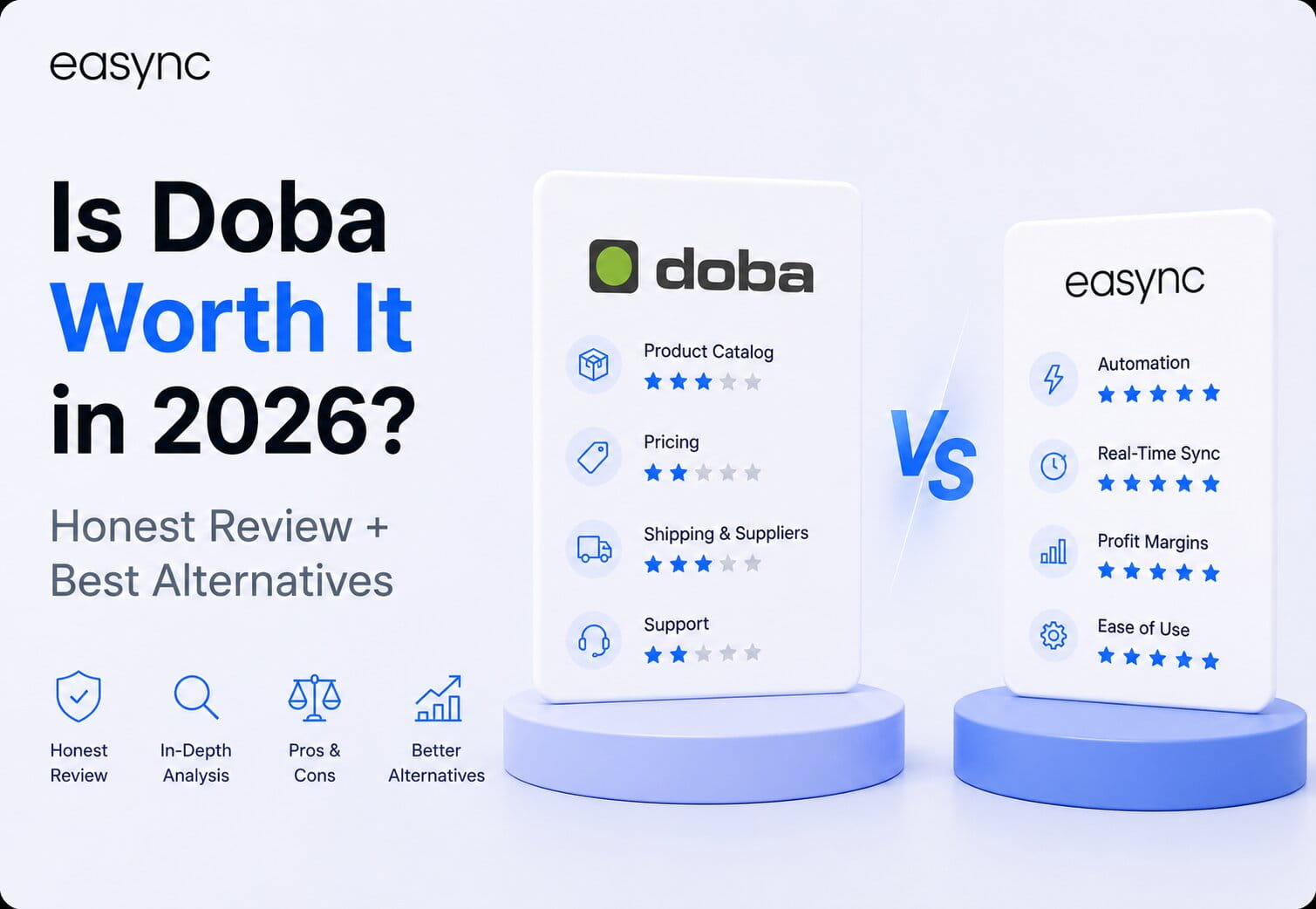
Is Doba Dropshipping worth it? For most sellers, not in 2026. Doba is a legitimate dropshipping platform with mostly US-based suppliers, more than 20 years in business and an A+ rating from the BBB. But its plans start at $29.99 per month for just 30 listings, many supplier prices sit close to retail, and the dashboard keeps pushing offers, pop-ups and AI tools. Doba is rated 2.9 out of 5 on Trustpilot and 4.3 on the Shopify App Store. It makes the most sense for sellers who run several stores and value fast US shipping more than margin.
Doba Dropshipping is a long-running marketplace that sets itself apart with a curated network of suppliers (mostly US-based), fast shipping and AI-powered tools for ecommerce. However, many ecommerce business owners find Doba hard to justify because of its plan prices, product costs and uneven product quality.
In this Doba review, I go through Doba dropshipping reviews from real users and add my own test to see whether Doba is still worth it in 2026 or whether you should switch to another platform. For the test, I connected Doba to my Shopify store and explored its products, suppliers, AI features and listing automations. Below you will also find current Doba pricing, pros and cons, and the best Doba alternatives.
What is Doba Dropshipping and How Does it Work?
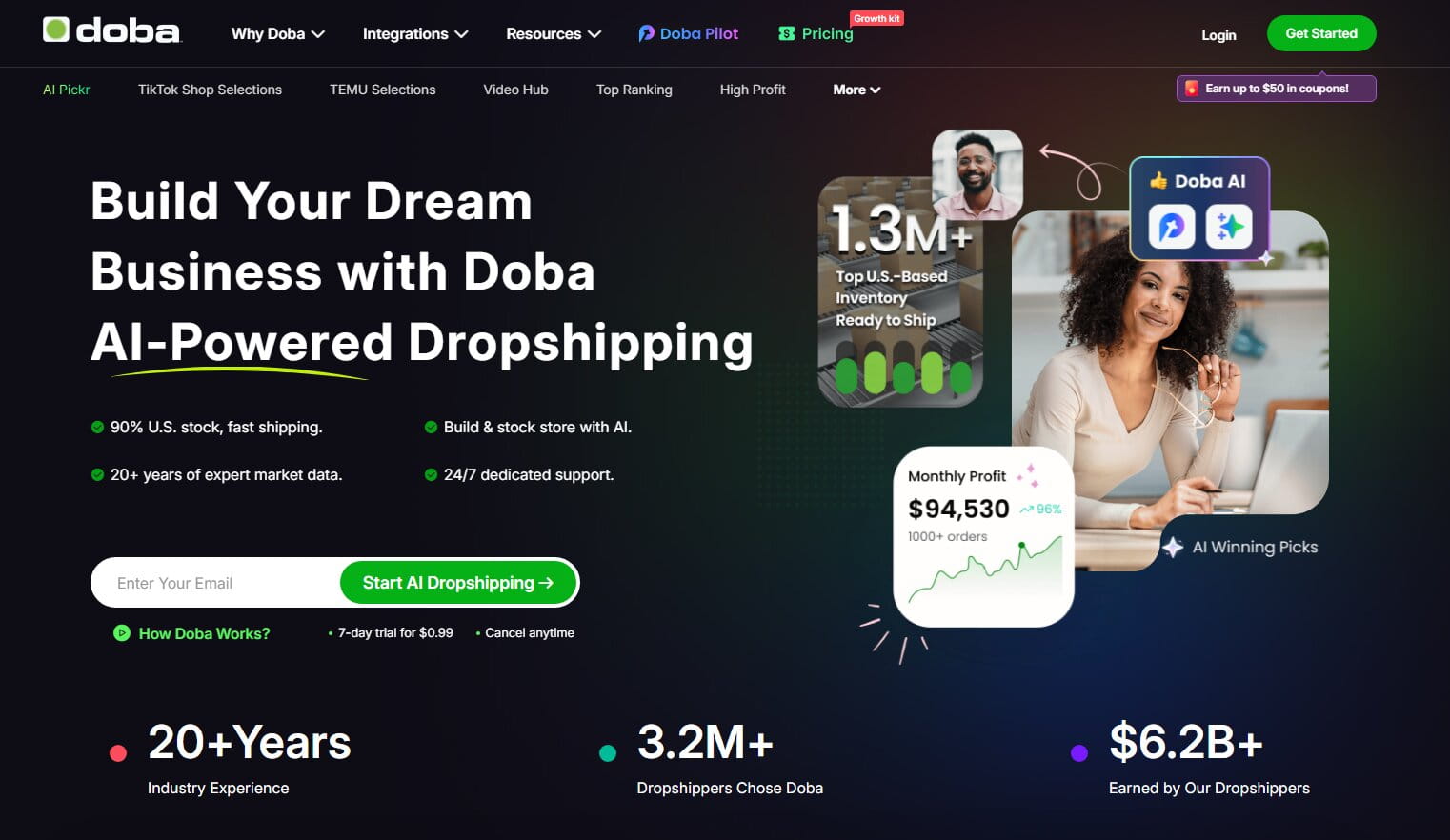
Doba is a dropshipping platform that lets you choose products from pre-vetted, mostly US-based suppliers, auto-list them to your store, manage orders and make sales, all through one dashboard. It connects to Shopify, eBay, Walmart, BigCommerce and other platforms.
A bit about Doba itself: the Doba company started in 2002 and is based in Lehi, Utah. Today Doba Inc. is owned by Focus Technology Co., Ltd., the company behind Made-in-China.com.
Doba sits between you and the suppliers. Doba says its supplier network is vetted for quality, delivery and reliability, and that the Doba marketplace gives you access to over 1 million SKUs, about 90% of them stocked in US warehouses. You browse the catalog, add products to your inventory list and push them to your store with a pricing rule (for example, 15% over the wholesale price). Incoming orders from Shopify, eBay, Wix and other connected stores sync to Doba, the supplier ships the item to your customer, and tracking information is sent back to your store.
Sellers can manage multiple storefronts and handle all orders from one dashboard. You only pay for a product after a customer orders it in your store, and the supplier then ships it directly to the buyer. In my test, I had to confirm and pay for each order in Doba before the supplier processed it.
My Review: Using Doba with Shopify Integration
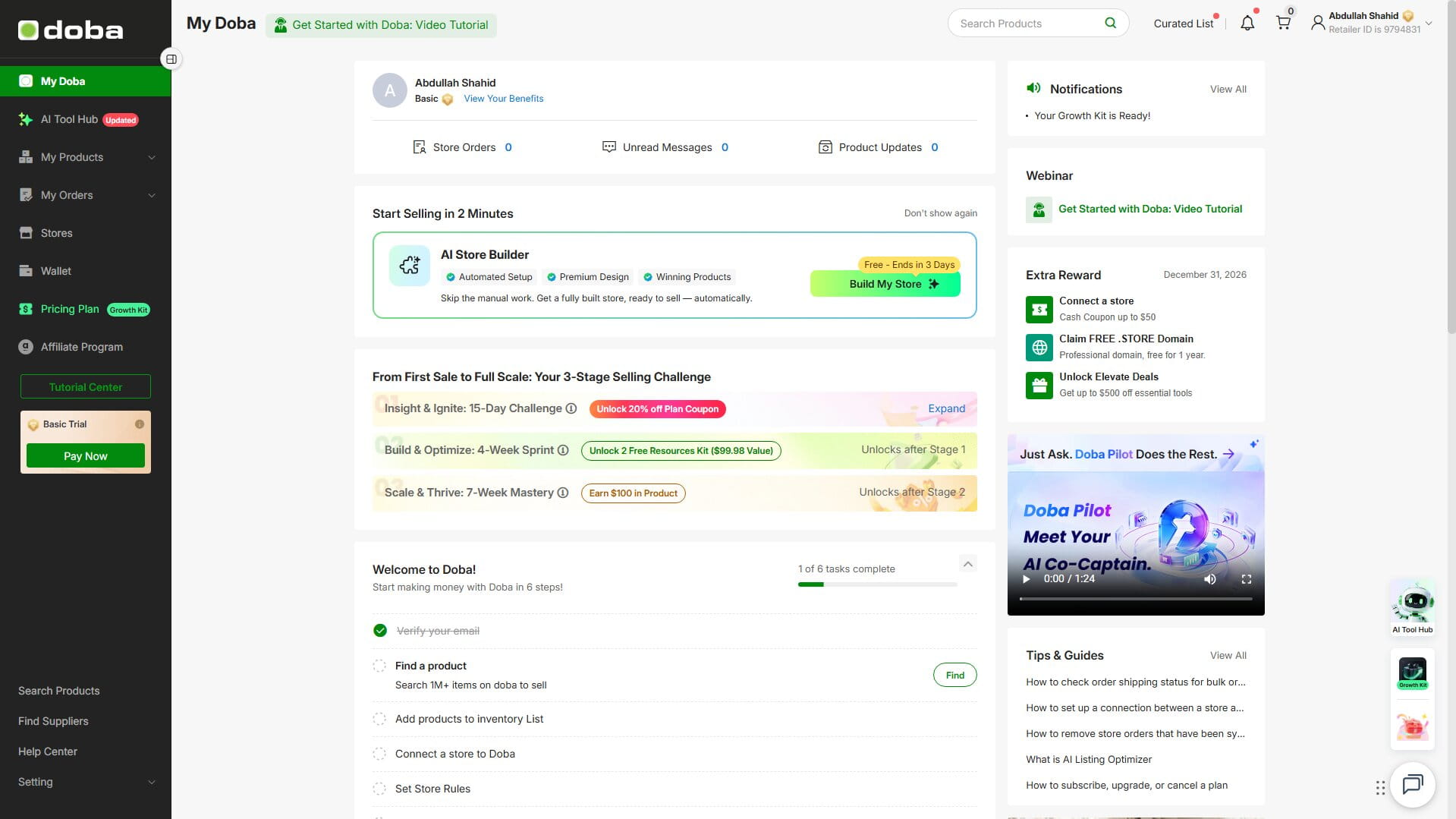
I connected my Doba account to Shopify for testing, since Doba and Shopify is the most common setup, and my impressions are mixed. Doba is a legit dropshipping platform, but the overall experience was very average.
Storefront Integration
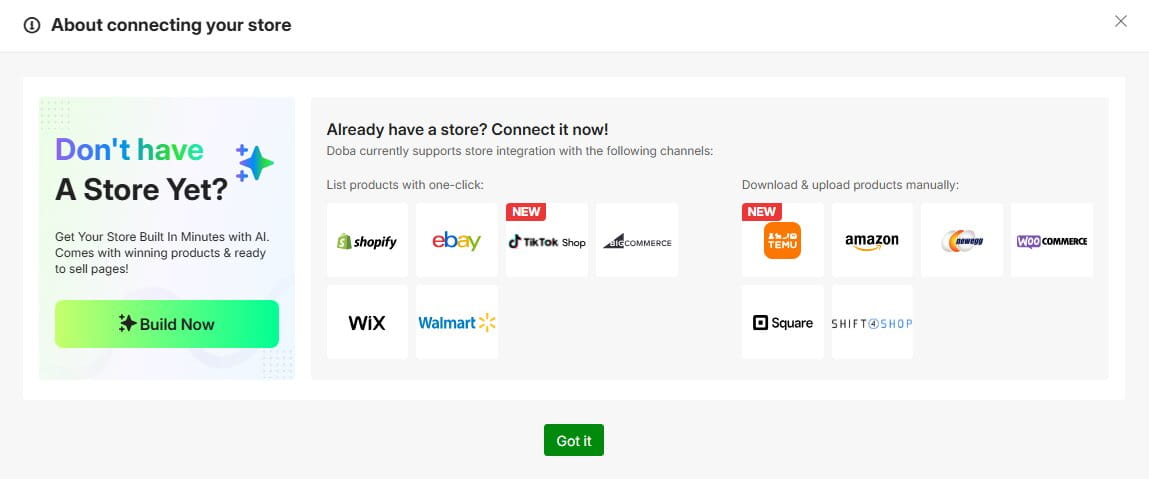
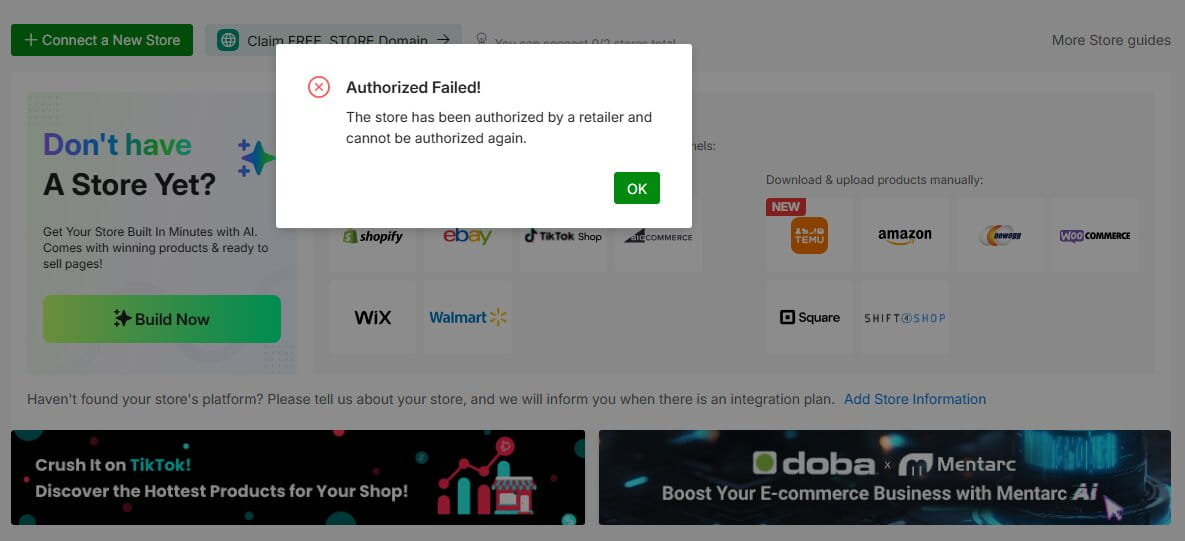
Doba splits its integrations into two groups. Shopify, eBay, TikTok Shop, BigCommerce, Wix and Walmart support one-click listing, so products go from Doba to your store directly. For Temu, Amazon, Newegg, WooCommerce, Square and Shift4Shop, you download product data from Doba and upload it to the store yourself. Product downloads are not included in the Limited plan, so these channels need Basic or higher. Doba has confirmed that its WooCommerce integration still syncs inventory, orders and tracking, but one Trustpilot reviewer complained that the lack of one-click listing was not clear before paying. Platforms Doba does not connect to at all, such as Squarespace, also have to work with downloaded product data.
Doba’s Shopify Integration Has a Bug
Their account linking logic seems flawed. I signed up on Doba with an email account, and they asked for $0.99 for a trial of their Basic plan. I paid for it, went to Shopify and tried connecting it. My Shopify account was registered under a different email. I installed the Doba Shopify app on my store and opened it. It automatically created another Doba account under my Shopify email, and I could not connect my original Doba account to my Shopify store. My payment was wasted, but at least the Shopify-connected account offered a free trial without asking for $0.99.
Doba Products, Listing and Sync
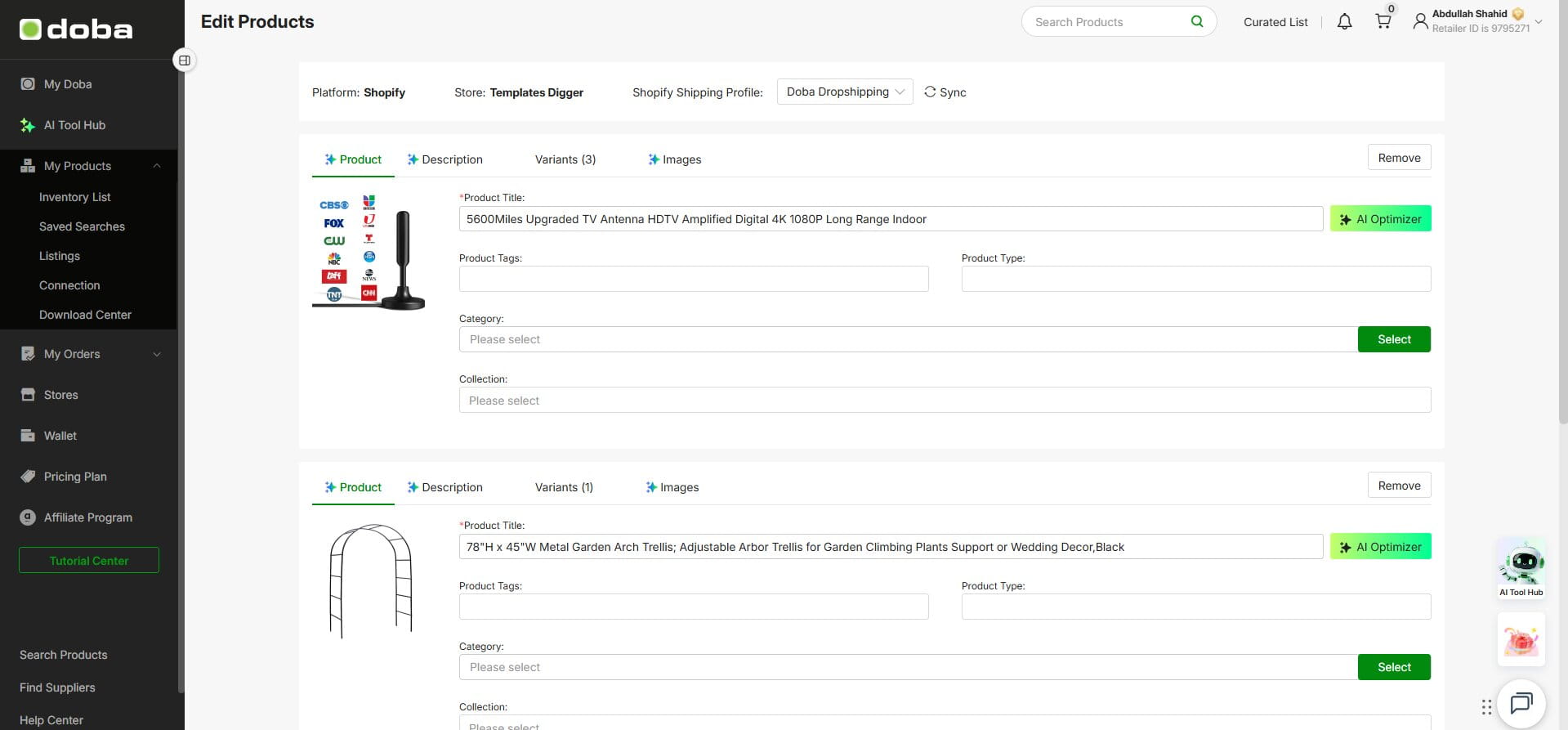
Like AliExpress or Amazon, Doba has its own product catalog. You browse the Doba product catalog by category or search, then add wholesale items from the Doba products list to your inventory list. You can come back to your listings anytime and sync them to your store in one click. Before syncing, you can edit the title, description and pricing, or set store rules like profit margin and auto-fulfillment options.
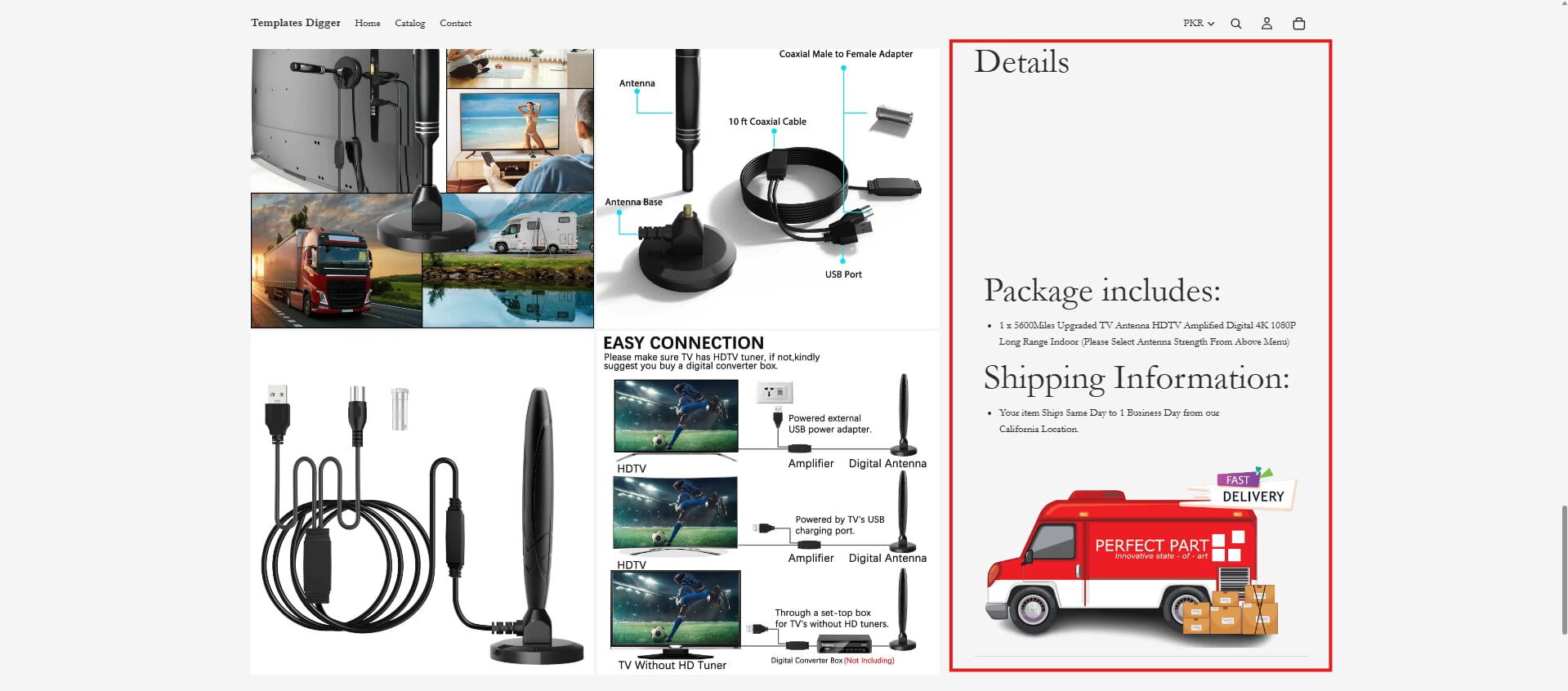
When you approve, the products sync to Shopify within a few minutes with images, descriptions, titles, variants and prices. However, I noticed that most of the description got lost in the sync, because the images inside it were not supported in Shopify’s format. As you can see in the screenshot below, the description has empty spacing and is missing about 80% of its content.
Keep the plan limits in mind here. Doba counts a one-click listing each time you publish a product, and inventory capacity is a separate limit on how many items it keeps in sync for you. On the Limited plan, that means 30 listings and 20 items in your inventory list, which is enough for a test but not for a real store.
Doba Automations & AI Tools
Doba covers the basic automations: price and stock updates from its suppliers, order sync and tracking updates. That is enough for a simple dropshipping workflow. In my test, price updates followed the suppliers’ prices only, and I did not find a way to reprice listings against other sellers, so you still need to check that your margin holds.
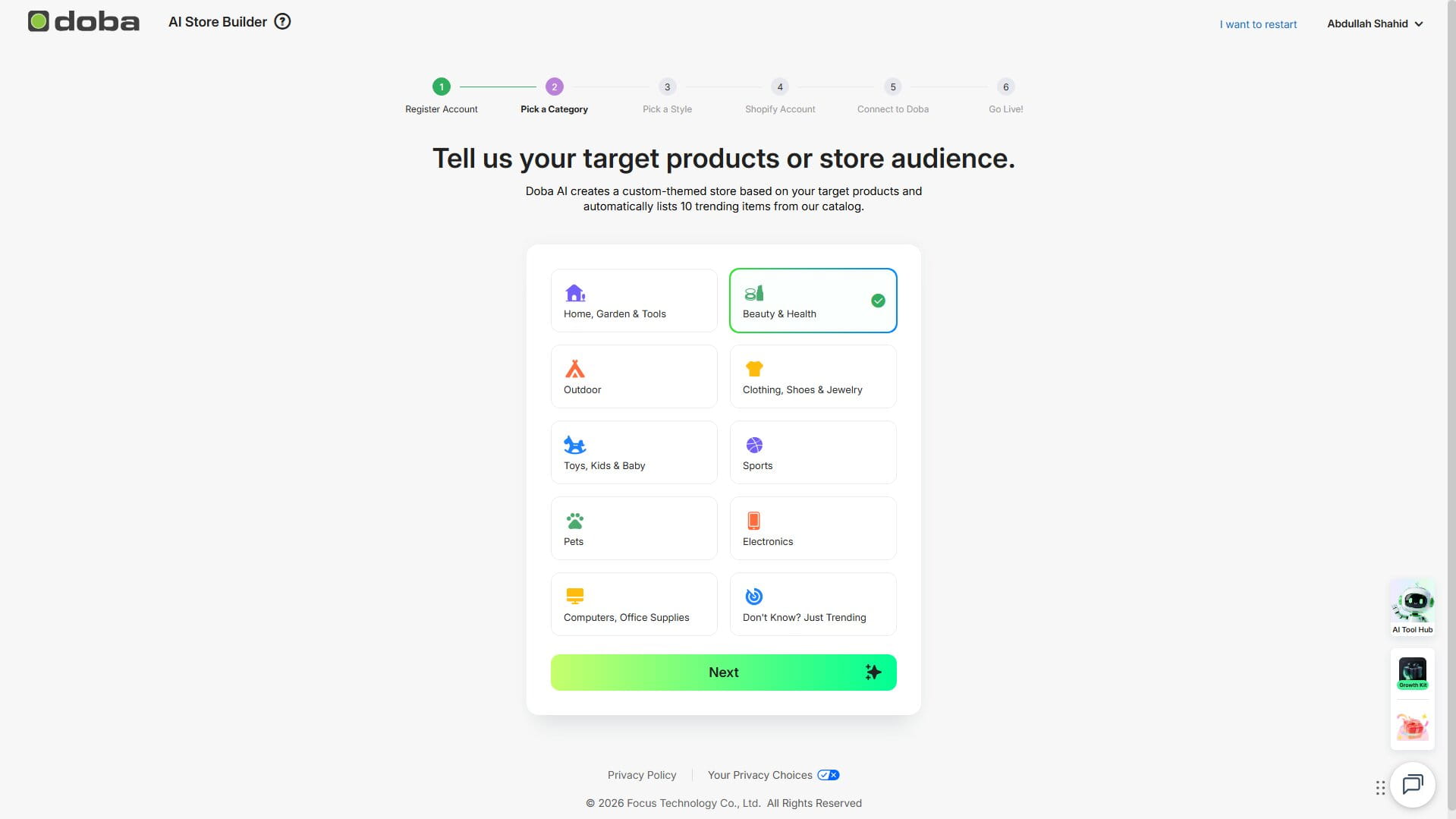
What I found annoying is how hard Doba pushes its AI tools while you are trying to use the platform. Doba AI now covers a whole AI Tool Hub, including an AI Store Builder, an AI Listing Optimizer for titles and descriptions, AI Image Studio and an AI Auto Lister, all paid with credits that come with each plan (100 on Limited, up to 3,000 on Enterprise). In 2026, Doba also launched Doba Pilot, an AI agent meant to run the workflow from product research and store setup to listing. In my experience, these features feel forced and are there mostly for the ‘AI-powered’ claim. Shopify’s built-in AI does a decent job with store design and descriptions, and it is free.
Doba Pricing in 2026: Plans, Limits and Free Trial
Doba has four plans on the Doba pricing page: Limited for $29.99 per month, Basic for $59.99, Standard for $149.99 and Enterprise for $299.99. Each higher plan adds more connected stores, listings and inventory capacity.
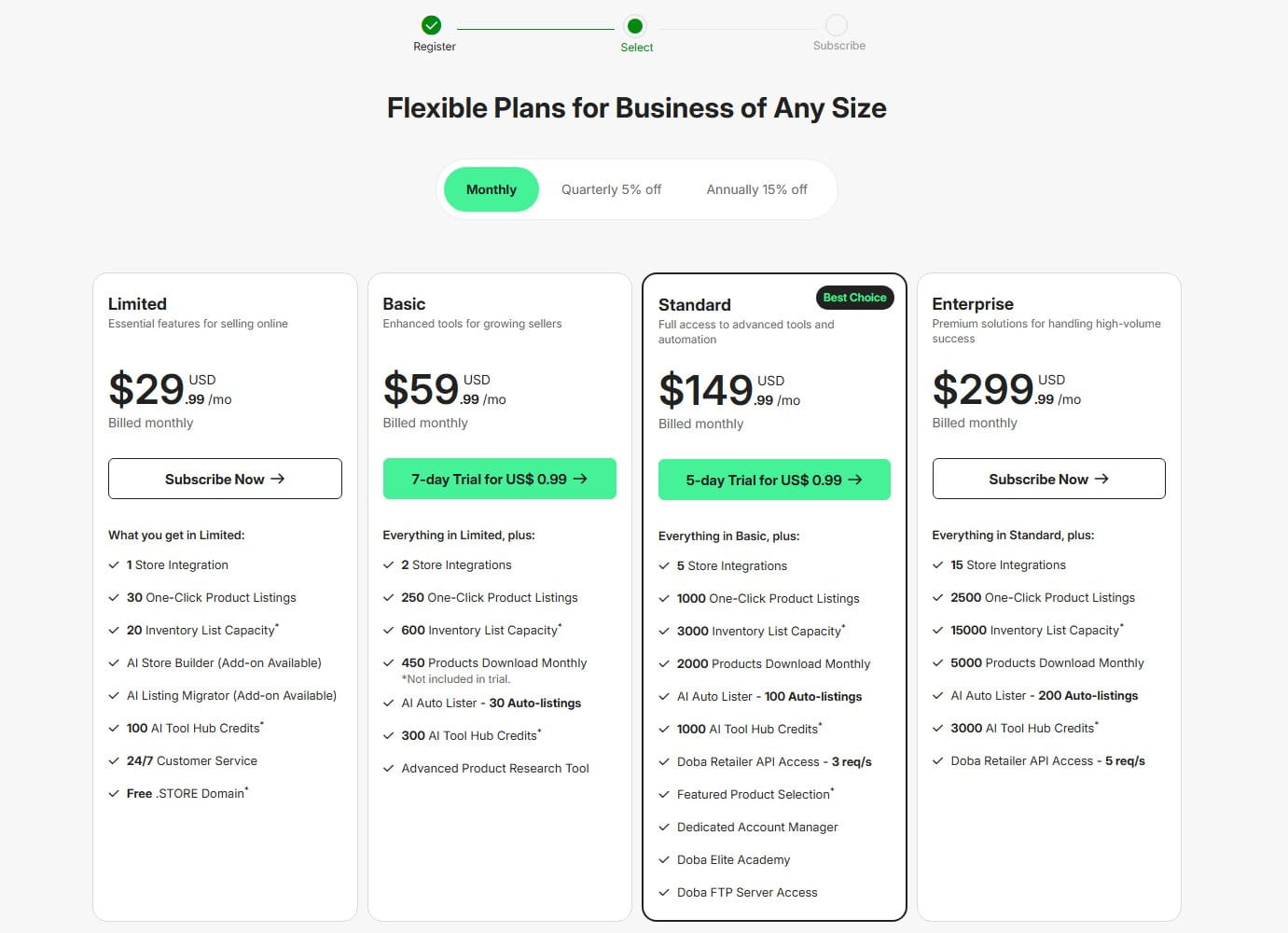
The Doba price you pay also depends on billing: quarterly billing takes 5% off and annual billing takes 15% off, which brings the plans down to $25.50, $51, $127.50 and $255 per month. Depending on the view, the pricing page can show quarterly prices first, where Basic appears as $57.00 per month. That is the monthly equivalent of a $171 charge every three months, not the monthly price. Enterprise has no quarterly option at all.
Doba does not charge per-order transaction fees, so your costs are the subscription plus the supplier’s wholesale price and shipping. So how much does Doba cost in practice? For a real store, plan on Basic or Standard, because Limited is built for testing.
Does Doba Have a Free Trial?
Not a free one on the Doba website. Doba offers a 7-day trial of the Basic plan and a 5-day trial of the Standard plan, both for $0.99, while Limited and Enterprise have no trial. The Basic trial also does not include product downloads. If you install Doba from the Shopify App Store, the listing says a free trial is available, which matches my experience: the account created through Shopify offered a Doba free trial without the $0.99 charge.
The trial rolls into a paid plan, so set a reminder if you are only testing. To cancel the Doba trial or subscription, open Pricing Plan from the account dropdown, click Cancel Subscription and choose whether to cancel right away or at the end of the billing cycle. Check the refund terms before you subscribe: one Trustpilot reviewer says they were told refunds were only possible within 72 hours.
Is Dropshipping With Doba Profitable?
Pricing is one of the most common complaints among Doba customers, and the subscription itself is not the main problem. The real issue is the price-to-profit ratio. You pay for the plan, and Doba wholesale prices on many products leave a thin margin on top of that.
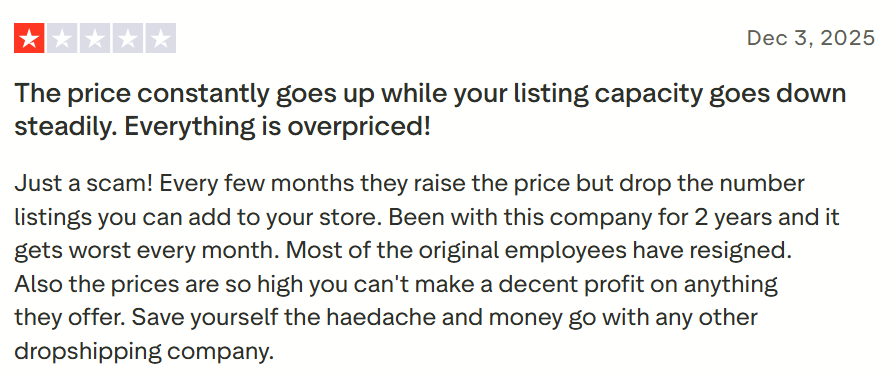
Paying $59.99 per month for 250 listings sounds reasonable, and it gives you room to test what works. The problem starts when you add up the rest. Reviewers on Trustpilot and the Shopify App Store say many supplier prices are close to, or even above, what the same items sell for on Amazon or Walmart. One reviewer who stayed with Doba for two years also says prices kept going up while listing limits went down. If you spend hundreds or thousands of dollars on social media and Google Ads to sell a product with a 5%-10% margin, the math rarely works.
So, is dropshipping with Doba profitable? It can be, but only with products where the supplier price leaves enough room after marketplace fees, ads and returns. Use the trial to check this for the exact products you plan to sell before you commit to a plan.
Doba Dropshipping Reviews: What Do Real Users Say?
Doba reviews are split almost in half. On Trustpilot, Doba is rated 2.9 out of 5 from 95 reviews: 49% are 5-star and 44% are 1-star, with very little in between. Only 12 of those reviews were posted in the last 12 months. For a platform that has been operating for over 20 years and takes pride in its vetted supplier network, these doba.com reviews tell a different story. When I used Doba dropshipping, I understood why there were so many negative reviews, and honestly, some of them make sense.
Most negative reviews focus on customer support, poor product quality from some suppliers, plan prices and wholesale prices that leave little margin.
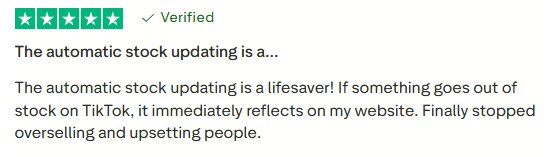
Customer support shows up on the positive side too: several recent 5-star reviews thank individual support agents by name. Users also say Doba is easy to use and beginner friendly, mentioning easy sync, product listings and auto-fulfillment.
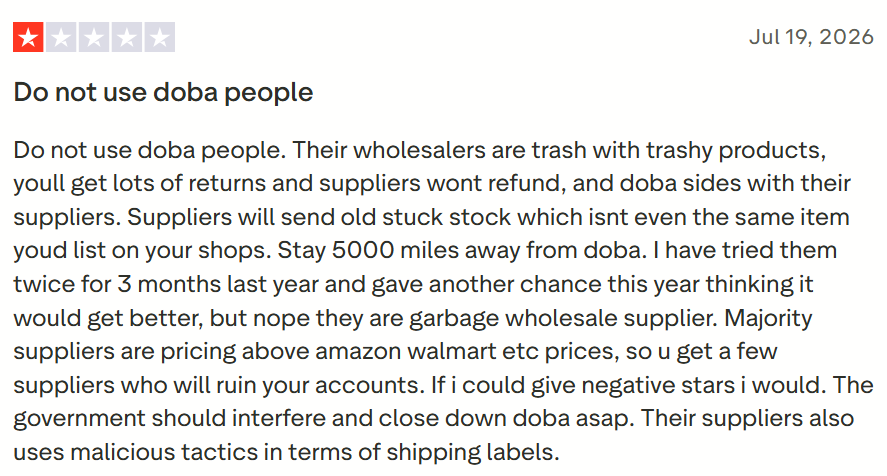
Reading through the negative reviews, many of them describe a poor supplier network and Doba siding with suppliers instead of dropshippers in disputes over returns and refunds. For someone paying $30-$300 per month just to use the platform, being let down by a supplier while Doba does not hold it accountable is frustrating, because their store reputation is on the line.
Some reviewers also say the pricing model is hard to keep up with, and costs climb quickly if you want to list more products or connect more storefronts.
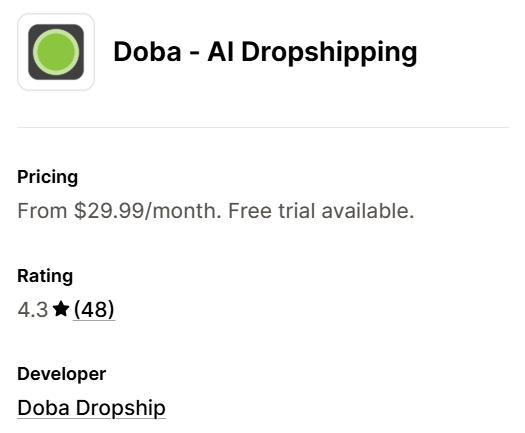
Ratings on the Shopify App Store are higher. There, Doba’s app is rated 4.3 out of 5 based on 48 reviews. Positive reviews there mention US-based vendors and quick shipping, while negative ones point to payment and setup issues. One seller wrote that after almost a year of effort, they finally got their first sale and then could not pay for the product with their business bank account.
Doba Pros and Cons: Who Should Use It
| Pros | Cons |
|---|---|
| Mostly US-based suppliers, with about 90% of SKUs in US warehouses, according to Doba | Wholesale prices on many products are close to retail, so margins are thin |
| Over 1 million products in one catalog | Plans start at $29.99 per month for just 30 listings |
| One dashboard for up to 15 stores, depending on the plan | The website trial is paid ($0.99) and only available for Basic and Standard |
| No per-order transaction fees | Supplier quality and return handling vary |
| One-click listing to Shopify, eBay, Walmart, TikTok Shop and more | Amazon, Temu, WooCommerce and some other channels need manual product upload |
| More than 20 years in business, BBB accredited since 2003 | The dashboard keeps pushing upsells and AI tools |
So, is Doba worth it? Only for some sellers: those who target US customers, want fast domestic shipping and prefer to work through one platform instead of building supplier relationships one by one. It is a weaker fit for beginners on a tight budget and for anyone whose strategy depends on the lowest possible product cost.
Trevor Fenner, founder of Ecommerce Paradise and a coach for high-ticket dropshipping, draws a similar line in his Doba review. In his view, Doba suits operators who run two to five stores, sell in categories where suppliers are scattered, and would rather not negotiate with each supplier individually. For high-ticket stores built on direct relationships with manufacturers and authorized dealer agreements, he sees direct suppliers as the better fit. His most practical advice is about the trial: search for the exact products you plan to sell and compare the wholesale price with what those items sell for on your marketplaces, because if the margin does not work in the first days, it will not work later either.
Doba Alternatives Worth Comparing
Sellers look for Doba alternatives for two main reasons: the dashboard is cluttered with challenges, offers and AI tools, and the margins on many products are too thin. These three dropshipping platforms are worth comparing.
Spocket
Spocket started as a marketplace of US and EU suppliers and now also offers AliExpress dropshipping, with a catalog of over 100 million products. Plans start at $39.99 per month for 25 unique products, and the Professional plan costs $59.99 per month for 250 products, or $24 per month billed annually. Monthly plans start with a 7-day free trial, and selling on eBay or Amazon requires the Empire plan or higher. We cover it in detail in our Spocket review.
Wholesale2B
Wholesale2B gives you access to over 1.5 million dropship products and handles orders, returns and tracking with suppliers for you. Browsing products and wholesale prices is free, with no credit card required. To sell, you activate a plan for your platform: store integrations, including eBay and Shopify, cost $49.99 per month for up to 2,500 items, the Amazon integration costs $99.99 per month, and annual billing saves 25%.
Zendrop
Zendrop combines a product catalog with its own fulfillment and branding options. It has a free plan for browsing the catalog, while the Pro plan costs $49 per month and Plus costs $79 per month, with up to 42% off for annual billing. New users who sign up through Shopify or Wix are billed by usage instead, based on how many products they link.
If you sell on Shopify and want more options, see our list of US and UK dropshipping suppliers for Shopify, or browse our blog for more platform reviews.
Doba vs Easync: How Each Automates eBay Dropshipping
Doba and Easync both help you dropship on eBay, but they automate two different business models. Doba gives you a catalog of wholesale suppliers. Easync is an Amazon to eBay dropshipping tool that also covers AliExpress to eBay and Amazon to Shopify, built around products you pick on Amazon or AliExpress. Here is how each one works on eBay.
How Doba Works on eBay
Doba connects to your eBay store, lets you list products from its catalog in bulk and syncs orders back to Doba. When a buyer orders, you pay for the item in Doba and the supplier ships it. This is the model eBay explicitly allows: eBay’s dropshipping policy permits fulfilling orders directly from a wholesale supplier. You are still responsible for delivery within the time stated in your listing and for the buyer’s satisfaction, so supplier reliability matters as much on eBay as it does on Shopify.
How Easync Automates eBay Dropshipping
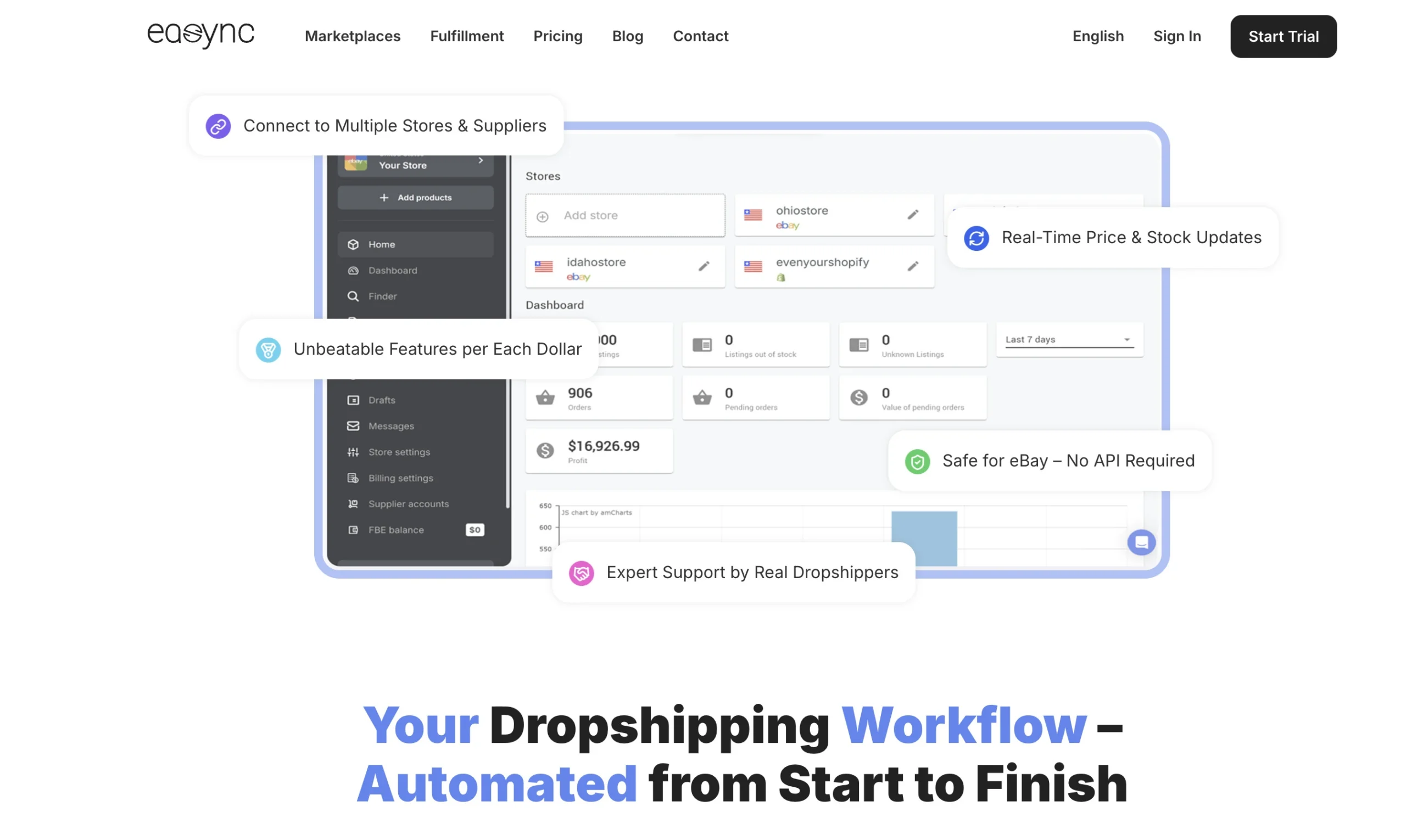
With Easync, you list items available on Amazon or AliExpress in your eBay store, and Easync keeps those listings in check. It monitors the source price and stock every 30 minutes and reprices your eBay listings automatically, so a price jump or a sold-out item does not turn into a loss or a canceled order. That price and stock tracking helps keep your account running without disruptions. When an eBay order comes in, auto-ordering places it on Amazon, and the tracking number is uploaded to eBay automatically. With Fulfillment by Easync (FBE), orders go through Easync’s managed Amazon accounts instead of your personal one.
This route comes with a policy risk. eBay’s policy does not allow listing an item and then buying it from another retailer or marketplace that ships directly to your buyer, and that is how this model works. Breaking the policy can lead to removed listings, selling restrictions or account suspension. On the other hand, you do not need to buy or store inventory, rent a warehouse or sign up with wholesale suppliers, and you can choose from a much wider range of products than any single catalog offers.
| Feature | Doba | Easync |
|---|---|---|
| Business model | Wholesale supplier marketplace | Automation software for Amazon to eBay, AliExpress to eBay and Amazon to Shopify |
| Products | 1M+ SKUs from Doba suppliers, mostly in US warehouses | Items you choose on Amazon or AliExpress |
| eBay policy fit | Wholesale dropshipping, which eBay allows | Retail sourcing, which eBay does not allow |
| Price and stock sync | Price and stock updates from Doba suppliers | Repricing and stock monitoring for eBay listings every 30 minutes |
| Order fulfillment | You confirm and pay for each order in Doba, the supplier ships | Auto-ordering from Amazon, optional FBE, tracking uploaded to eBay |
| Starting price | $29.99/month (30 listings) | $49.99/month (2,000 repricing listings, 200 auto-orders) |
| Trial | $0.99 for 7 days (Basic) or 5 days (Standard) | 7-day free trial |
| Best for | Sellers who want an eBay-compliant wholesale setup | Sellers who want to automate Amazon or AliExpress sourcing and accept the policy risk |
How to Set Up Easync for eBay
- Start the 7-day free trial and connect your eBay store.
- Choose where your products come from, Amazon or AliExpress, and set your margin rules.
- Add the products you want to sell, and Easync starts tracking their price and stock every 30 minutes.
- Turn on auto-ordering, or fund your FBE balance and activate FBE to have orders fulfilled through Easync’s managed Amazon accounts.
- Let Easync upload tracking numbers to eBay as orders ship.
Before you start, check the supported marketplaces to see which route fits your store.
Frequently Asked Questions
Is Doba legit?
Yes. Doba Inc. has operated since 2002, is owned by Focus Technology and has been BBB accredited since 2003 with an A+ rating, with 6 complaints filed through the BBB in the last 3 years. Some legitimacy concerns come from scammers who use Doba’s name on social media to sell dropshipping promises, which has nothing to do with the platform itself.
Is Doba a good dropshipper for beginners?
Doba itself does not ship anything. It is a platform, and independent suppliers fulfill your orders. For beginners, it is easy to start with, because you pick products from a curated catalog instead of hunting for products and suppliers on your own. The problem is cost: $29.99 per month buys only 30 listings, and margins on many products are thin. It works best for beginners who can afford to test for a few months, ideally starting with the $0.99 trial.
Why are Doba dropshipping reviews so mixed?
Doba is rated 2.9 out of 5 on Trustpilot, with 44% 1-star and 49% 5-star reviews. Most negative Doba dropshipper reviews are about expensive plans, supplier prices close to retail, thin margins, and poor supplier quality or communication. Positive reviews usually praise customer support, US shipping and ease of use. On the Shopify App Store, the rating is higher, at 4.3 out of 5.
How much is Doba per month?
On monthly billing, Doba costs $29.99 for Limited, $59.99 for Basic, $149.99 for Standard and $299.99 for Enterprise. Quarterly billing saves 5% and annual billing saves 15%, which brings the plans down to $25.50, $51, $127.50 and $255 per month.
Does Doba have a free trial?
On the Doba website, the trials are paid: $0.99 for 7 days of Basic or 5 days of Standard. The Shopify App Store listing says a free trial is available when you install Doba through Shopify. Either way, the trial converts into a paid plan unless you cancel it.
Can you use Doba on eBay?
Yes. Doba integrates with eBay, so you can list catalog products in bulk and sync orders. Because the products come from wholesale suppliers, this setup follows eBay’s dropshipping policy. The number of stores you can connect depends on your plan: one on Limited, two on Basic, five on Standard and 15 on Enterprise.
How do I contact Doba customer service?
Doba offers 24/7 customer service through chat inside your Doba account. The Doba phone number is (801) 682-4666, and you can also email help@doba.com. Standard and Enterprise plans include a dedicated account manager.
Is Easync a Doba alternative?
Only for a specific use case. Easync works differently from Doba: instead of a supplier catalog, it offers automation for sellers who dropship from Amazon to eBay, AliExpress to eBay or Amazon to Shopify, with repricing every 30 minutes, auto-ordering, tracking upload and optional Fulfillment by Easync. If you want wholesale suppliers, Doba or the alternatives above are a better match.
Ready to automate your dropshipping?
Join 41,000+ dropshippers using Easync.
Start Your Free 7-Day Trial G24.6/5
 Capterra4.8/5SourceForge4.8/5