
- articles
Best AI Dropshipping Website Builder in 2026: 11 Tools Tested & Ranked
Quick Answer: The overall best AI dropshipping website builder is Shopify with its built-in AI tools like Magic and Sidekick. Although some other website builders might create better designs, Shopify’s strongest advantage is the app ecosystem, and ecommerce CRM that comes connected to your dropshipping website. Wix is the second best option because it creates beautifully looking dropshipping stores.
One thing AI models have been getting exceptionally good at is coding. AI can now create a complete dropshipping website in one-shot prompts. However, I’ve seen people do a terrible job even with access to the best AI models and that led me to realize that people don’t know there is a whole backend to a store they are seeing. UI isn’t the whole story so in this blog, I tested and reviewed the best AI dropshipping website builders to see which ones would be the most effective options in the long-term.
What is an AI Dropshipping Website Builder?
An AI dropshipping website builder is a platform that uses AI to help create an online store for selling products through the dropshipping model. Some tools only provide the frontend connected to an ecommerce POS like Shopify, WooCommerce while other tools connect your dropshipping website to their own database of product catalogues, and provide order tracking and payment methods.
An AI dropshipping website builder does not handle order tracking, inventory management or order fulfillment. These backend tasks are handled by services like Wix, Shopify, and Easync. This is an important consideration when choosing a website builder, and the underlying ecommerce engine for your business.
Since dropshippers manage multiple storefronts for different product categories, your AI store builder framework should be easy and repeatable for several stores. I would not recommend custom developing your own product inventory and payment gateways. Use a service like Shopify, Wix, or Easync for dropshipping order fulfillment.
3 Types of AI Store Builders (And Which One You Need)
I’ve grouped AI store builders into three categories based on their scope, feature set and use cases.
1. All-in-one AI Website Builders
All-in-one website builders create entire sites (hosting, domain, store pages) from scratch within a few prompts. These apps can design fairly good one-shot designs. Wix AI, Shopify Sidekick, and Hostinger AI are some famous examples. I would also put Base44 and Lovable in this list but these tools are generous purpose coding agents, not for dropshipping specific workflows. Wix and Shopify’s AI agents perform better because they automatically connect to product and content CRMs for you. Moreover, you can buy and connect a domain directly via Shopify, Wix and Hostinger.
2. Dropship-Specific AI Store/Page Generators
Shopify AI Page builder apps like Zendrop’s AI, Sell The Trend AI Store Builder, Atlas AI and Dropship.io are some examples in this list that excel at creating specific landing pages inside your Shopify or WooCommerce store. If you already have a store, these products are great. Shopify Sidekick and Wix AI can also create dropshipping landing pages in an existing store.
3. AI builders for WordPress/WooCommerce
WooCommerce does not offer a built-in AI agent to create pages or set up your dropshipping store. You can use tools like 10Web AI Builder, Lovable or Bolt.new to set up your dropshipping website pages. A lot of manual work on connecting page with WooCommerce dashboard will be required. You can also use WooCommerce’s AI add-ons and plugins to help with landing pages.
If you’re starting a new store from scratch, I suggest Shopify Sidekick since Shopify’s ecommerce ecosystem is significantly larger and better than the rest of the ecommerce platforms.
My testing Methodology for Best AI Dropshipping Website Builders
I tested each tool thoroughly in September 2026. I tried creating one-shot dropshipping websites since that is what most beginners will do. I then analyzed the output, and how functional the final website really is. I noticed how many manual tweaks were needed afterwards, the quality of copy AI wrote, mobile responsiveness, and long-term reliability.
For dropshippers who need to launch campaigns fast, you need a reliable tool that can handle the backend database and inventory connections for you instead of you configuring it manually and that is a big factor in how this whole list was numbered.
Easync, the publisher of this article, is a dropshipping automation platform to help source products from marketplaces and sell on Shopify/eBay. It is not a website builder and was not ranked among the tools tested.
The 11 best AI dropshipping website builders in 2026
1. Shopify (Sidekick AI): Best AI Dropshipping Website Builder
Type: 1. All-in-one AI Website Builders
Shopify Sidekick (Magic AI suite) is the strongest all-in-one option for dropshippers building websites. It is not the smartest coding agent in the world, but it is in the right place and does the right things. I love it because Shopify owns the majority share in the ecommerce platforms market and is the easiest to operate for dropshipping storefronts.
Before Sidekick, every user had a default Dawn theme they could customize through liquid CSS and basic drag and drop. Sidekick AI now lets you customize your default dawn theme in a way you want. There are no additional AI costs or Sidekick limits on Shopify as of 2026.
The best part about using Sidekick isn’t how good the AI agent is, it’s the pre-configured connections you get to Shopify’s CRM. You get an easy-to-use dashboard to add products, manage inventory, setup payment vendors, shipping partners and other plugins. You can then connect your dropshipping suppliers like Zendrop, Printful, or Easync for product sourcing and order dispatch.
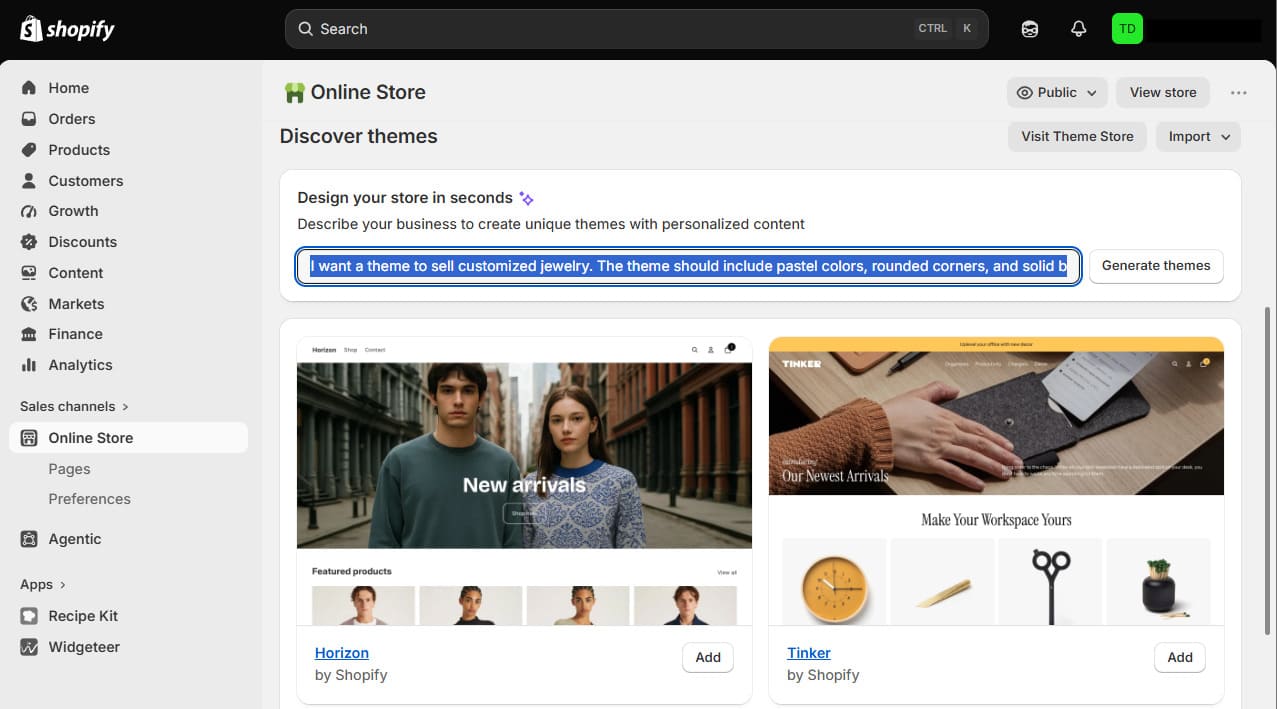
I tried creating a new theme for a customized jewelry store with a one-shot prompt. Sidekick made a few adjustments to its theme library and presented me with a few options within a minute. I selected one of the options and my products were already in there since it’s connected to my products and inventory by default.
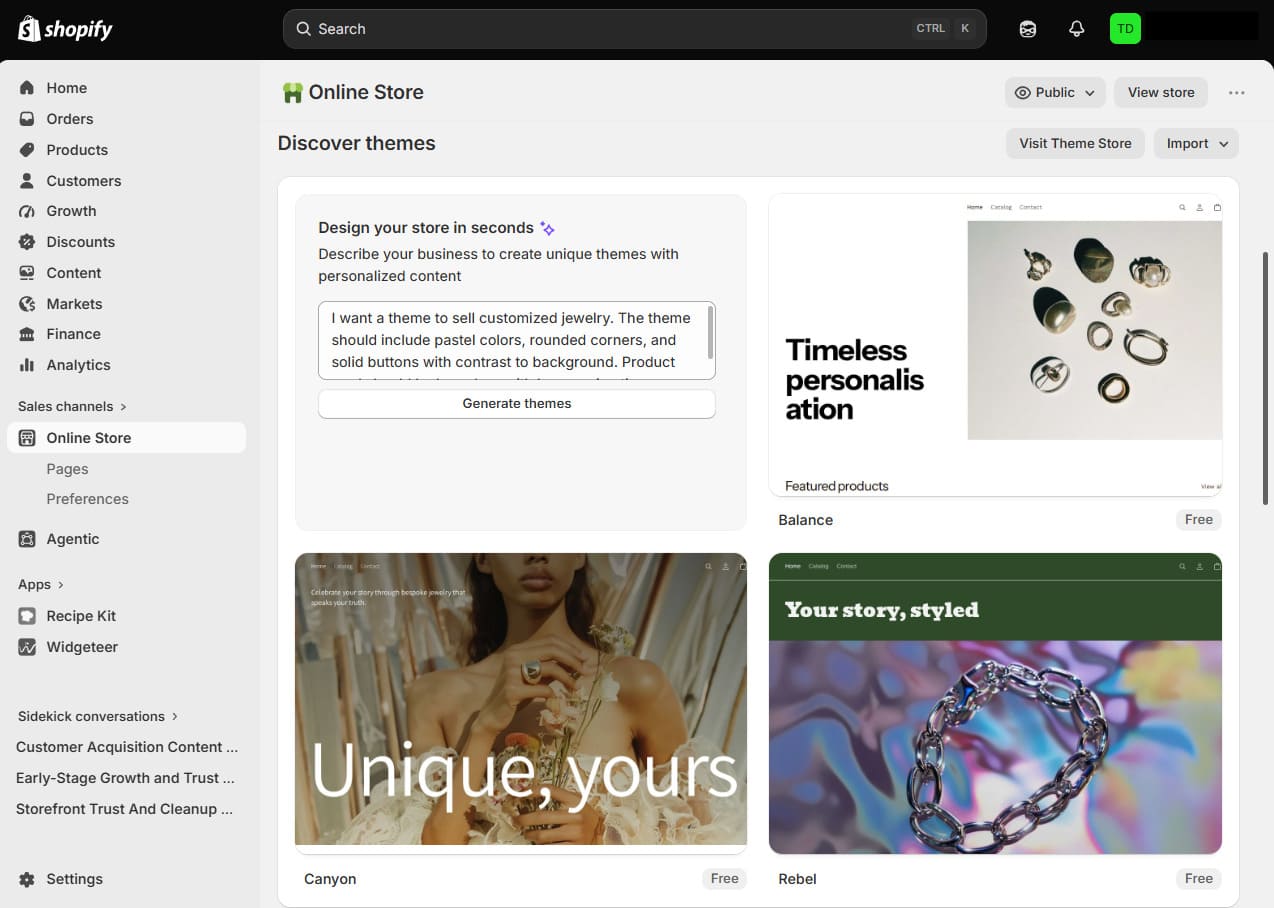
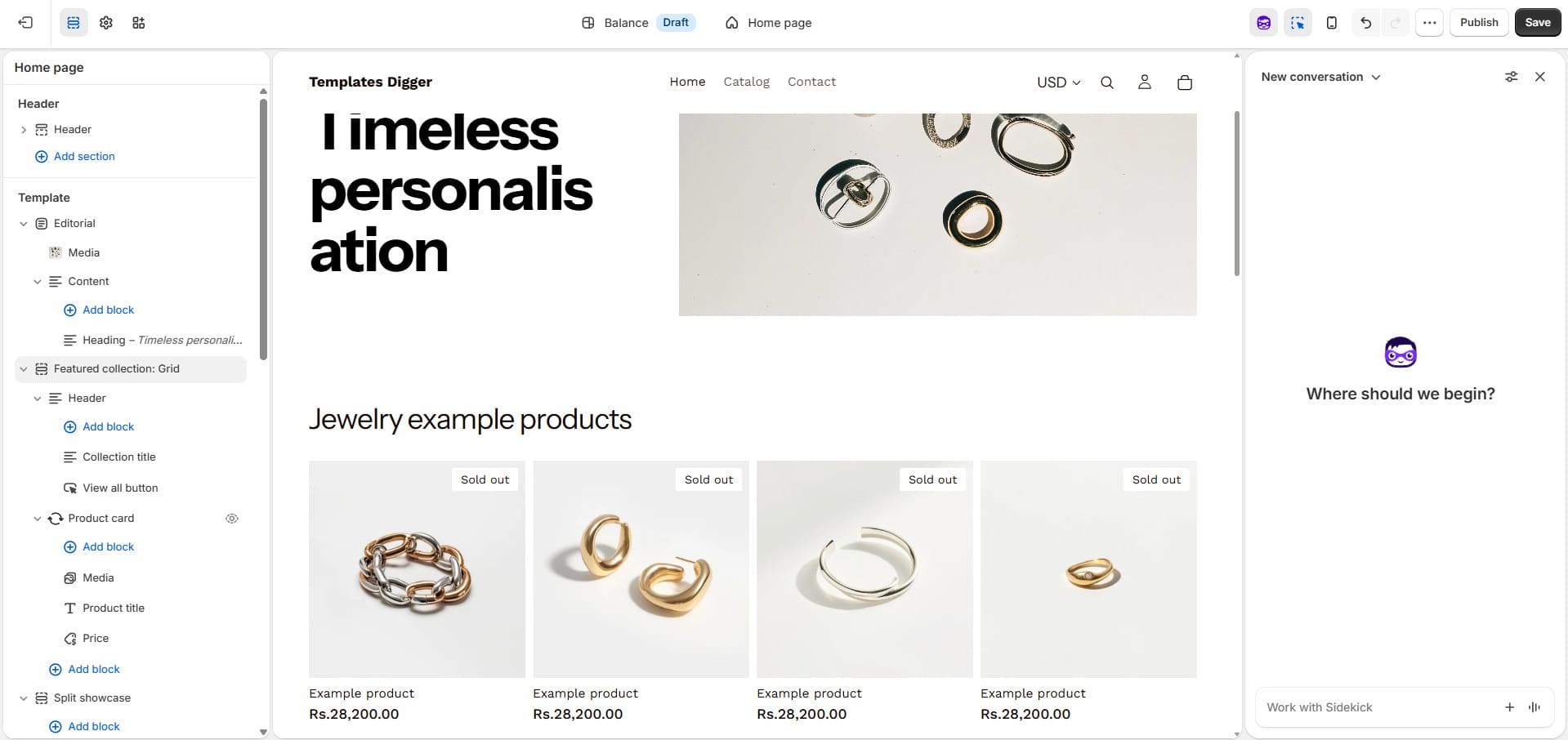
You can further customize individual sections, pages, product layouts and other parts of your theme using Sidekick in the sidebar in the theme editor. Shopify’s Magic AI suite includes features to auto-generate titles, descriptions, and SEO copy.
The latest Sidekick AI agent on your home screen now lets you dispatch agentic tasks related to orders, inventory management, and store design which I think is a significantly better offering instead of just a page builder.
Pricing: Free trial available with Sidekick included included in all plans; Basic Shopify starts at $39/mo
Pros: Huge app ecosystem; Powerful AI features built-in
Cons: AI Agent does not run on the smartest model; Small incremental changes instead of one-shot
2. Wix AI Website Builder: Best For Beginners
Type: 1. All-in-one AI Website Builders
Wix AI Website Builder is my 2nd best go-to option for creating a quick dropshipping website. I would rate the website creation and onboarding experience on #1 because the final output felt more customized and true to what I wanted.
Wix AI is easier than Shopify if you’re a beginner. The only reason I rate Wix #2 is because the app ecosystem is less established than Shopify. If you want a developer to take over your store or make a few adjustments, Shopify is a much better investment in the long run because you get access to tens or thousands of third-party apps and dropshipping platforms. Several dropshipping platforms don’t support Wix natively and that is the only reason it is at #2 in this list.
When you sign-up on Wix and create a new website, it asks you a few questions for context. This context defines your website, brand theme, and product descriptions as it is saved in AI’s memory going forward.
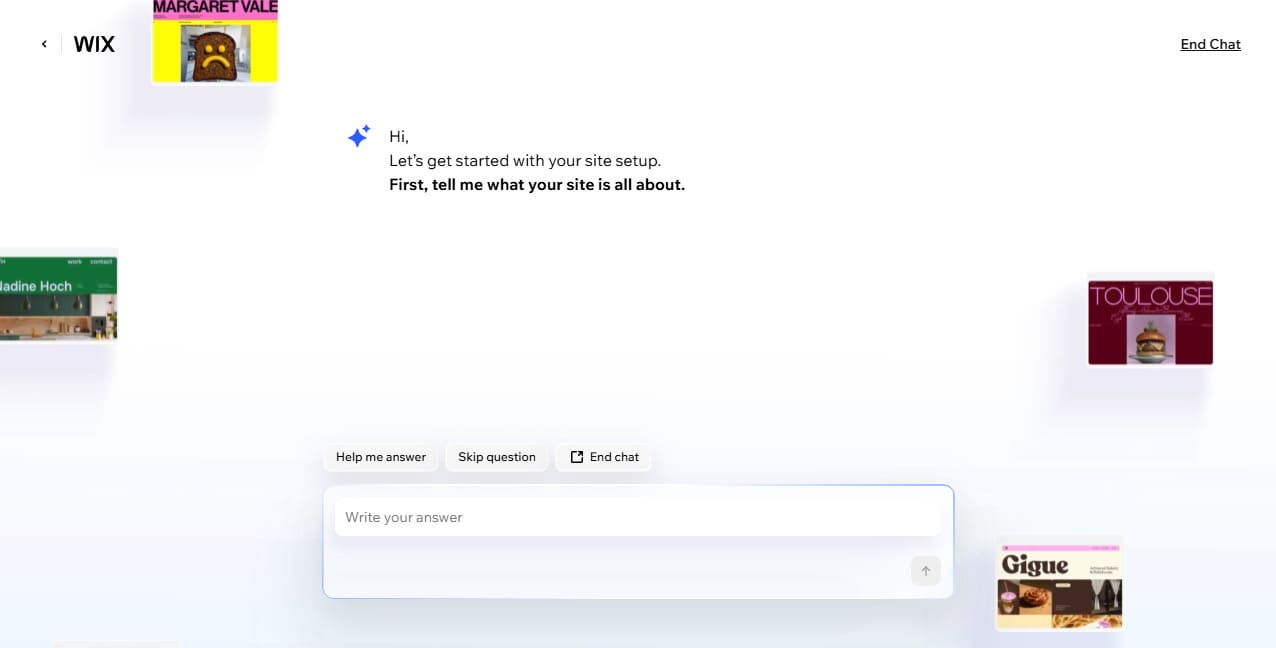
When you’re done answering the questionnaire, you are directed to the Wix dashboard. Understand that your dropshipping site has not yet been designed. Wix has only set up the basic dashboard for you with next actions like custom domain, adding products, and designing a store.
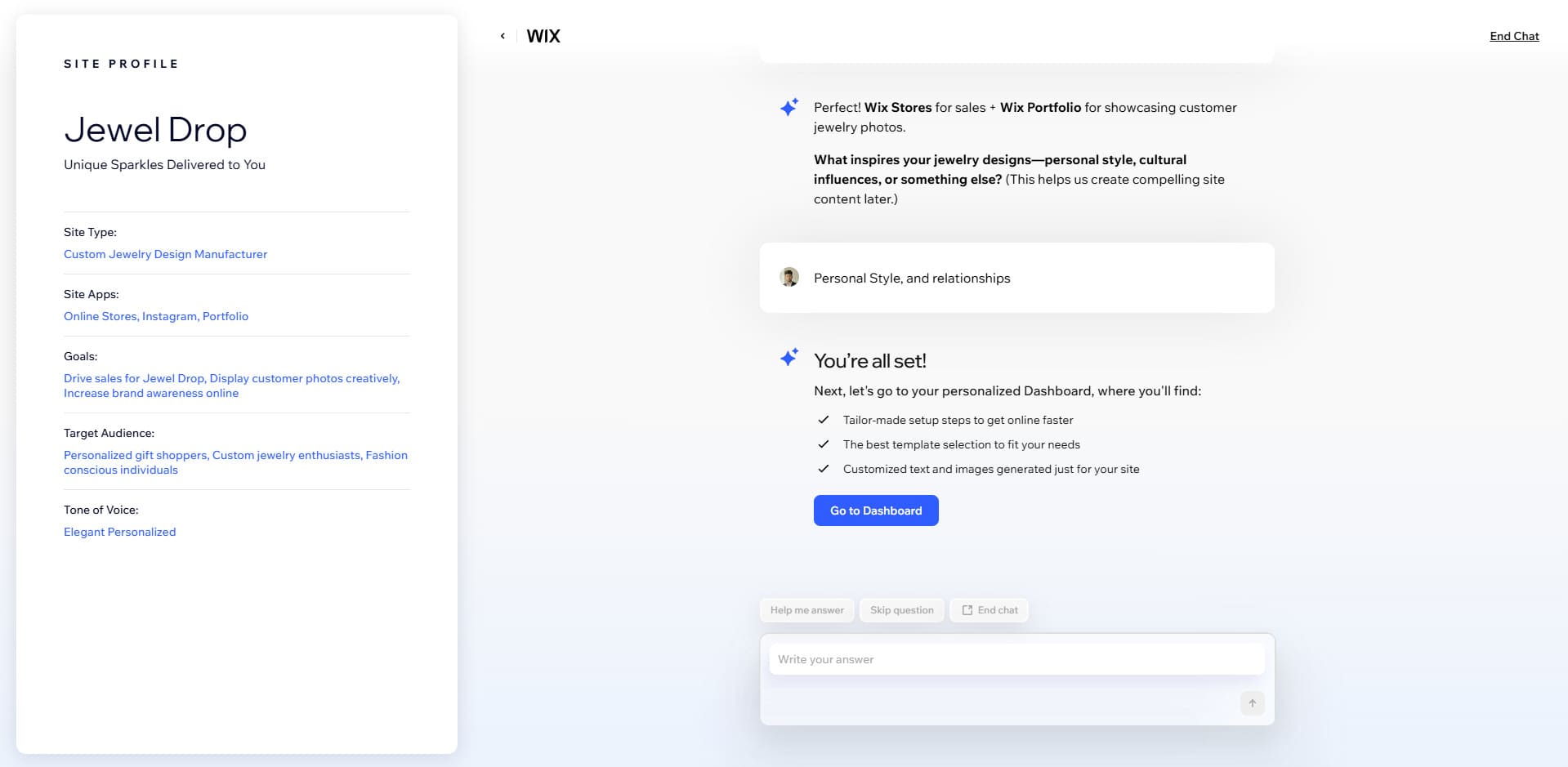
I selected store design and Wix filled it with a prompt based on my previous questionnaire interaction. After 6-7 mins of waiting, my complete site was ready to publish and connect to a custom domain.
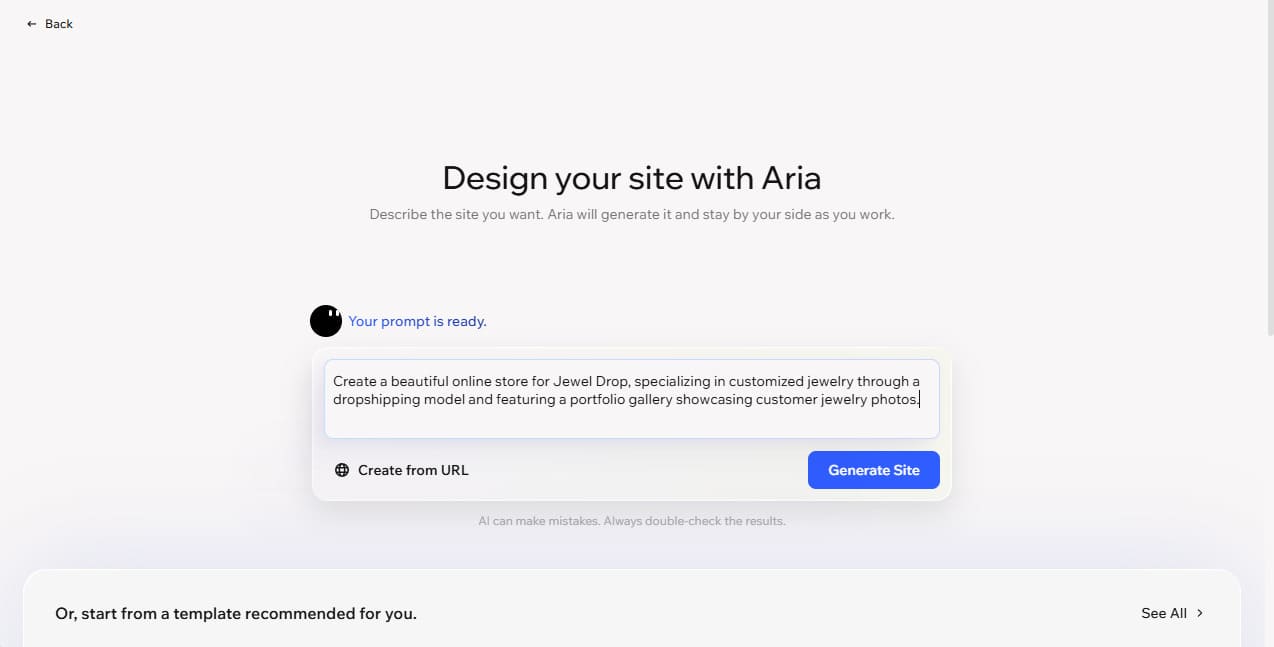
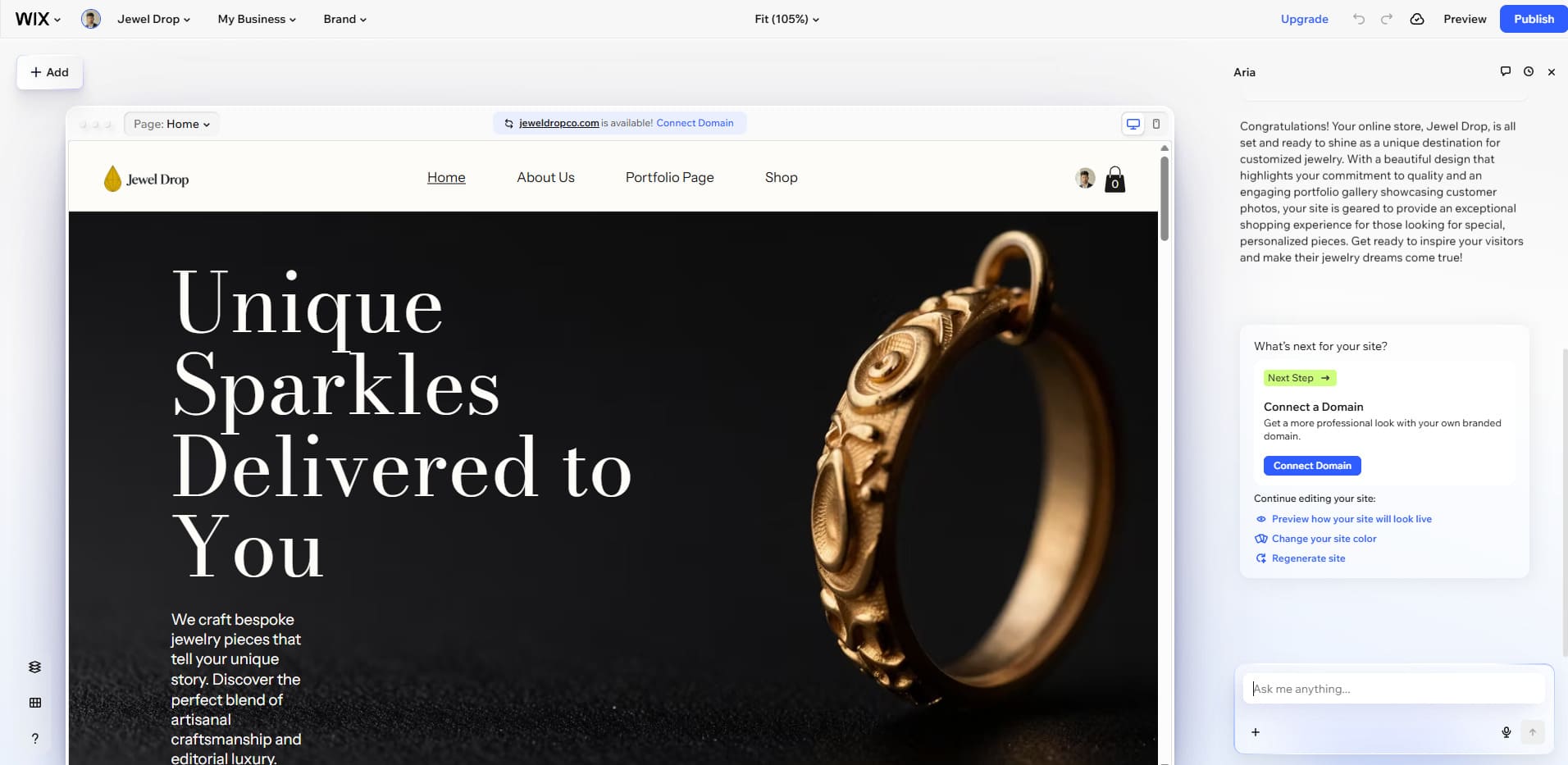
Apart from store design, Wix AI helps with logo design, and filling in product descriptions and titles. If you’re new to SEO and store management, Wix holds your hand more than Shopify by giving you suggestions on the next steps.
Pricing: Free Plan available; Core Plan at $29/mo; Business Plan starts at $39/mo (Ideal for ecommerce); AI Usage limits apply
Pros: Very easy for non-technical users; Includes free hosting and SSL; Marketing and SEO suite included
Cons: Less flexible than Shopify (fewer apps); AI usage limits; Need Business plan or higher for decent ecommerce experience
3. Hostinger AI Website Builder: Best Cheap AI Store (WooCommerce)
Type: 1. All-in-one AI Website Builders
Hostinger (formerly a domain name registry) is now a complete website builder with ecommerce features. You can create your own dropshipping website, list products, and run your ecommerce business through Hostinger Agents and free mailbox.
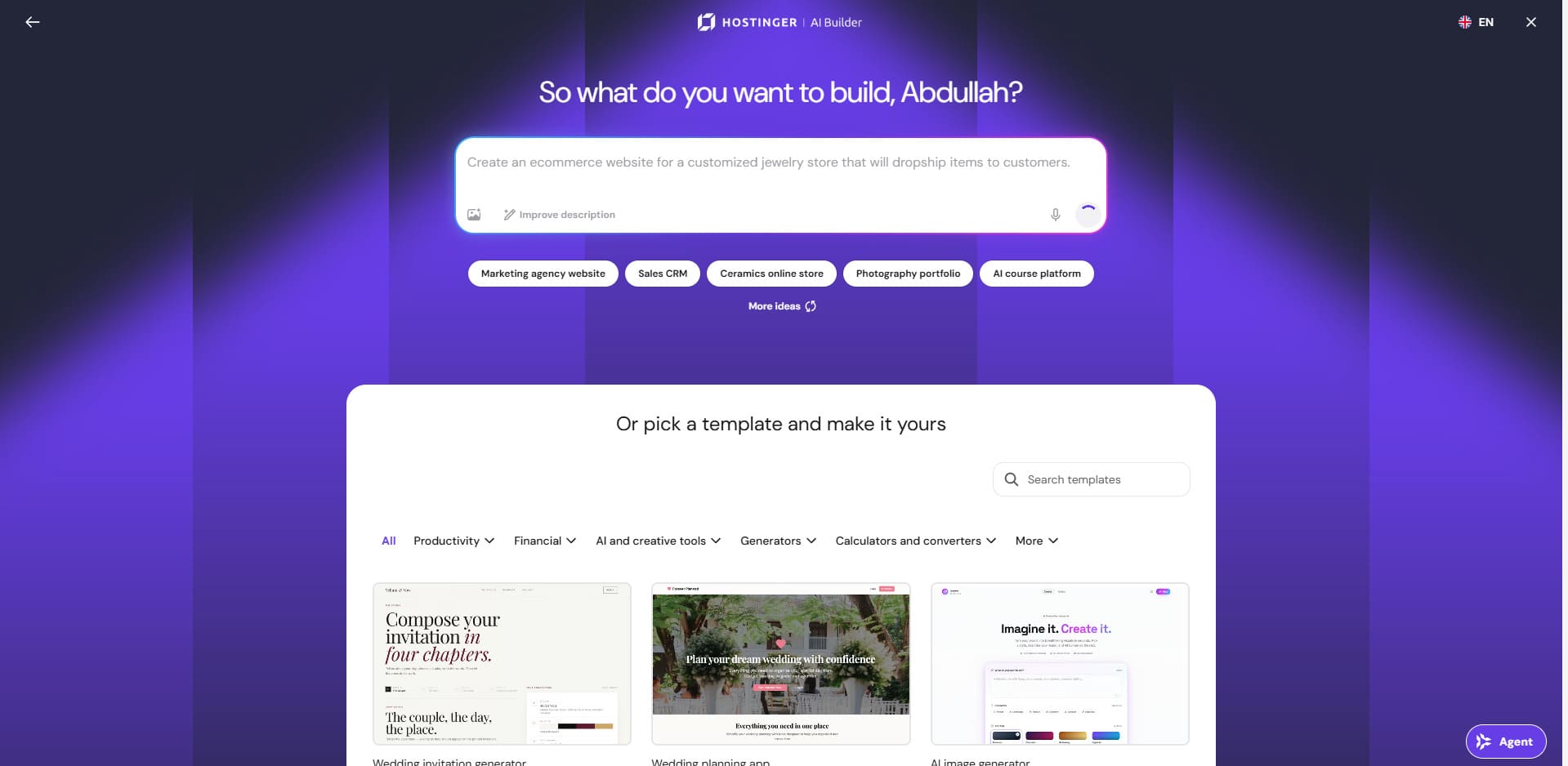
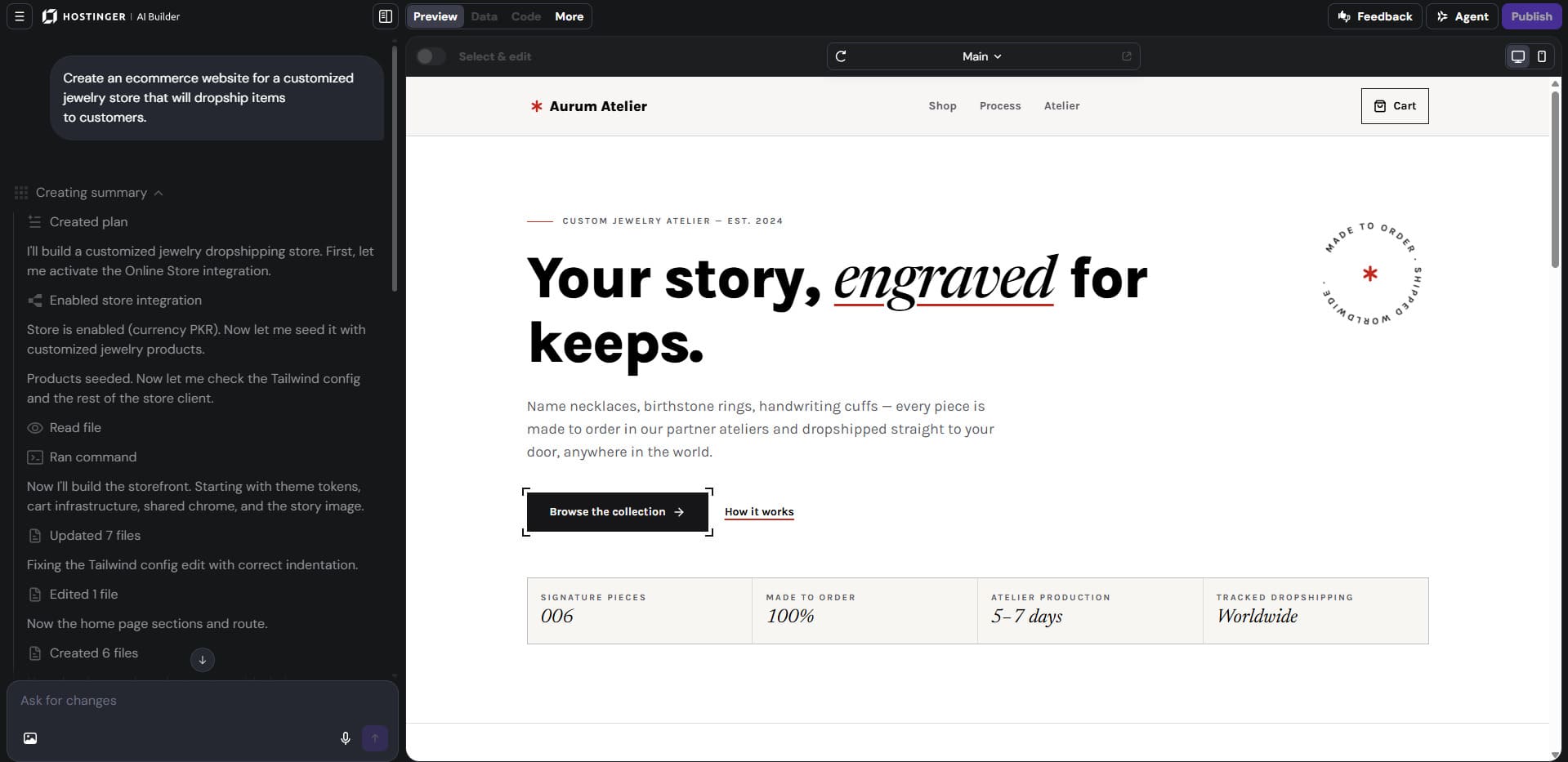
I used Hostinger AI Store Builder and my reviews are mixed. Their AI agent is smart enough to figure out I bought the ecommerce plan and set up a store with dummy products (that were actually put in my inventory), and an average looking store. I feel like this is the kind of design I get when I run a one-shot prompt in Claude Code. Nothing about the design felt ecommerce style. It was just a website with my products integrated that took approximately 20 minutes to build.
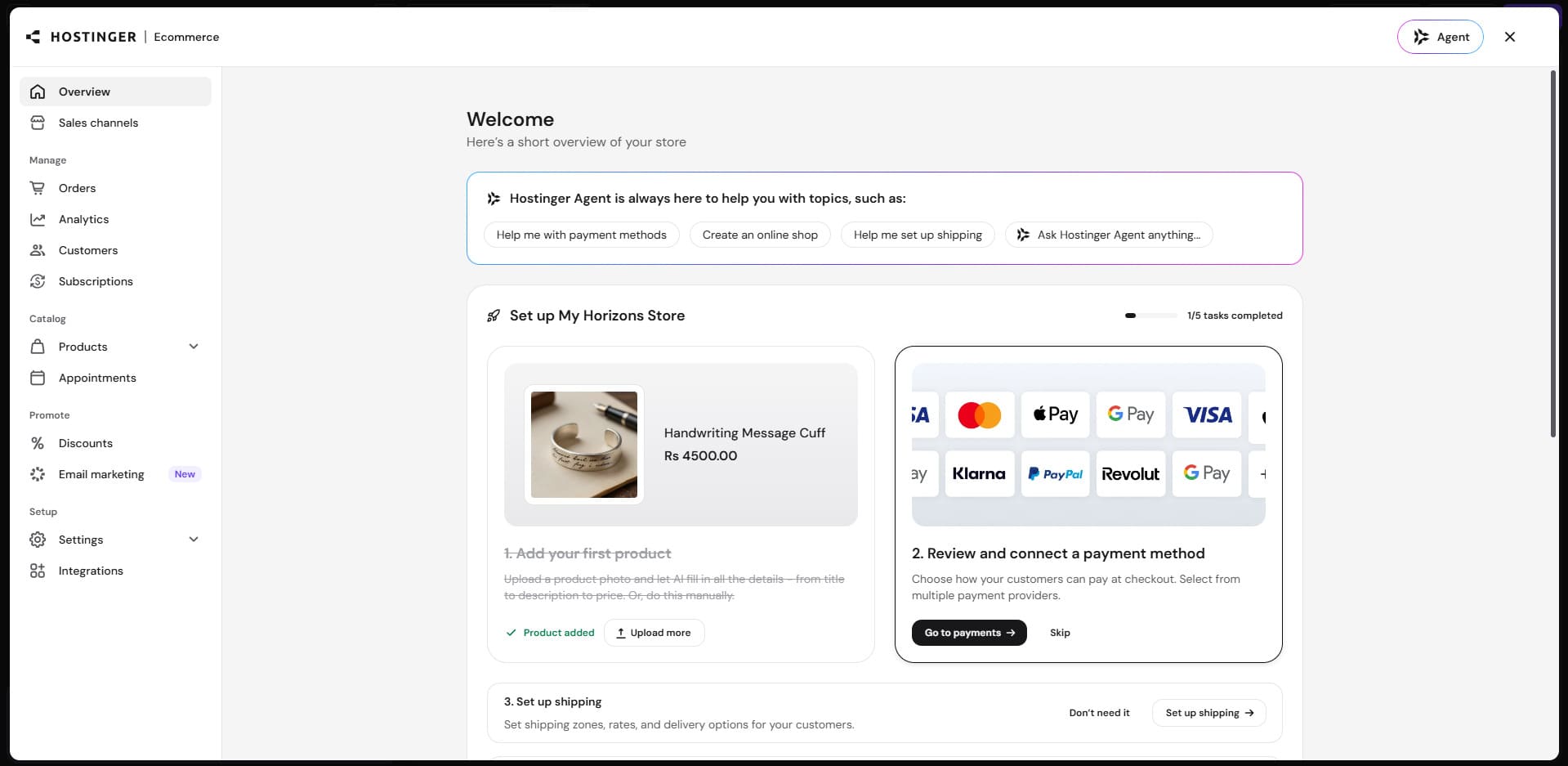
On the other hand, I find their dashboard clean and useful, second to Wix. They provide several payment integrations, and shipping rules. You can easily add/remove products, and make changes to your store design with their AI agent.
If you subscribe to at least an annual package, you get a domain, or even a mailbox on some plans for free along with hosting, and agentic integrations. You can connect Zapier, Hermes, n8n and other agents.
However, the strongest selling point of Hostinger AI is its native WordPress support. If you prefer dropshipping via WooCommerce, Hostinger can set up your store, and manage it for you which sounds weird since you can also connect other AI agents to WooCommerce as well for website development. The choice boils down to whether you like Hostinger’s offering.
Overall, I think Hostinger should only be used if you want to create multiple websites and host them under one subscription unlike Shopify that expects you to create another store and pay for it separately.
Beware of not getting into the bulk purchase trap without noticing. Hostinger markets insanely cheap subscriptions but they only apply if you’re paying for 36-48 months upfront. Real prices per month are completely different and are not advertised anywhere. I found out after subscribing per month to their $18.99 unlimited plan (which was advertised at around $3.5/mo), you have to pay separately for ecommerce functionality. They said its $7.99 additional and I agreed to find out they sneakily put a 12 month commitment to it that I had ignored. They try to charge you for a year or two at once and they try to hide that figure so you notice it less on your screen. I found it annoying because someone I know accidentally subscribed till 2030 while trying out their service.
Pricing: No free trial; Unlimited plan $18.99/mo (Ecommerce Add on: $11.99/mo); This includes 5 AI credits, hosting, free SSL and domain with 12 month commitment.
Pros: Great for creating multiple stores; includes hosting/email; 0% platform fee (Hostinger advertises “0% transaction fees” on eComm sites); free domain.
Cons: Tries to trick you into buying annual plans of everything; Pricing is much higher than advertised; General purpose builder, not ecommerce specific
4. Squarespace AI (Blueprint AI): Best For Design-Driven Stores
Type: All-in-one AI website/store builders
Squarespace is not a native AI page builder but instead a more traditional drag and drop builder that lets you design ecommerce websites, portfolios, and other kinds of websites to manage products, sales, appointments, etc.
Unlike the first three options, Squarespace focuses more on its pre-existing templates, customizing them slightly to your brand theme and experience and letting you make the rest of the changes through their drag-and-drop builder.
Squarespace does market an AI website builder landing page but after sign-up, I realized that it is just a smarter version of their drag-and-drop builder. You still need to do a lot of manual work to design your ecommerce dropshipping website according to your needs. If you want to use existing Squarespace templates and design a unique looking ecommerce store unlike generic Shopify themes, consider it. If you want complete agentic control, Squarespace isn’t the right fit.
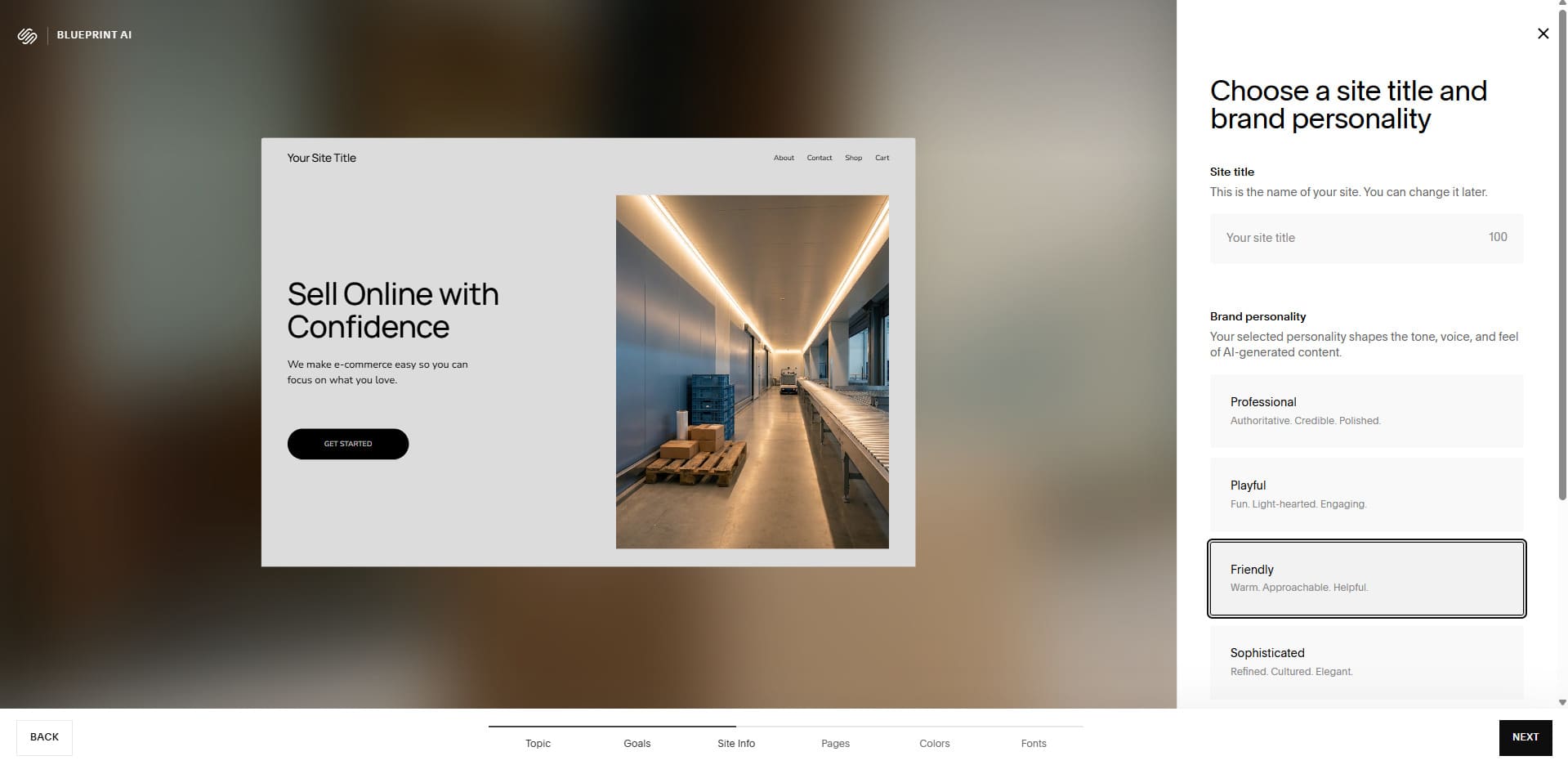
Squarespace also provides a dashboard to manage products, add payment providers, configure order fulfillment workflows and delivery partners, etc through its add-ons and built-in integrations. It is very close to Wix in experience the way it helps you out with SEO and gives you a checklist to complete.
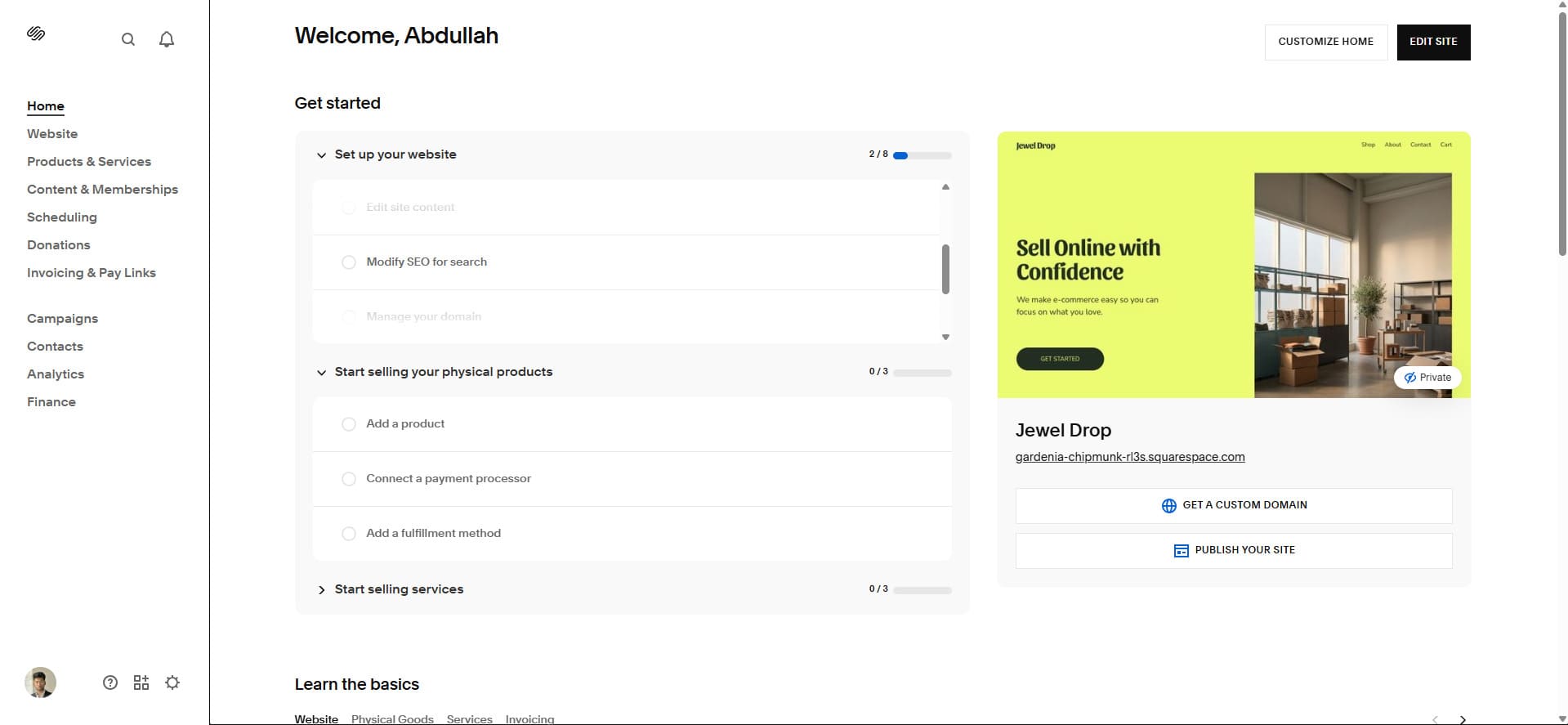
Pricing: Basic plan $19/mo, 2% transaction fees; Core plan $27/mo, 0% transaction fees, custom domain, JS & CSS customization, API support (see pricing details)
Pros: Best-in-class design and UX; No transaction fee on Core plans; Easy drag-and-drop editing
Cons: Fewer payment gateways and delivery partners supported; Less flexible product management; Limited Add-ons support unlike Shopify and WooCommerce
5. Ecwid: Good for Multi-Channel Promotions & Sales
Type: All-in-one AI website builder
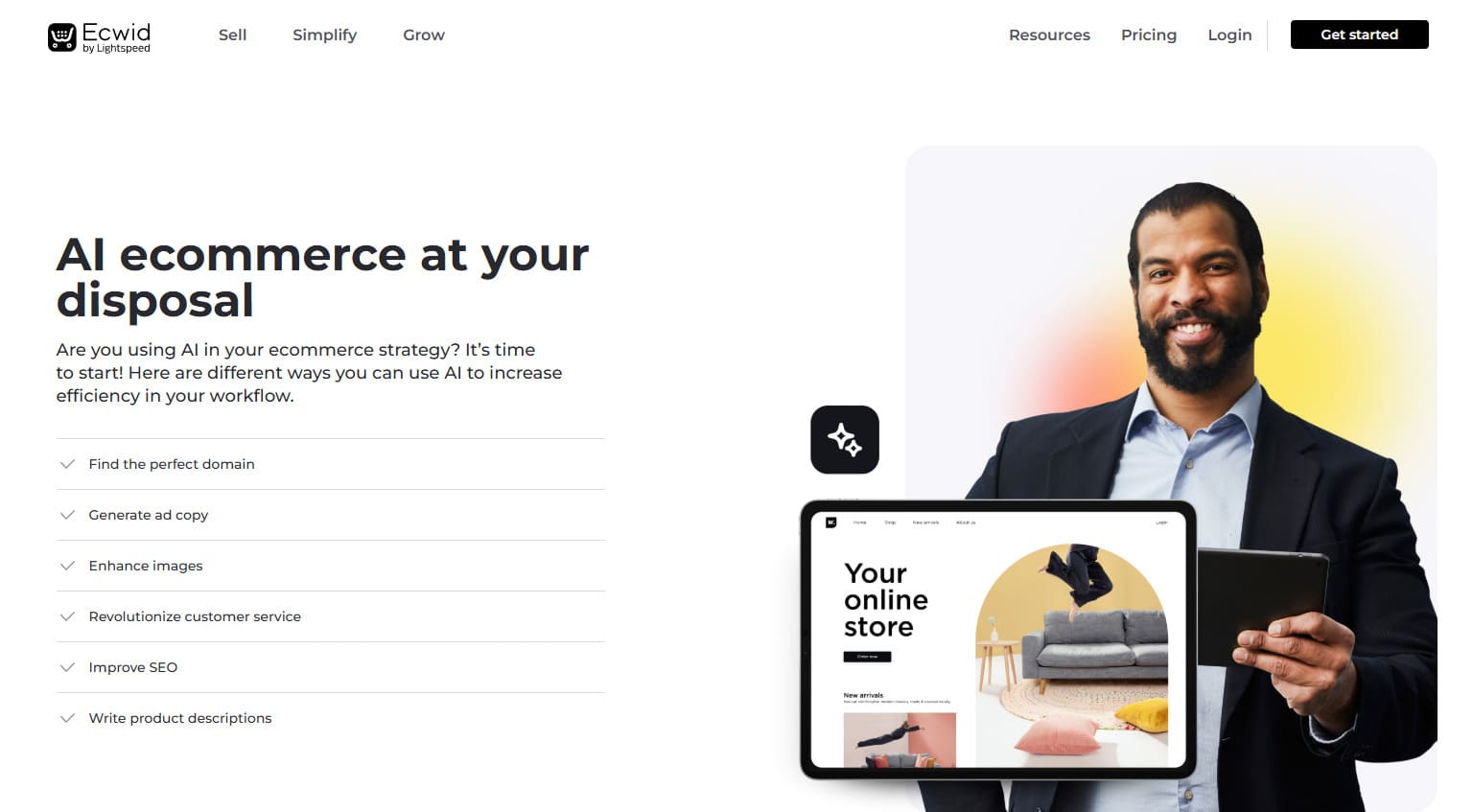
Ecwid is for beginners who want to sell on multiple channels like Facebook, TikTok and Google Shopping but don’t want the hassle of relisting everything. If you connect your social media platforms, Ecwid automatically makes your content shoppable on those platforms. Although Ecwid has a decent drag-and-drop website builder with AI sections builder, the key differentiator is definitely the multi-channel workflow.
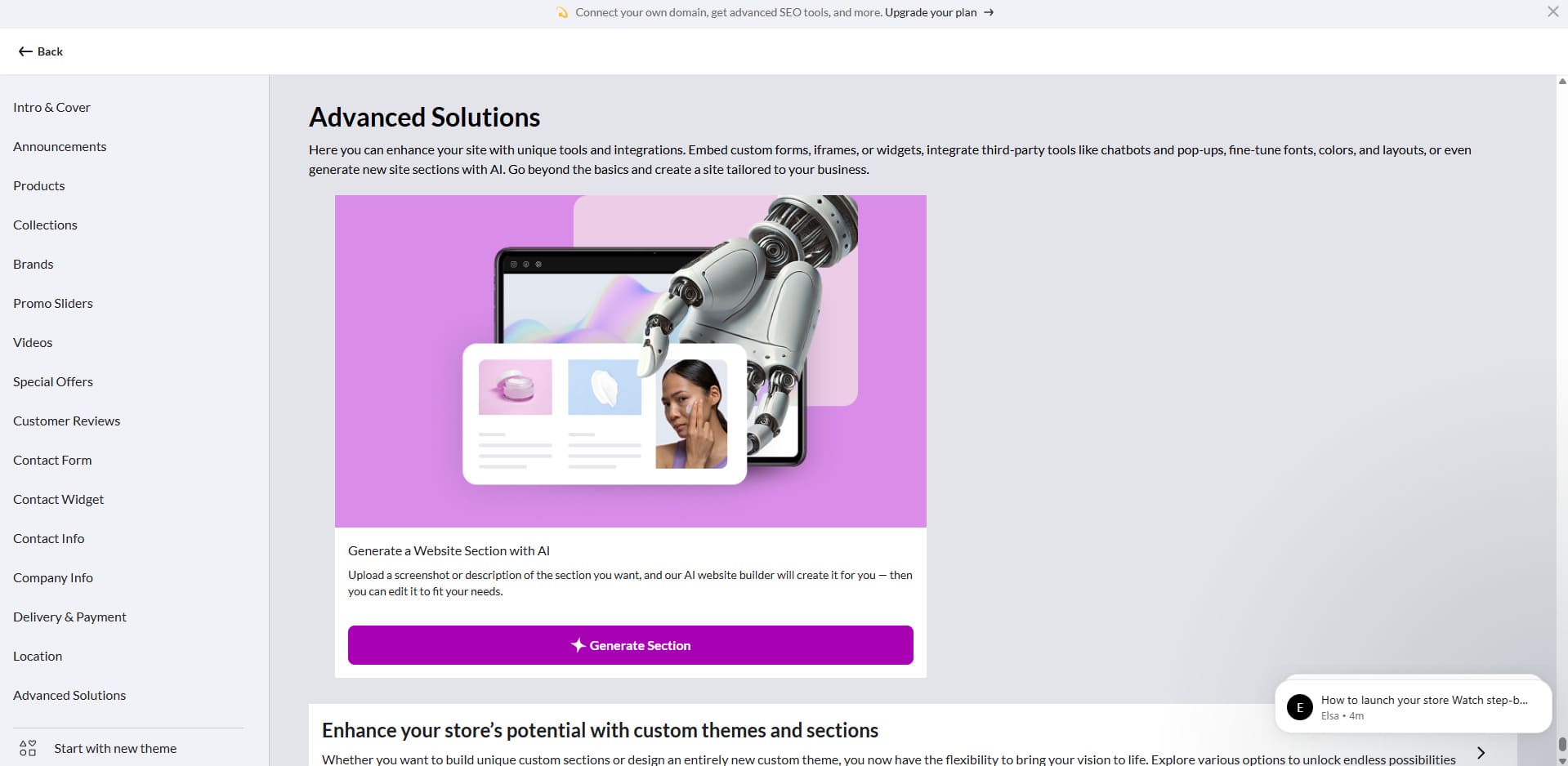
Ecwid does not aggressively market its AI section builder since it still relies on templates and themes as the base for website design before AI section builder comes into the picture. The experience is similar to Squarespace. You can select a theme and make small adjustments but can’t design the whole site in one-shot.
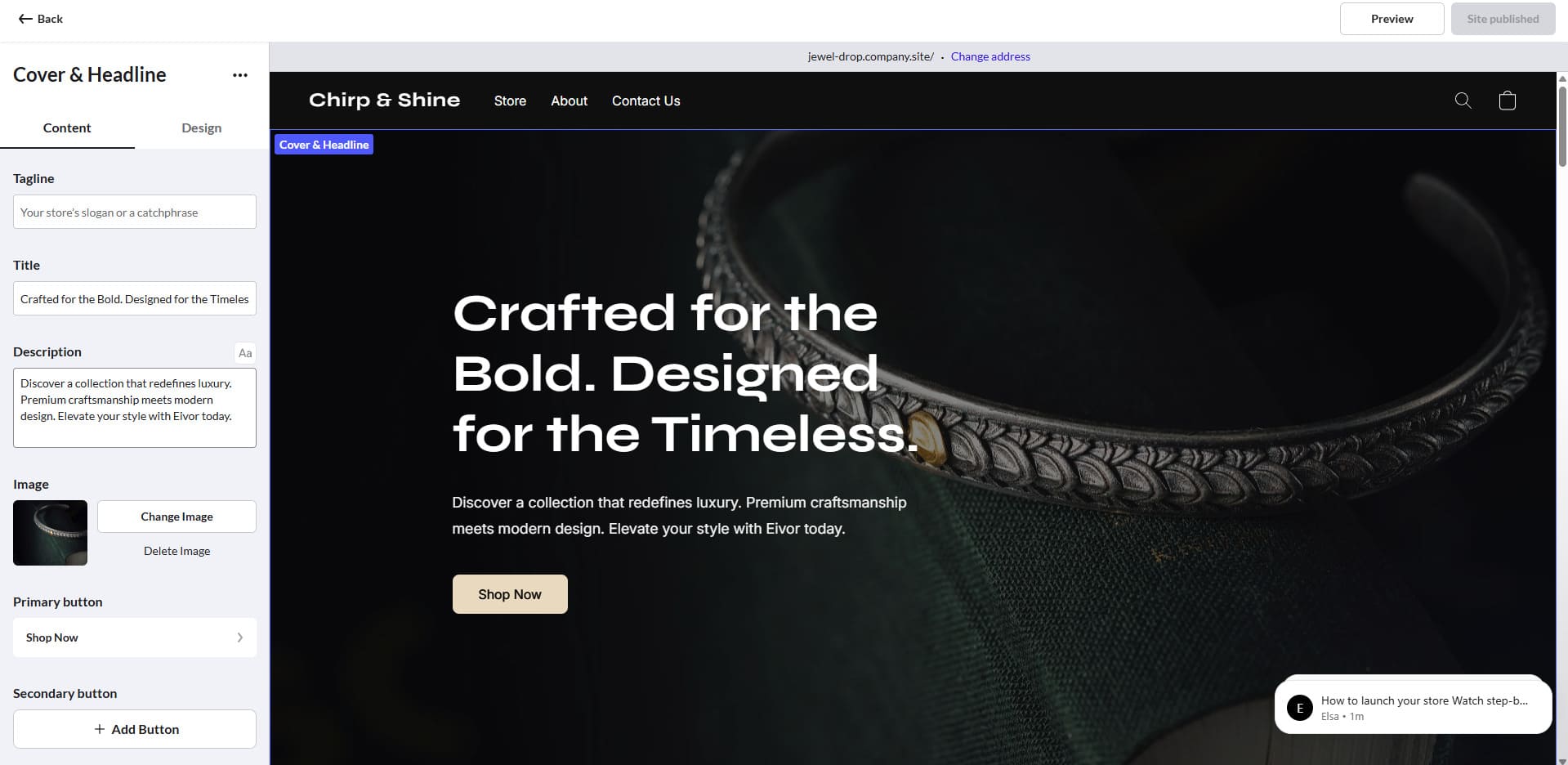
Ecwid allows you to build a custom section if you ever need. It could be a custom embed widget, a carousel of reviews and video testimonials from your customers, or something out-of-the-box that doesn’t exist in Ecwid’s templates.
Pricing: No free tier; Starter plan: $5/mo, 10 products, 70 templates; Venture plan: $35/mo, 100 products, Insta and FB integration; Unlimited plan: $149/mo, Everything unlimited (check full pricing)
Pros: 70+ website themes, Supports multichannel, AI section builder
Cons: Very basic AI (mostly manual editor); Limited products on starter plan; lacks advanced features of other builders
6. Sell The Trend: Dropshipping Research Tool & Gimmick Designer
Type: Dropshipping-Specific AI Store/Page Generators
Sell The Trend is an ecommerce dropshipping product research platform that helps you consistently find winning products, sourced from suppliers like AliExpress, and sell them on multiple storefronts like Shopify, Wix, WooCommerce, TikTok Shop and more. They’ve also been advertising an AI Store Builder tool that I tested and was disappointed with.
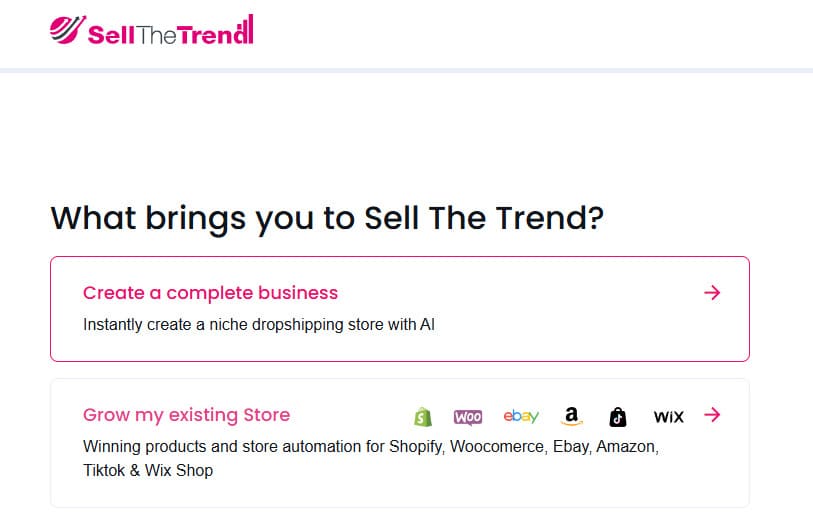
Sell The Trend’s AI Store Builder lets you create a store from scratch, or connect your existing storefronts. To try its full capability, I went complete scratch, and decided to let it design my store. You can either create a Shopify store, or your own custom website with Sell The Trend Shop which is an ecommerce engine of their own.
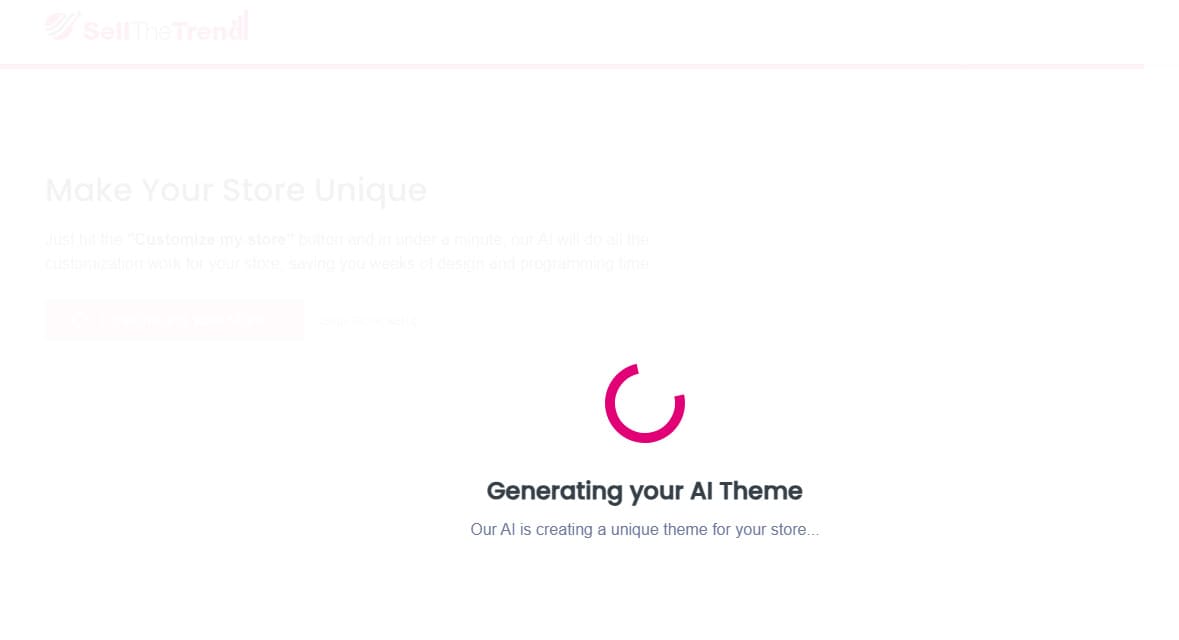
I was under the impression that I would get a cool looking design but in reality, I got a customized theme. In the name of AI, they gave me a modified theme with basic branding and a homepage image I selected from only 8 available options in their app. Nothing about this store was unique or ‘AI-driven’ as per my experience. You can’t even edit the theme from their app once it’s created.
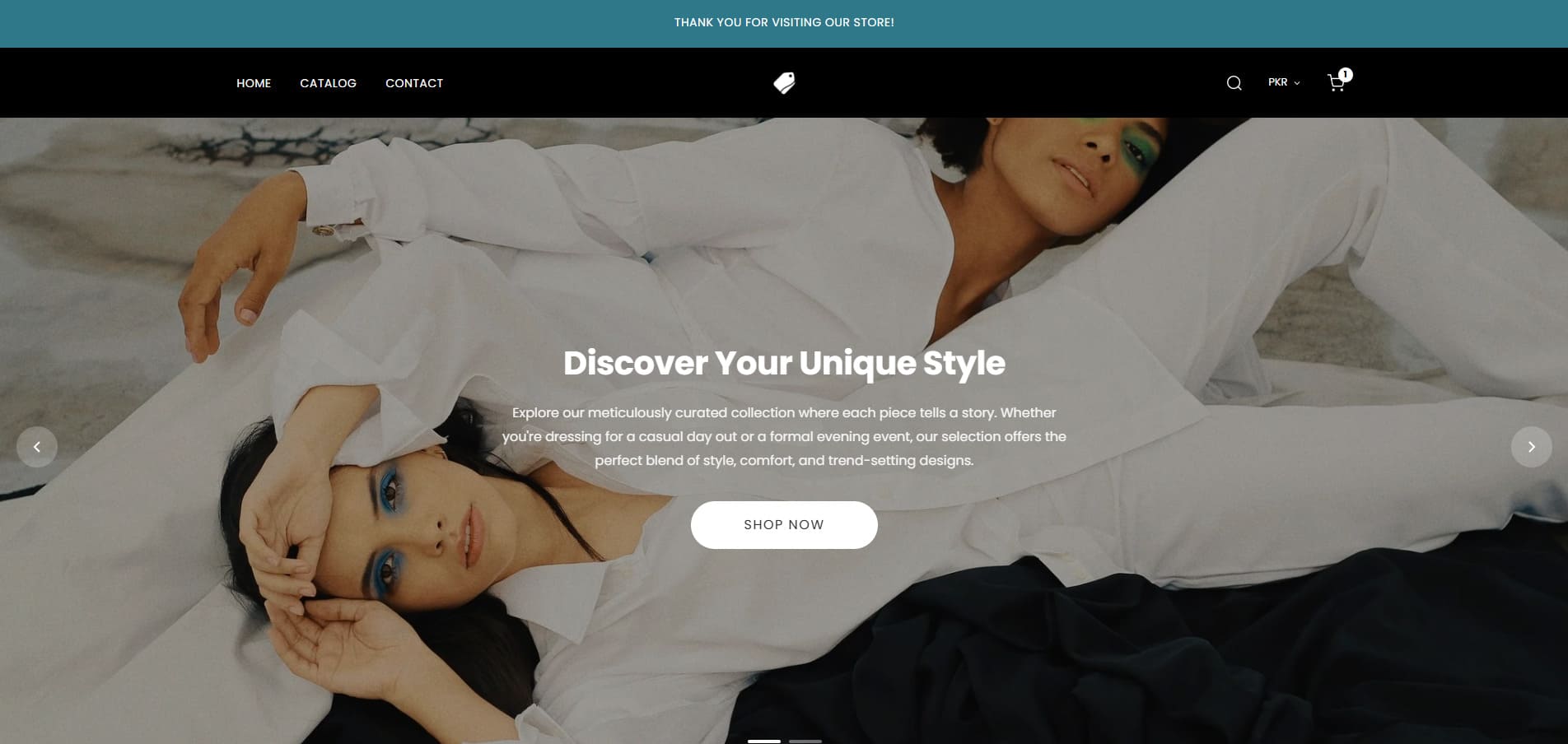
However, I see the potential in AI store builders from Sell The Trend. Dropshippers who know that it just modifies Shopify themes still choose it because they’re using the platform to source products from multiple suppliers, and sell them on Shopify. However, even then, I would recommend using Shopify Sidekick for customization and keep this product for order fulfillment and product sourcing workflows instead of treating it as a store designer.
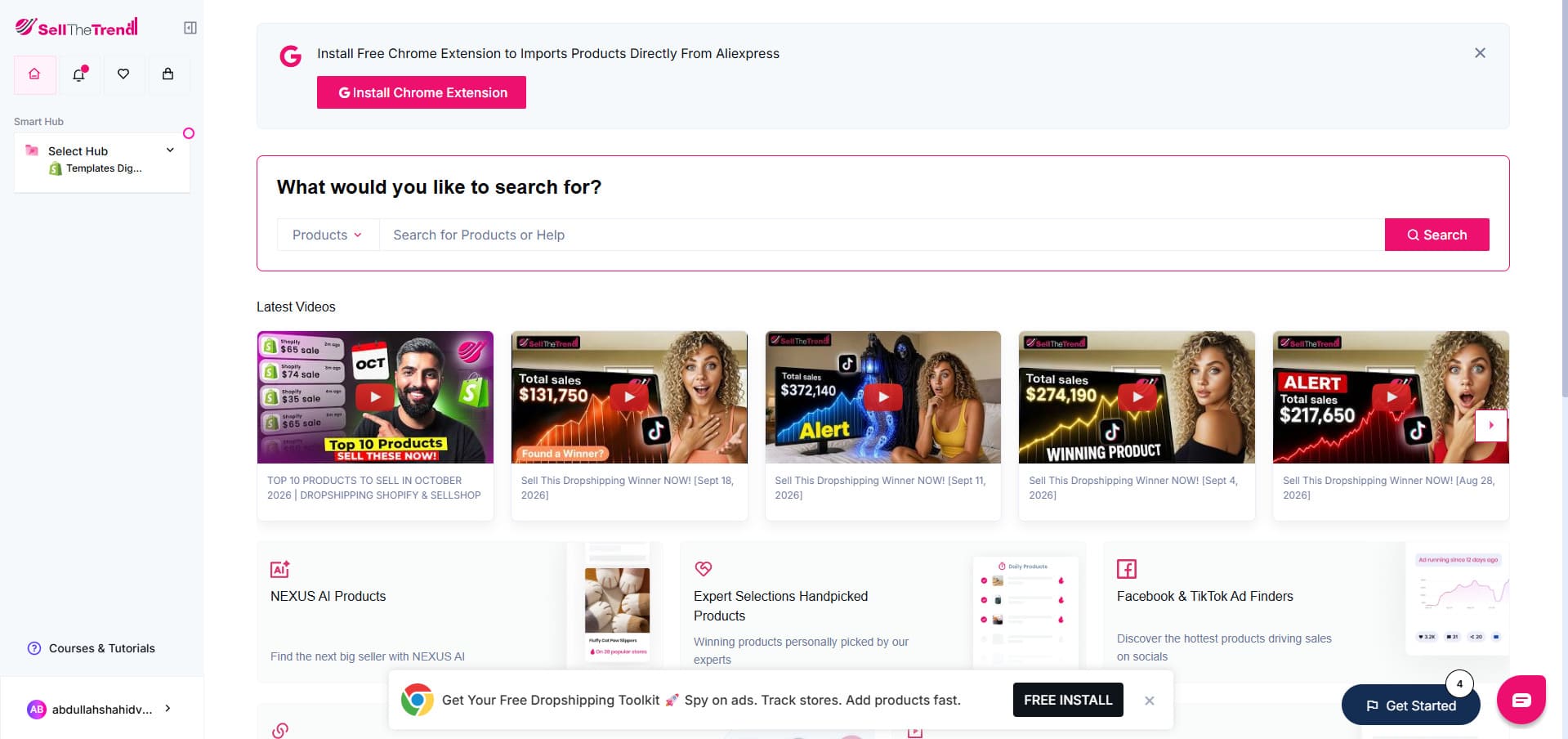
Pricing: Free trial available; Starts $29.97/mo (Standard Lite plan); Essential Plan: $49.97/mo (see Sell The Trend pricing)
Pros: Lot of training content; Daily winning products; Order fulfillment workflow
Cons: AI store builder is a gimmick; Pricing is too high for less features
7. Zendrop: best for automated fulfillment + dropship app
Type: Dropshipping-Specific AI Store/Page Generators
Zendrop is primarily a supplier directory that lets you find and buy dropshipping products for your customers. Zendrop features integrations to push products to your storefront, get orders, fulfill them from its vendor directory, and earn profits. A year ago, jumping on the AI bandwagon, Zendrop launched their AI dropshipping website builder.
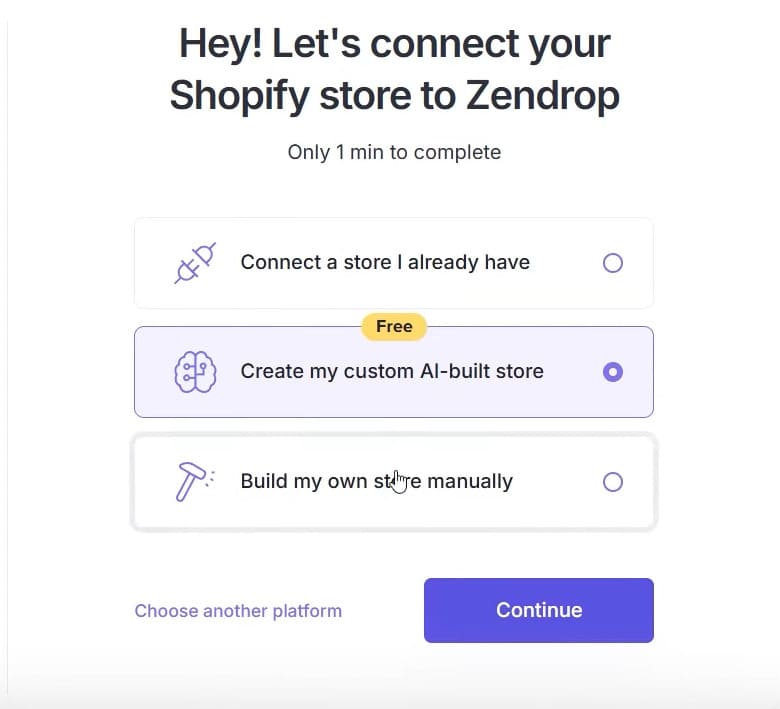
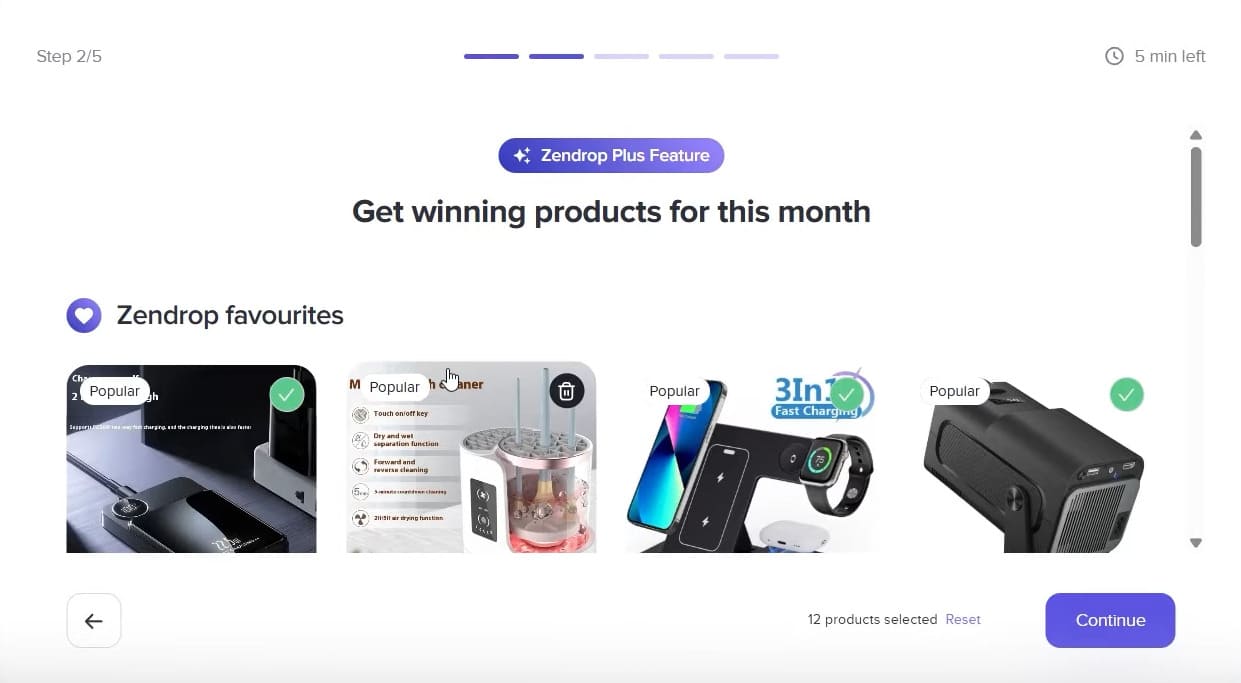
I tried Zendrop’s AI website builder and was rather unimpressed. I was expecting a lot more magic from a platform I am paying $79/mo for. Zendrop took my suggestions, my category type, and suggested a few winning products to list on my store in one-click while I was designing a storefront. I love the fact that it automatically lists a few trending products on my store from the very beginning.
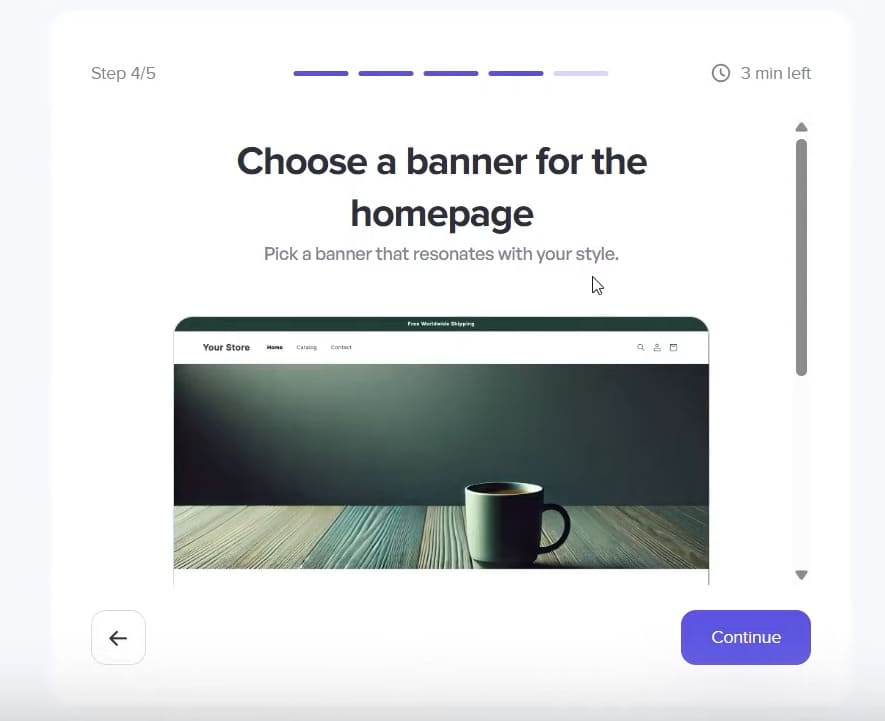
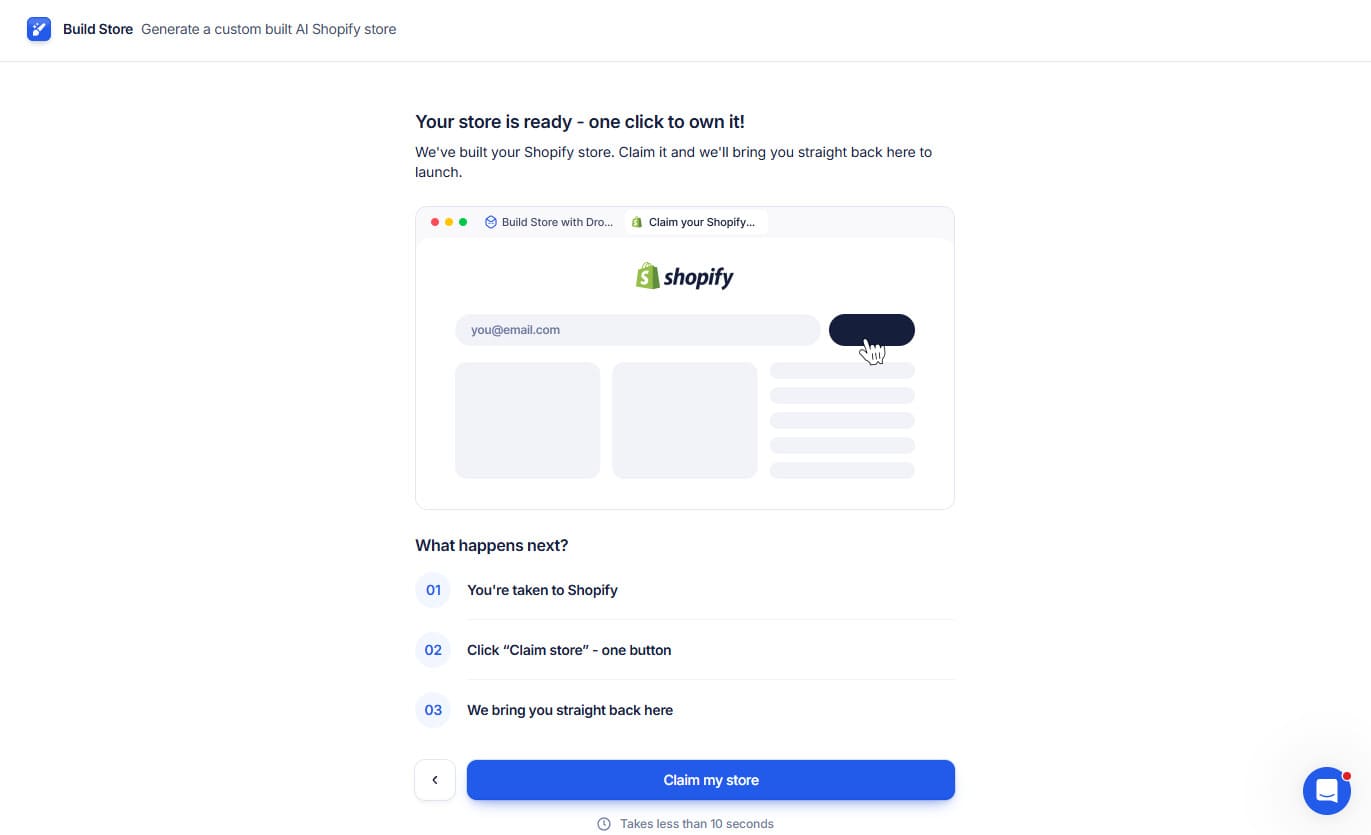
Note that while Zendrop supports Wix and WooCommerce integrations, it only builds a store for Shopify. If you ask it to create a website, it will give you a Shopify theme and ask you to sign-up and subscribe to Shopify first, in order to connect. The disappointing part is that Zendrop is also customizing a Shopify theme and calling it ‘AI website builder’. For your reference, Sell The Trend does the same thing for half the price.
Zendrop is a popular dropshipping platform and its moat is the supplier and product directory it has built over the years along with dropshipping automation platform. If you want to connect to Shopify, Wix or WooCommerce, it is a great starting point but I would not consider its page builder, especially when better alternatives exist.
Pricing: Free tier for browsing products; Plus plan: $79/mo to access AI and other automation features
Pros: Excellent fulfillment support; AI tools for product info; No per-order fees
Cons: Not an independent site builder (works within Shopify/Wix); limited AI creativity (mostly copy/descriptions)
8. Dropship.io: Find Winning Products & Get a Store Theme
Type: Dropshipping-Specific AI Store/Page Generators
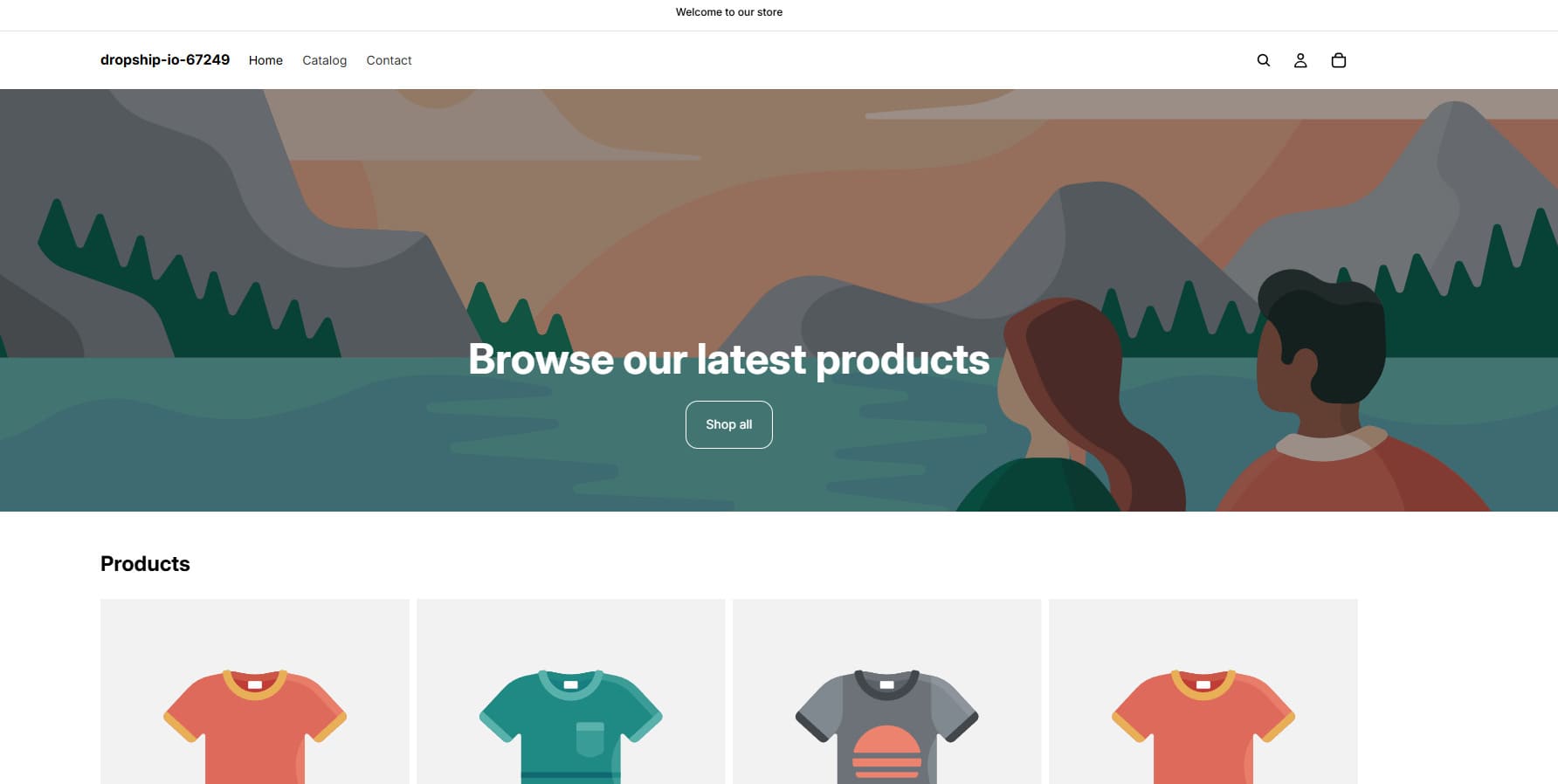
Dropship.io is also a focused dropshipping platform that offers winning products, competitors tracking, and provides their own supplier directory to source products from. To bring users to their platform, they offer a free customized Shopify theme for you which is the same strategy as Zendrop and Sell The Trend. They give you a slightly edited version of a basic theme so you might convert and become their customer.
Dropship.io’s generated theme was the most disappointing in this list. It literally gave me the default dawn theme which is already set up in Shopify when you sign-up. There was nothing exciting about the design itself but for total beginners, I get the appeal. If you’ve made it this far in this blog, I would advise you to ditch these dropshipping apps for page builders and use Sidekick AI.
Pricing: Store design is free; You only pay for Dropship.io subscription starting at $39/mo
Pros: Fast AI setup for testing a single product.
Cons: Immature, few features; limited support.
9. CreateMyStore.ai: Shopify Store Designer
Type: Dropshipping-Specific AI Store Generator
CreateMyStore.ai is a popular online site that people use to design their Shopify dropshipping stores. I read some good reviews about it on Reddit and decided to try. The final output was definitely much better than the rest of the category B tools. I was asked to explain my store, choose a design and enter an email that will connect to the Shopify store.
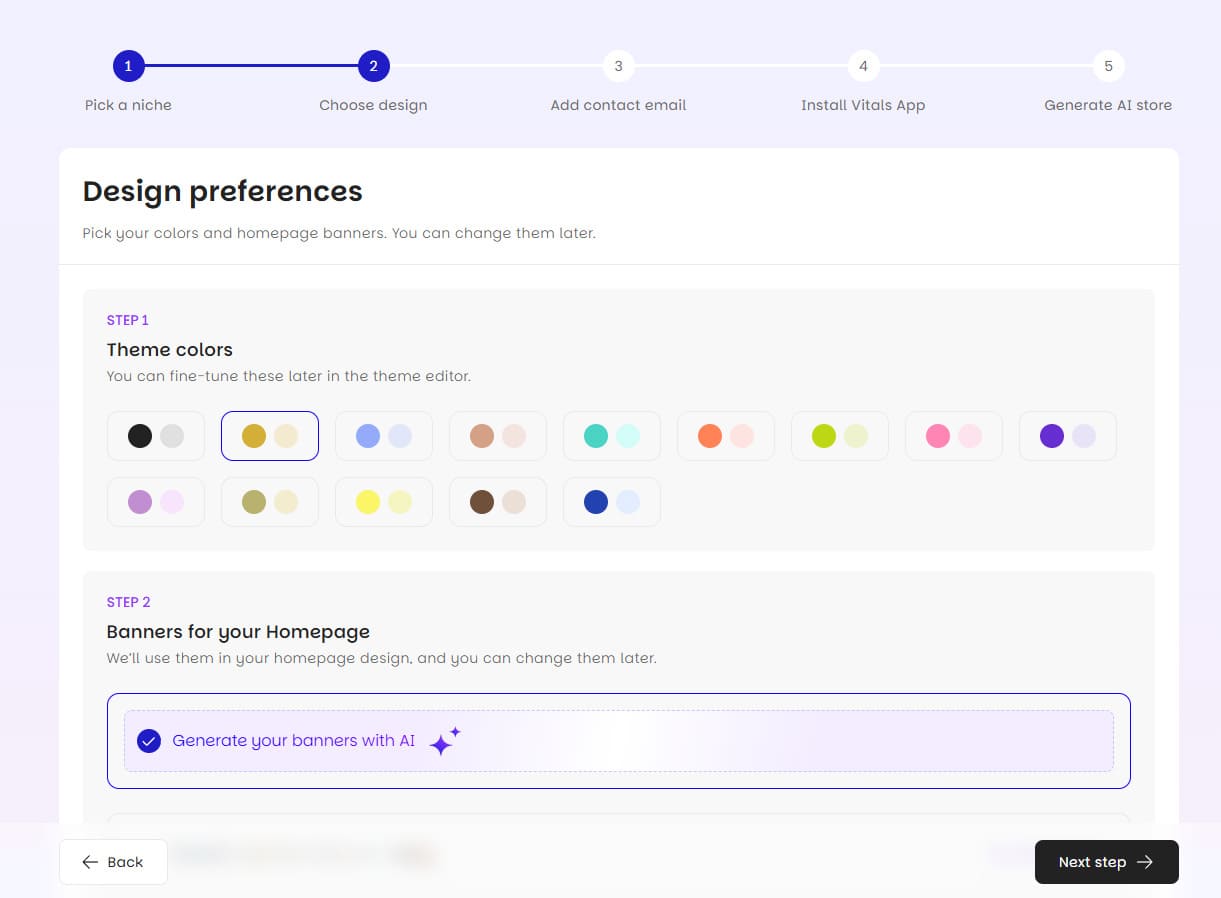
I was skeptical about Createmystore at first since there was no clear pricing page or web dashboard. When I got to store design, I realized that this website is a way for Vitals (a Shopify app) to sell their app subscriptions. You have to install a Vitals app to Shopify which then helps customize a significantly better Shopify store experience.
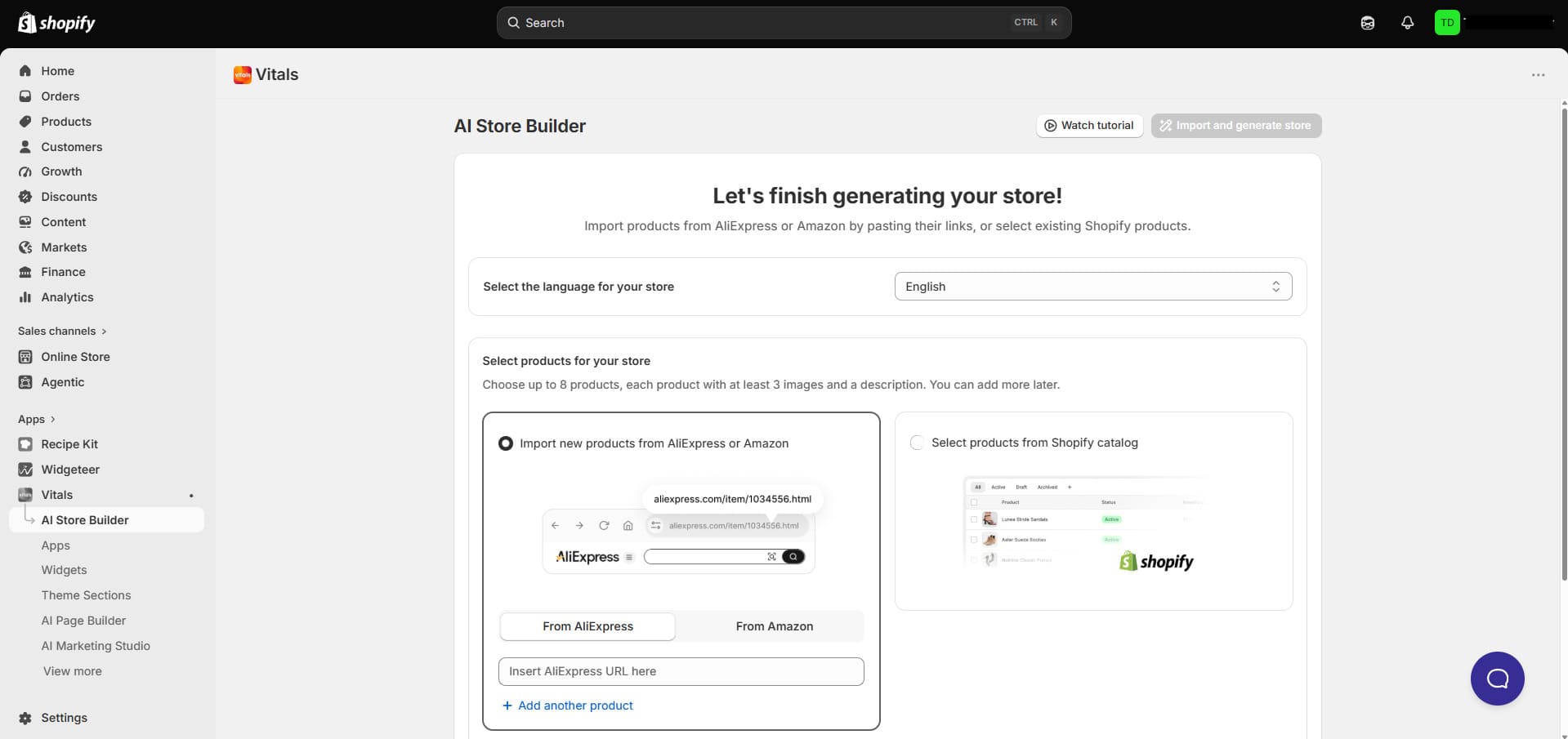
Vitals app lets you either list your existing Shopify products (if you have any) or import from AliExpress or Amazon by adding links. Vitals fetches those products, and lists them on the store it is about to design for you.
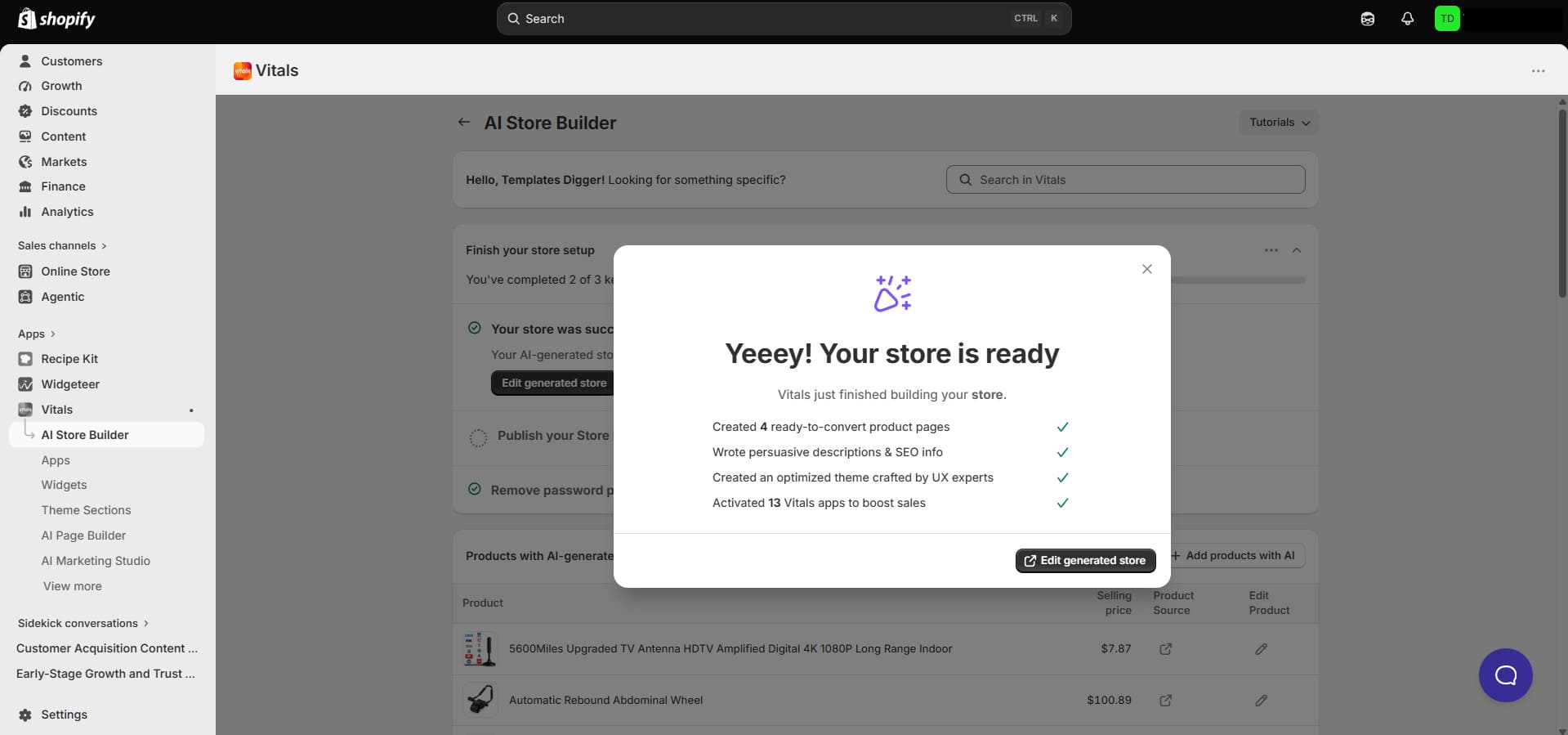
Vitals app works with default Shopify themes and brings its own flair to them. It gave me a good color scheme, better UI, and several widgets and sections that are originally missing from the default Dawn theme.
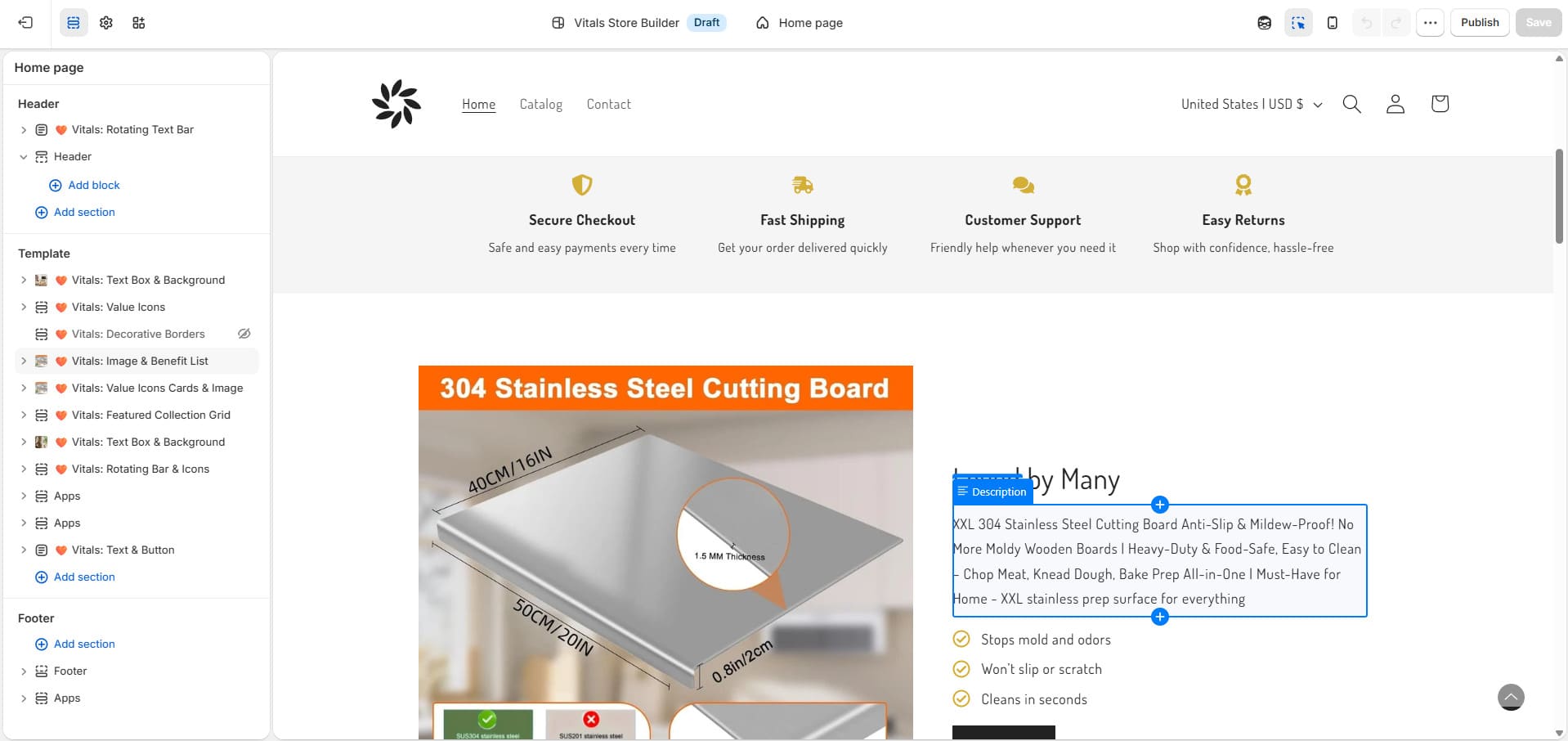
I loved the final store output because it felt more personalized, and different than the rest. Using Vitals features, you can add other things to your store like upsell and cross sell features, testimonials, reviews, etc. that generally require installing and paying for separate apps. You get most of the features from different apps into one bundled subscription that starts at $29.99/mo on Shopify.
Pricing: $29.99/mo on Shopify (Usage fees start after ~$1,000/mo in Vitals-attributed sales)
Pros: Better designs than default Shopify theme; Multiple apps bundled into a subscription
Cons: Still requires manual re-work; You lose access to your theme and sections if you uninstall
Honorable Mentions: Dropshipping Website Builders
Here are some other honorable mentions that I’ve tried from time to time, and heard about from dropshippers. Some of these tools are not specific to ecommerce or provide established CRMs and plugin support but are great for dropship website design.
10. Atlas AI: Atlas is one of the more dropshipping-specific tools because it builds Shopify product pages and stores around a product link. You paste a link from AliExpress, Amazon, Alibaba, or Shopify, and Atlas generates a Shopify-ready page with layout, copy, images, bundles, and cart upsells. This use case is perfect for dropshippers who hunt new products and instantly want to publish a page and run ads in no time. The catch is that Atlas is Shopify-only, and it does not replace supplier sourcing or fulfillment. Atlas starts at $39/month with a 7-day free trial.
11. Lovable: Lovable is a famous vibe coding tool that can also be used to create a dropshipping store. You get complete control over design and your backend since everything is being built from scratch but using Lovable requires a bit of system architecture understanding. You must have experience running and managing an ecommerce store to do a good prompting job. Otherwise, you’re looking at manually connecting several tools, architectures, and security leaks you never knew. Lovable has a free plan, but the practical paid starting point is usually Pro at $25/month.
12. 10Web AI Builder: 10Web is a general purpose website builder that helps with hosting, database, backend support and domain connection. The interesting part is that its specialized ecommerce website builder not only supports ecommerce stores with their own customized backend, but can also help with WooCommerce dropshipping websites and connect and push everything to your WooCommerce integration.
The complication with 10Web AI builder is that you need to carefully connect everything and ensure security since you have more control over your code and deployment than on Shopify or Wix. It starts at $20/mo for 1 website.
13. Base44: Base44 is closer to Lovable than Shopify. The most important selling point of Base44 is that it owns most of the infrastructure: Server, database, hosting, domain registry, plugins, AI agents, etc. Everything is easy to connect and agent driven. The fun use case is building the tools around your dropshipping business, not just the store itself. The complication is that ecommerce is not as ready-made as Shopify or WooCommerce. Base44 has a free plan, paid plans start from $20/month.
AI website builder comparison: features, pricing and limits
| Platform | AI copywriting | AI SEO metadata | Dropship apps | Marketplace sync | Pricing | Design |
|---|---|---|---|---|---|---|
| Shopify Sidekick | Yes, Sidekick AI | Yes, Sidekick can help | All major apps: Easync, CJdropshipping, Spocket, DSers, AutoDS, etc. | Amazon/eBay via apps and sales channels | Basic $39/mo, Grow $105/mo | 8.5/10 |
| Wix AI | Yes, Wix ADI / AI content | Yes, SEO Wiz | Modalyst | Instagram, Facebook, marketplaces/social channels on ecommerce plans | Core $29/mo, Business $39/mo | 9/10 |
| Hostinger AI | Yes | Yes, built-in | WooCommerce plugins / Hostinger Ecommerce tools | None | $18.99/mo with $11.99/mo additional for ecommerce | 7/10 |
| Squarespace | Limited | Yes | None natively | Limited: Instagram/social selling | Basic $19/mo, Core $27/mo | 8/10 |
| Ecwid | No | Limited | None natively | eBay/Amazon via apps | Starter $5/mo, Venture $35/mo | 5.5/10 |
| Sell The Trend | Yes, product AI | No | AliExpress, CJdropshipping, local suppliers | Supports Shopify, Amazon, eBay, WooCommerce, Wix, TikTok connections | Lite $29.97/mo, Essential $49.97/mo | 6.5/10 |
| Zendrop | Limited, product AI | No | Zendrop suppliers, AliExpress-style sourcing, CJ-style workflow | No native marketplace sync | Pro $49/mo, Plus $79/mo | 5/10 |
| Dropship.io | Limited; AI | No | Product research/import for Shopify-style dropshipping | No direct marketplace sync | Free theme, Tool is paid, Basic $39/mo, Standard $59/mo, Premium $99/mo | 2/10 |
| CreateMyStore.ai | Yes, AI sales copy/product pages | Yes, product SEO title/description | AliExpress-style product import; Shopify only | No | Free to build; Vitals suite $29.99/mo after trial | 7.5/10 |
Table notes: All the prices were verified on 24th September 2026. The table above focuses on front-end AI features. It does not cover back-end automation (supplier sourcing, pricing sync, order fulfillment). You can do that with dropshipping tools like Easync.
How to build a dropshipping store with AI in 7 steps
Here is a quick overview of how to build a dropshipping store with AI in 7 simple steps.
- Pick a niche & product focus (1–2 hours): Use some research tools and market understanding to decide the products you will sell. Use Google Trends, and other product hunting tools.
- Validate product demand (2–4 hours): Use tools like Google Keyword Planner, Amazon/Aliexpress best-seller lists, TikTok Ads Library to find winning products.
- Generate the AI store (5–10 minutes): Use Shopify Sidekick of Wix AI to build a store within a few minutes. Don’t spend time tweaking it yet.
- Review and refine AI content (30–60 minutes): Spend some time only improving the copy of your store and match to your niche. Don’t obsess over design yet.
- Connect suppliers (30–60 minutes): Install your dropshipping app in Shopify (Easync, CJDropshipping, Zendrop, Spocket, etc) and import actual products to your inventory.
- Set up store policies and settings (15–30 minutes): Add shipping, returns, and privacy policy pages. Configure payment gateways (Stripe, PayPal) and tax settings (VAT-inclusive pricing in UK/EU).
- Go live and make your first few sales to validate: Once your domain is connected and products are live, take your store online, and make a first few sales through paid ads to validate demand.
What AI Website Builders Can’t Do (And How to Cover The Gap)
AI Website Builders don’t help with product sourcing and automatic order fulfillment. Most of the products in the list are efficient at design and connecting your CRM or ecommerce backend to your storefront but none of these tools will help you source dropshipping products, automate orders, sync tracking from platforms like Amazon, AliExpress back to your Shopify or eBay store. You need specialized dropshipping automation and supplier software for that.
If you are a beginner and want the easy way, use platforms like Zendrop and Spocket to source products initially. You can install their apps on Shopify or Wix, and source products. These apps will provide suppliers, products and shipping. Once an order arrives on your dropshipping product, your app picks it up. You pay for it and their own suppliers dispatch it to your customer while syncing tracking back to your store.
If you are a seasoned dropshipper, and don’t like the fact that most dropshipping platforms now list products at market rates with no profit margin, you can try Easync. You can find products from AliExpress, Amazon, eBay, Walmart, etc. and import them to your Shopify or eBay store using Easync. The app will automatically sync products, collect orders, automatically pay for them and sync tracking and order info back to your customer and store. Easync completely automates the order fulfillment workflow. Moreover, if the price of your dropshipping product changes, Easync scans for price changes every 15 minutes, and can instantly reprice it on your store to protect profit margins. You can try it out with a 7-day free trial before committing to a paid plan.
In short, a store built with AI is “front-end ready” but without automation it means manually processing every order. That’s where tools like Easync come in.
Free vs paid AI dropshipping website builders
Wix AI, Dropship.io, Sell The Trend, CreateMyStore.ai are a few free builders. You get a free plan on Lovable with only 5 credits a day. If I had to pick the best free AI dropshipping website builder, it’s Wix AI. It has always been generous with pricing plans and lets you freely explore the platform instead of stuffing offers in your face like Hostinger.
Shopify, Squarespace, Ecwid, give you a free trial to comfortably test and launch your store before you make your first payment. Shopify even offers $1/mo subscription for 3 months before charging you the actual $39/mo which is a great starting point.
My clear winners are Shopify (free trial + paid) and Wix AI (free tier + paid) because they both do something out of the box, are perfect match for ecommerce dropshipping, and have a decent ecosystem of dropshipping apps.
Common mistakes when building a store with AI
When you’re designing with AI, you might make some rookie mistakes that I see people make time and time.
- Publishing AI text unedited: Page builders are not specialized in copywriting. They produce a generic copy that says a lot and nothing at the same time. It sounds inauthentic. Please spend some time refining it based on your brand image.
- Using AI-generated product images: If an AI builder populates your store with dummy content and images, get rid of it before going live. It looks really unprofessional.
- Missing legal pages: Don’t forget to write data use, privacy and refund policies. This is not just a legal risk, it also helps with return claims, better SEO, etc. For example, in the UK, prices must display VAT-included which is commonly overlooked. Moreover, most payment gateways only provide integration if you have proper compliance pages in place.
- Not thinking about backend and security: If you’re not using Wix or Shopify and vibe-coding from scratch using Lovable or Claude Code, you will need to deploy and manage your own product backend and dashboard for managing products. Many people make serious security mistakes. Get your backend connection, private API keys and other routes audited first.
Frequently Asked Questions
Can AI build a dropshipping website for me?
Yes, AI builders like Shopify Sidekick, Wix AI, Hostinger AI and CreateMyStore.ai can create dropshipping websites for you with functioning backend and add-on support for dropshipping platforms.
What is the best AI dropshipping website builder in 2026?
The best dropshipping website builder is Shopify Sidekick AI because it supports every dropshipping platform through the app marketplace, and has a well-developed platform for product management and order fulfillment automation.
Is there a free AI dropshipping website builder?
Wix has a generous free plan that lets you create your first website with AI builder. Shopify has a free trial for 7 days and $1/mo for next 3 months which is a great starting point for serious stores. I would not recommend investing in other AI builders since you’re still going to pay separately for an ecommerce platform anyways.
Can AI build me a whole dropshipping business?
AI can build the storefront, but not the entire business. It won’t find or vet suppliers, set competitive pricing, or run ad campaigns unless you’ve configured the right apps like Easync and Shopify together through APIs. Then, you can create a custom agent and skills in Claude or Codex to help you leverage these APIs and do the heavy lifting for you.
Is dropshipping dead in 2026?
No, dropshipping is still a viable model, especially for niches and new markets. Marketplaces like Amazon, eBay, TikTok Shop and even indie sites continue to have demand for a wide range of products. However, the low Chinese sourcing and high profit in US/UK markets model is gone due to tariffs and global conflicts. Your product has to be valuable to generate a profit.
Which is better for dropshipping: Shopify or Wix?
For serious dropshipping businesses, Shopify is generally better because of its vast app ecosystem and scalability. Shopify lets you connect to more supplier apps (AliExpress, CJ, Oberlo alternatives) and can sync sales to Amazon/eBay easily. Wix can work for small stores and has an AI builder that holds your hand through marketing, store setup and products, etc. Wix is a fine budget choice, but Shopify is better long-term for growth.
Do I still need a dropshipping automation tool if I use an AI website builder?
Yes. An AI builder handles the storefront but you still need automation for suppliers and orders. Platforms like Easync help with inventory sync, repricing, order fulfillment and order tracking.
How long does it take to build a dropshipping store with AI?
In my tests, the typical time from sign-up to a working store (without product sourcing) takes 10-20 minutes at max. However, this isn’t the hard part. The real part is sourcing good products and marketing your store properly.
Can an AI website builder connect to eBay or Amazon?
AI builders only create the store itself. To source products from eBay/Amazon or Walmart, you need third-party plugins and apps. Easync and other dropshipping platforms can help you sync products from Amazon, AliExpress or Walmart to your Shopify store.
Best Dropshipping AI Website Builder for the UK Market?
Shopify, Wix and Hostinger support UK checkouts in GB currency. If you’re looking for UK dropshipping suppliers, Easync provides fulfillment from Amazon UK. Most of the dropshipping suppliers source from US or Chinese suppliers so if you’re dropshipping from Amazon or eBay, Easync can help with UK product sourcing.
Conclusion
For most sellers, Shopify AI Sidekick is my top pick because it is the right example of proper AI integration rather than a gimmick. Sidekick runs on an older GPT 4o model but the way it understands Shopify’s Liquid CSS, your prompt, and your existing store layout is better than other AI designers. The most important part of using Shopify is the app ecosystem and easy-to-use CRM.
Wix AI is my second pick for beginners who care most about design and ease of use. Its AI builder can produce a polished storefront quickly, with far less setup than a more technical platform.
Once your storefront is ready, you can connect it to Easync and source products from marketplaces like Amazon, AliExpress, and Walmart, etc. Easync automates product management, repricing, order fulfillment, and tracking info sync for you. If you’re not using Shopify for your store, you can use Easync API to connect their platform to your custom store.