Quick answer: Walmart to eBay dropshipping is a retail fulfillment model where you list Walmart products on eBay at a markup, then buy from Walmart.com and ship straight to your eBay buyer after each sale. Reselling itself is legal, but both platforms constrain it: eBay’s policy permits dropshipping only from wholesalers and manufacturers, not from another retailer, and Walmart’s terms let it close accounts buying for commercial resale. Sellers who run this route anyway lean on business-grade buyer profiles and walmart to ebay dropshipping software to keep pricing synced, suppress retail invoices, and stay off both platforms’ radar.
This guide walks through how the model actually works in 2026: the policies on both platforms, the fees and break-even math, which categories are safe, how to optimize listings for eBay’s Cassini search, and how to handle the parts that get accounts suspended (retail invoices and returns). Much of it applies whether you fulfill by hand or automate.
What Walmart to eBay dropshipping actually is
Dropshipping itself is old. The reason it feels new is that marketplaces made it trivial to reach buyers without a warehouse. A dropshipper doesn’t touch production, raw materials, inventory, or storage. The job is narrower: find products that sell, list them well, and fulfill orders reliably through a supplier.

When a customer orders from your store, you forward that order to a supplier who packs and ships it. The supplier can be a wholesaler, a manufacturer, or a retailer like Walmart. The buyer only ever talks to you, so every question, return, and damage claim lands on your desk.
In this specific path, Walmart is the source marketplace and eBay is where you sell. Your profit is the gap between Walmart’s price and your eBay price, minus eBay’s selling fees and any sales tax you paid at Walmart. It is one of the most common US dropshipping routes because Walmart has deep inventory, fast domestic shipping, and predictable stock on staple goods.
One point of scope before the numbers start, because it saves confusion later. This model runs on US soil. Walmart.com delivers to US addresses and territories, and while it opened limited international shipping to Canada and Mexico in 2026, it does not ship to the UK or most of the world. Your buyer is therefore an eBay.com customer with a US address, and every figure in this guide is in dollars with US sales tax, because that is the currency the transaction actually happens in. You as the seller can be based anywhere. Plenty of people run this route from Europe or Asia, and their own country never enters the math. What doesn’t work is trying to serve eBay.co.uk buyers from Walmart, since the parcels can’t get there and eBay UK’s fee schedule is different.
Does Walmart allow dropshipping? The policy in plain terms
Walmart offers no formal program for buying from Walmart.com to resell on other platforms, so the Walmart dropshipping policy here is really a matter of terms and enforcement rather than an official rulebook. Reselling a Walmart product isn’t illegal, but Walmart’s Terms of Use let it cancel orders or terminate accounts used to buy the same products for commercial resale to third parties. eBay, for its part, allows dropshipping only when you source from wholesalers or manufacturers, and treats buying from another retailer to fulfill orders as a policy risk.
So the honest picture on “does Walmart allow dropshipping” has two layers.
On the Walmart side, the platform treats you as an ordinary shopper. There is no rule of physics stopping you from buying an item and reselling it. What Walmart watches for is patterns that look commercial: many packages going to many different addresses, high order volumes on a single profile, and buying that appears aimed at resale. When Walmart flags that behavior, it can limit quantities, cancel orders, or close the account. This is why a casual retail profile is fragile for anything past a handful of orders, and why serious sellers move to business-grade buyer profiles rather than a personal Walmart dropshipping account tied to their home address.
On the eBay side, the dropshipping policy is clearer. eBay explicitly allows dropshipping when you fulfill orders through a wholesale supplier. It does not allow listing an item and then buying it from another retailer to have that retailer ship it to your customer. In practice, plenty of sellers do dropship Walmart to eBay successfully, but the account risk is real, and it rises the moment a buyer realizes their package came from Walmart at a lower price. Everything below is about lowering that risk.
Walmart dropshipping policy vs eBay’s rules at a glance
Side by side, the two rulebooks pull in different directions:
| Policy area | Walmart | eBay |
|---|---|---|
| Is dropshipping allowed? | No formal program for reselling Walmart.com purchases on other platforms | Yes, but only when you source from wholesalers or manufacturers |
| Buying to resell | Terms of Use allow Walmart to cancel orders and close accounts used for commercial resale to third parties | Not regulated on the sourcing side, since eBay’s rules govern how you fulfill |
| Retail invoice in the box | Not Walmart’s concern, it’s a normal receipt | Grounds for a buyer complaint and policy action against you |
| Who answers to the buyer | Nobody, you’re an ordinary retail customer | You, as seller of record, for returns, damage, and delays |
| What enforcement looks like | Quantity limits, cancelled orders, account closure | Selling restrictions, listing removals, up to permanent suspension |
Read across the rows and the whole tension of this business model shows up. Walmart doesn’t care what you do with the item after it arrives, but it can close the account that keeps buying. eBay doesn’t police where you sourced from, but it will act on how the package arrives and how you handle the buyer. Your job sits in the narrow lane between those two.
Benefits of dropshipping Walmart to eBay
Walmart is one of the largest retailers in the world and now a major online marketplace, with inventory spanning grocery, baby, toys, clothing, beauty, personal care, home, and more. Pairing that catalog with eBay’s buyer traffic gives you a few concrete advantages:
- eBay offers tiered seller subscriptions, so your fees can scale with your volume rather than against it.
- You can brand your storefront with a logo and a story, which helps repeat business.
- eBay’s promoted and sponsored listings let you buy visibility when a product is working.
- Walmart’s domestic shipping is fast and predictable, which matters for eBay’s delivery expectations.
- Both platforms have real customer support, help centers, and active seller communities.
- The whole workflow, from sourcing to fulfillment to tracking, can be automated, which is where most of the time savings live.
The trade-off is eBay’s rulebook. Between the VeRo program, the dropshipping policy, return handling, and fees, there is more to learn than on a simpler channel. But the buyer traffic arrives without you buying it, which is the reason people keep choosing eBay.
The seller-of-record risk (and how to avoid the classic complaint)
The fastest way to get reported and suspended is for your eBay buyer to open a Walmart box and find a Walmart receipt showing a price lower than what they paid.
When you dropship, you are the seller of record even though Walmart physically ships the item. Your buyer believes they bought from you and holds you responsible for everything. The moment they see evidence of the true source and the true price, three things can happen: a negative review, an item-not-as-described case, or a direct report to eBay for retail arbitrage. Any of those hurts, and the last one can end the account.
The core defense is invoice control. Marking the order as a gift at checkout hides the price from the recipient and gets the item packed in a plain Walmart box, with the gift receipt emailed to you instead. One catch worth knowing before you build a whole catalog around it: Walmart applies this only to items flagged as gift eligible, and some products ship in manufacturer packaging that reveals the contents regardless. Check eligibility while you’re sourcing, not at the moment a sale comes in. Doing all of this by hand works until you forget once during a busy week, and one slip is all it takes, which is why it belongs in automated fulfillment settings rather than your memory.
Two more habits reduce exposure. Keep your own email and phone on the Walmart order instead of the buyer’s, so tracking and account messages come to you, not to a customer who might connect the dots. And never promise eBay buyers faster shipping, freer returns, or damage coverage that you don’t actually have at Walmart, because any promise you can’t back with Walmart’s terms comes straight out of your margin.
The math: eBay fees and your break-even price
For most categories in 2026, eBay charges a final value fee of about 13.6% of the total sale plus a flat per-order fee of $0.30 on orders of $10 or less or $0.40 above $10. Under managed payments there is no longer a separate PayPal processing fee to add on top.
Here is the point most beginners miss. That percentage applies to the entire transaction total, including the shipping and sales tax portions, not only the item price. So your true cost floor sits well above the Walmart sticker, and the number you need to beat is your break-even, not Walmart’s price.
A workable break-even formula:
Break-Even Price = (Walmart Price + Sales Tax) / (1 - eBay Fee Rate) + Per-Order FeeWorked example. Say a product costs $20.00 at Walmart, and you paid 7% sales tax, so $1.40. Your cash outlay is $21.40. With an eBay fee rate of 13.6% (0.136):
$21.40 / (1 - 0.136) = $21.40 / 0.864 = $24.77$24.77 + $0.40 per-order fee ≈ $25.17That $25.17 is the price at which you make nothing. Any profit has to sit on top of it. This is also why razor-thin markups fail: a listing priced at $23 in that example is losing money on every sale even though it looks like a $3 profit over Walmart’s price.
Run the same math across a few price points and the shape of the business becomes clear:
| Line item | Item at $15 | Item at $25 | Item at $40 |
|---|---|---|---|
| Walmart price | $15.00 | $25.00 | $40.00 |
| Sales tax at 7% | $1.05 | $1.75 | $2.80 |
| Your cash outlay | $16.05 | $26.75 | $42.80 |
| Break-even eBay price | $18.98 | $31.36 | $49.94 |
| Price for a 20% return | $22.75 | $37.62 | $59.91 |
| eBay fees at that price | $3.49 | $5.52 | $8.55 |
| Net profit | $3.21 | $5.35 | $8.56 |
Two things worth noticing. Cheap items are punishing, because the flat per-order fee eats a bigger share of a small sale and $3.21 doesn’t survive one return. And the gap between the Walmart price and your break-even is wider than instinct suggests: roughly $4 on a $15 item, closer to $10 on a $40 one. Sellers who mark up by a flat couple of dollars are working for free without realizing it.
The 7% tax rate above is illustrative, and the 13.6% fee is the standard-category rate. Sales tax varies by state, usually in the 5% to 10% range, and you generally pay it as the buyer at Walmart. Media and a few other categories carry different eBay rates, and none of this counts advertising or the cost of returns. Because Walmart prices move often, a fixed price will quietly slip below break-even the next time the source cost ticks up. Rule-based repricing (whether you build the rules yourself or run them in walmart to ebay dropshipping software) keeps the floor intact as costs change. You can sanity-check any listing with a free eBay fee calculator before you publish it.
Safe categories vs categories that get you banned
Category choice does more for account safety than almost anything else, and the split isn’t subtle once you know what to look for.
The safer zones share three traits: generic or unbranded goods, low emotional stakes if delivery slips a day, and cheap returns. Home improvement, kitchenware, garden supplies, and pet accessories fit that profile. So do the everyday staples Walmart prices aggressively: cleaning supplies, laundry products, baby care, personal care, and women’s clothing basics.
The danger zones are brand-name electronics, cosmetics, and anything heavy or bulky, and each fails for its own reason:
- Brand-name electronics are magnets for the VeRo program. Rights owners actively police their brands on eBay, and a single report can pull the listing and flag the account. Electronics also carry high return rates and “not as described” disputes.
- Cosmetics and personal-care brands raise authenticity and expiration questions. Buyers care intensely about whether a beauty product is genuine, and that scrutiny turns into cases.
- Heavy and bulky items look profitable until the first return. Return shipping on a large item can erase the profit from several good sales, and Walmart’s return routing on oversized goods gets complicated fast.
Before listing anything, cross-check it against eBay’s prohibited-items list and the VeRo list. Good automation checks new listings against VeRo and other flags before they go live, which catches problems earlier than a manual review usually does.
Step by step: building the store
Dropshipping Walmart to eBay comes together in a handful of stages. The sequence resembles other source-to-target setups, but Walmart and eBay each have quirks worth knowing.
1. Source products and reliable Walmart suppliers
Both marketplaces shift constantly, so trending categories need regular monitoring. Some are seasonal, some track the economy, some just follow changing taste. A bestseller on Walmart isn’t automatically a bestseller on eBay, because the audiences differ. The reliable order is to find what sells on eBay first, then locate a Walmart supplier for it.
Walmart’s own top-selling categories tend to have the best combination of price and stock reliability: baby care, personal care, cleaning and laundry supplies, women’s clothing, pet supplies, and kitchenware.
You can research manually by combing eBay ratings and reviews, search trends, social platforms, and trend blogs, which is thorough but slow. Automated research narrows the field in minutes using your own filters, then lets you compare eBay demand against Walmart availability, surfacing bestsellers with sales analytics, estimated profit, and a recommended price. You can also lean on curated lists of proven suppliers to shortcut the vetting.
Whichever way you research, keep more than one supplier per product so you have a fallback on price, quantity, or delivery. Read the reviews, and consider buying a sample to judge quality and take your own photos and video. One Walmart limitation: you can’t contact a supplier to negotiate terms before your first purchase, so early orders double as due diligence. Study Walmart’s return and damage policy closely, because you’ll need to mirror it in your own eBay policies rather than promise more than you can deliver.
2. Set up your eBay seller account and payouts
Start by creating your eBay seller account with accurate contact information and address. eBay may ask for an authorization letter for the items you list, and a manager may verify your details by phone. Answer that call. There are documented cases where a missed verification call led to a permanent suspension.
For payouts, eBay now runs managed payments. You link a bank account directly, eBay deducts its fees, and it deposits the rest to you. Payoneer still appears for sellers in a handful of regions that managed payments doesn’t cover, but for most US sellers the bank-linked managed-payments flow is the default now, not a PayPal or Payoneer setup.
Ease in deliberately. New sellers usually start with a low selling limit, often around ten items and roughly $500 in total value, and that ceiling rises month over month as you build positive reviews. Two performance lines matter, and they’re easy to confuse. eBay’s minimum standard is a transaction defect rate at or below 2%, and crossing it drops you to Below Standard, which brings a fee surcharge and reduced visibility. Top Rated Seller status is far stricter: a defect rate of 0.5% or less, cases closed without seller resolution at 0.3% or less, a late shipment rate under 3%, plus at least 90 days of history, 100 transactions, and $1,000 in sales over 12 months. Read the payment, return, and shipping policies, the prohibited-items list, and the VeRo list before you list a single product.
3. Set up a Walmart buyer account for fulfillment
You’ll also need a Walmart account to place the orders your eBay buyers pay for. Register with an email, name, and phone, and verify both the email and phone by code. You can add and remove delivery addresses freely, and all of them must be inside the United States. Walmart reserves the right to cap the number of items purchased per account, which is another reason volume sellers separate their buying profile from a casual personal one.
On shipping economics: without Walmart+, free shipping kicks in at a $35 order minimum, and orders below that carry roughly a $6.99 shipping fee (delivery-from-store options can run to about $9.95). A Walmart+ membership removes the minimum and gives free shipping, which usually pays for itself once you’re fulfilling regularly. Track each order in real time using the email and order number.
You can pull Walmart product descriptions into eBay automatically with software, but rewrite them. Copying descriptions and using copyrighted photos or video invites a VeRo takedown and possible suspension. Original descriptions and your own media also make your listings stand out from the sellers who cloned the same Walmart page.
4. List and price for eBay’s Cassini algorithm
eBay ranks listings with an algorithm called Cassini, which weighs relevance at roughly 40 to 50%, seller performance at 30 to 40%, and listing quality at 20 to 30%. To rank, you front-load keywords in an 80-character title and fill in as many item specifics as the category offers.
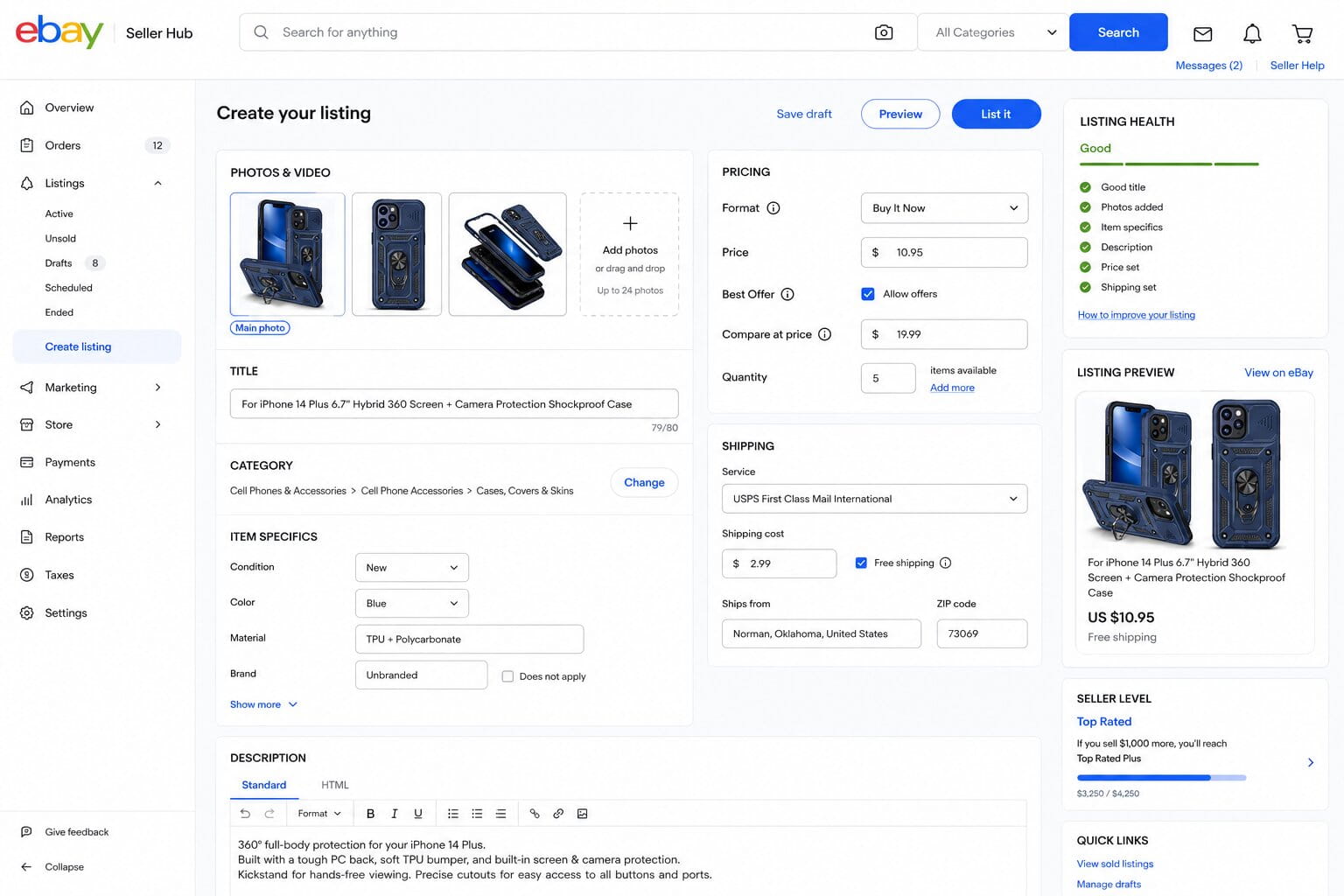
Cassini works from structured data. It matches a buyer’s query against your title first, then leans on item specifics to slot you into filtered searches, then multiplies all of that by your seller health. A perfect title on a Below-Standard account still sinks.
Titles carry the most direct weight, and you get 80 characters. A dependable structure:
[Main Keyword] + [Brand/Model] + [Key Feature/Color/Size] + [Use Case]Example, at 74 characters:
Cast Iron Skillet Lodge 12-Inch Pre-Seasoned Nonstick Pan for Camping HomeLead with the main keyword because early tokens get slightly more weight, work in the brand or model where it helps, then the distinguishing feature and the use case a buyer might actually type. Skip filler like “L@@K,” “WOW,” and emoji, which eBay reads as manipulation and can demote. If you’d rather not hand-build every title, the eBay title builder assembles 80-character titles from high-converting tokens.
Item specifics are the other half. Buyers filter by brand, color, size, and material, and a listing that leaves those blank simply doesn’t appear when the filter is applied, no matter how good the title is. There’s no official minimum, but treat 85% completion of the available specifics as a floor and aim to fill every field the category offers. Add as many photos as eBay allows, a clear category and subcategory, and shipping and return policies you can actually honor.
If you don’t automate, you’ll need to check supplier stock and prices constantly, ideally several times a day, and reprice by hand. Sell an item Walmart has since run out of and you’re forced to source it elsewhere at a loss or cancel, and cancellations hammer your seller rating. Automated tools reprice on your formula and pause listings before you oversell, which is the difference between a scare and a suspension.
5. Take orders and fulfill through Walmart
Once your listings are live, you fulfill each eBay sale from Walmart. The critical detail: enter your eBay buyer’s shipping details on the Walmart order, but keep your own email and phone on it. If the buyer’s contact goes on the Walmart order, they receive Walmart’s tracking and notifications, the dropshipping scheme becomes obvious, and a report can follow. Push the tracking number into the eBay order so the buyer can follow their package. Walmart+ orders typically ship in 24 to 48 hours.
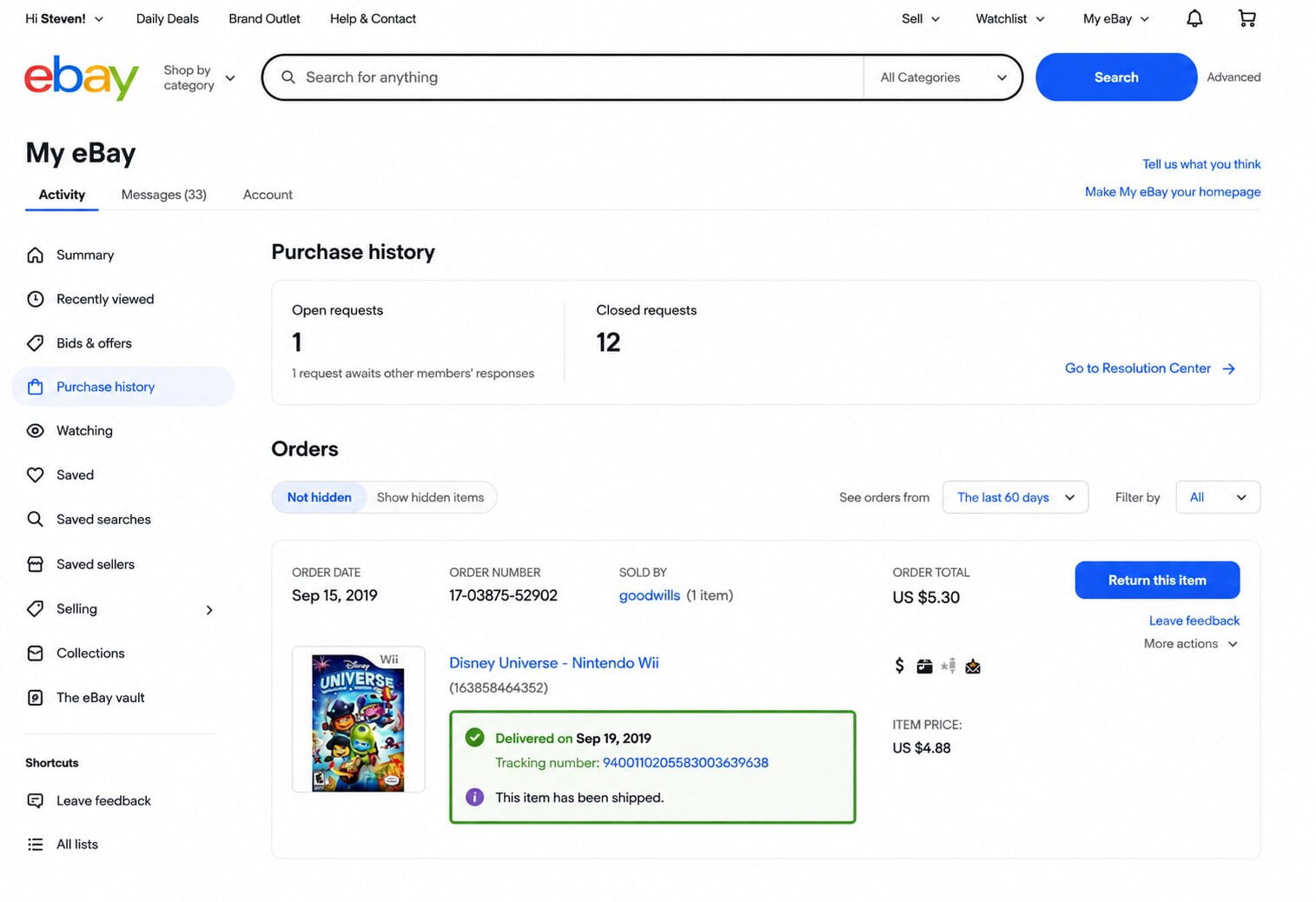
Don’t leave the store unattended for long stretches. Buyers ask pre-sale questions, and fast replies matter for both conversion and your metrics. AI-assisted replies can handle the common questions, but when a real delay or fulfillment problem shows up, reach out to the buyer directly and offer a small discount on a future order. That single habit prevents a large share of negative reviews.
6. Handle returns without eating the cost
When an eBay buyer requests a return, you accept it in eBay, then start a matching return on the Walmart order to get Walmart’s return label or QR code and route the item back to Walmart. Once Walmart refunds you, you refund the buyer on eBay. Done in that order, you only absorb the fee difference rather than the whole item.
A clean return flow looks like this:
- The buyer opens a return request on eBay. Respond inside eBay’s required window, since slow responses count against you.
- Accept the return. Fighting a legitimate return usually costs more in metrics than the item is worth.
- Log into your Walmart account, open the original order, and start a return to generate Walmart’s prepaid return label or QR code.
- Provide that label to your buyer so the item ships back to Walmart, or arrange the return to route to Walmart’s returns address.
- When Walmart confirms the return and refunds you, issue the buyer’s refund on eBay.
The order matters. If you refund the buyer before Walmart processes your return, you’re floating the cost and exposed if anything goes sideways. For bulky or oversized items this whole process gets expensive and slow, which is the practical reason to avoid those categories in the first place.
Walmart to eBay dropshipping software: where automation takes over
Read back through the previous six steps and a pattern shows up. Almost nothing that kills an account is a strategy mistake. It’s a timing mistake: a Walmart price that moved while your listing sat still, an item that sold after Walmart ran out, a gift receipt you forgot on a busy Friday, a tracking number that reached the buyer three days late. Each one is trivial in isolation and each one is a defect on your seller record.
Easync is built for this specific route, with Walmart as the source and eBay as the target across several eBay regions. On the research side it surfaces bestsellers with sales analytics, estimated profit, and a recommended selling price, so you compare eBay demand against Walmart availability instead of eyeballing two tabs. Listing happens in bulk, with your margin rules applied and automated checks against VeRo and other flags before anything goes live.
The parts that protect the account run continuously. Walmart prices and stock are monitored, listings reprice on your formula and pause before you can oversell, and orders are placed on Walmart with the buyer’s shipping address and your own contact details. Gift settings apply every time rather than when you remember, and tracking numbers land in the eBay order without copy-paste, which is what keeps the late-shipment metric clean.
What stays with you is the part worth your attention: which niches to enter, how aggressive your margins should be, and how to handle the buyers who need a human answer. If you want to see the mechanics before committing, there’s a 7-day free trial, and the pricing tiers scale with listing volume rather than charging beginners like high-volume sellers.
Advertising and growing the business
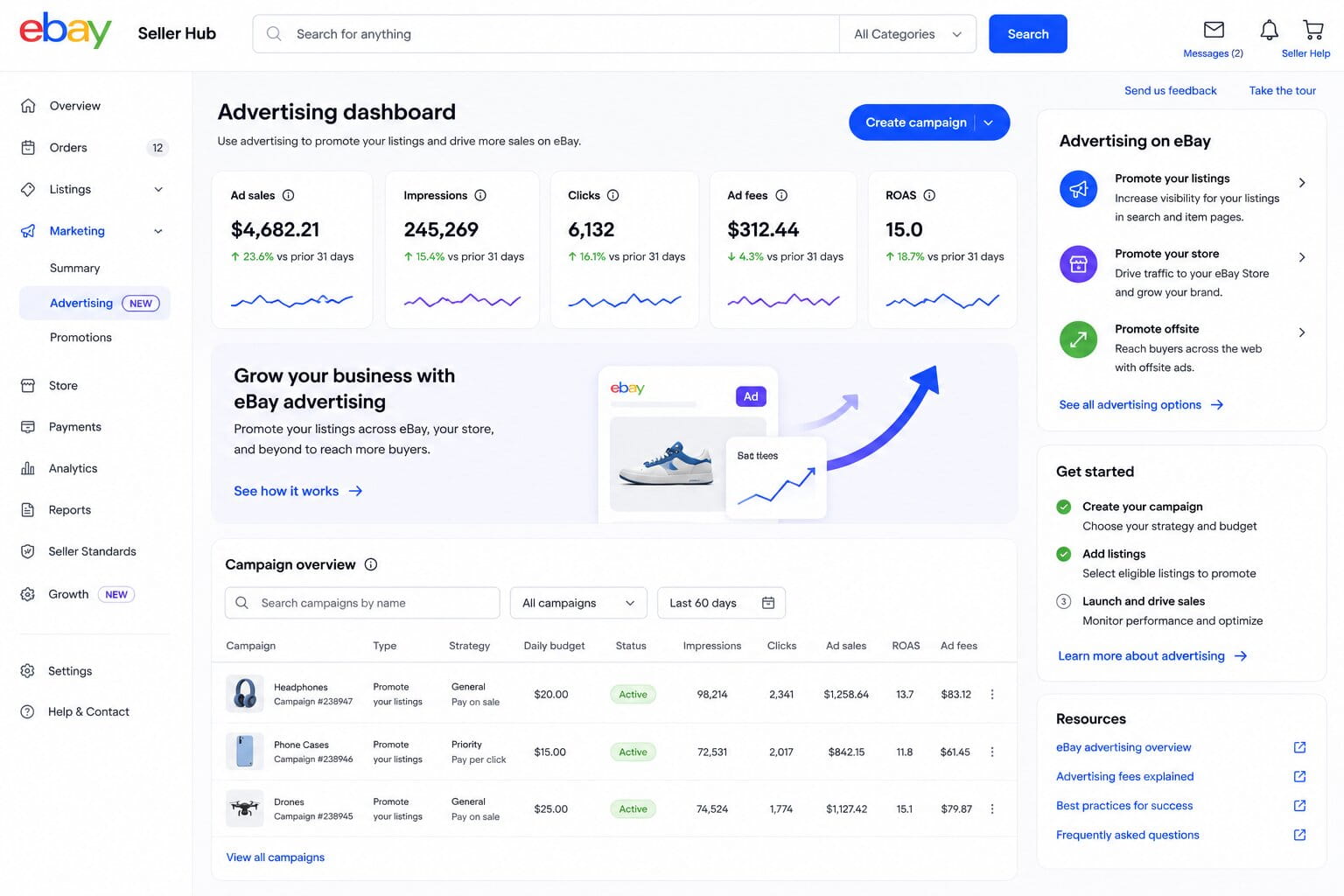
eBay’s ad options aren’t tied to where your products come from, so every standard online-marketing play is open to you. Promoted and sponsored listings buy visibility for a fee, and seasonal and annual sales events are worth joining. Everything is managed in Seller Hub.
Outside eBay, you can promote through social platforms, email to repeat buyers, reviews, blog posts, and forums, always pointing back to your store. To build a brand people remember, look for suppliers who can add branded packaging or a small gift to each order, which lifts repeat purchases and review quality. And keep investing in the listing itself, since strong descriptions and images feed the conversion signals Cassini rewards.
Conclusion
Dropshipping Walmart to eBay works for beginners and veterans alike. You skip inventory and warehousing while a retailer handles supply, and you focus on curation, pricing, and service. The downsides are eBay’s stack of policies (VeRo, dropshipping, returns) and its fees, which mean you can’t start with zero investment. In return you get buyer traffic you didn’t have to buy.
The sellers who last treat it as a real operation. They price above break-even rather than above the Walmart sticker, choose low-risk categories, suppress retail invoices on every order, and keep listings synced so they never sell what Walmart no longer stocks. Those are all timing and consistency problems, which is why automation tends to separate the accounts that scale from the ones that get suspended. Start small, build positive reviews, and expand as your limits and your metrics allow.
Frequently Asked Questions
Is Walmart to eBay dropshipping allowed?
Not cleanly, and the honest answer has two halves. eBay’s dropshipping policy permits fulfillment through wholesalers and manufacturers, and buying from another retailer to ship to your buyer falls outside it, which is why account risk is real rather than theoretical. Walmart, separately, can restrict or close accounts used for commercial resale. Plenty of sellers run this route regardless, and the ones who last control their invoices, manage stock and shipping times tightly, and keep order volume reasonable per buyer account.
Does Walmart allow dropshipping from its website?
Walmart has no formal program for buying on Walmart.com to resell elsewhere. Reselling isn’t illegal, but Walmart’s Terms of Use let it cancel orders or terminate a Walmart dropshipping account it believes is buying for commercial resale to third parties, especially when it sees high volumes shipping to many different addresses. Serious sellers use business-grade buyer profiles and automation rather than a personal retail account to reduce that risk.
How do I handle out-of-stock products from Walmart on eBay?
Walmart’s stock turns over fast enough that a listing can go stale within the hour, and through Q4 it happens constantly. When a buyer pays for something Walmart no longer has, you’re left sourcing it elsewhere at a loss or cancelling, and the cancellation lands on your record as a defect. Top Rated status tolerates a defect rate of just 0.5%, so a small handful of these costs you the badge. Inventory sync software watches Walmart and pauses or reprices listings as things change. Manual checking is fine at ten listings. Somewhere past fifty it quietly stops working.
What profit margin should I aim for when dropshipping from Walmart to eBay?
Margins commonly land between 10% and 30%, depending on demand, competition, and fees. Always price above your break-even, not just above the Walmart price, since eBay’s roughly 13.6% final value fee plus the per-order fee applies to the whole sale total including shipping and tax. Under managed payments there’s no separate PayPal fee to add. Rule-based repricing keeps your margin intact as Walmart’s costs move.
How do I set up a Walmart to eBay dropshipping business?
Start on the eBay side, because your account is the real constraint. A new seller usually opens with a ceiling near ten items and $500 a month, so building a thousand-listing catalog on day one is wasted effort. Get through eBay’s dropshipping, return, and VeRo policies before your first listing goes up, not after your first strike. Then set up a Walmart buyer account, and if you expect steady volume, Walmart+ earns its cost back quickly against the $35 free-shipping threshold. After that it’s ordinary operations: price above break-even, keep listings synced to Walmart, and put the buyer’s address on the Walmart order while your own email and phone stay on it. Software handles most of that workload. Choosing a niche and deciding how thin your margins go stays with you.
How do I handle Walmart packaging and invoices for eBay buyers?
Mark the order as a gift at checkout. Walmart then hides the price from the recipient, packs the item in a plain Walmart box where it can, and emails the gift receipt to you instead of tucking it into the parcel. The limitation is that this only applies to items tagged gift eligible, and a handful of products ship in manufacturer packaging that gives away the contents anyway, so it’s worth checking while you source rather than at the moment a sale lands. Some sellers also add a line to their listings warning that items may arrive in retail packaging. That manages expectations, though it won’t rescue you from a buyer holding a receipt for half of what they paid.
Can I automate the Walmart to eBay dropshipping process?
Yes, and past a certain volume it stops being a choice. Easync covers this particular route end to end, from importing products and watching Walmart prices to placing the order when a sale comes in, applying gift settings, and sending tracking back to eBay. Saved time is the obvious benefit. The one that matters more is that overselling and late tracking, the two failures that quietly kill accounts, happen precisely when a person is busy and a script isn’t.
What product categories work best for Walmart to eBay dropshipping?
Boring, generic, and cheap to send back. Home improvement, kitchenware, garden supplies, and pet accessories all qualify, as do the everyday staples Walmart prices hard, like cleaning and laundry products or baby care. The common thread is that nobody files a VeRo report over a dish rack and nobody opens an authenticity case over laundry detergent. Brand-name electronics and cosmetics fail on both of those counts at once. Heavy and bulky goods fail in a different way: the sale itself can look great, and then a single return eats the profit from four or five clean ones.

Eugene Stepnov – Author
Eugene is a senior e-commerce strategist with over 9 years of experience in dropshipping, online arbitrage, and marketplace compliance. At Easync. Eugene has experience in developing multi-account management technologies, such as GoLogin and secure browser solutions, providing Easync users with a head start in regulatory compliance and platform changes.

Reviewed by: Louis Profits
Louis is a marketplace dropshipping practitioner and educator specializing in eBay and Facebook Marketplace. He turns complex ops into simple, repeatable playbooks—covering winning-product frameworks, listing hygiene, pricing levers, and post-sale workflows.
At Easync, Louis contributes field-tested guides you can ship the same day: eBay launch checklists, FBM research sprints, and automation blueprints that tie directly into Easync (stock/price sync, auto-ordering, tracking updates, and KPI safeguards). Expect concise steps, screenshots, and templates geared to help you scale responsibly and protect your metrics.