
- articles
Organic Dropshipping 2026: How to Build a Viral Brand from Scratch
Building a profitable dropshipping business without spending thousands on ads sounds too good to be true. Yet in 2026, organic dropshipping has become the go-to strategy for beginners who want to trade their time for traffic instead of burning through advertising budgets.
This guide breaks down exactly what organic dropshipping is, whether it fits your situation, and the concrete steps to start attracting customers through free traffic sources.
Key Takeaways
- Organic dropshipping means building a dropshipping store using only free traffic sources like SEO, TikTok, YouTube, Instagram, email, and community groups instead of paid ads. You invest hours into content creation and audience engagement rather than thousands of dollars into Facebook, Google, or TikTok advertising.
- This approach is ideal for beginners in 2026 who have limited advertising budgets but can commit 10–20 hours per week to creating engaging content and building authentic relationships with their target audience.
- A creator posting daily TikTok videos about a pet grooming tool can realistically get their first 50 orders without spending a cent on paid advertising one semi-viral video with 50,000 views can drive meaningful organic sales.
- The global dropshipping market is projected to reach $1.25 trillion by 2030, and rising ad costs after the 2021 iOS privacy changes have pushed many sellers toward sustainable organic methods.
- This article covers what organic dropshipping is, who it’s for, exact steps to start, best organic channels, product ideas, and automation tools like Easync to streamline backend operations.
What Is Organic Dropshipping?
Organic dropshipping is a dropshipping model where customer acquisition comes entirely from unpaid organic channels—search engines, social media, email, online communities, and word-of-mouth instead of paid advertising campaigns.
The underlying business model remains identical to traditional dropshipping: you don’t hold inventory, suppliers ship directly to customers, and startup costs stay low. Only the marketing strategy changes from paid to organic.
The main organic channels include:
- TikTok, Instagram Reels, and YouTube Shorts
- SEO blog posts and long-form content
- Pinterest and visual discovery platforms
- Email newsletters and sequences
- Reddit, Facebook groups, and Discord communities
- Podcasts and offline referrals
One important clarification: “organic” here refers strictly to unpaid, algorithm-driven reach. It does not mean you must sell organic products or eco-certified items. You can profitably sell LED desk lamps, phone accessories, kitchen gadgets, or digital products—anything with organic marketing potential.
Think of it like YouTube organic reach: videos ranking and accumulating views over months or years without any ad spend. That’s exactly how organic dropshipping works for your online store.
Organic Dropshipping vs. Traditional (Paid Ads) Dropshipping
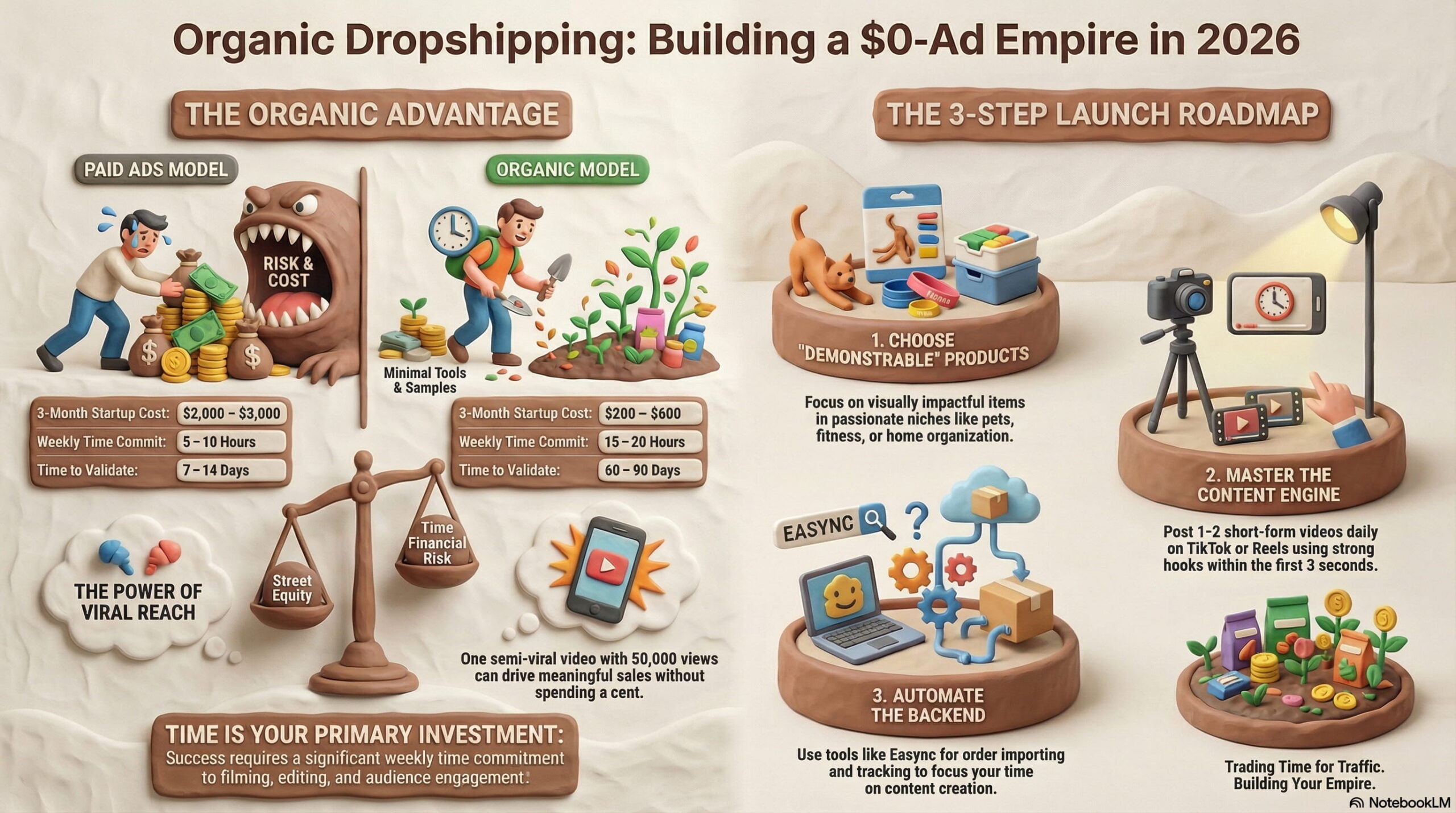
Traditional dropshipping typically launches with Meta ads, Google Shopping campaigns, or TikTok ads to buy traffic quickly. Sellers often spend $500–$3,000 in the first month testing creatives and audiences.
Organic dropshipping flips this approach:
- Paid approach: Test a product for 7–10 days, know if it’s viable quickly, risk losing your testing budget
- Organic approach: Spend $0 on ads but invest consistent time making TikTok videos, Reels, Shorts, and blog posts for several weeks before seeing steady organic sales
A concrete timeline example: with paid ads you might validate a product within two weeks. With organic methods, you might need 60–90 days of consistent posting to confirm product demand through free traffic.
Many experienced sellers in 2026 use a hybrid approach: validate winners organically first, then reinvest profits into paid ads to scale once unit economics are proven and customer relationships are established.

Time Becomes Your Investment
Instead of a $1,000 advertising budget, your “budget” becomes weekly hours: roughly 15–20 hours for filming, editing, posting, engaging, and writing content.
Here’s a practical comparison:
| Investment Type | Paid Dropshipping | Organic Dropshipping |
|---|---|---|
| First 3 months cost | $2,000–$3,000 in ads | $200–$600 in tools/samples |
| Time investment | 5–10 hrs/week managing ads | 15–20 hrs/week on content |
| Total “equity” | Financial capital at risk | ~240 hours of sweat equity |
The organic growth pattern looks different too: slow for the first few weeks, then occasional spikes when a viral video hits (10,000–200,000 views) or a blog post ranks on page one of search engines.
This model suits people who prefer stable, compounding organic traffic instead of volatile ad performance that can change overnight with algorithm shifts or policy updates.
Clarifying “Organic” in 2026
Organic dropshipping does not require selling organic food, cosmetics, or eco-products. The term only refers to unpaid, algorithm-driven organic reach.
Product types that work well organically in 2026:
- LED desk lamps and ambient lighting
- Pet grooming kits and accessories
- Phone accessories with visual appeal
- Kitchen tools solving common frustrations
- At-home fitness gear
- Beauty devices and skincare tools
Competition for organic reach has intensified significantly by 2026. Quality and consistency of your organic content matter more than ever.
Worth noting: regulations and ad policy updates—particularly stricter tracking limitations after the 2021 iOS App Tracking Transparency changes—pushed many dropshippers toward organic strategy alternatives. Rising CPMs and CPCs have continued climbing, making organic methods increasingly attractive.
Is Organic Dropshipping Right for You?
Organic dropshipping is not “easier” than paid methods, it’s often “cheaper” and better suited for certain entrepreneurs and products.
Consider this section a checklist: if most bullets describe you, organic dropshipping is likely a good fit in 2026.
Key suitability factors include budget constraints, available time, personality fit for content creation, niche type, and patience level. Many new sellers globally including in the US, UK, EU, and India, start organically because ad CPMs keep rising every year.
Budget and Risk Profile
Organic dropshipping is ideal if you cannot comfortably risk $1,000–$3,000 on ad testing in the first 2–3 months.
Even small advertising budgets like $100–$200 rarely provide enough data to optimize campaigns effectively. This is why organic methods are often more realistic for beginners with limited capital.
Real-world scenario: A college student uses savings to pay Shopify fees and purchase product samples, focusing entirely on free marketing efforts through TikTok videos instead of risking money on Google ads or Facebook campaigns.
Organic dropshipping still has costs:
- Store platform subscription ($29–$79/month)
- Domain name ($10–$15/year)
- Apps and tools ($20–$50/month)
- Product samples ($50–$150)
These expenses are far lower and more predictable than volatile ad spend, making them manageable even on tight budgets.
Time, Energy, and Creative Fit
Organic dropshipping works best if you can commit at least 10–15 hours per week to content and social media engagement for 3–6 months.
It especially suits people who enjoy:
- Filming short videos (even with just a phone)
- Writing blogs or social media posts
- Answering comments and building a social media community
- Managing community groups and discussions
If you dislike being on camera, you can still succeed using POV shots, product-only demos, hands-only videos, or faceless screen tutorials with voiceover.
Important caveat: If you want quick sales within 2 weeks or genuinely hate content creation, pure organic may frustrate you. A hybrid or paid-first approach might be more appropriate for your situation.
Product and Niche Considerations
Organic dropshipping favors niches with a passionate community: pets, fitness, beauty, gaming, parenting, DIY, home organization, and hobbies like fishing or photography.
Products with quick, obvious visual benefits perform best in social feeds:
- Before/after transformations
- Satisfying demonstrations
- Clever hacks and solutions
- Unboxing reveals
Niche example: A home-office productivity niche focusing on ergonomic accessories and cable management lends itself perfectly to desk makeover videos and “day in the life” content that can attract organic traffic.
Hyper-boring or ultra-commoditized organic products (like generic phone chargers with no unique angle) are harder to promote organically unless you have a distinctive bundle or storytelling approach.
How to Start Organic Dropshipping (Step-by-Step)
This section walks you from zero to first organic sales without ad accounts or paid campaigns.
Most people underestimate the time needed for content creation. A simple but strict weekly schedule is essential for organic dropshipping success.
Later sections will explore channels, product ideas, and tools like Easync to automate backend operations.
Step 1 — Choose a Profitable, Content-Friendly Niche
Pick a niche where you can easily create content daily—short-form videos, occasional blog posts, and emails with valuable content.
Strong organic dropshipping niches in 2026:
- Pet care and training
- Skincare tools and routines
- Home decor hacks
- Kitchen gadgets
- Student productivity
- Small apartment organization
- Low-cost fitness tools
Validate interest using TikTok search, Instagram Explore, YouTube suggestions, and Google Trends. Look for consistent demand, not just one viral video.
Mini-checklist for niche validation:
- Is there a clear pain point?
- Is the product visually demonstrable?
- Are there active communities (subreddits, FB groups, Discords)?
Step 2 — Set Up Your Online Store
Shopify and WooCommerce remain the main choices in 2026. Your dropshipping store should look trustworthy and be optimized for mobile users who click from social content.
Key store elements:
- Clean theme with fast loading
- Clear product titles and descriptions
- Social proof (reviews, user generated content)
- Simple navigation and frictionless checkout
- Trust pages: contact, returns policy, FAQs
Start capturing emails from day one using popups or inline forms with value-driven offers. Don’t lose organic visitors after a single session.
Step 3 — Find Reliable Suppliers
Supplier quality matters even more for organic dropshipping because poor shipping times or quality can quickly damage your reputation in comments and reviews.
Practical steps:
- Order at least one sample of each product
- Test the unboxing experience yourself
- Verify shipping times to main regions (US, UK, EU)
- Assess product consistency across multiple samples
- Test products thoroughly before promoting them
Use established supplier platforms like Spocket, Zendrop, CJdropshipping, or PrintKK that integrate with your store and support automation tools for seamless order processing.
Responsive supplier communication matters—especially the ability to handle scaling volumes if organic content suddenly goes viral and orders spike unexpectedly.
Step 4 — Create and Optimize Social Media Accounts
Focus on 1–2 main social media platforms first where organic reach remains strong in 2026. TikTok plus Instagram or TikTok plus YouTube Shorts are popular combinations.
Setup basics:
- Consistent handle/username across multiple platforms
- Clear profile photo or logo
- Concise bio stating what your store offers
- Link-in-bio or direct link to your store
Publish a few “foundation” posts immediately—product intro, demonstration, origin story—so your social media accounts look active before aggressively driving traffic.
Even if you don’t plan to post often on platforms like LinkedIn, securing your brand name improves credibility and prevents squatters.
Step 5 — Start Posting Content Consistently
Content output is the engine of organic dropshipping. Aim for 1–2 short-form videos per day and 1–2 longer pieces (blog or YouTube) per week.
Mix content types for master social media platforms presence:
- Tutorials and how-tos
- Before/after transformations
- “Day in the life” clips
- Problem/solution videos
- Social proof snippets and testimonials
Use native analytics (TikTok analytics, Instagram Insights, YouTube Studio) to track which videos drive store clicks. Refine future content accordingly.
Early videos will likely get low views. Focus on improving hooks, thumbnails, and storytelling instead of obsessing over early metrics.

Core Channels and Tactics for Organic Dropshipping
Organic dropshipping works across multiple channels: search, short-form video, communities, and email. Results are best when these organic channels support each other.
You don’t need every channel at once. Start with one or two, then add more as systems and automation free up time.
SEO and Long-Tail Blog Posts
Blogging attracts consistent search traffic by targeting long tail keywords like “best back stretcher for desk workers 2026” instead of just “back stretcher.”
Tactical approach:
- Use keyword research tools (Google Keyword Planner, free Chrome extensions) to find low-competition topics with buying intent
- Write comparison posts, how-to guides, and buyer’s guides that showcase products naturally
- Internally link blog posts to product pages
- Update content every 6–12 months to maintain rankings
According to HubSpot data, consistent blogging generates 67% more leads monthly—making organic search engine optimization a powerful long-term asset for your dropshipping business.
Short-Form Video: TikTok, Reels, and Shorts
TikTok organic dropshipping, Instagram Reels, and YouTube Shorts are the primary discovery engines for many dropshipping brands in 2026, especially for younger audiences.
Best practices for video quality:
- Strong hooks in the first 2–3 seconds
- Fast pacing with clear visuals
- Captions for viewers watching on mute
- Natural, non-pushy CTAs (“link in bio”)
Test multiple content formats: “TikTok made me buy it” demos, mini-tutorials, problem/solution storylines, and unboxing reactions. This approach to drive organic traffic requires consistency but yields compounding returns.
User-Generated Content and Social Proof
User generated content—customer photos, testimonial clips, unboxing videos—increases trust and conversion rates without feeling like traditional advertising methods.
Tactics to generate UGC:
- Run small giveaways with participation requirements
- Offer discount codes in exchange for honest reviews
- Encourage buyers to tag your brand with a specific hashtag
- Showcase product photos from real customers
Always get permission before republishing customer content. UGC can become pinned highlights, homepage sections, or compilation videos that build credibility for new visitors.
Communities and Groups
Joining or creating niche-focused communities on Facebook Groups, Reddit, Discord, or specialized forums provides valuable insights and relationship-building opportunities.
Take a “value first” approach: answer questions, share tutorials, provide honest reviews. Avoid spamming product links.
Example: A pet niche seller active in dog training community groups shares grooming tips that occasionally link back to their products. This builds authentic relationships while establishing expertise.
Communities also serve as powerful research channels, revealing language, pain points, and feature requests that shape product selection and educational content ideas.
Email Marketing to Capture and Nurture Organic Traffic
Organic social and search traffic are unpredictable. Email marketing provides a stable, algorithm-proof channel to turn one-time clicks into repeat buyers and build long term customer relationships.
Essential automated email flows:
- Welcome series introducing your brand
- Abandoned cart reminders
- Post-purchase thank-you emails
- Review request sequences
Capture emails using popups offering real value—discounts, helpful PDF checklists, or exclusive content—rather than generic “subscribe” messages.
Even small lists of 200–500 subscribers can drive meaningful repeat revenue with consistent campaigns focused on customer satisfaction.
Organic Dropshipping Products and Niches That Work Well
Not every product suits organic marketing equally. Some items have clearer visual hooks, emotional appeal, or community interest that make them natural fits for free marketing material.
Product viability depends on margins too. Follow the 3x rule: selling price should equal roughly 3× total landed cost to ensure profitability.
Products with Strong Visual Impact
Items showing visible change in seconds perform exceptionally well:
- Posture correctors with before/after demonstrations
- Cleaning gadgets revealing dramatic results
- Organizers transforming messy spaces
- LED lights changing room ambiance
- Scalp massagers and skincare tools
Content formats like “before and after” dorm cleanups, cable management transformations, or skincare routine time-lapses drive organic reach on TikTok and Reels where users decide in under 2 seconds whether to keep watching.
Show real-life use in relatable environments (small apartments, home offices, cars) rather than sterile studio shots to attract customers authentically.
Emotion-Driven Niches (Pets, Kids, Gifts)
Niches tied to strong emotions attract engagement, shares, and repeat potential buyers without traditional advertising.
Examples:
- Calming dog beds and anxiety-relief pet products
- Interactive cat toys
- Baby sensory toys
- Memory keepsake items
- Personalized gifts
The global pet and baby markets continue growing in the mid-2020s, underlining long-term potential. Maintain ethical standards: clear disclaimers for products that aren’t medical devices and honest communication about capabilities support customer satisfaction.
Educational and Problem-Solving Products
Educational or problem-solving products naturally lend themselves to tutorials, “how it works” videos, and beginner guides.
Examples:
- STEM toys with learning demonstrations
- Ergonomic desk accessories
- Posture correction tools
- Productivity planners
- Kitchen tools eliminating common annoyances
These products pair well with SEO and long-form valuable content since shoppers often search for advice before buying. A creator posting short “study hacks” videos featuring productivity tools can build a loyal customer base while linking to their store.
Bundling Strategies to Increase Order Value
Bundles—full skincare kits, complete kitchen starter sets, pet grooming combos—raise average order value and differentiate your offers from generic single-product listings.
Numeric example: If each item costs $6 and a bundle costs $18 total, selling at $49 leaves strong margins while feeling like a deal to customers.
Position bundles as “complete solutions” to specific problems rather than random product packages. Highlight bundles in both organic content and landing pages for upsell opportunities.
Automating Organic Dropshipping Operations with Easync
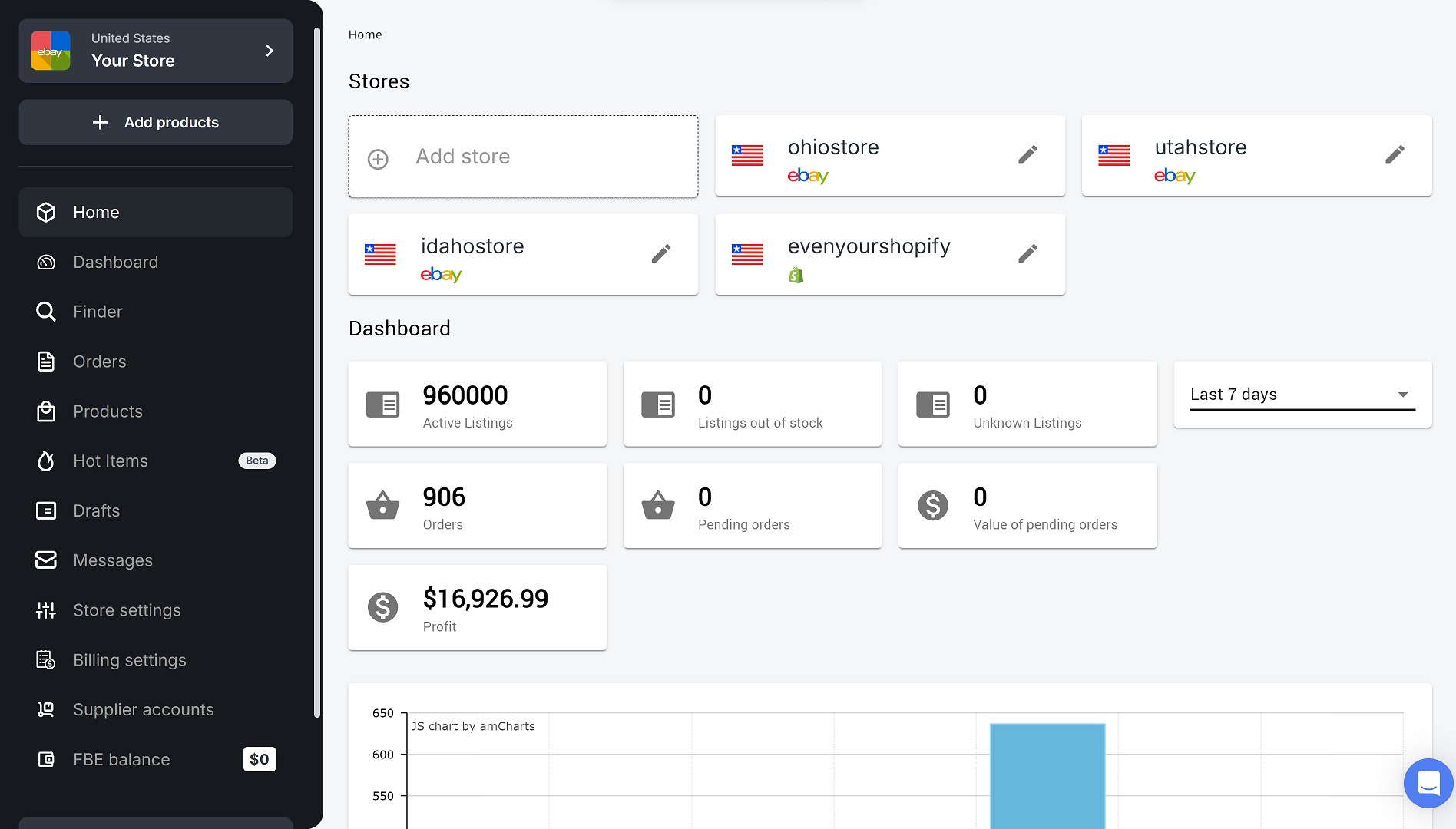
While marketing in organic dropshipping is manual and creativity-driven, backend operations should be as automated as possible to save time and avoid errors. Using Easync for organic dropshipping is especially useful once content begins working and orders arrive daily, because manual order processing quickly becomes unsustainable.
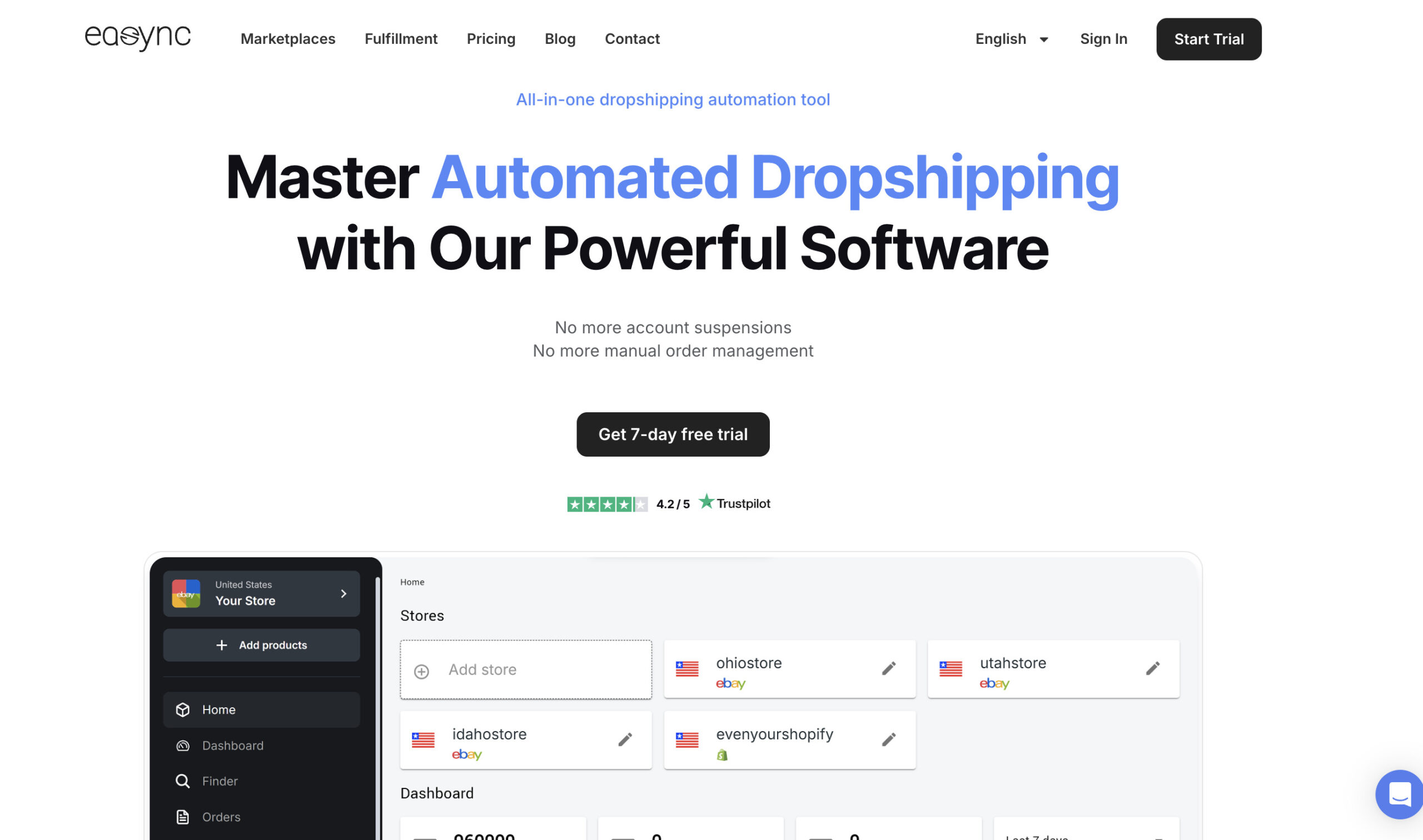
Easync supports automated product importing from major marketplaces, real-time stock and price monitoring to prevent out-of-stock sales or unprofitable items, auto-ordering to send orders to suppliers automatically, repricing rules that keep margins stable when supplier prices fluctuate, tracking synchronization that updates customers with current shipping status, and multi-account workflows to manage multiple stores or marketplaces from one interface.
By delegating these repetitive tasks to Easync, organic sellers can spend more hours on content creation, audience engagement, and community building instead of data entry and manual stock checks.
Marketing and Content Tips for Organic Dropshipping Success
Success in organic dropshipping comes less from secret tactics and more from consistent, audience-focused execution across months.
These guidelines should be tested and adapted based on your data. The core principle: identify what works and double down on winners.
Posting Rhythm, Testing, and Iteration
Start with one post per day on your main platform, increasing to two when capacity allows. Consistency matters more than perfection for building relationships with your target audience.
Test variations:
- Different hooks and opening lines
- Video lengths (15s vs. 30s vs. 60s)
- Angles (POV vs. narrator vs. product-only)
- Backgrounds and settings
Track which posts lead to meaningful actions (clicks, email signups, purchases) rather than just views. Create content series like “Day X of solving your [niche] problems” to build anticipation.
Trend Riding Without Losing Your Brand
Trends (sounds, formats, challenges) on TikTok, Instagram, and YouTube can produce quick visibility spikes if jumped on within 24–72 hours.
Adapt trends so they make sense for your niche and products. Avoid forced, off-brand memes that confuse your audience.
Not every trend is worth chasing. Focus on those where your product integrates naturally into the story. Even trend-based content should show product benefits or brand personality.
Storytelling and Showing Results
Show outcomes rather than listing features. Viewers should quickly understand how their customer journey improves with your product.
Content ideas:
- “Day in the life with [product]”
- “How I solved [problem] under $30”
- “3 ways this gadget saves me 20 minutes daily”
Use simple storytelling structures: problem → struggle → discovery → result → subtle call-to-action. Visual transformations work best: messy vs. organized pantry, slouched vs. corrected posture, restless pet vs. calmly sleeping.
Engagement and Community Building Beyond Sales
Comments, DMs, and live sessions build trust beyond immediate sales. Answer questions thoroughly, thank users for sharing experiences, and feature follower content.
Interactive elements:
- Polls and Q&A stickers
- “Ask me anything about [niche]” sessions
- Responding to every comment in early days
Strong social media engagement signals to algorithms that your content is valuable, significantly increasing organic reach over time through enhance visibility.
Financial and Strategic Considerations
Even with zero ad spend, organic dropshipping lives or dies by margins, cash flow, and realistic expectations. Financial discipline early on enables scaling later.
Unit Economics and Profit Per Order
Understand cost components per order:
| Cost Component | Example Amount |
|---|---|
| Product + shipping | $10 |
| Payment processing | $1 |
| Platform fees | $1 |
| Refunds/returns (averaged) | $0.50 |
| Total landed cost | $12.50 |
If you sell for $30, gross profit is roughly $17.50 per order. Needing $2,000 monthly gross profit means approximately 115 orders.
Even without paid ads, tool and operating costs exist. Maintain healthy margins from day one.
Pricing, Bundling, and Perceived Value
Organic traffic can support premium pricing if brand presentation, content quality, and perceived value are strong.
Psychological pricing guidelines:
- Under $30 for impulse buys from TikTok
- Under $50 for more considered purchases
- Free shipping thresholds (“Free shipping over $49”) nudge higher-value orders
Test different price points and bundle configurations while monitoring conversion rates and average order values.
Reinvestment and Long-Term Scaling
Reinvest early profits into:
- Inventory buffers for popular items
- Better content equipment (lighting, microphones)
- Design improvements
- Automation tools like Easync
After 3–6 months of consistent results, many sellers test paid ads using top-performing organic creatives—already proven to resonate with their target audience.
Long-term scaling may include launching private label versions of winning products, expanding internationally, or adding complementary product lines.
Patience matters: sustainable scaling in organic dropshipping is measured in quarters, not weeks.
FAQ
Is organic dropshipping legal in 2026?
Yes, organic dropshipping is legal in 2026 across major markets including the US, Canada, UK, EU, Australia, and India. You must comply with consumer protection laws, tax obligations, and platform terms of service. Be transparent about shipping times, refund policies, and customer support responsibilities. Respect intellectual property—avoid counterfeit or trademark-infringing products. Some platforms and payment processors have specific rules for dropshippers regarding proof of fulfillment and delivery times.
How long does it take to see results with organic dropshipping?
Timelines vary, but many sellers posting consistently see their first organic sale within 30–60 days, with more predictable patterns emerging after 3–6 months. Viral spikes can happen sooner but aren’t guaranteed. The realistic expectation is gradual improvement as skills, content quality, and trust accumulate. Commit to at least a 90-day consistent content plan before judging whether a niche or product is viable organically.
Can I combine organic dropshipping with paid advertising later?
Combining organic and paid traffic is common and often the best scaling approach once products and messaging have been validated. Top-performing organic videos and posts can be repurposed as ad creatives on TikTok, Meta, or Google with higher success chances since they’re already proven. Before turning on ads, ensure reliable suppliers, automated operations via tools like Easync, and clear unit economics to avoid scaling unprofitable offers.
How much money do I need to start organic dropshipping?
Most beginners in 2026 start with roughly $200–$600 to cover domain registration, store platform fees, a simple theme, product samples, and essential apps. While ad spend can be zero, fixed monthly costs exist. Starting completely free is difficult if you want a professional presence. Keep an emergency buffer for unexpected expenses like replacing damaged samples or handling refunds.
Is organic dropshipping still worth it, or is the market saturated?
Competition has increased significantly by 2026, but new products, trends, and niches emerge constantly. There’s still room for brands that execute well with quality content and superior customer experience. Differentiation comes from unique angles, higher-quality engaging content, and tighter focus on sub-niches rather than generic stores. Saturation is less about the overall market and more about whether you can bring something distinctive and consistent to a specific audience.