
- articles
Free Drop Shipping Methods Without Ads in 2026
Free drop shipping methods without ads are realistic in 2026, but nobody should mistake them for easy money. What “free” really buys you is a different trade: instead of paying for ad clicks, you pay with time, daily content, careful supplier vetting, and a stretch of manual work until your first sales prove a niche is worth keeping.
Key Takeaways
- You can start a store with no money by pairing a free platform, free suppliers, and organic traffic — paying only the product cost after a customer has already paid you.
- The traffic sources that actually work without a budget are TikTok, Instagram Reels, YouTube Shorts, SEO content, marketplaces, email, communities, and small influencer trades.
- Pick one main channel first. Spreading yourself across TikTok Shop, eBay, Facebook Marketplace, and a brand-new store at once is how most beginners end up with weak listings everywhere and traction nowhere.
- Your first sales can be fulfilled by hand, which keeps things close to genuinely free. Automation earns its place later, once the order volume starts eating your evenings.
- Growth is slower without ads, and that’s the honest catch. The upside is low financial risk and skills — research, pricing, content, branding — that carry over to anything you build next.
What “free dropshipping without ads” actually looks like
The model itself is plain enough: you list products in your store, a customer pays you, and then you pay a supplier to ship the item straight to that buyer. You never hold inventory and you never buy stock up front, which is the whole reason the barrier to entry is so low.
“Free” here means free to start — no ad spend, no paid apps on day one, and free plans wherever they exist. It does not mean free forever. You’ll still run into payment processing fees, platform commissions, shipping costs, and the product cost on every order. The point that matters is the order of events: the customer’s payment is what funds the supplier order, so money flows in before it flows out.
A concrete version of this: you build a small pet-accessories store on WooCommerce, list dog harnesses and travel bowls from a couple of well-reviewed suppliers, and you promote it only through TikTok videos, Reels, a few genuinely useful blog posts, and the odd helpful answer in a Facebook group. No ad account involved. That’s organic dropshipping — paid reach swapped for time and content. Suppliers like AliExpress, CJDropshipping, and Printful let you list without paying anything until a sale happens, which is what makes a true zero-budget start possible, just with more hands-on work than a funded store.
Best free dropshipping methods without ads in 2026
There are several ways to bring in sales without paid ads, and they suit different products, skills, and patience levels. The table below is meant to help you commit to one main traffic strategy rather than scatter your effort.
| Method | Best platform/channel | Best for | What to do first | Main limitation |
|---|---|---|---|---|
| TikTok organic | TikTok / TikTok Shop | Visual products, impulse buys, demos | Post 2–3 short videos a day around one product angle | Needs constant content |
| Marketplace SEO | eBay / Facebook Marketplace | Practical items, replacements, hobby gear | Optimize titles, photos, price, shipping details | Little control over branding |
| SEO content | WooCommerce / own store | Long-term free traffic and brand building | Publish guides around long-tail keywords | Slow to get the first visitors |
| Community selling | Reddit, Facebook Groups, forums | Products tied to a specific problem or hobby | Answer questions, recommend naturally | Direct pitching reads as spam |
| Email marketing | Own store / checkout | Repeat purchases and retention | Collect emails with a small discount or guide | Needs traffic first |
| Micro-influencer barter | TikTok, Instagram, Shorts | Reviews, UGC, social proof | Offer samples or affiliate terms | Not free if samples cost money |
| Manual marketplace testing | eBay, Facebook Marketplace | Validating demand as a beginner | List 10–15 products, track views and sales | Hard to scale by hand |
The best starting method is simply the one you’ll actually keep doing. Short-form video tends to bring attention fastest, marketplace SEO catches people who are already searching to buy, and content marketing is the slow burn that compounds into durable traffic months later. None of them works if you quit after two weeks.
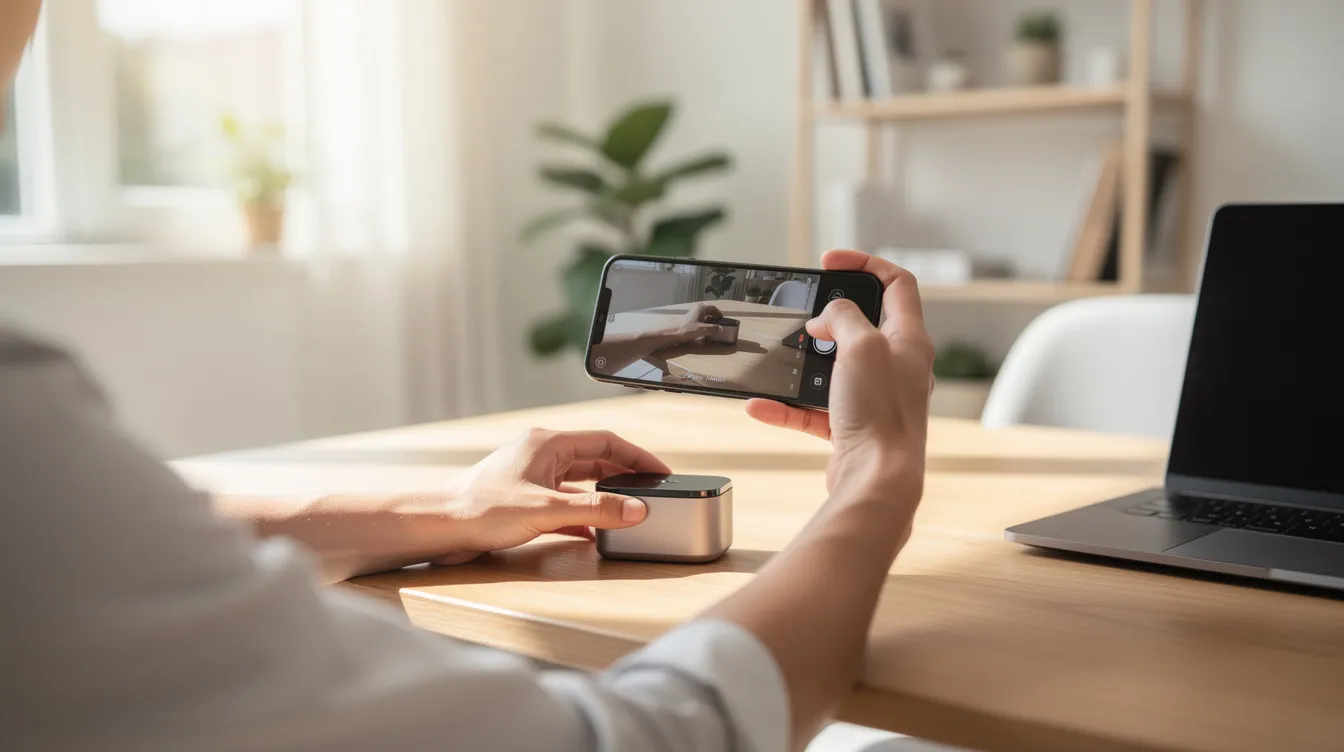
How to start dropshipping for free without ads, step by step
This is the path from zero budget to first sale, using free tools and a fair bit of manual execution. It assumes a 2026 setup: TikTok Shop, current marketplace rules, and the organic tactics that still work today.
Step 1: Choose one free platform for your first store
Pick a single platform to start. Juggling TikTok Shop, eBay, Facebook Marketplace, BigCartel, and WooCommerce on day one usually leaves you with scattered listings and thin content across all of them.
A rough guide to choosing: TikTok Shop if you’re comfortable on camera and your product demos well; eBay if you’re good with titles, photos, and working keywords naturally into listings; Facebook Marketplace if your niche is practical or local, like car accessories; your own store if you want brand control and can wait out the slower SEO climb. Phone gadgets do well on TikTok Shop because the demo sells them in seconds. Car organizers fit Facebook Marketplace because people search there by immediate need. Collectibles suit eBay, where demand is search-driven. A tighter brand like minimalist home-office gear belongs on your own store.
Step 2: Find free suppliers you can use without upfront fees
Search AliExpress, CJDropshipping, EPROLO, Printful, and similar platforms that charge nothing monthly or only bill you per order. You’re looking for suppliers with strong ratings, real photo reviews, clear refund terms, and delivery windows you can actually promise on a product page.
A simple filter that’s served sellers well: 1,000+ orders, 4.5+ stars, recent photo reviews, and shipping to the US or EU that matches what you’ll tell customers. A dog-harness supplier with 1,000+ orders, a 4.7 rating, and sub-18-day shipping is a safer first bet than a cheaper listing with no reviews at all. You can diversify suppliers later — early on, keep to a small, reliable group so your first month doesn’t turn into a refund queue.
Step 3: Pick products that work with organic traffic
Resist the urge to hunt for one mythical “winning product.” Test 10–15 items that are easy to show in a video, priced under roughly $40, and tied to a clear problem someone can recognize instantly.
The products that travel well organically are visual and obvious within about five seconds. Home organization shows a before-and-after. Beauty tools show a transformation. Pet accessories carry emotion and utility at once. Phone gadgets trigger a quick “oh, I want that.” Keep a simple spreadsheet with product cost, shipping time, review score, supplier link, your selling price, the margin, and one content angle per product. Aim to keep at least a 30–40% margin after shipping and fees, or the math stops working once refunds creep in.
Step 4: Set up a basic free storefront
A free BigCartel store, a free WooCommerce setup, Printful’s quick stores, or a marketplace storefront all work. Printful suits print-on-demand too, since you can make custom products with no inventory.
What a page needs to look credible: a clear title, edited photos, copy that talks about benefits, honest shipping times, a return note, and a short FAQ. Natural keywords in titles and descriptions help both marketplace search and Google. Use something free like Canva for a logo and a single colour palette. You’re not chasing a perfect design — you’re clearing the low bar of looking trustworthy enough that a stranger will hand over their card.
Step 5: Launch with free traffic only
A realistic first target is 10–20 visitors a day from organic traffic. Post short-form video on TikTok, Reels, and Shorts; a single video that lands can move real units. For the first week, aim for 2–3 videos a day if you can manage it, built on a simple hook-problem-demo-call-to-action structure, and add a marketplace listing or a blog post every day or two.
One thing worth holding onto here: conversions beat vanity. A clip with 1,000 well-targeted views that sends buyers to your page is worth more than 100,000 views from people who’ll never click. Track clicks, saves, comments, and actual purchases with free tools like Google Analytics or your marketplace’s own stats.
Step 6: Fulfil orders manually and keep cash flow safe
The manual loop is straightforward: a customer orders, you confirm the payment cleared, you place the supplier order, and the supplier ships to the buyer. Before you submit, double-check the address, the variant, the shipping method, any coupon, tax, and tracking. Then log it — Google Sheets or Notion is plenty — across stages like paid, ordered, shipped, tracking added, delivered. Doing this by hand is fine for the first 10–30 sales, especially if you’re sourcing from just a few suppliers.
Free product research methods (no paid tools)
Beginners tend to overcomplicate this with expensive apps. You can validate demand for nothing if you treat research as a daily 30–60 minute habit rather than a one-off. Picking a niche you actually care about helps, too, because it makes the content far easier to keep producing.
Marketplace data is the bluntest signal. eBay sold listings, Amazon Best Sellers, and TikTok Shop trending pages show what’s really moving — and eBay sold listings in particular confirm consistent sales over months rather than a one-week spike. Reverse-engineer the strong listings: their titles, images, bundles, price ranges, shipping promises, then note where you could do better with clearer photos or a smarter bundle.
Social trends fill in the rest. Search TikTok, Reels, and Shorts for phrases like “TikTok made me buy it” or specific terms tied to your niche, and read the demand off the reactions — view counts, the “where did you get this?” comments, the same product showing up from several creators. Google Trends is useful for spotting whether a query is rising or fading. Finally, track 5–10 competitors week to week: their reviews, shipping and return policies, pricing. The aim isn’t to copy them, it’s to beat them on the details they’re getting lazy about.
Working with reliable suppliers without paid tools
A free store still lives or dies on supplier reliability, and arguably more so — when you have no ad budget, every refund and bad review costs you traffic you can’t easily replace.
To vet for free, search AliExpress, CJDropshipping, EPROLO, and Printful, then filter by orders, rating, shipping options, and review photos. If you can spare a little, order a test sample; if you genuinely can’t, lean on multiple video reviews and buyer photos instead. A short message to the supplier sorts the responsive ones from the rest:
Hi, I’m planning to sell this product in my store. Can you confirm current stock, processing time, shipping to the US in 2026, your replacement policy for damaged items, and whether branded packaging is available?
Keep a quick scorecard on price, shipping, responsiveness, refund policy, and willingness to replace damaged goods. On the operational side, check supplier pages about twice a week for stock and price changes, hold a minimum margin of around 30–40%, and update your store when costs move. Be upfront about delivery windows on the product page and in order emails — vague timelines are what trigger chargebacks. Checking by hand is fine for a handful of products, but it gets unwieldy past 20–30 active listings, which is usually the moment people start thinking about automation.
Scaling free dropshipping with automation: Easync
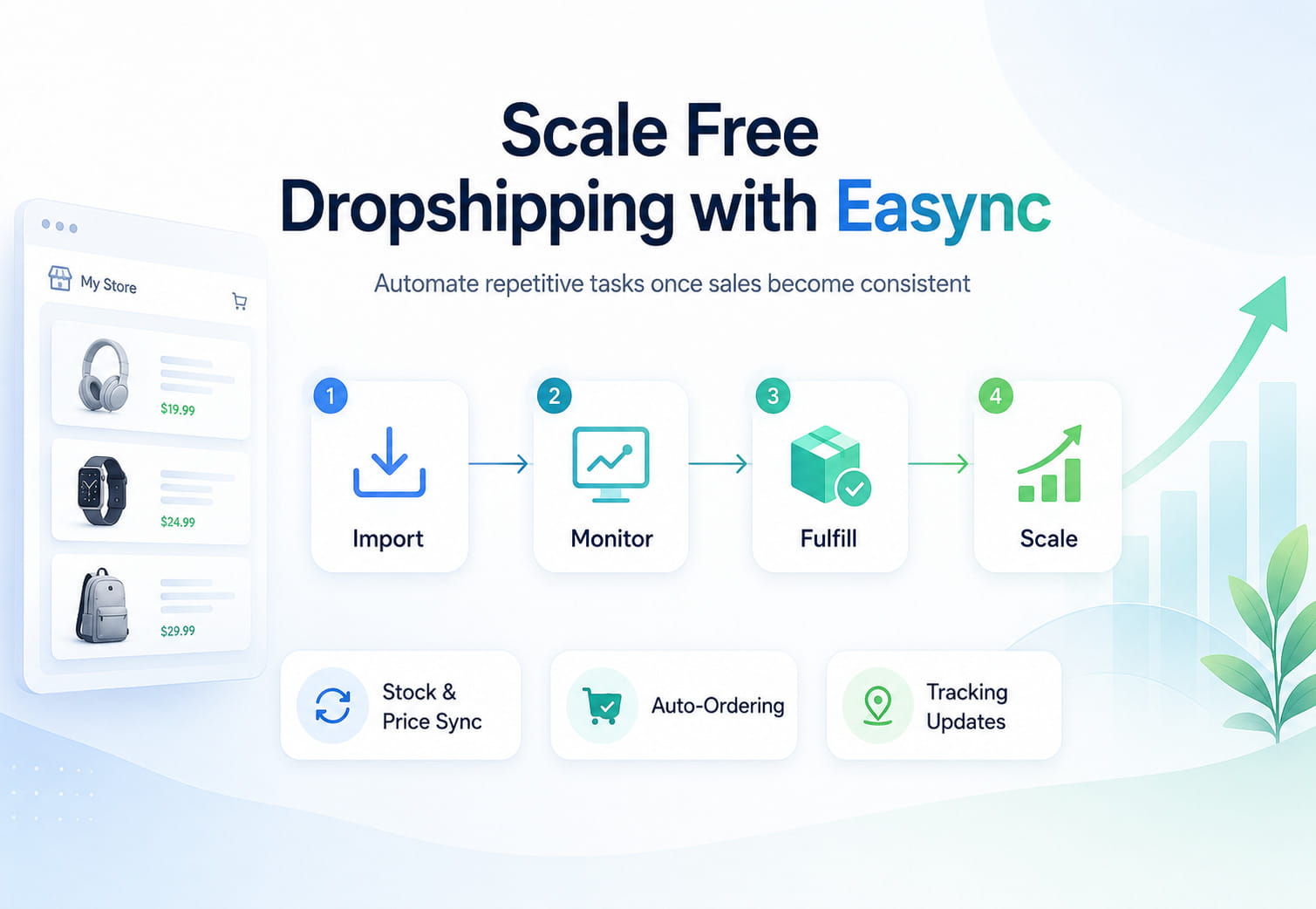
Once a free store is pulling consistent orders, the manual routine that kept costs at zero starts to cap your growth instead — and that’s the point where automation pays for itself. For free drop shipping methods without ads, the sensible move is to bring in a tool only after the sales are real, not before. Easync handles the repetitive parts of a busier store: importing products, monitoring stock and prices in real time so you don’t oversell or quietly lose margin, placing supplier orders automatically when a customer buys, applying repricing rules to protect your profit, syncing tracking numbers, and managing several accounts in one place. Practically, that lets you run a bigger catalogue without hiring anyone or going back to paid ads. A reasonable time to consider it is when you’re hitting 1–3 orders a day, you’ve crossed 20–30 active products, or order updates are eating more than an hour or two of your day. Below that, staying manual is perfectly sensible.
Brand and trust without ad spend
When you’re not paying for reach, your store design, brand, and customer experience become the marketing. The communities where your buyers already gather give you something ads can’t: direct access to the exact words, objections, and problems real customers have.
On a $0 budget, Canva covers a logo, a colour palette, templates, and product visuals, and a short brand story aimed at a specific person — busy parents, pet owners, remote workers, travellers — does more than any polish. Keep the colours, fonts, and tone consistent across your store, socials, and emails; a “minimalist home-office gear” brand should read completely differently from “bright kids’ activity gadgets.” Then let proof do the selling. Collect reviews, customer photos, and short clips, and offer a small discount or a shout-out in return for user-generated content. Being genuinely useful in the right subreddits and Facebook groups builds trust over time, whereas dropping product links into them tends to get you ignored or removed — so lead with help, not pitches.
Common mistakes in free, no-ads dropshipping
A few predictable errors cost people months, and they’re easy to sidestep once you know them. The big one is listing hundreds of random items; you’re far better off with 10–30 products across two or three sub-niches. Close behind is settling for weak suppliers — the cheap listing with no reviews always costs more later in refunds and angry messages. Inconsistency kills organic channels too, since posting for a week and then judging the results tells you nothing; give it several weeks of daily posting first.
The subtler traps are about focus. Chasing views instead of buyers feels productive but isn’t — targeted attention beats raw reach every time. Hiding your shipping times to look competitive backfires the moment a parcel is “late” against a promise you never made honestly. And thin product pages or slow support quietly leak the trust you have no ad budget to rebuild. Treat the first three to six months as a learning phase; a profitable store comes out of testing and consistency, not a single lucky video.
When to reinvest after starting for free
You can launch with no money, but scaling eventually asks for some reinvestment — the trick is keeping fixed costs low until organic traffic and repeat buyers justify them. A rough ladder that works: around your first $500 in sales, spend on samples and original content. By $1,000, sharpen your product pages, email flows, and content. By $5,000, it’s reasonable to look at automation, better branding, faster suppliers, and only then small paid tests, once organic has proven the demand is real.
The principle underneath all of it is simple enough: reinvest to support a store that’s already working, not to bolt on monthly fees before anyone’s proven they want what you sell.
FAQ: Free dropshipping methods without ads
Can I really start dropshipping for free without ads?
Yes, as long as you read “free” as swapping ad spend for time and manual work. Free platforms, free supplier accounts, organic traffic, and fulfilling orders by hand get you there — and you only pay the supplier after a customer has paid you.
What is the best free platform for dropshipping beginners?
It comes down to your product. TikTok Shop suits visual, demo-friendly items; eBay is strong where demand is search-based; Facebook Marketplace fits practical or local goods; and WooCommerce makes sense if you’re playing the longer brand-building game.
How can I get traffic without paid ads?
The reliable free sources are short-form video (TikTok, Reels, Shorts), marketplace SEO, blog content, communities, email, and small influencer trades. The mistake to avoid is doing all of them at half effort — pick one main channel and get good at it before adding another.
What products work best for free dropshipping?
Simple, visual, problem-solving things you can explain in a sentence. Pet accessories, home organization, beauty tools, phone gadgets, travel items, and straightforward print-on-demand products all tend to perform well organically.
When should I start using automation tools like Easync?
Stay manual while you’re finding your feet. Automation makes sense once sales are steady, you’re managing 20–30+ products, or you’re losing more than an hour or two a day to stock checks, ordering, and tracking. At that stage Easync can take over importing, monitoring, auto-ordering, repricing, and tracking sync.