Key Takeaways
- Beginners (0–6 months) typically earn $0–$1,500/month net, with many new sellers operating at a loss while learning
- Intermediate sellers (6–12 months) average $1,500–$8,000/month net once marketing and operations are optimized
- Advanced sellers (1+ year) can reach $8,000–$50,000+/month, though the upper range requires strong execution across multiple factors
- Sustainable net profit margins in 2026 range from 15%–30%, with anything above 35% considered excellent
- Your actual income depends heavily on niche selection, marketing skills, supplier reliability, and use of automation tools like Easync
Dropshipping doesn’t pay you a salary in the traditional sense. There’s no HR department depositing a fixed amount into your bank account every two weeks. Instead, what you take home depends entirely on how well you run your dropshipping business, what products you sell, and how effectively you manage costs.
This guide breaks down realistic income expectations for 2026 based on actual case studies, industry data, and practitioner surveys. Whether you’re considering starting your dropshipping journey or looking to scale an existing online store, you’ll find concrete numbers, proven strategies, and the key factors that separate profitable stores from those that struggle.
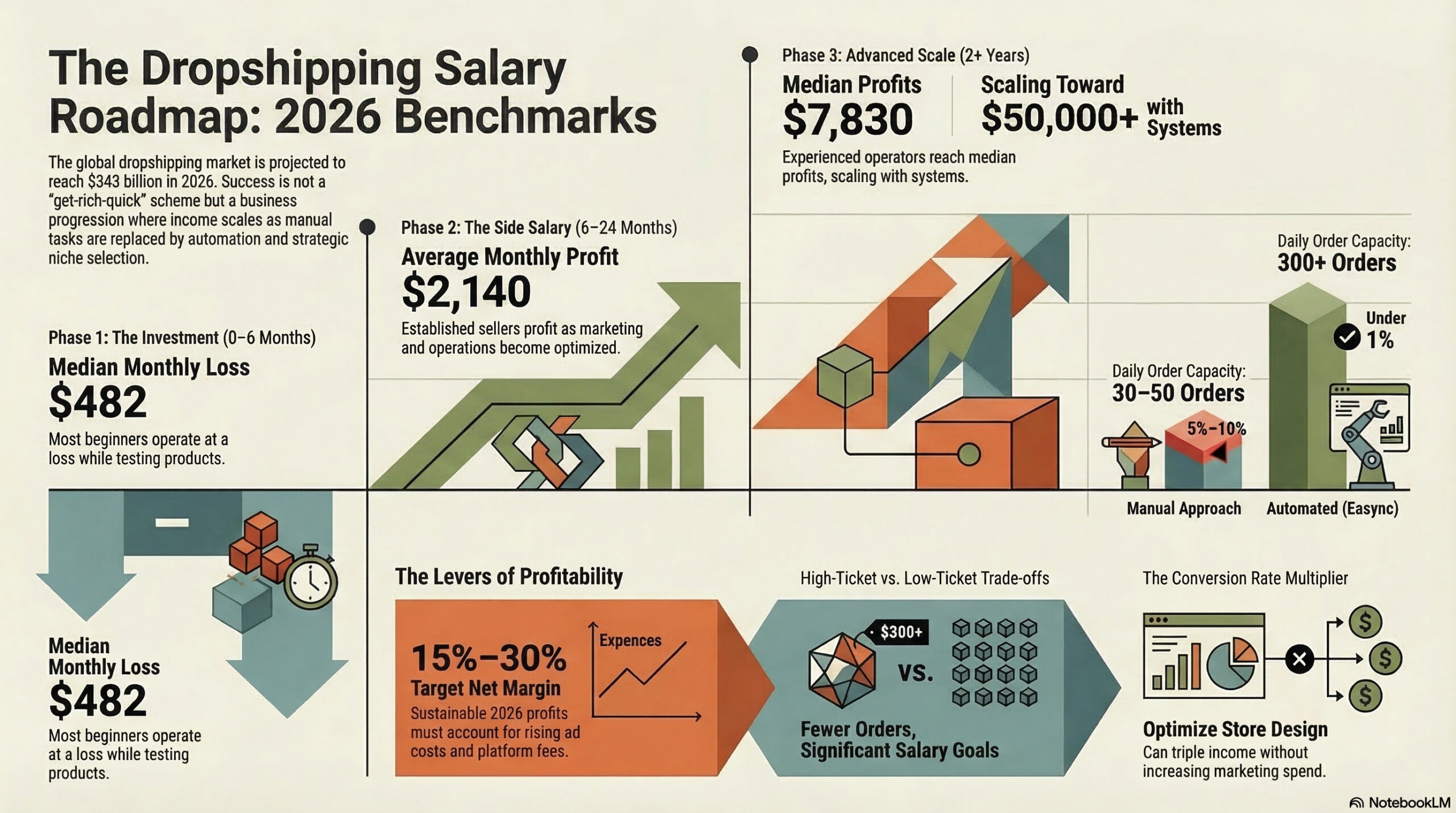
Dropshipping Salary Roadmap 2026 Benchmarks
Is Dropshipping Still a Good “Salary” in 2026?
Dropshipping doesn’t function like a regular job where effort directly correlates with a predictable paycheck. Your dropshipping income behaves like business profit fluctuating based on sales volume, operating costs, and market conditions rather than hours worked.
The global dropshipping market tells an optimistic story. According to Global Market Insights, the market reached approximately $343 billion in 2026, up from $290.7 billion in 2025. Other projections from Grand View Research suggest growth toward $1.2 trillion or more by 2030. This isn’t a dying industry it’s expanding rapidly.
Despite increased competition and rising ad costs, dropshipping can still reliably replace or supplement a traditional salary. The stores that fail typically do so because of unrealistic expectations thinking they’ll hit $10,000 per month within 30 days—rather than because the business model itself is flawed.
Many dropshippers fail because they treat it like a get rich quick scheme rather than a legitimate business requiring investment, learning, and patience.
What’s changed in 2026 is the infrastructure available to solo operators. Automation tools now enable one person to manage operations that previously required a small team. Tools like Easync help sellers handle product imports, inventory monitoring, and order processing automatically, making it more feasible than ever to run a salary-level business with reasonable hours.
How Much Do Dropshippers Actually Make in 2026?
Understanding dropshipping salary requires looking at both profit margin and monthly revenue. A store doing $50,000 in monthly revenue might sound impressive until you realize they’re netting 5% after all costs—that’s only $2,500. Meanwhile, a $20,000 store with 25% net margins takes home $5,000.
Based on a 2026 survey of 317 dropshippers across North America, Western Europe, and Australia, the reality is stark:
| Experience Level | Median Monthly Net Profit |
|---|---|
| New (0–6 months) | -$482 (negative) |
| Established (6–24 months) | $2,140 |
| Advanced (2+ years) | $7,830 |
| Portfolio operators (3-5 brands) | $22,500+ |
The majority of dropshippers earn modest side income while a smaller percentage who treat it like a full business reach multi-five-figure monthly profit. Surveys of small ecommerce stores on Shopify, WooCommerce, and major marketplaces show typical gross profit margins around 20%–30% for dropshippers, though this drops significantly once advertising and overhead are factored in.
Complete Beginners (0–3 Months)
The first three months of dropshipping are best understood as an investment phase, not an income phase. Most new sellers hover near breakeven while testing offers, learning advertising platforms, and figuring out product research.
Realistic expectations for beginners:
- Net profit range: $0–$1,000/month (many operate at a loss initially)
- Order volume: 10–80 orders/month
- Average order value: $20–$40
- Net margins: 5%–20% while learning
During this phase, your actual “salary” might be negative when you account for your time investment. What you’re really building are assets: pixel data for retargeting, email list subscribers, product insights, and operational knowledge.
The recommendation here is clear: keep your day job during this phase and reinvest any profit into marketing and automation tools rather than trying to pay yourself.

Intermediate Sellers (3–12 Months)
This is the “side salary” phase where income becomes meaningful but remains volatile. Sellers who consistently test dropshipping products and refine their marketing strategies start seeing real returns.
Typical intermediate metrics:
- Net profit range: $1,000–$8,000/month
- Order volume: 80–500 orders/month
- Average order value: $30–$60
- Net margins: 15%–25% with optimized ad spend
Many sellers in this bracket can match or exceed an entry-level job salary in their region by late 2026 if growth continues. This is where systemizing operations becomes crucial—without automation tools and documented processes, you’ll find yourself working 60+ hour weeks just to maintain current income.
Advanced Sellers (1+ Year)
At this level, dropshipping becomes a business-owner salary rather than hustle income. Structure, brand recognition, and systems are in place. Income becomes more predictable.
Advanced seller benchmarks:
- Net profit range: $8,000–$50,000+/month
- Order volume: 500–3,000+ orders/month
- Average order value: $40–$100+
- Net margins: 20%–35% through better suppliers and back-end offers
Top performers at this level typically negotiate improved wholesale costs, use private or white-label products, and often run multiple stores or sales channels. They’ve built relationships with reliable suppliers who offer faster shipping and better pricing.
At this stage, owners commonly pay themselves a stable salary from the business while keeping extra profit as retained earnings for reinvestment or future opportunities.

What Determines Your Dropshipping “Salary”?
Your earnings aren’t random. They’re driven by a handful of controllable factors that you can systematically improve over time. The key drivers include:
- Product niche and offer construction
- Pricing strategy and margin management
- Marketing skills and traffic acquisition
- Supplier reliability and fulfillment quality
- Store conversion rate
- Level of automation
Improving any single lever can increase income, but consistent progress across all of them compounds into serious profit over time.
Product Niche and Offer
Your niche choice determines the ceiling on your possible salary. A saturated market with intense competition and commoditized products will cap your margins regardless of how well you execute everything else.
Low-ticket impulse niches (under $25 accessories, gadgets) offer quick sales but thin margins. You need high demand and massive volume to generate meaningful income.
High-ticket niches ($300–$1,000 home equipment, fitness gear, specialized electronics) mean fewer orders but higher profit per sale. A store selling $500 standing desks might only need 40 orders monthly to generate significant income.
Trending niches showing strong performance in 2024–2026 include:
- Pet health gadgets
- Home office accessories
- Smart fitness equipment
- Eco-friendly household tools
- Posture and ergonomic products
Consider combining your product with bonuses that justify higher prices—video training, setup guides, or templates can transform a commodity into a value-based offer. This directly impacts your desired profit margin.
Avoid over-saturated, commoditized products where dozens of competitors sell identical items. These force economy pricing and razor-thin margins that make reaching a real salary nearly impossible.
Pricing Strategy and Profit Margins
Understanding the difference between gross profit and net profit is essential for calculating your actual take-home income.
Gross margin = Revenue minus product cost (typically 30%–50% in dropshipping)
Net margin = Revenue minus ALL costs (product, shipping, ads, fees, returns, tools)
Sustainable dropshipping net margin target for 2026: 15%–30%, with 35%+ considered excellent and sub-10% risky.
Here’s a concrete example: $20,000 monthly revenue at 25% net margin equals a $5,000 salary before personal taxes. That same $20,000 at 10% net margin? Only $2,000.
What silently erodes margins:
- Rising ad costs (CPCs increased 22%–38% year-over-year for many sellers)
- Refund rates (fashion niches often see 20%–30% returns)
- App subscription fees
- Payment processing fees (2%–3%)
- Shipping cost surprises
Traffic and Marketing Skills
Marketing is usually the biggest driver of revenue and therefore your potential salary. Your marketing strategies directly determine how many potential customers see your products.
Paid traffic (Meta, TikTok, Google Ads) offers speed but costs money upfront. You can scale quickly if your unit economics work, but competition has intensified significantly since 2022.
Organic traffic (SEO, TikTok content, YouTube, Pinterest) costs time instead of money. It’s slower but builds lasting assets and reduces dependence on paid advertising.
A typical high-performing funnel looks like:
- TikTok user generated content video captures attention
- Product page converts interest into purchase
- Email/SMS capture builds owned audience
- Follow-up sequence drives repeat purchases and increases LTV
Weekly testing of creatives, audiences, and landing pages is what moves a store from $1,000 to $10,000+ monthly profit. Data-driven optimization isn’t optional in 2026—it’s survival.
Supplier Reliability and Fulfillment
Good suppliers mean fewer refunds, support tickets, and negative reviews. This directly protects your salary by reducing shipping costs, preventing chargebacks, and maintaining positive reviews that help attract customers.
Shipping time comparison:
| Shipping Speed | Customer Satisfaction | Repeat Purchase Rate |
|---|---|---|
| 25–35 days | Low | Under 10% |
| 10–15 days | Moderate | 15%–25% |
| 5–10 days | High | 30%+ |
Consider alternatives to mass marketplaces: private agents, US/EU warehouses, and specialized dropship platforms. The cost of poor supplier quality extends beyond refunds it includes suspended ad accounts, lost lifetime value, and damaged brand loyalty.
Example scenario: A seller switched from a general marketplace supplier (18-day average shipping) to a private agent with US warehouse stock. Customer service tickets dropped 60%, refund rate fell from 12% to 4%, and repeat customers doubled within three months. Net monthly profit increased by $2,400 without any change in order volume.
Store Design and Conversion Rate
Conversion rate (CVR) turns the same traffic into higher or lower income. Improving CVR is one of the fastest ways to increase your salary without spending more on marketing.
Conversion rate benchmarks for 2026:
- Cold paid traffic average: 1%–3%
- Optimized stores: 3%–5%+
- Exceptional niche stores: 5%–8%
Impact example: At 1,000 monthly visitors and $50 AOV with 20% net margin:
- 1% CVR = 10 orders = $500 revenue = $100 net
- 3% CVR = 30 orders = $1,500 revenue = $300 net
Same traffic, triple the income.
Optimization levers include:
- High-quality product photos and videos
- Customer reviews and social proof
- Clear shipping and return policies
- Fast page load times (under 3 seconds)
- Mobile-first layouts
- Trust badges and secure checkout indicators
Tools like heatmaps and A/B testing help systematically improve CVR based on data rather than guesswork.
Automation and Systems
Automation doesn’t just save time—it increases the ceiling on how much money one person can earn. Manual order placing, price changes, and stock checks cap you at a few dozen orders per day before burnout and errors start killing profits.
Workload comparison:
| Task | Manual Approach | Automated Approach |
|---|---|---|
| Daily order capacity | 30–50 orders | 300+ orders |
| Hours required | 6–8 hours | 1–2 hours |
| Error rate | 5%–10% | Under 1% |
| Scalability | Limited | High |
With the right automation tools, a single operator can manage multiple stores and thousands of SKUs. This transforms dropshipping from a demanding hustle into a scalable business model capable of generating real salary-level income.
Dropshipping Salary by Business Model
Not all dropshipping approaches produce the same income profile. Low-ticket, high-ticket, niche, and branded models each have distinct revenue, risk, and workload characteristics.
Choosing a model that fits your capital, skills, and risk tolerance is essential for reaching your target salary. Many successful sellers in 2026 use hybrid approaches starting with a general store to test products, then building a focused niche brand around winners.
Low-Ticket, High-Volume Dropshipping
Low-ticket dropshipping focuses on products usually under $40: gadgets, accessories, decor, and impulse purchases. Revenue can climb quickly with viral creatives, but margins remain thin.
Typical metrics:
- Net margins: 10%–20%
- Order volume: High (hundreds to thousands monthly)
- Revenue potential: $20,000–$100,000+/month at scale
Worked example: $50,000 monthly revenue at 15% net margin = $7,500 salary. But this requires constant ad testing, fresh creatives, and high marketing budget tolerance.
Risks include:
- Ad cost volatility cutting into already slim margins
- Product fatigue requiring constant new launches
- High customer service volume from large order counts
- Income instability month-to-month
This model suits marketers skilled at short-form content creation and rapid product testing through social media platforms like TikTok.
High-Ticket Dropshipping
High-ticket dropshipping focuses on products priced $300–$2,000: furniture, gym equipment, specialized electronics, and premium home goods.
Monthly order volume is lower, but profit per sale can reach $100–$500+, leading to more stable income at lower total revenue.
Example calculation:
- 60 orders/month × $500 average order = $30,000 revenue
- At 20% net margin = $6,000/month profit
Considerations:
- Higher customer expectations for service and communication
- More complex supplier relationships
- Higher ad CPCs in competitive categories
- Longer sales cycles requiring pre-sale consultation
This approach works well for patient sellers willing to build authority sites, create detailed product pages, and handle customer inquiries professionally.
Brand-Focused and Private-Label Stores
Brand-focused dropshipping means building a recognizable identity with custom packaging, branded content, and often custom or semi-custom products. Initial months may show lower income due to design, sampling, and production costs, but margins and lifetime value improve significantly over time.
Example scenario:
- Monthly revenue: $80,000
- Net margin: 30%
- Monthly profit: $24,000
- Repeat customer revenue: 30%–40% of total
This approach is more defensible against competitors and ad platform changes. Repeat customers reduce dependence on constantly acquiring new buyers through paid advertising.
Brand-focused stores suit sellers planning to build an asset they could eventually sell often valued at 2–4× annual profit for well-documented, growing businesses.
How Long Until You Earn a “Salary” From Dropshipping?
Time-to-income varies significantly, but most committed sellers need several months before seeing consistent pay. Unrealistic timeline expectations cause many beginners to quit before their investment starts paying off.
Realistic timelines based on 2022–2025 case studies:
| Milestone | Typical Timeline |
|---|---|
| First sale | 1–4 weeks |
| Consistent profit | 3–9 months |
| Replace part-time income | 6–12 months |
| Replace full-time salary | 9–24 months |
Pace depends on budget, experiment velocity, and how quickly mistakes are corrected. Someone testing 10 products per month will learn faster than someone testing 2.
Factors That Influence Your Timeline
Major factors affecting how quickly you reach meaningful income:
- Starting capital: $2,000–$5,000 ad budget versus organic-only content strategy
- Marketing channel choice: Paid ads scale faster but cost money; organic takes longer but costs less
- Product selection: Finding product quality winners quickly versus months of failed tests
- Prior experience: Marketing or ecommerce background accelerates learning
- Willingness to reinvest: Putting profits back into growth versus withdrawing early
Those who learn rapidly from data—turning off losing ads quickly, iterating offers based on metrics—shorten their path to sustainable profit.
Anecdotal comparison:
- Seller A: Started with $3,000 budget, tested 8 products in first 6 weeks, found a winner by month 2, profitable by month 4
- Seller B: Started with $1,500 budget, tested 2 products per month, didn’t use automation, stuck at breakeven for over a year
Using automation tools like Easync to prevent stock and price errors avoids setbacks that can erase months of progress and delay reaching your income goals.
Setting Realistic Income Milestones
Instead of fixating on “I want $10,000/month,” consider tiered goals:
- Months 1–2: Complete store setup, run first ads, get first sale
- Months 3–4: Achieve first profitable week
- Months 5–6: Reach $500–$2,000 net/month
- Months 7–9: Scale to $2,000–$4,000 net/month
- Months 10–12: Push toward $4,000–$6,000 net/month with optimization
Treat any profit below your target salary as reinvestment capital during the first year. Many successful 2024–2026 case studies show compounding results after initial “flat” months where sellers felt like nothing was working.
Position dropshipping as a multi-year project, not a 30-day cash grab. Those who stay committed through the learning curve ultimately build substantial income streams.
Pricing Strategies That Shape Your Dropshipping Paycheck
Pricing is one of the fastest levers for changing your effective salary without needing more traffic. The difference between a 15% margin and a 25% margin on the same revenue is enormous over a year.
Each pricing strategy below has been adapted from traditional retail and proven effective in 2026 dropshipping contexts. Remember that pricing must always account for shipping, marketing, app fees, and sales tax to reflect true profit.
Value-Based Pricing
Value-based pricing sets prices according to perceived customer value rather than competitor prices alone. This works exceptionally well for problem-solving products where customers measure value by the solution, not the item’s manufacturing cost.
Example: A posture corrector that helps relieve back pain might cost $12 from your supplier. If your marketing, testimonials, and content effectively communicate the value of pain relief, you can price it at $49.99 and maintain healthy margins.
Analyze Amazon reviews, Reddit threads, and TikTok comments to understand what customers in your target market are willing to pay. Strong branding—professional logo, quality packaging, authentic user generated content—increases perceived value and justifies premium pricing.
This strategy works best for unique or problem-solving products where you can encourage customers to see the purchase as an investment rather than an expense.
Cost-Plus Pricing
Cost-plus pricing takes your total cost (product, shipping, transaction fees) and adds a fixed percentage markup. It’s straightforward and works well for less competitive categories.
Calculation example:
- All-in cost: $18 (product + shipping + fees)
- Target markup: 60%
- Selling price: $28.80
- Net profit per order: ~$10.80
At 500 orders/month, this generates approximately $5,400 in monthly profit before ad spend.
The risk with fixed markups: if ad costs rise or supplier costs increase, your margins can silently disappear. Recalculate your complete cost stack at least quarterly to ensure your pricing still works.
Economy Pricing
Economy pricing works by accepting low prices to capture high volume. This is common in general stores selling cheap fashion, accessories, or gadgets to attract customers with price-sensitive purchase decisions.
Net margins may fall below 15%, requiring large sales volume to generate meaningful income.
Comparison:
- $10,000 revenue at 10% net = $1,000 monthly salary
- $10,000 revenue at 25% net = $2,500 monthly salary
Economy pricing works best when you can operate with extreme efficiency. Low-ticket, high-volume businesses must eliminate waste, automate everything possible, and minimize customer service costs.
The danger: aggressive price competition can become a race to the bottom. Without differentiation beyond price, you’re always vulnerable to someone willing to accept even lower margins.
Penetration and Launch Pricing
Penetration pricing starts with lower prices to win early customers and collect positive reviews, then gradually raises prices once social proof is established.
Example timeline:
- Days 1–30: Launch at $24.99 (below target price)
- Days 31–60: Raise to $29.99
- Days 61–90: Raise to $34.99 (target price)
- Monitor conversion rate at each stage
Initial salary during this phase may be low or negative—you’re essentially investing in brand equity. This works best when paired with strong email/SMS capture so you can monetize early buyers later through upsells and promote products through follow-up sequences.
Warning: don’t stay in permanent discount mode. Locking yourself into low prices makes it psychologically difficult to raise them later and traps the business in low-margin territory long-term.

How to Grow Your Dropshipping Income Over Time
Moving from sporadic profit to a stable, increasing salary requires systematic optimization rather than random hustle. Once you’ve found products and marketing approaches that work, optimization becomes more valuable than constantly launching new items.
Core growth levers include:
- Increasing average order value (AOV)
- Improving customer lifetime value (LTV)
- Reducing operating costs and overhead costs
- Expanding into new markets or channels
Boosting Average Order Value (AOV)
Average order value equals total revenue divided by number of orders. Increasing AOV is one of the most direct paths to higher income without needing more traffic.
Impact example:
- Current: 500 orders/month × $30 AOV = $15,000 revenue
- Improved: 500 orders/month × $45 AOV = $22,500 revenue
- At 20% net margin: additional $1,500/month salary from same order count
Tactics to increase AOV:
- Create product bundles (main item + complementary items)
- Offer quantity breaks (buy 2, save 15%)
- Add complementary products as post-purchase upsells
- Offer free shipping thresholds above current AOV
Bundle example: A $29.99 phone stand bundled with a $14.99 cable organizer for $39.99 increases AOV by 33% while offering customers better value.
Increasing Customer Lifetime Value (LTV)
Repeat customers transform one-time sales into ongoing income streams, smoothing salary volatility and reducing dependence on constantly acquiring new buyers.
LTV impact example:
- One-time customer: $50 purchase, $10 net profit
- Repeat customer (3 purchases/year): $150 total, $30 net profit from same acquisition cost
Tactics to increase LTV:
- Email marketing flows with relevant offers
- Loyalty discounts for returning buyers
- Subscription offers where product lines support it
- Seasonal campaigns targeting past purchasers
- Cross-selling related items 30–90 days post-purchase
Higher LTV justifies higher initial ad spend, making it realistic to scale your marketing budget and reach larger monthly income.
Reducing Operating and Fulfillment Costs
Cutting unnecessary expenses often increases net salary faster than chasing more revenue. Every dollar saved in costs goes directly to your bottom line.
Common savings areas:
- Unused app subscriptions
- Overpriced suppliers (renegotiate once volume grows)
- Inefficient shipping methods
- Overlapping tools doing the same job
- Manual processes that waste time
Cost reduction example: Lowering supplier costs by $2 per unit through negotiation or switching suppliers adds $2 net profit per order. At 1,000 orders/month, that’s an extra $2,000 monthly salary from a single negotiation.
Conduct regular cost audits—at least quarterly—and renegotiate supplier terms as your order volume increases. Suppliers are often willing to offer better rates for consistent, growing accounts.
Expanding into New Markets or Channels
Once a product is validated in one country or platform, expansion becomes a logical path to higher income without starting from scratch.
Expansion options:
- Geographic: US only → US + UK + Canada + Australia
- Platform: Shopify store → add eBay, Etsy, or Amazon channels
- Product: Core product line → related complementary items
New regions have different price sensitivities and shipping considerations. Research local competitors and adjust pricing accordingly. Extra considerations include localized customer support, different shipping costs, and potential tax or regulatory requirements.
Multi-channel selling increases complexity significantly. This is where robust automation becomes essential—managing inventory, pricing, and orders across multiple platforms manually is a recipe for errors and burnout.
Using Easync Automation to Support a Higher Dropshipping Salary
For anyone running a dropshipping business with serious income goals, automation tools aren’t optional—they’re essential infrastructure. Easync provides the core automation capabilities that allow sellers to scale beyond manual limitations and maintain healthy profit margins even as order volume grows.
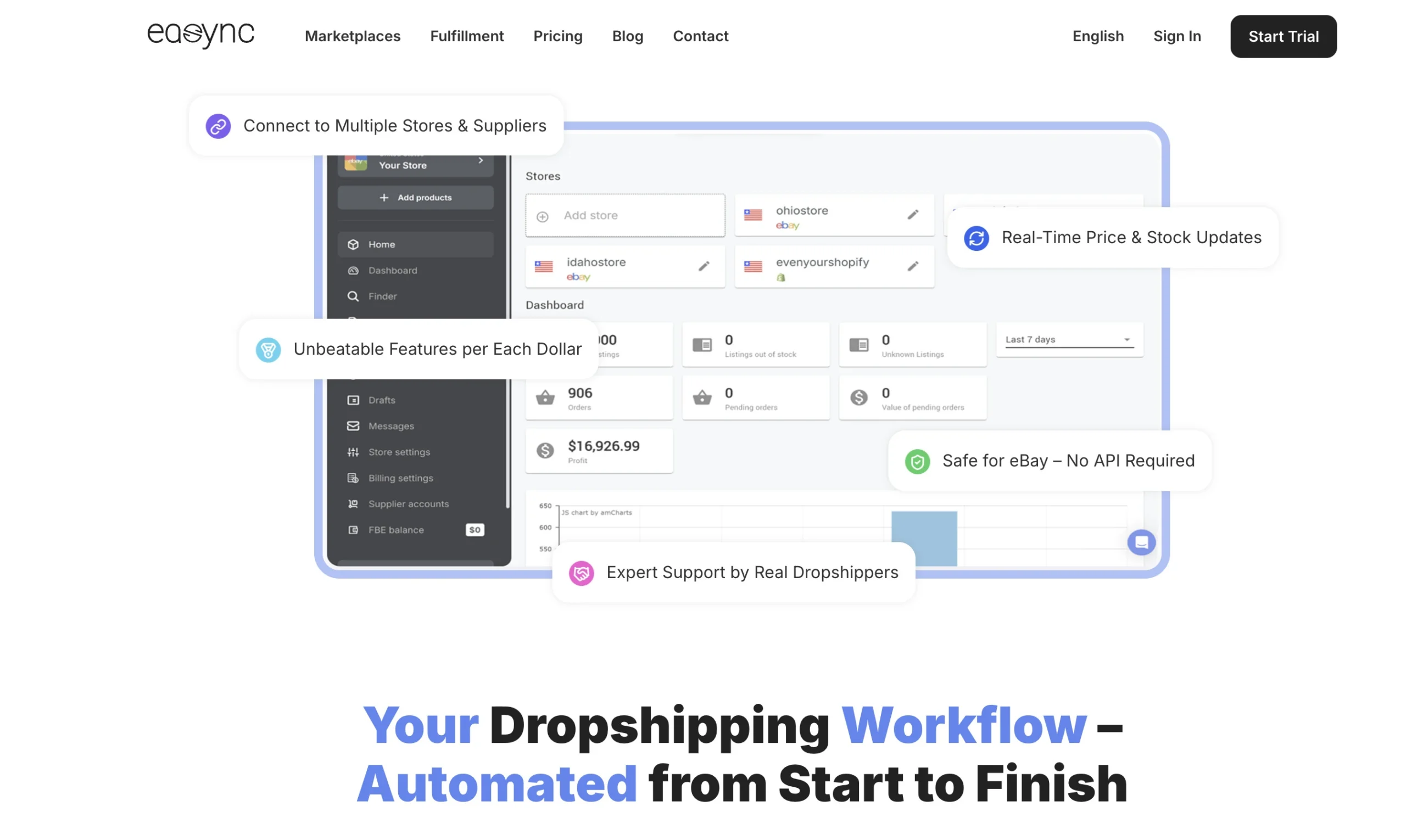
Easync supports automated product importing from major marketplaces, eliminating hours of manual listing work. Real-time stock and price monitoring prevents the costly mistake of selling out-of-stock items or products where supplier costs have increased beyond your margins. The auto-ordering feature pushes customer orders directly to suppliers without manual intervention, saving time and reducing errors that eat into dropshipping profits. Repricing rules automatically adjust your selling prices when supplier costs or marketplace fees change, protecting your margins without requiring constant manual monitoring.
Tracking synchronization keeps customers informed about their orders, reducing “where is my order?” support tickets that consume time and frustrate buyers. For sellers managing multiple stores or platforms, multi-account workflows allow control of everything from a single dashboard.
These features combine to save significant time, cut human error rates dramatically, and preserve the healthy margins necessary to hit specific salary goals whether that’s $3,000, $5,000, or $10,000+ per month. Rather than working more hours as volume grows, Easync users can maintain or even reduce their workload while scaling income. For anyone planning to move beyond a small side hustle into serious dropshipping earnings, this kind of automation is foundational.
Common Mistakes That Destroy Your Dropshipping Income
Many dropshippers fail not because the business model is broken, but because of avoidable errors that compound over time. Each mistake directly reduces your potential salary through refunds, ad losses, or account issues.
Choosing Products Based Only on Personal Preference
One of the most common beginner mistakes: picking products because they seem interesting rather than because market data shows high demand.
Validation steps that actually work:
- Search volume tools showing monthly searches
- Ad library research showing active competitor spending
- Marketplace best-seller lists and trend reports
- Social media engagement on similar products
A “cool” but low-demand product with no search engines traffic will burn through your marketing budget with minimal sales. Meanwhile, a “boring” problem-solving product in a profitable niche might generate consistent orders with minimal effort.
Treat product research as a weekly discipline, not a one-time task. Markets shift, trends emerge, and competitors enter and exit. Staying current on what people actually want to purchase products keeps your income growing.
Ignoring Analytics and Unit Economics
Not tracking key metrics turns your business into guesswork where you don’t know what’s actually profitable until it’s too late.
Example of hidden losses: Ads showing 1.5x ROAS might look acceptable on the platform dashboard. But once you factor in product cost ($15), shipping ($4), transaction fees ($1.50), and app fees ($0.50), that “profitable” campaign actually generates negative net profit on each sale.
Essential metrics to track:
- ROAS (Return on Ad Spend)
- CPA (Cost Per Acquisition)
- AOV (Average Order)
- Net margin per SKU and per channel
- Return/refund rates
Daily or weekly review of numbers helps prevent slow leaks that gradually erase monthly income. Any product that can’t demonstrate clear positive unit economics should be paused or reworked quickly.
Underestimating Customer Experience
Poor shipping times, vague policies, and weak communication lower repeat purchases and invite chargebacks. Customer trust erodes quickly when expectations aren’t met.
Case example: A store went viral on TikTok, generating thousands of orders in days. But their supplier couldn’t handle volume, shipping products took 35+ days, and the seller had no customer service infrastructure. The result: thousands in refunds, payment processor holds, and a destroyed reputation that made future marketing efforts ineffective.
Protective measures:
- Clear, honest shipping and return policies on product pages
- Proactive email updates at each order fulfillment stage
- Responsive support (even simple email or chatbot)
- Tracking synchronization through tools like Easync
Reputation in 2026 spreads quickly through social media platforms. One bad experience can generate viral negative content that tanks conversion rates for months.
Staying Manual for Too Long
Manually copying orders, checking stock, and editing prices is manageable at 5–10 orders daily. At 50+ orders, it becomes a bottleneck that limits growth and introduces costly errors.
Costs of manual errors:
- Overselling out-of-stock items → refunds and angry customers
- Shipping to wrong addresses → lost products and reshipping costs
- Missing price changes → selling below cost without realizing it
- Delayed order processing → longer shipping times and complaints
Without automation, many promising stores stall or close just as they become profitable. The owner burns out from operational demands rather than scaling into meaningful average earnings.
Automate early—especially product importing, inventory/price updates, and order fulfillment routing—to free capacity for strategy, marketing, and growth work that actually increases income.
FAQ: Dropshipping Salary and Income Potential
Can dropshipping replace a full-time job salary in 2026?
Yes, but typically not within the first few months. For motivated sellers who treat it as a real business, 9–24 months is a more realistic horizon to reliably match a mid-range salary. Replacement depends on consistent net profit across multiple months, not just one or two successful periods. Many dropshippers keep their day job until their store has produced six or more consecutive profitable months at or above their target income level. Automation and disciplined reinvestment heavily influence how quickly this milestone arrives. Plan a financial buffer before quitting employment, as dropshipping income naturally fluctuates more than traditional paychecks.
How much starting capital do I need to reach a meaningful dropshipping income?
Technically, you can start a dropshipping business with a few hundred dollars. However, reaching solid monthly income usually requires $1,000–$3,000 allocated to ads, testing tools, and basic apps over the first few months. This isn’t spent all at once—it’s spread across product tests and creative iterations. Organic-only marketing strategies can reduce cash requirements but typically extend the timeline to salary-like income by 6–12 additional months. Treat this money as business capital separate from personal expenses, and maintain extra reserves for unforeseen issues like ad account restrictions or supplier problems.
How do taxes work on dropshipping income?
Dropshipping income is typically treated as business income or self-employment income in most countries. Track all revenue and expenses products, ads, tools, software, so you can calculate net profit accurately for tax filing. Requirements vary significantly by region: US sellers may need to collect sales tax in certain states, while UK and EU sellers face VAT thresholds and registration requirements. Set aside 20%–30% of monthly profit (depending on local rates) for future tax payments rather than spending everything. Professional tax advice from an accountant familiar with ecommerce is strongly recommended, especially as your average income grows beyond side-hustle levels.
Is it realistic to earn a “passive income” from dropshipping?
Fully passive income from dropshipping is unrealistic. The business always requires some ongoing management, optimization, customer support, and marketing adjustments. However, with solid systems, delegation to freelancers or team members, and automation tools like Easync, many tasks can run with limited daily input. A more realistic goal is “low-touch income”—perhaps a few focused hours per day or week maintaining operations. Neglecting the business entirely leads to performance decline: stale products, worsening ad performance, and rising customer complaints. Build standard operating procedures (SOPs) so that routine operations can eventually be handled by others, freeing your time while maintaining income.
Do most dropshippers actually lose money?
Many new dropshippers either quit early or break even because they underestimate the learning curve and necessary testing budget. Initial losses during the testing phase are common and should be expected. However, those who track metrics carefully and iterate based on data systematically move toward profitability over time. Survivorship bias makes success stories more visible than failures, so it’s important to keep expectations grounded. Treating dropshipping like a real business with planning, budgeting, analytics, and proper automation tools significantly improves the odds of long-term profit. Consider initial small losses as tuition for learning the business, provided you’re actively analyzing results and adjusting your approach based on what the data shows.

Noah Edis is a freelance writer and systems engineer with a wealth of experience in modern hardware and software. When he’s not working on his latest project, you can find him playing competitive dodgeball or pursuing his personal interest in programming. At Easync, Noah helps thousands of sellers optimize their eBay and Amazon businesses by providing automation tools and practical guidance on account health, pricing, and inventory management.