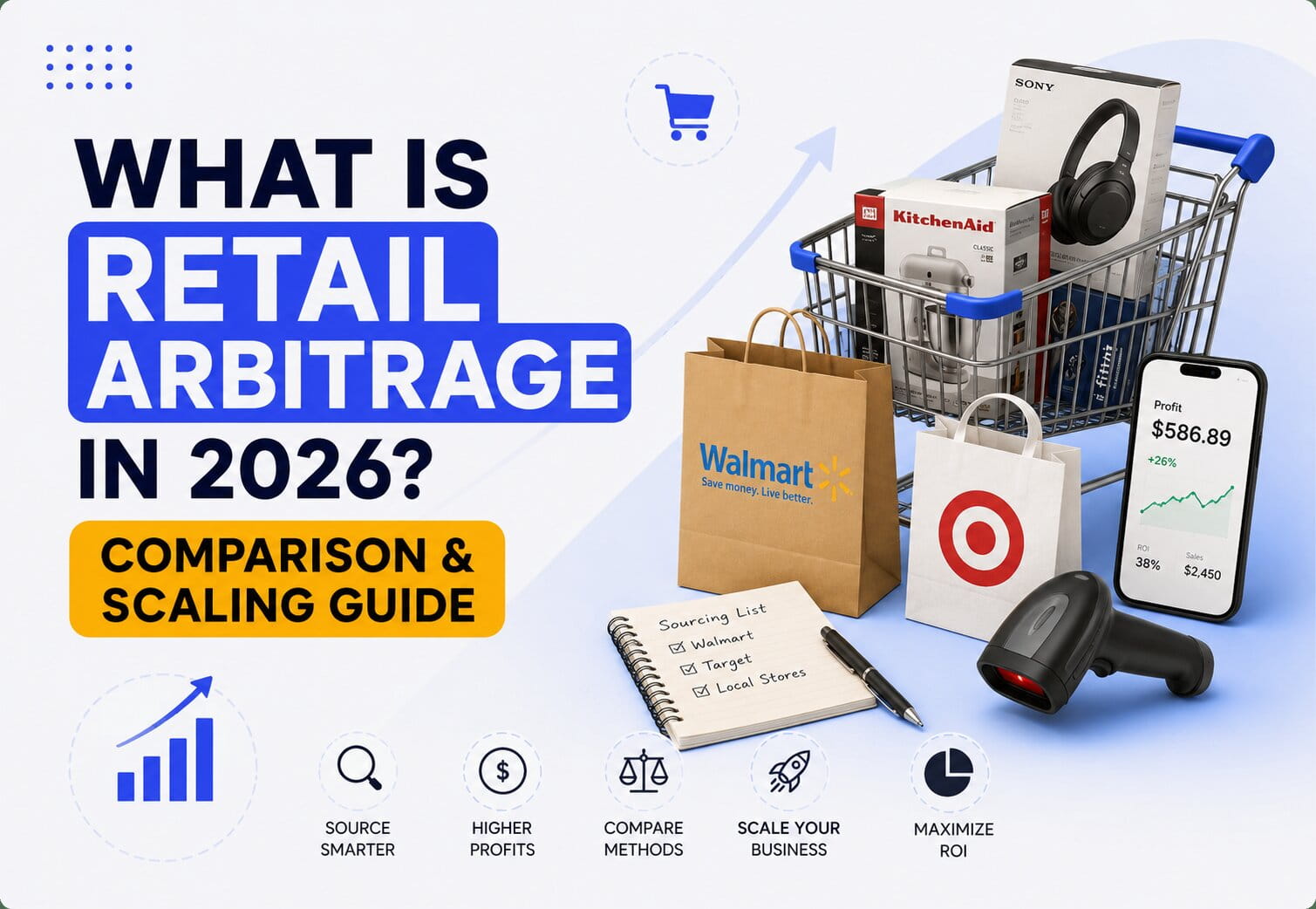
Somebody in your local Target is photographing a clearance sticker right now. Not for a group chat. That’s a job.
That’s retail arbitrage in a nutshell. In a physical store, you buy products at a low price and sell those products for a higher price online. Then you get to keep whatever survives the fees. People have been doing this for a very long time. The shelves still produce bargains, no matter how busy the internet has gotten.
2026 is a different animal, though. People are still winning from clearance sales. The things that have changed run in the background. The invoice checks and the four other people with the same app that have the same ideas as you.
There’s a problem with how this gets explained, though. Ask a seller what retail arbitrage means, and you get one answer. Ask Amazon or eBay, and you get a different one. You usually find out which definition counts when your account gets restricted.
So let’s break this down properly.
What is Retail Arbitrage in 2026?
Retail arbitrage is an e-commerce business model in which a seller purchases products from physical stores (Walmart, Target, or Home Depot) and then resells them for a profit on online marketplaces.
What makes this model so exciting is the simplicity of it all.
You walk into a store. You find the brick-and-mortar clearance racks shoved in the back corner near the seasonal junk. You pull your phone out and scan a barcode through an app.
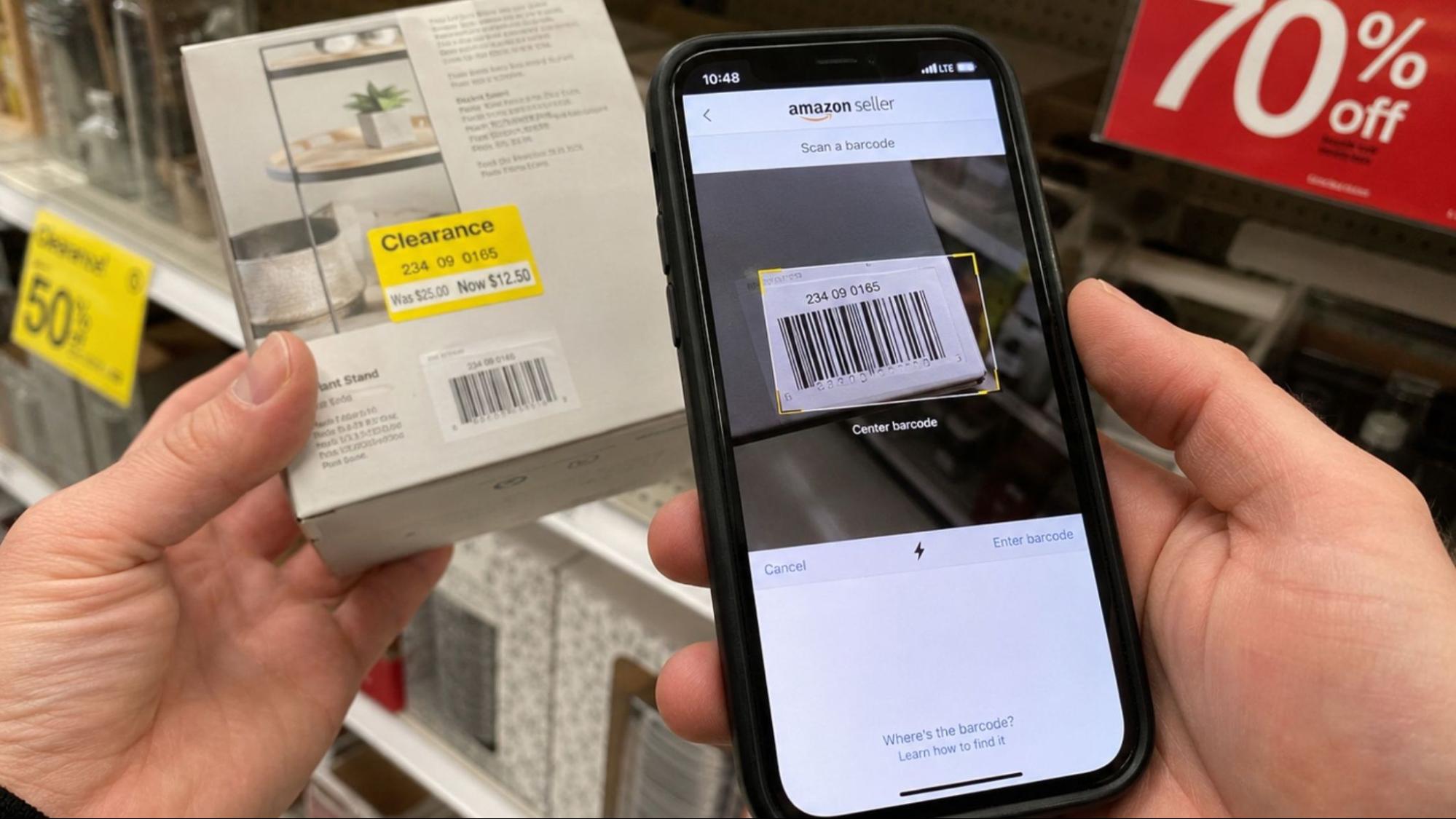
The Amazon Seller app scanner is free. That’s probably why it’s the most popular starting point. Scan a code, and you’ll see what the product currently sells for on Amazon. It gives you information on what you could profit from after the fees, and if you’re allowed to list it or not. Plenty of sellers will upgrade to paid scanners once speed starts mattering. Numbers never lie.
Say a product was $30, and that discontinued kitchen gadget is sitting at $12.00 on a clearance sale. That same item sells on Amazon for $34.99. You pay a referral fee and a fulfillment fee. You’re left with somewhere around $8 to $11 for every product you sell. Buy the six on the shelf, and that’s a hundred dollars for twenty minutes of work.
Doing that across 5 stores in an afternoon and you see what all the hypes about.
Now, the harsh truth in 2026.
Purchasing the whole clearance aisle works. It’s one of the few models where five hundred dollars and a car turn into something excitable. One problem is that there is a hard ceiling. That ceiling is you.
You can only be in one place at a time. That evening you spend wrapping gifts whilst your dinner gets cold. Having physical inventory means space. All those boxes need somewhere safe and dry to live. If you don’t have a huge 3-car garage, your living room, garage, and bedrooms will be stacked to the roof.
You also need to consider the paperwork. Brands sometimes lock big chunks of the catalog behind approval requests. IP restriction alerts pop up mid-scan, and the deal you were dreaming about just dies. Sales tax nexus becomes your problem the second you cross certain thresholds in certain states.
So retail arbitrage isn’t bad. It’s a full-time job. There are decent gross profit margins. You are finally the boss. But you’re working as much as physically possible.
Retail Arbitrage vs Dropshipping: What is the Difference?
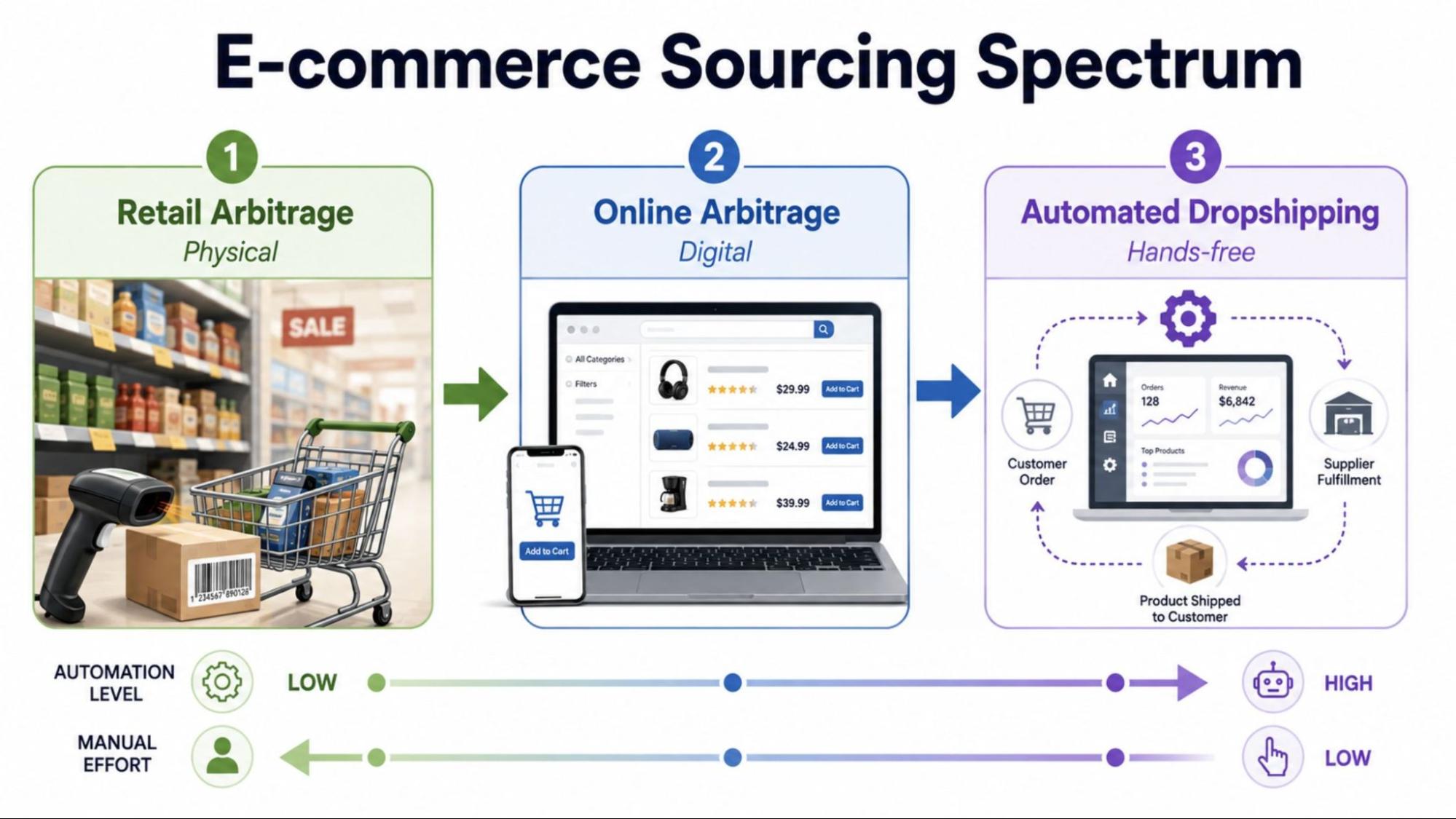
The one difference that stands out is who owns the inventory. With retail arbitrage, you purchase and control what happens with the inventory. Dropshippers enjoy the luxury of skipping that whole part and ordering directly from third-party suppliers without having to deal with the inventory.
This is the big one. Retail arbitrage vs dropshipping comes down to where your money sits and who does the work.
With Retail arbitrage, you buy first and hope the product sells second. That cart of clearance stock is upfront inventory capital, and it stays frozen until somebody clicks buy. Price tanks or the item turns out to be a dud? You now own that product forever or sell it at a loss. Physical inventory holding is what freezes your cash.
Dropshipping is the exact opposite. The customers pay for the product in your store, and then you use their money to order the product. This means you never have money stuck in inventory that isn’t selling.
| Feature / Metric | Retail Arbitrage (RA) | Online Arbitrage (OA) | Automated Dropshipping |
|---|---|---|---|
| Sourcing Location | Physical store clearance racks | Online e-commerce sites | Supplier databases / E-commerce sites |
| Upfront Capital | Required (Buy stock before selling) | Required (Buy stock before selling) | Minimal (Buy after customer pays) |
| Inventory Storage | Physical (Garage, home, or FBA) | Physical (Home or FBA Prep Center) | Zero Physical Inventory |
| Fulfillment Labor | Manual packing & shipping | Manual packing or FBA prep | 100% Automated via Easync |
| Scalability Ceiling | Capped by human hours & geography | Capped by capital & prep speed | Virtually Infinite (Cloud API) |
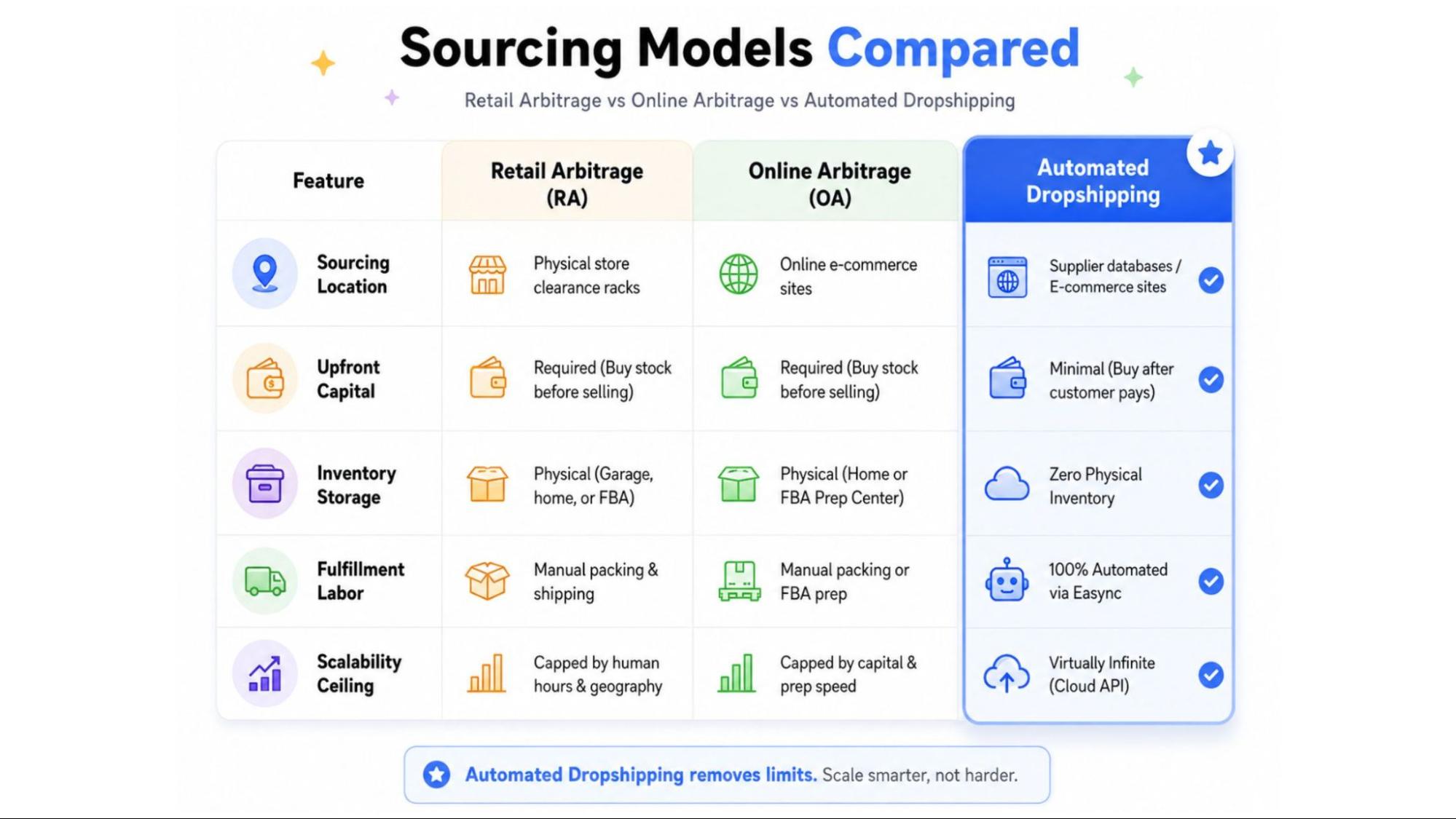
Then there’s the margins. Arbitrage margins get fat because clearance markdowns of seventy or eighty percent aren’t unusual. Dropshipping margins run thinner per unit.
With dropshipping, you make up for the thinner margins on volume. Fifty orders become five hundred, and your day looks exactly the same as it did yesterday.
Here’s the bit that blindsides people.
Marketplace policy compliance treats these models very differently. Both platforms also use the phrase “retail arbitrage” to describe something they don’t allow. Not the buying-clearance-and-shipping-it-yourself version. The version where you list an item, wait for a sale, then have another retailer post it straight to your buyer.
Read this before you build anything. Amazon’s dropshipping policy requires you to be the seller of record on every packing slip, invoice, and box, and prohibits buying from another online retailer and having that retailer ship directly to your customer. eBay goes tighter still, permitting dropshipping fulfilled from a wholesale supplier while prohibiting purchases from another retailer or marketplace shipped to your buyer. Seller of Record guidelines are the whole ballgame. Check both policies at the source before you commit.
Short version. Holding your own stock and shipping it yourself is one activity. Routing a customer’s order through somebody else’s warehouse is another.
Retail Arbitrage vs Online Arbitrage
Retail arbitrage involves sourcing physical products in-person from brick-and-mortar store shelves, while online arbitrage involves sourcing digital price gaps on different online stores all from a computer.
Retail arbitrage vs online arbitrage is simple when you answer this question: Are you finding deals with your feet or your browser tabs?
Online arbitrage is where most Retail arbitrage sellers drift once they get tired of all the driving around. It usually happens the same way, too. It’s cold outside, and you don’t feel like packing and unpacking a car. Sitting in your warm house, you open your laptop and manage to find 3 deals by the time you could have gotten changed.
The upgrade is obvious. Geography no longer gets in your way. A clearance markdown in a state you’ll never visit becomes as available to you as the one down the road.
What doesn’t change is the money. Online arbitrage still eats up upfront inventory capital, and you will still have to prep and store your boxes. You have basically swapped driving for a prep table. Your ROI per SKU looks much the same. Your back feels better. It’s the same business with a little less legwork. The warehouse problem stays your problem.
Retail Arbitrage vs Wholesale
Retail arbitrage relies on buying individual clearance items from retail stores without official brand relationships. Wholesale means you need to purchase bulk inventory directly from authorized brand manufacturers. You also need official B2B invoices.
Here’s where retail arbitrage vs wholesale stops being theoretical. Usually, a gate forces the conversation.
Some brands require you to get approval before selling their products.
This is the bit that catches new sellers. Ungating invoices have to come from authorized distributors. A Walmart receipt is a retail receipt, and Amazon rejects those for almost every gated category. What it wants is a commercial wholesale invoice showing full supplier details. At least ten of the products are roughly dated within 90 to 180 days, depending on the category. The name and address on it have to match what’s in your Seller Central account. Not close. Match.
So much for receipt sourcing as a shortcut. That loophole was closed a while back.
Wholesale solves the problem by design. You’re a customer of the brand, the invoices exist, and you can reorder the same winner next month and the month after. It creates stability.
The trade is everything wholesale wants upfront. Minimum order quantities. Real capital. Distributors who need to know who you are before they’ll open an account. Retail Arbitrage lets you start on a Saturday with whatever’s in your bank. Wholesale wants a business first.
Retail arbitrage lives off clearance spikes, which are moments rather than pipelines. Wholesale is the pipeline. Neither is better than the other; they are only right for the stage of business you are in.
Retail Arbitrage vs Scalping
Retail arbitrage is all about buying discounted clearance items to provide market liquidity. Scalping involves aggressively buying up artificially scarce, high-demand items (like limited sneakers or event tickets) to flip them at exorbitant markups.
People love lumping these together. They shouldn’t. Retail arbitrage vs scalping is a difference of intent. The intent of the buyer.
Arbitrage moves stock that people aren’t buying in one area. That gadget was dying on a shelf in Ohio while somebody in Arizona wanted to buy it. All you’re doing is connecting the two and profiting. The store got its shelf space back. You got paid.
In scalping, not everyone is winning. You purchase the scarce thing fast and wait for desperation to set the price. This happens often with products like limited sneaker drops or tickets for a tour.
This is sometimes a legal mess. The BOTS Act of 2016 made it illegal to use bots to get around ticket purchase limits. It only covers event tickets. Using Bots to scoop up trainers or anything niche sits outside that federal law. In December 2025, the Stopping Grinch Bots Act tried to extend that into retail, but it isn’t law yet.
The law is only half of it. Most marketplaces ban bulk automated checkout in their own terms of service, and retailers cancel bot orders on sight. You’ll lose the account long before anyone brings a court into it.
The honest version is this. Retail arbitrage redistributes stock that was already gathering dust. Scalping uses the shortage as a way to hike prices.
Retail Arbitrage vs Reselling
Reselling is a wide term for selling anything, really. Vintage, second-hand, you name it. Retail arbitrage is a specific sub-category of reselling focused exclusively on brand-new retail clearance products.
People use these two interchangeably all the time, and this is how sellers end up describing themselves incorrectly on their own about page.
Retail arbitrage vs reselling barely counts as a comparison. Reselling is the whole family. Thrift store flippers, estate sale hunters, vintage denim specialists, furniture restorers, and sneakerheads clearing out a collection. All resellers.
Retail arbitrage is one specific seat at that table. Brand new, still sealed, sourced from a retailer’s markdown rather than somebody’s attic.
The practical difference is repeatability. Vintage is one-of-one. You can’t sell the same product over and over again. Retail arbitrage is all about the quantities. Same product with the same information, and your listing stays the same.
That’s why retail arbitrage has more growth potential than reselling. You’re working with catalog items rather than treasure.
Why Physical Retail Arbitrage Hits a Labor Ceiling
Ask anyone two years into this, and you’ll hear the same story. Clearance aisle flipping stops being a treasure hunt and becomes a full-on shift.
To make enough money, you need to have visited 5 stores before lunch. Scanning until your thumb aches. Home to a hallway you can’t walk down because of boxes, then packing, then labels, then the run to the post office before it shuts.
The garage goes first, usually. Then the spare room. Then somebody in your household asks a very reasonable question about the dining table.
The ceiling isn’t your ambition. It’s the patterns. There are only so many hours, only so many stores inside a sensible drive, only so many boxes you can tape shut before midnight. Double your sales, and you’ve doubled your workload, which means you’re working harder for the same hourly rate.
This is when sellers start looking at automated dropshipping software.
Dropshipping Automation Software
Easync is a dropshipping Automation Software for eBay, Amazon & Shopify. It exists for the seller who has hit that wall mentioned above. It takes the parts of the day that don’t need a human and hands them to software.
Cloud-based auto-ordering means an order landing on your store gets placed with your source market automatically. No copying addresses at 11 pm. 24/7 dynamic repricing watches prices and stock around the clock so that your supplier price hike doesn’t turn your bestseller into a loss-maker while you sleep.
Tracking synchronization closes the loop. Pulling tracking numbers and pushing them back to your marketplace order without a spreadsheet in sight. Fulfillment by Easync handles the ship-out side, so packages leave from one place instead of whatever box a retailer sends.
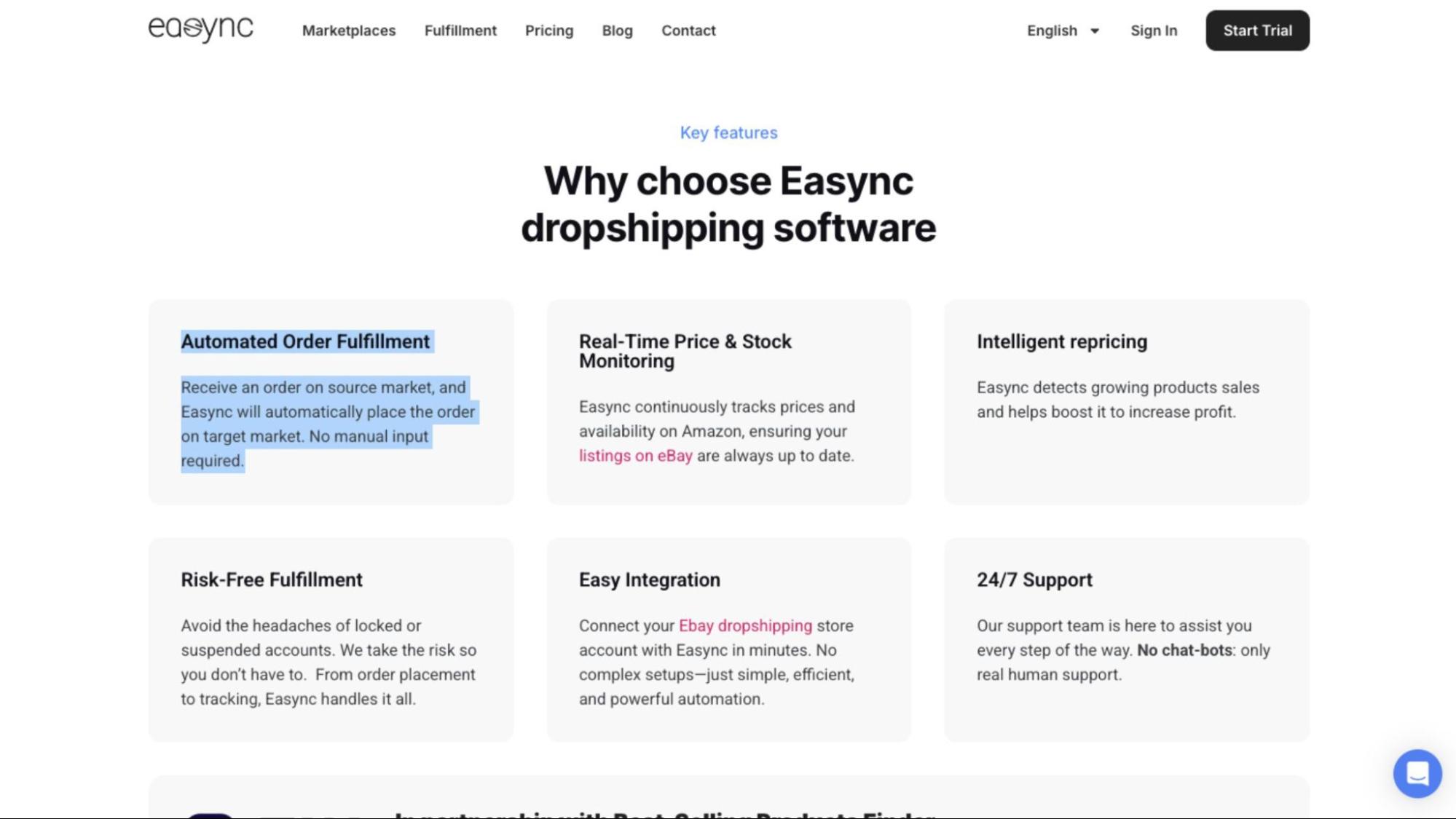
That’s hands-free fulfillment doing the boring work. Your job becomes choosing what to sell. That’s the part that actually makes you money.
Plans start at $49.99/month with a 7-day free trial and no card required, and the tiers scale based on how many listings you reprice and how many orders get placed automatically. Check the current policies of whichever marketplace you sell on before setting your source markets.
Frequently Asked Questions
Is retail arbitrage legal in 2026?
Yes. Buying a genuine product and reselling it is protected by the First Sale Doctrine, codified at 17 U.S.C. §109. This takes away the brand’s control over that specific unit once it’s been sold. You own it and can sell it.
Can you start retail arbitrage with no money?
No. Retail arbitrage needs cash on day one. You buy the stock before anyone has bought it from you. A realistic starting float is a few hundred dollars.
What apps do I need for retail arbitrage?
The Amazon Seller app scanner is where you start. It’s free with your seller account, and it does the job. Add Keepa for price history. It will tell you which products are worth selling in the long run. Once you’re selling across online channels at volume, automated dropshipping software like Easync handles all backend parts of the business without you having to be involved.
Free one first. Add the others when the workload demands them, not before.

Kaylin Bailey is an experienced e-commerce strategist and content writer specializing in dropshipping, automation, and online retail growth. At Easync, she focuses on helping entrepreneurs streamline their stores with data-driven insights, practical guides, and software solutions that optimize product sourcing, pricing, and order fulfillment. With years of hands-on experience in digital commerce and platform integrations, Kaylin’s articles offer actionable advice grounded in real-world testing, helping sellers stay competitive in a rapidly evolving marketplace.

Eugene Stepnov – Author
Eugene is a senior e-commerce strategist with over 10+ years of experience in dropshipping, online arbitrage, and marketplace compliance. At Easync. Eugene has experience in developing multi-account management technologies, such as Gologin and secure browser solutions, providing Easync users with a head start in regulatory compliance and platform changes.