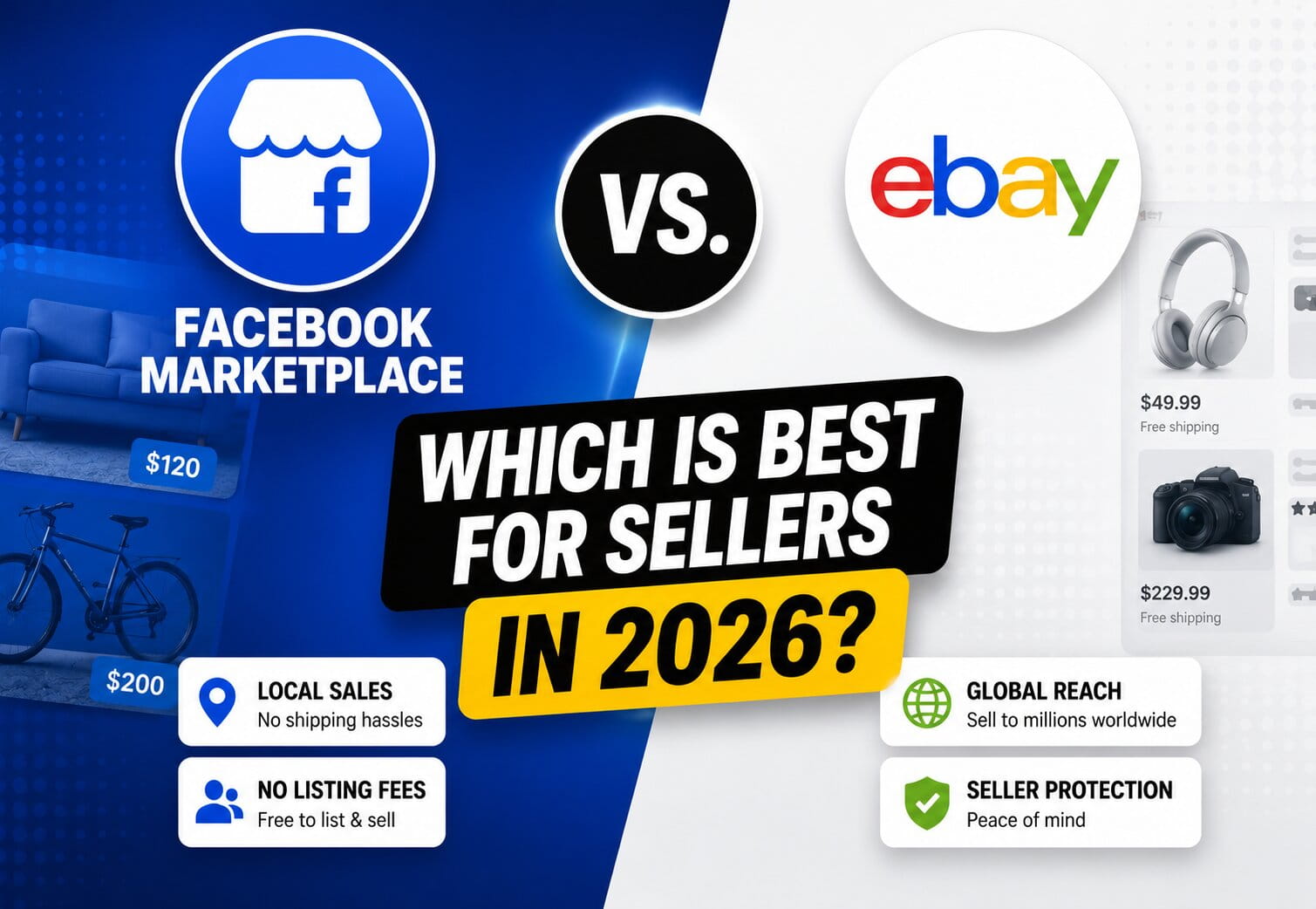
The Direct Verdict: Facebook Marketplace vs. eBay
Facebook Marketplace is best for local sales, cash transactions, zero-fee listings, and high-margin local flipping. eBay is the undisputed king for professional e-commerce, global audience reach, and high-volume dropshipping. While FB Marketplace offers cheaper upfront selling, eBay provides the robust infrastructure and automation tools needed to build a fully hands-off, scalable business.
If you’re selling a couch this weekend, it’s better to use Facebook. Use eBay if you want to build a store that sells while you sleep.
Understanding the Platforms: Local Social Commerce vs. Global Search Engine
These two platforms are very different if you look into them more deeply. One of the only similarities is that they let you post a photo of a product and price.
Facebook Marketplace runs on social intent and proximity. The whole model was built on local pickups, and Facebook took a more personal route. Basically, if someone wanted to purchase a mirror and searched for mirrors on Marketplace, the listing that’s closest to them will show up first.
eBay focuses more on a global scale and is made for cross-border merchants. The difference is that people on eBay have buyer’s intent. If they search the mirror in the eBay search bar. Cassini, which is eBay’s ranking algorithm, decides what listing to show you. Not based on proximity.
The numbers on who is shopping where are all over the internet. Those numbers are misleading if you read them wrong. Marketplace’s one billion users are not fake. The problem is that it counts everyone who opened a tab. Even people who just browse because they are bored.
eBay has 136 million active buyers. This number is calculated for people who have purchased something in the last twelve months.
Fee Structure Breakdown: eBay vs. Facebook Marketplace
Facebook is cheaper per sale. The fine print is where it gets interesting.
Hand an item over in person, and Facebook takes nothing at all. A $200 dresser from your garage puts $200 in your pocket. Ship that same dresser, and things change fast.
| Fee Type | Facebook Marketplace | eBay |
|---|---|---|
| Local Pickup | Free | Not really an option |
| Main Selling Fee | 10% of buyer total | 13.6% of buyer total |
| Minimum Fee per Order | $0.80 | $0.30 under $10, $0.40 above |
| Listing Fees | None | $0.35 after 250 free each month |
| Optional Extras | None | Store plans, Promoted Listings |
Both platforms charge their percentage on everything the buyer pays you. It’s not the price of your listing. Things like tax and shipping add up.
eBay’s category rates move around quite a bit. Guitars sit well below standard. Books can run higher. A basic Store plan or better will drop the main rate to 12.7%. This pays for itself over time, though.
The Takeaway on Fees
Facebook is cheaper per transaction, but not as much as the headline percentage portrays. If you sell an item for $60 and the shipping is 9$ then Facebook takes $6.90. eBay will take $9.75. That’s a $2.88 per sale.
You should look at the bottom end because of the $0.80 minimum. Sell a $5 accessory and Facebook’s minimum kicks in, so you’re paying $0.80. That works out to 16%, not 10%. Push below roughly $3.70, and Facebook actually starts costing more than eBay does.
Head-to-Head Comparison Matrix
Everything mentioned above is condensed into one view below. Facebook takes the fee column and anything involving local reach. eBay takes buyer intent, seller protections, and every row that touches scale.
The last line is the most important. The potential to have automation is what separates a platform you can sell on from a platform you can build on.
| Feature / Metric | Facebook Marketplace | eBay |
|---|---|---|
| Active Audience | ~1 billion social users (broad, browsing intent) | 136 million active buyers (high purchase intent) |
| Selling Fees (Shipped) | 10% of buyer total, $0.80 minimum | 13.6% Final Value Fee plus $0.30 to $0.40 per order |
| Local Cash Pickup | Excellent (0% fees, strong local demand) | Poor (built around shipping) |
| Sourcing & Dropshipping | Difficult to automate; strict account flags | Highly profitable when paired with automation |
| Logistics & Tracking | Basic shipping labels, slow tracking sync | Advanced fulfillment, international shipping (eIS) |
| Automation Potential | Very low (manual messaging and ordering) | 100% automatable via Easync.io |
The Differences Every Seller Must Know
The fees are the easy part to compare on paper. These are the differences that will decide if you can scale a business or not.
1. Buyer Intent & Communication Routine
Facebook Marketplace buyers are shoppers in the loosest possible sense. They message “is this still available?” and then vanish. Shoppers on Facebook will low-ball you with less than half of the price you want. They’ll arrive two hours late or not arrive at all.
eBay buyers are different. They see something they want, they hit buy now, and pay for the product. Your inbox stays empty, and your listing does all the work.
The difference compounds, and it compounds quickly. Sell ten products on Facebook, and you could be replying to sixty messages. Ten eBay sales, on the other hand, could mean zero messages.
There’s also a marginal cost buried in there. Marketplace has a haggling culture. Most of the buyers shop there for the sole purpose of negotiating. Unfortunately you listing will sit if you aren’t willing to cooperate. Knock 10% off to close a sale, and you’ve just handed back triple what you saved on fees.
eBay’s fixed-price format sets the expectation up front. Best Offer is there if you want it. The nice thing is that nobody assumes the sticker price is an opening bid.
2. Shipping & Dispute Protections
Facebook leans heavily toward buyer protection. It’s most evident in the dispute process. The tracking sync between carriers and the Marketplace checkout is flaky.
It can be frustrating when something goes sideways. This is because you are making your argument against an automated system that’s not going to budge.
eBay is by no means flawless. They do, however, have better systems in place for sellers aswell. You get documented Seller Protection policies, managed tracking upload, and automated return workflows. The great thing is that when a sale goes wrong, you get an appeals process staffed by people whose job is to resolve seller disputes.
The difference has a real price tag. eBay sellers rated Below Standard pay an extra 6% on final value fees, which stings, although at least the rules are published and your metrics are visible in Seller Hub. Marketplace account restrictions tend to show up with no explanation at all.
3. Scalability & Software Integration
This is where the debate ends for most serious sellers.
Facebook Marketplace actively restricts third-party API tools and aggressive automation. Bulk-listing software, auto-repricers, and automated order fulfillment either don’t exist or will get your account flagged. The platform was designed for individuals selling their own belongings. It still behaves that way to this day.
eBay went the other direction. It publishes developer APIs and encourages integrations, which is why a solo seller can realistically manage thousands of live listings without hiring anyone.
In practice, that means:
- Listing tools that upload 200 products at once
- Repricers that respond to competitors overnight
- Stock monitors that pull your listing before a supplier sells out
- Fulfillment software that places supplier orders and uploads tracking on its own
Marketplace has no equivalent to any of that. Trying to do so with any unofficial tools is a very quick way to get banned and permanently banned. If your life depends on the income, it’s just a risk not worth taking.
Why eBay Wins for Serious E-Commerce Scaling (And How to Overcome the Fees)
Most of the argument around selling on eBay vs Facebook Marketplace stops at the fee schedule, which is exactly why so many sellers get it backward. Sellers who flee to Facebook Marketplace to dodge eBay’s fees are playing the wrong game.
Go back to that $2.88 per sale, then add the labor. It’s fifteen minutes of messaging. Then you need to haggle and then meet up with potential buyers. Look at it as $20 dollars an hour. With one no buy, that’s almost $5 of your time.

Facebook’s costs are hidden rather than low. You pay in hours instead of dollars.
There’s a mistake on the eBay side, too, and it’s the more expensive one. Most sellers blame the 13.6% when the actual constraint is operational. Supplier prices change, and your listings don’t. Items go out of stock, and you find out when a buyer opens an unresolved issue case. Evenings disappear into copy-pasting tracking numbers.
That’s what caps most eBay stores at around fifty orders a month. It has nothing to do with the fee.
Run the numbers on the ceiling. If manual processing takes eight minutes per order across sourcing, ordering, and tracking upload, then 50 orders eat close to seven hours a month. At 300 orders, it’s forty hours, which is a full-time job you never meant to give yourself, doing work that requires no judgment whatsoever.
Sellers who break past that point aren’t grinding harder than everyone else. They’ve handed the repetitive parts to software.
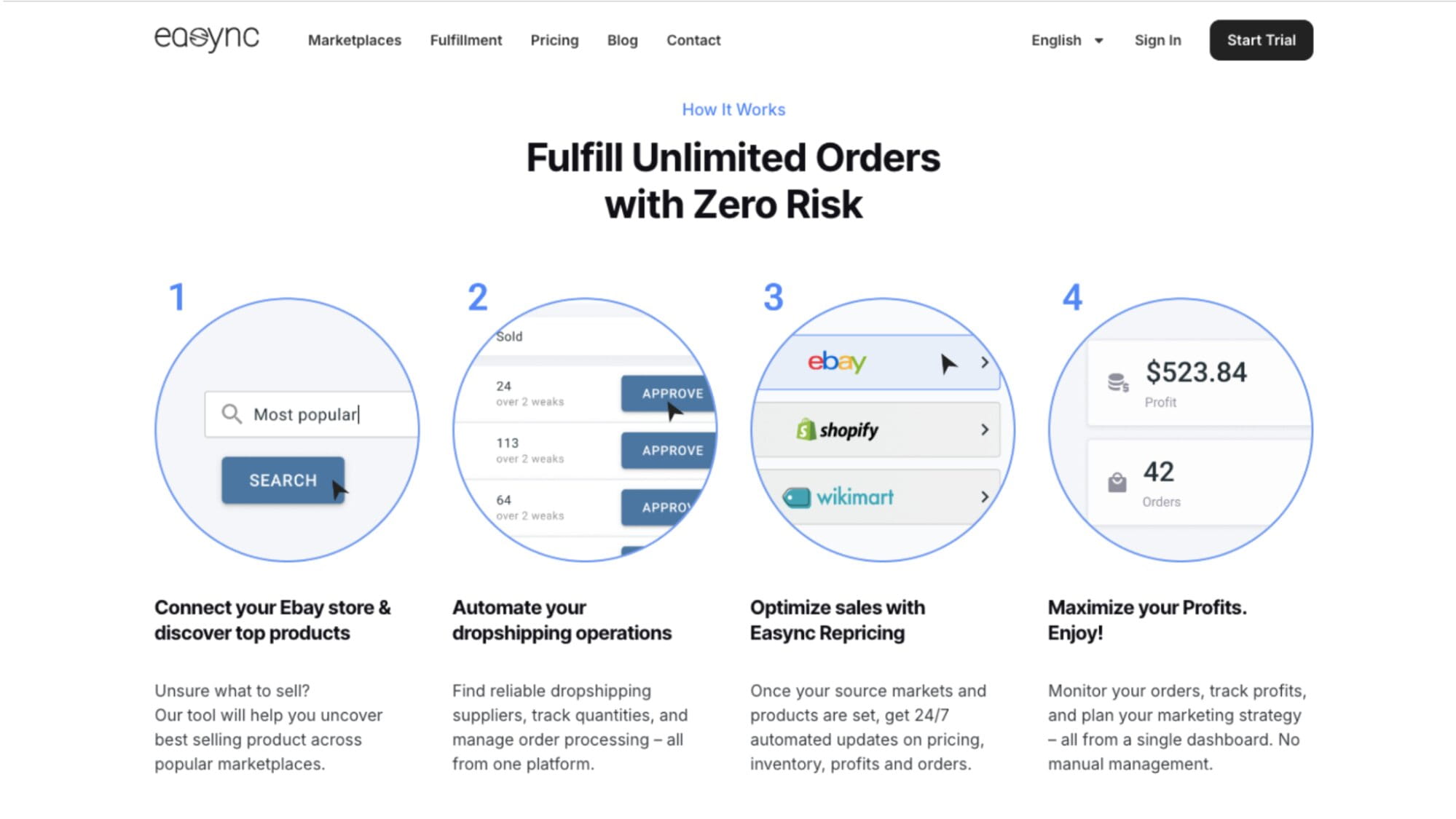
Master eBay Sales on Autopilot with Easync.io
Look back at the automation row in the comparison table. Marketplace blocks third-party tools and flags accounts that try to use them. eBay publishes APIs and invites them in.
That invitation is the entire reason eBay dropshipping automation software exists as a category.
15-Minute Price and Stock Sync
Easync checks every 15 minutes what your suppliers are doing. Be it Amazon, Walmart, or AliExpress. It then updates your eBay listings to match.
Say the supplier raises their price, your listing also goes up. If that suppliers stock runs dry. Your listing comes down before someone purchases an order that you can’t give them.
That kills the out-of-stock cancellations that drag seller ratings toward Below Standard. Those cancellations have their own 6% fee penalty on top of everything else.
Fulfillment by Easync (FBE)
This is where those eight minutes per order go. Easync takes the whole sequence off your desk:
- Places the order with your supplier the moment a sale comes in
- Pushes the tracking number to eBay as soon as it exists
- Closes out the shipping confirmation without you touching it
At 300 orders a month, that’s the difference between a business and a 40-hour admin week you never signed up for.
The AI Repricer
On eBay, your competitors’ pricing often determines if a customer chooses to buy from you or them. You may be selling the same product as a hundred other competitors, and it’s not humanly possible to keep up with all the price changes.
The repricer adjusts against them continuously while holding whatever margin floor you set. You stay competitive across thousands of listings without personally monitoring one of them.
What the 3.6% Actually Buys
Think about what this does to the comparison you started this article with.
A Marketplace seller and an eBay seller both have something happening on a Tuesday evening. One is answering “is this still available?” for the ninth time and driving to a parking lot at 8 pm. The other is doing nothing at all, because the software handled it, and the store took orders while they slept.
Those 3.6 percentage points are what buy that option. Facebook doesn’t sell it at any price.
Conclusion & Final Verdict
Facebook Marketplace earns its keep on local one-offs. Selling things like second-hand furniture or general garage clearouts. Basically, anything where shipping isn’t really going to work anyway. It’s a quietly good sourcing channel too. People list underpriced inventory locally all the time.
What it can’t do is grow with you. Every sale needs you there.
eBay costs more per sale and hands you a business in exchange. Those 3.6 percentage points buy structured search, seller protections, 136 million buyers with a card already out, and an API that lets software handle the parts that never needed a person.
The real question when you’re weighing selling on eBay vs Facebook Marketplace isn’t which one is cheaper. It’s which one can keep running when you close the laptop?
Most serious sellers run both. Local flips on Marketplace, everything shippable on eBay.
Sell where the buyers are. Automate where the platform lets you.
FAQ
Is it better to sell on Facebook Marketplace or eBay?
It depends on volume and item type. Facebook wins for local one-off buys. eBay wins for anything shippable that you want to sell repeatedly.
Does Facebook Marketplace charge more fees than eBay?
No, although the gap is smaller than most guides claim. Facebook charges 10% on shipped orders with a $0.80 minimum on the buyer’s full total purchase price. eBay charges 13.6% plus $0.30 to $0.40 per order for most categories. Local pickup on Marketplace is still completely free.
Can you dropship on Facebook Marketplace like on eBay?
Not in any way that scales. Facebook Marketplace restricts third-party API automation and offers no structured fulfillment integration. eBay supports full API-based automation. This is why software like Easync can run pricing, stock sync, and fulfillment end-to-end.
Do eBay listings really show up on Facebook Marketplace?
Yes, for eligible sellers. eBay and Meta launched the integration in 2025, and it has expanded since. Listings with shipping options can appear in the Marketplace feed with a partnership badge, checkout happens on eBay, and eBay says there’s no extra cost to the seller.

Kaylin Bailey is an experienced e-commerce strategist and content writer specializing in dropshipping, automation, and online retail growth. At Easync, she focuses on helping entrepreneurs streamline their stores with data-driven insights, practical guides, and software solutions that optimize product sourcing, pricing, and order fulfillment. With years of hands-on experience in digital commerce and platform integrations, Kaylin’s articles offer actionable advice grounded in real-world testing, helping sellers stay competitive in a rapidly evolving marketplace.

Reviewed by: Louis Profits
Louis is a marketplace dropshipping practitioner and educator specializing in eBay and Facebook Marketplace. He turns complex ops into simple, repeatable playbooks—covering winning-product frameworks, listing hygiene, pricing levers, and post-sale workflows.
At Easync, Louis contributes field-tested guides you can ship the same day: eBay launch checklists, FBM research sprints, and automation blueprints that tie directly into Easync (stock/price sync, auto-ordering, tracking updates, and KPI safeguards). Expect concise steps, screenshots, and templates geared to help you scale responsibly and protect your metrics.