
- articles
LLC for Dropshipping: Do You Really Need One?
Deciding on a legal structure is one of the first real business decisions a dropshipper faces, yet it is also one of the most misunderstood.
This guide focuses on forming and using an LLC for a dropshipping business in the United States, including whether you need one, what it costs, what it protects, and when it makes practical sense to form one.
Key Takeaways
- An LLC is generally not required to start a dropshipping business or sell through platforms such as Shopify, Amazon, or eBay in the U.S. You can generally operate as a sole proprietor without forming a separate legal entity, although licenses, permits, DBA registration, or tax registration may still be required.
- An LLC is a legal entity that can provide limited liability protection and a formal structure for contracts, banking, ownership, and business records.
- A sole proprietorship is often the simplest structure for testing products, validating demand, and starting with minimal paperwork. An LLC may become more useful as revenue, order volume, legal risk, or personal asset exposure increases.
- All costs, taxes, and rules for an LLC are state-specific. Formation fees, annual reports, franchise taxes, and other LLC costs vary by state. Check the current fees on the relevant Secretary of State and state tax agency websites.
- An LLC is not a guaranteed tax-saving method or a shield against every possible lawsuit. It works best alongside insurance, good suppliers, and proper compliance.
Do You Need an LLC for Dropshipping?
If you are asking, “Do I need an LLC for dropshipping?”, the answer is generally no. An LLC is not usually required to start a dropshipping business, open an online store, or list products on major e-commerce platforms in the United States. You can operate as a sole proprietor without forming a separate legal entity, although licenses, permits, DBA registration, or tax registration may still be required.
That said, an LLC for your dropshipping business becomes more useful as circumstances change. Here are the situations where it starts to matter:
- You are making consistent sales and generating steady monthly revenue.
- You are signing contracts with suppliers, fulfillment services, or payment processors.
- You have personal assets like a home, savings account, or investments that you want to protect.
- You are bringing on partners, hiring employees, or scaling ad spend.
- You want a more professional business name when dealing with banks and vendors.
An LLC is about liability protection and business structure, not an automatic tax hack or a guarantee against all lawsuits. Understanding that distinction is essential before deciding whether to form one.
Sole Proprietorship vs LLC for Dropshipping (Comparison Table)
The two most common structures for new dropshippers are a sole proprietorship and an LLC. The table below compares them across the factors that matter most when you are running an online store.
| Factor | Sole Proprietorship | LLC |
|---|---|---|
| Formation | No entity-formation filing is generally required; DBA, license, permit, or tax registrations may still apply | Requires state registration and LLC formation documents |
| Personal Liability | Owner is personally liable for all business debts and legal claims | Members may get personal asset protection if finances are kept separate |
| Startup Cost | Usually low; DBA or local registration fees may apply | State formation fees apply and vary by state |
| Ongoing Fees | Usually minimal; local renewals may apply | Annual reports, franchise taxes, registered-agent costs, or other state fees may apply |
| Taxes | Income reported on Schedule C; subject to self employment taxes | Single-member LLCs generally use pass-through taxation by default; multi-member LLCs are generally taxed as partnerships unless another classification is elected |
| Administrative Workload | Low; simple recordkeeping | Moderate; state compliance, company records, separate bookkeeping, and an operating agreement where required or appropriate |
| Legal Business Identity | Owner and business are the same legal entity | The LLC operates as a separate state-registered legal entity |
| Ability to Add Partners | Awkward; no built-in structure for shared ownership | Flexible; multi member LLC with defined ownership percentages |
| Best Suited For | Early testing, low revenue, validating products | Growing operations, higher-risk products, partnership-based businesses |
| Main Risks | Full personal exposure to lawsuits, debts, chargebacks | Ongoing maintenance costs; protection can be pierced if rules are ignored |

Operating as a Sole Proprietor: Pros and Cons
A sole proprietorship is the default structure for a person who starts selling without forming an LLC, corporation, or partnership. It is often the simplest way to test a dropshipping idea because there is no separate entity to create before the first sale.
Advantages of a Sole Proprietorship for Dropshipping
- Low startup costs. A sole proprietorship usually does not require a state formation filing. A DBA, local business license, seller’s permit, or other registration may still be required depending on the business name, location, and products sold.
- Simple administration. There are fewer formation documents, annual reports, and entity-level compliance requirements. This makes the structure easier to manage while testing products or learning how dropshipping works.
- Straightforward federal tax reporting. Business income and expenses are generally reported on Schedule C as part of the owner’s personal federal tax return. The owner remains responsible for applicable income and self-employment taxes.
- Easy to start and stop. A sole proprietor can usually begin operating quickly and can later form an LLC if the business becomes stable enough to justify a separate legal entity.
- Useful for early validation. This structure can be practical when the seller is still testing suppliers, product demand, advertising channels, and store profitability.
Disadvantages of a Sole Proprietorship for Dropshipping
- No legal separation between the owner and the business. The owner is personally responsible for business debts, contractual obligations, chargebacks, and legal claims.
- Personal assets may be exposed. If the business cannot pay a debt or faces a product-liability or intellectual-property claim, the owner’s personal finances may be at risk.
- Less suitable for partners. A sole proprietorship is owned by one person and does not provide a built-in structure for dividing ownership, responsibilities, voting rights, or profits between multiple owners.
- Business and personal finances can become difficult to manage. Although a separate bank account is still useful, the business is not a separate legal entity. Poor recordkeeping can make bookkeeping, taxes, and a later transition to an LLC more complicated.
- Scaling may create additional risk. As sales volume, contracts, advertising spend, refunds, and supplier obligations grow, the simplicity of a sole proprietorship may become less valuable than the legal and administrative separation offered by an LLC.
When a Sole Proprietorship May Be Enough
A sole proprietorship may be sufficient when you are testing a small number of products, generating limited or inconsistent revenue, operating without partners or employees, and accepting a relatively low level of business risk. It becomes less attractive when the store develops consistent sales, larger financial obligations, higher-risk products, or valuable personal assets that the owner wants to separate from business liabilities.
Using an LLC for Your Dropshipping Business: Pros and Cons
A limited liability company is a state-level legal entity that can separate the business from its owner or owners. An LLC may have one member or multiple members and can provide a clearer structure for ownership, contracts, banking, taxes, and recordkeeping.
Advantages of an LLC for Dropshipping
- Potential protection for personal assets. When the LLC is properly formed, maintained, and kept financially separate from its owners, it can help protect personal assets from many business debts and claims.
- A separate legal identity. The LLC can enter contracts, maintain business accounts, work with suppliers, and conduct business under its registered legal name.
- Clearer financial separation. A dedicated business bank account and separate bookkeeping make it easier to distinguish business income, expenses, refunds, advertising costs, supplier payments, and tax records from personal finances.
- Flexible ownership. A multi-member LLC can define ownership percentages, management responsibilities, decision-making rules, and profit distributions through an operating agreement.
- More suitable for partnerships. Compared with a sole proprietorship, an LLC provides a formal structure for working with co-founders, investors, or other business partners.
- Federal tax flexibility. A single-member LLC is generally treated as a disregarded entity by default, while a multi-member LLC is generally taxed as a partnership. An eligible LLC may elect corporate taxation, including S corporation treatment, although this does not automatically reduce taxes and adds additional compliance requirements.
- Better structure for growth. An LLC can be useful when a dropshipping business adds employees, contractors, multiple stores, larger supplier agreements, or more complex financial obligations.
Disadvantages of an LLC for Dropshipping
- Formation and ongoing costs. State filing fees, annual or biennial reports, franchise taxes, registered-agent services, and other compliance costs may apply.
- More administrative work. The owner must maintain business records, keep finances separate, complete state filings, and monitor ongoing compliance deadlines.
- No automatic tax savings. A single-member LLC is generally taxed in the same way as a sole proprietorship unless another federal tax classification is elected.
- Liability protection has limits. An LLC does not protect an owner from personal guarantees, the owner’s own wrongful conduct, or situations where the entity is improperly used or personal and business assets are commingled.
- Insurance and compliance are still necessary. Forming an LLC does not replace product-liability insurance, sales-tax registration, business licenses, product-safety checks, intellectual-property reviews, or supplier due diligence.
- An LLC may be unnecessary during early testing. A seller with no consistent revenue, no partners, low-risk products, and limited financial exposure may not yet receive enough practical benefit to justify the extra costs and paperwork.
When an LLC May Be Worth the Extra Cost
An LLC becomes more useful when the store generates consistent sales, sells higher-risk products, signs meaningful contracts, works with partners or employees, manages multiple stores, or creates enough financial exposure that separating personal and business liabilities becomes important.
Sole Proprietorship or LLC for Dropshipping: Which Is Better for Your Situation?
The right structure depends less on a single revenue number and more on the size, complexity, and risk level of the business.
| Dropshipping Situation | Structure That May Fit Better | Why |
|---|---|---|
| Testing a few products with limited sales | Sole proprietorship | Lower cost and less administration during validation |
| No partners, employees, or major contracts | Sole proprietorship | A formal ownership structure may not yet be necessary |
| Consistent monthly sales and growing order volume | LLC | Greater financial activity increases the value of separate banking, records, and liability protection |
| Selling electronics, children’s products, beauty items, or other higher-risk categories | LLC | Product-related claims may create greater legal and financial exposure |
| Working with a co-founder or business partner | LLC | An operating agreement can define ownership, responsibilities, and profit distributions |
| Signing supplier, contractor, or financing agreements | LLC | The business can enter agreements under a separate legal identity |
| Operating multiple stores or marketplace accounts | LLC | A formal entity can make banking, bookkeeping, ownership, and business records easier to organize |
| Hiring employees or regular contractors | LLC | A more formal structure can support payroll, contracts, and ongoing administration |
| Protecting valuable personal assets | LLC | Separating the business from the owner becomes more important as exposure grows |
A sole proprietorship is usually better suited to early testing and low-complexity operations. An LLC is generally more useful once the business has stable revenue, greater legal exposure, partners, employees, or significant contractual obligations.
Dropshipping‑Specific Risks and Why Structure Matters
Dropshipping carries unique risk points compared to businesses that manufacture or warehouse their own inventory. Because you never handle the product, it can feel low-risk, but legal exposure still exists at every step of the supply chain.
- Product liability. Dropshippers may face product-liability claims related to defective or unsafe products, even when a third-party supplier manufactures and ships the items. Products such as children’s items, electronics, and supplements may be subject to federal safety, labeling, or regulatory requirements. A dropshipper may still face claims or enforcement related to products sold through its store.
- Intellectual-property risks. If a supplier ships counterfeit or trademark-infringing goods, you can face legal claims for distributing them, even unknowingly. This is especially common when sourcing from overseas suppliers.
- Financial risks. Chargebacks, refund disputes, and platform account holds can create sudden cash-flow problems or debts for the business owner.
- Supplier disputes. Late shipping, non-delivery, and quality issues from multiple suppliers can trigger customer complaints, platform penalties, or legal action.
- Compliance risks. A dropshipping business may need to register for sales tax in states where it has nexus and is responsible for collecting tax. Requirements vary by state, sales channel, product type, and applicable marketplace-facilitator rules. Import rules, product labeling, and safety certifications also vary by product category.
These risks exist whether you are a sole proprietor or have an LLC. However, an LLC can sometimes limit personal exposure if the entity is properly formed and maintained with separate banking and clean records.
When Should a Dropshipper Consider Forming an LLC?
There is no universal revenue threshold that triggers the need for an LLC, but several practical signals suggest it is time to consider a formal legal entity:
- You are making consistent sales over several months, not just occasional test orders.
- Order volume is growing or you are selling higher-risk categories like electronics, baby products, or beauty items.
- You own a home, have a savings account, or hold other personal assets worth protecting with limited liability protection.
- You are about to sign major supplier contracts, seek financing, or open banking and payment accounts under a separate registered business entity.
- You are bringing on partners, contractors, or employees, which calls for an LLC operating agreement to define roles and profit distributions.
- An LLC may be worth considering when the business has consistent sales, meaningful contractual obligations, higher-risk products, valuable personal assets, partners, employees, or growing exposure to disputes and legal claims.
Weigh your state’s filing fee, annual reports, and ongoing compliance costs against the size and risk level of your dropshipping operations before committing.
How to Start an LLC for Dropshipping
Processing times vary by state and filing method. Here are the steps.
- Choose the state. Most small dropshipping businesses should form an LLC in the state where the owner lives. Registering out of state (Wyoming, Delaware, etc.) often means paying foreign-LLC fees in your home state on top of the formation state’s fees.
- Check the business name. Search your state’s Secretary of State database to confirm your desired business name is available and meets naming rules (most states require the name to include “LLC” or an equivalent).
- Appoint a registered agent. You need a registered agent to form an LLC in every state. A registered agent receives legal documents and official state notices on behalf of the LLC. You can serve as your own registered agent if you have a physical address in the state, or you can use registered agent services from a company like Northwest Registered Agent.
- File formation documents. You must file Articles of Organization (or a similar document) with your state’s Secretary of State. State filing fees vary, so check the current amount on the relevant Secretary of State website before submitting the formation documents.
- Create an operating agreement. An operating agreement documents how the LLC is owned and managed, how decisions are made, and how business assets and responsibilities are handled. It is especially important for multi-member LLCs and is also useful for documenting the structure and management of a single-member LLC.
- Obtain an EIN. An EIN is generally required for multi-member LLCs, LLCs with employees, and businesses with certain federal tax obligations. Some single-member LLCs may not need a separate EIN, although banks and service providers may request one. You can get one for free from the Internal Revenue Service.
- Open a business bank account. A separate business bank account is critical. It prevents mixing personal and business finances and supports your liability protection.
- Set up bookkeeping. Use simple accounting software or hire a professional to track business income, expenses, inventory costs, and tax obligations from day one.
- Check licenses, sales-tax registration, and resale certificates. Look at your state and local rules for a business license, seller’s permit, and sales-tax collection obligations. Where permitted, a resale certificate allows a business to purchase products intended for resale without paying sales tax to the supplier at the time of purchase.
- Keep the LLC compliant. File annual or biennial reports, pay franchise tax or similar fees, and update registered-agent or address information as required. Domestic entities created in the United States are currently exempt from federal BOI reporting requirements. Certain foreign entities registered to do business in the United States may still have reporting obligations under current FinCEN rules.

LLC, EIN, Business License, Seller’s Permit, and Resale Certificate: What’s the Difference?
These terms come up often and are not interchangeable.
- LLC: A state-level legal entity that can provide limited liability protection and a formal business structure for a dropshipping business. It is a popular business structure among registered businesses of all sizes.
- EIN: A federal tax ID issued by the Internal Revenue Service, used for tax filings, employing workers, and opening a business bank account. Think of it as a Social Security number for your business entity.
- Business license: A general local or state authorization to operate a business, often issued by a city or county. Requirements vary widely.
- Seller’s permit (sales-tax permit): Lets a business collect and remit state sales tax on taxable sales within that state. Registration requirements depend on the state, the type of nexus, the products sold, and whether a marketplace is responsible for collecting the tax.
- Resale certificate: Allows a dropshipping business to buy products from a supplier without paying sales tax at the time of purchase, because the items are intended for resale to end customers.
Insurance, Compliance, and Other Protections Beyond an LLC
Legal structure is only one layer of protection. A sustainable dropshipping business needs several others working together.
- Insurance. General liability and product-liability insurance can help cover legal claims related to property damage, bodily injury, or defective products. An LLC does not eliminate the need for coverage.
- Reliable suppliers. Choosing suppliers with clear policies, good track records, and legitimate product sources reduces quality and intellectual-property risks across your dropshipping operations.
- Accurate listings and clear policies. Use truthful product descriptions, realistic photos, and transparent refund, shipping, and return policies to avoid misunderstandings and chargebacks from payment processors.
- Separate banking and bookkeeping. Keeping a dedicated business bank account and clean records maintains personal asset protection and simplifies reporting to the IRS.
- Product compliance. For categories like children’s items, electronics, or cosmetics, check U.S. safety rules and certifications before listing them. Platforms are increasingly enforcing these requirements.
How Easync Can Support a Growing Dropshipping Business
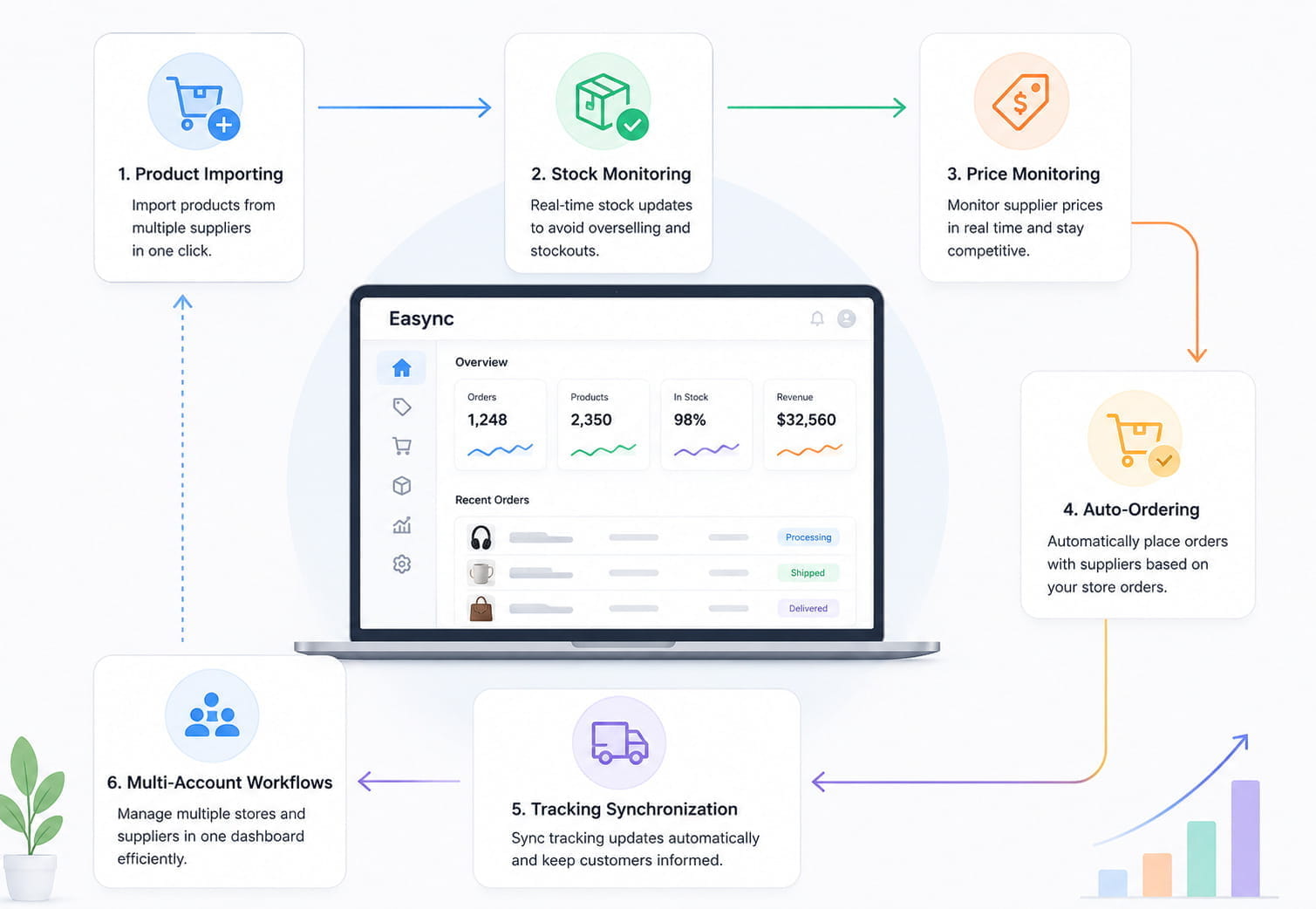
As dropshipping operations scale, manual product management becomes a bottleneck. Easync offers automated product importing from supported marketplaces, real-time stock and price monitoring, auto-ordering, repricing rules, tracking synchronization, and multi-account workflows. These features can help reduce manual work and errors as order volume grows. However, Easync does not provide legal, tax, accounting, LLC-formation, or compliance services. Business owners remain fully responsible for choosing the right legal structure, meeting tax obligations, obtaining licenses, and maintaining compliance in their state.
Common Mistakes Dropshippers Make Around LLCs
- Assuming an LLC is legally required before the first sale. This can delay learning and add unnecessary upfront costs when you could start selling immediately as a sole proprietor.
- Believing an LLC eliminates all liability. It does not prevent lawsuits; it may limit personal exposure under the right conditions. Insurance and compliant products are still essential.
- Mixing personal and business funds. Using one bank account for everything weakens limited liability protection and makes tax reporting harder. Keep personal finances entirely separate from business finances.
- Expecting automatic tax advantages. A single-member LLC is usually taxed like a sole proprietorship by default. An S corporation election may change how employment taxes apply, but shareholder-employees must generally receive reasonable compensation before taking non-wage distributions. The election also adds payroll, filing, and compliance requirements. Consult a tax professional before making that decision.
- Ignoring annual reports and state fees. Missing deadlines can lead to penalties, late fees, or even administrative dissolution of the LLC, leaving you without your formal legal structure.
- Skipping sales-tax registration and business licenses. Your state and local jurisdiction may require permits regardless of your business entity type. Non-compliance creates risk no LLC can shield you from.
- Using unreliable or non-compliant suppliers. Poor-quality products, counterfeit goods, or missing safety certifications can trigger refunds, platform bans, or product-liability claims no matter how your business is structured.
Conclusion: Is an LLC Right for Your Dropshipping Business?
Starting as a sole proprietor is often enough for early testing, low revenue, and learning the basics of e commerce. Starting without a formal entity can be reasonable during early product testing, provided the owner understands the personal-liability and compliance risks. The key is to stay aware of when risk outweighs convenience.
An LLC becomes a stronger choice once revenue grows, order volume increases, and you as the business owner have more personal assets or contracts at stake. It provides a clearer separation between business debts and personal finances, creates a formal structure for contracts, ownership, banking, and business records, and gives you a foundation to scale.
Before forming an LLC, check your state’s specific rules, formation fees, and tax environment. Consider talking to a tax professional for advice tailored to your situation and business goals. Remember that structure, insurance, good suppliers, and automation tools all work together to build a resilient and sustainable dropshipping business over time.
FAQ
Do you need an LLC for dropshipping in the U.S.?
No. An LLC is generally not required to run a dropshipping business or sell through platforms such as Shopify, Amazon, or eBay in the U.S. Many sellers begin as sole proprietors and form an LLC later when revenue, risk, and complexity increase. The main reasons to form one are potential limited liability protection and a clearer legal structure for contracts, banking, ownership, and business records.
Can I start dropshipping as a sole proprietor and switch to an LLC later?
Yes. Switching from a sole proprietorship to an LLC is common and generally straightforward in most U.S. states. The process involves forming the LLC, obtaining a new EIN if needed, and updating your platform accounts, payment processors, and supplier records with the new business name. Keeping clean financial records from the start makes the transition to a dedicated business bank account and new entity much easier when the time comes.
Do I need an LLC to sell on Shopify or Amazon?
No. Platform approval does not remove any state or local licensing, tax-registration, or permit requirements that may apply to the seller. These platforms mainly require identity verification, a bank account, and tax information, which can be your personal SSN or a business EIN. Forming an LLC is a separate decision based on liability exposure, tax considerations, and your long-term business goals.
Does an LLC protect me from all product-liability claims and customer lawsuits?
An LLC can help separate business and personal assets, but it does not prevent people from suing the business itself. Courts can sometimes reach personal assets if there is fraud, gross negligence, or if the owner personally guarantees debts or mixes personal and business finances. Product-liability insurance, quality suppliers, accurate product descriptions, and compliant products remain essential even with an LLC in place.
How much does an LLC for dropshipping typically cost in the U.S.?
LLC costs vary by state and may include formation fees, annual or biennial report fees, franchise taxes, registered-agent services, and other compliance expenses. Check the current fee schedule on your Secretary of State and state tax agency websites before forming an LLC.