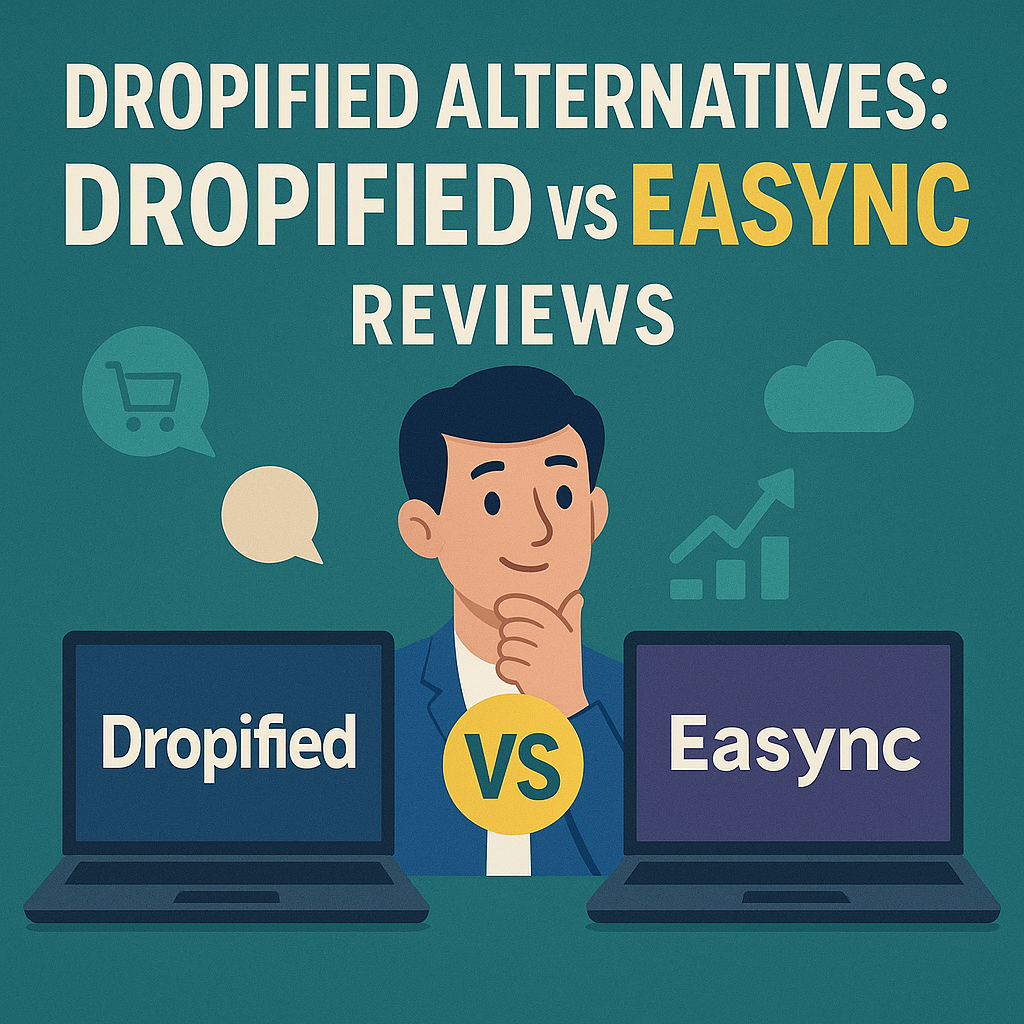
Quick answer: Dropified is not a marketplace dropshipping tool, and in 2026 it moved further away from being one. Its store integrations are Shopify and WooCommerce, with third-party software catalogues also listing CommerceHQ and GrooveKart. eBay and Amazon appear only as supplier sources you import from, never as sales channels you manage. On top of that, the 2026 product has been rebuilt around AI store building, with a single plan at $50/month (or $41.66/month billed annually) and a paid $1 trial in place of the free tier it used to offer.
If you sell on eBay or Amazon, that single fact disqualifies Dropified, no matter how good its AI features are. Most Dropified alternatives are built for the same Shopify-first workflow and inherit the same limitation. The one that isn’t is Easync, which is built specifically around eBay, Amazon and Walmart, starts at $49.99/month with a genuinely free 7-day trial, and includes done-for-you fulfillment (FBE) so your own buyer accounts never place the orders.
Dropified vs Easync at a glance, 2026
| Feature | Dropified (2026) | Easync (2026) |
|---|---|---|
| Sales channels | Shopify, WooCommerce | eBay, Amazon, Walmart, Shopify, WooCommerce |
| Supplier sources | AliExpress, Alibaba, eBay + Chrome extension | Amazon, Walmart, AliExpress, eBay, Best Buy, Home Depot and more |
| Stores per plan | 1 | Unlimited |
| Entry price | $50/mo ($41.66/mo annual) | $49.99/mo |
| Trial | $1 for 14 days | Free 7 days, no card required |
| Marketplace repricing | ✗ | ✓ (incl. variant-level) |
| Auto-order + tracking upload to marketplace | ✗ | ✓ (~60 seconds, with order screenshots) |
| Managed fulfillment accounts | ✗ | ✓ (Fulfillment by Easync) |
| VERO / blacklist protection | ✗ | ✓ |
| AI store builder + ad generation | ✓ | ✗ |
| Best for | Beginners launching a first Shopify store | eBay/Amazon sellers scaling listings and orders |
What Dropified is in 2026
Dropified launched in 2015 under the name Shopified, originally built to automate AliExpress-to-Shopify dropshipping. For most of its life it was a classic product importer: browse AliExpress, click, import to Shopify, auto-fulfill.
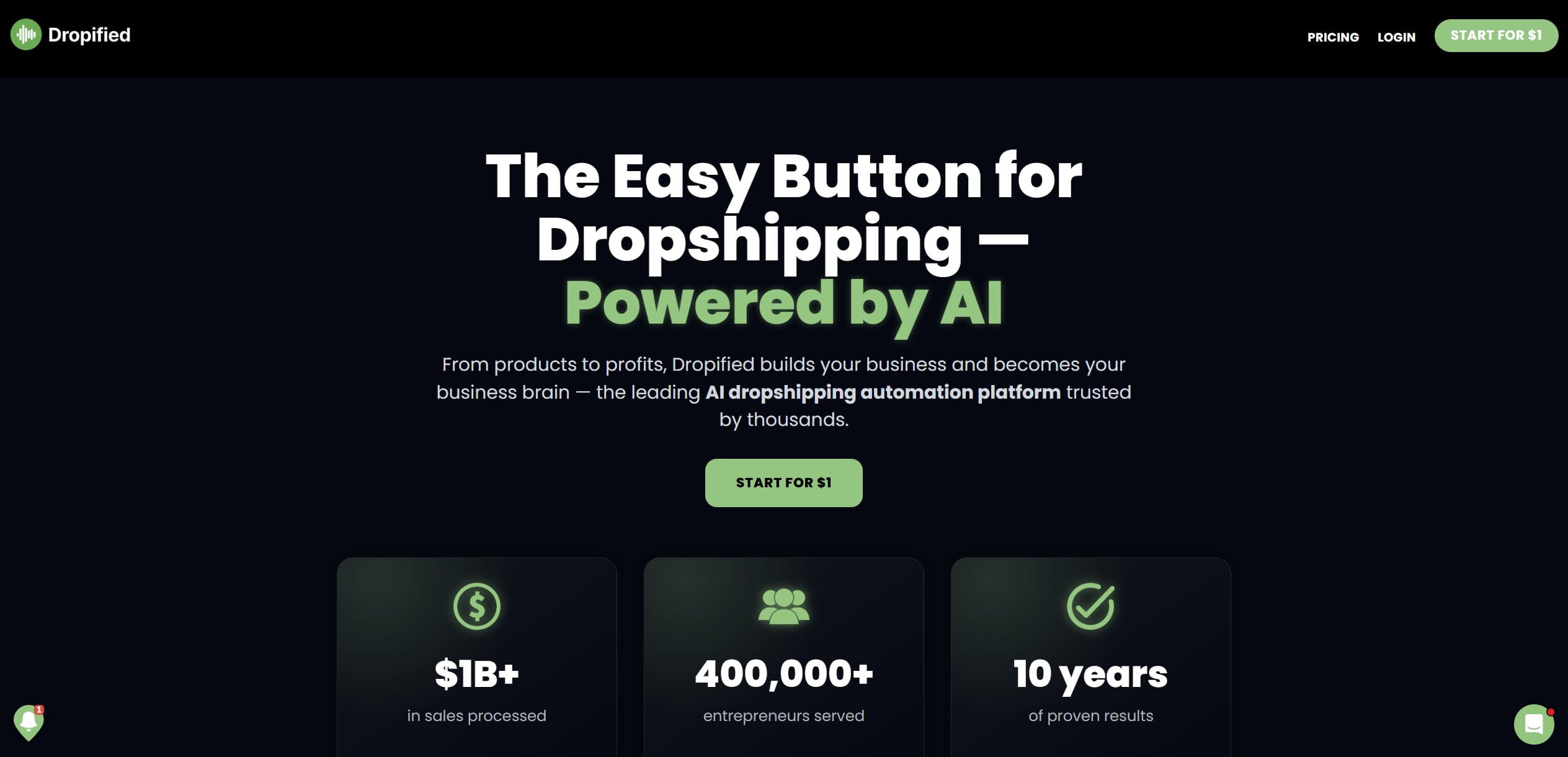
Its store integrations have consistently been Shopify and WooCommerce, with third-party catalogues also listing CommerceHQ and GrooveKart, and with eBay, AliExpress and Alibaba serving as supplier sources. That has not changed. What has changed is everything around it: the current pricing page reads less like an automation utility and more like a business-in-a-box built around AI.
The four things Dropified now does
- AI product research. The platform surfaces product suggestions drawn from what Dropified describes as over $1 billion in processed sales data.
- AI store building. It generates a Shopify store, including layout, copy, product pages and checkout, rather than expecting you to bring one.
- AI marketing. It drafts and launches Facebook, TikTok and Google campaigns, plus emails and social posts.
- Order automation. Orders, tracking updates and customer messages are processed automatically, with you approving the output.
Wrapped around all of it is what Dropified calls the AI Business Brain, a custom assistant trained on your catalogue and brand voice, working in 100+ languages.
Classic Dropified features that survived
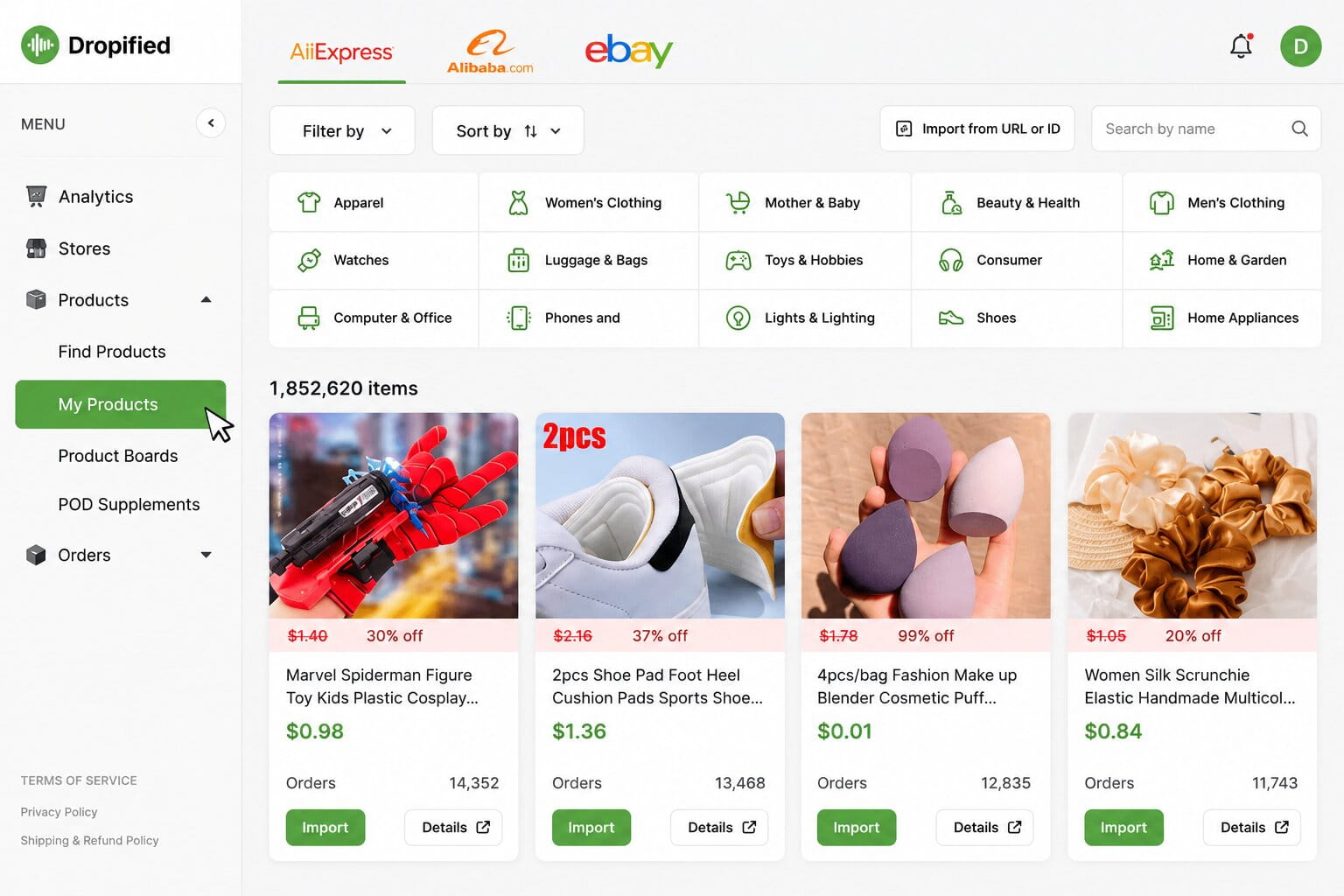
- One-click imports from AliExpress, Alibaba and eBay via Chrome extension
- Multi-vendor variant mapping (several suppliers mapped to one product)
- Bulk editing of prices, tags, categories and descriptions
- Product video and supplier-review import
- Captcha solving during automated supplier checkout
- Profit dashboard
- Order confirmation and tracking emails to buyers
Dropified pricing in 2026, explained plan by plan
Dropified has collapsed its old three-tier structure into a single plan sold on two billing cycles, plus a paid entry trial. There is no free tier and no feature gating: the only thing that changes between the two prices is how often you are billed.
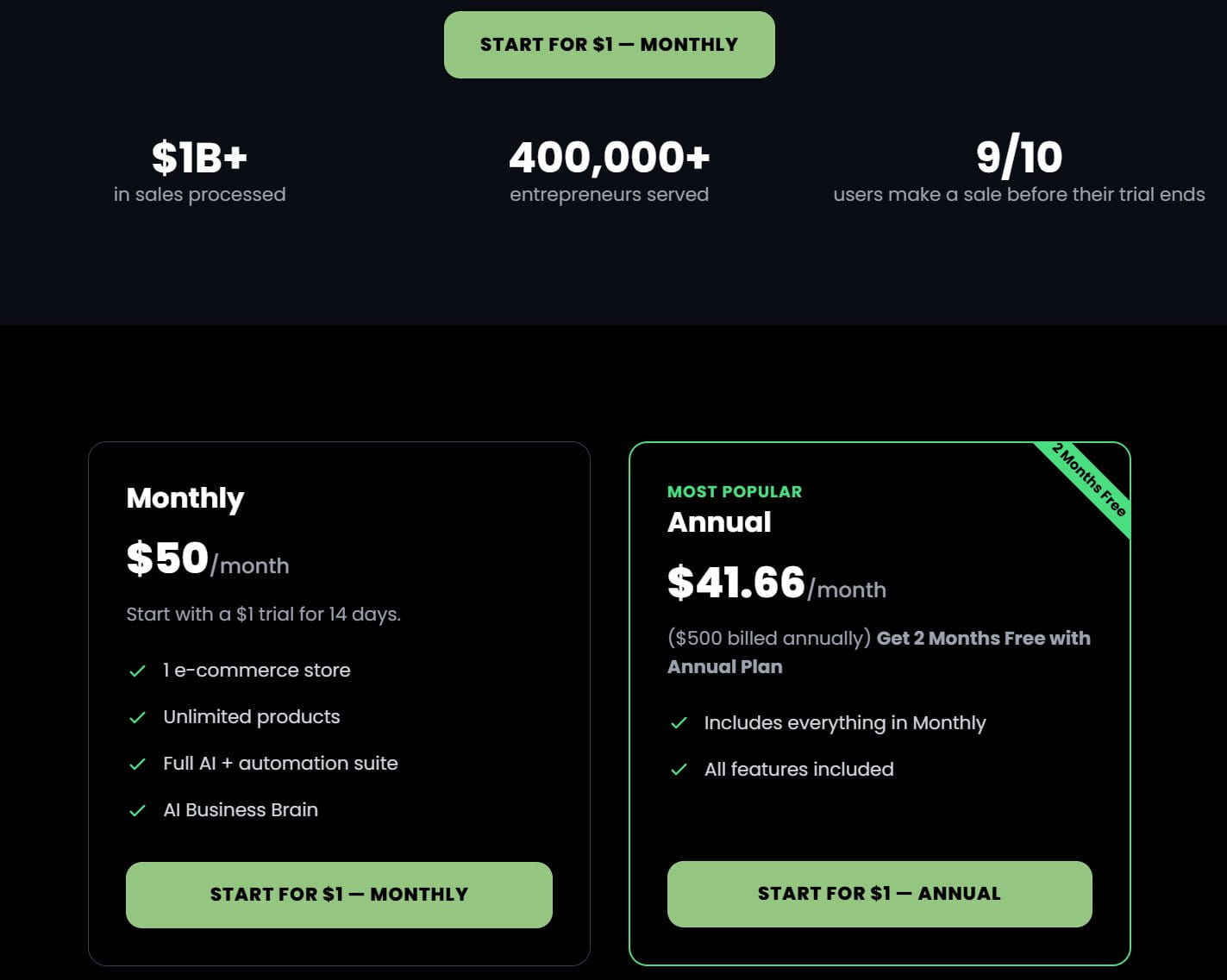
The $1 trial, 14 days. This is how every new account starts, and it is worth understanding what it actually is. It is not a free trial. You pay one dollar, you get full access to every feature for fourteen days, and at the end of the period the account converts automatically to whichever billing cycle you selected at signup. If you do not cancel inside those two weeks, you are charged the full amount. Dropified markets the trial aggressively, claiming that nine out of ten users make a sale before it expires, but the practical advice is simple: set a calendar reminder for day twelve.
Monthly, $50 per month. The standard plan. You get one e-commerce store, unlimited product imports, the full AI and automation suite, and the AI Business Brain. Nothing is held back for a higher tier, because there is no higher tier. Over a full year this works out to $600. Choose it if you want the freedom to cancel at any point, or if you are still deciding whether the platform fits your workflow.
Annual, $41.66 per month, billed as $500 once a year. The same plan on a yearly commitment, marketed as getting two months free. The saving against paying monthly is $100 a year, or roughly 17%. Dropified flags this as its most popular option. The catch is the one every annual SaaS plan has: you are committing $500 upfront to a platform you have used for fourteen days, and the reviews below suggest reliability is not universally praised. Run the monthly plan for a cycle or two before locking in the discount.
Two structural details matter more than the numbers:
- The old free plan is gone. Dropified used to offer a limited free tier that traded features for a 10% fulfillment fee. That option no longer exists, so the $1 trial is now the only way to test the product.
- One store, full stop. Products are unlimited, stores are not. A second brand means a second subscription, which turns $500 a year into $1,000.
To Dropified’s credit, the pricing is genuinely simple. Every feature is included at both price points, with no upsells, no feature gating and no per-order fees.
Dropified reviews: what users actually say
Third-party ratings are middling rather than bad. Capterra shows 4.0/5, though on a very small review sample, and SaaSworthy sits around 3.5/5 across roughly 70 ratings.
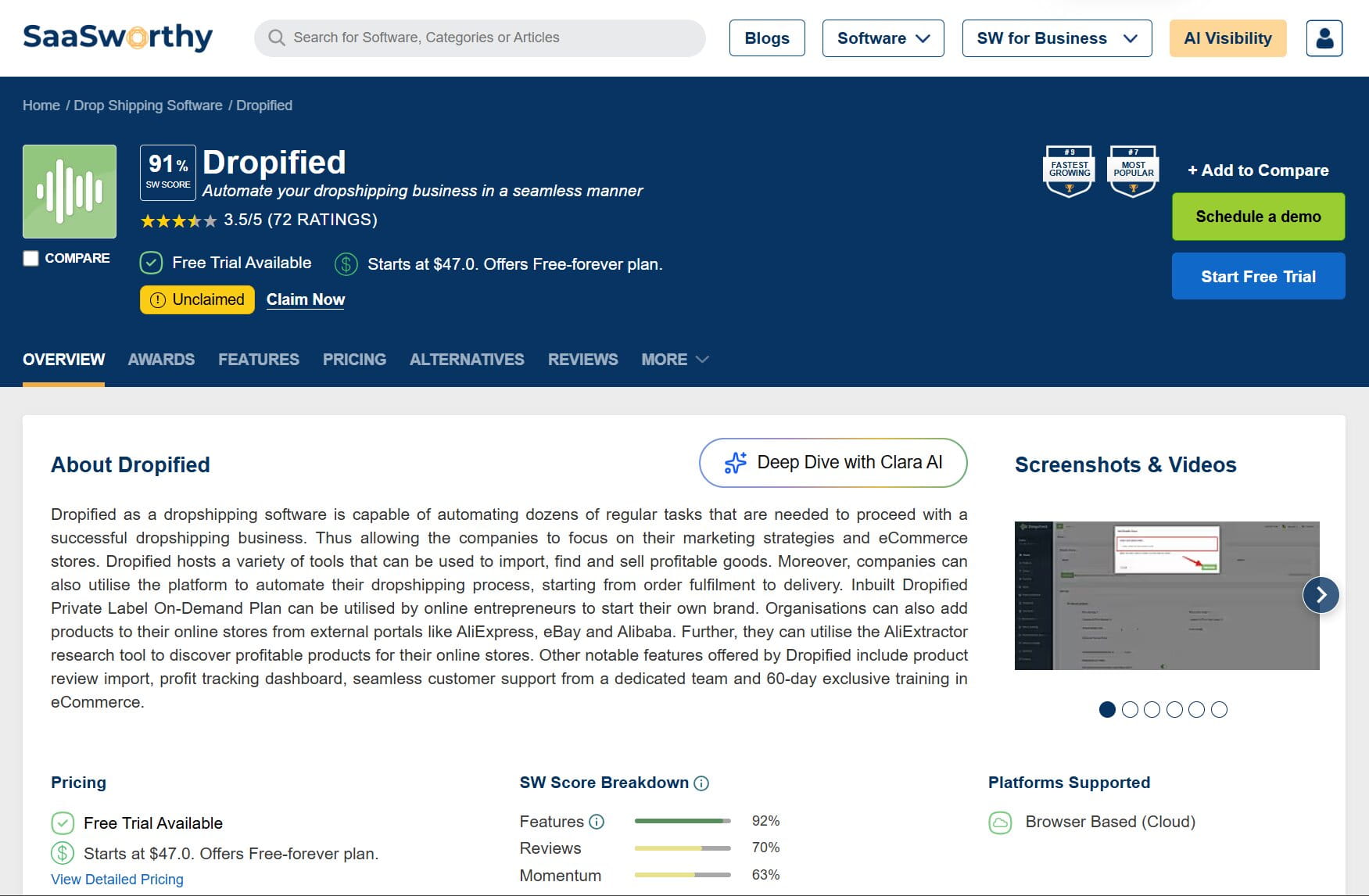
Recurring positives: the import workflow is fast, the interface is beginner-friendly, and the training material is thorough.
Recurring complaints, consistent across platforms over several years:
- Reliability. Reviewers describe intermittent outages, AliExpress login failures, and tracking that doesn’t always sync as advertised.
- Support responsiveness. Slow ticket turnaround and generic replies come up repeatedly, particularly on weekends.
None of this makes Dropified illegitimate. It has traded continuously for over a decade, operates from a registered US address, and reports serving more than 400,000 entrepreneurs. It does mean you should treat the trial as a real test, not a formality.
Dropified pros and cons
Pros
- Genuinely simple pricing: one number, everything included
- The AI store builder removes the hardest step for absolute beginners
- Strong AliExpress/Alibaba import workflow with multi-vendor variant mapping
- Bulk editing and image tools are mature and well documented
- 100+ language support is unusual at this price point
- Extensive onboarding: video tutorials, guides, live chat
Cons
- No eBay or Amazon selling channel. eBay is a supplier source, not a sales destination.
- No marketplace repricing, no seller-metrics tracking, no SKU-level marketplace analytics
- One store per subscription, which gets expensive if you run several brands
- No free trial. Entry is a paid $1 trial that rolls into a full subscription.
- Not built for bulk marketplace volume. There is no equivalent of managed fulfillment accounts or bulk auto-ordering at marketplace scale.
- Long-running reliability and support complaints in public reviews
Who Dropified is genuinely right for
A first-time seller who wants a branded Shopify store built for them, has no store yet, sources mainly from AliExpress, and wants AI to handle ads and copy. For that person, $41.66/month is reasonable and the AI build is a real shortcut.
Who it is wrong for: anyone whose revenue comes from eBay or Amazon.
Why eBay and Amazon sellers need something different
Marketplace dropshipping is a different discipline from running a Shopify store, and the tooling requirements diverge sharply.
On Shopify, you set your price and it stays there. On eBay, you’re competing against sellers who reprice hourly, and your listing’s visibility in Cassini depends on metrics Shopify doesn’t have: valid tracking upload rate, late shipment rate, defect rate, cancellation rate. Miss those and you don’t just lose margin, you lose the account.
That produces four requirements no Shopify-first tool addresses:
- Aggressive repricing, including at variant level, so a supplier price change doesn’t turn a sale into a loss.
- Tracking upload back into the marketplace, automatically and fast enough to protect your seller metrics.
- Order placement that doesn’t get your supplier accounts flagged for buying and shipping to third-party addresses at volume.
- IP and brand-restriction screening (eBay’s VERO programme) before a listing goes live, not after a takedown.
Dropified does none of these, because it was never designed to. That’s the honest gap.
Easync: the marketplace-native alternative
Easync is built for the workflow Dropified was never designed to handle: sourcing from a retail marketplace and selling on another marketplace, at volume. Over 41,000 dropshippers currently run on it.
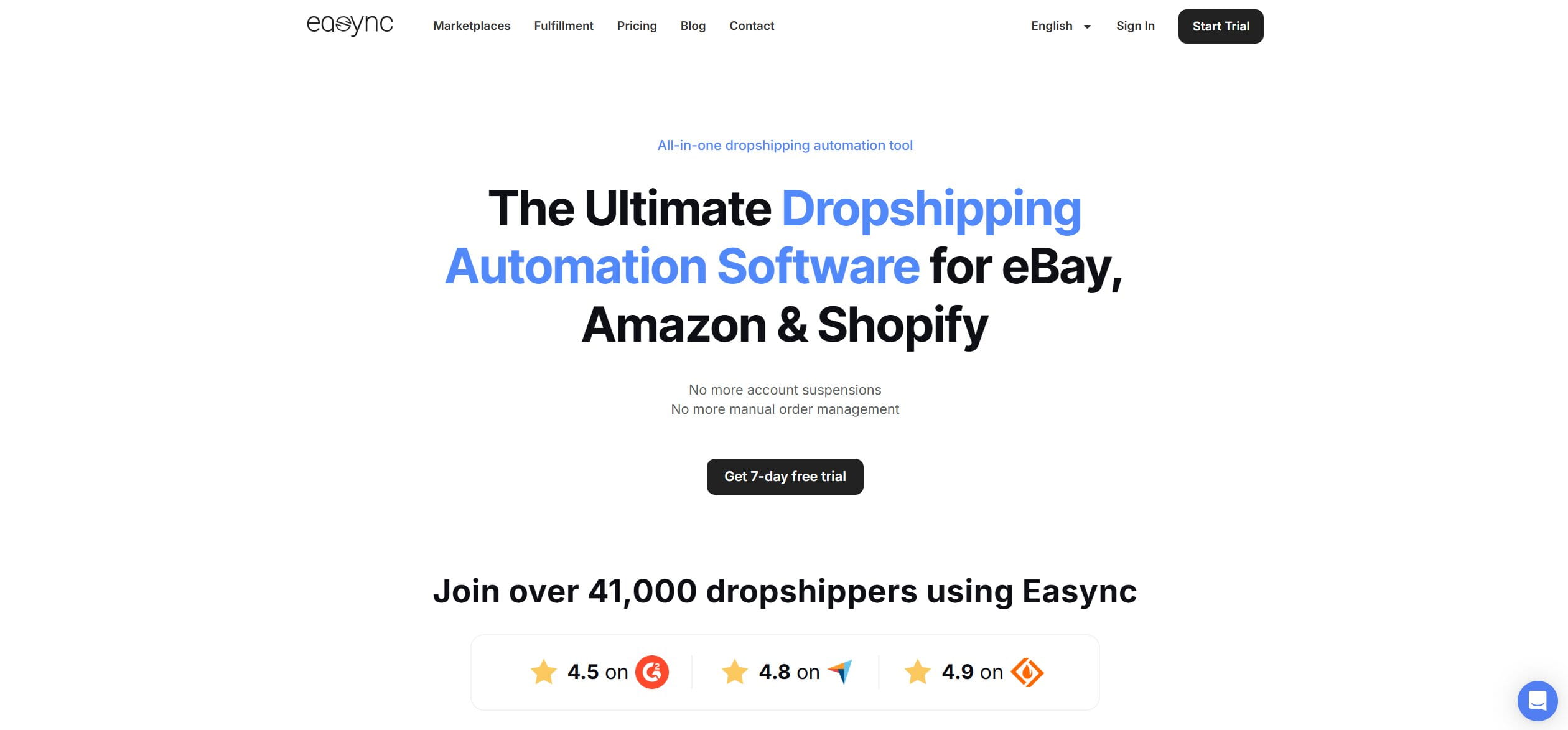
Supported sales channels: eBay, Amazon, Walmart, Shopify and WooCommerce. The marketplace side is where the platform-specific automation lives. Shopify and WooCommerce connect for sourcing, repricing and fulfillment rather than store building.
Supported supplier sources: Amazon, Walmart, AliExpress, eBay, Best Buy, Home Depot and others.
What Easync does that Dropified doesn’t
Price and stock monitoring around the clock. Easync checks your products every 15 minutes across more than 20 platforms and pushes any supplier price or stock change straight to your live listings. The point isn’t the sync itself. It’s that overselling and forced cancellations are the fastest way to destroy an eBay account, and manual monitoring cannot keep up past a few hundred SKUs.
Intelligent repricing, including variants. Rules-based repricing runs across every plan, and variant-level repricing is included even on the entry tier, so a nine-variant shirt isn’t priced off a single parent SKU.
Auto-ordering with proof. When a sale comes in, Easync places the order at the source marketplace with your buyer’s shipping address, typically within about 60 seconds, and attaches screenshots of the order and its tracking to the order record. That screenshot trail is what you use when a buyer opens an “item not received” case.
Automatic tracking upload. Tracking goes back to eBay or Amazon without you touching it, which is what keeps your valid-tracking-upload rate, and therefore your search placement, intact.
Fulfillment by Easync (FBE). This is the feature with no Dropified equivalent. Easync processes orders through its own managed fulfillment accounts rather than yours, and ships through Aquiline, an eBay-approved carrier operating across the US, UK, DE, FR, IT, ES and CA. Two practical consequences: your buyer accounts aren’t the ones absorbing the risk of a suspension, and buyers get carrier tracking that eBay recognises. UK fulfillment speed was specifically improved in the 2026 platform update, alongside more reliable Walmart sourcing.
VERO and blacklist protection. Restricted brands are screened before you list, rather than after eBay removes the listing and issues a strike.
Product research. The Hot Item Finder and the Amazon/ASIN Chrome extensions surface products by real sales volume and pricing data across marketplaces, and pull them into your store in a click.
Unlimited stores. Every plan supports as many connected stores as you want to run, against Dropified’s one. Note that the listing and order limits described below are pooled across all your stores rather than applied per store.
Supporting tools, free: eBay fee calculators for eight markets, a Walmart and WFS fee calculator, an eBay title builder, and a public API.
Human support, 24/7. No chatbot-only tier.
Easync pricing in 2026, explained plan by plan
Easync prices on volume rather than on features. Every plan, including the cheapest, includes Fulfillment by Easync and variant-level repricing, so upgrading buys you capacity and nothing else. Two numbers define each tier: how many listings the repricer can monitor, and how many orders it can place for you automatically each month. The ratio between them is fixed at ten listings per automatic order across all four plans, which tells you what conversion rate the pricing assumes.
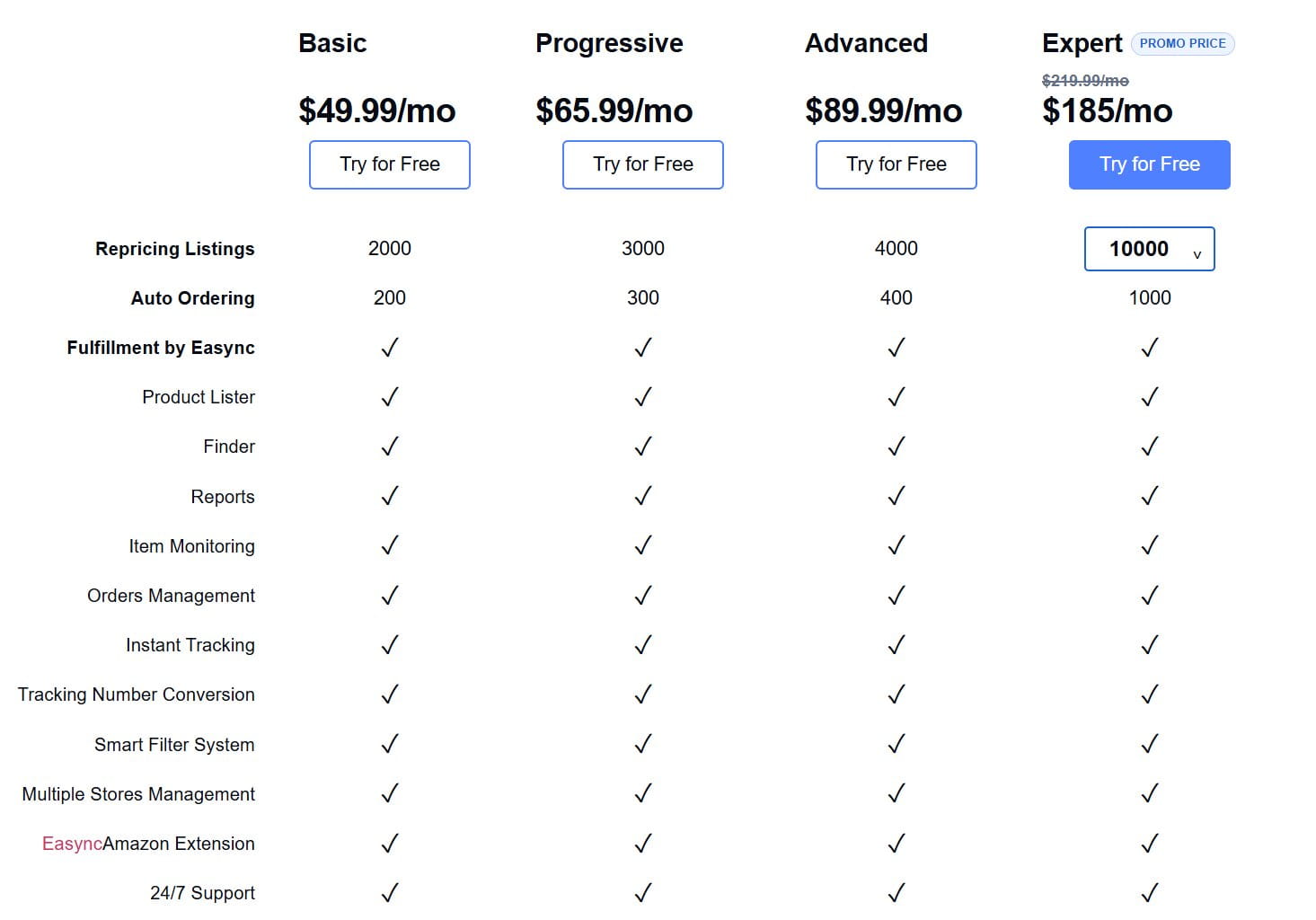
Free 7-day trial. No credit card is required, which matters more than it sounds: you can run Easync alongside an existing subscription to another tool without double-billing yourself or risking an accidental renewal.
Basic, $49.99 per month. Covers 2,000 repricing listings and 200 automatic orders. This is the tier for a store that is real but not yet large, roughly the first year of a serious eBay operation. Two things to note. It works out to about 2.5 cents per monitored listing and 25 cents per automated order, which makes it the least efficient tier per unit of capacity. And $599.88 a year is a genuine commitment for someone still testing the model, which is why the free trial exists.
Progressive, $65.99 per month. Covers 3,000 repricing listings and 300 automatic orders. The step up from Basic costs $16 and buys 50% more capacity, which is the single largest efficiency jump in the range: unit cost drops to about 2.2 cents per listing and 22 cents per order. If you are close to the Basic ceiling, moving here is cheaper than staying and being throttled.
Advanced, $89.99 per month. Covers 4,000 repricing listings and 400 automatic orders, and is the plan Easync flags as most popular. At $1,079.88 a year it is the point where the subscription stops being a small cost and starts needing to be justified by margin, so work backwards: at 400 orders a month, the tool costs about 22 cents per order, which any healthy dropshipping margin absorbs without noticing.
Expert, from $219.99 per month. Starts at 5,000 repricing listings and 500 automatic orders and scales upward from there, with pricing set by the volume you actually need. This is the tier most multi-store operators land on, and the reason is worth spelling out: connected stores are unlimited on every plan, but the listing and order limits are pooled across all of them. Adding a second store does not cost you a second subscription, it consumes capacity from the one you have, so the constraint is always volume rather than store count.
The practical advice: choose the tier your store will need in three months, not the one it needs today. Hitting a repricing ceiling mid-month is worse than paying $16 more, because unmonitored listings are exactly where oversell cancellations come from.
Easync reviews: what real users say in 2026
Ratings on their own say little, so here is what reviewers actually report, criticism included.
Ratings, as of August 2026. Easync holds 4.6 on G2, 4.8/5 on GetApp and 4.9/5 on SourceForge.
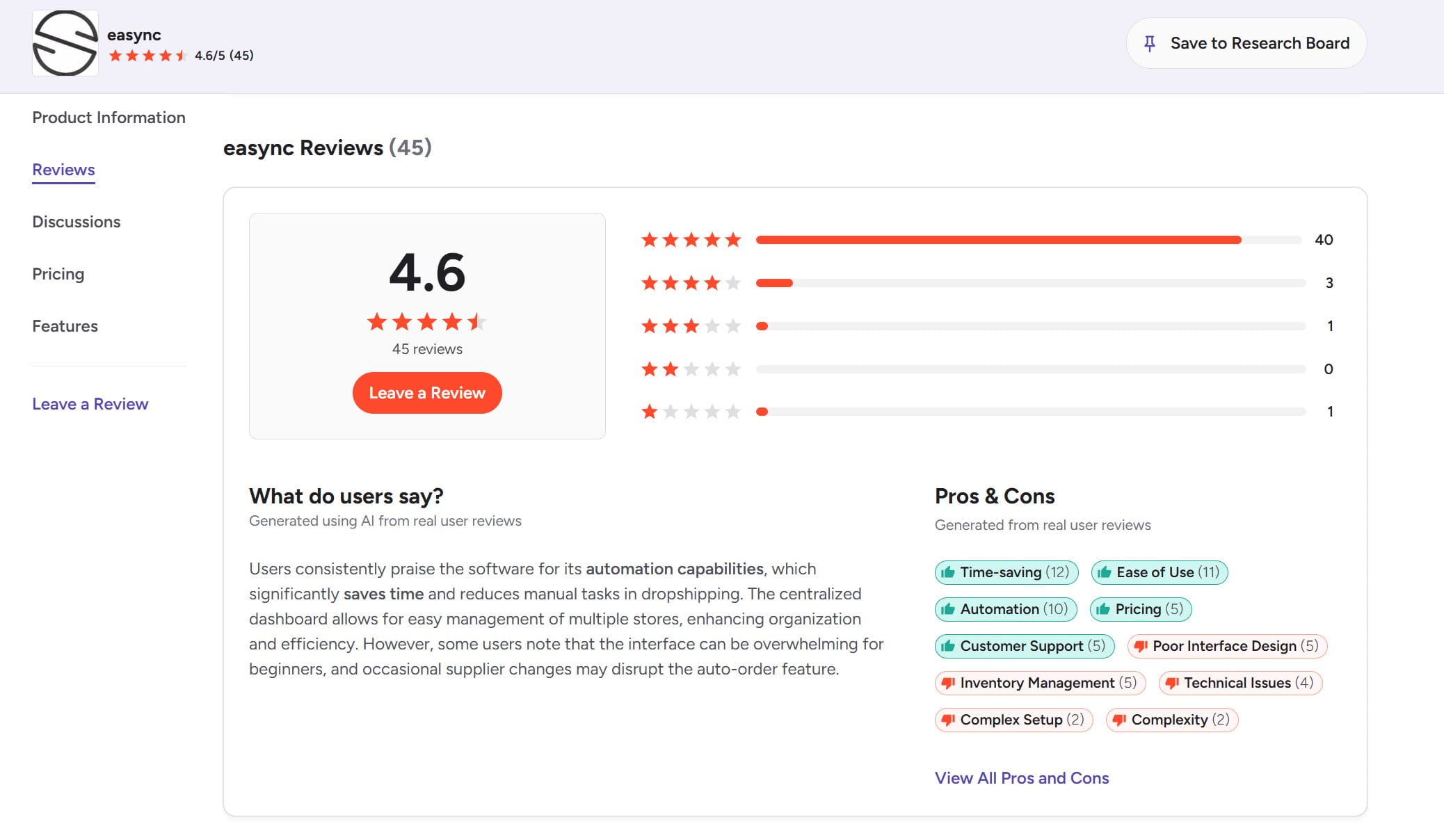
What reviewers consistently praise:
- Automation depth: auto-ordering, price tracking and stock monitoring together remove most manual work and most human error
- A single dashboard for multiple listings and stores
- Hours of daily work compressed into minutes at scale
- Value relative to price for sellers running real volume
What reviewers consistently criticise:
- The interface is overwhelming for beginners. This is the single most repeated criticism. G2 reviewers describe a real learning curve before the system pays off; SourceForge reviewers call the UI dated and note the same ramp-up for anyone completely new to dropshipping.
- Supplier changes can require manual intervention in the auto-order flow.
- Support response times slow during peak hours, per SourceForge reviewers, who otherwise praise support as human and responsive.
- $49.99 is above the market entry point. Cheaper tools exist. They don’t include managed fulfillment.
- Plans are capped by volume. 2,000 repricing listings and 200 automatic orders on Basic is generous for a starting store and tight for a scaling one.
Honest verdict on the criticism: Easync is not the right tool for someone testing dropshipping for a weekend. The learning curve is real and the entry price assumes you intend to run volume. If you’re listing 50 items to see what happens, you’ll feel like you’re overpaying, because you are.
Dropified vs Easync: head to head
Full feature comparison: Dropified vs Easync, 2026
| Capability | Dropified | Easync |
|---|---|---|
| Sell on eBay | ✗ | ✓ |
| Sell on Amazon | ✗ | ✓ |
| Sell on Shopify | ✓ | ✓ |
| Sell on WooCommerce | ✓ | ✓ |
| AI store builder | ✓ | ✗ |
| AI ad and content generation | ✓ | ✗ |
| Marketplace repricing | ✗ | ✓ |
| Variant-level repricing | ✗ | ✓ (all plans) |
| Auto-order with screenshot proof | ✗ | ✓ |
| Auto tracking upload to marketplace | ✗ | ✓ |
| Managed fulfillment accounts | ✗ | ✓ (FBE) |
| eBay-approved carrier | ✗ | ✓ (Aquiline, 7 markets) |
| VERO protection | ✗ | ✓ |
| Stores included | 1 | Unlimited |
| Free trial | ✗ ($1 for 14 days) | ✓ (7 days, no card) |
| Entry price | $41.66 to $50/mo | $49.99/mo |
The two products barely overlap any more. That’s the real finding: this isn’t a close comparison where one tool edges the other, it’s two tools that now solve different problems for different sellers.
Switching from Dropified to Easync
If you’ve been running Dropified on Shopify and want to open an eBay or Amazon channel:
- Start the free Easync trial. No card, so it runs in parallel with your existing subscription without double-billing.
- Connect your marketplace store. Setup is minutes, not days.
- Import a test batch. Fifty to a hundred SKUs from a source marketplace, using the Chrome extension or a pasted supplier link.
- Configure repricing rules and profit margins before anything goes live.
- Enable auto-ordering and FBE and run ten real orders end to end. Check the screenshot trail and the tracking upload timestamps yourself.
- Only then scale, and only then cancel Dropified, if you’re no longer running the Shopify side.
You do not have to choose exclusively. A Shopify store built and marketed with Dropified, plus an eBay channel automated with Easync, is a legitimate configuration. The two tools are doing different jobs even where they connect to the same platform.
The verdict
Choose Dropified if you have no store yet, you want AI to build a Shopify site and write your ads, you source from AliExpress, and you’re comfortable with one store, a $1 paid trial, and public reviews that flag support and uptime as weak points.
Choose Easync if your revenue comes from eBay or Amazon. Dropified cannot sell there. Easync reprices, auto-orders, uploads tracking, screens VERO, and through FBE takes the fulfillment risk off your own accounts. Accept the learning curve and the $49.99 floor as the cost of doing marketplace volume safely.
Choose neither if you’re testing dropshipping casually. Both tools charge like infrastructure because that’s what they are.
Start your free 7-day Easync trial. No credit card required.
FAQ
Is Dropified still worth it in 2026?
For Shopify and WooCommerce sellers who want an AI-built store, yes: $41.66/month billed annually with every feature included is competitive. For eBay or Amazon sellers, no. Dropified does not offer marketplace selling channels, and treats eBay purely as a supplier source.
Does Dropified work with eBay?
Only for importing. You can pull products from eBay listings into a Shopify or WooCommerce store, but you cannot manage, reprice or fulfill eBay listings with Dropified.
How much does Dropified cost in 2026?
$50/month billed monthly, or $500/year ($41.66/month) billed annually. There’s a $1 trial for 14 days and no free plan. Both options include one store and unlimited products.
How much does Easync cost?
Four plans: Basic $49.99, Progressive $65.99, Advanced $89.99, and Expert from $219.99 per month, scaled by repricing listings (2,000 to 10,000+) and automatic orders (200 to 500+). All include Fulfillment by Easync and variant repricing. The 7-day trial is free and requires no card.
What is the main difference between Dropified and Easync?
Channels. Dropified sells through Shopify and WooCommerce and leads with AI store building. Easync sells through eBay, Amazon, Walmart, Shopify and WooCommerce, and leads with marketplace automation: repricing, auto-ordering, tracking upload and managed fulfillment.
Can I use Dropified and Easync together?
Yes. Both connect to Shopify and WooCommerce, but they do different jobs there: Dropified builds and markets the store, Easync automates sourcing, repricing and fulfillment. On eBay, Amazon and Walmart there is no overlap at all, because Dropified does not operate on those channels.
Does Easync protect my eBay account from suspension?
It reduces the main causes. FBE places orders through Easync’s managed fulfillment accounts instead of yours, tracking uploads automatically to protect your valid-tracking rate, stock sync prevents oversell cancellations, and VERO screening blocks restricted brands before listing. No tool can guarantee against suspension, because marketplace policies change and enforcement is at eBay’s discretion.
Which is better for beginners?
Dropified, if the goal is a first Shopify store, because the AI build removes real friction. Easync, if the goal is eBay or Amazon, though beginners should budget a week to learn the interface.

Eugene Stepnov – Author
Eugene is a senior e-commerce strategist with over 9 years of experience in dropshipping, online arbitrage, and marketplace compliance. At Easync. Eugene has experience in developing multi-account management technologies, such as GoLogin and secure browser solutions, providing Easync users with a head start in regulatory compliance and platform changes.

Reviewed by Cameron Lawrence
Cameron is a marketplace dropshipping operator and educator known for clear, repeatable workflows that take newcomers from first listing to consistent sales. On his YouTube channel he breaks down Facebook Marketplace, eBay, and adjacent platforms with step-by-step tutorials, live Q\&A sessions, supplier outreach templates, and real “from-the-field” case studies.