
- articles
Ecommerce Cost Optimization: 5 Ways to Cut Costs in 2026
Quick answer: Ecommerce cost optimization is the strategic, data-driven process of reducing operational overhead, supply chain friction, and software bloat without sacrificing product quality or customer experience. It targets five core areas, inventory holding, fulfillment and logistics, customer acquisition costs, SaaS tools, and manual order processing, typically recovering 12% to 25% in operating margins.
Unlike reactive cost-cutting, which recklessly slashes budgets at the expense of service levels, cost optimization identifies structural waste across five core operational pillars: inventory holding, fulfillment and logistics, customer acquisition (CAC), SaaS stack redundancy, and manual order processing. By replacing manual labor with automated platforms, consolidating duplicate software, and optimizing carrier strategies, online merchants typically recover 12% to 25% in operating margins while maintaining brand integrity.
Cost Cutting vs. Cost Optimization: What Is the Difference?
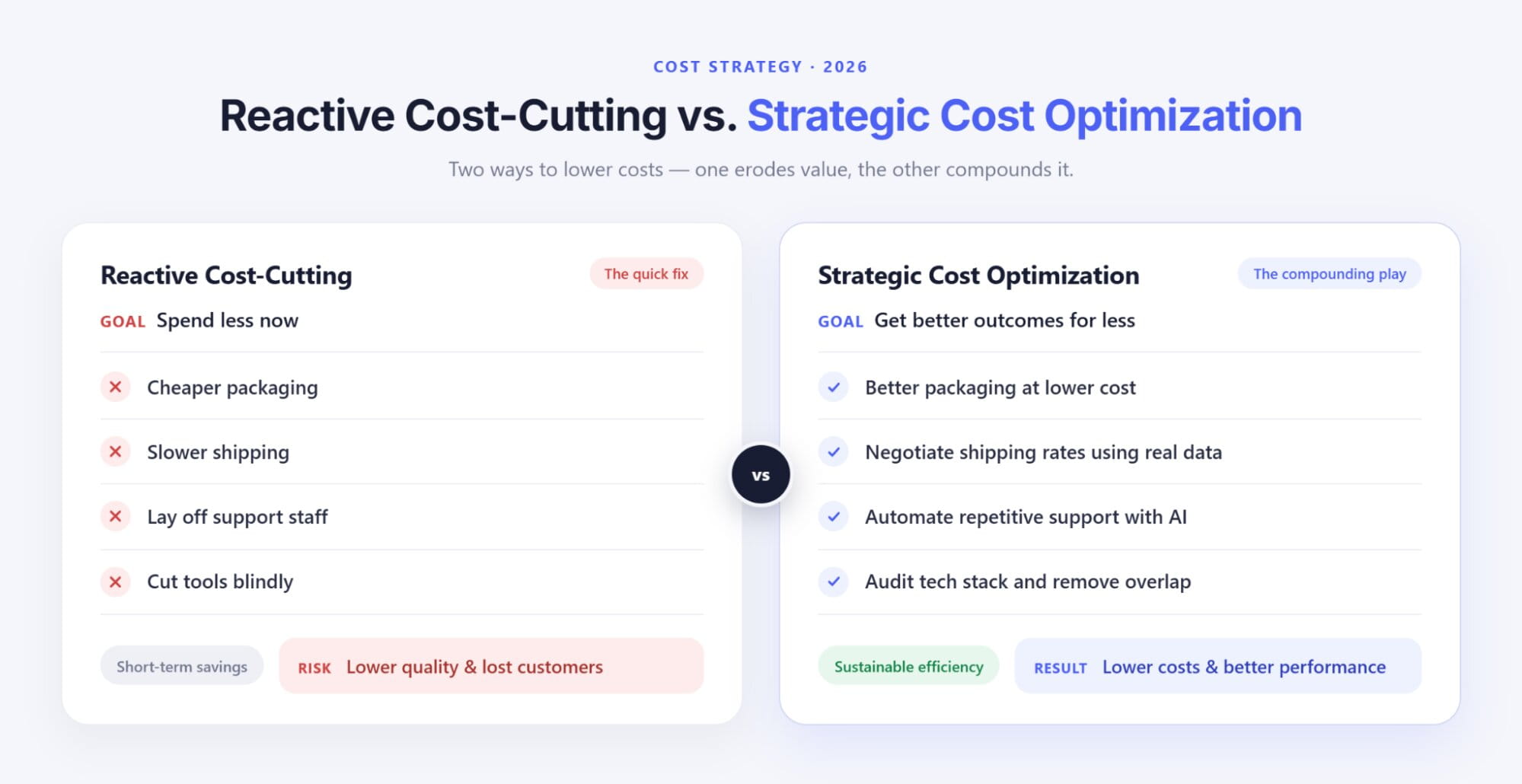
The word on the street is that 7 out of 10 ecommerce startups don’t even survive their first year in business. That’s mainly because a lot of ecommerce founders actually confuse “cost cutting” with cost optimization (or something our readers in the UK probably know as “eCommerce Optimisation”). These concepts are diametrically opposed to each other; while cost cutting is reactive, cost optimization helps you spend money more strategically.
- Cost Cutting: You see that your margins have shrunk, so you reach for the scissors. In the end, you choose cheaper packaging that arrives dented; you downgrade from 2-day to 7-day shipping to save 3 bucks on every order; and laying off your support may make your response times balloon from 2 to 18 hours. These methods work fine at first, but by the third month, your return rates may exceed, repeat purchases drop, NPS tanks, and you end up losing thousands of dollars in lifetime customer value to save a few hundred bucks.
- Cost Reduction: This is online store cost reduction done right. Since you cut costs surgically. Not bluntly. You don’t ask how I can spend less, but you ask how I get the same or better outcomes for less. It means you don’t fire your support team. You also implement AI chatbots to handle repeat inquiries in an instant, so your agents can focus on complicated questions. You don’t switch to slower carriers; you negotiate dimensional weight based on actual shipping data. Auditing your tech stack will help you identify four tools doing the same job.
Why Optimization Beats Cutting Every Time
Ecommerce cost optimization lets you eliminate operational waste across different departments, such as inventory management, fulfillment, customer acquisition, technology, and even manual processing. You’ll also maintain or improve order accuracy, delivery speed, CSAT, and repeat purchase rates. Your dropshipping automation ROI will ultimately benefit from optimization. Also, traditional cost-cutting measures destroy your LTV through three brutal mechanisms:
- Degraded fulfillment (cheaper packaging that increases damage and slower shipping spikes WISMO inquiries)
- Reduced support capacity (cutting headcount without automation that tanks CSAT)
- Quality compromises (cheaper suppliers increasing returns & negative reviews)
Cost optimization focuses on process efficiency. You can turn variable labor into fixed software costs with automation. You also eliminate stockouts through demand forecasting. That’s how you reduce emergency restocking at premium rates. Negotiating vendor terms based on your operational data lets you achieve genuine e-commerce fulfillment cost savings.
What Are the Core Components of Ecommerce Expenses?
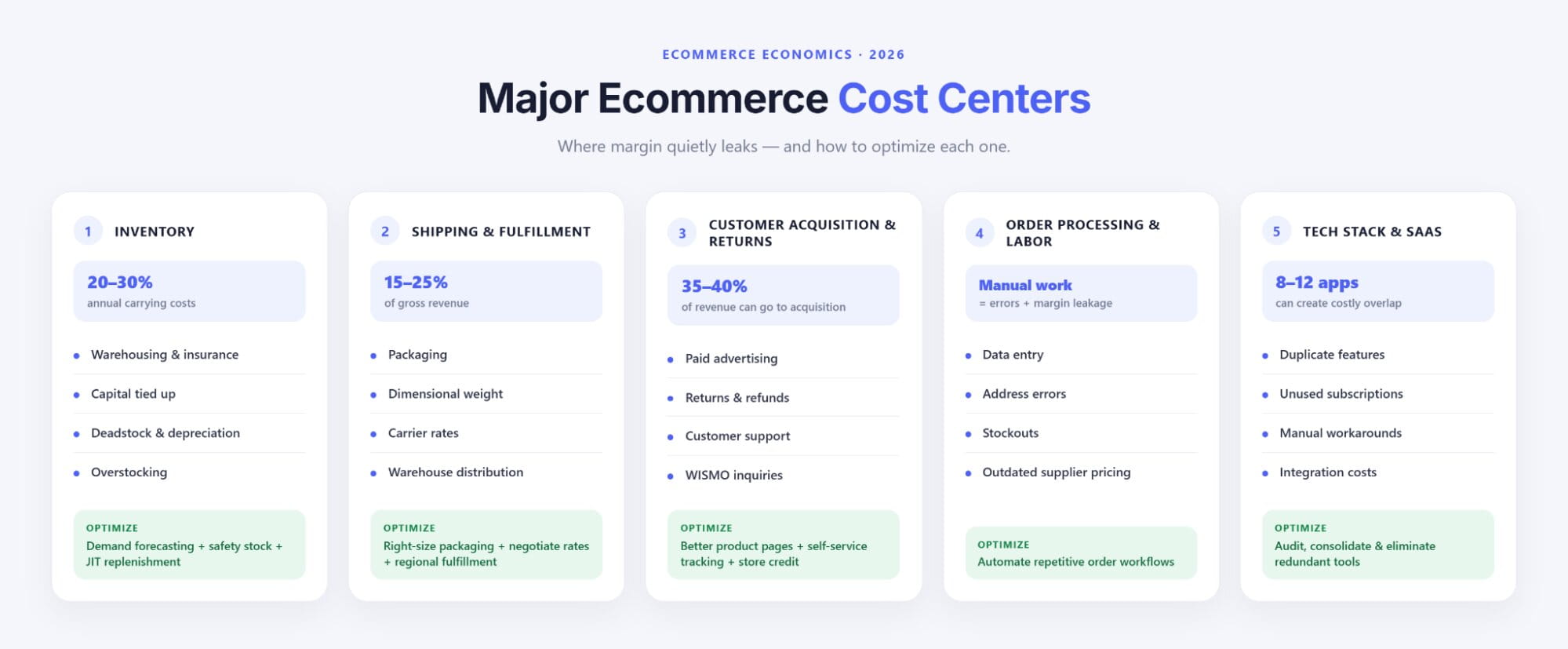
If you wish to reduce ecommerce operating expenses, you need to start by figuring out the core components of your annual expenditures. Exactly what you spend your money on! When it comes to a standard online store’s expenses, they fall into five buckets: COGS (cost of goods sold), logistics, CAC (customer acquisition cost), operations, and software. Learning where your money goes is the step to optimizing it… but that’s when store owners make big blunders.
Many merchants these days merely have a vague sense of their expenses; they know that they are spending a lot on ads and that fulfillment costs a pretty penny. However, they can’t tell you their exact cost breakdown by category. Which means they can’t benchmark these expenses against industry standards or even identify which areas are bleeding their profit margins.
This table gives you a clear idea of your core ecommerce expenses and their importance:
| Cost Component | Benchmark (% of Total Revenue) | Common Profit Leaks | Optimization Action |
|---|---|---|---|
| 1. Cost of Goods Sold (COGS) | 25% – 40% | Supplier overcharging, high defect rates, poor MOQ terms | Bulk negotiation, switching to verified B2B suppliers |
| 2. Fulfillment & Shipping | 15% – 25% | Oversized packaging (DIM weight), manual carrier selection | Box size optimization, regional 3PLs, automated shipping rules |
| 3. Customer Acquisition (CAC) | 15% – 30% | Ad spend waste, unoptimized product pages driving high returns | Clearer product specs, 360° photos, exchange-over-refund policies |
| 4. Operations & Labor | 10% – 15% | Manual order entry, copying tracking codes, stockout delays | Order processing automation, 24/7 price/stock sync (Easync) |
| 5. Tech Stack & Software | 3% – 8% | “App bloat”, unused plugin subscriptions, redundant tools | Subscription audits, consolidating single-use apps into unified stacks |
The 5 Core Pillars of Ecommerce Cost Optimization
Profit leaks in the world of ecommerce don’t happen randomly. They tend to cluster in certain predictable areas. An analysis of over 250 European retailers indicates that rising e-commerce penetration is driving down profit margins because of high operational costs and intense price competition. There are basically five core pillars of ecommerce cost optimization. If you wish to recover your operating margins without a decline in product quality or customer service, you should consider these online store cost reduction pillars right away:
1. Inventory Management & Stock Carrying Costs
Did you know that holding inventory costs far more than the purchase price? When you simply hold inventory, you pay for warehouse space, insurance, and the capital tied up in your unsold stock. There’s also deadstock depreciation. That thousands of dollars in slow-moving inventory might even be worth less at a discount! Or zero… if it sits six more months.
For example, a merchant may even hold $100,000 in average inventory but end up paying 20% to 30% annually in carrying costs; in other words, they’ll probably $20k to $30k yearly in fees, insurance, opportunity cost, and depreciation. They’re bleeding cash monthly!
Demand forecasting changes the whole equation, however! You can use historical data and seasonality (also, lead time variability) to figure out your optimal reorder points. Calculate safety stock scientifically: (Maximum daily sales × Maximum lead time) minus (Average daily sales × Average lead time). Just-in-time replenishment can take this precaution even further. Hold 20 days of inventory instead of 60 days, and reorder more frequently to make this work…
2. Shipping, Packaging & Fulfillment Overhead
Fulfillment can easily eat 15% to 25% of gross revenue for most stores. Inefficient operations can push this number to over 30%. That’s around $100k to $200k a year disappearing into oversized boxes and unnegotiated rates. Dimensional weight pricing is actually where most merchants lose money without their knowledge. Since carriers charge based on the greater of actual or dimensional weight, a 12×10×8 inch box has a DIM weight of 6.9 pounds.
You can see that if your product weighs just 2 pounds, you’re basically paying 3.5 times what you should! Right-sizing packaging across your top 20 SKUs will help you cut shipping costs by 15% to 25%. For instance, a merchant can potentially save $2.40 per order just by switching to appropriately sized boxes; at 800 orders a month, this is more than $23,000 a year in savings for them. You can also consider:
- Regional warehouse distribution reduces average shipping zones
- Splitting inventory between coasts drops average zone from 6.2 to 3.8, cutting costs 18-22%
- Negotiate carrier rates at 100+ orders monthly. Set free shipping thresholds 10% to 15% above current AOV
3. Customer Acquisition (CAC), Returns & Customer Service
Paid ad costs have actually spiraled. Facebook CPMs have risen a lot since the early 2020s. Many merchants today spend around a major part of their revenue on acquisition. Also, returns compound the problem by costing 3 times as much as successful orders to process. Product page optimization reduces your returns right at the source. You should:
- Add 360-degree photos with accurate sizing charts (and measurements)
- Upload videos of the product (along with detailed descriptions)
- Consider switching from cash refunds to store exchanges
- Offer 10% to 15% bonus on store credit
- Rely on self-serve tracking portals that cut WISMO inquiries 60-80%, freeing support for revenue-generating work.
4. Automated Order Processing & Labor Reduction
Manual order processing kills your profit silently. Manual data entry puts the accuracy of this data into question, too. Mistyped addresses mean reshipments. Selling out-of-stock inventory triggers cancellations. Ordering at outdated supplier prices costs 3% to 8% in margin leakage.
Employees are making errors when doing repetitive tasks, and usually slow down after making a mistake (further degrading their performance). But software solutions are immune to mistakes; therefore, as an example, one can argue that a dropshipper who processes as many as 800 orders manually actually spends 40 hours and loses around $500 to errors and margin leaks. You can eliminate this problem simply by switching to Easync today.
5. Tech Stack Consolidation & SaaS Overlap
Modern-day ecommerce tech stacks tend to be bloated. If you’re a merchant using a dozen apps and most are paying for a lot of unused features, that’s a problem! App bloat doesn’t happen all of a sudden; it happens gradually. You start with emails, then move on to SMS, upsell takes place, and Zapier connects them all. Six months pass by, and now you’re paying over hundreds of dollars for overlapping tools that require manual workarounds.
We suggest auditing by listing every subscription, cost, use case, and feature that you have used. You’ll realize that duplicate functionality is everywhere. You should consolidate email, SMS, and push into one omnichannel platform. Try to replace separate shipping & inventory. Pruning your stack by 30% to 40% is actually pretty realistic! A merchant using Easync can easily go from 11 tools at $1,240 a month to just 6 tools at less than $700…
Key Cost Optimization Metrics & KPIs You Must Track
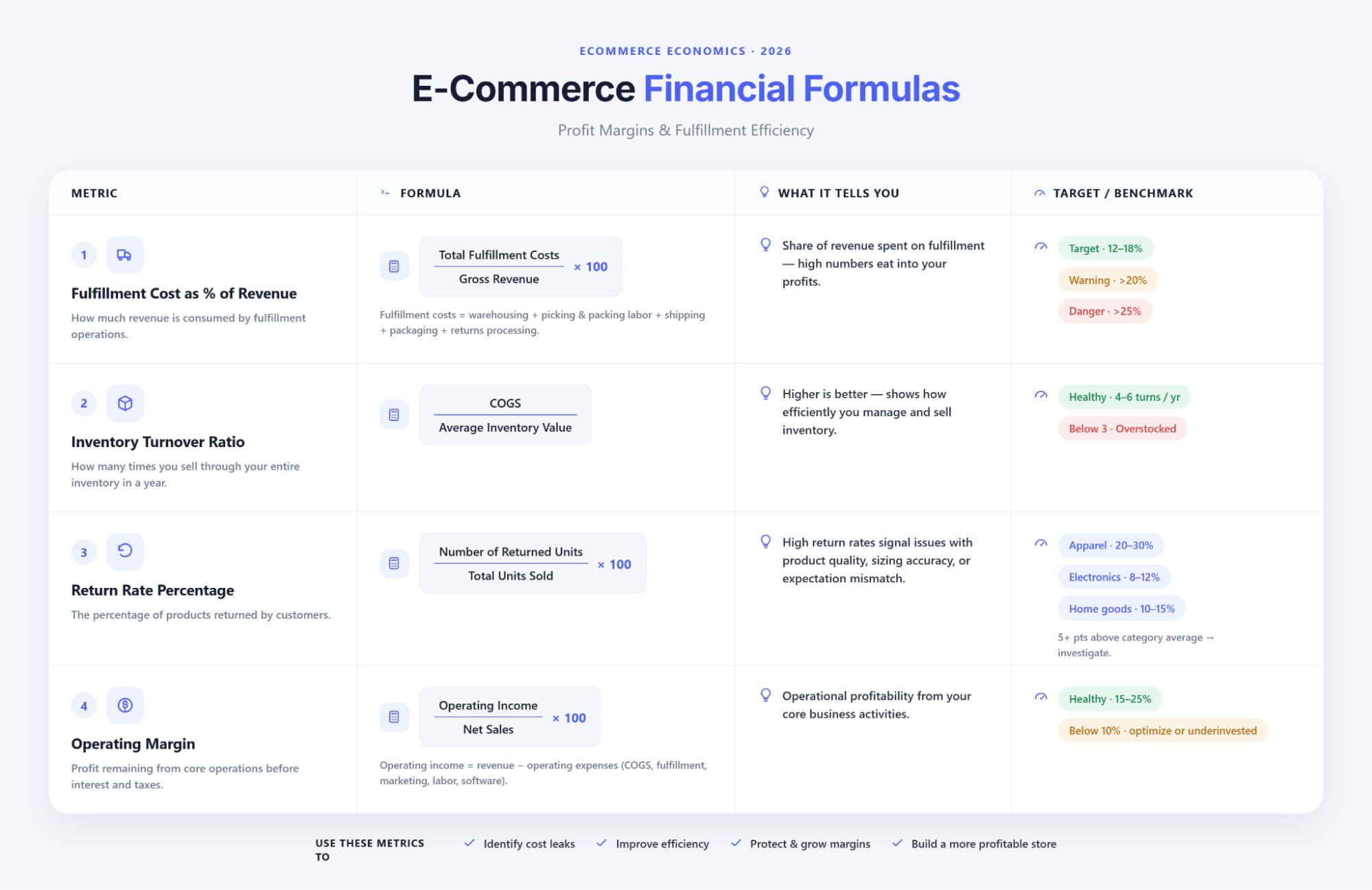
Once you decide to reduce ecommerce operating expenses, keep in mind that you just can’t optimize what you’re not actively measuring. Most merchants believe it’s enough tracking one’s revenue and conversion rate. They may also track ROAS, but that’s it! However, the metrics that actually predict your profitability tend to live deeper in your operations. You should track these 4 KPIs religiously:
- Fulfillment Cost as a % of Revenue: You should calculate this one as per the equation given below. Total fulfillment will be your warehousing fees, picking & packing labor, the cost of shipping your products, packaging materials, and returns processing. Target 12% to 18%. But if you’re going above 20%, you should optimize these expenses, since if the number goes above 25%, fulfillment is basically destroying your margins.
(Total Fulfillment CostsGross Revenue) * 100
- Inventory Turnover Ratio: This metric tells you how many times a year you basically sell through your entire inventory. If you get a ratio of 4, it means you turn inventory 4 times a year. Or roughly 90 days. A ratio of 8 means you turn it every 45 days. So, the higher this number goes, the better you’re doing! But this number shouldn’t go up at the expense of stockouts. Most healthy ecommerce businesses actually target around 4 to 6 turns annually. If this number is below 3, it means you’re simply overstocked.
COGSAverage Inventory Value
- Return Rate Percentage: The industry average varies by category. Apparel runs 20% to 40%. Electronics run 8% to 15%. Home goods stand around 10% to 15%. The rule here is simple: if your return rate exceeds the category average by 5+ percentage points, you will have problems with product quality, sizing accuracy, expectation mismatch, etc.
(Number of Returned UnitsTotal Units Sold) * 100
- Operating Margin: Your operating income is (as you already know) revenue minus your operating expenses (including COGS, fulfillment, marketing, labor, software, overhead, etc.). Healthy ecommerce businesses target 15% to 25% operating margin. If you get a point below 10%, it means you’re easily vulnerable to any disruption. Staying well above 25% means you’re either highly optimized or underinvesting in your store’s growth.
(Operating IncomeNet Sales) * 100
You should review these metrics every Monday morning. Put them in a dashboard you can see at a glance. If any metric drifts outside the target range for two consecutive months, investigate the root cause immediately. That’s how you gain long-term fulfillment efficiency without degrading the quality of your services in the name of sightless cost cutting!
Eliminating Operational Waste: How Easync Automates Ecommerce Cost Optimization
Many merchants don’t realize that manual order entry, delayed stock updates, and supplier price fluctuations actually represent some of the most dangerous and silent profit leaks in the world of modern ecommerce. If one supplier raises their prices by $15 overnight (for instance) or runs out of stock on a top seller, that can burn thousands in canceled orders and chargeback fees.
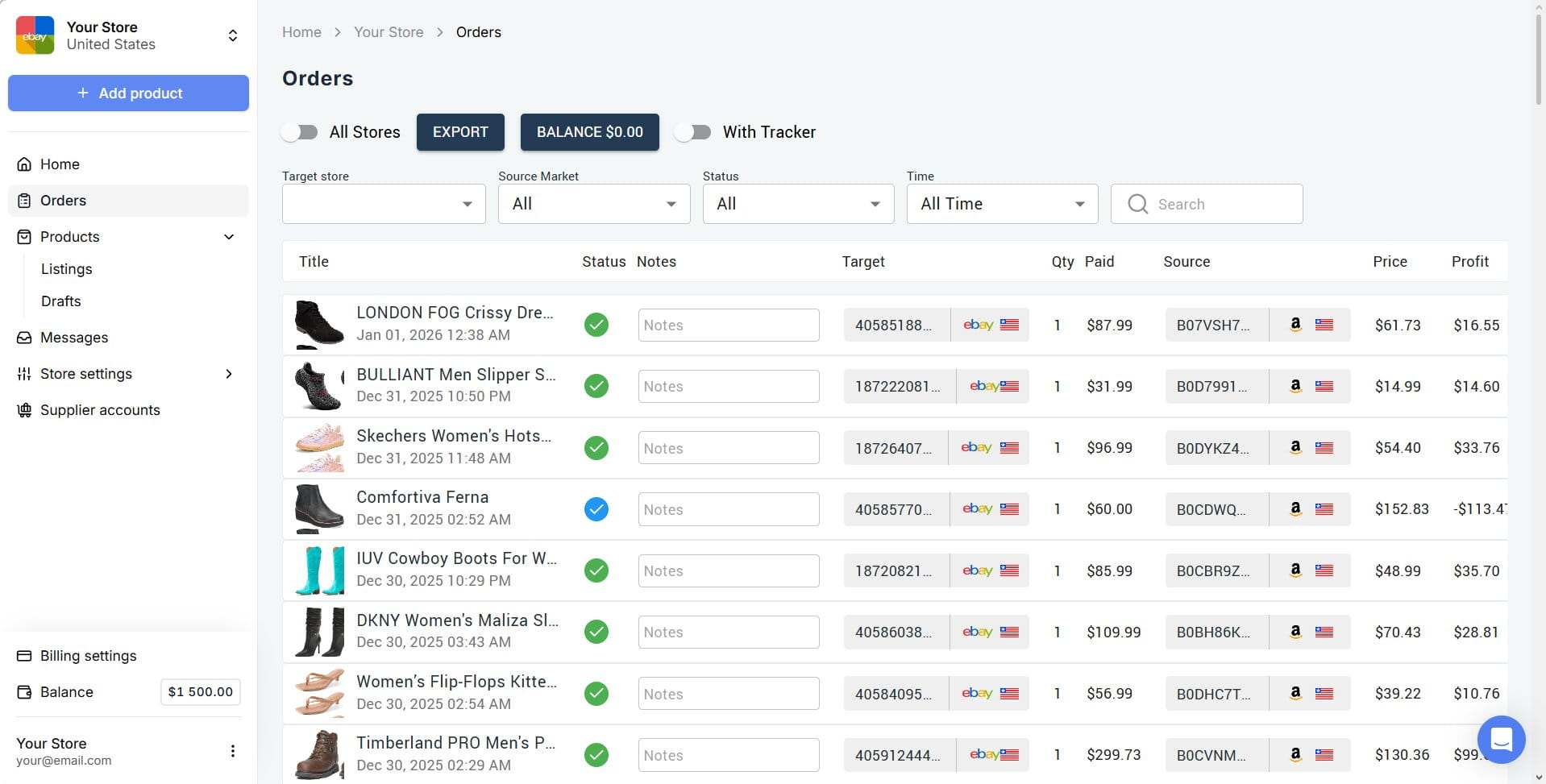
Merchants usually don’t discover these problems until their customers start complaining or they get hit with chargebacks. But the damage is done by then! If you wish to reduce ecommerce operating expenses, you should choose a reliable software solution. Easync connects directly to this problem. It’s built specifically for ecommerce businesses that need to eliminate manual processing, protect margins from supplier volatility, and automate their operational tasks.
Here are different features in Easync that help you successfully optimize your expenditures:
24/7 Price & Stock Synchronization
Your supplier can change their prices without notice or run out of stock on your best sellers. If they discontinue the products you’re actively advertising on your social media sites, it affects not just your sales but also your relationship with customers. If you’re not monitoring all this in real time, you’re basically selling items at outdated prices or promising inventory you don’t have.
Easync keeps monitoring your suppliers’ inventory levels across all connected channels. So, if a supplier ends up raising their prices, Easync will automatically update your storefront listings at a moment’s notice. If a product goes out of stock, Easync marks it as unavailable on your store. For instance, you can catch a supplier price increase of $18 per unit within hours of the change; as a result of this quick action, you can refrain from selling hundreds of units at the old price.
Automated Order Fulfillment (Auto-Ordering)
Manual order entry is slow and expensive. Not to mention prone to mistakes. If you dedicate 3 to 5 minutes for a single order, processing 500 orders a month costs you 25 to 42 hours of labor. If you add in the error rate of 2% to 4% on manual data entry, you’re basically paying for these mistakes on top of the labor. But Easync routes customer purchases automatically to your core supplier with details like shipping address, product variants, and other important information.
- No manual copying
- No pasting into supplier portals
- No typos in shipping addresses.
For instance, dropshippers processing 800 orders monthly can easily reduce order processing time from 40 hours to 2 hours per month, with the 2 hours spent only on exception handling for edge cases. This way, they can easily maximize the return on investment from automated dropshipping workflows.
Automated Tracking Number Upload
Many customer support tickets are WISMO requests. Your customers want to know where their order is. They send emails and make phone calls. They message you on social media. All such inquiries take around 5 to 10 minutes to resolve. Your support team is pulled away from most of their revenue-generating activities. That’s where Easync’s automation saves your time.
Easync automatically fetches tracking updates from your suppliers and feeds them back to your sales channels. Doesn’t matter if it’s Shopify, eBay, Amazon, or Walmart. As a result, when a supplier generates a tracking number, it gets uploaded to the order, and the customer gets an automated notification. That’s how we eliminate WISMO tickets right at the source. Customers can see their tracking information in their order confirmation email or account dashboard.
You can potentially reduce WISMO inquiries from 180 monthly to 34 monthly after implementing automated tracking uploads, freeing around 12 to 15 hours of support capacity per month.
Repricing & Profit Margin Protection
This fact doesn’t need to be repeated: supplier price volatility remains a threat. Raw material costs can fluctuate a lot! Currency exchange rates tend to shift as well. Suppliers adjust pricing quarterly… or even monthly. If you don’t update your retail prices in response, your margins will just evaporate. Easync lets merchants establish strict pricing rules and minimum profit margin thresholds. You can set rules to (for example) maintain a 35% minimum margin on all products.
When supplier costs change, Easync recalculates your retail prices right away to maintain your target margin. For instance, your supplier costs may increase costs by 22% on a product line doing 45k a year. Easync can adjust retail prices within 4 hours, protecting thousands in annual margin that would’ve been lost with manual repricing and helping them avoid losing money.
Step-by-Step Roadmap: How to Conduct an Ecommerce Cost Audit
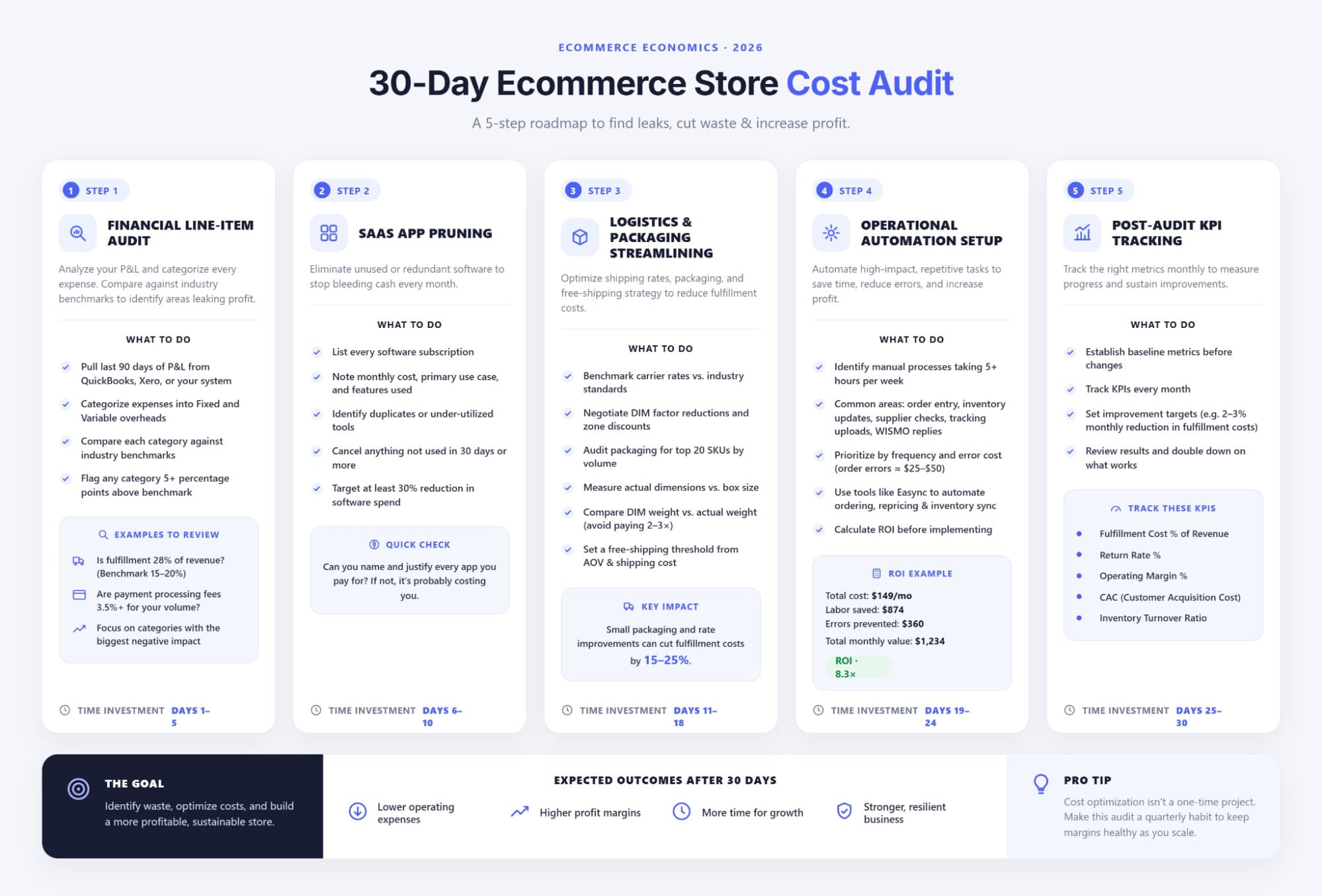
You may have asked to do a cybersecurity audit to assess your store’s vulnerability to online attacks and cybersecurity threats. But you can also do a cost optimization audit to figure out exactly where you’re bleeding your profit margins. This systematic approach will help you find a clear path from diagnosis to implementation. Without this audit, your cost optimization methods will simply remain a guessing game. Here’s how you can start. In five steps:
- Financial Line-Item Audit: You should start by pulling your last 90 days of profit and loss statements. You may export them from QuickBooks, Xero, or whatever accounting software you’re using right now. Categorize every expense into fixed overheads (which simply means costs that remain unchanged with order volume) and variable overhead (costs that may scale as your sales grow). Is fulfillment costing you 28% of your revenue when the industry benchmark is 15% to 20%? Are payment processing fees at 3.4% and not at your volume? If you see a category that’s 5+ percentage points above the current industry benchmarks, that’s what you need to target and optimize.
- SaaS App Pruning: Let’s go to one of the most important wounds from which your profit tends to bleed, i.e., unnecessary software. If you realize that you’re spending $800 every month on different software solutions but can’t name half of them, that’s a problem! You should list every software subscription you have; note each subscription’s monthly cost, primary use case, and how many features you actually use. You may find duplicates or tools you barely even touch! So, cancel anything you haven’t used in 30 days or more. You should target at least a 30% reduction in your software expenses.
- Logistics & Packaging Streamlining: The first thing to do here is benchmarking your carrier rates against industry standards. If you’re shipping 100+ orders every month, it’s important to negotiate DIM factor reductions and zone discounts. If you don’t do this, it means you’re overpaying for these services. We suggest auditing your packaging across your top 20 SKUs by volume. You need to measure the actual product dimensions and compare them to the box you’re shipping in. Don’t forget to calculate the DIM weight vs. the actual weight to make sure you’re not paying for 3x the weight you’re shipping. Also, set free shipping thresholds by an equation, i.e., if your average order value is $67 and average shipping cost is $8.50, set free shipping at (at least) 75.
- Operational Automation Setup: The next step is to identify manual processes that claim over 5 hours of your team’s time every week. You order entry & inventory updates. Not to mention supplier price checks and tracking number uploads. Moreover, customer support responses to WISMO inquiries. Don’t forget to prioritize automation by frequency and error cost. Order processing errors can cost you $25 to $50 per mistake; that’s a way higher priority than monthly reporting automation. Easync automates supplier ordering & repricing to help you here. You must also calculate ROI before implementing it. Let’s say, if a tool costs $149 per month but saves 35 hours of labor at $25/hour (not to mention preventing 12 errors at $30 each), that’s $1,234 monthly value on a $149 investment.
- Post-Audit KPI Tracking: In the end, you need to establish baseline metrics before you make any changes. Like what’s your current fulfillment cost as a percentage of revenue? What’s your return rate? What’s your operating margin? Don’t forget to set benchmarks for every month to check if you can see any visible progress. For instance, target a 2% to 3% monthly reduction in fulfillment costs through packaging optimization. That’s how you can see how much progress you have made and what sort of expenses you’ve actually optimized.
FAQs | eCommerce Optimization
What is the difference between cost cutting and cost optimization?
Cost cutting reactively slashes expenses left and right, degrading product quality and slowing down customer support as a result. Cost optimization proactively streamlines your processes and eliminates redundant manual labor through automation.
What are the largest operational expenses for an online store?
The primary cost drivers in ecommerce are COGS (cost of goods sold), fulfillment and logistics, (around 15% to 25% of order value), customer acquisition costs (CAC), labor and operations, and software (SaaS tech stack fees).
How can small ecommerce businesses reduce shipping costs?
Stores can cut shipping expenses by optimizing packaging dimensions to avoid dimensional weight surcharges. You can use multi-carrier comparison tools and rely on regional fulfillment hubs. Set strategic order minimum thresholds for free shipping.
How does automated order management cut ecommerce costs?
Automated platforms like Easync eliminate manual order entry. Using these software solutions helps prevent human typist errors and keep stock levels synchronized 24/7 to avoid the pesky out-of-stock penalties. You can also reduce the customer service labor spent answering tracking requests.
How do product returns impact online store profitability?
Product returns cost double shipping fees. Plus warehouse processing labor. Merchants may lower return rates by publishing high-resolution product media and detailed sizing charts, along with precise descriptions. You can offer store credits or exchanges over cash refunds.
Reduce Ecommerce Operating Expenses with Easync
When it comes to online store cost reduction, it shouldn’t be treated as a one-time exercise, but a continuous operational discipline. Merchants who truly win long-term are the ones who know how to cut costs once and then just move on, i.e., the kind of people who build systems that keep identifying waste, automating manual work, and protecting margins for all forms of external volatility. That’s how you make your dropshipping store thrive and expand!