Giving away 13% of your hard earnered sale to eBay can start to feel personal.
Is there a way out? You might be looking and stumble across Truegether. Free listings. Free selling. No final value fee. Surely this must be some sort of typo.
Suspicion finds its way, and then you realize nothing is free. What’s the catch, and is it the kind of catch that costs you money or the kind that wastes your year?
So if you’re asking is TrueGether legit, want the real TrueGether reviews instead of the ones on their own blog, and need an honest TrueGether vs. eBay breakdown before you move your inventory anywhere, that’s what this is.
Fair warning: it’s not the answer the fee-haters want.
The Direct Answer: Is TrueGether Legit or a Scam?
Yes. It’s a legitimate US-based marketplace, founded in 2012. It runs payments through PayPal and Amazon Pay. It’s not a scam. Your money isn’t going anywhere strange, and buyers are protected by the payment processor.
So that’s the safety question answered. It’s also the wrong question.
The thing that should actually worry you isn’t whether TrueGether will rob you. It’s whether anyone will show up to buy. Listing costs 0%. Selling costs 0%. And the traffic is close to nothing.
Zero fees on zero sales is still zero.
What Is TrueGether and How Does It Work?
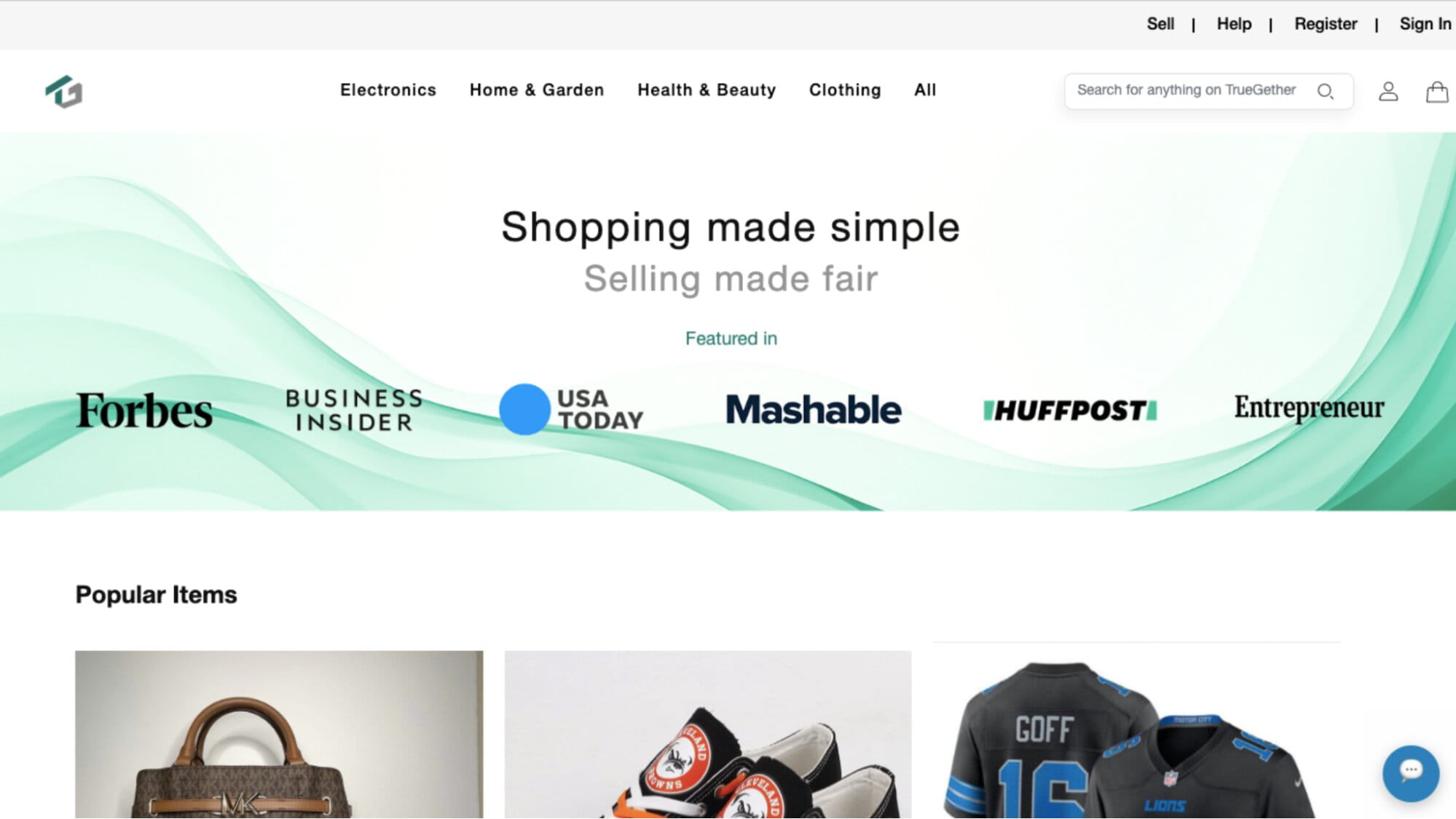
TrueGether is disguised as a social marketplace. But looking at it more practically, it’s a free storefront that feeds Google.
This is how TrueGether works. First, you upload your inventory and pay nothing to list it by the way. When it sells on the standard plan, you pay no final value fee. That’s their whole model. To be fair, none of that is fake. There aren’t many places left where you can list a thousand items and owe nobody anything.
This is the catch. Nobody browses TrueGether. No one is opening the app out of boredom on their lunch break. If a buyer finds your listing, it’s because Google sent them.
How TrueGether Actually Makes Money
There is never going to be a scenario where someone runs a marketplace for free.
TrueGether’s money comes from its Premium tier. The cost is roughly $19/month plus 5% per sale. What you’re buying is visibility. The platform uses AI-driven campaigns to push your listings out to Google Shopping and Bing Ads.
Read that again, because it’s the whole business model. The free plan gives you a shelf in a shop with no front door. The paid plan buys you the door.
There’s one more thing the “100% free” marketing doesn’t mention. Your payment processor still takes a cut. PayPal charges around 2.9% plus $0.30 a transaction. TrueGether doesn’t waive that. It isn’t theirs to waive.
So free is more like 3%. Which is still cheap. Just not free.
TrueGether Reviews: The Good, the Bad, and the Ugly
Here’s where it gets interesting.
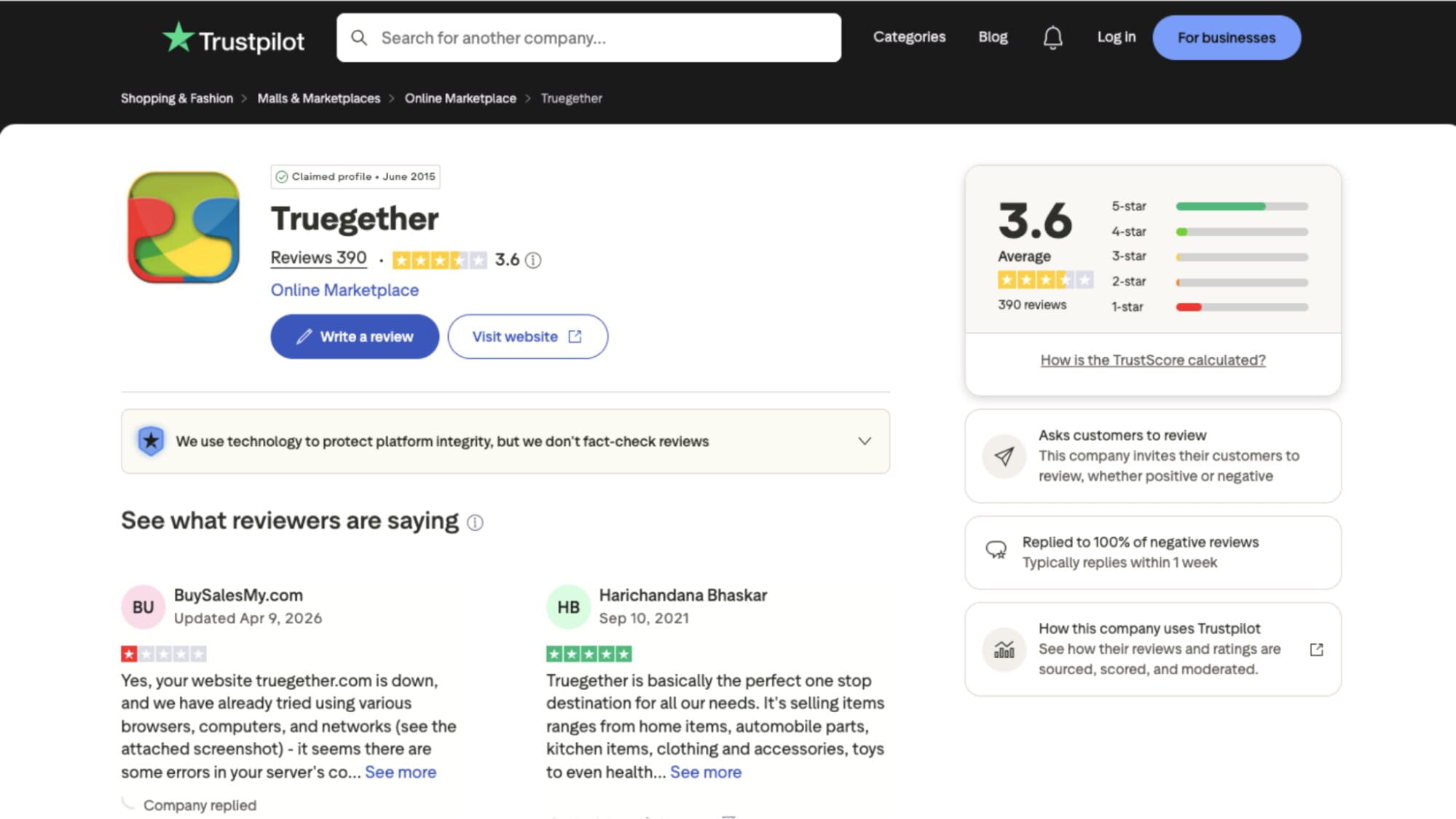
TrueGether sits at 3.6 out of 5 on Trustpilot across roughly 392 reviews. Which sounds fine. Better than fine, honestly.
But always read the reviews first.
Most TrueGether reviews on Trustpilot are from buyers. The reviews from buyers lean towards things like, checkout was smooth. Payment felt safe. The delivery arrived on time. The product matched the description. Over and over, in nearly the same words, with almost no detail in any of them.
Notice what’s missing? The people whose experience you actually care about are barely in there.
The Good
The free tier is genuinely free to list, and it isn’t a trial. Bulk CSV import works. It syncs with eBay tools. This means you’re not typing listings twice.
And there’s one feature nobody talks about that’s smarter than anything else on the platform: you can import your eBay feedback score. If you’ve spent four years building 900 positive reviews, you don’t start from zero. You arrive already trusted. Most new marketplaces would kill for that idea.
The Bad
The ghost town.
Search around outside Trustpilot, and the same complaint keeps surfacing, from Reddit threads to other resellers’ write-ups: hundreds of items listed, months gone by, barely a view. One reseller’s public experiment put 50 items up and sold 3 in the first month, and all three were obscure, specific things, the kind of item somebody Googles by exact name.
That’s the pattern. TrueGether is bad at popular products and okay at weird ones. Nobody’s searching Google for a generic phone case. They are searching for a discontinued part for a 2011 blender.
The Ugly
Support is email only, and reply time is usually 24 to 48 hours. Not a disaster. Not great when a sale is on fire.
The messier problem is in the BBB complaint file, and it’s worth reading carefully because it isn’t the story you’d expect. The complaints aren’t from sellers whining about traffic. They’re from brand owners, companies filing because unauthorized sellers listed their products on TrueGether using their images and even branding without permission. The same seller name shows up across multiple complaints.
To TrueGether’s credit, they respond and pull the listings.
But it tells you what free listing attracts. When there’s no cost to list and no real gate to get in, you get everything. Including people who shouldn’t be there.
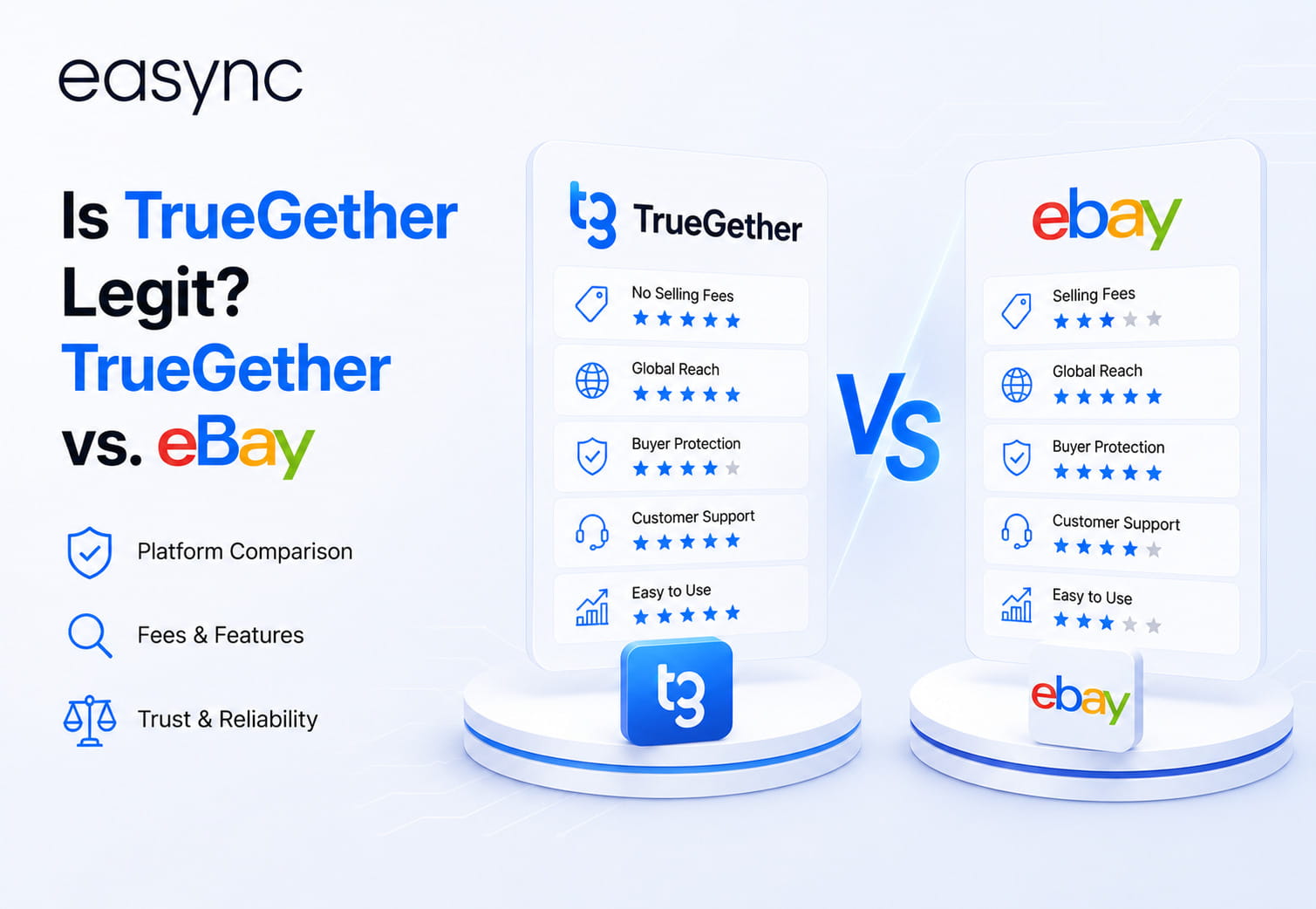
TrueGether vs. eBay: Head-to-Head Comparison
Strip out the marketing from both sides, and TrueGether vs. eBay comes down to five rows.
| Feature / Metric | TrueGether | eBay |
|---|---|---|
| Active Buyers | Very low. Relies heavily on external search traffic | 130+ million active buyers globally, with massive internal traffic |
| Listing & Final Value Fees | 0% on the free plan, or 5% on the Premium advertising plan | High. Roughly 12% to 15% final value fees plus insertion fees |
| Traffic Acquisition | Google Shopping and Bing Ads syndication | Huge built-in organic search volume through eBay’s Cassini engine |
| Seller Trust & Reputation | Low market recognition. Customer service is email only | The gold standard. Strong buyer and seller protections, fast support |
| Ease of Dropshipping | Slow sales cycles. Manual tracking management | Extremely profitable but brutally competitive. Requires automation |
Row one and row two are the entire decision.
Why eBay Is Still King for Dropshippers (Despite the Fees)
The fees feel like a sting. Nobody’s arguing that. The 13% feels like a large amount of every sale to give away, it is.
It’s not uncommon to think that looking for a cheaper eBay alternative is the best option. It’s not. You may save on the 13%, which looks good on paper.
Think about what you’re actually buying with that 13%, though. You’re not paying eBay for nothing. That 13% is the cost for a stadium that’s full of people who came there specifically to buy something today.
TrueGether hands you an empty stadium and lets you keep the ticket money.
A 13% fee on a sale beats a 0% fee on silence. Every time. Thirteen percent of $32 is worth having. A hundred percent of nothing is nothing.
So if the fees aren’t the real problem on eBay, what is? The answer is the work that comes with running a successful store.
The actual thing that kills eBay dropshippers isn’t the final value fee. It’s the different workloads you have to undertake.
Supplier prices are always changing. You might not notice those price changes. That means you could be selling a product at a loss. Likewise, a supplier could run out of stock. If someone purchases that product from your store, you have to cancel the order. That opens a door to getting bad seller ratings.
As you can see, the main problem isn’t really the 13%. The problem is tracking all these constant changes and running a good store. There is a solution for tracking, but there isn’t one for fees.
How to Solve eBay’s High Fees and Complexity: Automated Dropshipping with Easync.io
Beating eBay’s fees by running to TrueGether isn’t the right way to do it.
You beat the fees by making the sale volume big enough and the overhead small enough that 13% stops mattering.
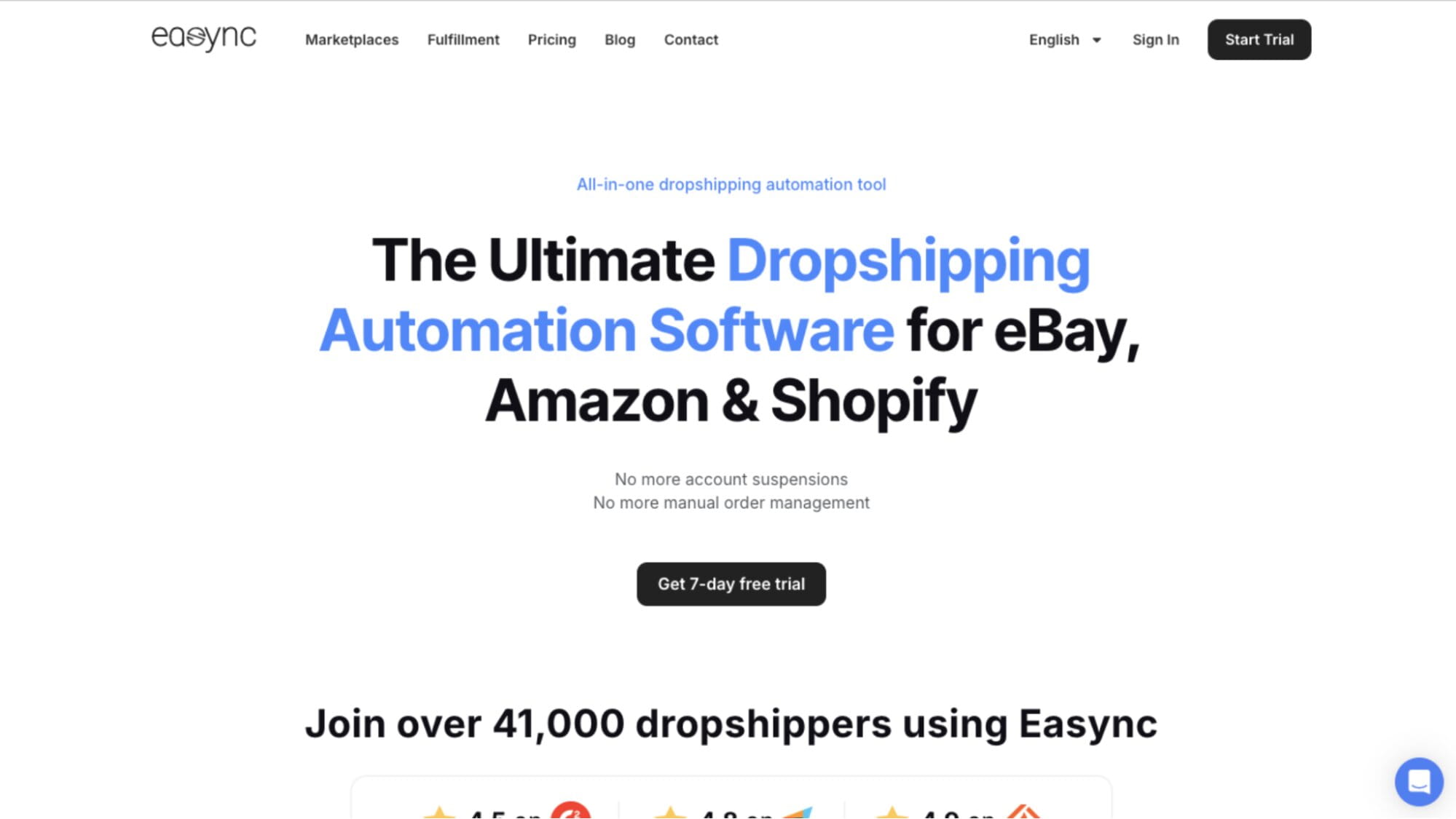
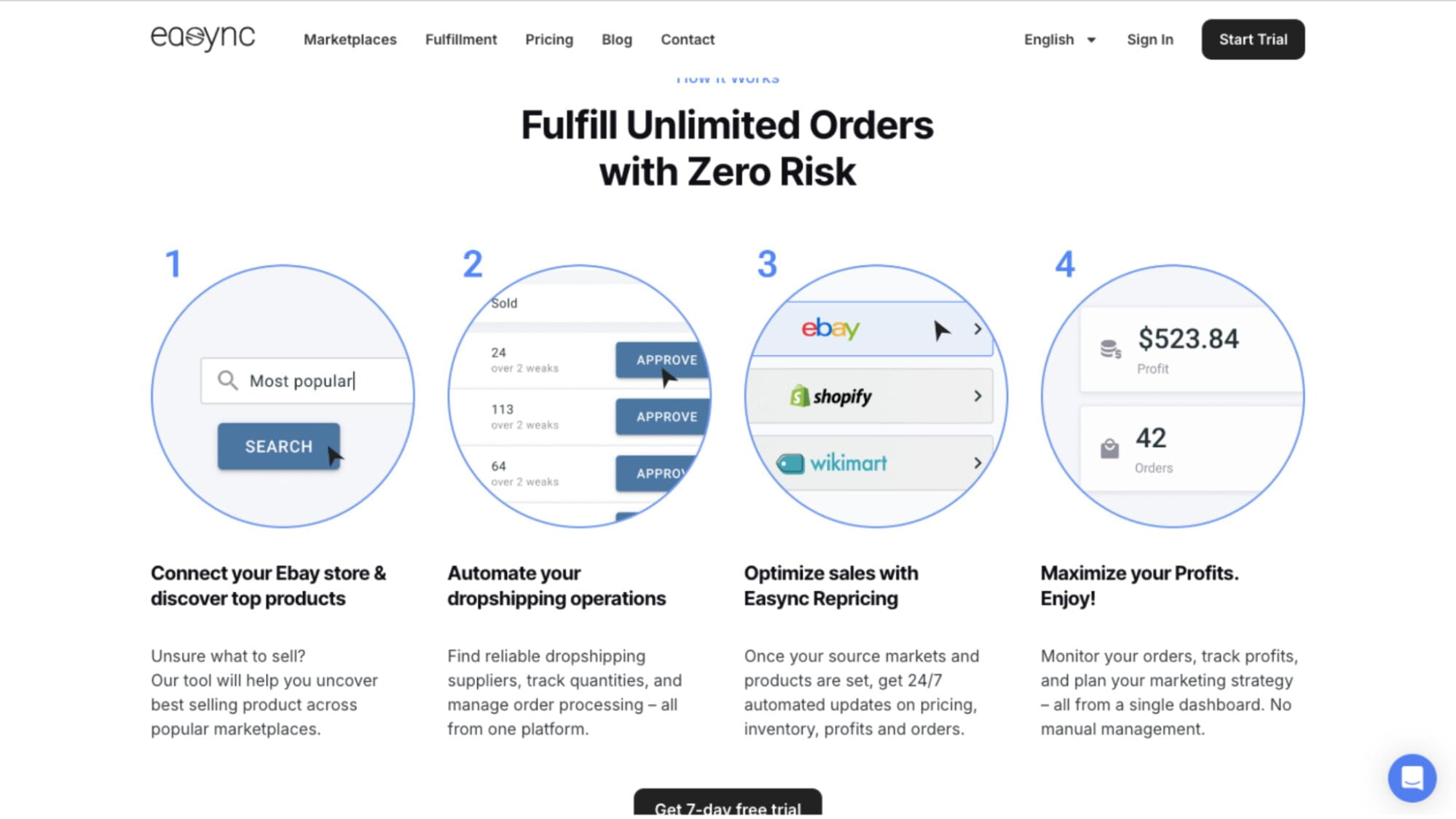
That’s what Easync does. It’s dropshipping automation software for eBay that makes the 13% feel small.
15-Minute Price and Stock Synchronization
Easync watches the markets that you source your products from. It could be Amazon, Walmart, or even Aliexpress. It updates your eBay listings every 15 minutes to match any price changes or out-of-stock signs.
Fulfillment by Easync
When you get a sale. Easync handles everything after that. It orders the product from the supplier, then uploads the tracking number, and then handles the shipping confirmation. Easync gives you back your time so you can grow your business.
Advanced AI Repricer
Your prices automa move with the competition automatically. That’s what lets you absorb eBay’s final value fees and stay comfortably profitable. Protecting your margin from hand is risky business and hard to keep up with volume.
Add it up, and eBay’s fees turn into what they always should have been. A cost of doing business. Not a reason to go find a worse business.
FAQ: Is TrueGether a Legit eBay Alternative?
Is TrueGether legit?
Yes. It’s a real US-based company, founded in 2012, using PayPal and Amazon Pay for payments. It’s legitimate. It just isn’t busy.
Is TrueGether actually free?
Nearly. The standard plan charges no listing fee and no final value fee. You’ll still pay your payment processor. Expect to budget around 2.9% plus $0.30 per PayPal transaction. The Premium plan is $19/month plus 5%.
Why am I getting no sales on TrueGether?
Because there’s almost no internal traffic. Buyers arrive through Google. Not by browsing. If you’re not on the Premium plan pushing listings to Google Shopping, you’re mostly invisible.
Is TrueGether a good eBay alternative?
As a replacement, no. As an extra shelf you cross-list onto for free, sure, as long as the listings are automated and it’s costing you nothing but a click.
Can I move my eBay reputation to TrueGether?
Yes. TrueGether lets you import your eBay feedback score, so you don’t start as an unknown.
Conclusion: Should You Sell on TrueGether or eBay?
TrueGether is small. But it works well as a low-risk place to park secondary stock while you sell somewhere serious. Free is free. If a long-tail item you’d forgotten about sells off a Google search six weeks from now, that’s money you weren’t going to get otherwise.
Just don’t confuse a side shelf with a shop.
You need buyers to have a real business. The buyers are on eBay. All 130 million of them. The fee is what the door costs. The door is worth it.
And the complexity that makes eBay feel like a second job? That’s the part that was always solvable. Easync handles the sourcing, the syncing, the repricing, and the fulfillment, so the only thing left for you to do is decide what to sell.
There is no need to hunt for cheaper options. Rather, learn about automating the one that already works.

Kaylin Bailey is an experienced e-commerce strategist and content writer specializing in dropshipping, automation, and online retail growth. At Easync, she focuses on helping entrepreneurs streamline their stores with data-driven insights, practical guides, and software solutions that optimize product sourcing, pricing, and order fulfillment. With years of hands-on experience in digital commerce and platform integrations, Kaylin’s articles offer actionable advice grounded in real-world testing, helping sellers stay competitive in a rapidly evolving marketplace.

Reviewed by Cameron Lawrence
Cameron is a marketplace dropshipping operator and educator known for clear, repeatable workflows that take newcomers from first listing to consistent sales. On his YouTube channel he breaks down Facebook Marketplace, eBay, and adjacent platforms with step-by-step tutorials, live Q\&A sessions, supplier outreach templates, and real “from-the-field” case studies.