Key Takeaways
- Ecommerce is the broad umbrella of online selling, while dropshipping is a specific retail fulfillment method where you never hold physical inventory—your third party supplier ships directly to customers.
- Traditional ecommerce typically delivers higher profit margins (40-80%) and stronger brand control, whereas dropshipping wins on low startup costs and minimal financial risk.
- In 2026, both different business models remain viable paths to start selling online, but they suit different budgets, skills, and long-term business goals.
- For sneaker dropshipping specifically, automation tools like Easync handle product importing, real-time stock and price monitoring, auto-ordering, and tracking synchronization to keep operations lean.
- This guide includes a pros-and-cons comparison table plus concrete scenarios showing exactly when to choose ecommerce vs dropshipping for your situation.
Introduction: Ecommerce vs Dropshipping in Today’s Market
Global ecommerce sales are projected to exceed $7 trillion in 2025 and approach $8-9 trillion by 2026, fueled by 2.86 billion online shoppers worldwide. This growth makes online retail more accessible than ever for aspiring entrepreneurs.
Here’s the critical distinction: “ecommerce” refers to the overall concept of selling goods or services online through your own ecommerce website, marketplaces, or social channels. “Dropshipping” is one specific way to fulfill orders inside the broader online business ecosystem—where you sell products without ever touching inventory.
If you’ve been wondering what’s the difference between ecommerce and dropshipping, this article covers exactly that: definitions for each model, a side-by-side comparison across costs, margins, control, and scalability, and a clear decision framework. Examples focus on physical products like sneakers, apparel, and gadgets rather than digital products or services.
What Is Ecommerce?
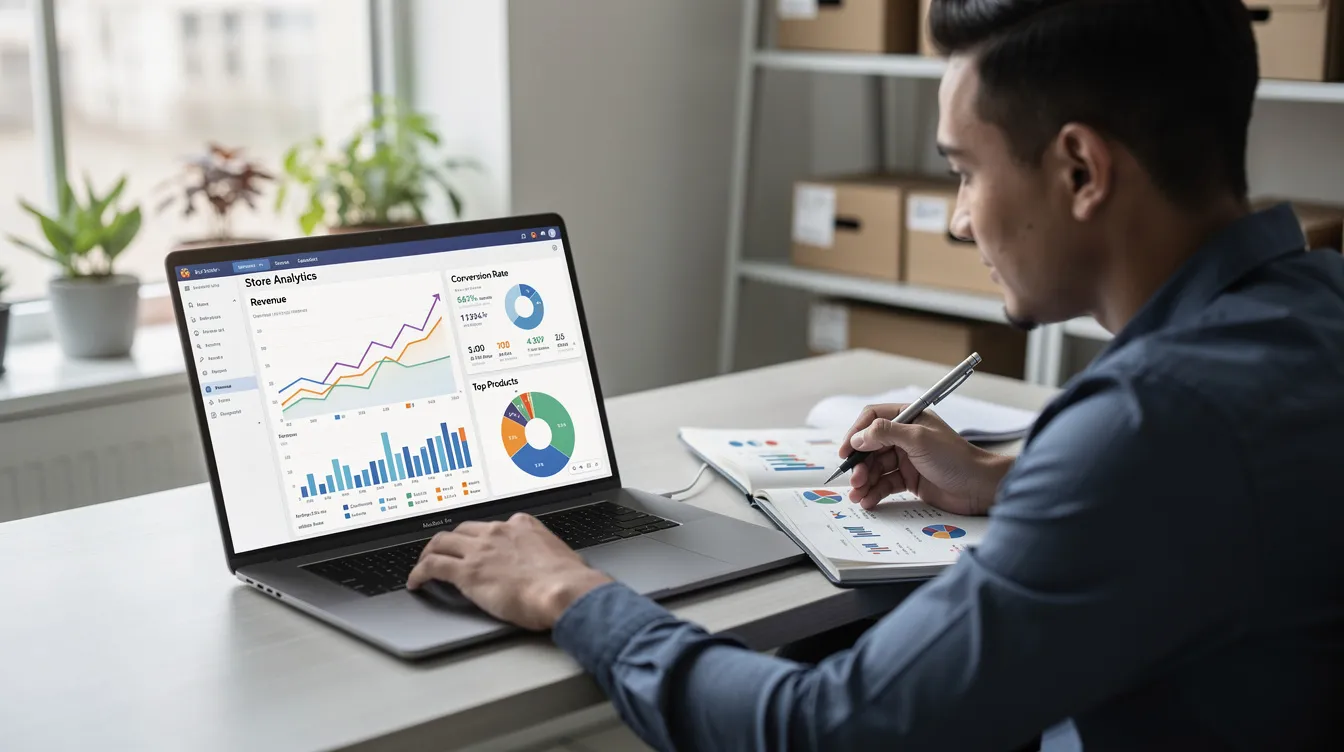
Electronic commerce is the buying and selling of goods or services online via your own online store, marketplaces like Amazon or eBay, or social commerce channels. It’s the foundation of modern online shopping.
In a traditional ecommerce model, the seller typically purchases, stores, and ships their own inventory—or uses third-party logistics providers while still owning the stock. This gives the store owner direct control over the entire order fulfillment process.
Concrete examples include:
- Branded fashion stores like Warby Parker or Allbirds
- Electronics shops with curated product offerings
- Handmade jewelry brands
- Direct-to-consumer sneaker labels operating since the early 2010s
A standard ecommerce operation involves product sourcing from wholesalers or manufacturers, warehousing (even starting small in a garage), website management on platforms like Shopify, marketing via ads and content, picking and packing orders with custom branded materials, shipping, and handling returns.
Key traits of traditional ecommerce:
- 24/7 store availability across time zones
- Global reach without physical storefronts
- Complete control over stock levels and branding
- Ability to manage inventory with forecasting tools
- Direct ownership of customer relationships
Benefits of Traditional Ecommerce
Traditional ecommerce businesses enjoy several distinct advantages:
- Higher profit margins: Bulk purchasing or manufacturing enables 40-80% margins compared to retail prices, giving you significant pricing power
- Stronger brand control: You own exclusive product lines, custom packaging, and the entire customer experience
- Consistent product quality: Pre-shipment inspections and quality standards reduce defects to under 2%
- Fast shipping: Local 3PLs can achieve 2-3 day domestic delivery, boosting customer satisfaction
- Long-term asset building: Gymshark built a $1.4 billion valuation through owned inventory and repeat buyers comprising 40% of sales
Owning inventory enables custom unboxing experiences with branded boxes, inserts, and thank-you cards that build customer engagement and loyalty.
Drawbacks of Traditional Ecommerce
The traditional ecommerce model comes with real challenges:
- Higher upfront investment: Initial inventory typically requires $1,000-$20,000+, tying up cash with risk of unsold inventory
- Warehousing costs: Storage space runs $5-10 per pallet monthly, adding ongoing expenses
- Operational complexity: Beyond 100-200 orders monthly, you need staff or automation for managing customer expectations and fulfillment
- Cash flow pressure: Inventory turns might take 60-90 days before you see returns
Consider a small streetwear brand that over-ordered 2024 hype hoodies, expecting the trend to continue. By 2025, momentum faded, forcing 30-50% markdowns just to clear dead stock. Poor forecasting in traditional ecommerce can quickly erode profits.
What Is Dropshipping?
The dropshipping model works differently: you list products on your dropshipping store, a customer pays you, and you forward the order to a third party supplier who ships directly to the buyer. You never own or physically handle physical inventory.
Your main roles become marketing, store optimization, and customer communication—including handling customer inquiries and providing excellent customer service despite not controlling the shipping process.
The global dropshipping market crossed $200-300 billion by mid-2020s and is projected to reach $476 billion by 2026, representing 10-15% of total ecommerce volume.
The dropshipping workflow:
- Customer orders via your online store
- You receive payment and forward order details to supplier
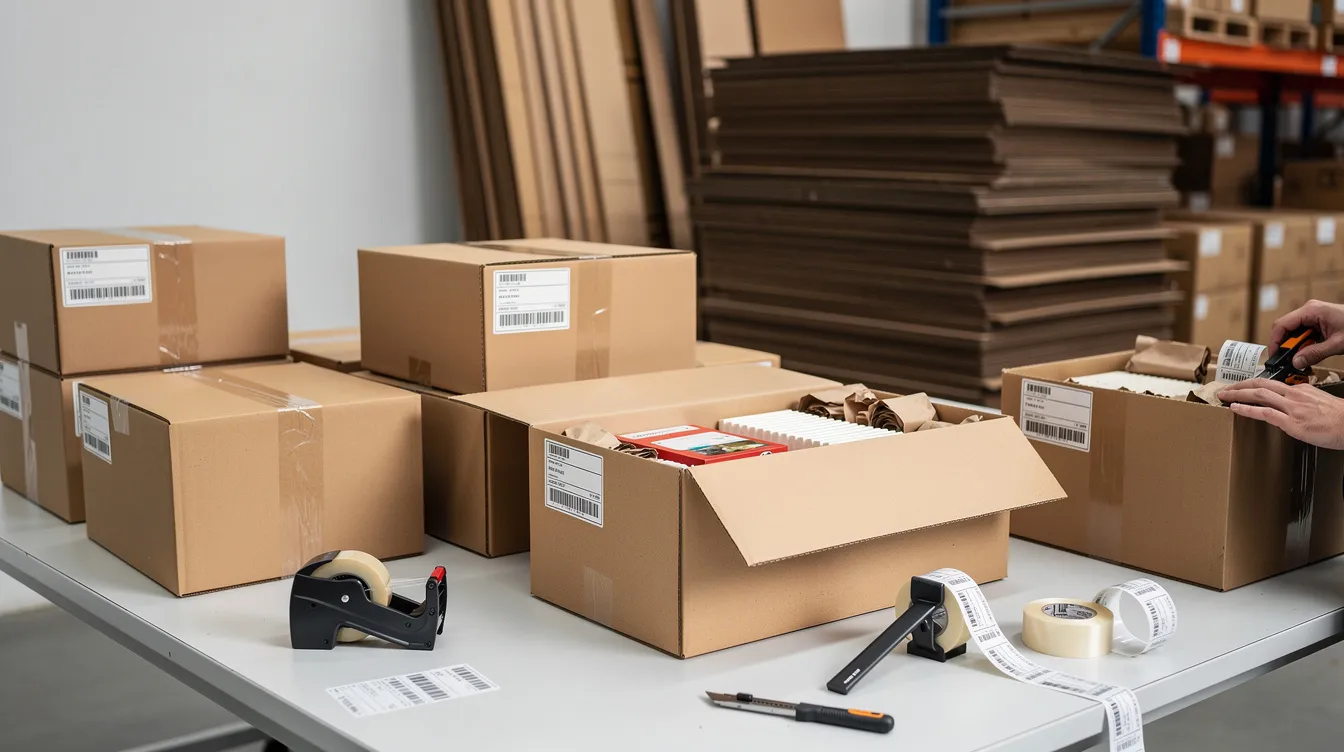
- Supplier handles storage, packaging, and shipping
- Product is shipped directly to customer
- You handle support and any issues
Dropshipping is a subset of ecommerce—purely a fulfillment and inventory strategy, not a separate concept.
Benefits of Dropshipping
Dropshipping offers compelling advantages for new entrepreneurs:
- Ultra-low startup costs: Launch with $100-$1,000 covering domain ($10-20/year), platform fees, apps ($50-100/month), and initial ads—no significant investment in inventory upfront required
- Zero inventory risk: You only pay suppliers after receiving customer payment, dramatically improving cash flow
- High flexibility: Test multiple niches quarterly—sneakers this month, fitness gear next—without stock overhang
- Location independence: Manage your dropshipping business from anywhere with internet, serving customers globally
- Simplified operations: No picking, packing, or managing storage space
Solopreneurs regularly achieve $10K/month via effective marketing strategies with Facebook ads delivering 3-5x ROI.
Drawbacks of Dropshipping
The dropshipping business model has real limitations:
- Thinner profit margins: Expect 10-30% margins after supplier cuts, compared to ecommerce’s 40-80%—you’re paying near-retail versus bulk discounts
- Limited control: Shipping times often stretch 10-20 days, especially cross-border from China, and you can’t control packaging quality
- Higher refund rates: Inconsistent quality leads to 15-25% higher refund rates than traditional models
- Supplier dependence: Stockouts during viral campaigns can devastate your reputation
- Branding challenges: Generic packaging makes building loyalty difficult—repeat rates hover at 10-20% versus 30-40% in traditional models
Imagine launching a sneaker dropshipping store. A TikTok video goes viral, driving 1,000 orders overnight. But your dropshipping supplier depletes inventory, leaving hundreds of customers waiting—and your reviews suffering.
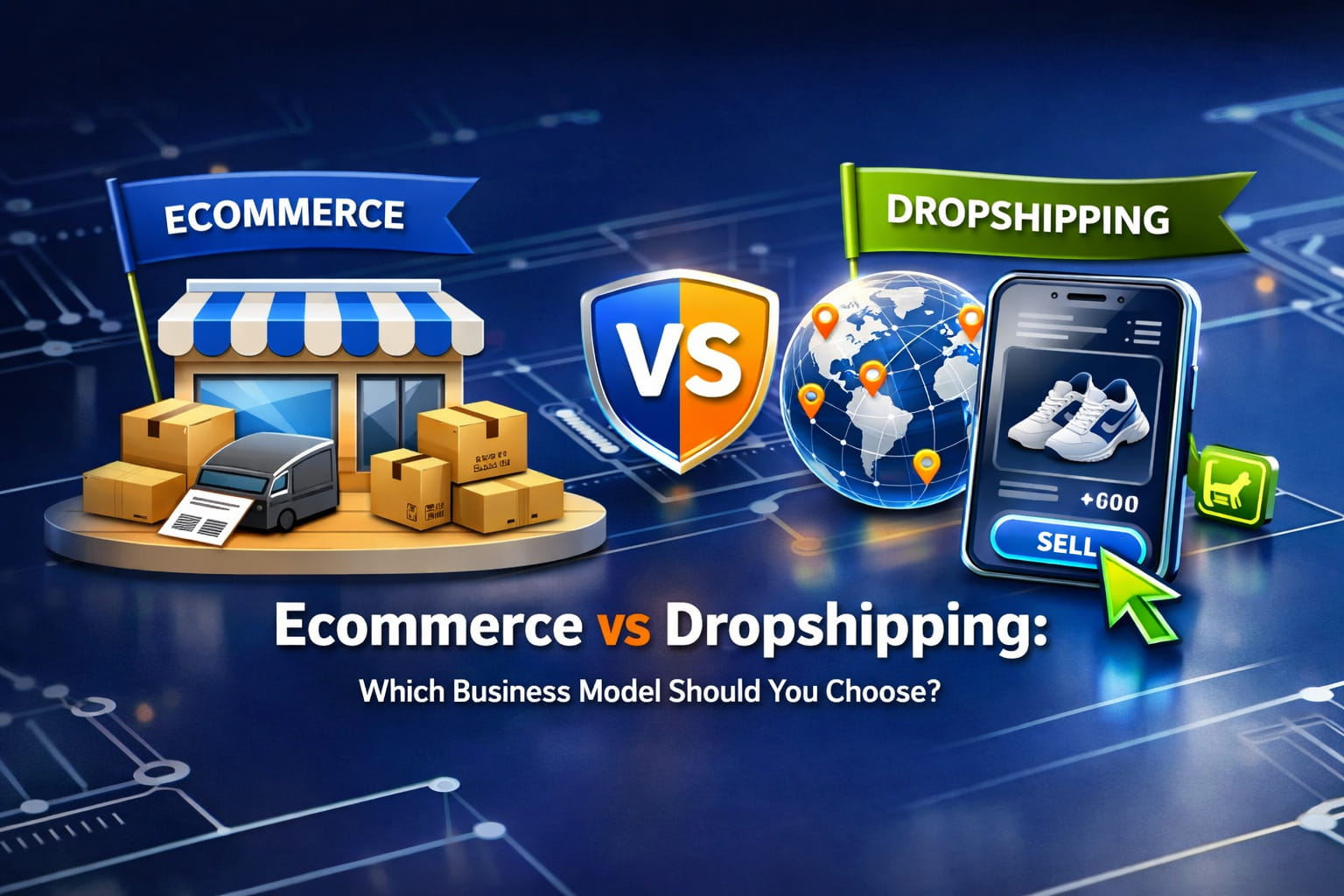
Ecommerce vs Dropshipping: Core Differences
So what’s the difference between ecommerce and dropshipping on a practical level? Both fulfill the same basic function – selling products online – but they diverge dramatically across inventory ownership, margins, control, and complexity.
The following subsections walk through the most important comparison angles. If you want a quick snapshot, skip ahead to the comparison table below.
Inventory Management and Upfront Costs
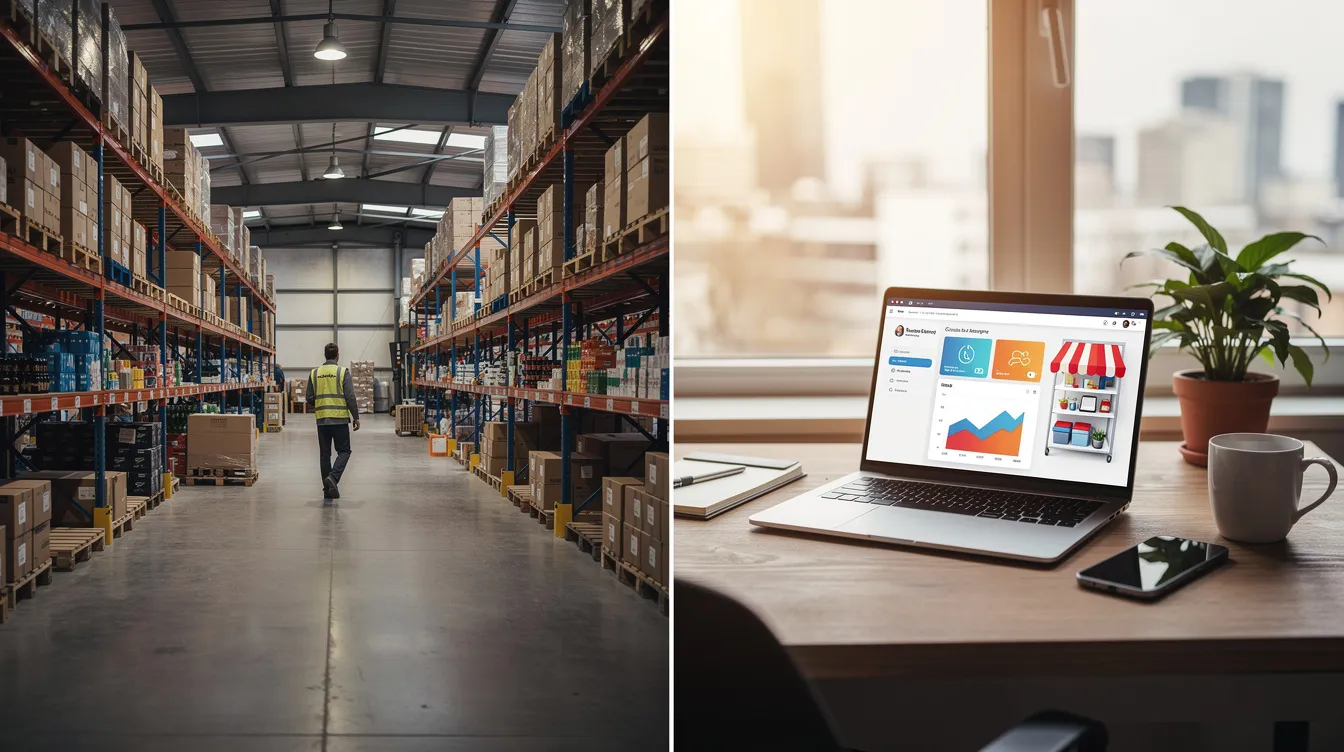
In traditional ecommerce, you purchase and store inventory before selling. This requires significant upfront investment but gives you more control over stock levels through inventory management systems.
With dropshipping, you rely entirely on multiple suppliers for stock. Your initial investment goes toward ads, tools, and branding—not purchasing inventory.
Cost comparison:
- Launching a small branded sneaker ecommerce store: $5,000+ minimum
- Launching a basic sneaker dropshipping site: $200-$500
Ecommerce owners must forecast demand and tie cash into stock. Dropshippers invest in marketing and supplier relationships instead.
Profit Margins and Pricing Power
Ecommerce typically yields higher per-unit profit because owners leverage bulk purchasing at 50-70% below retail after negotiations.
A $100 hoodie bought wholesale at $30-40 generates 60-70% margin. The same hoodie dropshipped at $60-70 supplier cost yields only 15-30% margin.
Dropshipping can still be profitable, but requires higher sales volume and strong marketing ROI to compensate for lower profit margins and intense competitive pricing pressure.
Product Quality Control and Customer Experience
Ecommerce owners can inspect products, choose materials, and enforce quality standards. Defect rates drop below 2% with proper oversight, directly improving customer satisfaction.
Dropshippers rarely see products before customers do. Product quality depends entirely on supplier audits, test orders, and reviews—leading to 5-10% defect risks.
This gap affects refunds, returns, and disputes when items don’t match customer expectations. Mitigation strategies include ordering samples and maintaining backup reliable suppliers.
Shipping, Fulfillment, and Delivery Times
Traditional ecommerce enables control over the fulfillment process:
- In-house fulfillment or local 3PLs
- 2-3 day shipping in US or EU markets
- Custom packaging with branded inserts
- Consistent shipping logistics
Dropshipping shipping times vary widely:
- Often 7-21 days depending on supplier location
- Less predictable tracking information
- Generic packaging hurts the customer experience
- Limited control over the shipping process
Some modern dropshipping suppliers now offer US/EU warehouses with 5-7 day shipping, partially closing this gap.
Branding, Customization, and Long-Term Value
Traditional ecommerce makes building a memorable brand straightforward. You control custom packaging, labels, product design, and the complete customer experience.
Dropshipping usually means generic products with limited customization. Some “branded dropshipping” partners allow custom boxes and tags at extra cost, but options remain limited.
Consider a minimal sneaker label using full ecommerce control—custom insoles, premium boxes, handwritten notes. This differentiation builds long-term customer lifetime value that generic dropshippers simply cannot match.
Scalability and Operational Complexity
Both models scale, but differently:
Ecommerce scaling:
- Requires more infrastructure (warehouses, staff, systems)
- Benefits from economies of scale on per-unit costs
- Shipping costs drop at 1,000+ volumes
- Needs supply chain management investment
Dropshipping scaling:
- Scales mainly through marketing and reliable suppliers
- Can hit quality and supplier-capacity limits during spikes
- Revenue grows faster than infrastructure
- Automation tools become critical for managing orders
Both dropshipping and ecommerce fulfillment benefit enormously from clear processes and automation as volume increases.
Comparison Table: Pros and Cons of Ecommerce vs Dropshipping
Understanding dropshipping vs ecommerce requires seeing the trade-offs side by side. This comparison captures the core differences covered above.
| Model | Main Pros | Main Cons |
|---|---|---|
| Ecommerce (Own Inventory) | Higher profit margins (40-80%); Full quality and inventory control; Branded unboxing builds loyalty; Fast 2-3 day shipping; Exclusive product lines; Direct customer oversight; Long-term asset value | $1,000-$20,000+ startup inventory costs; Warehouse management expenses; Scaling requires staff/infrastructure; Unsold stock risks; Cash flow tied to inventory; Demand forecasting challenges |
| Dropshipping (Supplier Fulfillment) | Under $1,000 to launch; No inventory or warehouse needed; Location independence; Easy niche testing with samples; Simplified operations; Quick product additions; Lower financial risk | Thin 10-30% margins; Supplier-dependent quality; 7-21 day shipping delays; Generic branding hurdles; High competition from low barriers; Growth limited by supplier reliability; Lower repeat customer rates |
Choosing Between Ecommerce and Dropshipping: How to Decide
There’s no universal “best” model. The right choice depends on your budget, skills, time, and risk tolerance.
Key decision questions:
- How much capital can you invest upfront?
- How much control do you need over product quality and branding?
- How soon do you need to see profit?
- What’s your risk tolerance for inventory?
- Do you have long-term brand-building ambitions?
Decision scenarios:
- Low budget, low risk: Dropshipping suits beginners with under $1,000 to test viability
- Brand-focused, long-term: Ecommerce works better for founders seeking defensible brands
- Hybrid approach: Start dropshipping to validate winners, then stock best-sellers for better margins
When Dropshipping Might Be the Better Choice
Dropshipping offers advantages in specific situations:
- Limited capital (under $1,000 available)
- Desire to test multiple niches before committing
- Validating product ideas before bulk purchasing
- Running a side hustle alongside full-time work
- Unable to manage a warehouse or team yet
A practical example: launch a niche sneaker accessory dropshipping store via suppliers like CJdropshipping. Test products for 30-60 days, identify winners, then decide whether to invest in custom designs and inventory.
Keep expectations realistic—margins stay slim, and success requires careful supplier selection and strong marketing.
When Traditional Ecommerce Is the Stronger Option
Ecommerce shines under different conditions:
- You have $5,000+ capital to invest
- Clear niche with validated demand
- Long-term brand ambitions
- Product quality matters to your audience
- You value fast shipping and repeat customers
Consider a small European apparel brand that shifted from dropshipping to holding stock in 2024. Result: 60% margin improvement, better reviews, and the ability to open pop-up retail locations.
Traditional ecommerce is more suitable if you plan to seek investors, sell the brand eventually, or build a recognizable online retailers presence.
Using Automation Tools for Sneaker Dropshipping (Easync Focus)
Sneaker dropshipping presents unique challenges due to fast-moving market trends, limited releases, and constant price fluctuations. Managing this manually leads to oversells, margin erosion, and frustrated customers. For sneaker dropshipping specifically, automation tools like Easync streamline operations and reduce manual errors by 80-90%.
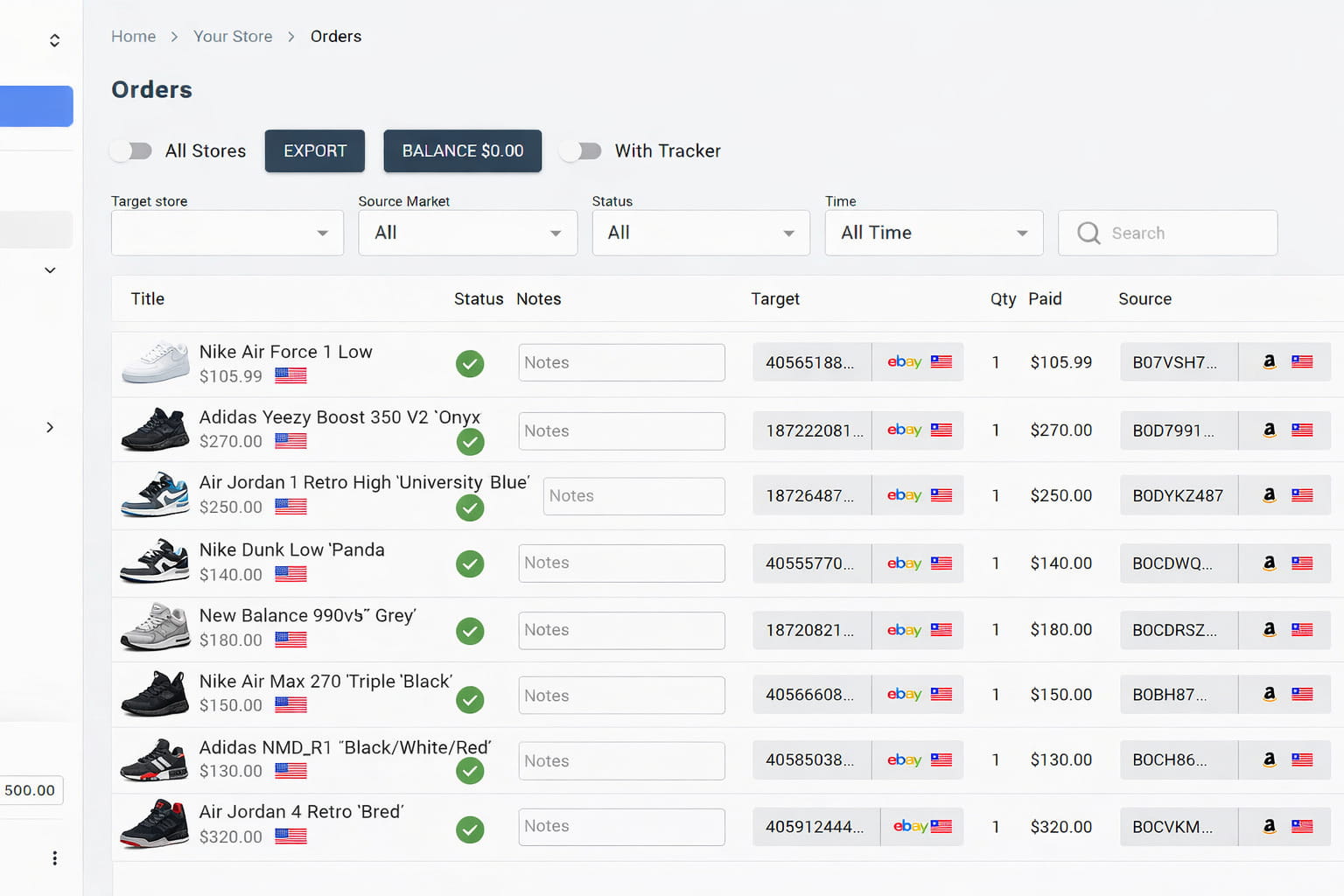
Easync provides automated product importing from suppliers, real-time stock and price monitoring to avoid overselling sold-out colorways, auto-ordering once a customer completes payment, repricing rules to maintain 20-25% margins amid market volatility, tracking synchronization so buyers receive accurate shipping updates instantly, and multi-account workflows for managing several stores or marketplaces simultaneously.
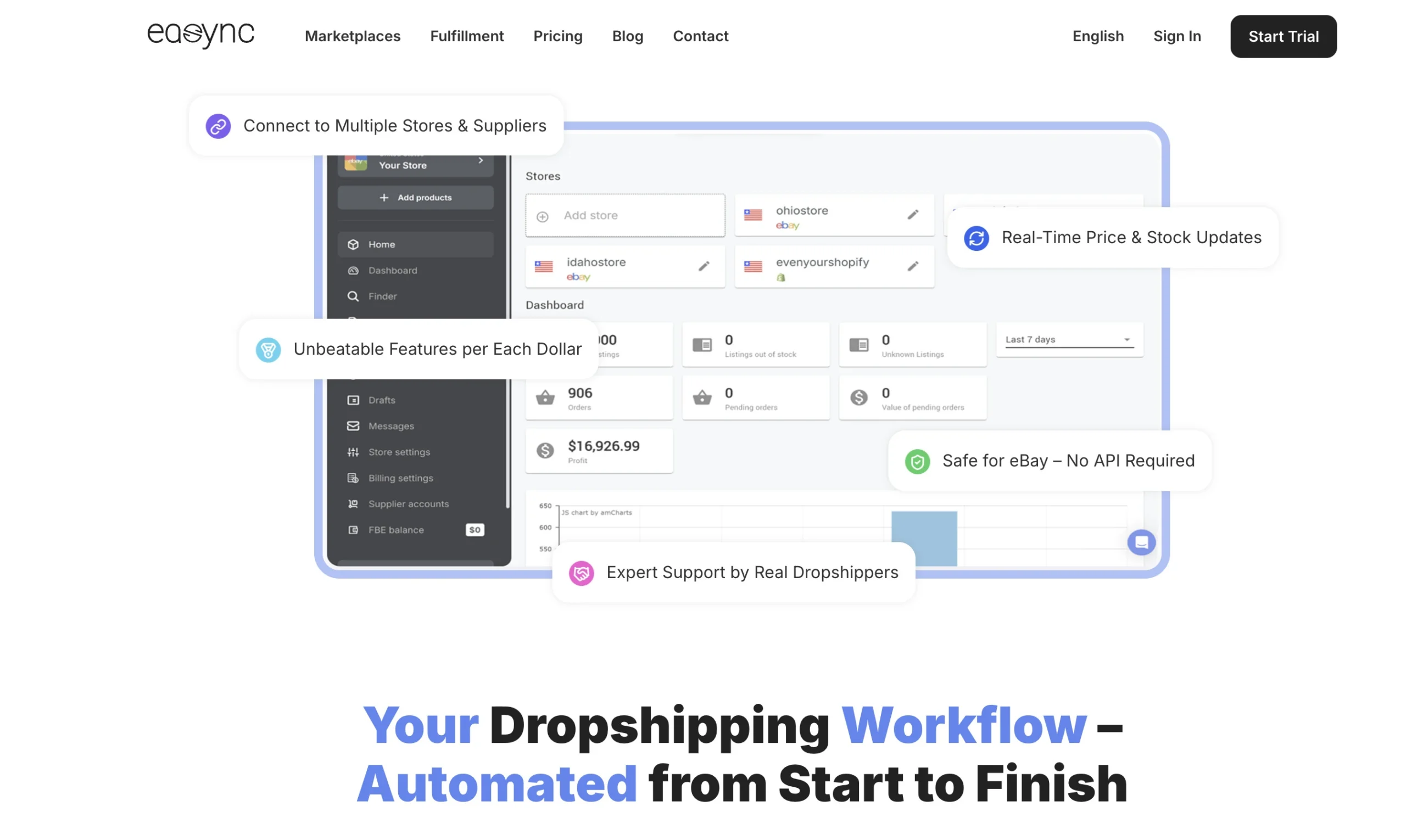
This automation frees store owners to focus on finding trending sneakers, running effective marketing strategies, and providing excellent customer service rather than drowning in spreadsheets and manual order processing.
Hybrid Approaches: Mixing Ecommerce and Dropshipping
A hybrid model combines both strategies: stock core best-sellers (typically 60-70% of sales) for control and margins, while dropshipping experimental or long-tail products.
This balances risk and control. You enjoy higher profit margins and brand control on main items while testing new products cheaply through suppliers.
Practical scenario: A sneaker brand holds inventory for its own designs and best-selling colorways. Complementary items like cleaning kits, premium laces, and socks are dropshipped through reliable suppliers—testing demand before committing to stock.
Tips for managing hybrid operations:
- Use clear SKU naming conventions separating owned vs. dropshipped items
- Implement ERP or inventory management systems for real-time visibility
- Coordinate shipping expectations with customers (own items ship faster)
- Maintain backup suppliers for high-velocity dropshipped products
Summary: Ecommerce vs Dropshipping in 2026
Ecommerce represents the higher-investment, higher-control path—purchasing inventory, managing fulfillment, and building brand equity over time. Dropshipping offers a low-barrier, lower-control alternative that lets you sell products without significant capital commitment.
Neither is universally superior. Many successful online business founders start with dropshipping to validate demand, then graduate into traditional ecommerce as profits grow and they understand their market.
The path forward: choose one business strategy, validate a niche within 60-90 days, then refine based on actual results. Don’t overthink the initial choice—both models allow pivoting as you learn what works for your specific business goals.
FAQ: Ecommerce vs Dropshipping
Is ecommerce the same as dropshipping?
No. Ecommerce is the overall concept of selling goods or services online—it encompasses any online store or marketplace transaction. Dropshipping is one specific fulfillment strategy within ecommerce where you don’t hold inventory and rely on suppliers to ship directly to customers. Many ecommerce stores own inventory and handle their own fulfillment, while dropshipping stores still count as ecommerce because they sell online.
How much money do I need to start with dropshipping vs ecommerce?
A basic dropshipping store can launch with $200-$500 covering domain registration, platform fees, a simple theme, and initial advertising budget. A small ecommerce brand with physical inventory typically needs $5,000 or more to cover product sourcing, initial stock, and storage. Marketing spend matters in both cases, but inventory remains the biggest cost difference.
Is dropshipping legal and safe in 2026?
Dropshipping is legal in most countries as long as you comply with local tax laws, consumer protection regulations, and avoid counterfeit or prohibited products. Stay safe by being transparent about shipping times (clearly stating 14-21 days if applicable), maintaining clear return policies, and working only with reputable, vetted suppliers. Chargebacks from delayed shipments represent the main risk, mitigated by clear customer communication.
Can I switch from dropshipping to traditional ecommerce later?
Absolutely. Many brands start with dropshipping to test demand, then bring successful products in-house once they see consistent sales—roughly 20-30% of dropshippers transition after reaching $50K+ revenue. You can gradually phase in stocked inventory for best-sellers while continuing to dropship experimental items, creating a hybrid approach that balances risk and control.
Which model is better for building a long-term brand?
Traditional ecommerce with owned inventory generally offers better long-term brand-building potential. You control product quality, packaging, shipping speed, and the complete customer experience—factors that boost customer lifetime value 2-3x through repeat purchases. That said, dropshipping can serve as a $100K/year stepping stone, allowing you to validate products and build an audience before making larger inventory investments.

Noah Edis is a freelance writer and systems engineer with a wealth of experience in modern hardware and software. When he’s not working on his latest project, you can find him playing competitive dodgeball or pursuing his personal interest in programming. At Easync, Noah helps thousands of sellers optimize their eBay and Amazon businesses by providing automation tools and practical guidance on account health, pricing, and inventory management.