
- Amazon Dropshipping
- articles
What Does Open Box Mean? Smart Buying & Open Box on Amazon, eBay
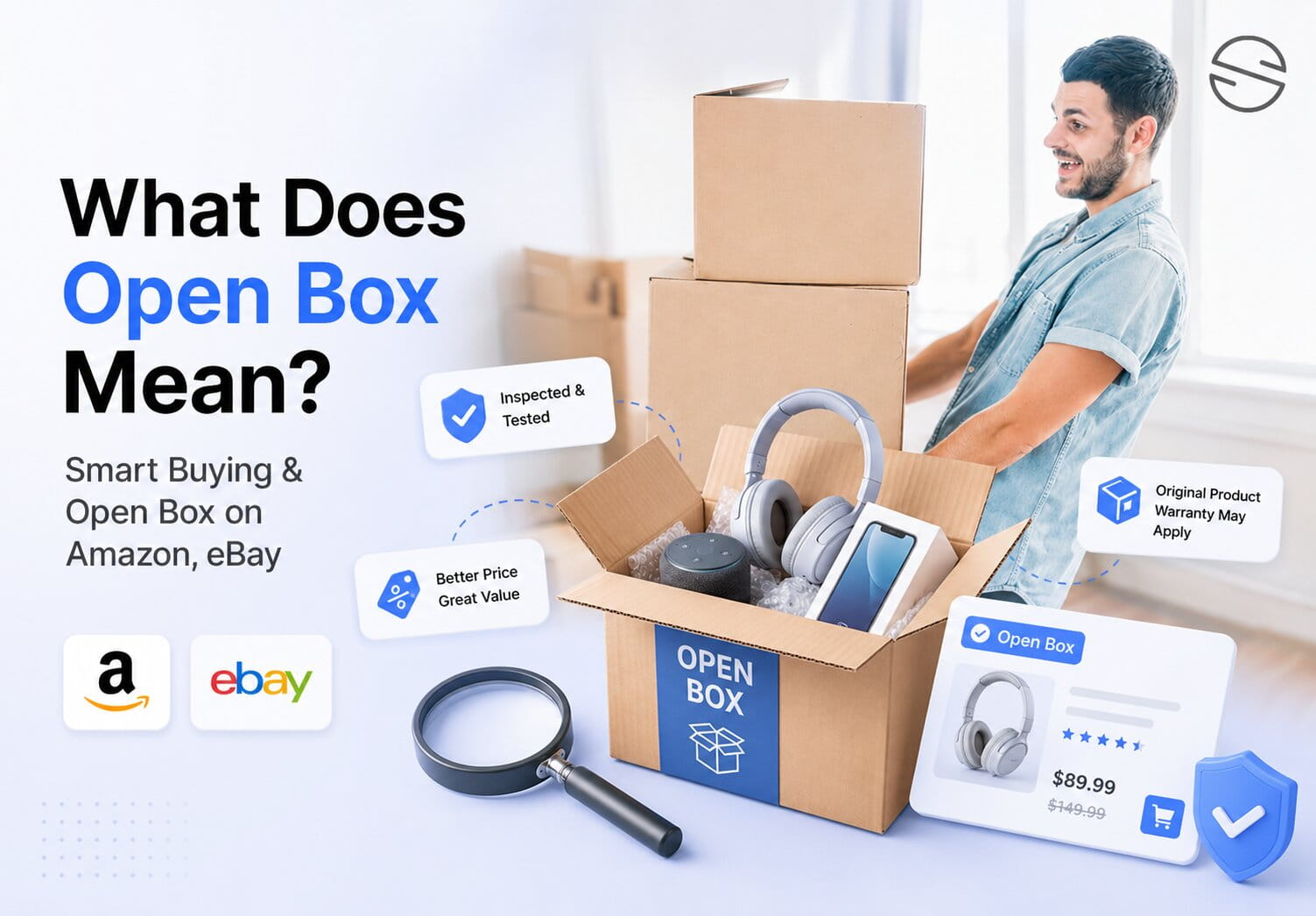
Quick answer: Open box means the packaging was opened, but the product inside was never really used. Most open-box items are customer returns, retail display units, or shipments whose outer carton got crushed in transit, and they typically sell for 10% to 30% below the sealed version of the same product. What you give up is the pristine box, sometimes a manual or a cable, and often the manufacturer’s warranty, though warranty and returns vary more between retailers than most buyers expect.
What Is Open Box and How Does It Work?
An open-box item is a product whose seal has been broken but whose condition is still essentially new. It goes back to the retailer, gets inspected and graded, and returns to the shelf at a lower price because it can no longer legally be sold as sealed.
The reasons behind open box merchandise are pretty ordinary. Someone orders a monitor, opens it, decides the screen is smaller than they pictured, and sends it back within the return window. A shipping carton takes a corner hit and arrives dented, so the buyer refuses it even though the product inside is untouched. A store pulls a unit out of its box to put on the sales floor, and after a few weeks of being looked at it gets marked down. Bundles get split up. Preorders get cancelled after the warehouse already picked and packed them.
Retailers process this volume constantly, and they all run some version of the same workflow. The unit gets logged, visually inspected, powered on where that applies, checked against an accessory list, cleaned, and repackaged either in its original box or a plain replacement. Then it gets a condition grade, and the grade determines the price.
What varies is not just how carefully that inspection is done, but what the term is allowed to cover in the first place. Some retailers reserve open box for units that were never repaired. Others permit minor repairs under the same label. That is the single most useful thing to know before you buy open-box items anywhere: the words are standardized, the definitions behind them are not.

Open Box vs Used: What’s the Real Difference?
Open box means opened but not used. Used means someone actually owned and operated the product for a while. The gap between those two shows up in cosmetic wear, in what is left in the box, and in how much protection you get after the sale.
The confusion is understandable because both categories often live in the same storefront and both are technically classified as pre-owned. Here is how the four main conditions compare.
| Condition | Packaging | Functional Wear | Warranty | Return Policy | Typical Discount |
|---|---|---|---|---|---|
| Brand New | Factory sealed, all original materials | None, never powered on by a customer | Full manufacturer warranty | The retailer’s standard window | Baseline price |
| Open Box | Opened, sometimes scuffed, occasionally replaced with a plain box | None to minimal, may have been powered on once or displayed | Inconsistent, ranging from full retailer-backed coverage to none at all | Varies more than any other condition, from a standard window down to final sale | Roughly 10% to 30% off |
| Used | Original box often missing, accessories may be incomplete | Visible from light scratches up to heavy wear depending on grade | Almost never included | Retailer return window only, if any | Roughly 20% to 50% off |
| Refurbished / Renewed | Repackaged, accessories may be compatible replacements rather than originals | Was defective or heavily used, then repaired and tested back to working order | Program guarantee rather than manufacturer warranty | Usually the longest of the four, backed by the program | Roughly 15% to 50% off |
Two of those columns deserve a warning. Warranty and returns on open box are not a property of the condition, they are a property of the retailer, and the range is enormous. The section further down compares the major ones side by side.
If the same product is available in both open box and used at similar prices, take the open box. The premium you pay is essentially insurance against wear you cannot see in a photo.
How Open Box Works on Amazon (Amazon Resale)
Open box on Amazon lives inside Amazon Resale, which is the current name for the storefront that used to be called Amazon Warehouse. Amazon announced the rebrand in August 2024, and the storefront continues to sell used, pre-owned, and open-box products with the same delivery, customer service, and returns handling as the rest of the site. Old bookmarks still work, and the shortcut amazon.com/resale takes you straight there.
You will find these listings two ways. Either browse the Resale storefront directly, or scroll down a normal product page and look for the “Save with Used” or “Buy Used” block, which is where the Amazon open box items for that ASIN show up if any exist.
Returned stock passes through two separate inspections before any of it reaches you. At the return center, staff examine every side of the manufacturer’s packaging for damage or broken seals, then check the item itself against the description for signs of use and damage. A second inspection happens before the item can be listed on Amazon Resale, and for electronics that step includes powering the unit on, testing it, and resetting it to factory settings. Each item then gets one of four listing conditions.
- Used, Like New. This is what most people mean by openbox on Amazon. Amazon describes it as perfect working order with all essential accessories present, though the packaging itself may be damaged.
- Used, Very Good. Limited use and minor cosmetic imperfections, fully functional, possibly repackaged, and possibly missing non-essential accessories, which are named in the item description.
- Used, Good. Moderate wear and minor cosmetic damage such as a small scratch. This is the grade where Amazon warns that valuable accessories may be absent and the product may be unusable until you buy them separately.
- Used, Acceptable. The item performs its main function but shows clear use, including scratches, dents, and worn corners. Accessories, components, or spare parts may be missing, and again the unit may not work until those are purchased.
Read those last two grades carefully before chasing a deep discount. The missing part is not always a manual or a cable, and Amazon says outright that in some cases the product will not function until you replace it.
Deal forums and price-tracking sites usually compress it into one word, so searching for openbox Amazon listings will surface the same inventory under a different spelling.
The savings are real without being spectacular. As of July 2026, the Resale storefront advertises average customer savings of over 22%, and the spread on any individual product depends heavily on category and grade.
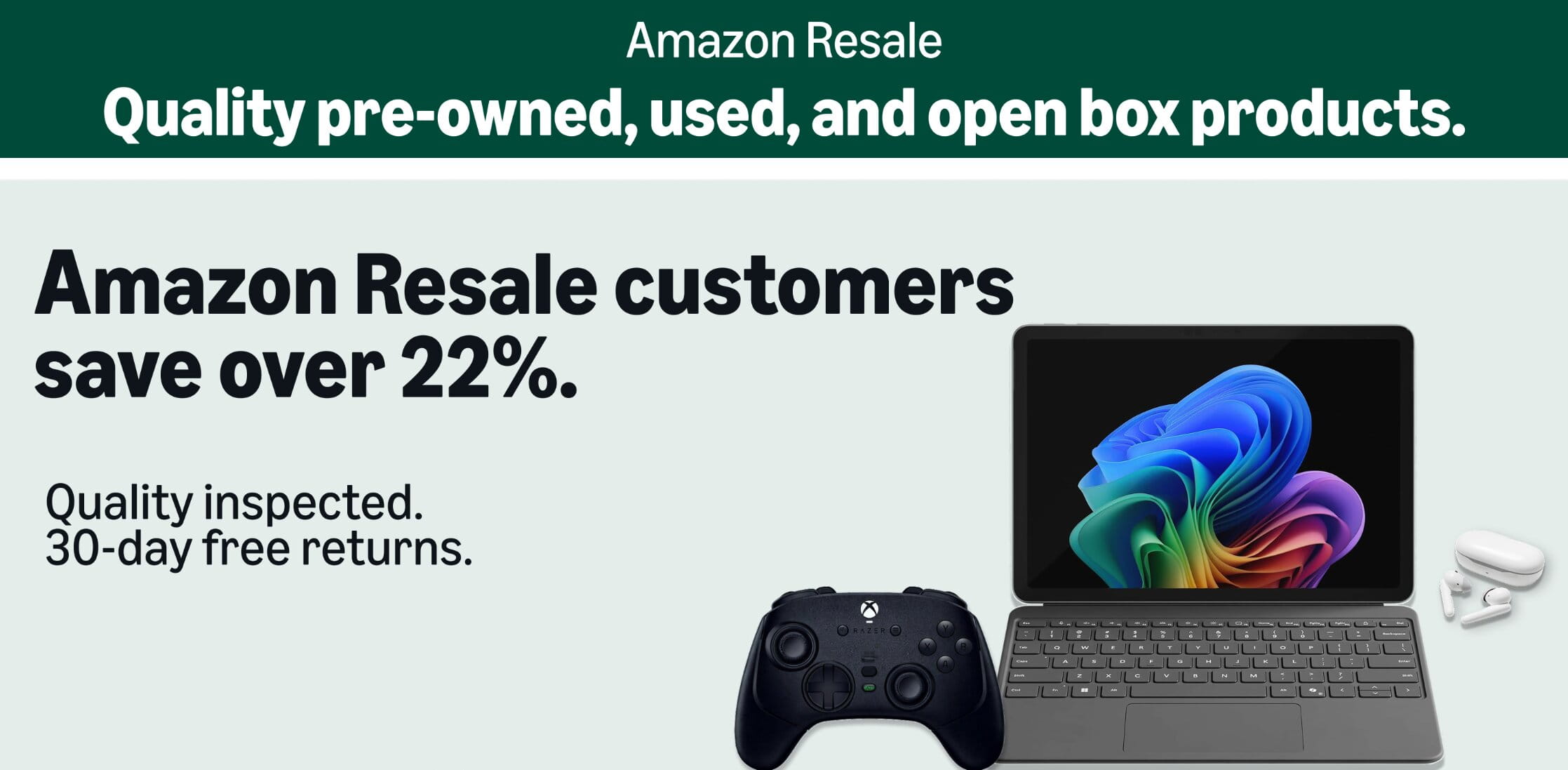
Amazon also layers promotions on top of Resale pricing from time to time. In June 2026 the storefront ran an extra discount of up to 25% on selected items, marked with a “Save 25% at checkout” line underneath the price. A similar promotion at up to 20% ran the month before, with free shipping for Prime members. These come and go without much warning. What tends to stay constant is the base used price, while the size of the extra discount moves around, which is why the only comparison worth making is against the current new price rather than against what the same Resale listing cost a month ago.
Amazon Resale products ship from Amazon and can be returned within 30 days of receipt, and the storefront lists those returns as free. That window is your main protection, because manufacturer coverage on these listings is inconsistent. Some products keep it, many do not, and the warranty is tied to the original purchase rather than yours. Read the listing rather than assuming either way.
One more detail worth knowing if you buy Amazon open box regularly. Returned units get an LPN sticker, a barcode label where LPN stands for “license plate number,” a unique serial that identifies that specific physical unit as it moves through Amazon’s fulfillment and returns process. It is typically applied over whatever barcode was already on the packaging. If you open a package and find a white label reading LPN covering the original code, that unit went through the returns pipeline. On a Resale listing this is expected. On a listing sold as new, it is a reason to ask questions. Buyers cannot look the number up themselves; only the merchant who sold the item can pull the record.
What Is Open Box Electronics and Furniture?
Electronics and home goods dominate this category because they are expensive, they get returned often, and their outer packaging is bulky enough to take damage in transit. The buying logic is different for each.
Features of Open Box Electronics
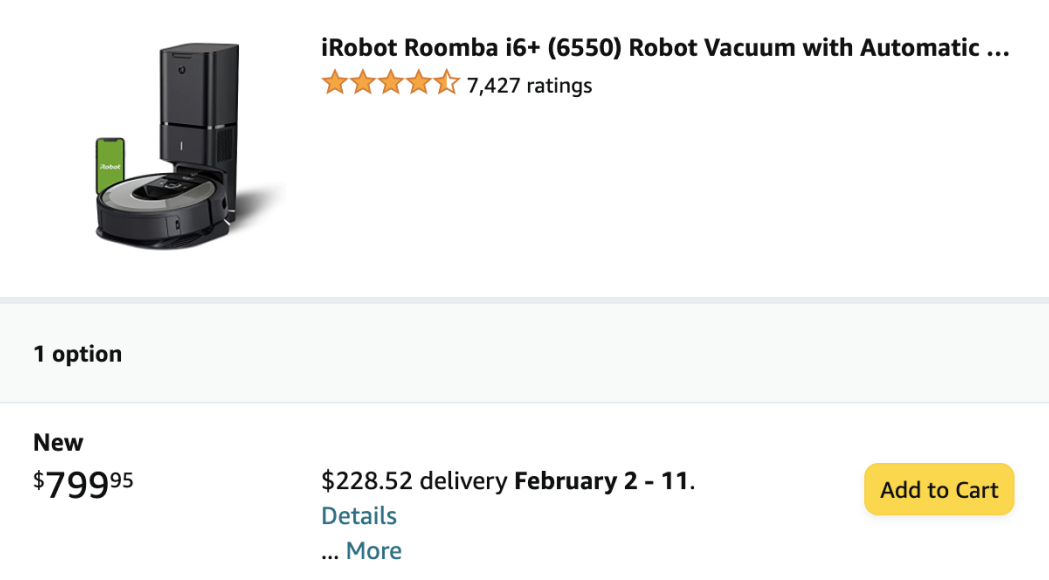
Open box electronics are the highest-value and highest-risk part of this market. TVs, laptops, monitors, headphones, game consoles, and small kitchen appliances move through returns constantly, and the discounts on them are the deepest you will find.
The thing to watch is not the product, it is everything around the product. Manufacturers ship laptops with a specific charger, TVs with a specific stand and remote, cameras with a specific battery and strap. When those go missing during returns processing, the replacement cost can eat the entire discount. A proprietary laptop charger can run $60 or more. A TV stand for a discontinued model may not be purchasable at all.
Before buying, read the condition notes line by line, then power the unit on the day it arrives. For anything with a screen, run a solid color across the full display to catch dead pixels. For anything with a battery, check the health readout if the operating system exposes one.
On the account side, Amazon states that a factory reset is part of its evaluation for electronic items, so a properly processed unit should arrive clean. Verify it anyway. A device still tied to a previous owner’s login is a recurring headache with phones, tablets, and smart home gear, and it is far easier to return in week one than to chase later.
Buying Open Box Home Goods and Furniture
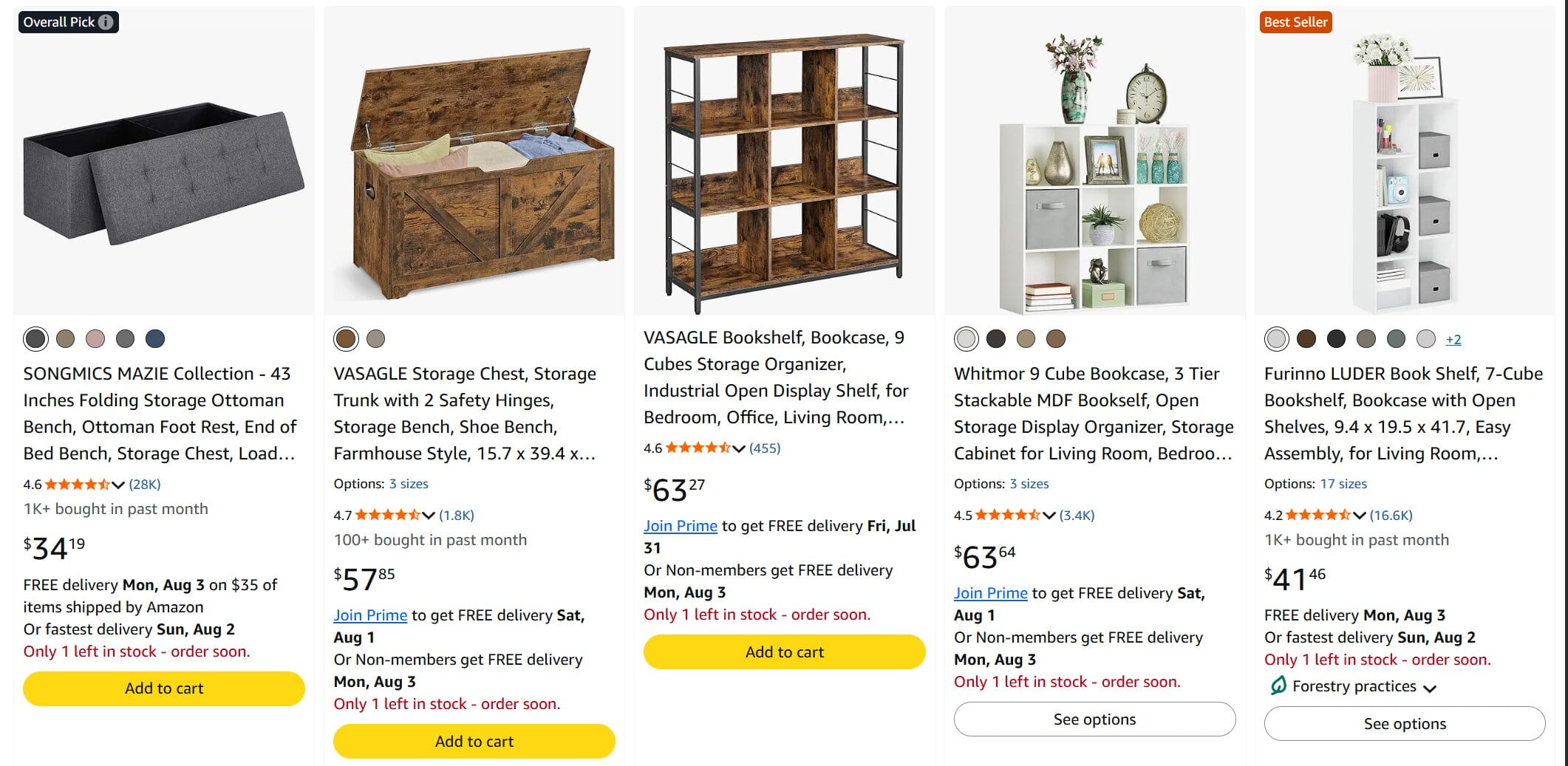
Furniture is where open box quietly makes the most sense, because the thing that gets damaged in shipping is almost always the cardboard rather than the contents.
Take a concrete case. A six-drawer open box dresser listed at 25% off, with condition notes describing a scuffed and torn outer carton and a small tear in the interior foam. The retailer photographed the packaging, graded it accordingly, and dropped the price. When it arrives, the veneer is unmarked, the drawer glides are still in their sealed bags, and the hardware packet is untouched. You saved a couple hundred dollars on a box that went straight into recycling anyway.
The risk profile for flat-pack furniture is narrow and specific: missing hardware and missing assembly instructions. Hardware you can usually replace from a hardware store or by contacting the manufacturer, who will often mail a replacement packet free. Instructions are almost always downloadable as a PDF. Neither is a dealbreaker, but count every screw and dowel against the parts list before you start assembling, because discovering a shortage halfway through is how a good deal turns into a bad weekend.
Assembled furniture is a different matter. Check joints, drawer alignment, and the back panel, since those are what get damaged when a heavy piece is moved without its packaging.
What Is Open Box Delivery and Inspection?
Open box delivery refers to receiving a package whose seal has already been broken and inspecting it properly at the point of arrival, before the return clock runs out on you.
Do the inspection the same day. Photograph the outer packaging before you cut it open, especially if there is visible crushing or tape that looks like it has been reapplied, since those photos are what settle a dispute later.
Then work through three things in order. Check the serial number on the product against the serial number printed on your invoice or receipt, because a mismatch is the clearest evidence you can have that the wrong unit was shipped or that something was swapped during processing. Lay out every accessory the listing promised and tick them off one at a time against the manufacturer’s own parts list, not just against the listing description. Finally, power the item on and put it through whatever passes for normal use for at least a few minutes.
Speed matters more on some sites than others. With a 30-day Amazon window you have room to be thorough over a weekend. With a retailer that treats open box as final sale, your only leverage is a defect report filed quickly, so the inspection needs to happen the day the box lands.
Keep the packaging until you are confident you are keeping the item. This is not just practical advice. Amazon asks that returns come back in original or unused condition and in the original manufacturer’s packaging, including tags, components, accessories, manuals, and other inserts. Photographs of a box you no longer have are worth much less than the box itself.
Open Box vs. Refurbished (Renewed): Which Should You Choose?
The cleanest way to separate them: open box describes a unit that came back and was graded as-is, while refurbished describes a unit that was diagnosed, repaired, and then certified. Amazon and eBay both draw the line that way, and for most shopping decisions it holds.
An open-box unit under that definition has an unknown but usually short history. Nobody replaced a component, and the parts inside are the parts the factory installed. The tradeoff is that nobody intervened either. It was tested and priced according to what the tester found, and if it had failed testing it would have been routed somewhere other than the open-box shelf.
Refurbished works the other way around. Something was wrong, a technician found it, and the unit was repaired and put through a test protocol before being certified. The parts may not all be original, and the cosmetic condition may be imperfect, but the after-sale protection is considerably stronger. Amazon Renewed items are backed by the Amazon Renewed Guarantee, which lets you return the product within 90 days of receipt, or within a year for a Renewed Premium product, for a full refund or replacement. Premium sits at the top of the Renewed range and is held to a stricter functional standard than the tiers below it.

Here is the wrinkle worth knowing before you generalize. Not every retailer keeps that line clean. Some define open box loosely enough to include units that were repaired before relisting, which puts part of their open-box inventory functionally closer to refurbished. Newegg is the clearest example, and it is covered in the retailer comparison below. So the never-repaired assumption is safe on Amazon and eBay, and worth verifying anywhere else.
There is also a third warranty structure that almost nobody mentions. Some Amazon Renewed items come with a 30-day return period followed by a free 11-month limited warranty serviced by Asurion, covering defects in material and workmanship with no deductible. If you are comparing two Renewed listings for the same product and one is cheaper, this is often why. Check which structure applies before deciding the cheaper one is the better deal.
So the choice comes down to what you are optimizing for. Want the shortest possible ownership history and the lowest chance of internal tinkering? Open box, from a retailer whose definition excludes repairs. Want the longest coverage window and a repair record behind the unit? Renewed. For anything with a battery, or anything you plan to keep for more than two or three years, the Renewed guarantee is usually worth the extra money.
Where to Find Open-Box Deals Besides Amazon
Amazon Resale is the largest source of open-box inventory, but Best Buy, eBay, Newegg, and Walmart all run their own versions, and the protections attached to each differ sharply. Here is the short comparison before the details.
| Retailer | What the label covers | Returns | Warranty |
|---|---|---|---|
| Amazon Resale | Customer returns and open-box stock, graded Like New through Acceptable, no repairs | 30 days from receipt, listed as free | Inconsistent, check the listing |
| Best Buy Outlet | Returns and display units graded Excellent, Good, or Fair | Covered by the Return and Exchange Promise | Yes, with Geek Squad Protection available |
| eBay | Seller-declared, definition varies by category | Set by each seller; Certified Open Box requires 30-day free returns | None by default; Certified Open Box adds a one-year Allstate plan |
| Newegg | Returns that may have undergone minor repairs | Final sale, replacement request within 30 days | Usually none |
| Walmart Restored | Refurbished rather than open box | 90-day free return on Like New, Good, and Fair | Premium carries a minimum one-year warranty |
Best Buy Outlet
Best Buy sells open-box products through its Outlet alongside clearance, refurbished, and pre-owned stock. Open-box items are products returned under the Return and Exchange Promise, each one tested or inspected to verify working order and appearance and assigned a condition of Excellent, Good, or Fair. Most include all parts and accessories, with exceptions noted in the condition.
The practical catch is availability. Excellent is the condition you will find online, while Good and Fair are generally limited to Best Buy stores or online for Store Pickup. If you want the deeper discount you usually have to go look at the item in person, which is not the worst outcome for a Fair-grade appliance you are buying because of a dent.
Best Buy also draws a line most retailers do not. Refurbished and pre-owned are separate categories from open box, with refurbished carrying a minimum 90-day warranty on most products.
eBay
eBay is the widest selection and the widest quality spread, because the grading is done by tens of thousands of independent sellers rather than by one warehouse operation. Two things make it navigable.
The first is that eBay’s condition definitions are strict on paper, so a listing that does not match them gives you a clear basis for a claim. In Electronics, Cell Phones, Computers, Home & Garden, and Health & Beauty, “Open box” means an item in excellent, new condition with no wear, possibly missing original packaging or protective wrapping or unsealed in its original box, including original accessories, and possibly a factory second. No wear is the standard, not a suggestion.
The second is the Certified Open Box badge, which filters for sellers who consistently hit service metrics and adds a warranty on top. Both the buyer-facing terms and the seller-facing requirements are covered in the dropshipping section below, since that is where they matter most.
Returns on ordinary eBay open-box listings are whatever the seller set, so read that field before bidding rather than assuming a standard applies.
Newegg
Newegg is where the word “open box” carries the least protection, and PC builders in particular should read the terms before clicking. Newegg’s own disclaimer states that open box items were previously opened and may have been unused or very lightly used, that they are inspected for working condition and may undergo minor repairs, that accessories and retail packaging may or may not be included, and that Newegg will not send out missing accessories even when they are required for the item to function. It also notes that open box items usually come without manufacturer or vendor warranty or technical support, though coverage may survive if the previous owner never registered the product.
Two things follow. The repairs clause means Newegg’s open box overlaps with what other retailers would call refurbished, so the never-broken assumption does not apply here. And the returns are restricted: Newegg treats open box items as final sale and does not accept returns or refunds on them, though it will consider a replacement request if you report a problem within 30 days of delivery. The terms differ on NeweggBusiness, so check which storefront you are actually buying from.
If you buy an open-box graphics card there and the power adapter is missing, that is your problem and your expense. Price accordingly.
Walmart Restored
Walmart belongs on this list with a caveat: Restored is a refurbished program, not an open-box one, so it is an alternative to Amazon Renewed rather than to Amazon Resale. Restored items are professionally inspected, tested, and cleaned by performance-managed sellers, and come in four conditions: Premium, Like New, Good, and Fair. Like New, Good, and Fair carry a 90-day free return, while Premium comes with a minimum one-year warranty, with some exclusions noted on the product page.
For a buyer, that 90-day window is the most generous baseline in this comparison, with the caveat that you are buying refurbished rather than untouched stock. For a reseller, Premium is the interesting tier, because a one-year warranty is a selling point you can put in a listing title.
When to Shop for the Best Open-Box Prices
Open-box supply follows returns, and returns follow buying peaks, so the best selection lands a few weeks after everyone else finished shopping. Late January through February is the deepest window of the year.
The reason is mechanical rather than mysterious. Retailers extend their return deadlines over the holidays, which pushes the whole wave of unwanted gifts into the new year rather than into December. Amazon did exactly this for the 2025 season, letting most purchases made between November 1 and December 31 come back as late as January 31, 2026. Everything that arrives in that wave gets inspected, graded, and relisted over the following weeks.
Smaller waves follow the same pattern after any concentrated sales event. Prime Day ran June 23 to 26 in 2026, and the Resale promotions that showed up in May and June sat right around those peaks. Back-to-school returns feed September and October. Seasonal categories mark down hardest when the season turns, which is why patio furniture and air conditioners get cheap in autumn and space heaters get cheap in spring.
None of this means you should wait if you have found a good price today. Open-box stock is one of a kind and does not sit around. It means that if you are shopping flexibly for something expensive, the calendar is worth a little patience.
Amazon Open Box for eBay Dropshipping: Opportunities and Risks
Open-box inventory is attractive to resellers because the margin is built into the sourcing price, but eBay’s product sourcing rules put hard limits on how you can move it. Understand the policy first, then the tactics.
eBay allows dropshipping when you fulfill orders directly from a wholesale supplier, and it does not allow listing an item on eBay and then purchasing it from another retailer or marketplace that ships directly to your customer. The policy also states that you remain responsible for safe delivery within the timeframe in your listing and for the buyer’s overall satisfaction, and that enforcement can include removing the listing, issuing a warning, restricting activity, or suspending the account.
Which means the compliant way to work with Amazon open box inventory is to buy it into your own hands first, then list and ship it yourself. That sounds like extra work, and it is, but for this specific category it happens to line up with what you needed to do anyway. You cannot honestly describe an open-box unit you have never seen. You cannot photograph the actual scuff on the actual corner. You cannot confirm the charger is in the box. Handling open box merchandise at any real volume means building a receiving process, not just a sourcing one, and taking possession is the only way to list this inventory accurately. Accurate listings are what keep your defect rate down.
There is a structural constraint here that catches sellers by surprise. Amazon points out that every Resale item is one of a kind, so it cannot replace one with an identical unit in identical condition, only with something similar if it happens to be in stock. Translate that into eBay terms and it means you have no replacement path of your own. When a buyer asks for an exchange rather than a refund, you either have a second unit sitting on your shelf or you are refunding.
Condition matching is where most sellers get into trouble, because Amazon’s grades and eBay’s grades are not the same vocabulary and eBay’s own definitions shift between categories. In Electronics, Cell Phones, Computers, Home & Garden, and Health & Beauty, “Open box” requires excellent, new condition with no wear, original accessories included, allowing for a missing or unsealed original box and for factory seconds. In Business & Industrial the label reads “New—open box,” and the bar is looser: excellent new condition with no functional defects, possibly missing original packaging, and explicitly allowed to have been used for testing or demo purposes.
That distinction matters more than it sounds. A demo unit you could legitimately list as eBay new open box in Business & Industrial would be misgraded under the electronics definition, where no wear is the standard. If your Amazon unit came in as Used, Like New with everything present, open box works in either category. If it came in as Very Good with a scratch on the housing, list it as used and describe the scratch. Buyers who receive an open box item with visible wear file cases, and those cases hit your metrics.

There is also a certified tier. eBay’s Certified Open Box program covers like-new items from quality-approved sellers, ships free with 30-day free returns, and includes a one-year warranty serviced by Allstate Protection Plans. You do not apply for it and it costs nothing. The badge appears automatically on eligible listings within Electronics and Home once you meet the criteria, which require an Above Standard or Top Rated seller level and a business account. Eligible categories currently include cell phones, smartwatches, laptops, tablets, headphones, appliances, vacuum cleaners, tools, and video game consoles, and eBay notes that list is subject to change. The listing-level requirements are the “Open Box” condition, free delivery, at least 30-day free returns, an “Item Not as Described” rate below 4%, an “Item Not Received” rate below 1%, and a minimum of 25 open box transactions every three months. If your metrics or seller level slip during an evaluation period, eBay removes the badge and the warranty, then reinstates both once you recover.
Now the part that trips people up. The instinct with any resale model is to keep your own return window shorter than your supplier’s, so you can always push a bad unit back up the chain. That instinct does not survive contact with open box, and it is worth being clear about why. Amazon gives you 30 days on a Resale purchase, but you spend most of that window receiving, inspecting, photographing, and listing the item, and the buyer’s clock only starts when they receive it. By the time a return reaches you, sending it back to Amazon is rarely still an option. Certified Open Box then requires 30-day free returns on top of that.
The conclusion is not that the model does not work. It is that your intake inspection is the only real protection you have, because you are effectively the end of the return chain. Test thoroughly on arrival, reject anything questionable back to Amazon while your own window is still open, and treat the units you decide to list as inventory you now own outright. If you source from a retailer with final-sale open box, that logic is even stricter, since there was never a return path to begin with.
The repetitive parts of this workflow are exactly where software earns its keep. Easync handles pricing and inventory sync across eBay, Amazon, Walmart, Shopify, and other channels, keeps orders and tracking data moving without manual re-entry, and offers fulfillment through its own service for sellers who would rather not run the packing bench themselves. For open-box stock in particular, the piece that pays for itself is repricing. These units are one of a kind, and the new price they get measured against keeps moving, so the margin you listed at last week is rarely the margin you are holding today. Let the automation watch the numbers and spend your own hours on the part nobody can do for you, which is opening each box, testing what is inside, and describing it honestly.
Checklist Before Buying or Listing Open-Box Items
- Read the condition notes in full, twice. The missing accessory is almost always disclosed there rather than in the title.
- Compare against the current new price, not the list price. A 30% discount off an inflated MSRP is not a discount.
- Check who is selling. On Amazon, confirm whether the seller is Amazon Resale or a third party, since the return handling differs. On eBay, look at feedback volume and the accurate description rating specifically.
- Look up the return terms for that specific retailer before you buy, because they range from 90 free days to none at all.
- Ask whether any warranty applies, and from whom. Original manufacturer coverage, retailer coverage, and program guarantees are three different things with three different claim processes.
- Verify the serial number against your receipt the day the item arrives.
- Count accessories against the manufacturer’s parts list, not the listing text.
- Price out any missing part before you buy. If a replacement charger costs more than the discount, walk away.
- Photograph everything on arrival, including the outer box, before disposing of any packaging.
- On Amazon Resale, do not count on an exchange. Each unit is one of a kind, so a refund is usually the only remedy available.
- If you are reselling, keep a folder per unit with photos, serials, and shipping labels. Serial number disputes are the most common way an open-box sale goes sideways months later.
- Be suspicious of unusually deep discounts paired with vague photos and no returns. That combination is how sellers offload units they know are defective.
Frequently Asked Questions
Is open box the same as used?
No. Open box means the seal was broken but the product was not meaningfully used. Used means the product was owned and operated, and it can range from lightly worn to heavily worn depending on the grade. Open box vs used is mostly a question of ownership history, and that history is what determines how much cosmetic wear you should expect.
Does open box mean someone returned it?
Usually, though not always. Customer returns are the biggest source, followed by store display models, damaged shipping cartons, cancelled orders, and split bundles.
Do Amazon open box items come with a manufacturer warranty?
It varies, and often they do not. Warranties attach to the original purchase, so coverage frequently does not carry over to a unit resold as used. Check the specific listing, and treat Amazon’s return window as your reliable protection.
How long do I have to return an Amazon Resale purchase?
Amazon Resale items ship from Amazon and can be returned free within 30 days of receipt. Category exceptions exist, and the window differs in some non-US marketplaces, so confirm on the listing.
Can I exchange an Amazon open box item instead of returning it?
Not for an identical unit. Because each Resale listing is a single graded item, Amazon can offer a refund or a similar item if one is in stock, but not the same product in the same condition.
Which retailer gives the best protection on open box?
Among true open-box programs, Amazon Resale and Best Buy Outlet are the safest, with a 30-day free window on Amazon and Return and Exchange Promise coverage plus warranty at Best Buy. Newegg is the weakest, treating open box as final sale. Walmart Restored offers a longer 90-day window, but it is a refurbished program rather than an open-box one, so it belongs in a comparison with Amazon Renewed instead.
When is the best time to buy open box?
Late January and February, when holiday returns have finished cycling through inspection and back onto the shelf. Smaller waves follow other sales peaks, and seasonal goods drop hardest as their season ends.
What is open box delivery?
It refers to receiving and inspecting a package that was already opened once. In practice it means checking the serial number against your receipt, confirming every listed accessory is present, and powering the item on quickly enough that you can still return it if something is wrong.
Is “new open box” on eBay trustworthy?
The definition is strict in most consumer categories, requiring excellent condition with no wear and all original accessories. In Business & Industrial the same label allows demo and testing use, so read which category you are buying in. Enforcement depends on the seller, so weigh feedback and photographs heavily. Certified Open Box listings in electronics and home categories add vetting plus a one-year warranty.
Are open box appliances and furniture riskier than electronics?
Usually less risky. Large items get damaged packaging far more often than damaged contents, which is why something like an open box dresser frequently arrives in perfect shape. The main things to verify are complete hardware and, for assembled pieces, sound joints.
Can I resell open-box items I buy on Amazon?
You can resell inventory you have purchased and taken possession of. What eBay prohibits is listing an item and then having another retailer ship it directly to your buyer, which is why open-box reselling works best as a buy-inspect-relist model rather than a pass-through one.
The honest summary of open box is that it rewards people who read carefully. The discount is real, the products are usually fine, and the failure cases are almost always something that was disclosed in the condition notes and skimmed past. Spend the extra two minutes on those notes, inspect the item the day it lands, and open box turns into one of the more reliable ways to pay less for the same thing everyone else bought sealed.