This release focuses on three areas that directly affect how sellers source, fulfill, and manage orders at scale: sourcing costs, automation coverage, and marketplace flexibility. Together, these updates make it easier to run a profitable, multi-platform dropshipping operation without adding manual work.
Sellers using Auto Ordering now have more control over sourcing expenses, a new fully automated ordering path for AliExpress, and simpler day-to-day order tracking on eBay. On top of that, Shopify connectivity has been expanded to support stores outside the US, opening the door for sellers looking to grow into new regions.
Each of these changes was designed with one goal in mind: reducing the manual effort required to run an automated store, while giving sellers more visibility and control over their margins.
Key Takeaways
- Amazon Tax Exemption support added to Auto Ordering, helping eligible sellers avoid unnecessary taxes on supplier orders
- Improved margin protection for sellers sourcing through Amazon accounts connected to Auto Ordering
- AliExpress Auto Ordering is now live, extending core automation to a major additional supplier network
- Reduced manual fulfillment work for sellers who previously processed AliExpress orders by hand
- eBay Order ID now visible directly in the order list, improving order lookup and management
- Faster order identification, reducing time spent opening individual orders to find details
- Expanded Shopify store connectivity, now supporting non-US stores
- Greater flexibility to scale into international markets using existing automation workflows
Taken together, these updates reduce operational overhead across sourcing, fulfillment, and order tracking, while extending automation to more suppliers and regions. The result is a platform that supports growth without adding complexity.
Lower Sourcing Costs with Amazon Tax Exemption
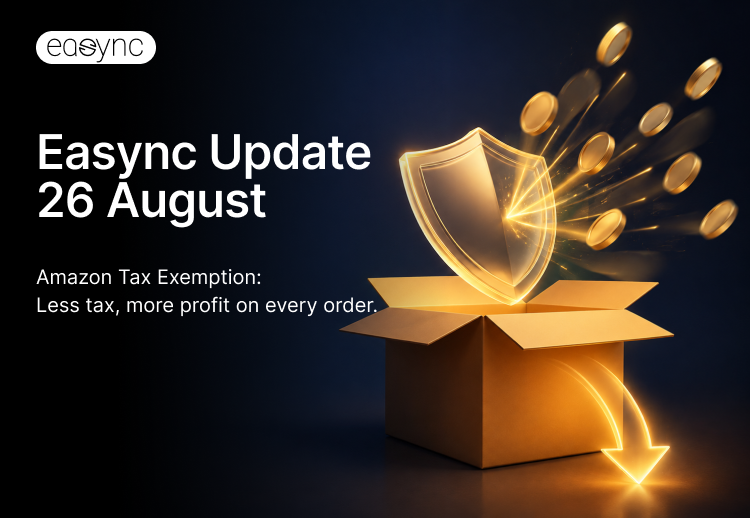
Sellers can now apply Tax Exemption when connecting Amazon accounts to Auto Ordering. This allows eligible, no-tax Amazon accounts to be used for automated sourcing, helping avoid unnecessary taxes being applied to supplier orders.
For sellers operating at volume, small per-order costs add up quickly. Unnecessary taxation on supplier purchases directly reduces margins, especially in competitive categories where pricing is already tight. By supporting tax-exempt Amazon accounts within Auto Ordering, Easync helps sellers keep more of their revenue on every order that flows through the platform.
Because Auto Ordering is a core part of the platform, improvements like this go beyond convenience. They directly affect profitability at scale, particularly for sellers with high order volume where even small savings per transaction translate into meaningful gains over time.
This update gives sellers more control over how their sourcing costs are structured, without requiring any change to their existing fulfillment workflow.
AliExpress Auto Ordering Is Now Live
Auto Ordering now supports AliExpress, allowing orders from this supplier network to be processed automatically instead of manually. Previously, sellers using AliExpress as a supplier needed to place and manage those orders by hand, which slowed down fulfillment and added daily operational work.
With Auto Ordering now available for AliExpress, order processing happens automatically, reducing the time between a sale and fulfillment. This is particularly valuable for sellers managing multiple suppliers, since manual ordering tends to become a bottleneck as order volume grows.
Because Auto Ordering is a core part of the platform, expanding it to a major supplier network like AliExpress represents a meaningful step forward in automation coverage. Sellers benefit from more reliable fulfillment workflows, fewer manual touchpoints, and a reduced risk of delayed or missed orders during high-volume periods.
This update also makes it easier for sellers to diversify their supplier base without increasing manual workload, since AliExpress orders can now be handled through the same automated system as other supported suppliers.
Easier Order Management with eBay Order ID Visibility
The eBay Order ID is now displayed directly in the order list, rather than requiring sellers to open each order individually to find it. This may seem like a small interface change, but it has a direct impact on daily order management.
Sellers frequently need to reference a specific eBay Order ID when investigating a customer inquiry, checking payment status, or cross-referencing with eBay directly. Previously, this meant opening each order one at a time to locate the correct ID, which slows down support response times and adds unnecessary friction to routine tasks.
With the Order ID now visible at a glance, sellers can quickly identify and manage specific orders without extra clicks. This improves day-to-day efficiency, particularly for stores handling a high volume of orders where speed and accuracy in order lookup matter.
This change reflects a broader focus on giving sellers clearer visibility into their operations, reducing the small delays that can accumulate into significant time loss over a busy sales period.
More Flexible Shopify Store Connections
Shopify store connections have been improved, with new support for non-US Shopify stores. Previously, store connectivity was primarily built around US-based stores, which limited automation options for sellers operating internationally.
With this update, sellers can now connect Shopify stores from other supported regions and manage them using the same automation tools available to US stores. This removes a significant barrier for sellers looking to expand their operations beyond the US market.
Marketplace and platform compatibility play a central role in long-term scalability. As sellers grow, many look to diversify across regions and platforms to reduce dependency on a single market. By extending Shopify support internationally, Easync makes it easier for sellers to pursue that kind of expansion without needing separate tools or manual workarounds for non-US stores.
This update also reinforces the platform’s broader direction: expanding marketplace and regional coverage so that automation can scale alongside a seller’s business, regardless of where their stores are based.
Strengthening the Platform for Scale
This release reflects a continued focus on reducing operational friction across the core areas that matter most to automation-driven sellers: sourcing, fulfillment, and order visibility. Each update was designed to remove a specific point of manual effort, whether that meant unnecessary sourcing costs, manual order entry, or time spent locating order details.
Expanding Auto Ordering to AliExpress represents a meaningful step in broadening core automation coverage, giving sellers more flexibility in how they source products without sacrificing reliability. Combined with Amazon Tax Exemption support, sellers now have more tools to protect margins directly within their existing automated workflows.
Improvements to order visibility and Shopify connectivity may appear smaller in scope, but they address real, recurring friction points in daily store management. Faster order lookup and broader regional support both contribute to a smoother, more scalable operation, particularly for sellers managing multiple stores or expanding into new markets.
As automation coverage grows and platform usability improves, sellers are better positioned to scale their operations without a proportional increase in manual work. This balance between automation depth and day-to-day usability remains central to how the platform evolves.
As the platform continues to evolve, updates like these help ensure automation remains reliable, scalable, and easy to manage for growing eCommerce operations.