Key Takeaways
- eBay Managed Payments has been fully rolled out since September 2021, and payment holds are now a core part of eBay’s risk controls, especially for new and high-risk sellers.
- Most holds are triggered by preventable issues: slow shipping, missing tracking, high “item not as described” rates, and abrupt sales spikes on risky items.
- Automation including inventory syncing, auto-ordering, tracking uploads, and repricing can dramatically reduce the behaviors that cause eBay to hold funds.
- Disciplined handling times, accurate listings, and using tools like Easync for dropshipping workflows are the fastest practical ways to reduce or avoid payment holds.
- Holds can’t be fully “turned off,” but sellers can shorten their duration and frequency by maintaining excellent performance metrics and consistent, automated operations.
Introduction: What eBay Managed Payments Holds Are (and Why They Matter)
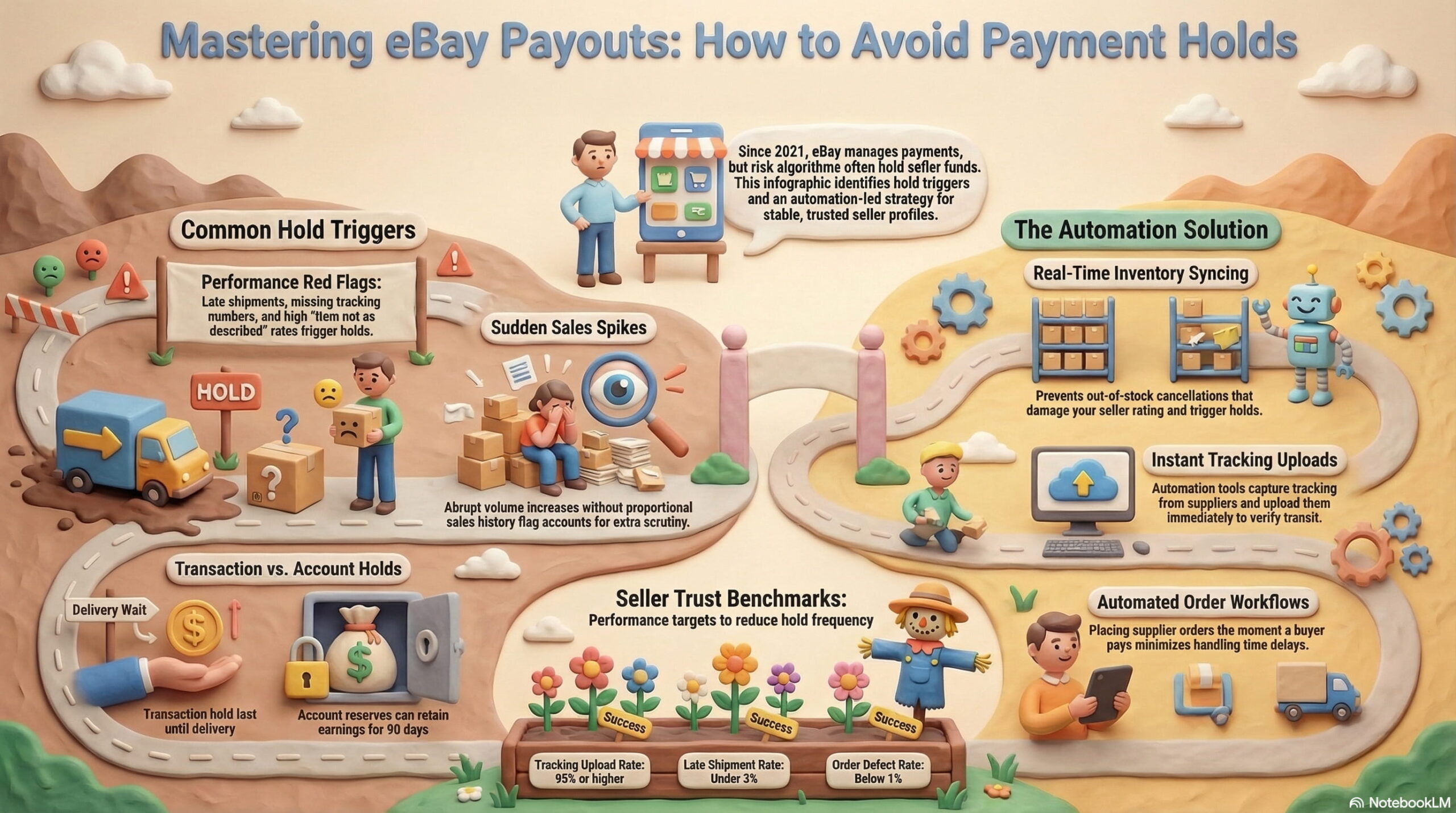
Since eBay completed its transition to managed payments in 2021, every seller now gets paid directly to their bank account instead of through PayPal. This sounds cleaner and it is, but there’s a catch. When eBay’s risk algorithms detect something concerning, your funds can be held for days or even weeks before you can access them.
For dropshippers and high-volume sellers, this creates real problems. You need cash to buy inventory, cover shipping costs, and issue refunds. When money sits frozen in limbo, your entire operation slows down.
This article will show you exactly how automation and tight operational control can prevent most avoidable holds and speed up your payouts. Here’s what’s at stake:
- Cash flow strain that prevents restocking and scaling
- Delayed business growth from unpredictable payout timing
- Stress dealing with customer service while funds are locked
- Potential spiral where one hold triggers more scrutiny
How eBay Managed Payments Works in 2026
eBay Managed Payments is now the default system globally, having fully replaced the old PayPal-centric model by late 2021. The platform partnered with Adyen the same payment processor behind Uber and Spotify—to handle everything in one place.
Here’s how the payments process works:
- Buyer pays: They choose from multiple payment methods including credit card, debit cards, PayPal, Apple Pay, Google Pay, PayPal Credit, and even gift cards
- eBay processes: The platform handles the transaction, validates payment, and confirms the order
- eBay deducts fees: Selling fees, subscription fees, and any related fees are automatically subtracted
- Payout initiated: Remaining funds move to your linked checking account
The timing is fairly consistent. Funds typically become available within about 2 business days of confirmed buyer payment. Your bank then takes an additional 1-3 business days to complete the deposit.
You can choose your payout schedule daily, weekly, biweekly, or monthly through Seller Hub. However, when eBay’s systems detect risk, holds override these schedules entirely. Your chosen timing becomes irrelevant until the hold clears.

Why eBay Places Holds on Managed Payments
eBay uses automated risk models to protect buyers, comply with AML and KYC regulations, and prevent fraud. When these systems flag an account or transaction, the result is either a temporary hold or rolling reserve on seller funds.
Common triggers include:
- New seller accounts or accounts with limited selling history
- Sudden spikes in order volume or average order value
- Listings in high-risk categories like electronics, luxury goods, and collectibles
- Late shipment rates exceeding handling time commitments
- Missing or delayed tracking uploads
- High defect or cancellation rates
- Frequent “item not as described” claims
- Chargebacks or Money Back Guarantee cases
Holds typically take two forms:
| Hold Type | What Happens | Duration |
|---|---|---|
| Transaction-level | Full funds held until tracking shows delivery plus buffer (e.g., 3 days) | Days to 1-2 weeks |
| Account-level reserve | 5-30% of earnings retained on rolling basis | Weeks to 90 days |
While you can’t completely eliminate the possibility of a hold, you can substantially lower the risk. The key is stabilizing the patterns that eBay’s systems flag as suspicious—consistent shipping, clean tracking, and low defect rates.
Most Common Hold Scenarios for eBay Dropshippers
Automation dropshippers face amplified exposure to holds because their business model includes longer fulfillment chains, thinner margins, and less direct inventory control. eBay’s systems are particularly sensitive to dropshipping patterns.
Dropshipping-specific triggers:
- Delayed ordering from suppliers leading to late shipping scans
- Out-of-stock items causing cancellations after buyer payment
- Suppliers changing prices dramatically, forcing sellers to cancel or ship cheaper substitutes
- Inconsistent tracking uploads from non-eBay-recognized carriers
- Using obscure international shipping services eBay cannot properly verify
For new accounts showing dropshipping-style patterns, eBay commonly holds funds until USPS, UPS, FedEx, or Royal Mail scans show “Delivered” plus an additional 3-day buffer. This means you might wait 7-10 days after shipping before accessing money from a single sale.
In 2024-2026, eBay has shown heightened scrutiny on high-volume automation dropshippers exhibiting abrupt sales surges without proportional history. If your account suddenly jumps from 10 to 100 orders weekly, expect closer monitoring.
Using Automation to Prevent eBay Managed Payments Holds
Operational quality directly impacts eBay’s risk scoring. Consistent on-time shipping, clean tracking data, and low defect rates reduce the chance of holds. Automation targets exactly these metrics.
Core automation strategies:
- Real-time inventory monitoring: Prevents selling out-of-stock items that lead to cancellations
- Price synchronization: Avoids listing items at incorrect prices that force order cancellations
- Automated ordering workflows: Ensures supplier orders are placed immediately when the buyer pays, not hours later
- Automated tracking capture: Uploads tracking to eBay as soon as suppliers ship, eliminating manual delays
- Rules-based repricing: Prevents over-aggressive undercutting that leads to unprofitable orders and cancellations
The critical point is eliminating manual gaps. No waiting until “tonight” to place supplier orders. No forgetting to upload tracking. No guessing on stock levels.
When you use third party tools that handle these tasks automatically, you directly improve the exact metrics eBay evaluates: handling time compliance, defect rate, and cancellation percentage.

How Easync Automation Helps Minimize eBay Payment Holds
For automation-based dropshipping, using Easync can significantly reduce the behaviors that trigger eBay Managed Payments holds by tightening the entire order cycle. Easync supports automated product importing, real-time stock and price monitoring, auto-ordering, repricing rules, tracking synchronization, and multi-account workflows—each feature directly addressing a common hold trigger.
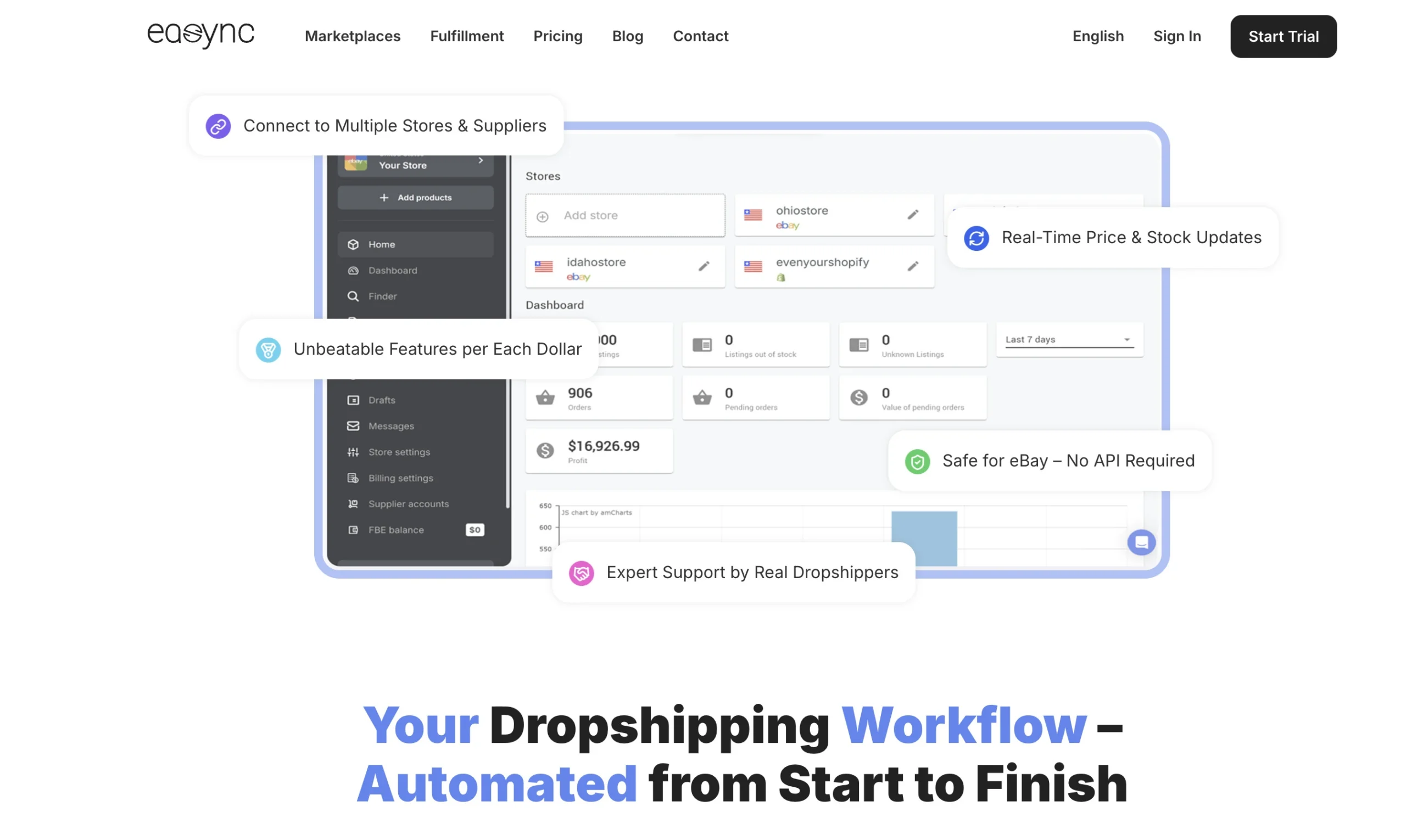
Feature-to-benefit mapping:
| Easync Feature | How It Reduces Holds |
|---|---|
| Automated product importing | Rapidly lists supplier items with correct titles, descriptions, and policies, lowering listing errors that lead to “item not as described” disputes |
| Real-time stock and price monitoring | Prevents overselling out-of-stock items and price mismatches that cause cancellations and negative feedback |
| Auto-ordering | Places supplier orders automatically the moment eBay orders receive payment, reducing handling times and late shipment rates |
| Repricing rules | Maintains profitable prices while reacting to supplier changes, minimizing cancellations from unprofitable orders |
| Tracking synchronization | Automatically pulls tracking numbers from suppliers and uploads them to eBay, ensuring consistent “carrier accepted” and “in transit” scans |
| Multi-account workflows | Keeps operations consistent across several eBay accounts, so all accounts maintain the performance metrics eBay uses for holds decisions |
While Easync cannot override eBay’s policies, it systematically reduces late shipments, cancellations, and defects. This is the most reliable path to fewer holds and faster release of funds when holds do occur.
Operational Best Practices to Avoid Holds (Beyond Automation)
Tools alone aren’t enough. You need disciplined policies that align with eBay’s risk expectations.
Actionable practices:
- Set realistic handling times: Base your commitments on actual supplier performance data from Q4 2025 and early 2026, not optimistic estimates. If your supplier averages 3-day fulfillment, don’t promise 1-day handling.
- Use trackable carriers: Stick with USPS, UPS, FedEx, Royal Mail, and other services with valid end-to-end tracking numbers recognized by eBay.
- Maintain cash buffers: Keep 2-4 weeks of average shipping and refund costs available to withstand occasional holds or disputes without operational disruption.
- Avoid extreme volume spikes: Don’t jump from 20 to 200 listings overnight. Gradually build history, especially in high-risk categories.
- Respond to buyer messages quickly: Answer within 24 hours to prevent cases, chargebacks, and defects. Proactive communication resolves issues before they escalate.
- Create accurate listings: Use real photos where possible, write honest condition notes, and include precise descriptions. “Item not as described” claims are top reasons for eBay to watch accounts closely.
These practices work alongside automation. One handles execution; the other shapes strategy.
Building a Stable Seller Profile That eBay Trusts
eBay’s payment risk systems are heavily influenced by long-term account health and consistency across months. Building trust takes time, but the payoff is fewer holds and faster payouts.
Profile-building actions:
- Maintain Top Rated or at least Above Standard seller status
- Keep defect rate below 1%
- Maintain late shipment rate under 3%
- Upload tracking for 95%+ of orders
- Keep cancellation rate within eBay’s published thresholds
- Keep policies consistent—don’t change handling windows, return terms, or shipping methods dramatically from week to week
- Grow order volume steadily rather than multiplying sales 5-10x in a single week
Accounts with 3-6 months of clean history see notably reduced hold frequency and duration. eBay’s systems reward predictability. If your selling experience shows consistent patterns, the algorithms treat you as lower risk.
Check your benchmarks in Seller Hub regularly. This is where you find everything you need to understand how eBay views your account.
What To Do If Your Funds Are Already on Hold
If you’re reading this with money already locked up, you need a damage-control plan.
Immediate steps:
- Check the Payments or Orders section in Seller Hub for hold details, including estimated release dates and reasons where provided
- Continue shipping on time and uploading tracking—held transactions usually release faster once delivery is confirmed
- Communicate professionally with buyers to prevent disputes and cases while the hold is active
- Review your account metrics before contacting eBay support so your request is targeted and informed
- Document your supplier relationships and fulfillment processes in case eBay requests verification
What to avoid:
- Mass-cancelling orders (this worsens your metrics)
- Changing banks frequently (may trigger additional verification delays)
- Dramatically altering listings or policies (signals instability to algorithms)
- Panic moves that create more red flags than they solve
Holds usually resolve once delivery confirmations accumulate and buyer issues remain absent. Patience combined with continued excellent performance is your fastest path to released funds.

FAQ
How long do eBay Managed Payments holds usually last?
Most transaction-level holds last until tracking shows the item delivered plus a short buffer—often 3 days for newer accounts. Account-level reserves can run for several weeks or a rolling period such as 90 days until risk metrics improve. Exact durations vary by region, account history, and category. The hold message in Seller Hub provides the authoritative information for your specific case. Consistent on-time delivery with tracking is the fastest way to shorten hold durations over time.
Can automation tools completely prevent eBay from ever holding my funds?
No third-party tool, including Easync, can disable or bypass eBay’s risk rules. Holds are built into the platform’s compliance and fraud prevention infrastructure. However, automation dramatically reduces the triggers late shipments, cancellations, missing tracking, and sudden anomalies. In practice, sellers using comprehensive automation experience holds far less frequently and see faster release when holds do occur. Frame automation as a long-term risk-reduction strategy, not a guarantee that funds will never be held.
Are eBay Managed Payments holds more common for new sellers?
Yes. New eBay accounts and accounts with limited selling history are routinely monitored more closely. Expect tighter controls for the first few months, especially when listing high-value items or operating in risk-prone categories like electronics or luxury goods. New sellers should use automation from day one to build a strong record of on-time shipping and low defects, establishing trust faster than those who rely on manual processes.
Does linking a different bank account or changing payout schedules affect holds?
Changing your bank account or payout frequency does not remove or override existing holds. In fact, frequent banking changes may trigger additional verification steps. Holds are driven by transaction-level and account-level risk factors, not which bank receives your payouts. Keep your banking details stable and focus your efforts on improving performance metrics rather than attempting to “game” payout settings.
Is dropshipping against eBay’s rules under Managed Payments?
eBay allows dropshipping when sellers work with legitimate wholesale suppliers and ensure timely shipping with quality control. What’s prohibited is listing items from other marketplaces where the seller can’t control service quality and items ship directly from retail competitors. Regardless of method, you bear full responsibility for meeting shipping times, product quality, and customer service standards. Automation combined with reliable, vetted suppliers plus adherence to eBay’s published dropshipping policy is essential for maintaining healthy payments and avoiding holds.

Noah Edis is a freelance writer and systems engineer with a wealth of experience in modern hardware and software. When he’s not working on his latest project, you can find him playing competitive dodgeball or pursuing his personal interest in programming. At Easync, Noah helps thousands of sellers optimize their eBay and Amazon businesses by providing automation tools and practical guidance on account health, pricing, and inventory management.